The Super Mario Bros. Movie (2023)

⭐️⭐️⭐️⭐️

Dirs: Aaron Horvath, Michael Jelenic
52-film challenge, film 28

As an adult, I can see a few problems here and there that I will of course comment on momentarily — but basically your kids will probably love this, as will most teens and adults that are old enough to remember Donkey Kongand Super Mario Brothers games they played as a kid. This is the first kid‘s film I’ve seen in a long time that I think children will wear out the Blu-ray of from repeated viewings.

You can safely forget any previous attempts at bringing these characters to life in a film, especially that 1993 thing — this one gets it right for the first time. As far as current-generation Mario fans are concerned, this film is damn near perfect — and its biggest flaw, if you can call it that, is that is so busy packing in references that the story sometimes takes a back seat to other events, and that’s okay.

The movie represents a huge jump in quality from the previously third-rate Illumination animation firm, thanks to a wealth of pre-designed characters and an obviously huge software upgrade. Up till now I have pretty much loathed everything they’ve done, particularly Despicable Film (my title for it) and the introductions of the incredibly lazy (and Pixar-“inspired”) Minions. It was like their mission was to make children stupider via inducing attention-deficit disorder.

I’ve seen some reviews from adults that the movie is still too superficial and fast-paced, but in part thanks to Illumination’s previous work, that’s what kids want. Besides, the “lore” of this movie is very well-established in the video games, so there’s no need to go over all that, you just accept the situation and welcome Mario and Luigi’s extended family. Directors of Batman and/or Superman movies, pay attention.

Since I also am an adult — most of the time — I also have a few minor criticisms, but before I get to that the first thing that should be said is that this is what kids/family cartoon computer animation should look like if your name isn’t Pixar/Disney: Incredibly colourful, true-to-the-characters design, followed through for new/additional characters, gorgeous locations, and of course — very little regard for the laws of physics.

The biggest letdown for me was that Mario and Luigi didn’t retain their “fauxtalian” accents throughout the movie, but I can also see how that might offend real-world Italians if they did it through the entire film. This is explained in the film as being exaggerated for the purposes of a TV commercial the brothers make (so you do indeed get to hear Mario say “it’s-a me!”), but except for occasionally remembering to say “Mama Mia,” and of course “Woohoo” a lot, mostly it sounds like Chris Pratt being a New Yorker.

Charlie Day as Luigi does a better job, but the movie is stolen voice-wise by the far-better-cast Jack Black as Bowser, Anya Taylor-Joy as Princess Peach, Keegan-Michael Key as Toad, and Seth Rogan and Fred Armisen as the two main Donkey Kong characters.
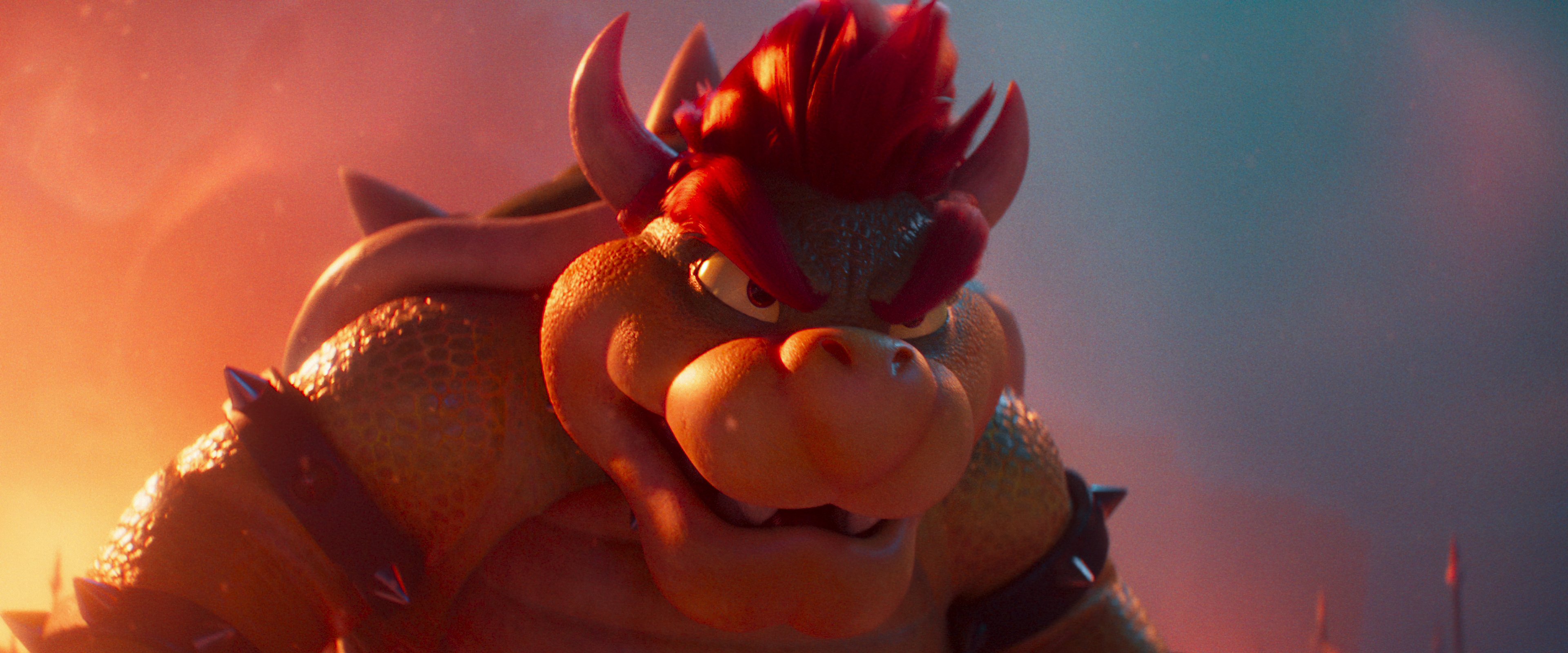
Considering many of these characters started off as pixelated bits, the character design is excellent, and instantly “feels” like this is the way the characters should look, even though technically they only got to this point through generations of iteration as the console game technology improved. Likewise, this is a level of background and “set” work we have never seen from Illumination previously, and even the jokes work most of the time.

Princess Peach and Toad prepare for the big race

The film starts off in what passes for “the real world” and, after a funny scene of the brothers failing as real-world plumbers on their first big job, they discover a pipe that leads to what we’ll call Mario World with the characters we know and love. The rest of the movie builds out from the premise of Bowser wanting to marry Princess Peach by force, threatening the peace of the various kingdoms and Mario (& Luigi, who has a much smaller role of mostly being the victim that needs rescuing) arrive just in time to help the Princess and her people fight back.

In short, this movie is one I’ve rated highly because it absolutely achieves what it sets out to do, which is to flesh out Mario World, establish the underlying lore, and defeat the enemy, and looks good doing it. The frantic pacing will perhaps annoy some adults, but there are plenty of reference-checks for us Mario veterans to appreciate, especially if you loved Mario Racing. It’s no classic film-wise, but it will absolutely take its place as a go-to kids’ movie the whole family can enjoy.

Dark Star (1974, dir. John Carpenter)


⭐️⭐️⭐️½
52-week film challenge, film 27

This is the first time in literally decades I’ve seen this film, and yet it left such a mark when I first saw it that most of it was already burned into my memory. This was very much the (accidental) forerunner of Star Wars as well as being part of an array of now-forgotten but excellent Sci-fi movies from the early 70s that included Colussus: the Forbin Project, The Andromeda Strain, Silent Running, Solaris, Fantastic Planet, Soylent Green, Westworld, Sleeper, and even another in the genre of “expanded-version-of-a-student-film” that hardly anyone saw called THX 1138.

I once met Dan O’Bannon shortly after Alien came out at some SF convention in Miami (I think) and a very young me probably fanboy’d his ear off about Dark Star rather than the movie he was presumably there to promote, but he was polite and seemed impressed that I’d seen it. I did also absolutely love Alien, for the record, but I think all I said about it to him was to congratulate him on writing what was in my youthful estimation the scariest alien horror movie everrrrrr before moving on to Dark Star.

If my memory serves me right, my late friend Kelvin Mead, who was collecting 8mm and 16mm versions of cult movies at the time, had a print — and that’s how I saw it, sometime in ‘78 most likely. It was John Carpenter’s first major film as a director (and composer, he also did the soundtrack), and while it’s quite rough compared to the big SF Hollywood films of the day, it really holds up pretty well if you overlook the limitations of the $60,000 budget. Let’s say there weren’t a whole lot of nihilistic sci-fi comedies to compare it to until the TV show “Red Dwarf” came out some 14 years later.

The story, very basically, focuses on four extremely bored starship personnel (there were five, but one died before the film begins), who have been warping around the galaxy for the last 20 years destroying what are deemed to be unstable planets with smart bombs. While they’ve only aged by three years, the monotony of the job (which is the only part of the voyage most of them like) has really caused entropy to set in in myriad ways.

They all have long hair and unkept beards, and sound suspiciously like USC film student (heh). The core three who do most of the work are called Doolittle, Pinback (more about him in a moment), and Boiler. Talbi, on the other hand, has sequestered himself in the ship’s observation dome and just stares out at the heavens all day.

When they are doing their job, they are (almost) a well-oiled machine, especially in a crisis — which is happening more frequently because they do next to no maintenance at all of the aging ship’s issues. The conversations Pinback has with the smart bombs (who talk back occasionally) introduce the comedy element early on. The rest of the time they are either indifferent or spiteful to each other.

Having started life as a student film, the film is woefully padded with “extended remixes” of various scenes, including a very minor subplot about Pinback’s “pet,” a very bored alien he doesn’t pay enough attention to. A loooong sequence of Pinback losing a battle with the “beach ball with feet” alien is really nicely shot, but goes on far too long. The optical effects in the film are surprisingly good, but if you’ve seen George Lucas’ similar “expanded student film” then you get the idea that a little more money got stretched out very thin to turn it into a feature.

The saving grace of Dark Star, though, is the dark comedy and great ensemble acting. Although Doolittle (Brian Narelle) is the replacement “commander,” Pinback (O’Bannon) is the source of most of the comedy, and embodies every annoying office worker everywhere. At one point, Pinback confesses that he isn’t actually Pinback, but a man named Bill Frug who saw the real Pinback go crazy and remove his jumpsuit before killing himself. Frug put the jumpsuit on, was mistaken for Pinback by indifferent superiors, and placed on the ship. The other two argue lightly about how long it’s been since Pinback told this story before.

Meanwhile, the ship continues to deteriorate, at one point causing one of the bombs to exit the hangar early, awaiting commands to arm itself. These are handily the best scenes of the film, where Pinback (mostly) must convince the bomb that the signal to leave the bay was an error (twice). It’s even funnier once you realise that O’Bannon also voiced the smart bombs, so he was literally arguing with himself.

The air of psychological tension and claustrophobia throughout the film, only avoided by Talbi by not really interacting with the others much, is beautifully executed (and O’Bannon freely used that dynamic again in Alien). Speaking of tension, I should mention the soundtrack, which includes a full-on country song of all things, all written/performed/sung by Carpenter.

Most of the soundtrack works subtly to heighten the growing issues both between the crew and between the crew and the ship (and the bomb) to bring us to the finale, which in my view was a huge and very satisfying albeit dark payoff. Up to that point, it is fair to say that Dark Star is an entertaining, but slowly-paced (because of the padding) psychodrama in space, that features effects that mostly work (but, like the ship itself, occasionally doesn’t).

The climax of the film is genuinely inventive and surprising, but the denouement is (chef’s kiss). There are several later films one can point to (like Alien) that were clearly influenced by this, and in particular the dutiful-but-patronising female voice of the ship’s computer (voiced by Barbara Knapp) is now a stock Sci-fi cliché.

If you have the patience to stay with it during the padded-out stuff, you’ll be glad you went on this journey. As a blueprint for some of Carpenter’s later work as well as O’Bannon’s, it offers some real insight into where they (and Lucas, since he was at the same film school a few years earlier, and doing similar things) picked up their style, but is also a clever exploration of the “lonely outpost” scenario with enough original twists to sustain it.

Hell Drivers (1957, dir. Cy Endridge)

⭐️⭐️⭐️½
52-week film challenge, film 26

Is this a movie you need to see? Maybe, if you like star-gazing. There are an astonishing number of people in this otherwise slightly-above-average late 50’s Pinewood Studios kitchen-sink drama who would go on to greater fame both internationally and/or just in the UK film industry. Here’s a partial list:

  • This was only Sean Connery’s second credited film role, and its a minor but distinctive one. Five years after this film, he would be the first and most memorable James Bond.
  • Stanley Baker, who played the lead role of Tom, also found worldwide fame a few years later with 1961’s The Guns of Navaronne.
  • William Hartnell, who plays the truck company manager Cartley awfully smartly, would be the original “Doctor Who” six years later.
  • Patrick McGoohan, well known for “The Prisoner” and many film roles now, was one of the leads in this film. Again, just six years later, he would star in Dr.Syn, or The Scarecrow.
  • David McCallum had an early part as Tom’s handicapped brother and the reason he went to jail, and was a well-established film actor by this point, but seven years later he would co-star in “The Man From U.N.C.L.E” on US TV and become a household name with a long (and continuing) illustrious career.
  • Jill Ireland is unrecognizable as the waitress at the Pull In Diner. She married McCallum as a result of them meeting on this film, divorced him 10 years later, and famously married Charles Bronson a year after that following her meeting him on a film he and McCallum worked on together (The Great Escape).
  • Marianne Stone was never a huge star, but holds a Guinness Book of World Records title for “Actress with the Most (Film) Screen Credits,” with over 200 movies on her resume.
  • John Kruse, who wrote the original short story, went on to write for “The Avengers” and more famously “The Saint,” among other shows of that genre.
  • Cy Endfield was forced to relocate his career to the UK thanks to the McCarthy hearings in the early 50s, but was nominated for a BAFTA for Hell Drivers and went on to later acclaim for exotic war movies like Zulu (1964).
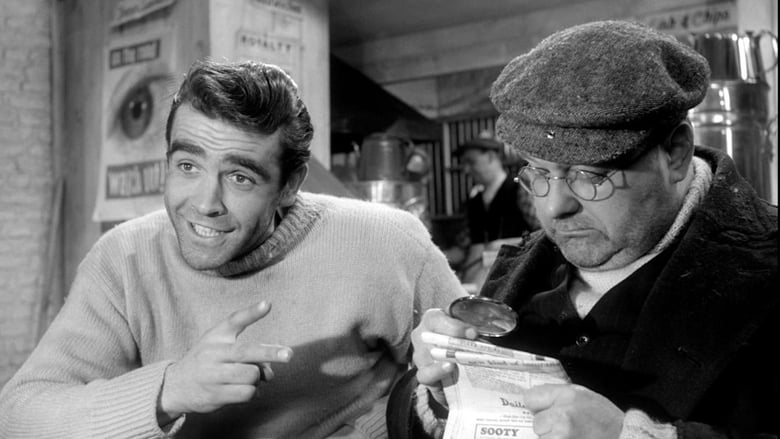
Hallo! Ish me, Sean Connery! Check out my “aye” brows!

The rest of the cast also contains many other names familiar to 1950s and 60s UK film fans. Nearly everyone who had a speaking part in this film (not to mention a couple of the background artists) can also be found in literally dozens of other movies.

But anyway, what about this movie? It’s a well-shot and well-directed tale of a shady trucking company that hires a motley set of drifters, hobos, and ex-cons as ballast haulers who must drive big trucks like crazy people in order to meet the nearly-impossible schedule set out by the management. Ruggedly handsome ex-con Tom Yately (Baker), in desperate need of a job, gets drawn in to this rabbit hole and decides to take on the borderline-psychotic Red (McGoohan), befriends the only decent person among the drivers, Gino (Lom), and attracts the ladies with his rugged good looks and reluctance to share too much information (Cummings and Ireland).

Red (L) threatens Tom and Gino.

As the title suggests, Hell Drivers is a very macho film with a whole crew of manly men who do man things, mannishly. The work is hard and dangerous, and the company knows full well that anyone they lose to an accident or death is easily replaced.

This is a lovely scene as Tom learns the ropes from the mechanic, Ed (Wilfred Lawson)

The drivers are attracted by the good money, but responsible for the cost of any mechanical faults, accidents, speeding tickets (which oddly never happens to any of them in the course of the film), or absences. As mentioned, in order to meet even bare-minimum 12-run quota they pretty much have to drive like maniacs, and attract much honking of horns and a load of near-misses. Red, the “pace setter” does 18 runs a day and holds a solid-gold cigarette case as a prize for anyone brave enough to beat him.

The film isn’t all crazy truck-racing sequences shot on overcranked film, though, and the story is nicely balanced between the job and what the drivers do off the job, which is mostly limited to eating at the Pull In Diner, sleeping in their rented rooms at a boarding house, and occasionally disrupting the local church social. We also spend quality time with Tom and Gino getting to know each other, the love triangle that ensues with Peggy, and Tom’s increasingly-hostile social time with Red and the other drivers.

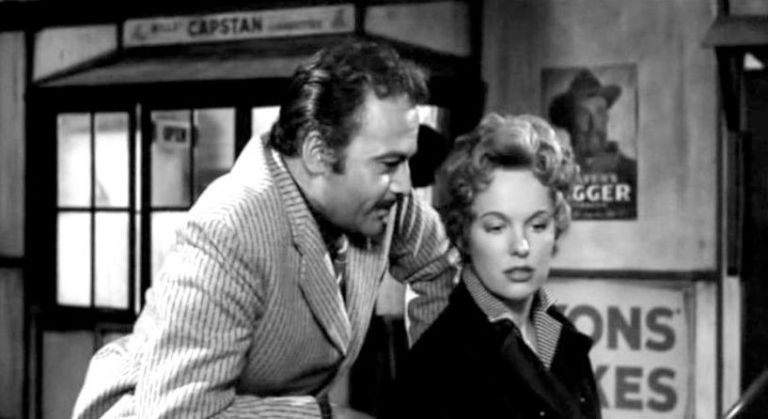
Gino loves Lucy, but Lucy loves Tom (for no clear reason other than she finds him hot).

Matters of the heart and of the fists as well as of the reckless driving come to a simultaneous head in the lead up to the climax and subsequent denouement, executed even better than I expected from such a workmanlike film. While Baker gruffs his way through most of the film, there is a surprising off-shoot of the plot where he returns home to his family, only to be cruelly rejected by his own mother.

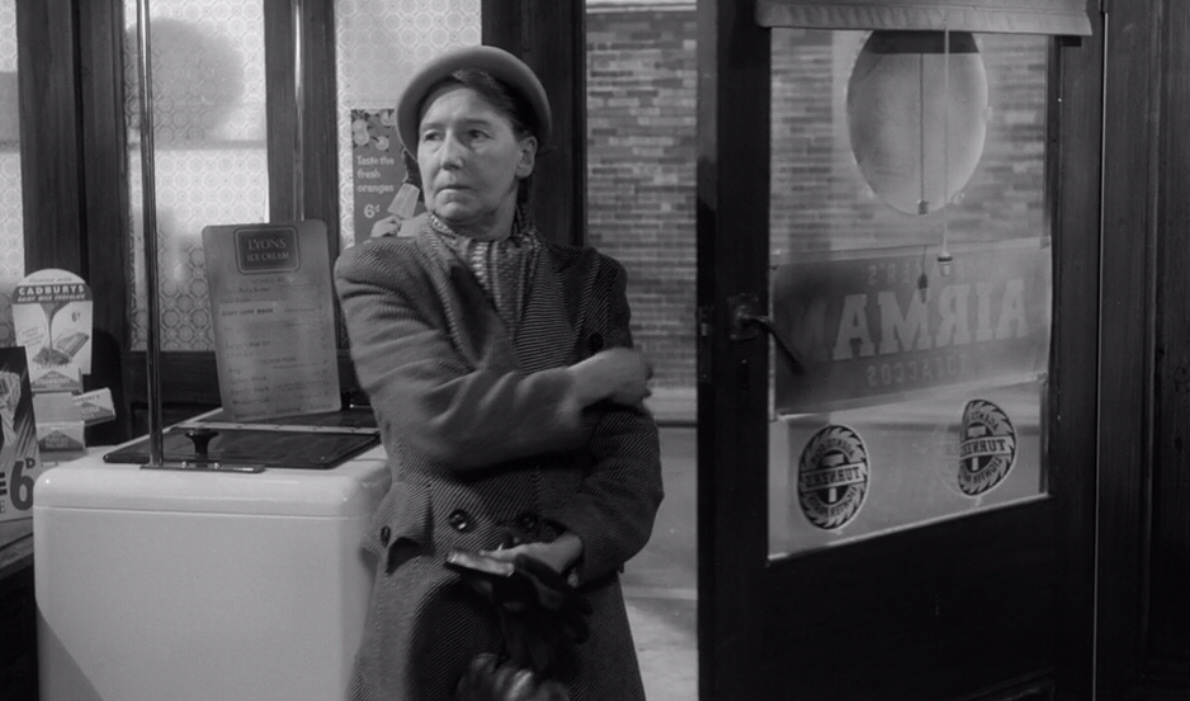
Beatrice Varley as Tom’s mother, who has let the bitterness of her son’s folly consume her.

While the entire backstory of that scene is never fully explained, we gather that the reason Tom is an ex-con is that he served a year in jail for reckless driving, which resulted in the crippling of his young brother Jimmy (McCallum). Beatrice Varley as Tom’s mother is pure, unforgiving ice water, with a perfect delivery of a chilling line: “For you it was a year, for me and Jimmy it is a life sentence!”

A very young David McCallum as Jimmy, Tom’s crippled brother.

Speaking of that, the film does have its moments of sparkling dialogue, and the friendship between Gino and Tom is a touching and multi-layered sub-plot with some nice twists. I don’t think it will be giving anything away by saying that of course one of the drivers dies in the film, but there’s a nice twist even in that.

I should also mention the solid music score by Hubert Clifford, which comes to prominance in the racing sequences and is far more subtle elsewhere. Jim Groom as sound designer offers some nice touches with notes of nature sounds amongst all the engine noise. If you’ve seen the 1953 film The Wages of Fear, this has a similarly macho character-driven story of desperate men driving, but the two are distinctly different nonetheless.

William Hartnell’s scenes, though brief, really show off his acting chops.

So, in the end, it worth a watch? If you like gritty realism in your late-50s domestic-drama UK films, this one will likely win you over. The overcranked speed shots of the trucks get annoying, but there is still some genuinely hair-raising moments in them, and just seeing McGoohan at his most unhinged, along with a jokey yet already distinct Sean Connery and a young David McCallum (among others), is just as entertaining as the story.

There is a hell of a lot of crazy-ass truck driving in this thing. Take that, Convoy!