⭐️⭐️⭐️⭐️½
52-week film challenge, film 34
Note: this is a 20-anniversary, “remastered” version of a review I initially did for my film blog back in 2003, but I did indeed watch the film again on October 2nd, 2023 to refresh my memories for this new version.
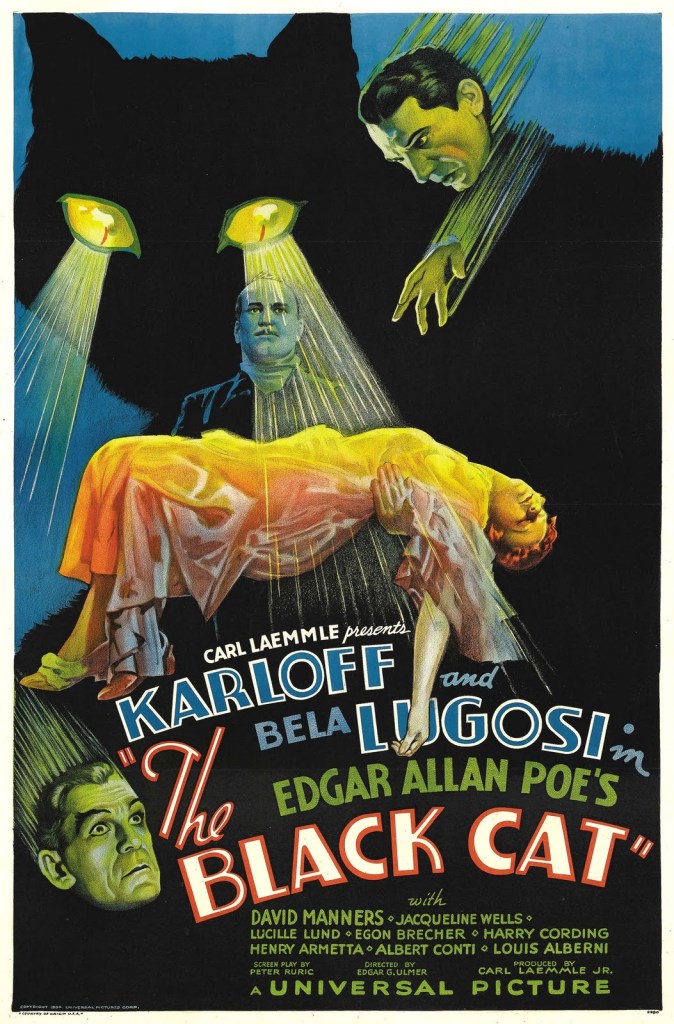
As I publish this, it is the beginning of October and the season of the witch, so if you are seeking a slow-burn horror film absolutely brimming with style — this may well be the most Neo-Expressionistic/Art Deco horror movie ever made — starring two absolute legends of horror in unconventional roles, have I got a great movie for you.
I think I first saw The Black Cat when I was about 12, and I’m sure it was one of those that played a role in my lifelong interest in highly-styled architechture and design in films.
At that age, parts of the film were indeed scary, but it was all too weird and mesmerising for me to take my eyes off of it. When I reviewed it again from my own film blog in 2003, the exterior model and interior sets of Dr. Hjalmar Poelzig’s house was the second greatest thing about it, the first of course being the first time I’d seen Karloff and Lugosi acting together without monster makeup.
The third thing about this movie is its incredible time compression. Despite some glacial pacing in some scenes between the two leads, there is plenty of action, especially near the end, and the film packs in necrophilia, satanism, murder, double-crosses, torture, the horrors of war, an undead black cat, secret vaults, and so much more into a film that astonishingly runs only one hour and four minutes.

The film makes numerous references to World War I, but the set design and intentional cruelty (not to mention its unusual setting of Hungary) also act as a prescient forerunner to World War II in some ways. The (black) cat-and-mouse game Lugosi’s Vitus Werdegast and Karloff’s Poelzig play might be seen by some as slow, but the tension between them is delicious.
The basic plot is, at its core, Standard Horror Plot #17: two “perfectly ordinary” strangers meet mysterious character on a train, who happens to be going to the same place they are; incident ensues, so mysterious character offers his new friends shelter at nearby house of arch-enemy; sufficient weirdness starts right from that moment and gets darker and weirder until “happy?” ending.
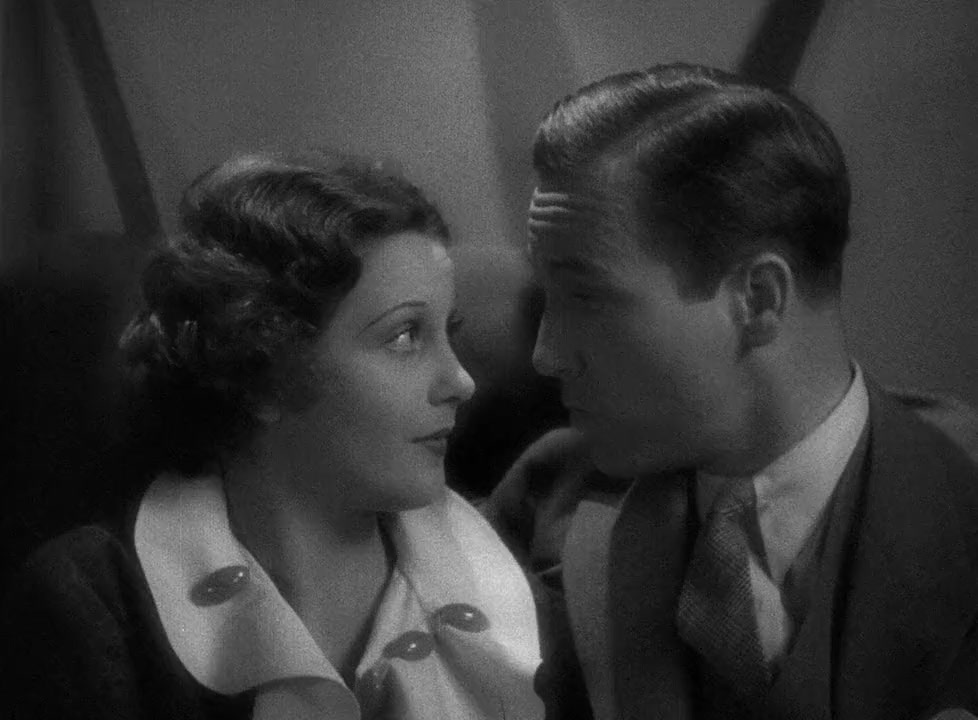
In this case, the couple is Peter (David Manners) and Joan Allison (Julie Bishop under the stage name of “Jacqueline Wells”), the mysterious (and intense) stranger is the kindly but creepy Bela Lugosi (Werdegast), and the mysterious mansion is the home of Karloff (Poelzig). I should mention that Werdegast has a hulking manservent named Thamal (Henry Cording), who pretends to be Poelzig’s servant.
Joan, who has been injured when their bus (from the train) goes off a cliff, is attended to by Werdegast, but from the moment Karloff (and his geometric hair) appears, the tension and complexity of Werdegast and Poelzig’s relationship just builds and builds. They talk a lot, but don’t say much — their eyes, wardrobe, and silences say a lot more.

And the house!! For an architecture fan like me, the exterior model shot, taken straight out of Frank Lloyd Wright’s dreams, was a thrill. Then, to see the perfectly art-deco 30s interior sets, looking as minimalist and futuristic as 1934 can manage, still astounds and impresses. Poelzig looks completely at home, which is not to say that he ever looks relaxed or comfortable but rather to say that his appearance and wardrobe complement the rooms perfectly.
An important element I missed on earlier viewings of the film is that the house is built on the ruins of a World War I battlefield they both participated in. Werdegast was taken prisoner and spent 15 years in jail, while Poelzig spent the time seducing first Werdegast’s wife and then, when she died, his daughter (yeah, the creep-o-meter just went to 11).
Like the chess game the two men play for control of Joan (Werdegast wants to set them both free, Poelzig has other unnamed and probably unspeakable plans), every interaction between the two is the clash of two opposing forces who both like and hate each other. Incredibly, Werdegast is the hero of The Black Cat, but his fatal flaw is revealed early on: he has a nearly psychotic fear of cats.
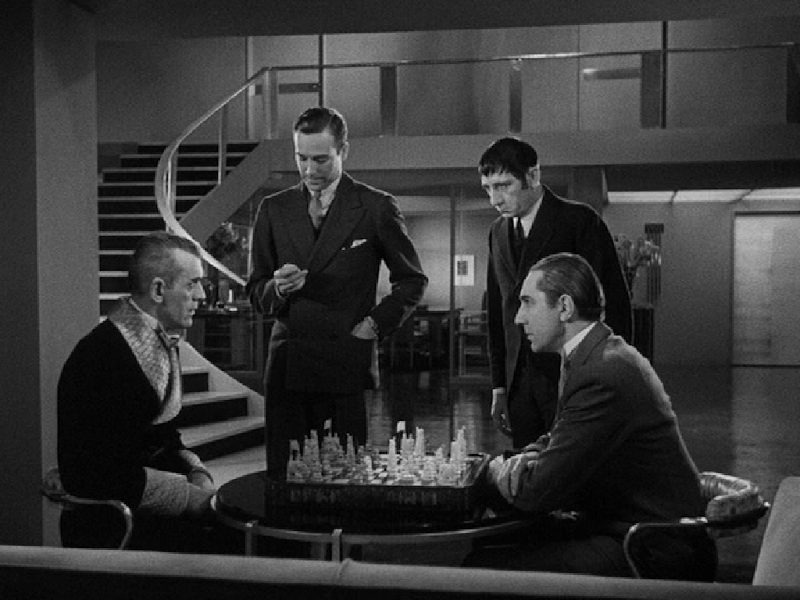
When one appears in Poelzig’s house, Werdegast grabs a knife and throws it to expertly kill it. Other black cats (or maybe the same one, as Poelzig makes reference to a cat’s many lives) appear in the film, but the amazing thing is that Werdegast kills a cat right in front of everyone, but nobody seems to think anything of it. This is the only real link to Poe’s work in this movie.
What makes this movie stand out from the thick river of horror movies produced around the same time is that so much of the actual horror is understated or imagined rather than actually seen by the viewer. If it weren’t for the gorgous costumes and sets, this film would be as close to a radio play as a horror movie could get!
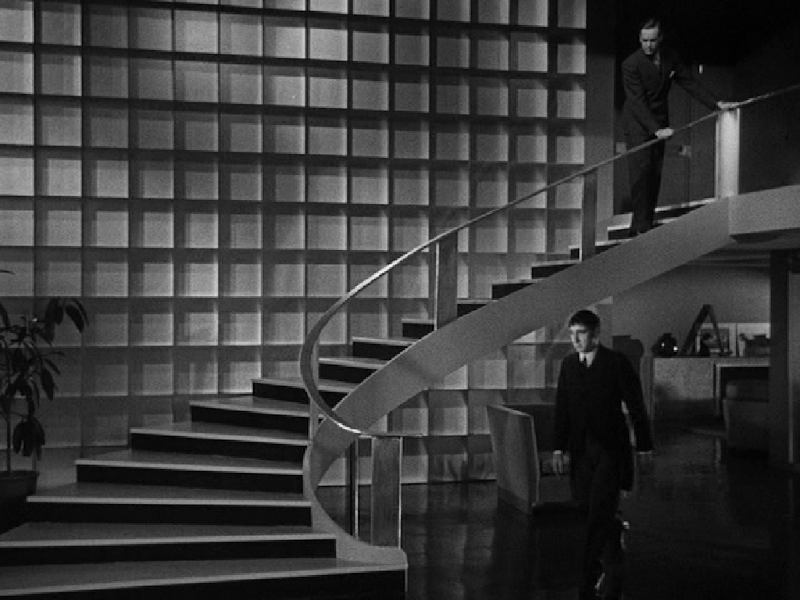
Stripped of their usual arsenal of makeup, Karloff and Lugosi rely on their great chemistry to light up the set, in this — the first of eight films where they appear together. The architecture of the house and interior sets are so stunning (have I mentioned this already?) that it should get third billing, behind Karloff and Lugosi but ahead of Manners and Bishop. As another reviewer noted, “architectural nuts probably rent this movie as architecture porn. The house is that cool.” She’s absolutely right.
Once Poelzig is revealed as a Satanist who has designs on Joan for a sacrifice, the film’s action finally kicks into high gear. Unlike the stage-y verbal jousting of earlier, Werdegast — who every so often says he is “biding his time” for his revenge” — now has to make good on that threat, and quickly.

The climax, in which Werdegast “wins” in the sense of triumping over Poelzig is really quite stylish and stunning, but even in shadow, Werdegast’s delight at inflicting torture on Poelzig is a little tough to watch, even 90 years later. The newlyweds, which everyone stopped caring about 30 minutes ago, escape with their lives — which any viewer of The Rocky Horror Picture Show will have seen coming a mile off (and that’s is not the only influence The Black Cat had on Richard O’Brien’s little moneyspinner).
While this movie has some issues of its own — I’m still trying to figure out what an all-American couple like Peter and Joan are even doing in postwar Hungary, the delicious slow-burn and the stars’ chemistry make this pre-code horror movie a time capsule of incredibly beautiful horror like nobody has made since. If you’re ready for something off-beat, classic yet wonderfully dated, comic in spots and scary in a psychological way, you are ready to cross paths with The Black Cat.

 The Chasbah