1979 — Revolt Into Style (Disc 3)

(2022, Cherry Red)

THE OVERVIEW

The final disc in this three-CD set feels a lot like someone spent a lot of time on the first two, then realised “oh crap, there’s a mountain of stuff I haven’t even gotten to yet!” and tried to cram as much of it in at the last minute — which reminds me of me and my suitcase packing. There is a marathon 27 tracks here (literally hitting the 80-minute CD limit), and as with the other two discs, the “hits” are in the minority and the also-rans are in the majority.

Much of the fun of this set is discovering some lost gold, but also this whole set paints a picture of both the fall (but lasting influence) of punk and the rise of post-punk, which dominated ’79 until fashion (and better/more affordable synthesizers) entered the picture, whereupon it evolved again into New Wave. Some acts were more forward-looking (XTC, Human League, The Monochrome Set, The Vapors, The Wall), some weren’t (Swell Maps, Disco Zombies, The Regents, Notsensibles) but most were just taking advantage of the spirit of the times to either play at being a rock star (The Zipps, The Monks, The Freshies), or seriously explore their own creative path (The Mekons, PiL, Scritti Politti).

What I like about these sorts of “specific year, period, or genre” comps, at least the way Cherry Red does them, is that they make you a true Whitman’s Sampler of the subject, rather than focusing on the most memorable hits like most labels would — thus grossly misusing the term “Best of.” Instead, we get a marbled slice of the whole cake — nothing truly terrible, but the gamut of acts that got to the record-cutting stage who ended up being run-of-the-mill at worst, and gloriously daring and original at best.

One thing I noticed about the third CD was that the famous/infamous “two minutes-ish” standard was really starting to slip – most of the songs here are over two minutes, many are over three minutes, and a handful sail right past a scandalous four minutes!

At a total of 76 tracks, “Revolt Into Style” is probably best suited as the soundtrack for a 1979-themed party, with prizes for those who can name the more obscure tracks, but … as a snapshot of a moment in music, it is far better and more representative of a time where the “next big thing” wasn’t yet clear, and popular music was open to more possibilities than had been there for a while.

THE MUSIC

Disc 3 starts off with a strong set of four songs — one from the quixotic XTC, who managed to become a minor but mainstream success with a number of charting hits; two from bands that are beloved by their fans (which include me), but all but unknown to everyone else (The Revillos aka Rezillos and The Monochrome Set); and a oddly attracting but utterly obscure song about driving habits (!) from a band that sank without a trace (Passage).

★“Making Plans for Nigel” is one of Colin Moulding’s unlikely hits, which must have confused the heck out of main songwriter Andy Partridge (who had to wait quite some time for one of his to climb the charts. It is, as is a theme throughout the entire boxset, not a love song — and showcased their angular soundscape and unconventional vocals, yet still managed to become their first Top Twenty single and bring more attention to the band. Happily, they kept following up with strong choices for single and album material for quite a while.

★“Where’s the Boy for Me?” is a brilliant mod-ish parody of teenbeat songs (like those of Lesley Gore, whom I adore) and those boy-crazy beach movies. It features the best damn fake Farisa sound around, plus the requisite twangy guitar solo, great garbage-can-lid drums, and starts frantic and builds up to a sudden hard stop. Not the first band to create a warped image of the 1950s, but one of the best.

★“The Monochrome Set” by The Monochrome Set is, surprisingly, not the only self-named single on this disc (!), but in this case it’s a manifesto of wit and whimsy from the point of view of the bored, cynical offspring of the rich — one of those things Noel Coward might have tossed off if he’d been a pop star. The single version included here was reworked a bit for the album version (found on Strange Boutique), but its the blueprint for Bid’s entire ouevre of smart, humourous songwriting.

★Passage were the first band on the disc that were utterly new to me, and the song “Taking My Time” is … odd … in its subject matter, but it has lodged itself firmly in my head for some reason. I mean, who writes a song about bad driving? It really makes me curious to explore whatever other music they put out. Perhaps the fact that it was produced by David Cunningham of the Flying Lizards gives it a touch of commerciality (with surprise cello at the end), coupled with a simplistic chorus and odd subject.

THE BEST OF THE REST …

★Other winners on this disc for me included “Empire State Human,” which is technically the very first Human League single (the one before, “I Don’t Depend On You,” was done under the name The Men). Of course Human League were one of the bands that took their very forward-looking sound and made commercial hay with it, but this one stands out even on this disc the way Gary Numan did on Disc 1. It’s a story-song, which I always like, plus its really funny.

It didn’t actually do well on initial release, what with being a song about a man who is deteremined to become the tallest person in the world (and succeeds), but was re-released later and became a hit. The segue out of the song features the lyrics “fetch more water, fetch more sand/biggest person in the land,” which somehow works with the whole bizarre thing. I love it.

★“Kiss the Mirror” by The Wall is an early dark-rock song that predates the big obsession with that genre as we suffer through the Thatcher reign of austerity in the UK, followed by the election of war-happy Ronnie Ray-Gun in the US. While this particular track suffers from some poor production or mastering, it can’t hide the band’s talent — and made me go look up some more of their scattered discography, all of which I sampled was in much the same solid vein.

Their first single, “New Way,” was another John Peel favourite (as you may have gathered, his opinion was very important to the compilers of this set, as it was to most young people in the UK at the time). “New Way” borrowed a chorus from the Sex Pistols, but they’re forgiven because the song was produced by former Pistols Paul Cook and Steve Jones. Beset by personnel changes, the band split up in 1982, but have had at least one reunion (in 2007), and their two studio albums have been augmented by a live album in 2009 and a compilation of the Ian Lowry material that came out in 2021.

★Public Image Ltd’s lesser-heard single “Memories” is an other example of a band that doesn’t sound like everyone else (often a problem for the also-ran bands, on this disc in particular). Long-forgotten but brought to my attention in this track is the repeated use of the phrase “I could be wrong” — which he used again to even greater affect on the band’s biggest hit, “Rise.” Feeling nostalgic after hearing this, I went to look up their latest album (End of World) and sampled the song “Car Chase” — yep, still Johnny, still unique, still great.

The very next track on the disc is the compilers sneaking in a musical joke. “Johnny B. Rotten” by The Monks, who have no aspirations of imitating either the Sex Pistols or the former Mr. Rotten; it’s just a fun pop song taking the piss — or maybe it’s meant as the flip side of “Johnny B. Goode.”

★Then we come to a breath of fresh air with The Vapors’ first single, “Prisoners.” In many ways, it’s the same old “three chords and a cloud of dust” approach so many of the other bands use, but smart backup vocals and the stylish interplay between David Fenton and Ed Bazelgette really shows off their talent. It can’t have hurt that Fenton borrowed a musical phrase from Bruce Springsteen’s 1975 hit “Born to Run,” but I love how he used it here.

Finally, we get to a ska song (sort of), and it’s Madness’ “Bed and Breakfast Man,” a very mainstream hit from the Nutty Boys, again in the tradition of a Kinks-ian story-song but with that ska influence. This was the one that proved the band wouldn’t be a one-hit wonder, and that they could grow and embrace other styles as well.

★There’s also a single by the emerging Dexy’s Midnight Runners called “Dance Stance” (originally called “Burn It Down” when they were still a punk band, and that titled returned for the album version). Singer Kevin Rowland and guitarist Al Archer had soured on punk, rethought their goals, and came up with Dexy’s style of northern soul.

This was the first indicator of their new direction, and it’s thus rougher than what they would become, but it still captures that rebellious spirit the fuelled punk, addresses an anti-Irish sentiment that was prevalent during “The Troubles,” and takes it in a different direction (including a litany of Irish literature legends name-checked in the song). Thankfully we get the demo version here, rather than the official single (which stripped out the remaining punk element and just wasn’t as good).

★Another keeper was The Lurkers with “New Guitar in Town,” which does a lovely job with what would later be called “jangle pop.” It closely follows the style of drum-and-guitar driven fast pop that dominates the sound of ’79, but good vocals and agile play make it work.

★The last of the highlights for me was the inclusion of the perennial post-punk novelty number, “Where’s Captain Kirk?” by Spizzenergi. You gotta love a man (Kenneth Spiers) who has made an entire career (still going!) out of a single song (okay, that’s not quite true … have you heard his cover of “The Model” by Kraftwerk?), and ever-changing band names on the theme of “Spizz.” Fast, fun, whacky, excellent guitars and gratuitous vocal effects (plus a human farisa organ!) … what’s not to love?

… AND THE REST OF THE REST

Another wrinkle that occasionally gets into the music here (and throughout the collection) is the introduction of sax and occasionally other horns to add some soul and punch to the guitar-heavy sound. In the earlier discs, bands would often lead with the bass and drums, but by Disc 3 bass has been mostly pushed into the background in favour of more guitar. We’re also sloooowwwwlllyyy getting back to love songs, which isn’t a bad thing — but we were enjoying the break and the variety of other subjects that dominate this compilation.

As we’ve noted across these discs, there was (and still is) a tradition of the occasional single (that sometimes does rather well) of a bunch of lads on a musical lark (see also “Zip Nolan” by the Cult Figures on Disc 2). These days its mostly the realm of novelty Xmas singles or forcing the tournament football team to make a loutish charity record, but a … let’s call it “project” … called Swell Maps managed to make a career out of it for a while.

The example given here, “Real Shocks,” will remind listeners of the Cult Figures, but to be fair one can detect more musicianship than is immediately evident in this basement-studio type sound of young men having a good time, semi-melodically. Having sampled them a bit more (going back to 1972!), I acknowledge that they didn’t always sound like this — in their early days they were more acolytes of Can and Faust — but I doubt any of their output will ever make it into my collection except by means of a compilation like this.

That said, it is similarly paired well with the next track, “Friends” by The Zipps, who really were a group of students from Belfast who recorded exactly two songs and then went back to school and the rest of their lives. Even though there was only this one single from them, it actually ended up as a pretty good effort — but lead singer Mel Power just wasn’t lead-singer material (though I think it could be a hit if some more-talented group covered it).

Next up is “Disco Zombies” by the Disco Zombies. Now, I’m kind of a sucker for bands that write songs about themselves (see also “The Monochrome Set” and “Hey Hey We’re the Monkees”), but this one is a bit on the meh side, relying like many of the songs here on a limited set of guitar chords. As with The Zipps’s effort, the song isn’t actually bad, just poorly produced — and without the spark of much talent.

“Number 12” by The Pack is, as you’d expect from a Rough Trade release at this point in its history, pretty “yelly” and punky. It’s actually the b-side from the “King of Kings” single, but ultimately The Pack went nowhere. The lead vocalist Kirk Brandon and Simon and Jon Werner (guitar and bass, respectively) got together years later as Theatre of Hate, which was a more successful effort.

The Mekons, who are still active (but slowing down) to this day, are represented by “Work All Week,” a pre-album single not included on the album until a 1990 reissue. Given that they came from the same group of students that formed Gang of Four and Delta 5, and that the band used Gang of Four’s instruments to record it, as you can imagine it sounds a lot like them.

The musical style is still gelling on this one, but the lyrics make a good comment on the price of love under capitalism. This really should have been paired with “You Got to Pay” by The Only Ones from Disc 1.

Following this we have a deliberate attempt to be “commercial” by punk band 999 after various singles and a couple of albums failed to interest the public — they did better later — and this didn’t move the needle for the band. It’s pretty meh, to be honest, but astonishingly they are still together, playing and releasing albums as recently as 2020.

The Outcasts were an interesting story: a decent band, you might like them if you only listen to the music, but apparently the members were all hooligans who constantly got in fights and other such shenanigans. The song included here is called “Self Conscious Over You,” and it’s not bad at all, and it’s one of the few songs about love on this disc. It’s a pity they self-sabotaged themselves out of a potential career.

“Children of the World” by The Freshies changed up the mood as a middle-of-the-road pop band with a nice sound but un-followable lyrics. Chris Sievy had (and still has) a propensity for silly titles, and indeed in 1981 he had a hit with this band with a cute song called “I’m in Love with the Girl on the Virgin Manchester Megastore Checkout Desk,” which a glorious title for a single. These days, he’s better known as Frank Sidebottom, another odd but enjoyable cult thing.

Secret Affair, a “mod” revival band with punkish leanings, are also still around — having taken a long break after the third album — and this song, “Glory Boys” was indicative of the direction they would take for the rest of their recording career.

“7 Teen” by The Regents shows up on a lot of post-punk compilations, and is the only song on this disc explicitly about sex. Cleverly put together with a female backup crew that gave them a strong faux-50s vocal sound, the single version used here includes the lyric “a permanent reaction” rather than the original “a permanent erection.” It hit #11, but The Regents never had a successful follow-up.

The Boys (formerly the Choirboys) are up next with “Kamikaze” — a hard-rocker story-song that has a low opinion of Japanese-made motorbikes. It would be seen today as a bit racist, but I can testify that this was “a thing” back in those days, with Harley fans spitting on Honda and Kawasaki bikes for being small and fuel efficient.

“Easy Way Out” by the Carpettes is an enjoyable but kind of a fatalistic punk number. They eventually went full-on New Wave (with Mod influence) later on in their career and for me were more interesting in that period.

This brings us to an early Scritti Politti single “Messthetics,” of which the clever title is the best thing about it, apart from Green Gartside’s fine (and slightly lower register) vocal. The song itself is a bit of a mish-mash, but you know — refer back to the title!

This brings us to the very last track and that feeling you get where you’ve completed a very long, somewhat grueling yet pleasant journey. The Notsensibles (who might well be Swell Maps collaborating with Cult Figures, they’re that similar) bring us “I’m in Love with Margaret Thatcher.” Have I mentioned the influence she had on most of this music? That said, I suppose we do have to “thank” her for a lot of the protest content that came out in these years.

She was a very hated woman in many quarters, and remains so to this day — as is only right and proper. Sadly, the Tories learned nothing from this, then or now. Even worse than that, it’s no longer too fashionable to craft protest songs about bad government policies on either side of the Atlantic, and that’s a damn shame. As Johnnie B. Rotten himself once said, “Anger is an energy.”

THE WRAP UP

Even though this set covers a tremendous pivoting year in music, it’s frankly not for everyone — or even most people. They’ll want “the hits” or at least more familiar songs from 1979 from bands they recognise, and that’s fine … but it’s not this box set’s purpose.

As I mentioned previously, it’s more like a candy box — there’s (almost) nothing here that isn’t sweet and nice, but if you’ve ever gotten a box that has no “map” of what’s inside the chocolates … there’s a few you’re sure you will like, but the others are a little bit of a gamble.

Thanks to the thoughtful curation, a wide gamut of power-pop tastes are catered to, and for those who like a bit of adventure and are open-minded, this is a fun journey. It’s augmented nicely by some brief but informative notes about each release that occasionally shine a new light on the music you’re hearing.

1978 through the early 80s was a period where record companies really had no idea what was going to “hit” with the public, and with the birth of the indie label, almost anyone with a interesting sound or look had a shot. Those days seem long gone now, and music is likely to be done by “AI” in the near future with minimal human involvement (or emotion), so enjoy some passionately hand-crafted <s>pottery</s> music that may or may not be very good, or is good but not to your taste, or is familiar and fun, or is utterly fantastic and right up my alley and why have I never heard this before?

If you’re up for a little musical spelunking, you’ll hit the highs and (relatively soft) lows with this set, and maybe open up your tastes a little bit more. Can’t ask for much better than that.

1979 – Revolt Into Style (Disc 2)

OVERVIEW

Moving on to disc 2, we find a higher ratio of commercially-successful singles, but still a fair selection of “who?” bands and also-rans. For me, at least, the ratio of obscure bands dropped considerably, and the number of tracks that actually charted went up.

Sadly, this disc also features a couple of tracks I’m not inclined to listen to again. I didn’t hate anything here — the tunefulness of this collection, along with the humour evident in even some of the “bad” songs is one of the hallmarks of 1979 (the year we could make fun of punk, apparently), but we’ll come back to some of those later.

That said, it also has a higher ratio of “add to playlist” songs (11 out of 24 tracks) and a bit more variety. The brash, angry influence of punk is starting to fade, but thankfully not the sense of urgency: most of these songs hover around three minutes, with some closer to two minutes (and one that’s even less than that!).

THE MUSIC

The disc kicks off with “Up the Junction,” a really clever composition by Squeeze from their second album that pulls off an entire UK kitchen-sink drama told within a song of love won and lost without using any repeated lyrics or offering a chorus. As I listened beyond this story-song, I kept coming back to it to check that it really did sound as muddy from a production standpoint as I initially thought it did, and indeed its true; very muffled drums and bass, and the vocal was a bit understated but at least properly recorded.

After a few re-listens to be sure, I decided to check my copy of the album — only to find that the entire Cool for Cats sounds pretty bad, even by then-contemporary standards. Producer John Wood (and the band), for shame!

Just for the record (heh), Squeeze’s first album (titled U.K. Squeeze outside the UK) did not have this problem, even though the band itself produced two of the tracks, with John Cale producing the rest of the album. Although the band didn’t like working with Cale too much (he wanted “tougher” songs than they had been doing), I think the debut album holds up pretty well, and the two tracks the band produced themselves slot nicely into their general ouevre.

The very next track on Disc 2 is also by a band that went on to bigger and better, so let’s take a look at all the best-known tracks here first. “Groovy Times” by The Clash was an interestingly off-beat choice for this comp, as it comes from an EP released after the second of their influential “punk” albums.

It’s an alarmingly relaxed and amiable single, with Joe trying to croon as best he can, but the lyrics are a bit snarky still. Hard to believe this is on the same EP as their blistering cover of “I Fought the Law,” which for me is the definitive version of that song.

Track 3 is a rougher single than you might expect from The Records, who hit it big right out of the gate with their first single, “Starry Eyes.” Good to hear them doing something a bit harder, but this track reminded me that I haven’t listened to the band’s non-singles output in years, and that I should rectify that. “Girls That Don’t Exist” is a song that grows on you, though it is less than their best.

Other notable tracks I enjoyed on the disc from the “name brand” bands include Skids’ “Masquerade” (very anthemic, but I’m still not quite sure what it’s about); Gang of Four’s “At Home He’s a Tourist” because it’s still brilliant; “Disorder” by Joy Division (for being the most New Order-ish of the JD songs); the Jags’ best-known song “Back of My Hand” because it’s a damn-near-perfect pop single; “Kid” by The Pretenders because “first and best” lineup doing a different sort of ballad; and The Jam’s energetic “When You’re Young” for its less-chosen single status and teen-life subject. There’s also the Echo & the Bunnymen version of “Read It in Books” as an alternative to Julian Cope’s version — long story short, McCullogh and Cope (and Pete Wylie) were once in a band together, and they wrote this back then.

Having just mentioned Julian Cope, I should add that the “original” (aka demo) version of “Bouncing Babies” is here, and like the Squeeze song the sound quality pretty bad compared to the tracks around it — Cope (whose vocal is nicely clear) is pushed back in the mix like he’s singing from inside a wardrobe. The drum sound is akin to someone beating on carpet rolls with an exhaust pipe, and the bass isn’t much better — and yet you still can’t hide what a good song it is.

The Undertones may be a band you’ve not heard before, but I’ve been a fan from the debut of their first album from the moment it was available as an import. It showed some fresh-faced Irish lads on the cover, it was a Sire record, and their logo had an arrow pointing forward in it. I was sold, and even more delighted to hear its light, happy pop-punk sound (remembering that “The Troubles” were still going on when this came out), complete with the most Irish vocalist you could hope to hear this side of the Rovers in Feargal Sharkey (also a very Irish name, to be sure!).

“Here Comes the Summer” isn’t their best song, but it’s very representative of that early-era sound they had, and is just naturally infectious. Happy, cheerful Irish people? Don’t breathe a word of this to James Joyce!

The first real clanger you come across is track five, by Clive Langer (and the Boxes). “The Whole World” features some nice guitar work by Clive, but is otherwise pretty undercooked and unmemorable, and we’re back to “working class” accents with not much to say. Thankfully he became a producer (along with Alan Winstanley), and was responsible for a lot of great stuff from other artists.

As for the other “lesser” tunes on this disc, “Burning Bridges” by The Cravats wasn’t a bad song per se, but it had a really bad vocalist. Spat-out and snarled spoken lyrics work well in punk songs, but less so in hooky, sax-driven, upbeat frantic rock. It’s short (2’27”), which musically is a shame … but vocally, it’s a relief.

Speaking of bad singers, “Citinite” by Fashion is represented here, featuring short-lived original vocalist Al James. The rest of the band are pretty good, but oh my gosh he’s terrible. I’m so glad they dropped him, and the promise you can hear musically on this song is more fulfilled by the time we get around to their best-known album, Fabrique.

Rounding out the “crap singer” trilogy, we have the Teenbeats with “I Can’t Control Myself,” that pairs a really catchy riff with a singer who only occasionally delivers a smooth vocal — the rest is pretty rough, and sounds put-on, like someone told them to sound “edgier.”

“Alternative Suicide” by The Numbers isn’t actually bad, but it just doesn’t gel. It’s a dark rocker with an amusing viewpoint, but if I’m being kind I’ll say that it’s ahead of its time with its Mopey Goth Kid style.

It does pair well with Adam and the Ants’ “Whip in My Valise,” though … a slow-burn ode to the “pleasures” of BDSM with very arch, darkly campy vocals from Mr Goddard. It’s really more notable for featuring the original Ants — guitarist Andy Warren went on to the Monochrome Set (where he resides to this day), and the bassist and drummer were stolen away by Malcolm McLaren to form Bow Wow Wow.

A special mention of badness has to be given to The Stranglers, and it’s astonishing to think that their song “(Don’t Bring) Harry” was ever considered a single, when in fact it may well be the worst thing they ever recorded (and certainly the worst song on this disc). As a big fan of the original lineup and early albums, the slow pace of the song doesn’t throw me off nearly as much as Hugh Cornwall’s attempt at a whispery “dreamy” vocal featuring a lot of low notes he doesn’t quite hit, in a song about heroin that has some fine musicianship but a vocal that sounds like Cornwall was on heroin when it was recorded.

The remaining songs on this disc range from “meh” to “good, but not quite there,” and there’s only a handful of them, thankfully. Ruts’ “Something That I Said” is a fully competent rock song that moves along well but repeats its title way too many times, covering up for a lack of lyrical meaning. Plenty of tasty guitar work for you to pump your fist to, though.

Likewise, “There Must Be Thousands” by The Quads was a nice find, a working-class club-friendly band pouring out the earnest rock with above average subject matter, with feeling. “Radio-Active” by The Cheetahs is a pretty pleasant slice of power-pop, but its anti-radiation theme (admittedly a significant topic of the times) wears a bit thin now, and this one is a forerunner of the many songs of the 80s that were also had that (less obvious) fretting about the potential for nuclear attack.

Cult Figures’ “Zip Nolan” is kind of funny if you’re drunk (as the band seems to have been); it comes across as an improvised theme song for a fictional action hero put together at the pub that’s barely coherent and sounds like frat boys having a laugh at karaoke.

Another dumb/funny song is the final track on the disc, “I Want My Woody Back,” by The Barracudas. It starts off as a lament, but like it’s a double-entendre for … something … so the band feel the need to explain in the song that a “Woody” is a wood-paneled car you take your surfboards and girlfriends to the beach in for a day doing beach stuff. Unlike “Zip Nolan,” though, this one is well performed and might make a cute girl blush, and thus it brings the disc to a gentler, lighter-hearted end.

1979 – Revolt Into Style (Disc 1)

(2022, Cherry Red)

SERIES OVERVIEW

If you were a young person in the very late 70s, but old enough to be really into music, then you’ll be aware that 1979 was a pivotal year in the aftermath of the punk revolution in the UK. Where 1977 saw punk “die” (not) and fall off radio’s radar, it diversified and injected fresh excitement into ska and mod music, and 1978 was where punk-influenced music began to chart again, becoming a lasting influence in popular music.

Witness for the prosecution, exhibit 1: Cherry Red’s “1979: Revolt Into Style,” a three-disc buffet of singles both famous and completely obscure that collectively represent what I would call the DIY-versification of rock and pop after the kick in the nads the corporate-label acts got from punk. The youth of the late-70s, who saw little to no future and what might be coming under Thatcher looked pretty bleak, protested in the form of their own contributions to sound and culture.

Importantly, punk (and let’s not forget The Velvet Underground) taught a LOT of artists across genres that it was okay to write political songs, angry songs, message songs, and really just anything that was on their minds more so than just love songs. It also took from punk rock the idea that your message should be important, so get to it quick and don’t hang about — plus it wore Lou Reed’s “not a trained singer” influence as a badge of honour for quite a number of the vocalists.

Punk’s most direct musical mutation was collectively known as New Wave, but a fair amount of it was just pop and rock underneath a studied anti-style — or as Bowie would phrase it just a year later, “same old thing in brand new drag/comes sweeping into view.” Following the punk explosion of musical rage, David seemed to be signaling that being too political and serious all the time might make Jack a dull boy before too long, and Scary Monsters was the proof.

Bowie needn’t have worried. As a new decade containing a fearful future foretold by Orwell loomed, the forces of traditional pop put up a brave fight to hold on to their power and popularity. As Bill Nelson puts it in the lead-off track, “Though I know the time is nearly 1984, it feels like 1965.” The song in which he sings that takes its title from a poem about Elvis (Presley, not Costello) that includes the line “he turns revolt into a style.”

And that’s exactly what was happening by the time 1979 rolled around. The songs in this compilation — which showcase that half-way point between wanting to change the world and the more traditional rock-band path of wanting to get rich & famous & groupies — range from deadly serious to clearly taking the piss, using whatever sound and vision they had to hand.

The accompanying booklet for the set contains bits of background info about each song, which provides for a list of interesting tidbits. The journey through the sets themselves provide all the variety of a musical rollercoaster, and even the hit-and-miss parade of songs do succeed in painting a picture of the emerging “new normal” for bands and artists.

Though still bound musically by the traditional rules of rock music, the new “wave” here comes to the fore in singing styles, subject matter, arrangements, and a sense of urgency that gives a lot of the music its power. In a few cases, the mastering for these records sounds as though it came from the 45s themselves, as undoubtedly the master tapes in some cases couldn’t be located.

As with all samplers, whether music or chocolates, it’s all basically good — and half the fun is finding new gems. We’ll highlight our previously-unknown best cuts, and what we thought was the worst songs on each given disc.

DISC 1 – THE MUSIC

As mentioned, every disc in this set has a mixture for familiar and “new to my ears” material, which keeps things interesting (another key rule for the post-punk set: don’t get too formulaic). While there were only a handful of tines on Disc 1 that I’d keep on rotation (nine or 10 songs out of the 24 on this disc), not a single song rated a no-star or one-star rating from me, and you gotta love a disc with a packed 77 minutes of runtime and little filler.

Among my favourites on Disc 1 was the lead was the lead off, “Revolt Into Style,” by Bill Nelson’s Red Noise — very much ahead of its time and probably would have been a bigger hit if Nelson’s vocals were more prominent in the mix. Other four- or five-star efforts in my opinion included:

★ “I Feel Flat” (Andy Arthurs and the Rock-Along Combo), which showcased the adenoidal style singing that was briefly in fashion, paired with a very catchy tune and “not a love song” lyrics about loneliness.

★ “Rhythm of Cruelty” by Magazine, which — alongside “The Staircase” by Siouxsie and The Banshees, “Rebellious Jukebox” by The Fall, and “Sink Your Boats” by Ian Dury and the Blockheads on this disc — showcased bands that emerged into the public consciousness fully formed, like Zeus’ children, and already sure in their trademark sound.

★ “Stop Being a Boy” (the Squares), which may or may not be an ahead-of-its-time song about gender identity but with a hefty dose of irony in the way it is sung versus its lyrics. I don’t want to spoil it, but I could imagine the late Tiny Tim having a go at a song like this (!).

★ “Me I Disconnect From You” by Gary Numan is far and away the most original song, both musically and lyrically, on this disc — and as anyone who knows Numan’s second album (as Tubeway Army) can attest, this single served as a powerful advance scout for the synthesizer armies already assembling, that would come into their own with the 80s. Young Mr. Webb had some money and skills behind him, and it really stands out in the context of this mostly bass/drum/guitar driven disc.

★ “Highly Inflammable” by X-Ray Spex, by contrast, shows off more range that they had previously been known for — hinting at a future new direction — but became their farewell single when singer/songwriter Poly Styrene (Marianne Elliot-Said) left.

There were a few ties for two-star rated tracks, but for me the single worst song on this disc was by Toyah (the band, starring Toyah Willcox) with the “why on earth is this here” prog-rock track “Victims of the Riddle (Part 1),” which the influential New Musical Express (NME) accurately dubbed “theatrical froth.” She’s a strong singer in the Kate Bush mold, but let’s just say I’m in no rush to hear Part 2.

Another noteworthy “odd man out” is Eddie & the Hot Rods’ song “Media Messiahs.” They were a traditional power-rock band (hence the name) that got the memo and tried gamely to go with the flow, reasonably successfully.

This was an unsubtle but relevant “message” song about the existing mainstream media of the time. The band never quite cut it with me, but at least they were reading the tea leaves of the times and trying to become (stay?) relevent as the world temporarily moved on from crotch-rock, and as a result they have managed to wangle their way onto quite a number of “New Wave” samplers, and even made the soundtrack album to Rock n Roll High School.

The other tracks here range from “Not bad, not great” to “amiably forgettable,” and quite a few of the artists not singled out in the list above still went on to bigger and better — but again the important thing is not just the songs you find you like and/or are familiar to you from way back then. It’s the journey of hearing these artists working with their new insights, new rules, and new sounds is itself a revistation to a time, place, and political reality that had a profound effect on what had been, to this point, a more easily-defined decade of mainstream entertainment.

The Black Pirate (1926)

Director: Albert Parker
⭐️⭐️⭐️⭐️⭐️

I like to think I’ve seen most or all of the “key” early/silent movies, and I’m sure I’ve covered a fair few of the essentials, but every now and again I come across one I somehow missed. The Black Pirate is a masterpiece I somehow overlooked — a Douglas Fairbanks movie, no less! — and it is magnificent.

This was a very early film done in “two strip” Technicolour, so it was probably pretty shocking to audiences in its day for a number of reasons, and a recent remastering means we have a lovely, clear print of it to enjoy now. Although Fairbanks had previously done swashbuckler films, I think The Black Pirate is the primary seed of all future pirate movies.

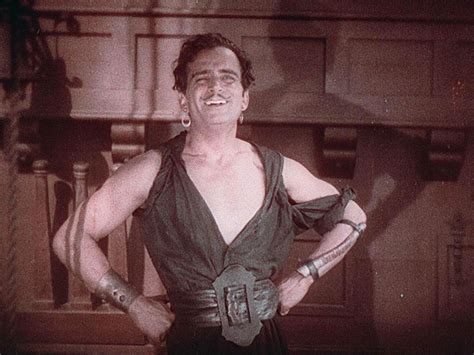
Comin’ at ya with both barrels!

This is the one they all draw from in one way or another, because its so well done, and while I only have one real criticism of it, so much of what we think of when we think of a “pirate movie” or “high seas adventure film” is all present and accounted for, right here. When it comes to cinematography, music, stunt work, performances, and pacing, this movie is pretty much without flaw.

The main focus, as with Thief of Bagdad and other Douglas Fairbanks adventure films is of course Fairbanks and his enthusiastically physical stunt work, including swinging from ropes, climbing up things with incredible vigour, lowering himself from high up in the mast by sticking a knife in a sail and “riding” it down, and — needless to say — swashing his buckles impressively.

Avast ye swabs! We be a silent movie in colour! Shiver me timbers!

Lest this degenerate into a Fairbanks fan fest, I should mention that the noted actor and director Donald Crisp plays McTavish, who assists our hero even in his darkest hours. Crisp had directed Fairbanks in Don Q, Son of Zorro a year earlier, and their chemistry is very obvious here.

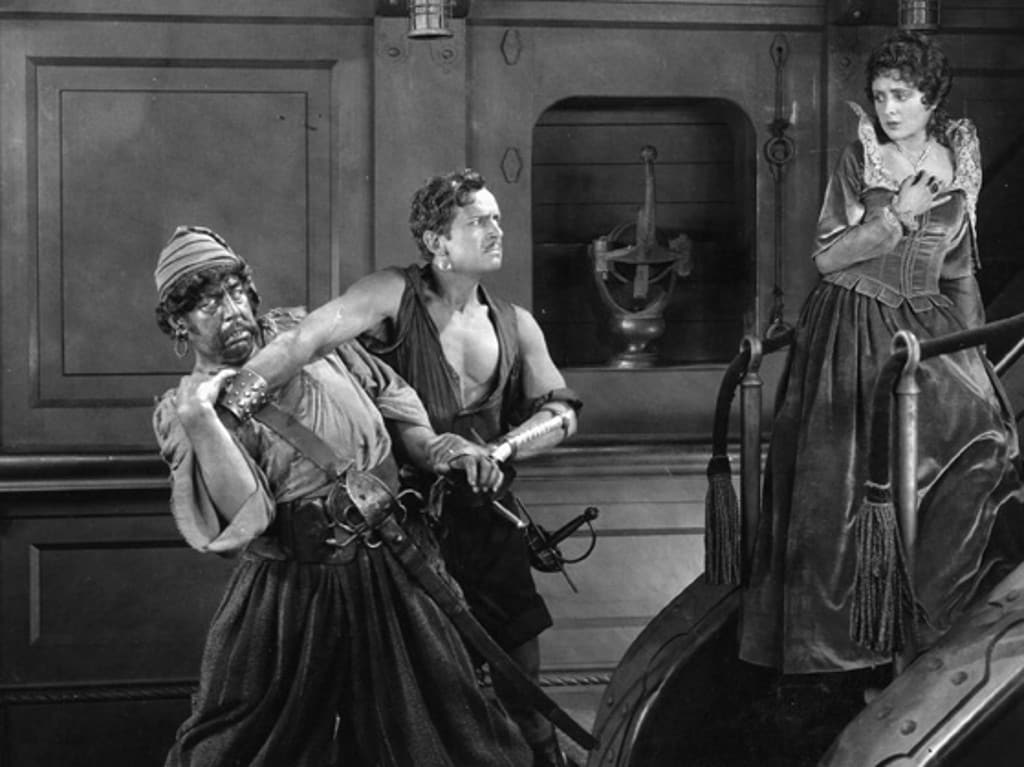
McTavish (left), a shipload o’ scalawags, and The Black Piraten (right)

The story is credited to Fairbanks, who used a pseudonym and essentially cobbled a Cliff Notes version of Howard Pyle’s The Book of Pirates and their archetypal illustrations. The plot moves along surprisingly speedily for a film from the 1920s, and the film’s 94 minutes go by very easily thanks to minimal plot breaks between action scenes.

The film opens immediately to one of those action scenes, where pirates have already taken over a ship and are plundering it before setting fire to the gunpowder in a manner that gives them time to get away before the ship blows up. Two survivors wash ashore on a deserted island, a father and son. As the father dies, the son (Fairbanks) vows revenge on the pirates.

When the pirates park their own ship on the opposite side of the island, Fairbanks appears as the boastful “Black Pirate” and demands to join their crew, setting himself two challenges that he completes that impresses everyone but the second-in-command Pirate Lieutenant, which sets up the conflict.

The soon-to-be-dead Pirate Captain and his first mate, the Pirate Lieutenant.
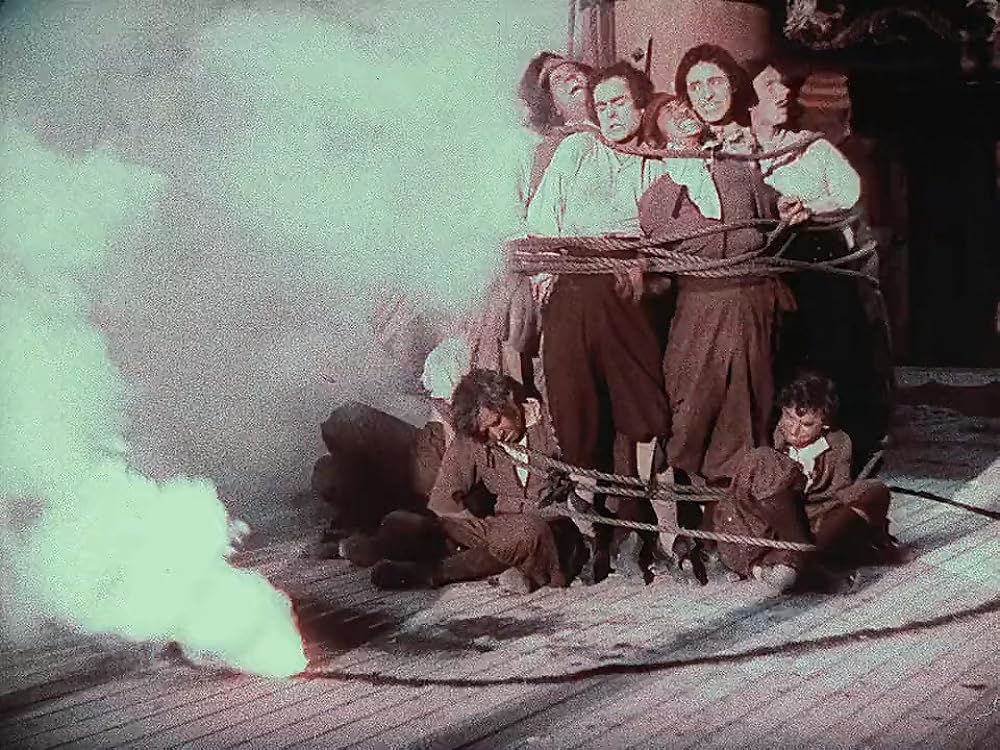
The pirates tie up the crew and use a gunpowder trail to give them time to get off the ship before it blows up — ingenious and cruel all at once.

When the Black Pirate leads the ship to another successful raid (but cleverly prevents them from blowing up the ship), the crew are pretty much ready to make him Captain but for the Lieutenant. When a woman (Billie Dove) is discovered on board the raided ship, the Lieutenant claims her as his prize, but the Black Pirate — who has fallen in love with her on first sight — claims she is a princess they can hold for hostage as long as she remains “spotless and unharmed,” i.e. no raping!

After a few twists, Fairbanks saves the day and the dame, of course, with the help of troops who successfully rout the pirates. Luckily for him, the “princess” has fallen for him as well, and it turns out he’s actually a Duke, and she a noblewoman! How incredibly convenient (nobody cares, it’s the action scenes that are important).

One amusing note of trivia: apparently Fairbanks’ wife Mary Pickford insisted on doubling for Dove for the scene were the Black Pirate kisses the Princess. Jealous much, ma’am?

The one criticism I have is that, although the pirates do get busted, the Black Pirate does in fact lead a raid on another ship, allowing the pirates to steal all the passengers’ valuables (but preventing their mass murder) and takes a hostage who really has no choice but to fall in love with him because otherwise she’ll be raped by the Lieutenant and likely the rest of the crew. I must also point out that the TV show “Mythbusters” also tested the “riding down a split sail” trick and declared it implausible — this hasn’t stopped it being used repeatedly in pirate movies since 1926, though.

Yes, the one woman in the film is completely treated as an object and under threat of rape, but Fairbanks’ altruistic love and protection saves the day and of course causes her to fall in love with him.

Add The Black Pirate to your list of enjoyable popcorn action movies. The sort-of colour helps, but this is really a stunt movie that sets the tone for the genre of seafaring adventure, and so even if the plot is a bit lightweight, it remains a great film.

Ha! Ha! I win!