[Cherry Tree, 2019]
Please to see the King

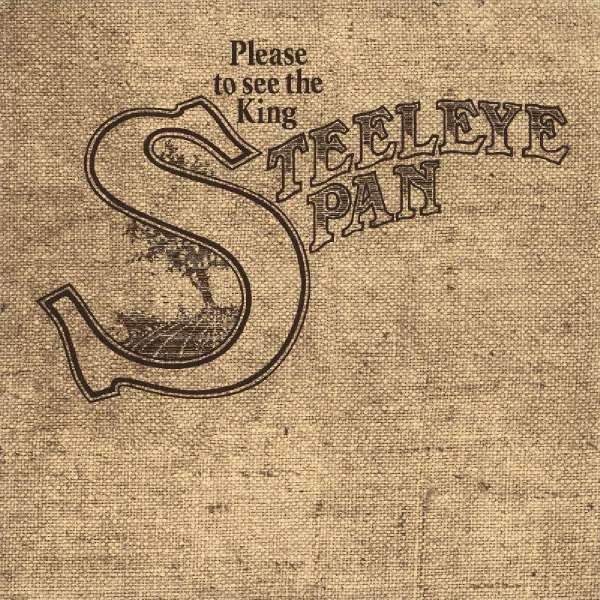
THE OVERVIEW
The second album from Steeleye Span is very much “more of the same,” and yet wildly different at the same time. Having found an audience that embraced their mix of modern, classic, and ancient instruments combined with mostly traditional English folk songs, they stuck to their unique “formula” of “traditional folk songs with some electric guitar and bass” doggedly.
So much so, in fact, that the first track on Please to see the King is a re-recorded version of “The Blacksmith” from their previous album! It’s hard to guess at the reasons why, but the new arrangement sets a tone of syncopation and other percussion in place of drums, and involves the reformulated band to a bigger degree vocally.
To the casual listener, this sounds very much like the previous album, with familiar vocalists Maddy Prior and Tim Hart and a similar musical mix of acoustic and electric instruments. The Woods, Gay and Terry, left the band before the group had even played its first live gig, and Gay’s presence in particular is missed.
However, this new lineup (adding friend of the band Martin Carthy, who had originally suggested the band’s name, and fiddler Peter Knight to replace the Woods) is widely considered the “definitive” early Steeleye lineup, with the first album personnel considered an excellent but “false start,” since the band would move into a heavier space with more male voices, percussion but no drums, and more group singing.
The cumulative effect is that this is something of a different band doing things a bit differently, but the additional backing harmonies and similar material helps cushion the changes. It helps that this same lineup stuck around long enough to record the follow-up album, Ten Man Mop, and even tour!
This album did pretty well, reaching #45 on the UK album charts, but died a death in the US on initial release. A later re-release of the album following the band signing to Chrysalis Records the following year sold far better in the US.
THE ALBUM
The title of the album refers to a tradition carried out on St. Stephen’s Day (December 26th), the “Cutty Wren” ceremony. A caged wren is paraded around in towns and villages as if it were the king.
This is directly referred to in the album by the penultimate song on the album, “The King.” The lads who would parade the Cutty Wren were referred to as “wren boys.”
“The King” is often sung around Christmastime, and the band sings it a cappella, which will remind listeners of the “Calling-On Song” from the first album and is every bit as charming as that one.
This album starts with notes from electric guitar and bass that begins with the new version of “The Blacksmith,” with another lovely lead vocal from Prior. The middle eight is an a capella la-la chorus from the whole band, an instrumental break, and then Prior returns accompanied by some backing vocals. Organ can be heard in the background, and another instrumental break finally debuts Knight’s fiddle before wrapping up with another a capella section.
“Cold Haily, Windy Night” is, to be blunt, a song about a soldier begging his lover to let him in to the house on the aforementioned night. After some persuading and the possible detection by her mother, the maiden does let him in and they end up making love.
The soldier turns out to be a cad who, having gotten what he wanted, exits stage left — leaving a angry girl and her furious mum. It’s sung by Tim Hart in his stylised “folk song” manner.
Next up: two instrumental jigs combined into one piece. “Bryan O’Lynn” was a character from Irish folk song who was quite the dandy, though none of the lyrics are sung here. “The Hag with the Money” (Cailleach An Airgid) is another traditional song with lyrics, sadly not sung (as the original song is rather amusing).
We get back to lyrics and Maddy on lead with “Princess Charlie Stuart,” a song about good old Bonnie Prince Charlie. It covers the rebellion led by Charlie to restore the House of Stuart to the throne at the Battle of Culloden in 1745. It was ultimately unsuccessful, and Stuart was exiled first to France, then to Spain, the latter of which is mentioned in the song.
It’s a typically beautiful and haunting Scottish ballad, sung from his love’s perspective and hailing both his physical stature as well as the willingness of 700 highlanders to die in battle for him.
“Boys of Bedlam” is a song that dates from 1618, and is one of the earliest folk songs that deals with mental illness and insanity. “Bedlam” is shorthand for St. Mary Bethlehem hospital in London, now known as Bethlem Royal Hospital, which was an insane asylum. The hospital funded itself, in part, by charging townsfolk a penny to come and gawk at the antics of the unsupervised inmates.
The song starts off as a minimalist duet with Maddy and Martin, with just the simplest percussion. This expands slowly with electric bass imitating a bell tolling, then the pace picks up with guitar, mandolin, and organ and the song becomes a bit more … jolly? Both the object of the song and the narrator describe visions that are fairly described as bonkers.
The song shifts again into its last verse with somber, wailing backing vocals, with the faster pace now seeming more … sinister. A touch of banjo rounds out the finale.
“False Knight on the Road” is another traditional, which might be considered the “original version” of the more well-known song, “The Devil Went Down to Georgia.” Both songs document a confrontation between a mortal and the Devil (the false knight), but in this case its a brave boy who stands his ground during the quizzing and riddles from Satan. Ultimately, the Devil gives up and concedes the contest.
This moves us back to Maddy singing, with “The Lark in the Morning,” which always reminds me of the “argument” about whether it is night or day that Romeo & Juliet have in their bed in the wee hours. The fiddle on this track enhances the sweetness of the melody.
“Female Drummer” also features Prior, singing about a young lass who disguises herself and becomes a drummer soldier in disguise. She maintains the ruse until another girl falls in love with her and “finds” that her soldier boy is a girl, reports the drummer to her superior, who “unbuttoned my red tunic and he found that it was true/‘It’s a shame,’ he says, ‘to lose a pretty drummer boy like you.”
We finally arrive to the finale of the album, consisting of the outstanding a capella song “The King,” and the climax of the entire album, “Lovely on the Water.” The blending of the band’s voices on “The King” is just fabulous.
Finally, the song that truly embodies the best of this incarnation of the band, a serpentine guitar line with rock-solid bass, and Prior’s story-song rendition of “Lovely on the Water.” It is yet another naval-wartime ballad, tells the tale of a couple where the man must leave, and their sad parting dialog.
The middle eight takes a forewarning turn, cleverly using the instruments to recreate the troubles and perils ahead, before he may someday return. Unlike most other songs of this nature, the lyrics do not foretell or reveal a tragic ending, leaving their fate open-ended.
THE BOTTOM LINE
If you’re in for a penny with this band, then you’re in for a pound. While putting more emphasis on the electric side of their musical equation, these remain traditional English folk tunes in both style and subject matter, and are lovingly resurrected for a new generation and a wider audience here.
If you enjoyed the first album, you’ll almost certainly like this one as well, despite the shift towards more male voices; Martin and Tim shoulder most of that burden, and are distinct enough in their styles to add flavour to the stew, and clever overdubbing of Maddy doing background vocals to accompany her leads makes Gay Woods’ departure a little easier to overlook. Martin and fiddler Peter Knight add new sounds to the repertoire, nicely making up for Terry Woods’ departure as well.
The selection of material is also very strong, with one new version of an old favourite to start things off and ending on a tremendously strong wartime ballad, with a variety of tunes and subjects interspersed as they were on the previous album, with only the instrument jig break seeming a little out of step. Now that the Mk II Steeleye has gotten off the ground, we’ll see if they can keep it going for another record before the lineup evolves yet again.
Next time … Mr Reservoir Butler Rides Again!
 The Chasbah