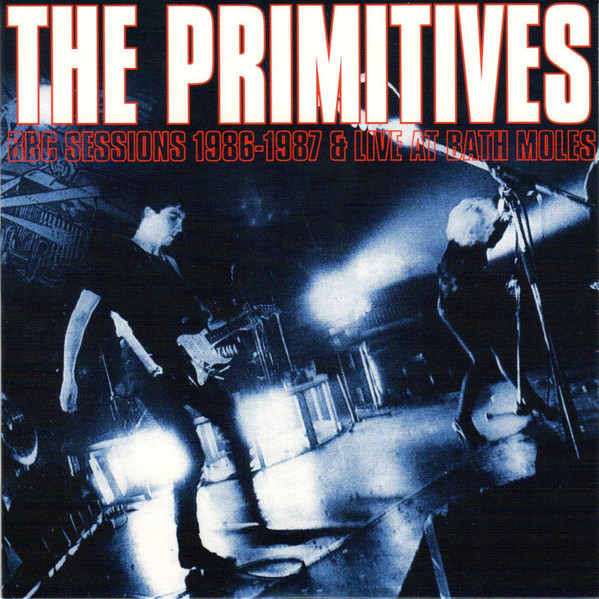
BBC Sessions 1986-1987 and Live at Bath Moles
(Cherry Red, 2020)

THE PROLOGUE
We’ve arrived at the “odds and sods” basement of this five-storey structure, having gone pretty chronologically from their earliest self-made recordings and through the course of their first three official albums. While we’ve had a few “live in the studio” songs, what we haven’t had so far is any live recordings.
Owners of Everything’s Shining Bright, the previous compilation of The Primitives’ early days, had what appears to be a full summer of 1987 concert at the Institute of Contemporary Arts in London. Bloom! doesn’t include that particular concert, but replaces it with a different one, recorded live in Bath, England at the famous Moles nightclub, a club that encouraged home-grown talent and helped a shedload of popular bands get their start, from the 80s incarnation of King Crimson, to The Cure, to Eurythmics and many more contemporary acts.
I myself got to see a show there once — not of The Primitives, but another of my beloved underdog bands, Scotland’s Trashcan Sinatras. I have a taste for great indie rock bands that do great things artistically, but go almost nowhere commercially. It’s my background in high school and college radio to blame.
Moles sadly closed after a 45-year run in 2023. It was a more intimate club, with a capacity of just 220. The Primitives show included here takes up the second half of Disc 5, but before that we get various BBC Radio sessions the band did “live in the studio” across 1986 and 1987.
THE MUSIC
If you’ve made your way through these discs along with this review, or were just a fan of the band, you’ll known most of the songs done live for various BBC Radio hosts well. True to form, the group can perform these songs live nearly as well as with the luxury of a studio, with all the pop genius intact and only secondary guitar lines missing.
The set for Janice Long, in mid-June 1986, kicks off with a grunge-y take on “Really Stupid,” a fast number about a loudmouth lout that Tracy has had more than enough of. This is followed with “Nothing Left,” one of their best numbers but I’ll (still) be damned if I can quite figure out what its about — something about the joys of being unsociable is my best guess.
The band not having studio to work with makes the songs’ lyrics easier to hear (if still not always understand), and the hooks more obvious. You really gain an appreciation of the live configuration for drummer Tig Williams and bassist Paul Sampson, not to mention Tracy’s voice.
“Run Baby Run” is another song about someone leaving someone — this is an act that doesn’t want to get into specifics for some reason. “I’ll Stick With You,” by contrast, is about pairing up with someone because it’s getting dark.
A session for host Andy Kershaw exactly one month after the Janice Long get-together kicks off with “Where the Wind Blows” and its bass line, plus some echo on Tracy’s voice (supported by Paul on the sub-chorus). “Across My Shoulder” is another one of the band’s “breakup” songs, but not as catchy as “Really Stupid.”
I’ve enjoyed “Spacehead” many times, though as with most Primitives songs I’m not studying the lyrics very closely. It makes its second appearance on this box set here — a fast, snappy, almost Ramones-esque number about a strange lad that has caught Tracy’s eye.
What I didn’t mention earlier (and is even more obvious in this live version) is one of the more awkward lyrics in the band’s repertoire, with Tracy having to make “What is that boy on?/He’s a strange per-son” — pronounced as “per-sohn” — work somehow (twice!).
But never mind that, we’ve arrived at “Crash,” which is really, really missing its second guitar line when done live, along with the effective echo effect on the “shut” in “shut your mouth.” Yet another breakup song, but still an insanely good showcase of what the band is all about. This is the song you play for someone to get them into The Primitives.
For this particular performance, Tracy seems to be struggling to get the lyrics out as fast as the band wants to play, and I detect some small adjustments in tempo during the performance to accommodate.
The next session — the last for 1986 — was for the very famous DJ John Peel, well known for introducing new acts to the British public. While I have no doubt that he helped the career of The Primitives, it somehow didn’t turn out to be enough in the end. That said, we are in the early days of the band here, before they’d been signed to RCA.
This session kicks off with a very feedback-y and rockin’ version of “Stop Killing Me,” yet another song about leaving someone, that rocks very well thanks to the excellent band backup vocals and harder rock arrangement.
This is followed with “Shadow,” where Tig shifts to the tabla while Paul’s guitar is recreating the drone effect so prominent in traditional Indian music alongside Steve’s bass, fusing raga and pop very effectively with a mystical lyric.
Paul takes lead on “Buzz Buzz Buzz” as he usually does. The live version can’t take advantage of the overdubs and suffers some emphasis on the chorus because of it, but its still a wild 60’s-style number one might have imagined a young Elvis performing in one of his movies about falling head-over-heels for someone upon first meeting.
The last song for this session was a surprise — The Primitives do a Rolling Stones song, “As Tears Go By,” and despite Tracy’s gentle vocal, this version turns out to be far more danceable than the Stones’ original ballad ever imagined it could be.
We then jump to April of ‘87, and the band have been invited back onto Peel’s show for another live round. Happily, they didn’t do any of the same songs as they’d done in the previous session.
The set starts with “Dreamwalk Baby,” which follows the studio version pretty closely, and just as they sing in the chorus, the lyrics “make no sense at all” to me, at least. Something about crawling in there though.
Next up is “Ocean Blue,” and it seems that the band has invested in some fancier effects equipment since their last appearance, allowing for more echo on the drums and light vocal effects for Tracy. It remains a lovely song about (I think) a budding romance.
“Everything’s Shining Bright” is another song about a new love, and we get a chance to really appreciate the lyrics, where Tracy requests that at the end of the evening “why don’t you turn out the light/so everything is shining bright.” It’s good to know she’s not breaking up with someone for a change.
This is followed by a rarely-heard song for the band, “She Don’t Need You,” which we last heard on the “Thru the Flowers” EP and which never actually made it onto any of the albums covered here. After those two previous romantic songs, we’re back to a song about a breakup, this time told in second-person for a change.
And with that, we move seamlessly on to the gig at Moles nightclub in Bath, and the reason why this particular show was picked becomes obvious — it repeats only one song from the selections heard in the radio sessions it shares this disc with.


The sound quality and mixing on this gig is excellent, and the band is using a Farisa synth to give the songs an even more 60s vibe. This version of “All the Way Down” is a faster, poppier, and much more danceable version than the one Paul sang on Pure, and it really rocks this time around. The catchiest song about chronic depression yet written, with a wild organ solo beefed up by a fuzz tone guitar effect.
We move on to another unhappy-theme-turned-groovy-pop song, “Sick of It.” A new instrumental break, a new arrangement, and the aforementioned Farisa effect keep this party charging ahead at full steam. Cynicism was never this much fun!
Tracy introduces “Give This World to You” as a “very new song,” and even with the supplemental 60’s party vibe included in this show, you can tell that the band is stretching their wings a bit. Of course, the song turns up later on the album Galore. “Ooh, I enjoyed that!” Tracy says at the end of the song.
The inclusion of the synth at this gig really adds a great new feel to the band’s performance, and I kind of wish it had been used a bit more in their album versions on some numbers. It’s mostly not present or in the background on “Outside,” and Tracy clears up a mystery in her introduction of “Slip Away,” which she brightly says is about masturbation. Again, there’s a awkward rhyme in “I’m gonna drive my soul into the setting sun/I’ve got to get away from all this tedi-um.” It’s kind of adorable.
If nothing else, this box set gives us a variety of arrangments for the song “You Are The Way,” and I am here for all of them. The live version again benefits from the low-key but present organ addition. Tracy has to hit some very high notes at the top of her range a couple of times on this one, and she nonetheless nails it.
Next up is “Earth Thing,” which had a Farisa in it in the first place, so thank heavens it’s here. I’m tempted to say this is my favourite Paul-led song, and with the adrenaline-fueled slightly faster tempo here, along with the furious playing by the band, make this a guaranteed party smash, and that’s before the “jam break” that finishes the song out, featuring the bass first, and mad organ solo second. This is the best version of this song, ever.
“See Thru The Dark” is another upbeat song about kind of a downbeat subject, using metaphors for depression to encourage its subject to “see through” the present and look ahead to brighter days.
Introduced as “quite an old one,” the band quickly launches into “Stop Killing Me,” and Tracy has no trouble spitting out the lyrics to this great song. The organ is dispensed with for this number, to try and stick to the original arrangement as much as possible, and it rocks along merrily as a result. Those “bop-bop-be-dop” backing vocals just make this song extra catchy.
The concert comes to an end with the old reliable, “Way Behind Me.” Throughout this show, Paul has mirrored Tracy’s vocal in spots to recreate a “vocal doubling” effect, and at this point he’s very good at it. Listening to this, I much regret never having caught the band in concert, but I have to wonder if the mix from the soundboard we’re getting here is clearer than what the audience experienced.
At the end of the number, the band says goodnight (so we’re not getting the encores). The gaps between songs leads me to believe we’re only getting edited highlights of a longer show — this was only about 30 minutes of music, not counting the BBC sessions, but if it’s at all representative of what they actually sounded like live, then it’s to my shame that I didn’t get a chance to experience them in person.
THE POST-MORTEM
Bloom! pretty thoroughly documents the band’s original period of activity across their own Lazy Records label before moving on to RCA for their first three albums. Although they did do well in the charts on occasion, it must have been very frustrating for a young band to work that hard and not get more recognition.
Right alongside a handful of other bands, The Primitives should have been staples of the summer tour season. Their songs are airy, poppy, and almost relentlessly upbeat, while their lyrics are allegorical enough for fans to give them their own interpretation.
Perhaps their retro-influenced sound just wasn’t in fashion yet, or their lack of “anthemic” songs like what (for example) U2 was cleaning up with was the problem. The record company appears to have given them a fair amount of support, and they got plenty of good press (especially for a band from the midlands!).
The first album made it to #6 in the charts, and “Crash” did one better in the singles ranking. By the time the second album came out a year later, however, the scene had changed — acid house music and heavier bands like My Bloody Valentine had captured the spotlight.
The Primitives still had a loyal fan following, but Pure — which indulged Court’s more psychedelic stylings — didn’t do as well with its singles, though the album itself did reasonably well. By the time 1990 rolled around and the “Madchester” movement had blossomed, The Primitives were being seen as a “throwback” band for their devotion to 1960s and 70s-style grooves.
Now with the band stretching out and exploring their psychedelic side more fully, Galore should have been perceived as a “triumphant comeback” album, but the label delayed its release by a full year, and by then the Blur-Oasis “war” was in full swing, so The Primitives just got ignored, and then dropped from their label.
The booklet included in Bloom! mentions that shortly after being dropped, the band self-released a cover of “Some Velvet Morning” under the pseudonym Starpower — and lo and behold, it got underground buzz and sold well (though it didn’t chart). RCA ironically offered this “new” band recording session money, not knowing it was the act the company had just dropped.
As a result of this, The Primitives decided not to continue. Thankfully, they reversed that decision in 2009, judging the time to be right for a reformation.
The band periodically put out new EPs and albums until 2017, but have continued to tour and are still an active touring act. They tend to play various festivals in summer, and will be touring with Hugh Cornwall and The House of Love during the winter of 2024.
Next time: Mega-Metamatic!
 The Chasbah