⭐️⭐️⭐️⭐️ Disney/Pixar Studios Director: Pete Docter
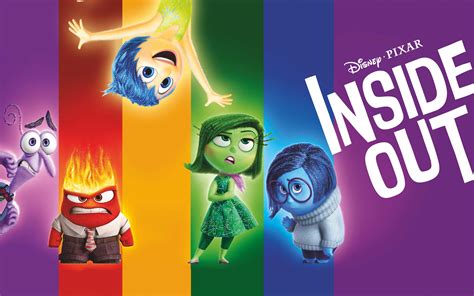
A short review: this is a pretty brilliant film, focusing on Riley, an 11-year-old girl, and her emotional state. It’s also the story of Joy, one of those emotions living in her head, coming to an understanding of the role Sadness should play in Riley’s present life and memories.
The other emotions are good, but kind of backgrounded — except for Anger, played brilliantly by Lewis Black. The parents are fairly minor characters as well, which I felt was a flaw at first, but they’re very much meant to be minor characters — the focus is on Riley. There are occasional representations of what’s going on in Mom’s and Dad’s brains, and those are also amusing.
The film won a (very large) bucketful of awards for Best Animated Feature that year, though only one Oscar — for Best Animated Feature. The American Film Institute and the National Board of Review, however, both picked it as one of the Top 10 films of 2018. It has since become another Pixar family classic, and is really well-suited to show boys and girls at around Riley’s age, or kids of almost any age who are going through the trauma of moving and leaving their previous friends behind.
Riley is, for the most part, a well-adjusted and well-rounded kid with a happy childhood and loving parents. We should all be so lucky, eh?
There is one serious flaw in the story that bothers me: when Sadness touches a memory, she changes it into a sad one from its previous state — she gets scolded for this several times in the film. Oddly, when (let’s say) Anger touches one of the memories, it doesn’t change — nor does it when Joy or any other of the emotion characters touch it. It’s not reeeeaalllly a plot hole as much as it is foreshadowing, but there was probably a better way to handle that.
That said, the most genuine sad moment in the film is a stunningly perfect heartbreaker: Bing Bong, and that’s all I’m going to say about that.
In short, it remains of Pixar’s best original movies. Even better ones have since been made from that studio, but Inside Out is still truly great, still relevant – and really does tug at the heartstrings, elicit emotional responses. For the non-kids this was also aimed at, the film gently gives us parenting advice while also making us recall our own pre-teen years.
The grey tones, minimal lighting, and troubled dinner conversation reflect Riley’s more sombre emotional state as she wrestles with the adjustment to a new town, no friends, and her emotional struggles.
I’d recommend you reacquaint yourself with this film before seeing the new sequel, Inside Out 2. I’m glad they waited nine years to do the sequel.
So if Disc 1 was the Showpeople album and a handful of bonus tracks, and Disc 2 was a lot of the pre-album demos and some live tracks recorded before and around the first album, what could Disc 3 possibly hold for us?
The answer is: the best of the rest. In particular, these 2022 remixes (and in one case, a 2021 remix), remastered from the original tapes by Tot Taylor himself are just the bee’s knees. You think you’ve heard “Baby It’s True” and “Beat the Beat” enough times already, but you my friend are wrong.
Sadly, there aren’t any YouTube versions of any of the 2022 remixes, so instead the videos we include will be some rare items and later appearances (so don’t be alarmed by the change in hairstyle!)
Our first choice was a stop of the 2016 Heaven 17 UK tour (which we got to see two dates of, but sadly not this one in Bury St. Edmonds), where Mari performed two songs you along side Martyn Ware and the band. So enjoy.
So the first half of Disc 3 is just these fabulous new remixes , with the second half being the “odds-n-sods” collection — a US remix here, an alternate take there, a Spanish version found in the rumpus room, and a 7-inch edit balanced precariously on the liquor cabinet.
There’s even an instrumental version in here somewhere. Let’s dive in, shall we?
THE MUSIC
The disc kicks off with sonically wider, cleaner, and “glow-up” 2022 remix versions of Showpeople tracks “Baby It’s True,” “Beat the Beat,” and “Ecstasy.”
There’s also new remixes of “Glamourpuss” (two remixes, in fact, in different years!) “Rave,” “She’s Had Enough of You,” “You Look So Good,” and the US remix of “Just What I Always Wanted.” There’s also the original UK version of “Ecstasy,” just thrown in for good measure.
For the 2022 remixes of the album tracks, the new version beats the original every time — with one exception. The 2022 version of “Ecstasy,” replaces the 80s drums of the album version with traditional ones, but quickens the pace considerably — it might actually be a little too fast. The UK original version elsewhere on this disc keeps that same manic speed, so I have to bow to the wisdom of the US record company that made them re-do the song at a sensible tempo.
The 2022 remix of “Rave” is really a cleaned-up and slightly re-edited version of the “live in the studio” version heard on Disc 2. Oddly, the Wilsations are not co-credited on the Disc 3 version, though of course they are still there.
Likewise, the 2022 remix of “She’s Had Enough of You” is a notable improvement on the original we heard on Disc 2. It seems like it is pitch-shifted a little from the other version, which only benefits the song.
This brings us to the 2021 remix of “Glamourpuss,” here given the subtitle “(Scenario).” The piano intro is completely different, and jazzier, just for starters, and then the sax comes in. Sadly, this version keeps the corny b-side “band introduces the singer” gimmick, and then the original piano comes in and the song gets underway.
Give me the 2022 remix version on this one any day.
The “U.S. Remix” version of “Just What I Always Wanted” starts off with the whispered “Let’s Go,” then proceeds to drag out the intro of the song and ruin the energy of the original until Mari finally shows up and gets the number going properly after the first minute. Of the three versions found on this box set, the original album cut is the best, in my opinion.
Note to Tot Taylor and/or Tony Mansfield: when you have someone say in a song “let’s go,” there needs to be a burst of energy that follows that. I’m not quite sure how you missed that, but them’s the rules.
So now we move into the second half of Disc 3, which offers no remixes but more alternate versions. We start with a song only heard on Disc 1, “One Day is a Lifetime.”
This time, The Wilsations are credited, even though we don’t hear a peep out of them vocally. It’s listed as an “Alternate Version,” and apart from correcting an editing error at the very beginning of the original Showpeople track, the main change is the band’s presence is felt throughout the track rather than only sporadically.
“Tu No Me Llores” is “Cry Me a River” in Spanish, and a classic is a classic in any language. The middle-eight reverts back to English, but the verses have been rewritten slightly to rhyming purposes. After the instrumental break, we come back to Spanish.
This is followed by an instrumental version of “Would You Dance With a Stranger.” A solo sax starts us off for a few bars, then the piano softly comes in behind the sax.
Finally the upright bass arrives, and the disc officially earns its Apple Music and Spotify classification of “Jazz” with no qualifiers. It’s a beauty in either version, but as lovely as it is the lack of Mari is keenly felt.
The 7-inch DJ Edit of “Wonderful (To Be With)” is shorter than the lead-off track on Disc 1, but otherwise unchanged. Again, The Wilsations get credit on this version, where they didn’t on the Showpeople album track.
The last two tracks on Disc 3 should be classified as “curiosities” or perhaps “experiments.” It’s two versions of the song “Let’s Make This Last,” first heard on Disc 2 as the “De Lorean Style Mix,” with squiggly sonic effects at the intro.
The first version on Disc 3 is referred to as “Let’s Make This Last (A Bit Longer),” a clever name for an extended mix, but also has the subtitle “Stereo Shift Mix Loop One” that really makes hay with the synth remix effects.
It takes nearly two minutes for Mari to finally appear and the song to get going properly. I can see where a club DJ would make great use of this, but its an awfully odd duck on an album of faux-60s poppy love songs.
The second version opens with crowd noise (not from a live gig), and is another busy remix, but with no time wasted on extended synth loops (though that’s not to say there aren’t some, just that they get moved to the middle). Like the first mix, this wouldn’t work outside of a club, but at least its much shorter.
On the other hand, the actual song is chopped to ribbons, with the verses removed entirely and replaced with random cheering-crowd snippets. Just my opinion, but this is a pretty awful way to end the disc.
I think if these needed two mixes needed to be included at all, they should have come earlier — maybe right after the 2022 remixes. Move the beautiful “Tu No Me Llores” and “Would You Dance With a Stranger” instrumental to the end, and you’d finish the experience of this box set on a high note.
It can be said (fairly) that an entire second disc of material very similar to what appeared on the first album proper might end up overstaying its welcome — unless you really enjoy full-band-and-singers 60s style love songs as a genre. In hindsight, this set should have started with this second disc — another great batch of similar material that was mostly made prior to the production of Showpeople, and thus serves better as a primer on what Tot and Mari were going for.
If you heard the material here first and then heard the resulting album, it would make for a more interesting contrast between their initial approach — sure-fire crowd-pleaser songs for concerts, for the most part — and what Showpeople ended up being, which is more of a showcase of all types of genre song styles for Mari.
These are singles (A and B sides), along with some rarities and leftovers. The big mystery with this material is “why didn’t the leftovers here constitute a second album?” These are very solid numbers that stand perfectly aside the songs that made the cut. How on earth she could ever afford such a large band (as this style of music requires) before getting a record deal is an even bigger mystery!
THE MUSIC
The first three tracks are all that kind of bombastic high-energy full-band affair that I enjoy, and all three — “Love Man,” “If That’s What You Want,” and “Dance Card” — could have easily been on the album if there had been room for more of that.
We finally get to something more focused on Mari along with track 4, “She’s Had Enough of You.” Another great track and breakup song, with a nice variation of style from the previous three “rave up” tracks. Track 5 is another winner, the original “Beat the Beat” single that is kind of a calling card for her style, again with a focus on Mari’s singing rather than so much of a group effort.
“Glamourpuss” (track 6) opens exactly like a classic noir crime drama score, and surprisingly the band introduce themselves before bringing “on” Mari. This time, her “real voice” offers both spoken and sung lyrics, and the band sing on the chorus. It’s a delightful “show” number and I can only imagine it was a big hit at the live gigs.
Finally, the original version “Baby It’s True” shows up as Track 7, and as expected it’s a tighter, introduction-less, straight-to-the-point version of the song first heard on Disc 1, without two full minutes of pointless DJ blather. The drums are still oddly leaden, but getting into the song itself is much quicker, and improves the tune a great deal. I still think this could have been a stone-cold classic in the hands of someone like Dr. Robert of the Blow Monkeys.
Wurlizer organ (!) shows up prominently on “Woe, Woe, Woe” (track 9). There’s a cute wanna-be boyfriend banter bit at the end. Mari’s later career — where she focused more on jazz as herself rather than the early-60’s person she originally projected — is foreshadowed in “Beware Boyfriend,” (track 10) a successful fusion of the 60s song style with some jazzier arrangements. Singing in her natural register also stregthens her delivery.
“It’s Happening” (track 11) and “Rave” (track 12) both seem a bit like filler tracks. The former is like another high-energy upbeat song played at 16rpm instead of 45. There’s nothing wrong with the track except that its thin material stretched out s-l-o-w-l-y simply for change-of-pace reasons.
“Rave (with The Wilsations, Live Version)” features Mari mostly speaking rather than singing with the band, showing off the interplay that was a highlight of her concerts of the period. You’d often see numbers exactly like this in 60s movie musicals. It’s a nice homage.
The original version of the cover “Ain’t That Peculiar” (track 13) is exactly what you want from this song — a torchy, bouncy number with playful instrumentation, a sparing amount of background vocals, and a great lead from Mari.
I also enjoyed track 14, “The Maximum Damage” — it’s not what you think it’s about, which I like a lot, and has some limited (but nice) call-and-response.
“Let’s Make This Last (De Lorean Style)” (track 15) is a rare number that completely abandons any pretense of faux-60s style — it’s very much of the early 80s. It “breaks the mood” a bit, but as referees and judges sometimes say about exceptions with strong arguments, “I’ll allow it.” 🙂
Track 16, “Would You Dance With a Stranger,” is a fabulous little 1950s jewel of a ballad featuring Mari’s soft and seductive tones. If the title sounds familiar, it’s because it was a hit in 1952 for Peggy Lee, and Mari’s version is a very faithful cover in terms of both music and vocal styling. It was an Italian song originally, with English lyrics by Ray Miller, and used again (sung by Miranda Richardson) in the 1985 film Dance With a Stranger, which is set in the 1950s.
This is followed by another cover, this time of Marvin Gaye’s “What’s Going On” now oddly done in the swinging girl-group style. It mostly works, but it’s a little discombobulating to follow a 50s-style ballad with a political early-70s anthem. Who did the track sequencing here, a wheel of fortune?
We finally set the TARDIS back to the proper 60s period with track 18, “Stop and Start,” very much something I could hear Diana Ross and the Supremes singing. A lot of this album would convince people the material was all written in the emulated time period, rather than (mostly) by Tot in the 80s.
And speaking of the 60s, track 20 is a cover of The Beatles’ “I’m Happy Just to Dance With You,” originally appearing on 1964’s A Hard Day’s Night soundtrack album. In this case, it’s done as a guitar-and-voice-only ballad, which is a nice take on the idea. Mari makes mention in the liner notes that this was the first time she had recorded without Tot Taylor and her usual coterie, and gave her the vision to go further in her musical career.
The final (21st) track on Disc 2 is called “Let Me Dream,” and is only the second track on the disc credited to “Mari Wilson featuring The Wilsations,” the first of course being the “Live Version” of “Rave” (track 12). It certainly has a “live in the studio” feel, but I can only guess that the reason for the different credits on these two tracks compared to most of the tracks here was because the latter were recorded with session musicians until they got the band together.
Approximately 20 years after the musical and social period that inspired her as a pre-teen, recording artist Mari Wilson hit the UK scene with a pair of 60s-style singles, a beehive hairdo, and a talented backing band. She had actually dipped her perfectly-manicured toe into the water first in 1980 with a pair of non-charting singles (with the Imaginations).
Undeterred, she took another, more successful stab at it with another pair of singles in 1982 that did get into the charts: “Beat the Beat,” which peaked at #59, and “Baby It’s True,” which did better but stalled at #42. The backing band was now called the Wilsations, and the pieces were moving into place.
For those early singles, every song was a mission statement; a declaration of love for a bygone style that had broken a lot of women into the charts back in the day, and established women in rock and pop as a force to be reckoned with – most prominently in the early 1960s and the rise of the girl groups. Like those groups, there’s a svengali behind Mari Wilson — songwriter and producer Tot Taylor.
The backstory on her career, told by Wilson herself in the liner notes, is a good one — starring a struggling artist/backup singer with a vision (and a day job in an office in Perivale). She gets called in to sing lead on a “Motown” type song from a group of three guys, and ends up being so brilliant that Taylor (then going by the name “Teddy Johns”) flips the script and makes them the band and her the star.
Taylor quickly secured a singles deal on the strength of her vocal and the song, and they then re-record “If That’s What You Want” in a real studio. It was a while before the whole act came together (and a few friends like Kirsty McColl and Julia Fordham lending a hand), but eventually they had a commitment from a record company, an advocate in A&R at GTO Records, and a stack of faux-60s tracks, and shortly after the A&R guy formally joined the fold, an official record deal with London Records.
By 1983, most music lovers were focused on emerging artists in rock that had been part of the “New Wave” scene in final years of the 70s and first years of the 80s, now seasoned acts with an album or three under their belts. Chart-toppers in the UK in ’83 included New Romantic act Spandau Ballet, Australia popsters Men at Work, former faux-punkers The Police, ambitious New Wavers Duran Duran, the accurately-named Culture Club, and reggae devotees UB40.
A “throwback/nostaglia” type act like Mari Wilson should have been as “popular” as Sha Na Na in a market focused on a new generation of radio-friendly mainstream acts, but Kinder’s faith was eventually justified — somehow the young adults of the 80s had a soft spot for those smart and stylish 60s sounds.
Combine that influence with some clever production and a killer riff, and “Just What I Always Wanted” became one of the surprise hits of the year, getting into the Top 10 on the first try. Combined with Mari’s beehive and cinched one-piece day dress, the perfect matching of the look and the sound pushed her into the charts and the public consciousness .
THE MUSIC
With her debut album Showpeople, the first disc in this expanded 3CD set, every song is a mission statement. It’s always fun to revisit a long-forgotten genre and give it new life, and Mari has the pipes, sensibility, and style to do so (alongside svengali songwriter Taylor). Her main vocal style is nightclub-singer in nature, but with more (synth) strings.
The record kicks off with “Wonderful to Be With” — a riff on early-60s girlpop that clearly sets forth the rules of this game. Right from the kickoff, it’s a big love song number with layered vocals, (synth) strings, and a perfect composite of the style, even throwing in a few “space” synth sounds for good measure.
We shift gears pretty hard on the second track, “The End of the Affair” with a bolder vocal style and a big change in mood. This is a “I’m gonna win him back” type song that is often the subject fodder for country music, but here it is a classic “begging her man to break up with his side piece” number, with the requisite “band guys” vocal interjections. Even just two songs in, you can tell that Taylor has a masterful grip on this entire genre.
Yet another style is trotted out for “One Day is a Lifetime,” with busy horn work and a sultrier vocal from Mari expressing how she misses her man (presumbably not the same man as from “The End of the Affair”). Bonus: great guitar work from Keith Airey (who was known as Gary Wilsation for concert purposes)
“Dr. Love” brings the distinctly 80s Linn drums to the fore, slightly breaking the illusion of pure early-60s sentiments, but the band-guys vocal interjections redeem it, not to mention having a lot of energy for a “I’ll prove my love” type song.
Likewise, “Remember Me” rocks harder than a tragic song about finding out your love is cheating on you should. Thankfully, this one is made whole by having the smarts to include the title of the song whispered when mentioned, giving it the needed drama.
“Cry Me a River,” the classic Arthur Hamilton torch song, was another charting hit for Mari, reaching #24. Better still, this was a nice ballad-y change of pace after the last three more energetic numbers. This one goes straight-up stings-n-sax, with very little percussion.
And so we come to “Just What I Always Wanted,” a complete stomper of a rave-up the brings back the 60s go-go energy back in force, using the bass to drive the rhythm (not to mention so strong back-up singers). Mari never opts for a truly straight “girl-group” vibe, more of a Diana Ross-oh-and-yes-The-Supremes-back-there-somewhere approach.
It certainly works here, and is difficult to believe this isn’t a cover of an actual 60s single or a track from a period musical. There’s even room for a nice trumpet solo, and I absolutely love the drop-dead stop ending.
“This Time Tomorrow” starts off with violin and piano, a fresh opening for this record so far. It turns into a dramatic ballad with strings, followed by drums finally. It includes a very quizzical line, where Mari sings “I will stay tonight … tomorrow,” which … even as a Doctor Who fan, I’m not sure how you pull off that bit of time-paradox.
Mari returns to the infrequently-used lower register for “Are You There with Another Girl?” for another “man is cheating on me” song, this time by no less that Burt Bacharach and Hal David. There are some nice synth touches here and there, and a flute solo no less! Mari double-tracks her vocals on this and a number of the other songs, which isn’t really necessary as much as its deployed in my view.
We head back to quite a high register (and a Synclavier piano opener) for “I May Be Wrong,” another “I’m making a mistake but I can’t help myself, I want you back” song that doesn’t quite work, in part because the chorus seems overly busy, which undermines the ballad-y verses.
The bass-lead energetic soul love song groove is back for “Ecstasy (US Version),” which is also one of the few numbers where Mari’s vocal isn’t doubled at all. I find it a very catchy albeit busy number (with a nice spoken middle-eight) that could have been a single.
The original UK and European versions of this album ended with “This is It” (the US version didn’t include this song, and ended with “Cry Me a River”). This is another overly-busy number that sabotages itself like “Dr. Love” did, with various “big/busy” musical phrases and vocal styles forcibly joined together.
Taylor’s just not quite got this “big musical” type number style quite down, plus it repeats itself a lot and thus goes on for a minute or two too long. At least there’s a funny (unintentional) ending with a froggy-sounding synth for a few bleeps at the very end.
“Just What I Always Wanted (Extended)” begins the “bonus tracks” section of this version of the album. not to knock on Tot too much, but this is a recipe for how you take a perfect single and ruin it. First, make the instrumental opener so long (almost two minutes!) that the listener thinks its a karaoke version, but just as one starts to sing it, finally they bring in the vocals on … the chorus!
Second, edit the first verse (badly and obviously) down to just two lines, so it goes right back into the chorus. Thankfully after that, the song gets back on track and flows as it did originally for the rest of the number.
“Cry Me a River (Smooth Remix),” by contrast, is a perfection of the original version of the number. The piano-synth bits stay, the other synth parts go, the sax and Mari’s superb vocal (now clearer than the original as well) really bring the spotlight where it belongs.
You can practically smell the cigarette smoke in the nightclub in your mind, and nice little touches of violin and synth strings are thoughtfully and discreetly blended in. Tot, I didn’t know you had it in ya!
Sadly, this short interlude of sheer ballad perfection wasn’t to last too long. It’s followed by a “Discotheque Arrangement” of “Baby It’s True” (this original to be found on Disc 2). A long warm up break includes a wretched “strip club DJ” type intro which is pretty awful and goes on seemingly forever.
Nearly three minutes later (at least including “naming” the band), Mari finally appears. It’s a pity the song is pretty lightweight, with the first verse spoken. The chorus is fine, the music is okay, but this goes on way too long at seven minutes total.
We finish this disc with an “Extended Version” of “Ain’t That Peculiar,” which again features an overlong extended intro and some oddly discordant guitar (not heard elsewhere on this disc, thank goodness). Once the song actually gets going, it’s … okay … but seems awfully stretched out. Thankfully, the “real version” is on Disc 2, so we’ll reserve judgement.



 The Chasbah