Virgin/EMI Records, 1972/2018
3CD + 1 DVD, book

THE PROLOGUE
Although Roxy Music as we know it began in 1970, it was two further years before the concept became a recording act, providing evidence of what they were up to in the form of their debut album. For this super deluxe box set, founder Bryan Ferry emptied his vaults for material well beyond the original album, including the early demos, album out-takes, radio sessions, and a DVD of mostly short television appearances, capped (on the DVD) by a new 5.1 DTS and Dolby AC3 mix of the album by Steven Wilson.
Billed as a 45-anniversary deluxe box set — even though it actually came out a year late, in 2018 — this weighty box includes three CDs and one DVD, the latter of which contains both visual and audio-only information (more on that later).
Where the weight gets put on is in the incorporated 136-page book documenting the band’s formation by The Guardian journalist and author Richard Williams, who first wrote about the group for the music paper Melody Maker in 1971. It features a plethora of previously rare or unpublished photos from those early days, along with a Ferry-approved essay on the founding and early days of the band. Everything is on a heavy stock glossy paper, surrounded by a glossy, high-grade cover.
We’ll begin our examination with the packaging and book before diving into the music. The set’s presentation, from the outside, suggests that you might be buying a five-disc vinyl box set and/or a coffee-table art book of the sort you find in museums, but thankfully this hefty tome devotes itself as much to sound as to vision. While there’s no vinyl to be found here, there are three CDs, 1 DVD, and the book on to very pleasurably work your way through.
THE BOX AND THE BOOK
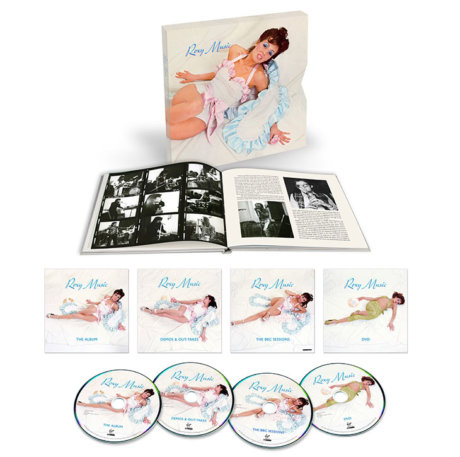
The box is a three-sided slipcase box for the book, and the discs are tucked away in individual sleeves in the back of the book. The box reproduces the cover of the book, which in turn is a recreation the outside cover of the album. On the back of the box is a “removable” — if one is patient and careful — spot-glued paper outsert that shows the band logo, a brief blurb explaining the contents, the covers of the four discs in miniature, and the contents of each one.
This is the only spot on the outside where you will see all the requisite industry logos for the material inside, including the DVD logo, the all-region logo, and a couple of others. Given how radical a departure this album was from the mainstream in 1972, that “exempt from classification” MPAA “E” logo feels very appropriate.
The sound recording and other copyright logos and text are first seen on the stuck-on paper, as well as discreetly placed on the bottom of the slipcase. If one chooses to remove the paper to appreciate the full cover reproduction, the legally-required info is still there — a classy touch.
As packaged, the book spine is showing on the “open” side of the outer box, reproducing the gatefold spine. This of course means that as you pull the book out, you’ll be seeing Kari-Ann Muller’s lower leg and the gold record side of the cover.
If there’s one thing you can count on from a Bryan Ferry-led project, it’s that it should look, feel, and sound like no expense was spared, and that it is an important release. There’s only so much you can do to make a CD or vinyl album into a luxury item — though in the 70s, making it a gatefold album design was one sure way of transmitting that feel to the buyer, and indeed this debut album got the gatefold treatment in its original release.
The inside front and back cover and first and last endsheets showcase film positives of the many alternate takes and poses of Ms. Muller. There’s a title page with just the band’s logo, of course, and then the essay begins on the following page with yet another reproduction of the iconic cover.

Within the first few paragraphs, we learn that the two-tone Roxy Music logo uses a blue and pink that exactly matches the shade of Muller’s eye shadow and lipstick — again a mark of a premium product and that the carefully-constructed image with Muller’s “sultry” gaze was “an explicit taunt to the new rock establishment” that had come to dominate the form in the late 1960s.
Author Richard Williams notes that Elvis Presley had used a similarly bold two-tone logo and provocative photo for his debut album in 1956, and that eight years later, the Rolling Stones used an “unheard of” at the time stark photo with no text other than the Decca logo on the cover — another daring move for a debut album.
Eight years after that, Roxy Music made used the provocative and daring swimsuit-clad Muller, in a “glamour” type shot in a wraparound style, as their attention-grabbing debut cover. Compared to most the album covers of the time, Roxy’s cover was bold and wildly sexy for the time: “a signpost to a future of exotic promise,” as the essay describes it.
The book is a collaborative effort between Ferry, Wilson, Puxley, and a small army of mostly-uncredited photographers, although Ferry himself is among them (his are likely the photos of the other band members in rehearsal rooms). Without delving much into specifics and glossing over any conflicts, it outlines the history of the band, starting with Ferry’s idea for it, with his friend Graham Simpson providing some musical foundation, and the process of recruiting the others — including some, like Roger Bunn and Dexter Lloyd, who didn’t last past the demo tape.
Andy Mackay was an early addition who made the grade, though, and he was the one who the world must thank for bringing in Brian Eno. Eno was initially brought in to play Andy’s synthesizer and mix the sound, meaning he would be at the mixing desk rather than onstage with the band. The group rehearsed at the home of Ferry’s girlfriend Susie Cussins, to whom the first album is dedicated.
Phil Manzerera had been part of that round of auditions, but had been passed over initially, and then called back when Ferry’s first choice — David O’List — eventually didn’t pan out. O’List went on to a fairly illustrious career playing with a bunch of bands, including The Nice, Jet, Jethro Tull, Pink Floyd and others. He has two solo albums out in the 21st century.

By May 1971, “Roxy” was finally deemed ready to cut a demo to shop to record labels. Ironically, the big obstacle with the first round of record companies didn’t turn out to be the band — it was Ferry.
His singing was very out-of-fashion for the rock of the time, with a mannered upper-class style and sort of anguished general tone, as if he is straining to not just say the lines rather than sing them. No hint of blues or soul style could be detected, and he had a rather fey quavering falsetto that was sparingly used.
That first demo tape, which we’ll get to hear on Disc 2, is all pre-Eno, and mostly features the “Mark 1” version of the band, with the early musicians and rougher sketches of the songs they would become, some with different titles.
They had to change the name to “Roxy Music” since there was already a band named “Roxy” in the US. The demo helped solidify the band, specifically helping attract Paul Thompson as the new (and permanent) drummer, replacing Lloyd, and of course eventually adding the mystery ingredient that was Brian Eno and his cutting-edge electronic wizardry.
This lineup, and a dash of glam and glitter and sequins all over the place, got them invited to a lot of events. Eventually, they met the legendary DJ John Peel, who had heard the demo. With the help of John Walters, Peel’s producer, they got a couple of live guest spots on Peel’s popular radio show.
This got them the thing they needed most: some positive press in the mainstream and music papers. From there, everything started to fall into place, and the band we know and love was cemented and offered the chance to make an album.
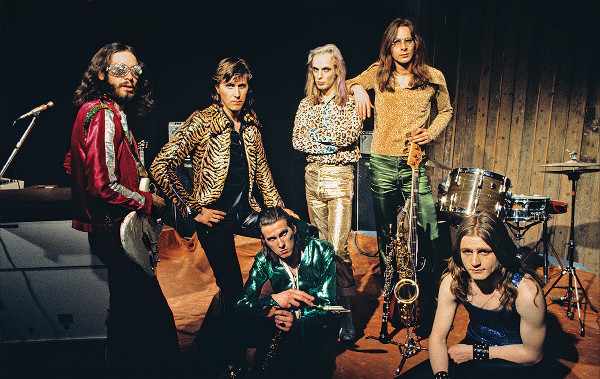
The essay itself is peppered with early images, and after the words we get many pages of more photos from live gigs and in the studio, some candid shots and a handful of formal pics. Even in these, we see also the band’s visual sense: Ferry’s formality, Eno’s glitter bombing, Mackay’s sequins, Manzanera’s bizarre eyewear. Thompson, who occasionally favored leopard-print and caveman-type clothing when he wasn’t shirtless but for a sequined vest, was the least-photographed member in these as he’s always in the back, of course.
This is followed by pages of lyrics (accompanied by more photos), the typewritten original lyric sheets (with a few scratch-throughs and notes), a page of quotes reflecting on the album by Ferry, a few pages of Puxley’s eccentric descriptions of the songs and key lyrical phrases, a few more pages of Keri-Ann photos including one in a completely different outfit).
This goes on to show images of the master-tape boxes, early press releases and bios, many pictures from the Lincoln Festival in May of ’72 (their first festival show), the UK tour of ’72 program book cover and dates (with a few photos), a brief tour diary, an ad for the album, a montage of small venue notices, want ads the band took out looking for a drummer and guitarist (“for avant-rock group”, single covers and posters from various countries, newspaper notices (mostly positive, but a few not quite complimentary), the US tour listing, and — finally — big colour pictures and stills from TV appearances, and the US and UK shows.
The book wraps with a two-page spread of the CD covers and their contents, a page of credits for the book, the CDs and some of the photos, and another page of Keri-Ann outtakes.
Next time: Disc 1 — the “original” album!
 The Chasbah