D-I-Y or Die! Art, Trash, & Neon
Punk 45s in the UK 1977-78
(2022, CD, Soul Jazz Records)
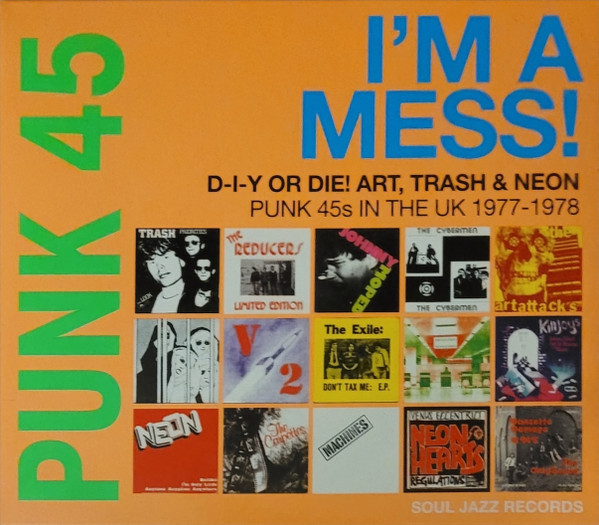
Recently, I have discovered that this compilation is in fact part of a series of punk compilations from Soul Jazz Records that started in 2013 under the “brand” name of “Punk 45,” with each release given a title borrowed from one of the songs on the disc, a subtitle describing the overall style, and a sub-subtitle covering the specific period.
The one we’re reviewing in this case, for example, is the most recent original compilation, though the label reissued the first disc in the Punk 45 series, “Kill the Hippies! Kill Yourself!” on vinyl only in 2024, which I view as symbolic of society’s general regression but is more honestly probably an attempt to lift the comp series out of obscurity.
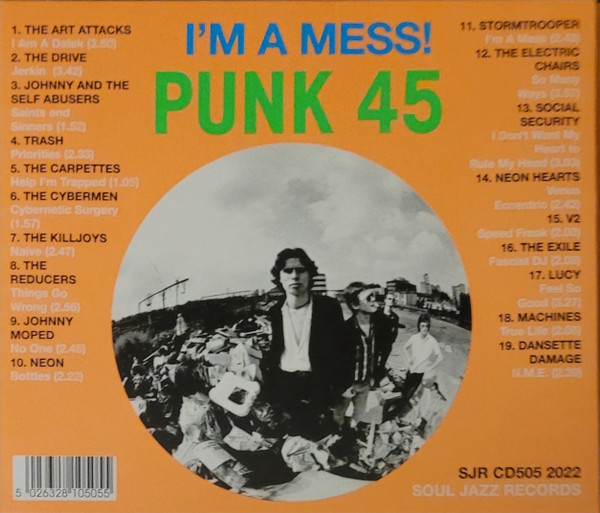
Before we dive in, a brief clarification: the track listing on the back of I’m a Mess! might have been the actual running order at one point in the production process, but it’s not the one we actually get — a truly DIY sort of error, you might say. The correct song order is reflected below.
Overall, this is a compilation of indie punk singles released in the UK in 1977 and 1978, a sampler rather than a comprehensive collection. Now that the background is out of the way, let’s dive in.
The Art Attacks – “I am a Dalek”
Well you know this title is going to grab my attention, given my lifetime love of the TV show “Doctor Who.” And indeed, what’s more punk than a Dalek? Their entire worldview is that everyone but themselves are unworthy and should either be subjugated or killed. It defines punk rock right from the start with three chords, a cloud of dust from furious playing, barely-tuneful singing and multi-tracked Dalek chanting.
The Drive – “Jerkin’”
Rock has a history of songs about masturbation, which is funny because people often join rock bands as much to get hooked up with groupies as they do to make music. This one is far more tuneful than “I am a Dalek” and has a more polished rock sound that betrays their pub rock background.
A lot of bar bands devolved into punk rockers when they observed which way the wind was blowing, and went right back to their usual styles a year or two later, let’s be honest
Jonny & The Self Abusers* – “Saints and Sinners”
Speaking of masturbation, this band is the forerunner of Simple Minds, a band you generally don’t think of when the work “punk” is in the conversation. But by damn, they do a nice job of putting the bass up front on their take on fast punk. The song matter is simple, but well sung and with a bit of harmony thrown in. Nice drop-dead ending also, the first on this album but a common exit for many punk songs.
(*this is how the band’s name is spelled on this compilation; I have seen the name spelled a bit differently elsewhere)
Trash – “Priorities”
Trash have a pretty good vocalist and (gasp!) backing vocals. Like Jonny and the Self Abusers — the bass is the anchor here, alongside the (talented) drummer. Punk is about very simple song structures and simple messages, and this embodies that principle.
The Carpettes – “Help, I’m Trapped”
Speaking of backing vocals, this one is so fast it’s almost punk rapping, with the chorus handled by the rest of the band (with a bit of echo) to give it a distinct sound. A good example of a song that doesn’t outstay the strength of its concept, like a few others here.
Stormtrooper – “I’m a Mess”
The title track of the compilation. The backdrop of chords gives us some under-melodies to add a bit of sophistication (just a bit) to the usual wall of guitar, drum, and vocals. This is an example of punk as being reflective of what was going on in Thatcher’s England.
The Electric Chairs – “So Many Ways”
Wait, what’s this?? GIRLS?? Well I never! And the guitar isn’t the lead instrument, rather a drum machine is? And is that … a sitar? What the blazes is going on? A hint of synth? Robotic “singing”? Did this band time-travel back four years from 1981?
Clearly this is where DIY ethic mentioned in the title comes in. One has to remember that sounding like robots was a fresh take on a punk vocal at the time. I do actually believe I can detect a hint of melody in here as well. Seven singles in, and punk is already evolving! I’m happy to see some female representation at this early stage.
Social Security – “I Don’t Want My Heart to Rule My Head”
Things are just going from bad (as in amateurish) to worse (not very punk, really) with this ahead-of-its-time New Wave-ish anti-love lament. Our narrator really, really wants you to know he’s not interested in a long-term relationship, so his idea here is that this must be anti-rock music, in that he’s not doing this pull groupies — or, apparently, get famous.
Neon Hearts – “Venus Eccentric”
Finally, frenetic sax makes its punk debut. The song consists of the singer complaining about what a bad relationship he’s in, but apparently the sex is great, so I have to give him points for broaching what would become a universal theme in rock music. Bonus points for a fast-paced but distinctive guitar solo.
The Cybermen – “Cybernetic Surgery”
Some punters with ambition and cultural references to Doctor Who (again) provide us what the punks always said they were like emotionally. There is some early vocoder use to make a sort of “cyber” vocal here and there. Musically quite catchy, with a sax break in the middle. As ruthlessly efficient as the monster they are named after.
The Killjoys – “Naive”
Now here’s a real punk song — the singer blaming other people and society in general for his ills. There’s some female vocals supporting the chorus of “I’m bitter” which sadly devolves into various moaning/screaming.
The Reducers – “Things Go Wrong”
More women! And another song about blaming others for the world’s ills, or your specific ills. It doesn’t have the frenetic pace of first-wave punk songs, but it certainly has the attitude and “bad relationships with various entities” subject matter down pat.
Johnny Moped – “No One”
This song takes the opposite approach — its message is that I am no one, and no one is going to make me feel bad. The lead singer brings a distinct northern accent to the party. Punk failed to get away from the “guitar player needs a solo, however short it might be” mentality of rock pretty early on, but this one finishes with a more typical hard-rock ending.
Neon – “Bottles”
Strange sounds in a loop a the beginning, possibly produced by bottles on guitar strings (GET IT?). Vocals pushed back in the mix on the verses, but not on the chorus — hmmm — and they sound like hippies that have been ordered to go punk. It’s not very good, but at least it’s short.
V2 – “Speed Freak”
Air raid sirens enter the chat as a song intro .. at last. A fast rap of verses followed by the simple chorus of (mostly) “Speed freak yeah.” Not the first song here that has been poorly mixed, either.
The Exile – “Fascist DJ”
A complaint rant about a club DJ who wouldn’t take requests. Literally, that’s it.
Lucy – “Feels So Good”
Now here we have a song tailor-made for pogoing, with an urgent beat and a DIY lyric about the DIY ethic. Moves along at a fast clip, which makes the guitar solo more work (and shorter) than it would otherwise be.
Machines – “True Life”
Old-school punk/rap with a lyric about facing up to the fact that the world sucks and it won’t get any better. Nihilist, maybe, but not wrong.
Dansette Damage – “N.M.E.”
Ah, yes, the old “song starts at one tempo in the intro, then picks up a different tempo when the lyrics start” trick. As you might guess, this song is about a fellow obsessed with the New Musical Express newspaper (I guess you could say it was his “enemy” — thank you, thank you, I’ll be here all week). The title eventually becomes all, and the song devolves from there, as is proper and correct for obsession songs.
Is this compilation worth your time? If you have an interest in unsung OG punk rock, then yes — there are some gems here amongst the mediocrity. It hasn’t aged poorly, I will say that for it, but I’ll also say it is mostly pretty clear why these bands didn’t advance within the movement.
One last note: the vinyl version of this compilation featured a bonus single for Record Store Day 2022 that included a b-side which is not part of the CD version. Both the a- and b-side of the single contained songs by the band Stormtrooper. The a-side was the title song in the compilation, “I’m a Mess.” The extra song on the b-side is “It’s Not Me.”







 The Chasbah