Yellow Submarine (1968)

Director: George Dunning

⭐️⭐️⭐️⭐️
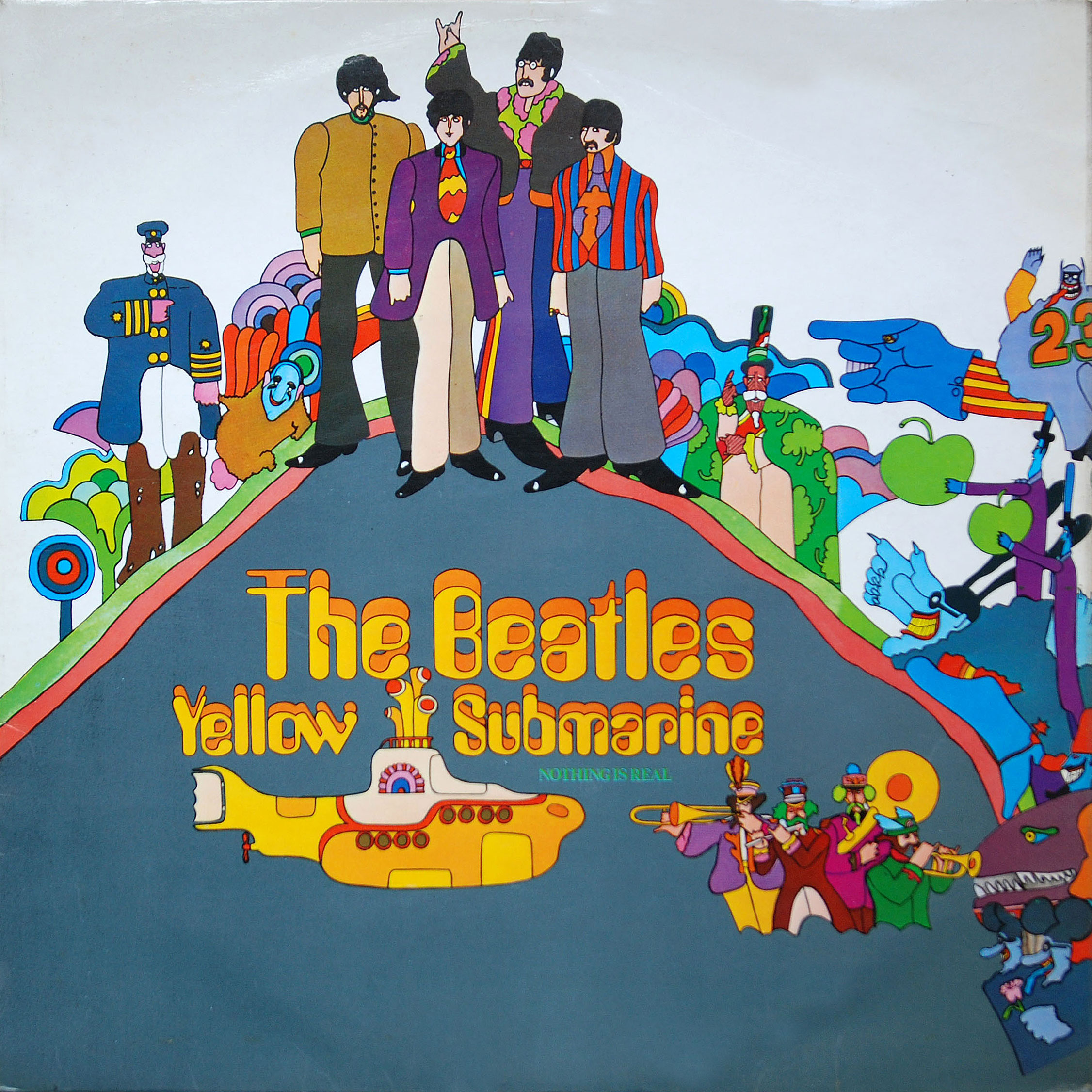
I’ve seen this film quite a number of times in my life, but until now I haven’t written about it because I still think of its as a “kid’s movie,” since I first saw it as a child myself. My affection for it meant I bought the DVD release when that came out in 1999, though I haven’t yet gotten (and should get) the later 4K/Blu-Ray version at some point.

The adult in me is always, always disappointed that the Beatles themselves did not play a bigger role in the film, though they do appear in a short and kind of awkward live-action sequence at the very end — and of course those are their real voices in all the songs. Voice actors portrayed them in all the film’s dialogue for some reason, though the impersonators do a credible enough job making the four Liverpudlians sound (mostly) distinct from each other.

The Lord High Mayor thanks “The Beatles” for their help. I’m not sure why “George” is consistently shown as somewhat darker-skinned than the other Beatles.

John Clive portrayed John Lennon’s speaking voice, and Geoffrey Hughes played Paul McCartney pretty accurately. A completely uncredited Paul Batten did most of George Harrison’s voice.

There’s a reason Batten didn’t complete his role in the film, or get credited for it — midway through it, he was arrested for being a deserter from the British Army!

Special kudos to Paul Angelis for his very spot-on Ringo — he (unlike most of the other voice actors) played multiple roles, including the narrator, and the Chief Blue Meanie, with great variety — and following Batten’s arrest, Angelis took on the rest of the George Harrison dubbing as well.

The Blue Meanies gather their forces to invade Pepperland.

Comedian Dick Emory was the only other actor to voice multiple roles (he did Max, the Lord Mayor, and the principal add-on character of Jeremy Hillary Boob, who acts as a kind of guide through the adventure. As near as I can tell, he’s the only main character entirely original to the film, in the sense of the fact that he’s not inspired by or referenced by any Beatles lyric.

The unique animation of the film is very influenced by Peter Max and the general mod/psychedelic tone of the late 60s, but I was suprised to later learn that Max actually had nothing to do with the film. Looking at the artwork now, it’s an obvious influence of course — but not up to the standards of Max’s print work.
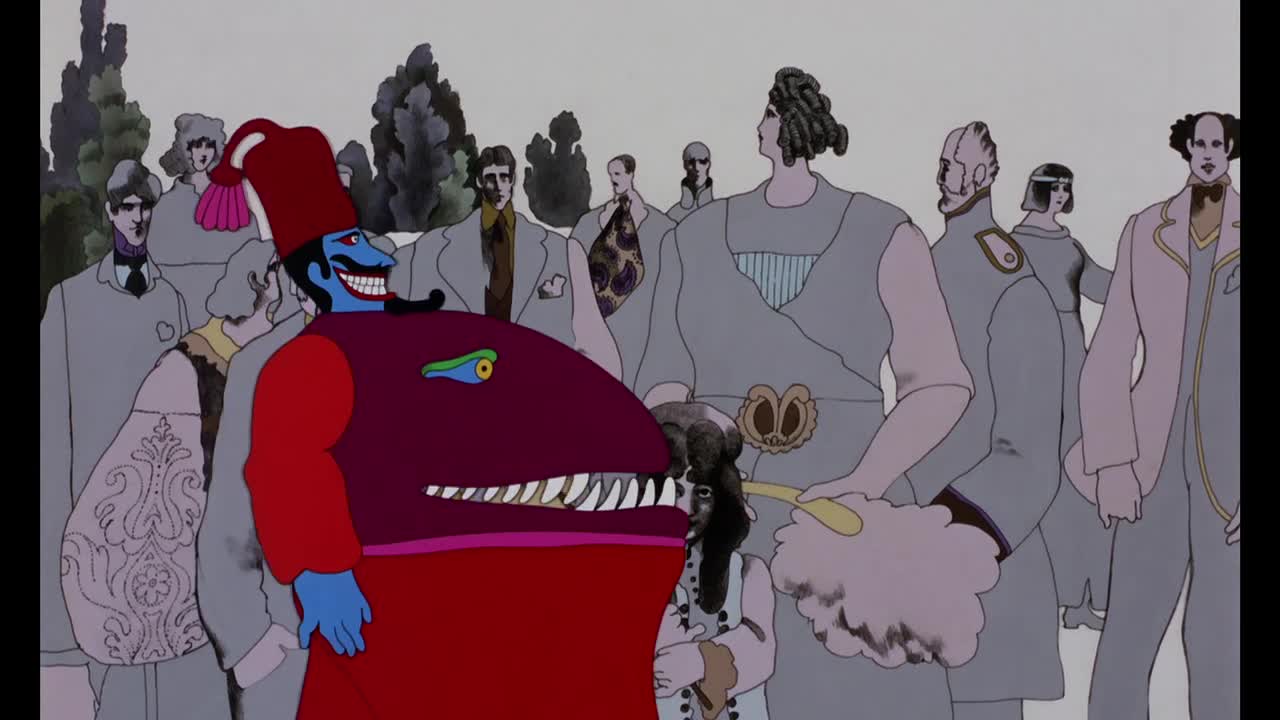
One of the Meanies’ underlings enforces the music ban to suppress any acts of rebellion.

The 1999 DVD release boasts “frame by frame hand restoration” and does indeed look terrific. It also included a 5.1 surround sound remix, as well as the original stereo and mono audio as options. The version I have also offered reproduction film cells, stickers, and an expanded booklet — the latter featuring an introduction by Disney and Pixar’s John Lassiter.

Lassiter points out that the mixed-media animation of Yellow Submarine undoubtedly was influenced by then-recent UK immigrant Terry Gilliam, who brought his style of mixed-media animation to early shows like “Do Not Adjust Your Set” before ending up in “Monty Python’s Flying Circus.” The images in Yellow Submarine subsequently influenced cartoons for US kid’s shows like “Sesame Street” and “The Electric Company,” and even “Schoolhouse Rock.”

Was Gilliam’s work influenced by this, or did Gilliam influence it? Gilliam was already doing this style of image before he was a part of Monty Python, so I think it was the latter.

As for the film itself: what it lacks in plot complexity, it more than makes up for with this visual feast. The rich imagination and style of the original characters in “Pepperland,” from the Lonely Hearts Club Band to the supporting characters of Sgt. Pepper, Old Fred, the Blue Meanies, the Apple Bonkers, and the helpful Jeremy Boob are all interesting enough to keep the film moving along between musical numbers.

Jeremy Hillary Boob, a new friend they meet in the Sea of Holes.

It might have been good to not have so much of the film’s background be completely white, but I guess they opted to put the main artwork front and center — to say nothing of saving money on background animators.

That’s not to say the backgrounds aren’t imaginative, such as the Sea of Holes and the Sea of Science (among others), which do a good job holding viewers’ attention across the thin plot. There’s even time for a classic “hall of doors” comedy bit during one of the numerous musical numbers.

Another of the many “seas” our heroes pass through on their way back to Pepperland.

It is helpful to bear in mind when watching the film that much of this Beatles music would have been brand new or very recently released to the original cinema audience and fans of the band, including “Only a Northern Song,” “Hey Bulldog.” Of course, the foundational musical score outside of the songs came from George Martin, and remains excellent and memorable as his soundtrack work generally is.
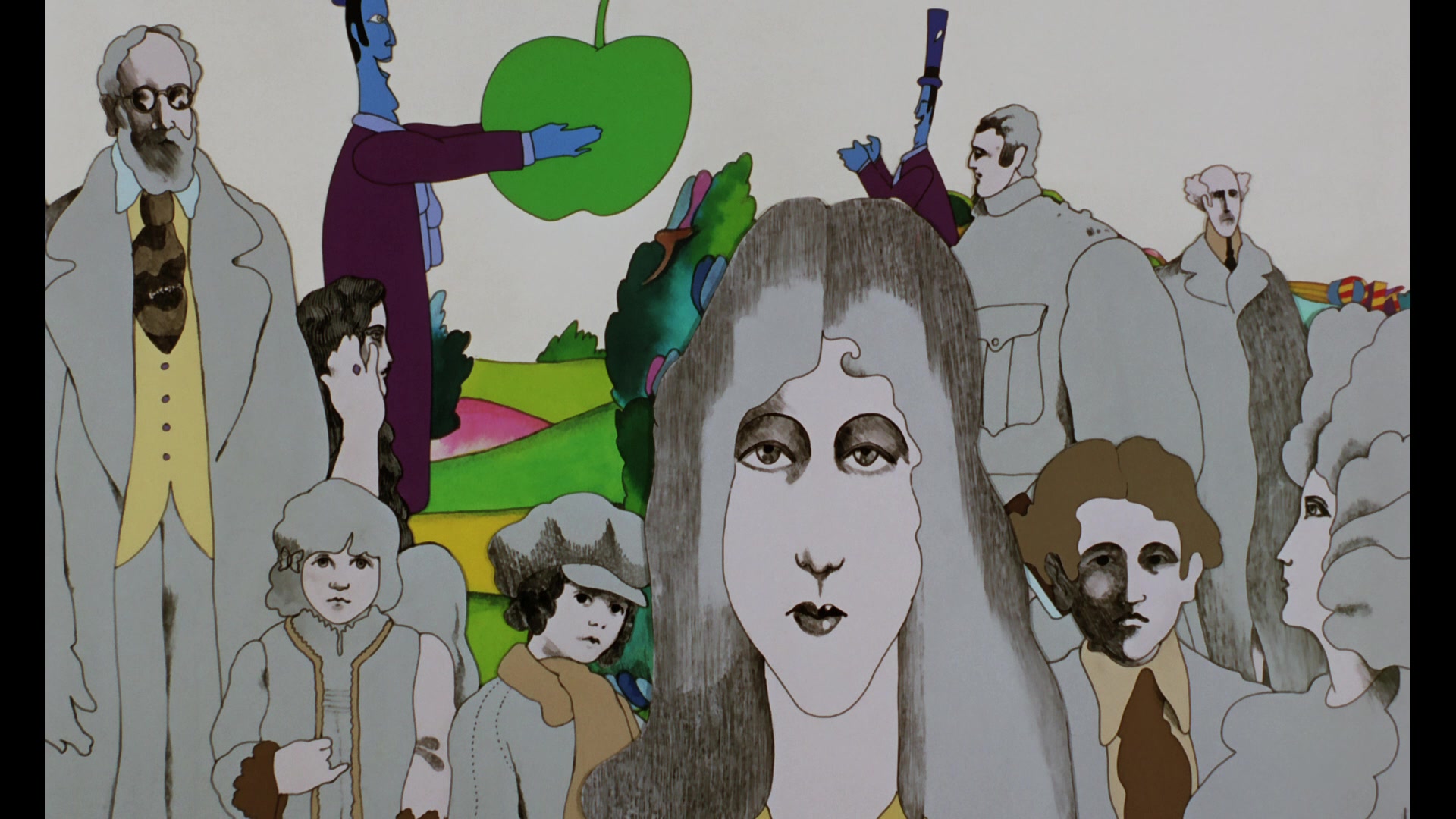
The lifeless, frozen people of Pepperland as the Blue Meanies and the Apple Bonkers invade.

Some of the best animation takes place at the beginning and end of the film: the population of Pepperland being attacked and frozen, drained of all colour — and the restoration of Pepperland at the conclusion. The plot, such as it is, is that the Blue Meanies decide to be evil and come over the hill to steal all the music that brings joy to the people of Pepperland.

They starting by attacking Sgt. Pepper’s Lonely Hearts Club Band, the main source of the music there. The incredibly elderly Lord High Mayor sends his lieutenant, Old Fred, to get help.

Sgt. Pepper (right) and Old Fred (left) climb the stairs to get to the Yellow Submarine.

Fred manages to outrun the Meanies, commandeering the handy artifact of the Yellow Submarine, and travels through strange lands before coming across the Beatles, whom he persuades to help him.

They cross those and other “lands” in trying to return to Pepperland, with occasional stops to explore. Once back in Pepperland, our heroes evade the Meanies and Bonkers before the Beatles can finally take the place of the original Sgt. Pepper’s band, using their own music to unfreeze Pepperland and defeat its enemies and restore the original Lonely Hearts Club band.
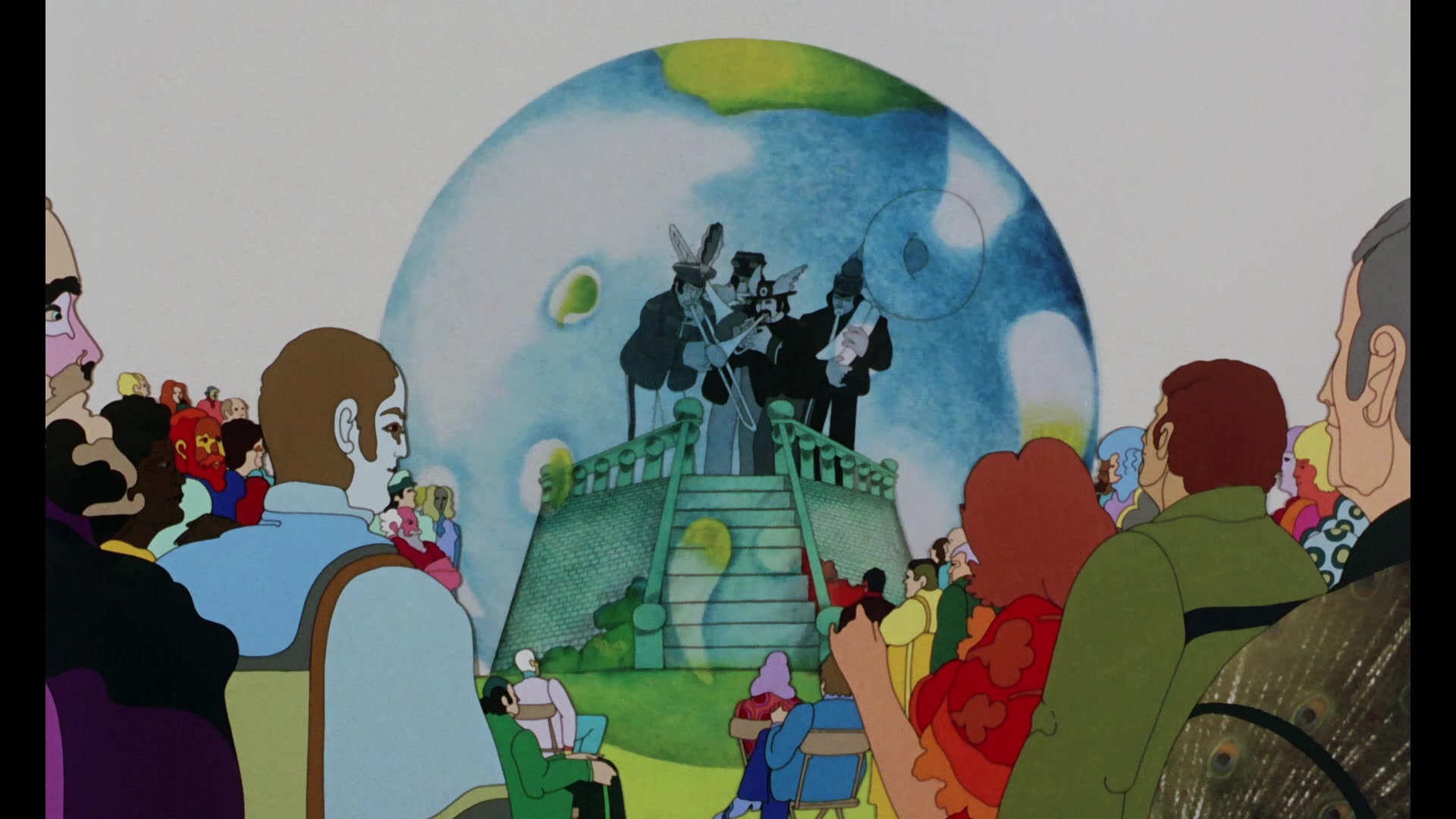
The (original) Lonely Hearts Club band after being stopped from making music at the beginning of the invasion.
The band finally get restored and live to play another day.

By today’s pacing standards, some viewers will feel it a bit drawn out (which it is). However, if you appreciate the Beatles’ late-60s output and the changes the band itself was going through, watching the beautiful artwork (still like no other animation I can think of) and listening to the songs will help the 90-minute length go by pleasurably.

It remains a unique film, both in the history of animated films and as the only non-live action Beatles movie. It also remains effective as a time capsule of a short moment in history where this look, sound, and style was all the rage.

Yellow Submarine reminds me a lot of episodes of TV comedy “Laugh-In,” which adopted a very similar look and feel for its whimsical and fashionable late-60s comedy show.

The inside of the Yellow Submarine.

You never knew what was going to happen next in that TV show, and likewise you mostly don’t know what you’ll be seeing next in Yellow Submarine. There are some 17 (!) Beatles songs heard in whole or in part, so if you are one of the few that really don’t like the Beatles’ music, this film is most definitely not for you.

For everyone else, more than five decades after its original release, it’s a musical and visual treat that blends fab (four) pop-rock tunes and simple but stylish animation to make for a pleasant animated adventure musical. The fact that there’s (still!) nothing else much like it all these years later is a testament to the originality of the approach.

After initially not wanting to be a part of the film, the Beatles were won over by the artwork, and appeared in a short cameo at the end of the film after all.

If the Beatles had done their own voices for the dialogue, I’d have rated it the second-best of the Beatles’ five-film music career, with number one being their whimsical debut A Hard Day’s Night, which I reviewed in 2023.

Sadly they didn’t, so I think it gets knocked down to third place, with the uneven but wonderfully weird Magical Mystery Tour in second (for me), the straight performance film and breakup documentary Let It Be in fourth, and the witless Help! a nearly-undisputed clunker at the bottom of the list.
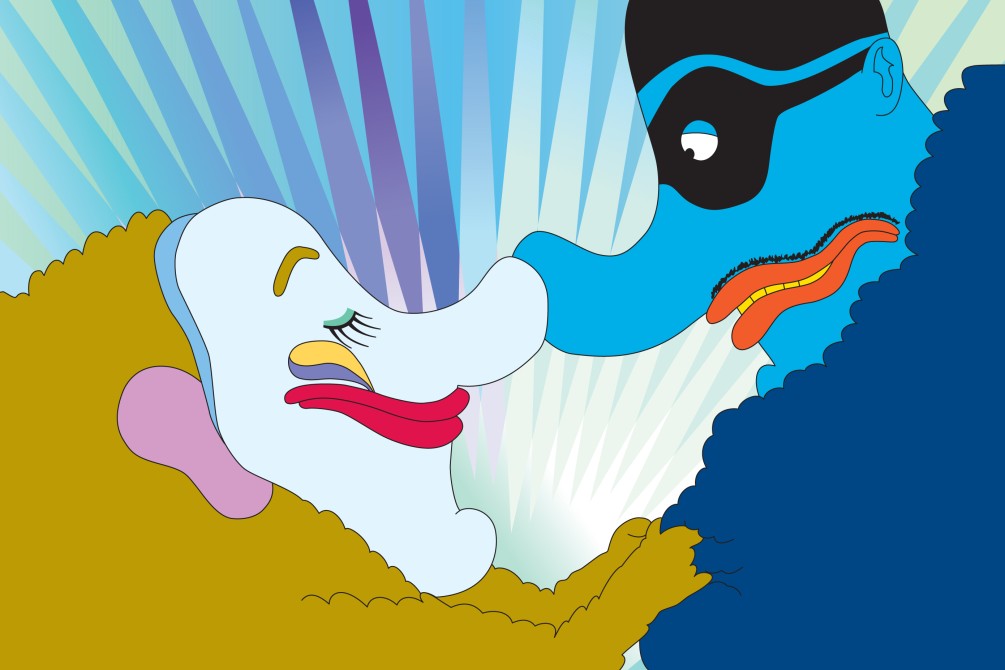
Love always finds a way.

Tetsuo, the Iron Man (1989)

Director: Shinya Tsukamoto
⭐️⭐️⭐️⭐️

If you’ve seen this film, there’s not a lot I can say apart from some small bits of trivia that you might not already know. If you haven’t seen it, this is the first and perhaps the greatest Japanese cyberpunk/body horror/indie metal/sex comedy film of all time. I haven’t seen either of the two sequels, but that’s the only reason I say “perhaps.”

Perfectly timed with a youth-cultural rising tide of nihilism, low-budget renegade filmmaking, steampunk fashion, and the emergence of “industrial” music, Tetsuo combines it all into a movie that was very much of its moment. I first saw the film at and independent cinema in central Florida a few months after it premiered, and I was simply not prepared for the onslaught of sight and sound I witnessed.

It was in some ways traumatic, in other ways compelling — and it haunted me for a while with a mixture of revulsion and wonder at the time. I have finally dared to take a second look, and I squirmed in places — but could still could hardly bear to blink.

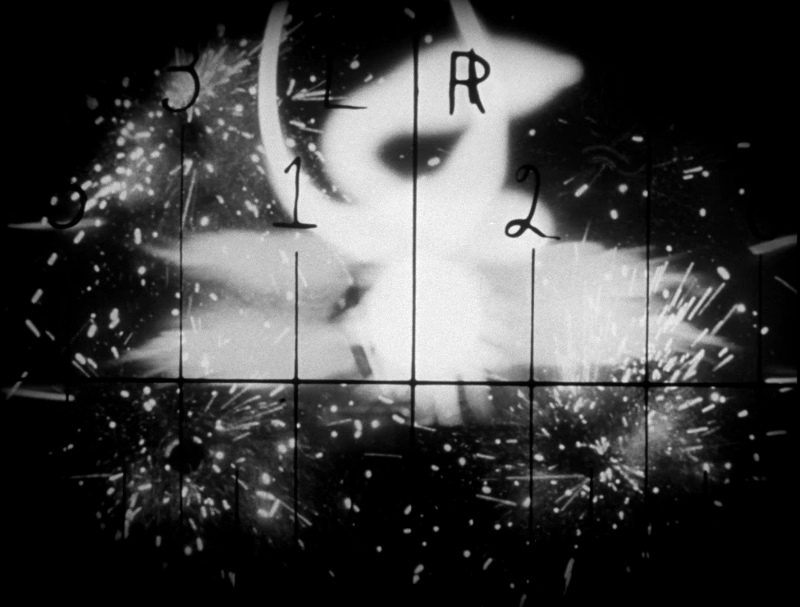
The film is in B&W, and doesn’t look quite as absurdly cheap as it is most of the time thanks to ludicrously frenetic stop-motion effects, brilliant editing, and mesmerizing performances, while still mostly giving its audiences only glimpses of what’s fully happening. The assault of hard music contributes to the urgency and raw emotions on display throughout.

The film went on to be an enormous influence on both musicians and indie directors, and makes those Godzilla movies look like pastoral landscape paintings for children by comparison.

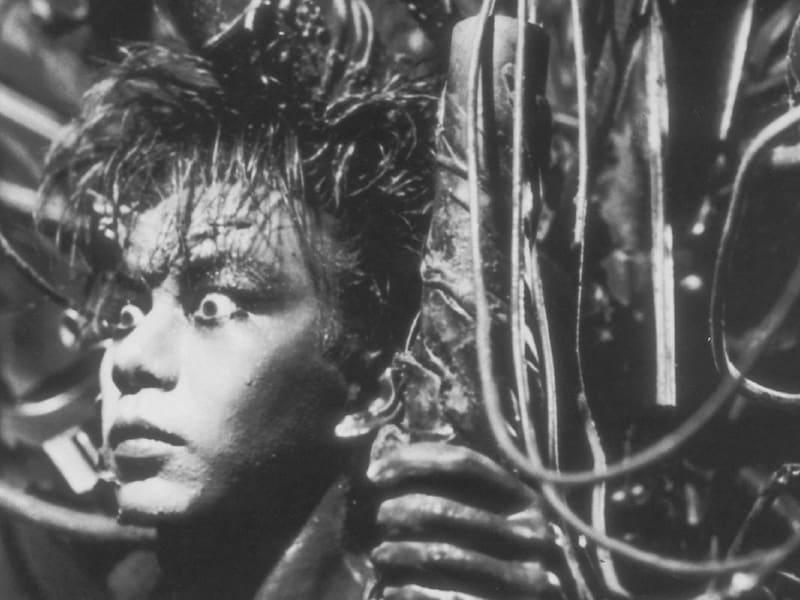
The plot is weird yet simple: we start with meeting a young man (played by director Tsukamoto) who is cutting his thigh open so he can insert some metal into it. His surroundings are composed of lots of scrap metal, and this is a fetish of his apparently.

It goes very wrong, and maggots begin to feed on the wound. Driven mad with disgust, he runs out of his tiny room and into the night, and is soon run down by a “salaryman” (businessman) — played by Tomorowo Taguchi — and his girlfriend (Kei Fujiwara).

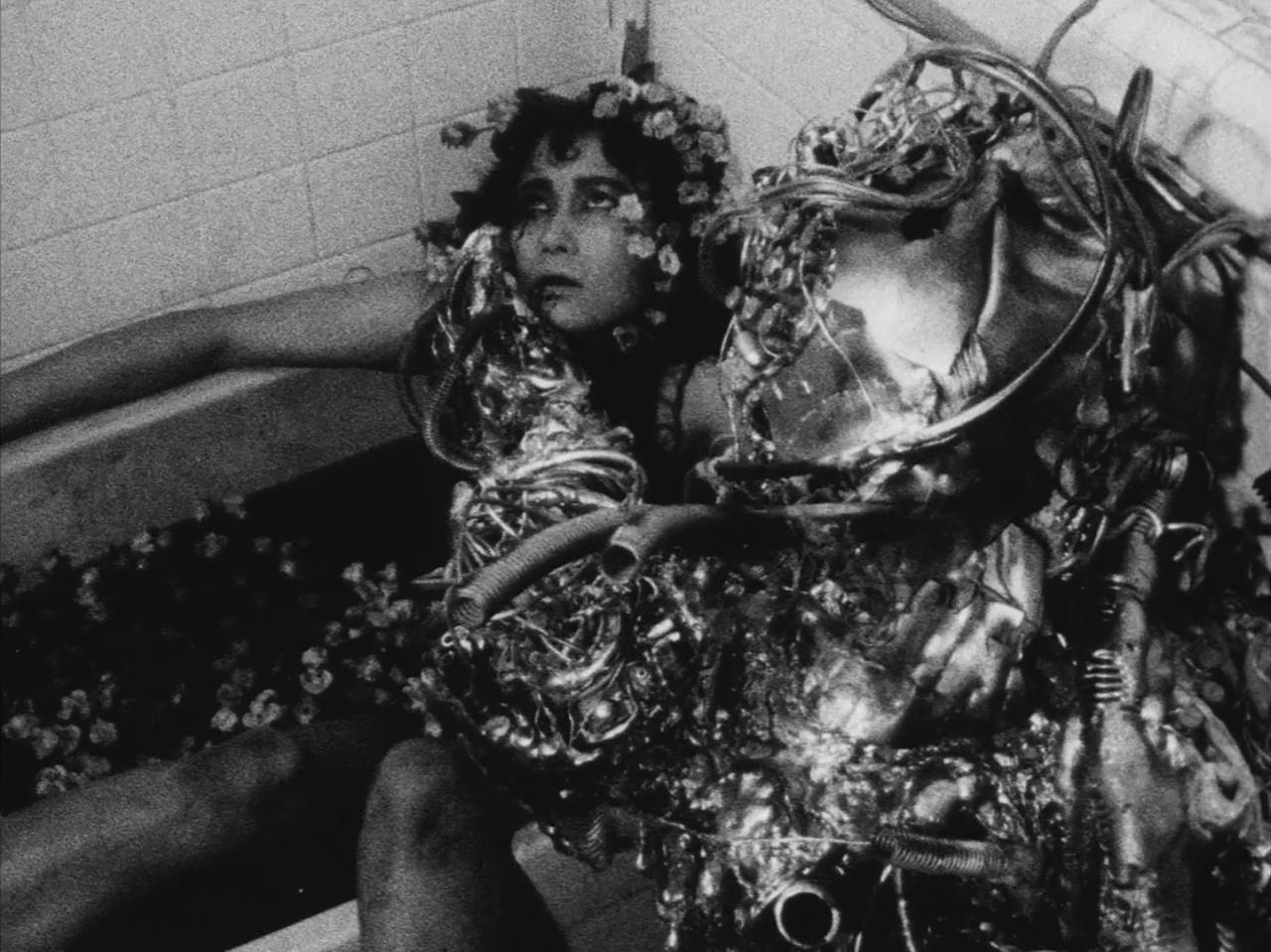
The pair investigate the corpse, are revolted, and dispose of the body. Not long after, the businessman notices that he is growing metal out of his body, and soon the girlfriend is transmuting as well.

Slowly but surely the metal is taking over their bodies (mostly done using stop-motion animation), turning them both into metal-human hybrids. This takes a while, and is documented in beautiful detail in the grainy B&W cinema verité style, augmented with the hardened edges of industrial music.

Once it starts, it is a relentless onslaught, and the victims here are bewildered, terrified, and powerless to stop it.

To this point, the film is a hyperactive low-budget body horror escapade, but strangely compelling. We know where this story is going, but it is clever enough to make us want to see it through.

The salaryman’s transformation is much further along by the time the girlfriend turns up, equally starting to transform. They end up being compelled to have what I’ll just call “drillsex,” which at this point provides a much-needed moment of relative levity.

Others have described the film as something of a mash-up between Un Chien Andalou (1925), Videodrome (1983), and Eraserhead (1977) in Japan, and I have to nod and say “yes, but with all these films thrown in a blender while you’re watching them.” Tetsuo vibrates with energy and intensity, never relents from its breakneck pace, and cranks the music up to 11.

Since it’s release, we’ve all started down its path: rare is the moment now where you don’t see someone glued to their smartphone, to the point where we treat it as an extension of “ourselves.” The messages of the film regarding societal sexual repression, industrialized alienation, body dysmorphia, work-life imbalance, and are alternately sublimated and beaten over your head.

Being so hyperkinetic and, well, metal is likely to be overwhelming for any casual viewer, even though the film clocks in at a mere 67 minutes (and thank heavens its not any longer). By the end, you’re not sure if the salaryman and his girl likes what has ultimately become of them or not.

It reminds of a rollercoaster you’ve never been on before: terrifying, exhilarating, and you’re relieved you survived it — and then, knowing that you did, you want to go back and do it again.

Tsukamoto served as writer, director, producer, art director, lighting director cinematographer and editor of the film. A number of the other crew members who worked on the film quit in disgust or in dispute with what Tsukamoto was doing.

It is a visionary, hugely influential and eye-popping film in many ways, but I think most people whose idea of a horror movie is Friday the 13th would probably turn down a second opportunity to see it. That said, a little of that metal fetishism stays with you, in the sense that you can’t unsee it.

Maestro (2003)

⭐️⭐️⭐️
Writer/Director: Josell Ramos

Only in New York would you find people who brag about inventing Chicago house music. 🙂

But more seriously, this is a video documentary covering some of the origins of DJ culture that grew out of predominately gay-oriented clubs in New York City in the late 1970s and into the 80s. Ramos talks to the now-legends of that era, the DJs at clubs like The Loft and The Paradise Garage and that sound did indeed make its way to Chicago to blossom in the Windy City.

What’s interesting and important about this documentary is that it brings together people who danced their night away at those clubs and the DJs behind that music, and how the magic of the sound opened the (closet) door of these gay clubs to women, straight people, and 24-hour party people of all races. Aside from the music itself, the diversity was a very special thing in the 70s and 80s, particularly the largely black, white, and Hispanic crowds.

As the world was grower darker as the 80s began with the election of Reagan and the dawn of the AIDS epidemic, people — especially those in the LGBT+ community — went looking for the sound and the fury, and were drawn by word of mouth alone to a trio of clubs across the years that held out the opportunity for escape and ecstasy of all sorts. In hindsight, it is unsurprising that straight people who got told about the scene found it irresistible.

Everybody, Everybody

These were bold DJs who experimented beyond the standard mixing two records with similar tempos together. People like Larry Levan, David Mancuso, Frankie Knuckles, Nicky Siano, and Francis Grasso (Nu Yoik names if ever I’ve heard some) had an open-door and open-mind policy, and dared to mix rhythms and sounds, created a form of manipulating the vinyl that would lead to hip-hop’s “scratching” in the 90s, and would build the music, over the evening, into non-stop ecstatic dancing.

That said, the production/direction is mostly fine but occasionally the camera work is a bit ham-fisted, as one might expect from a first-time director. That said, Ramos has to rely heavily on interviews conducted between 1999 and 2003 with the former DJs and patrons.

This probably couldn’t really be avoided: there isn’t much surviving video from the clubs from that era (though a bit more than you might suspect), and thus the audience is bounced back and forth between footage from the time and 2003-era interviews with the movers (DJs) and shakers (club-goers) who patronised these clubs, and some of them frankly go on too long. I spotted the late artist Keith Haring dancing in some of the footage, and a later section of the doc spotlighted him.

The DJs, now middle-aged guys, recollect their glory days with real fondness, especially Levan, and paint themselves as friends and colleagues using music as a weapon against the mainstream and it’s close-minded attitudes.

The interviews are mostly good (particularly with the DJs) but get a bit more repetitive with the club-goers, though Ramos wisely mixes single-person and group interview comments. If I have to complain about something, I’ll pick two things: first, I really wish this had been shot on film, though I completely understand why it wasn’t.

Second, there are not enough clips of still-famous DJs like Jellybean Benitez, Dimitri from Paris, and UK DJ Pete Tong singing the praises of these innovative pioneers, and I’m not sure there’s a good excuse for that apart from budget.

As a club patron in those days myself, though not of course in NYC, I recognized a song or three from the soundtrack, like Booker T and MG’s “Melting Pot,” Chocolette’s “It’s That Easy Street Beat” and Sylvester’s “Over and Over.” Here, the song “Release Yourself” by Aleems is used very effectively to relate a story about how a DJ can remix the music to build, and then release, tension.

I’m not personally a huge fan of house music, but I know very, very well that the combination of alcohol, certain recreational substances, fabulous light shows, and attractive people overwhelmed by screamingly loud beat music being built to a frenzy and then cooled back down can be the closest thing to sex you can have while (barely) clothed (and sweating like a pig). The video feels a bit long but is only 88 minutes. The “survivors” of those days, the club goers and DJs, seem to have established a friendly bond that comes from knowing you were a part of something special.

Ramos’ focus on the music means that he has left an opportunity to explore the tight-knit gay community that fostered these club on the table, and that’s a bit of a shame (though it’s certainly a subject that has been covered elsewhere). If you remember your clubbing days, particularly if they were in the late 70s into the 90s, you may want to seek this video out — the DVD version includes a second DVD of more material, and a CD of some of the music featured in the film.

The Muppet Christmas Carol (1992)

⭐️⭐️⭐️½
Disney Studios
Director: Brian Henson


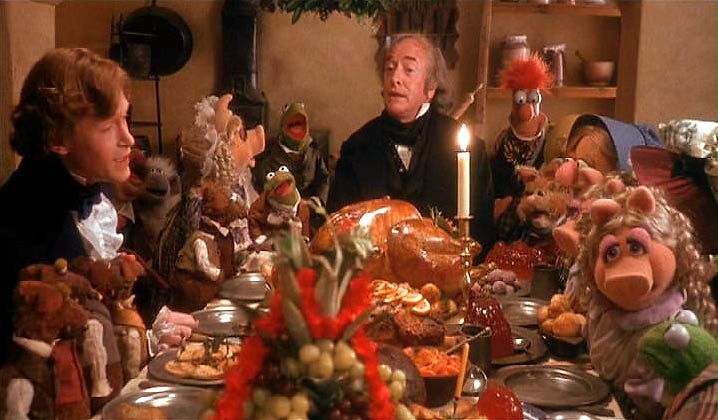
We have a Christmas tradition of what I think is the best version of “A Christmas Carol” ever committed to film, the 1951 Alastair Sim version (UK title: Scrooge, and my review of it is here). This year, just to do something a little different, we revisited The Muppet Christmas Carol after not having seen it since its 1992 theatrical debut, just to change things up a bit. The film sticks to the same story (more faithfully than Scrooge, in some ways), but approached the source material in an almost-completely different way: it’s a musical, for starters, and it only has two substantial speaking roles for human beings.

In short, this film is a technical marvel, and the overall story is well-executed — but Caine as Scrooge is curiously flat, and the songs (by Paul Williams) are both samey, and rather meh. I’d certainly recommend this one over my beloved 1951 version when it comes to “suitable for kids, grandparents, pets, and the whole family,” but while it scores well on some fronts, its general over-busyness, the decision to make it a musical, and the changes to the story probably won’t sit well with Dickens fans.

Statler & Waldorf as the Marley BROTHERS (wtf?) was the film’s first overreach in shoehorning Muppets into the story.

I’m not sure who’s to blame for Michael Caine’s mostly-lifeless portrayal of Scrooge; director Brian Henson was of course focused on his muppets, and they uniformally shine here, so he may have decided that Scrooge’s inhumanity to his fellow man should be more low-key until his reformation. Or maybe Caine thought the movie was dumb, and did it for the paycheck (that’s certainly the vibe he gives off for the first two-thirds of the film).

For what it’s worth, I think the film would have worked better with maybe one big musical number at each end rather than making the whole thing a musical, since the songs are, to be frank, unmemorable and just fill time. The Muppets’ recasting into various roles from the story, on the other hand, works surprisingly well, with The Great Gonzo (Dave Goelz) as Charles Dickens (among many other roles) and Rizzo the Rat (Steve Whitmire, again also playing Kermit, Beaker, Bunsen Honeydew and a half-dozen other parts) serving as the Greek Chorus to Gonzo’s Dickens narration. Long-time Muppet veterans Jerry Nelson and Frank Oz take up their usual roles with wit and gusto, with David Rudman handling some minor roles and a cameo from the Swedish Chef.

Gonzo (left) as Charles Dickens narrates, while Rizzo questions the story.

When Scrooge is seen in flashbacks in the early parts of his life (Raymond Coulthard, Russell Martin, Theo Sanders, Kristopher Milnes, and Edward Sanders), the character is more “alive,” a trait Caine slowly picks up on during his ghostly visits, and finally brings to the fore at the very end. The other main human-being speaking role is Fred, Scrooge’s nephew, and actor Steve Mackintosh is just fine in the role, but should have been used elsewhere (we’ll come to that later).

A lot of respect must go to the muppet performers in the lead roles, who have decades of experience with these familiar characters and carry it off on a movie scale just as well as they do on television. Special respect must go to the muppet performers who play the ghosts: the floating and diminutive Ghost of Christmas Past (Karen Prell with voice by Jessica Fox), the giant Ghost of Christmas Present (Jerry Nelson and Donald Austen), and the effectively haunting Ghost of Christmas Yet to Come (Rob Tygner and Donald Austen).

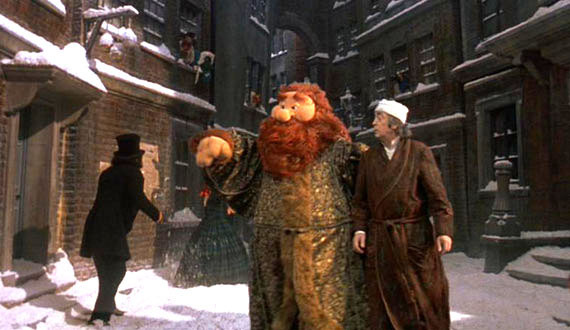
The Ghost of Christmas Present guides Scrooge through London
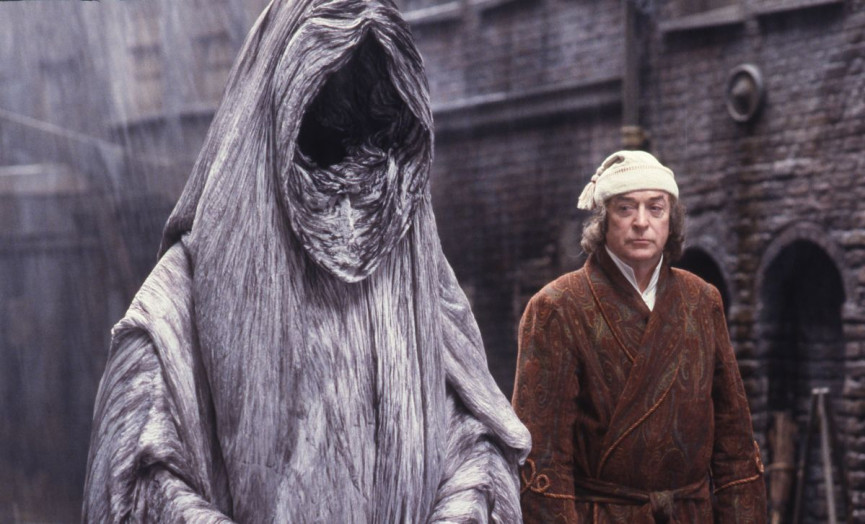
The Ghost of Christmas Yet to Come is suitably spooky but not TOO scary for kids.

There are also dozens of “little” Muppet characters (mice inside the homes, rats who work for Scrooge’s office, etc), and some giant characters, and the spirit of Jim Henson lives on in these parts and the talented people who bring them to life. In the finale, we get to see over 100 muppets in a panning shot, a very impressive accomplishment that makes them all the more “real” throughout much of the film.

It later came out that English actors David Hemings, Ron Moody and David Warner (the latter would have been my pick), alongside American comic George Carlin (who might also have been quite good) were considered for the role of Scrooge before Michael Caine finally won the role. I’m still not sure if Caine’s low-key misery was his choice or Henson’s, given that this is a family/kids version of the tale, but Caine noted that he based his portrayal on the present-day vultures of Wall Street and the banks, which may account for the more bloodless, cynical portrayal.

This is as evil looking as Caine gets, and he looks more bored than menacing.

The “London street set” used in the film was uncannily similar to the one used in the 1951 Scrooge — modified for scale, obviously — which delighted me, but while I understand the decision to keep the Muppet characters the audience would know using their original voices, the lack of UK accents from nearly everyone apart from Mackintosh and Caine was a disappointment to me, especially for the Ghosts. Given that the story, author, characters, and filming location were all in the UK, I felt like every character (with the Swedish Chef obviously exempt) should have added a UK lilt to their voices.

I haven’t mentioned Kermit the Frog as Bob Cratchit thus far in the film, for two reasons: first, although Bob is the raison d’etre of Scrooge’s reformation, he’s hardly in the film; and two, he doesn’t really communicate Cratchit’s plight because Kermit is a good-natured, happy frog at heart and is incapable of portraying suffering. I can’t believe I’m saying this, but Kermit was badly miscast, and should have played nephew Fred — while Steve Mackintosh, who played Fred, should have played Bob.

Fred, the Cratchit family and friends, Scrooge, etc – nobody seems poor here at all.

Nitpicking aside, the film does carry a lot of family-friendly humour, and succeeds in reforming Scrooge and being generally heartwarming. It’ll never replace Scrooge for me, but that said it is also nowhere near the worst version of A Christmas Carol committed to film. As a first version for kids to see that might get them interested in the story and other film versions, it’s fine.

The one high mark I will give this version is that, despite the musicality and comedy inherent in it, it does not shy away from painting the capitalist banking system as morally bankrupt and preying on poor people — the point of Dickens’ original tale in the first place, so good on them for that.

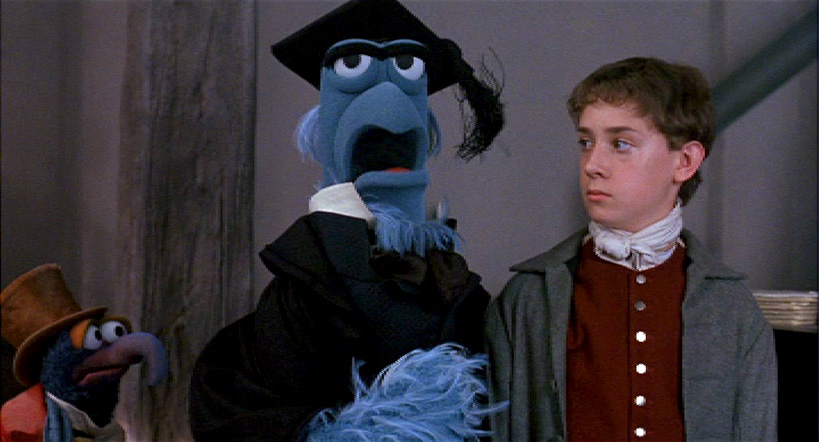
There’s a moment where Sam the Eagle, the All-American type, gets corrected in scene that this is a British story, and does a retake correcting “the American Way” to “the British Way” that I found quite amusing. On the whole, it’s a classic aimed at the smols in your household, it’s cute, it’s fun. There’s an extended version of the movie that restores one cut song, but don’t bother with that — one more song is exactly what this movie didn’t need.

Sam Eagle has a brief but amusing cameo in the movie. Yay!

Inside Out (2015)

⭐️⭐️⭐️⭐️
Disney/Pixar Studios
Director: Pete Docter

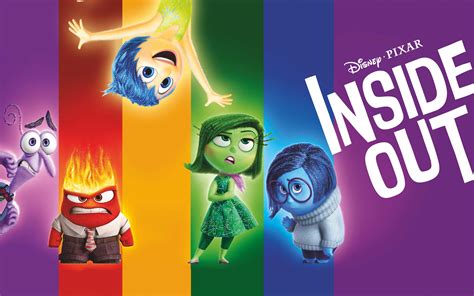
A short review: this is a pretty brilliant film, focusing on Riley, an 11-year-old girl, and her emotional state. It’s also the story of Joy, one of those emotions living in her head, coming to an understanding of the role Sadness should play in Riley’s present life and memories.

The other emotions are good, but kind of backgrounded — except for Anger, played brilliantly by Lewis Black. The parents are fairly minor characters as well, which I felt was a flaw at first, but they’re very much meant to be minor characters — the focus is on Riley. There are occasional representations of what’s going on in Mom’s and Dad’s brains, and those are also amusing.

The film won a (very large) bucketful of awards for Best Animated Feature that year, though only one Oscar — for Best Animated Feature. The American Film Institute and the National Board of Review, however, both picked it as one of the Top 10 films of 2018. It has since become another Pixar family classic, and is really well-suited to show boys and girls at around Riley’s age, or kids of almost any age who are going through the trauma of moving and leaving their previous friends behind.

Riley is, for the most part, a well-adjusted and well-rounded kid with a happy childhood and loving parents. We should all be so lucky, eh?

There is one serious flaw in the story that bothers me: when Sadness touches a memory, she changes it into a sad one from its previous state — she gets scolded for this several times in the film. Oddly, when (let’s say) Anger touches one of the memories, it doesn’t change — nor does it when Joy or any other of the emotion characters touch it. It’s not reeeeaalllly a plot hole as much as it is foreshadowing, but there was probably a better way to handle that.

That said, the most genuine sad moment in the film is a stunningly perfect heartbreaker: Bing Bong, and that’s all I’m going to say about that.

In short, it remains of Pixar’s best original movies. Even better ones have since been made from that studio, but Inside Out is still truly great, still relevant – and really does tug at the heartstrings, elicit emotional responses. For the non-kids this was also aimed at, the film gently gives us parenting advice while also making us recall our own pre-teen years.

The grey tones, minimal lighting, and troubled dinner conversation reflect Riley’s more sombre emotional state as she wrestles with the adjustment to a new town, no friends, and her emotional struggles.

I’d recommend you reacquaint yourself with this film before seeing the new sequel, Inside Out 2. I’m glad they waited nine years to do the sequel.

Journey Into Prehistory (1955)

(Czech title: Cesta do pravěku)
dir. Karel Zeman
⭐️⭐️⭐️⭐️

There’s a song by the Norwegian band synth-pop band a-ha on their debut album, Hunting High and Low, called “Living a Boy’s Adventure Tale.” Karel Zeman’s remarkable second feature film, Journey Into Prehistory (US title: Journey to the Beginning of Time) is that phrase fleshed out in colour.

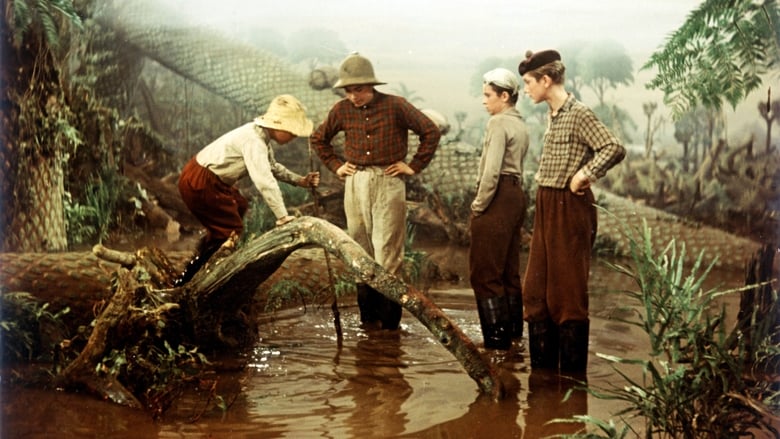
It uses the framework of a group of pre-teen and teen boys thirsty for knowledge and adventures as a vehicle to achieve Zeman’s own boyhood dreams, combining 2D and 3D models, animation, and live-action into a seamless Sci-fi fantasy film. While slow-moving by today’s standards, it is a perfect illustration of the kind of imaginative escapades you would have found in books and serialized magazine stories in the late 19th and early 20th centuries.

For those not familiar with Zeman’s work, his films are some of the most effective combinations of live-action and animation ever done to that point — until a fan of his, Terry Gilliam, began his own filmmaking career. While I haven’t seen many Zeman films, the other two I have seen — the amazing 1962 Baron Munchausen and the jaw-droppingly incredible 1958 Invention for Destruction — are just mind-blowing masterpieces of imagination. Zeman combines his own filmic skills with whimsical tales and brings great stories into the visual world of movies.

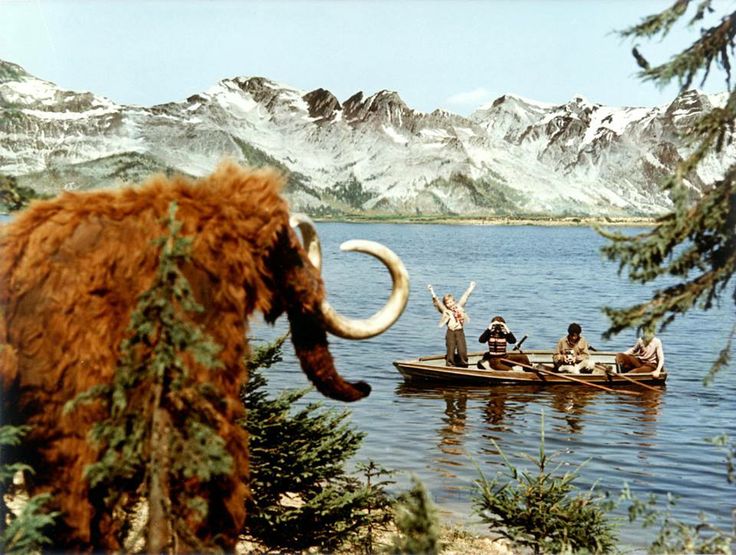
The boys encounter their first prehistoric creature — a curious wooly mammoth.

In the film, the boys learn about the prehistoric creature the trilobite by examining the fossil of one. The youngest, Jirka (Vladimir Bejval), is disappointed that there are no living triobites left, so the older boys propose taking a trip back in time to find one — like you do — and take a boat up river into a cave that allows them to pass through it, and into progressively earlier eras of earth’s development as the continue upstream.

The oldest boy Petr (Josef Lukáš) narrates most of the film and does most of the rowing and planning, while the second-oldest Toník (Petr Herrmann) keeps a logbook. Jenda (Zdeněk Husták) and Jirka, the younger boys, help out as they can, with Jirka in particular running off to explore too eagerly, which causes the occasional misadventure.

Jirka (left) is a bit of a jerk-a sometimes, deliberately ignoring safety warnings to explore.

They indeed pass through the four main periods of prehistory (as defined in 1955) — from the Ice Age, to the Tertiary, the Mezozoic and the Paleozoic, and all the way back to Silurian age.

This film is more sparse on the effects compared to Zeman’s later ones, but importantly when special effects appear, they are as realistic as it was possible to make them. Some effects used puppetry, some used a very smooth form of stop-motion, but clever use of shot-matching allowed the actors to travel with beautiful backgrounds and “living” prehistoric creatures very smoothly integrated and fluidly animated.

Along their journey, they encounter and learn about progressively older examples of prehistoric creatures. Interestingly (at least to me), the film makes no attempt to get the boys back to their own time, even after tragedy befalls their original vessel. I don’t want to say more about the plot to avoid spoilers, but the film is both blatantly educational but also filled with moments of danger, suspense, and the single-minded energy of the young to sate their curiosity.

The Czech version runs 93 minutes, and while the pacing makes it sometimes hard to stay on board with the slowly-unfolding story, the promise of another effects sequence soon will hold most viewers, and also curiosity about how the story will be resolved.

A life-size Stegasaurus model was built for this sequence.

A US version was created later, using a new intro and outro where the boys (replaced by US actors shot only from the back of their heads in the opening and end sequences) imagine the whole adventure while visiting the Museum of Natural History, and stretches credibility pretty hard. The recut US version runs only 84 minutes, dropping some exposition to get to the effects more quickly.

The story is a mash-up of Jules Verne’s 1912 novel The Lost World and a Russian novel called Plutonia from 1915, both obviously influences on Zeman (he would go on to a brilliant and straight-up later film combining several Verne stories named after the primary story its based on, the novel Facing the Flag).

For many years, the existing prints of Journey Into Prehistory were of such low quality that the film almost passed into unseen obscurity, following its initial worldwide success. Thankfully, the film has since been digitally restored and repaired, so we can see it the way Zeman intended.

A friendly creature from long before the dinosaurs

The Black Pirate (1926)

Director: Albert Parker
⭐️⭐️⭐️⭐️⭐️

I like to think I’ve seen most or all of the “key” early/silent movies, and I’m sure I’ve covered a fair few of the essentials, but every now and again I come across one I somehow missed. The Black Pirate is a masterpiece I somehow overlooked — a Douglas Fairbanks movie, no less! — and it is magnificent.

This was a very early film done in “two strip” Technicolour, so it was probably pretty shocking to audiences in its day for a number of reasons, and a recent remastering means we have a lovely, clear print of it to enjoy now. Although Fairbanks had previously done swashbuckler films, I think The Black Pirate is the primary seed of all future pirate movies.

Comin’ at ya with both barrels!

This is the one they all draw from in one way or another, because its so well done, and while I only have one real criticism of it, so much of what we think of when we think of a “pirate movie” or “high seas adventure film” is all present and accounted for, right here. When it comes to cinematography, music, stunt work, performances, and pacing, this movie is pretty much without flaw.

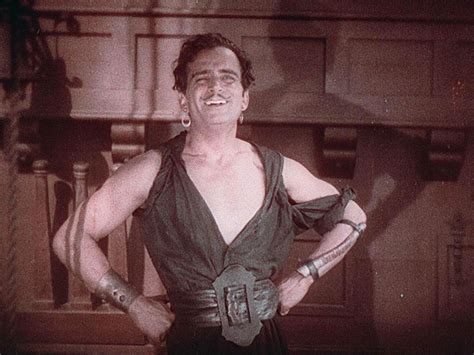
The main focus, as with Thief of Bagdad and other Douglas Fairbanks adventure films is of course Fairbanks and his enthusiastically physical stunt work, including swinging from ropes, climbing up things with incredible vigour, lowering himself from high up in the mast by sticking a knife in a sail and “riding” it down, and — needless to say — swashing his buckles impressively.

Avast ye swabs! We be a silent movie in colour! Shiver me timbers!

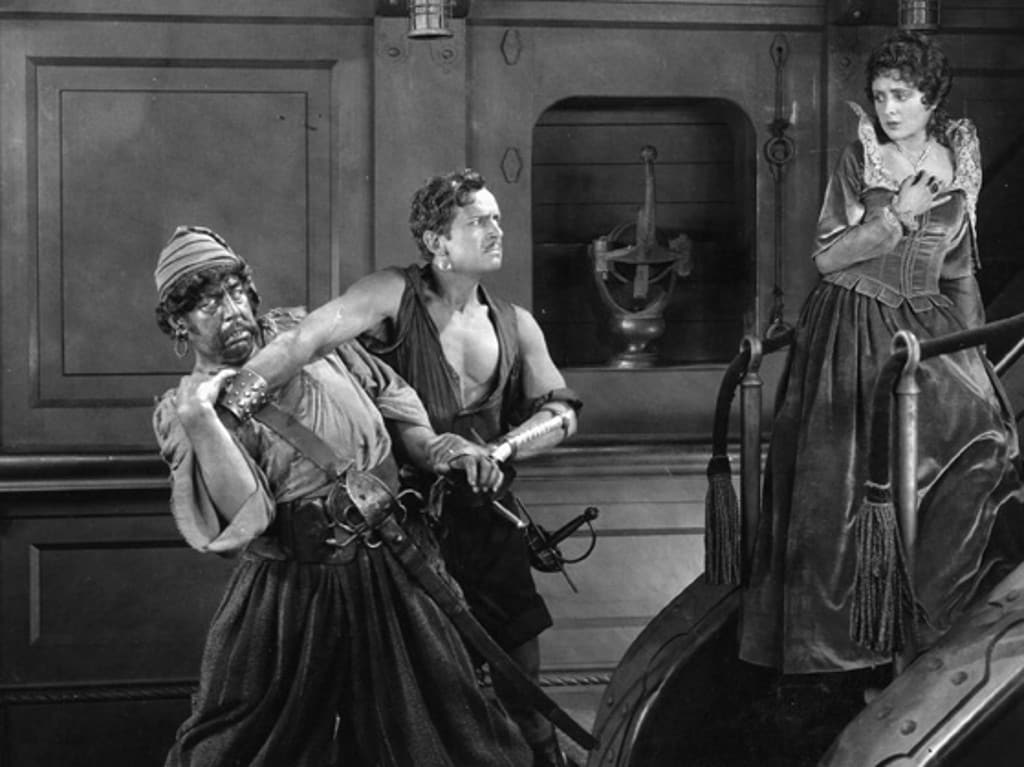
Lest this degenerate into a Fairbanks fan fest, I should mention that the noted actor and director Donald Crisp plays McTavish, who assists our hero even in his darkest hours. Crisp had directed Fairbanks in Don Q, Son of Zorro a year earlier, and their chemistry is very obvious here.

McTavish (left), a shipload o’ scalawags, and The Black Piraten (right)

The story is credited to Fairbanks, who used a pseudonym and essentially cobbled a Cliff Notes version of Howard Pyle’s The Book of Pirates and their archetypal illustrations. The plot moves along surprisingly speedily for a film from the 1920s, and the film’s 94 minutes go by very easily thanks to minimal plot breaks between action scenes.

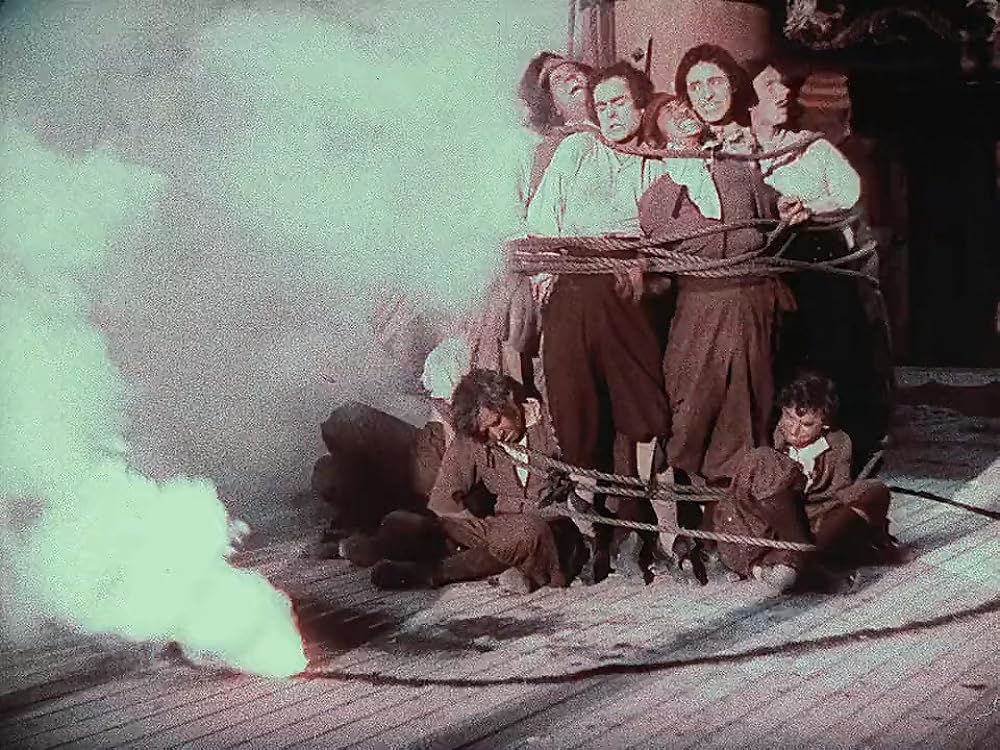
The film opens immediately to one of those action scenes, where pirates have already taken over a ship and are plundering it before setting fire to the gunpowder in a manner that gives them time to get away before the ship blows up. Two survivors wash ashore on a deserted island, a father and son. As the father dies, the son (Fairbanks) vows revenge on the pirates.

When the pirates park their own ship on the opposite side of the island, Fairbanks appears as the boastful “Black Pirate” and demands to join their crew, setting himself two challenges that he completes that impresses everyone but the second-in-command Pirate Lieutenant, which sets up the conflict.

The soon-to-be-dead Pirate Captain and his first mate, the Pirate Lieutenant.
The pirates tie up the crew and use a gunpowder trail to give them time to get off the ship before it blows up — ingenious and cruel all at once.

When the Black Pirate leads the ship to another successful raid (but cleverly prevents them from blowing up the ship), the crew are pretty much ready to make him Captain but for the Lieutenant. When a woman (Billie Dove) is discovered on board the raided ship, the Lieutenant claims her as his prize, but the Black Pirate — who has fallen in love with her on first sight — claims she is a princess they can hold for hostage as long as she remains “spotless and unharmed,” i.e. no raping!

After a few twists, Fairbanks saves the day and the dame, of course, with the help of troops who successfully rout the pirates. Luckily for him, the “princess” has fallen for him as well, and it turns out he’s actually a Duke, and she a noblewoman! How incredibly convenient (nobody cares, it’s the action scenes that are important).

One amusing note of trivia: apparently Fairbanks’ wife Mary Pickford insisted on doubling for Dove for the scene were the Black Pirate kisses the Princess. Jealous much, ma’am?

The one criticism I have is that, although the pirates do get busted, the Black Pirate does in fact lead a raid on another ship, allowing the pirates to steal all the passengers’ valuables (but preventing their mass murder) and takes a hostage who really has no choice but to fall in love with him because otherwise she’ll be raped by the Lieutenant and likely the rest of the crew. I must also point out that the TV show “Mythbusters” also tested the “riding down a split sail” trick and declared it implausible — this hasn’t stopped it being used repeatedly in pirate movies since 1926, though.

Yes, the one woman in the film is completely treated as an object and under threat of rape, but Fairbanks’ altruistic love and protection saves the day and of course causes her to fall in love with him.

Add The Black Pirate to your list of enjoyable popcorn action movies. The sort-of colour helps, but this is really a stunt movie that sets the tone for the genre of seafaring adventure, and so even if the plot is a bit lightweight, it remains a great film.

Ha! Ha! I win!

Tom of Finland (2017)

(dir. Dome Karukoski)
⭐️⭐️⭐️
52-week challenge, film 52

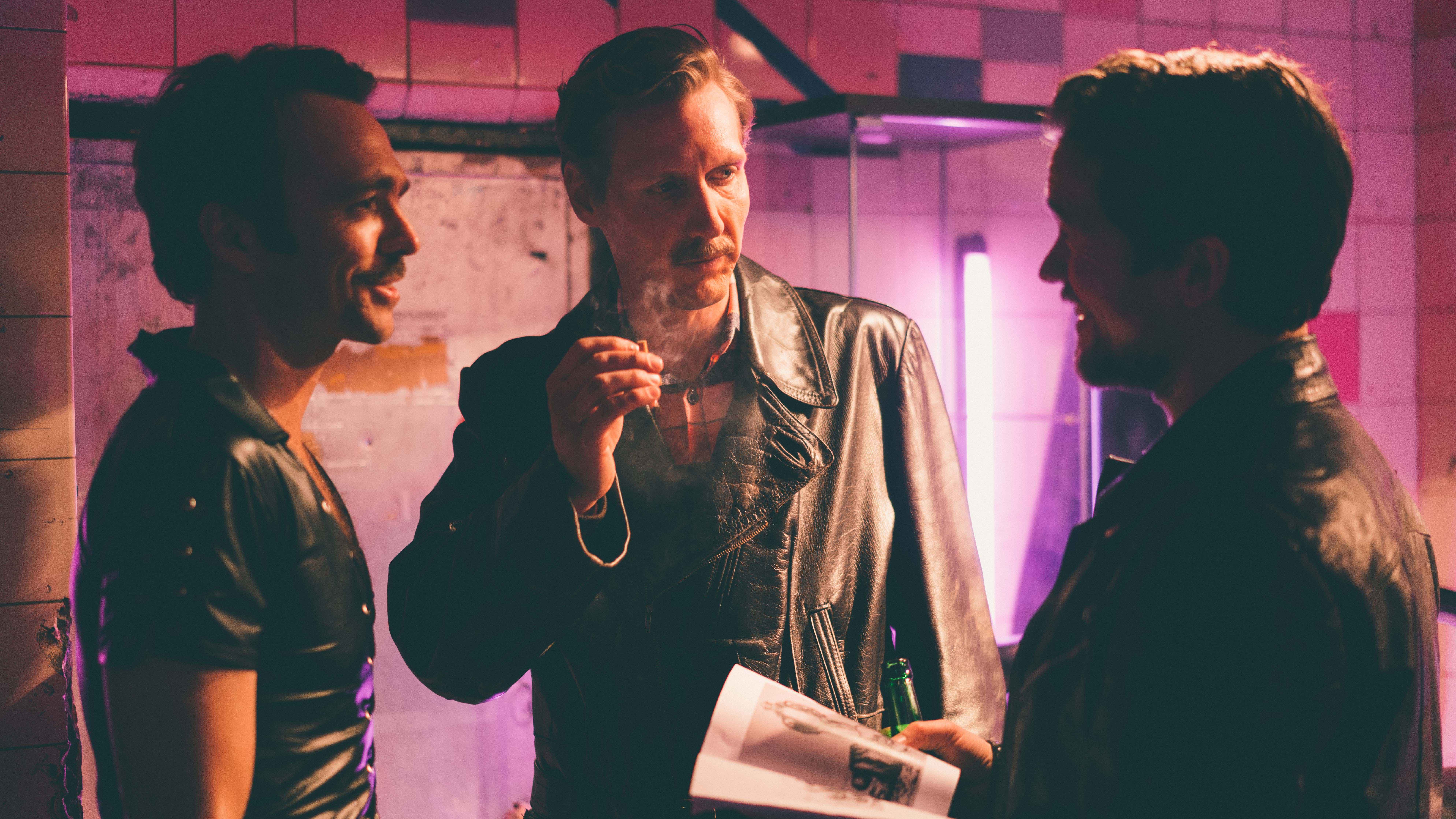
When looking this film up and reading the description, I was led to believe that this would be a documentary of the artist Touko Laaksonen (portrayed by the similar-looking Pekka Strang), better known in the gay community (at least previous generations thereof) as “Tom of Finland.” Disappointingly, it isn’t … but it is a biographical drama of the man, which gives us a lot of background information on his adult years both in finding inspiration for his art, and his rise to fame-slash-notoriety.

The film itself was made in Finland, which really marks an acceptance of the artist the country shunned for decades. Learning more about this time as a Finnish soldier in World War II is worthwhile, and about his remaining family (we only see Touko from about the age 23-onwards) — his sister Kaija (Jessica Grabowski), with whom he lives. As the film begins, Touko has returned from the war with some mental scars, but also an obsession … men, especially men in leather or more traditional kinds of uniform.

He makes his living by day as a commercial artist for an ad agency, but begins frequenting parks after dark where other gay men meet for anonymous sex. One amusing scene where he first meets Veli (Lauri Tilkanen).

Their sex is interrupted by police, but instead of running, Touko composes himself and walks casually through the park — running into the police and asking them what’s going on, thus allying any suspicion that he might be one of the homosexuals. There aren’t many laughs in this film, but there are few more to be had in the final third.

Kaija doesn’t accept Touko’s homosexuality, and is mostly unaware of his predilection for explicit fetish erotic drawings. They are both talented artists, so Touko takes to hiding his “gay” portfolio in the attic. As so many gay men in the 1940s to 80s did, he skated a very fine line between looking for love (or something a bit quicker) and avoiding the police and society’s rejection.

The film shows Touko getting older, getting beaten by straight men he mistook for gay, and the other realities of life for gay men in a sexually-repressive society. He finally does meet up with Veli again (ironically when Veli begins dating Kaija), and the trio pal around for a while until Veli finally ends up with Touko, which forces Kaija to accept the situation.

The final third of the film, where Touko’s drawings begin to been seen in the US and bring his pen name great fame, is where the viewer feels things are finally coming together for Touko. He is flown to LA and sees the fetish scene he has created among the gay men there, and is hailed as a hero.

Finally getting up the courage to publish his own book of his work, he runs into a roadblock … nobody in Finland will publish him. In one of the most amusing scenes in the film, Touko and Veli finally locate a religious Jewish printer who is willing to take on the work, but is too small a shop to print and bind 10,000-plus copies. An ingenious solution ensues, and “Tom’s” lasting fame is ensured.

Now in a stable relationship and his own place back in Finland, and celebrated as a gay icon in the US and elsewhere, “Tom” has found his place in the world at last … until Veli gets sick (of throat cancer), and other gay men are being stricken with what become known as AIDS. Touko feels partially responsible for this “gay” disease, but is quickly dissuaded as the epidemic grows.

The last scene in the film is an elderly Touko, having lost Veli some years before, appearing at a fetish convention as the guest of honour, walking on stage to an army of Leatherman. As he gazes across this army of men his works inspired, his opening words are “Hello, boys …”

As with the man himself, the film’s first half is very straightforward and mostly strait-laced, at least as much as a biographical drama of a gay man can be. As with Touko’s art finding its audience, the film finally starts to loosen up and celebrate its subject in the final third, and while the first half can seem stilted and slow at times, the last act makes the journey all worth it.

Author’s note: Well, I did it. An average of one movie every week for a year, with a few days to spare, even — documented with what I hope readers will find as informative and helpful reviews. The point of this exercise was to select a bunch of films randomly, some I’d seen before but most I hadn’t, and appraise or re-appraise them to help others decide if they wanted to delve into a particular film, as well as encourage readers to take a chance on some films they wouldn’t normally make the effort to see. If you look over the whole set, I found a bunch of new gems over the course of the year.

What’s great about movies is the way they can bring you into worlds outside your own, especially in a visual way that books cannot fully compete with. Like travel, film broadens the mind, and sometimes profoundly changes some aspect of your own worldview — or just takes you out of your own reality for a couple of hours, which can be good for your own mental and emotional health.

I’ll continue to post the occasional movie review here, but for 2024 I’ve decided to take up a new reviewing challenge — I’ll be sharing with you my discoveries, delights, and disappointments (if any) once a month over a given box set of music CDs — sometimes a career compendium, sometimes a greatly-expanded album, sometimes just a curated collection of music related to a given theme. The CD format is said to be commercially dying, ironically giving way to its predecessor, vinyl — which, as you may have guessed, I find a very odd consumer choice.

Hopefully we’ll see you over at Bargain Boxset Bin Bonanza — a new page coming soon to this same website — in the near future, and we much appreciate those of you who have visited to read the film reviews.

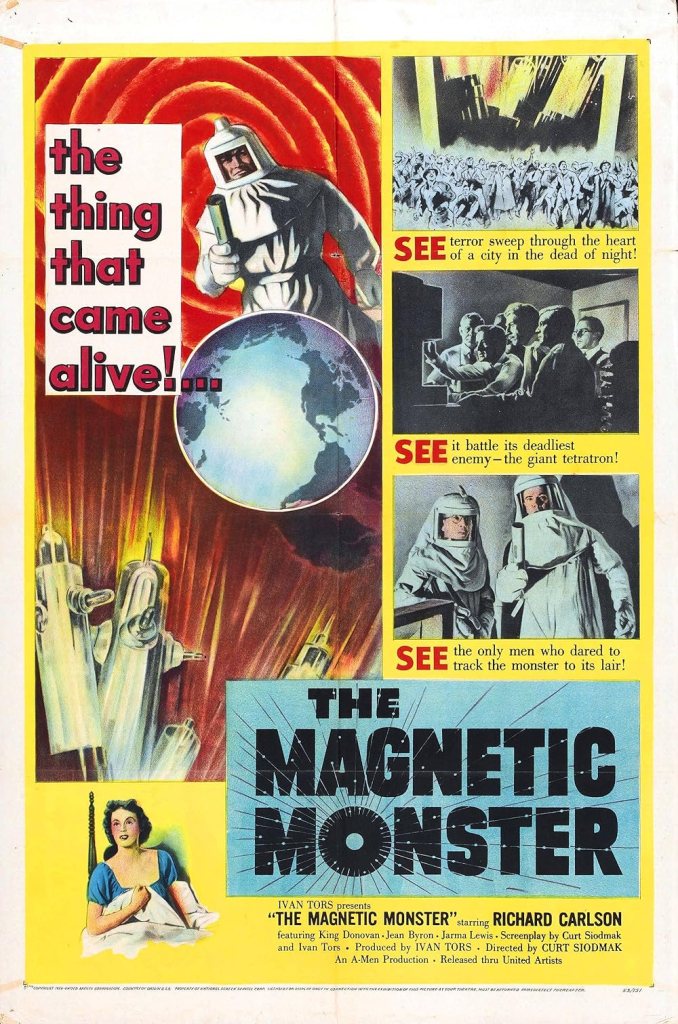
The Magnetic Monster (1953)

dirs. Curt Siodmak and Herbert L. Strock
⭐️⭐️⭐️
52-week film challenge, film 51

Despite some laughably bad science in much of it, no actual monster in the traditional sense of the term, and an effects-heavy climactic scene borrowed from another movie entirely, this Atomic Age film ends up being better (and surprisingly suspenseful) than you’d expect.

The investigation begins.

In 1953, America’s veterans had returned home, and the country had collectively forged a new direction: confident, industrious, lots of new inexpensive housing, the GI bill to get college-educated or trade-skilled, and basically hope for a bright future for nearly everyone. That said, there was the shadow of the coming nuclear arms race, and an understanding that scientific exploration isn’t always for the betterment of mankind.

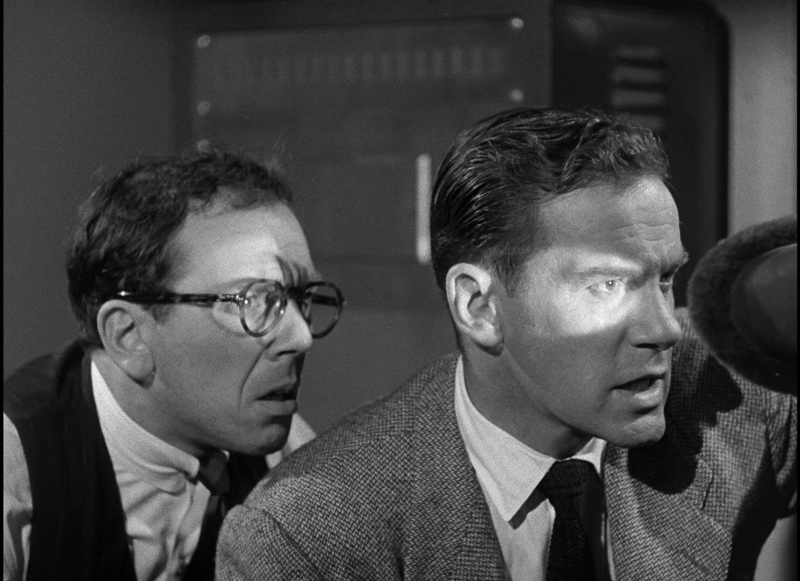
There’s a lot of magnetism in this flick, but sadly none between Drs Stewart (center left) and Forbes (center right)

That’s the mindset needed to better understand this picture, the first of a trilogy (!) of adventures involving the Office of Scientific Investigation (OSI), a group of scientists who investigate possible irresponsible uses of … SCIENCE! (Cue Thomas Dolby music here). Richard Carlson, also seen in It Came From Outer Space and many other cult pictures, stars as Dr Jeff Stewart.

His partner in this one is Dr Dan Forbes (King Donovan, another fantasty-film actor), and the first half of this film is basically a more-scientific police procedural — there’s a business in town that suddenly has all kinds of weird things happening, specifically things getting magnetised (as we quickly find out). The effect appears to be coming from a flat above the magnetised store, but by the time they work this out, the “culprit” has fled the scene, taking whatever it was that was causing this with them.

Oh yeah, we should remember to wear these protective suits from time to time!

The sub-plot, such as it is, is that Stewart’s wife is pregnant but not showing (a constant source of conversation between them — “why aren’t you fat yet?” for example), and Stewart is inspired to buy a house for what he is sure will be a baby boy, but can barely afford it because apparently OSI officials are in it for the love of … SCIENCE! Bonus points for a now-hilarious breakdown of what it will take to buy a house in the early 50s on their basic budget.

“Why aren’t you fat yet?” patronizes Dr. Stewart.

Drawn-out story short, Stewart and Forbes track down an irresponsible scientist, Dr Howard Denker (Leonard Mudie) who was fooling around with making unstable elements and accidentally created a whopper — a radioactive isotope that, every 11 hours, uses magnetism to create energy from every available source in order to double its mass. While the problematic element is still small enough to fit in a briefcase, its exponential needs and growth means it will very quickly become a huge problem that threatens to destroy Earth, aka uncontained nuclear fusion.

Stewart and Forbes confront Dr Denker, who has brought this element on board a commercial plane (!) to try and get it to a university in California to make it their problem to solve, as he is dying from radiation poisoning. Literally in his dying breaths, Denker absolves himself from any responsibility for creating this world-eating thing, saying that he wasn’t responsible for the consequences of his experimentation.

Amoral dying scientist is also irresponsible at handling dangerous materials!

Thus, the second half of the movie is a race against time. Even though the element is still of a size that is portable, it will continue to cause havoc every 11 hours when it needs to be “fed” — and its appetite is also exponetionally growing. The OSI convinces the town to undergo a blackout so that all available electricity can be diverted to the next “feeding” of the element so as to minimize the consequences — but now they have 11 hours until this thing is going to need 600 million watts of power for its next “meal.”

Stewart consults with various other scientists (more doctors per square inch in this movie than any other I can think of!) and eventually comes up with a theory: if he “over feeds” the element, it should split up into two stable elements, ending the threat to earth. But where to get that kind of power?

Stewart and Forbes witness the element drawing energy out of thin air (above), creating micro-explosions and growth.

A US general blabs about a top-secret energy facility deep underground off the coast of Nova Scotia in Canada, and can provide the 600 million watts, but may not be able to be pushed much beyond that. Stewart and Forbes take the risk, fly as quickly as possible to the base, and make it just in time for the start of the magnetisation cycle that starts the “feeding” frenzy of energy collection.

The underground base and its magnetron/cycletron (not sure) are huge and impressive — and come from another movie, the 1934 silent German film Gold, very much in the mold of Metropolis’ special effects. Nearly-seamless editing puts Stewart at the controls of the machine as he pushes it well beyond its tolerances to “overfeed” the element, eventually causing the machine’s destruction — and a few tense moments of magnetisation where Stewart — who has barely escaped with his life — thinks he may have failed, and the world is doomed.

Happily, the magnetised things suddenly fall off the walls, and Earth is saved. The taxpayers of Canada are on the hook for replacing a now-dead power station, but let’s not talk about that! Quick, back to domestic bliss, patronising sexism, and house-buying!

Dr Stewart saves the world … but not this power station … by pushing it into the Danger Zone.

Despite the all-over-the-place levels of scientific credibility, The Magnetic Monster is actually a surprisingly gripping film that holds audience suspense, still. It’s that 1950s earnestness of “we can do anything” spirit that foreshadows the space program and other great accomplishments of the following decades, I think, but it still works.

The OSI’s own computer (seen here) is called “M.A.N.I.A.C,” and it’s dancing like it never danced before.

Scrooge (1951)

dir. Brian Desmond Hurst
(US title: A Christmas Carol)
⭐️⭐️⭐️⭐️⭐️
52-week film challenge, film 50

Naturally we have to do at least one Christmas movie in the 52-week challenge, and for me of course it would be this one. I watch this movie every year, and never get bored of it — always admiring something new, like the lighting of certain shots, the long shadows Scrooge casts, details of Bob Cratchit’s family and so on endlessly.

There are many decent-to-excellent film versions of “A Christmas Carol,” but this one is far and away my favourite, in large part because of its marvelous casting, superb performances (particularly from Alastair Sim as Scrooge), and striking B&W cinematography. Every single member of the cast is on point, camera angles are uniformally well-chosen, the musical score is quite striking (more about that later), the supporting characters are also very memorable, and in short this film is perfect in all the ways — even the additions to Dickens’ story are so well-done you’d hardly believe, for example, that there’s no Mr. Jorkin (Jack Warner) in the original novella.

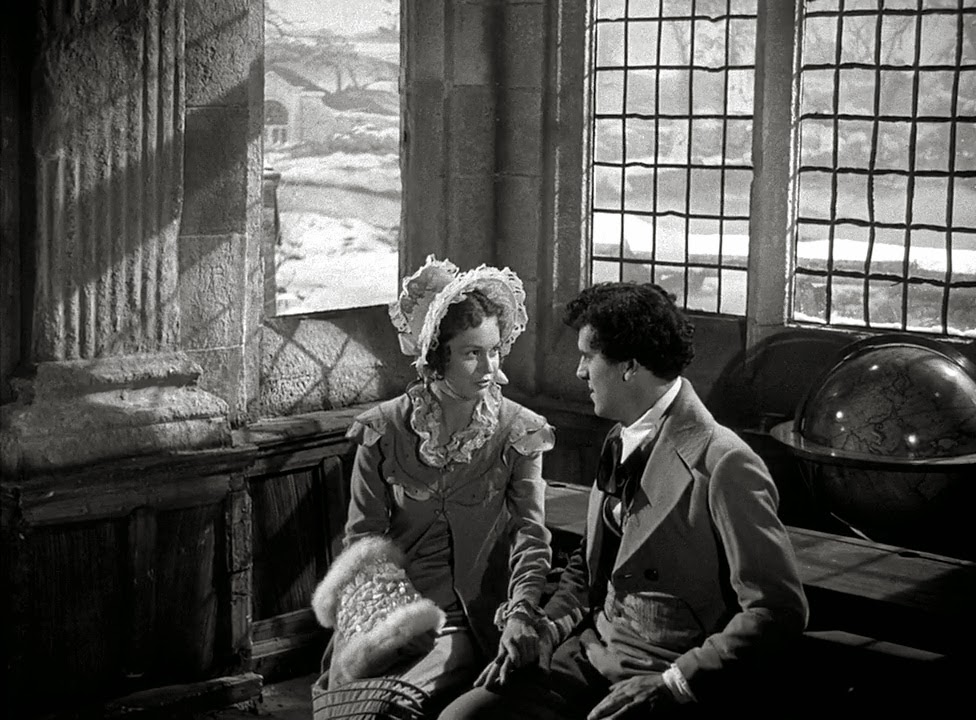
Mr Jorkin (Jack Warner, middle) introduces Young Scrooge (George Cole, right) to his future partner, Jacob Marley (the film acting debut of Patrick McNee, left).

I sincerely believe that if Dickens could be brought forward in time to watch his story on film, this one would be the one most likely to meet with his approval. Certainly he’d like it better than either of the two best-known previous attempts, the comical short silent version from 1910 or the mediocre full-length version starring Reginald Owen from 1938.

Everyone thinks they know the story of “A Christmas Carol,” but relatively few have ever actually read the original work. Changes required to make the story more visual in the various film versions have added elements to the original story, and so does Scrooge, but it is a testament to the skill of screenplay writer Noel Langley that the joins are largely seamless to anyone this side of a Dickens scholar.

Scrooge wasn’t always a jerk: he was always kind and tender to his sister Fanny (Carol Marsh)

In particular, Dickens’ original social commentary is strongly intact in this version, and resonated deeply in postwar Britain of the early 1950s, when the country struggled with crushing debt from the war, and continuing rationing and austerity. Also preserved is traces of Dickens’ Christian faith, and while explicit in some moments it doesn’t overshadow the message of social justice and the responsibility of the the well-off to alleviate the suffering of the poor.

Marley’s ghost (Michael Hordern) tries to show Scrooge the suffering of the poor, but it’s not (yet) effective.

Aside from the radiant performance of Alastair Sim, who set a bar of believability in both pre- and post-reformation Scrooge that no other actor has equaled, special mention should be made of Mervyn Johns as Bob Cratchit, Hermione Baddeley as Mrs. Cratchit, Michael Hordern as Jacob Marley, the incredible Ernest Thesinger as the mortician, Miles Malleson as Old Joe, and of course Kathleen Harrison as Mrs. Dilber, another performance that will never be bettered. There are a wealth of character actors in this, all doing their British Character Actor thing to an absolutely flawless standard.

Special mention too must go to Richard Addinsell, who gave the film a very booming, menacing score that softens all the way to down to music box-like Victorian lullaby in places, and throws in a traditional ballad (“Barbara Allen”) for the film’s climax. Finally, the combination of Ralph W. Brinton (the art director) and C. M. Pennington-Richards (the cinematographer) produce a detailed but very dark style where the shadows are long, the lighting is sparse (until Scrooge’s reformation), and the harshness of life in Dickens’ fable is not shied away from — it is simply gorgeous to look at, and downright spectacular if you have a OLED high-definition television.

Glyn Dearman as Tiny Tim, enjoying a splendid display of Victorian toys.

In these current days of increasing western poverty and misery, with inflation making the working class ever poorer and more angry, the film again becomes more relevant to complement its timeless moral. To quote Bob Cratchit, “it is a perfect pudding!”

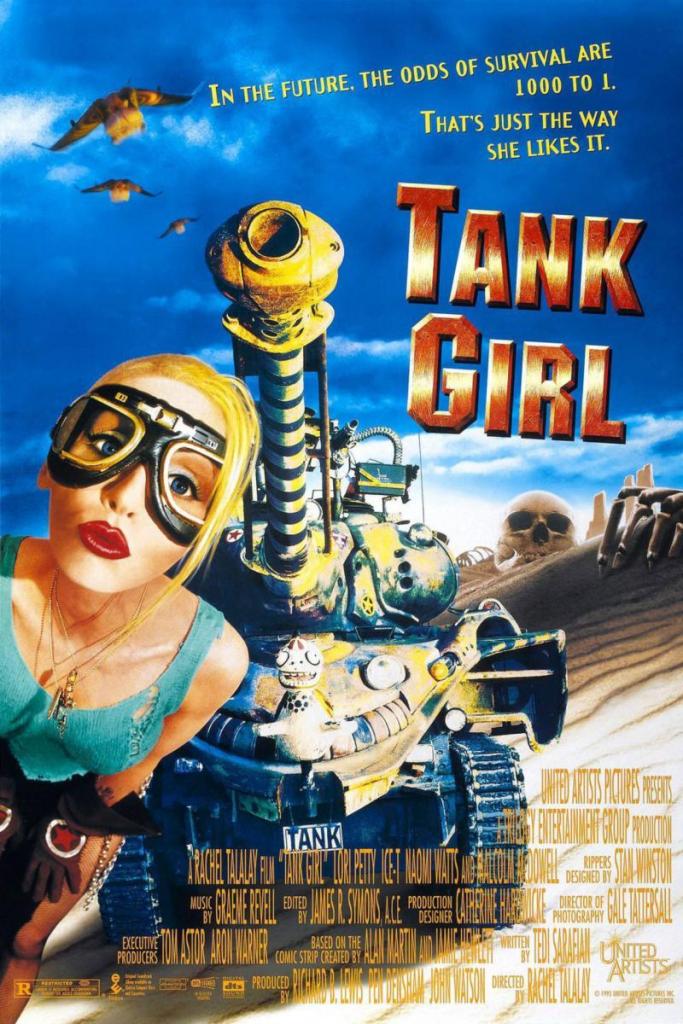
Tank Girl (1995)

dir. Rachel Talalay
⭐️⭐️⭐️⭐️
52-week film challenge, film 49

This review has to come with three disclaimers:

  1. I have never read the “Tank Girl” comic (though it looks like something I’d enjoy). I am reviewing the film strictly as a movie.
  2. I have met and chatted with the director, Rachael Talalay, about her career, US-Canadian immigration issues, and more recently I was present in Chicago for the debut of her latest bit of TV work (for Doctor Who, as it happens), but this doesn’t influence the review too much.
  3. I am aware that the film was, in parts, heavily re-edited by the studio.

With that out of the way, let’s dive in.

Hoo boy, has Tank Girl ever aged well. On its original release, it didn’t do well financially, though it later earned cult status on the strength of its strong “feminist futurism” and humour. It is almost, but not quite, a mirror-universe version of 1984’s The Adventures of Buckaroo Bonzai Across the Eighth Dimension, only with far fewer goatees and more mutants, who eventually form an alliance to take down the mad big bad (Malcolm McDowell, in this case).

Like the earlier film, it has a definite aesthetic that reflects the decade in which it was made, is funny but not meant as a parody, and does some excellent world-building that pays homage to its influences. In the case of Tank Girl, the world of 2033 looks increasingly likely to come to pass — only instead of a comet directly hitting earth causing the climate to change, we just have man-made climate change. I can see this “future” from my house, so to speak.

A hasty voiceover from yet-to-be Tank Girl herself (Lori Petty) sets up the story: since the comet hit (presumably with enough force to push the earth closer to the sun), it hasn’t rained in 11 years, and the world has mostly turned to desert. The (male) elites have taken control of the enormous reservoirs of water underneath the sands in the only livable area left (the former Australia), thus controlling nearly all of the remaining population.

Director Talalay with star Lori Petty.

Some Mad-Maxian-type rebels live “free” in the outback in a commune, relying on finding and tapping into parts of the reservoir to survive. Although the head of the monopolistic Water & Power Corporation, Kesslee (McDowell), is trying to find and destroy these water pirates, the rebels fear another enemy much more: The Rippers, who are kind of armored super-soldiers operating from a secret base.

Buck is quickly established as a sarcastic rebel even before the commune is attacked.

The Rippers attack both W&P and occasionally the rebels under cover of darkness. Insert your own analogy to the aboriginal native populations of various countries (and of course capitalism) right here.

W&P discover the last well the commune has tapped, and attack the commune (which is decorated like every 90s teen’s dream) with corporation troops, killing many of the rebels. The body count includes Rebecca Buck’s (Petty) boyfriend Richard (Brian Wimmer) and, after a brave fight, capturing Buck and a young girl from the commune named Sam (Stacy Linn Ramsower).

Sam (L) and Rebecca

In a classic trope, Kesslee is fascinated by Buck’s spunk and sarcasm — and instead of just killing her, instead enslaves her. When she continues to rebel, he subjects her to various tortures.

Buck meets a fellow prisoner, who Buck nicknames Jet Girl (Naomi Watts) because she is being used as a jet mechanic by the cruel (read: rape-minded) troops. Jet Girl urges Buck not to fight back, but Buck is having none of it — and saves Jet Girl from a stalker trooper by pretending to be Jet Girl’s jealous girlfriend.

Kesslee decides to use the rebellious Buck to lure the Rippers out into the open, but the plan backfires, and Kesslee is gravely injured. Buck gets a tank (and is now Tank Girl), Jet Girl steals a jet, and they seek shelter and spend time modifying their weapons and plotting to break W&P’s control of the world’s water.

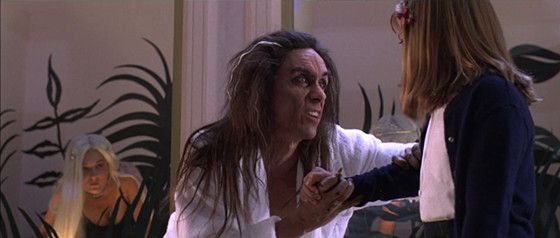
Their success prompts Kesslee to use the little girl Sam as both a hostage and bait, and puts the child in serious danger at one point — I don’t want to say more than that, but Iggy Pop is involved, and not in a good way. The Girls (Tank, Jet, and the little-seen Sub) get wind of this, and redouble their efforts.

Iggy Pop as a (thankfully unsuccessful) pedophile.

The ladies form an alliance with the Rippers, who we discover are mutated men (and the occasional dog that was first mutated into a man) who have been fused with kangaroo DNA (because Australia!) into a funny-looking mercenary force originally created by W&P before being largely wiped out for rebelling. Kesslee hopes their united force will attack so that his army can crush them all, but things don’t quite go according to plan.

That’s Ice-T on the left there, as T-Saint — one of the smarter and more poetic Rippers.

The film might possibly err a little too much on the comic side, but the look and set pieces are aesthetically pleasing throughout. As mentioned, looking at this almost 30 years after its initial release, it seems prescient and less unrealistic than it probably did in 1995. Indeed, “Kesslee” rhymes with “Nestle,” and if you don’t think that evil corporation isn’t trying to buy up as much of the fresh water supply as it can, you might want to read up on that topic.

In the meantime, the rise of women as role models, heroes, rebels, and the leads of non-drama films over the last three decades makes Tank Girl ever more relevant as the years go by. When it was first released, some critics and most audiences didn’t quite “get it,” but the tween/teen girls who got to see it took it into their hearts, and built a cult following around it.

The film turns out to have had enormous staying power as an influence, both outside and inside Hollywood. Although the film flopped in its theatrical run, it did okay with critics — and I think it has since garnered enough respect that a Blu-ray release beyond just the US would be justified.

The “Girls” together — (L-R) Jet, Tank, and Sub

If said Blu-ray could also include a ”restored” version that undid the watering-down cuts and edits the studio insisted on (among many other things, reducing Jet Girl and the blink-and-you’ll-miss-her Sub Girl’s roles, not to mention changing the ending), I think it could even be a hit on the revival circuit as well. As Ms. Talalay has gone on to a strong career in TV and film since then, I look forward to asking her about the “Kesslee” name, and the possibility of a “Director’s Cut,“ when next our paths cross.

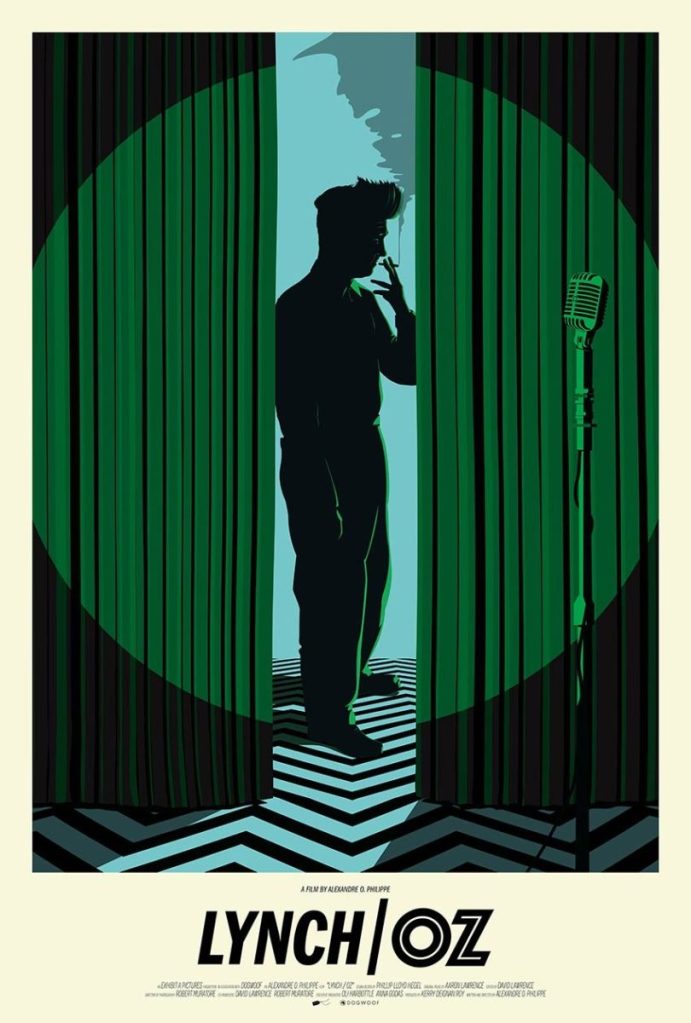
Lynch/Oz (2022, dir. Alexandre O. Philippe)


⭐️⭐️½
52-week film challenge, film 48

The short version: this film-school set of academic essays read aloud with visual accompaniment, which collectively try waaaaaay too hard to connect everything David Lynch has done to the 1939 film The Wizard of Oz is overlong and misguided.

That’s not to say that there aren’t a lot of references and visual cues in Lynch’s work that parallel TWoO; of course there are.

He’s obviously influenced by it, and there’s plenty of examples, either spoken in his films or visual/story metaphors. In answer to one essayist’s question at a Q&A somewhere, Lynch himself says that not a day goes by that he doesn’t think about that film.

Glinda the Good Witch literally makes an appearance in Wild at Heart, FFS.

The problem (one of several) with the central premise behind this is that most artists Lynch’s age or younger can easily be demonstrated to have been influenced by The Wizard of Oz: it was a unique film that embraced Technicolour in a new way, giving new life to L. Frank Baum’s first Oz book (he went on to write another 13 in the Oz series). The film version’s characters, dialogue, and songs have all entered the public consciousness in a huge and enduring way, thanks to the film’s yearly repeats on television and its extravagant, nearly-timeless tale of poverty, fantasy, and the power of friendship and imagination.

Even if you accept that Oz was a major influence on Lynch’s films — and there’s plenty of evidence that it was, in places — the documentary goes on to point out that it was also a significant influence in dozens and dozens of other films that have nothing to do with Lynch at all, thereby diluting Lynch/Oz’s central premise. This adds significant time to the already-thin but interesting premise, with the documentary running a very long-seeming hour and 49 minutes, when it could have been a really tight and more interesting hour.

Lynch/Oz is divided into six chapters, following what director Philippe probably thought was a Lynchian oddball introduction by odd-looking Jason Stoval (as Sid Pink) that falls very flat, as does the reprise at the end of the doc.

Another element that might have helped make this tribute less dull would have been to actually see the six essayists who read their written analyses of Oz’s influence on Lynch. Instead, we get clips from many other movies that also in some way reference The Wizard of Oz, seeming undermining the point of this particular doc — Oz is a very influential picture across all of the last 80 years, we get it.

Amy Nicholson has one of the weakest premises in her section, titled “Wind.” Yes, she talks about the use of strong winds to be transformative agents in both The Wizard of Oz and Lynch movies, of which there are but a handful of examples. Rodney Ascher’s “Membranes,” which posits the dividers between “reality” and the things beyond that (often illustrated with curtains in Lynch’s work, akin to Toto pulling back the curtain to reveal that the Wizard is not who he seems), is much more successful. It’s a very, very, obvious point, but well-explored.

Lynch’s films frequently deal with a character discovering a larger — and more sinister — world than the one they live in, which sparks a journey of discovery.

The third essay is the one that is the most completely worth watching: fellow filmmaker John Waters, who has a delightful personality and distinctive speaking voice that radiates joy, talks about how he and Lynch are of similar age, and so of course are in some ways influenced by the same films they saw as kids — not to mention that, like Lynch, he developed a fixation on the undersides of façades. Waters shares an anecdote of meeting Lynch, talks about their shared influences, and similar — but very distinct — desire to poke around underneath the fantasies we all try so hard to fit into our realities: it’s by far the best of the essays.

That’s not to say Karyn Kusama’s pondering on “Multitudes” in her exploration isn’t good also, but it marks a return to the more dry and academic style of analysis that has dominated this documentary until Waters brought some fun in with him. Thankfully, this is followed by Justin Benson and Aaron Moorhead’s humourous ruminations on the frequent reference to a never-seen “Judy” in Lynch’s TV and film work, which brings in an excuse to explore the influence of Judy Garland’s own life on Lynch — a genuine and, once you see it, obvious musical influence that their essay makes clearer.

I did appreciate the documentary pointing out some examples of red heels (and even clicking them) in Lynch’s work.

This leaves David Lowery to bring up the rear with his essay on the theme of digging — a pretty weak link, and a curious choice for the finale of the documentary. He pokes around at the rather obvious point that Lynch’s characters often try to either bury things they don’t like, or have such things dug up (metaphorically or literally).

As a Lynch fan, I was hoping I’d get more out of this documentary than I did, though I do appreciate both some of the essays and examples they gave to support their point, and of course the archival footage of Lynch interviews, which are sprinkled throughout. Lynch doesn’t talk that much about his own work, so these nuggets are rare and Lynch’s obtuse way of answering questions about his work are mischievous and amusing.

If they’d drop the pretentious opening/closing, the seemingly-endless references to non-Lynch films that have obvious Oz references, and maybe the weakest of the essays (either “Wind” or “Dig”), you’d have a smart, shorter documentary with some real insight. It’s too bad director Philippe didn’t do that, because what he ended up with is a documentary that will have you squirming in your seat — for all the wrong reasons.