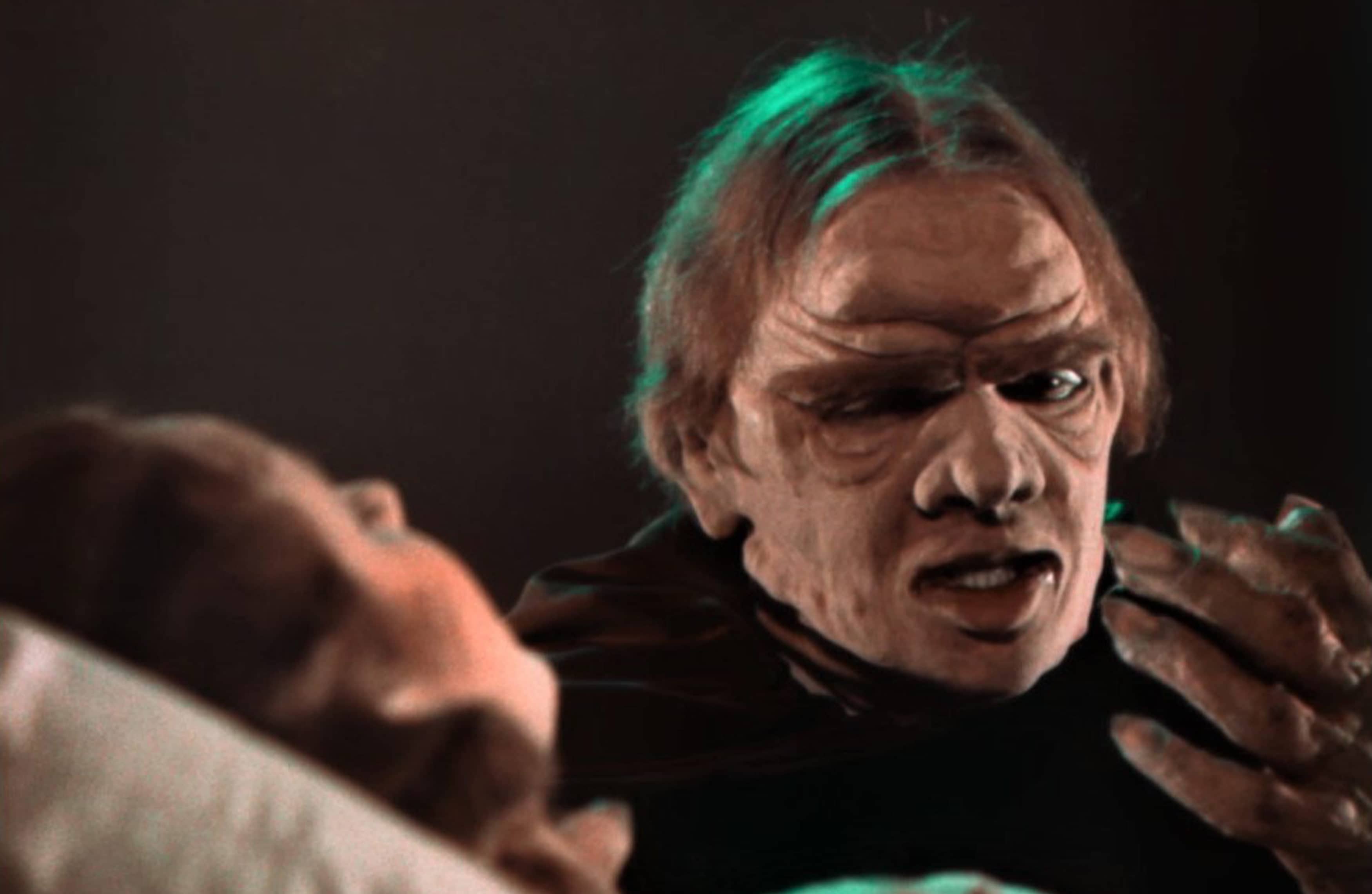
Godzilla Minus One (ゴジラ-1.0) (2023)

directed by Takashi Yamazaki
⭐️⭐️⭐️⭐️
52-week film challenge, film 47

This remake of the first Godzilla film from 1954 (my review of that one is here) is a really clever reimagining that turns the perspective around: the focus here is on the human beings affected by the monster, rather than the monster itself. It makes brilliant sense in that the original really showed off the effects, but the new one looks at this phenomenon from a completely different angle.

I certainly did not expect a Godzilla movie to be this emotional, nor did I expect it to be entirely in Japanese with English subtitles in North American cinemas (nice touch). I find it fascinating that 37 films in — with multiple “reboots” from both Toho and Legendary Pictures — they found something new to say about kaiju generally, and yet also reiterate the original’s analogy to nuclear war.

Furthermore, I was completely gobsmacked when I discovered that the budget for this shot-in-the-arm epic was a mere $15 million — there are some films that exist where the catering bill for the shoot was around that amount!

I have, of course, seen quite a number of Godzilla movies over the years, though I largely haven’t seen the post-2000 comeback films. Growing up, Godzilla movies were fun and cheesy, and you (or at least I) never paid a moment’s attention to who was in those (model) ships, tanks, and buildings the monster trashed like the cheap paper maché they were. I also watched TV shows inspired by those movies, including “Ultraman,” a particular favourite.

Godzilla looks so “smol” in the 1954 original. Inflation, I guess, whatcha gonna do?

The genius of writer, director, and visual effects chief Takashi Yamazaki is in putting the emotions and the people up front in this version, with the title character itself getting a fair amount of screen time, but only very rarely being the focus. He even explains both why Godzilla keeps coming back, and why he’s so gigantic and “Hulk-like” compared to his first appearance.

That said, the vast majority of the time spent here is on the humans, specifically telling the story of Kōichi Shikishima (Ryunosuke Kamiki), a kamikaze pilot near the end of World War II — when the outcome was no longer in doubt — who chickens out, and feigns engine trouble and lands on Odo Island. That night, Godzilla emerges and attacks the base. Shikishima gets into the plane, but cannot muster up the courage to shoot at the dinosaur-sized monster.

He survives to find only one other survivor, Tachibana (Munetaka Aoki), who blames Shikishima for the deaths of the other men. A year later (1946), he returns home and learns that his parents were also killed by Allied bombers. He meets a woman named Noriko (Minami Hamabe) who is taking care of an orphaned baby named Akiko (Sae Nagatani) that she has rescued.

As he is suffering from survivor’s guilt, he takes care of Noriko and Akiko, forming a sort of family. Although all three clearly care for each other, it is not made explicitly clear if Shikishima and Noriko actually became romantic partners.

Meanwhile, Godzilla gains his gigantic size and atomic powers via the US military’s nuclear testing in Bikini Atoll. The enlarged and super-powered monster attacks the ships, and then heads towards Japan.

By mid-1947, Shikishima has had some success in a dangerous but well-paying job, aboard a ship clearing mines left by the US around Japan. Authorities, which have been tracking Godzilla’s slow approach to Japan, order the minesweeper try and delay Godzilla’s approach so that more powerful ships can get there.
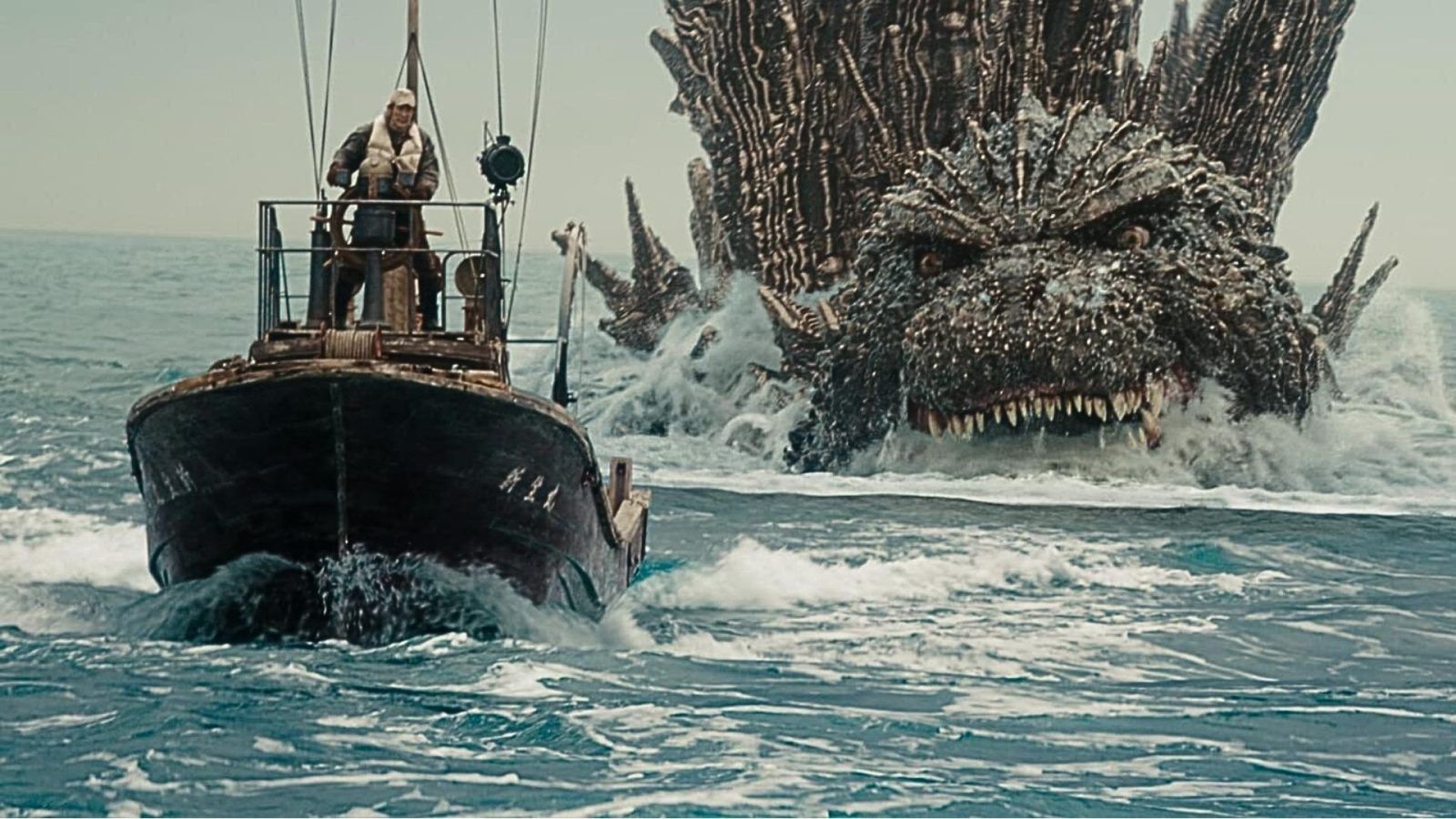
Cleverly, the shipmates use a mine and manage to release one that explodes in Godzilla’s mouth — which does some actual damage — but the creature can seemingly regenerate from injuries. A heavy cruiser arrives just in time, but is destroyed when Godzilla shows off its new power of atomic breath.

Of course, Shikishima is re-traumatized by the return of Godzilla, now enomous and unstoppable. Godzilla eventually reaches Japan, and attacks the city of Ginza. After tanks engage Godzilla, it again employs its atomic breath, destroying the city and seemingly killing Noriko after she saves Shikishima. He is yet again re-traumatized by this loss.

Since neither the US nor Russia will help because of tensions between the two, the Japanese government essentially gives up and does nothing. One of the minesweeper’s crew, Kenji Noda (Hidetaka Yoshioka), assembles a team and comes up with a plan to destroy Godzilla, using a small group of former Navy veterans — including Shikishima — and some disused Navy carriers to carry out the plan.

Unbeknowst to the others, Shikishima has finally been pushed too far, and plots his own revenge on Godzilla, that will presumably cost him his life. He makes arrangements for the care of Akiko with neighbour Sumiko (Sakura Ando), and pretends to cooperate with Nodi’s plan.

And like a good neighbour, Sumiko is there …

That sets up Act 3, and I don’t want to go into the plot any further because the movie is still playing in cinemas as I write this, except to say that some good twists ensue as the group bravely takes on Godzilla and Shikishima seeks revenge and redemption.

I, at least, was surprised by the finale as well as the final scene. I was also utterly delighted by some surprise callbacks to the original film.

Noriko sees Godzilla for the first time, shortly before she is swept away.

I was downright shocked by how engaged I was with the emphasis on the people affected by these events, and how right this alternative approach felt, viewing it from my cinema seat in a world where Godzilla is a stuffed toy with a very long history (and, as mentioned, an ongoing successful franchise for Toho).

70 years on from the original film, the monster itself can still elicit nostalgia and appreciation, but going back to its roots from a very fresh angle has given Godzilla Minus One something new: emotional connections with its audience beyond a general fandom. I’m not sure if this approach would work repeatedly, but it has certainly injected some fresh blood (sorry) into a franchise that had become cliché.

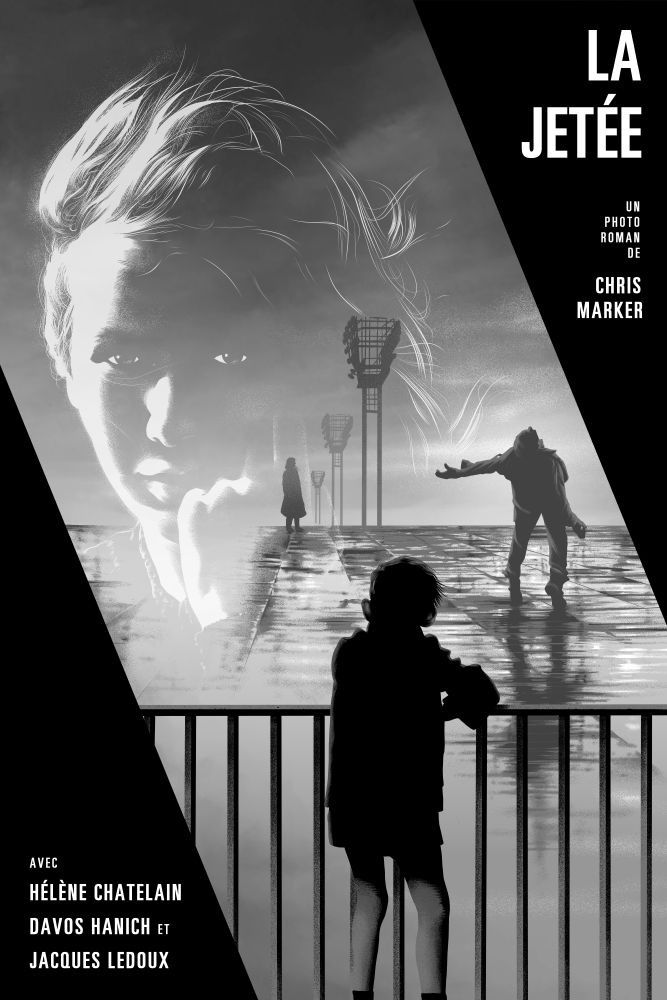
La Jetée (1962)

dir. Chris Marker
⭐️⭐️⭐️⭐️⭐️
52-week film challenge, film 46

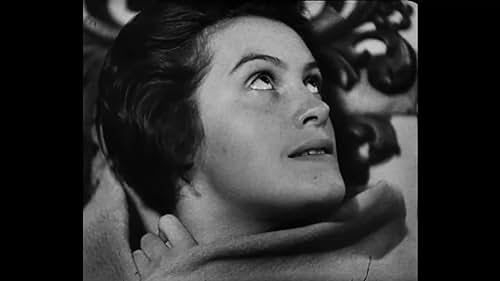
I believe I am correct in saying that La jetée, at only 28 minutes long, is the shortest film in “Sight & Sound” magazine’s listing of the greatest films in history (currently ranked at #67 in the critics’ poll, but #35 in the directors’ poll). Nonetheless, its impact on the medium of film, on storytelling, and on the notion of “science fiction” is significant.

Some wag once called it “a slide show with an IQ of 180,” and they’re … not wrong. Except for a small moment of moving images, the film is composed almost entirely of photographic still images, where the viewer must study what’s briefly on screen carefully to extract as much information as possible, combining the visual information with the audio cues and narration. Of course the medium of film is itself a series of photographed still images, but show quickly enough that the illusion of movement, of synchronised sound, of emotion and performance, is fluid.

Here, director Marker slows down the flow to create an irony, rendering it as a unique method from which we get our information; we infer, rather than see, the passage of time between each image — that interesting process in our minds where our vague memories and our dreams cross each others’ paths.

The “story,” such as it is, is stark and minimal: in a bleak post-nuclear dystopia sometime after World War III, a man is selected by a small group of scientists (German, it seems, given the whispering that occasionally appears behind Jean Négroni’s vital and nearly poetic narration), to engage in an experiment to save the present by calling on the past and the future to provide a solution — induced psychological “time travel”

The man has always held some strong mental images to keep his memories intact, and these scientists can see into people’s minds, so they have picked him. While being held captive, he is injected with something to prompt his (mental) return to the past, before the current situation, where he meets a woman not unlike “The Time Traveller’s Wife” — a figure not part of his memories, who accepts each new visit without question, calls him “her ghost” and builds a bond of trust and friendship with him.

Having successfully sent him into the past, the scientist then attempt to send him into the future, with far more obscure results. The man, seduced by the woman of his “dreams,” appears to “escape” his present and live permanently within his memories with this woman — combining the hazy glow of happy memories with this new dream-like woman, forging his own personal paradise.

Despite the vagueness that is part and parcel of this story, there is a definite ending I won’t spoil. The narration acts as a hypnotic element drawing the viewer in alongside the score — the visuals, the narration, the score, and the still-image juxtaposition of past, present, and future all interplay with each other to create a remarkable journey that is likely to stay with viewers as they reassess their own recollections, dreams, and reality.

Yes, the Terry Gilliam film 12 Monkeys is something of an expanded and re-envisioned remake of La jetée, but I’d encourage anyone who hasn’t seen that (or even if they have) to sit with La jetée and let it mess with your own head a little bit.

Even the title is a bit of a mind-slip: Literally, it refers to the jetway at Orly airport (which we repeatedly come back to), but it’s been pointed out to me that the could be seen as a play on là j’étais, which translates to “there I was.”

Radio On (1979)

dir. Chris Petit
⭐️⭐️
52-week film challenge, film 45

I’ll admit it, the soundtrack of Radio On is what pulled me into watching it. The very late 70s, 1978-79 in particular, were the original “post-punk” years and pivotal to me finding my musical “tribe,” which covered punk, ska, and especially New Wave with its synthpop vibes, calling back to Kraftwerk and other synth pioneers.

On that front, the film ticks many of my musical boxes: early Devo, Kraftwerk, Robert Fripp, Ian Dury, Wreckless Eric, Lene Lovich, The Rumour, and David Bowie all appear in full or (mostly) bits, so the soundtrack would normally get five stars from me — except that you rarely hear the full songs. Still, the aesthetic is there, and it’s the best part of the movie.

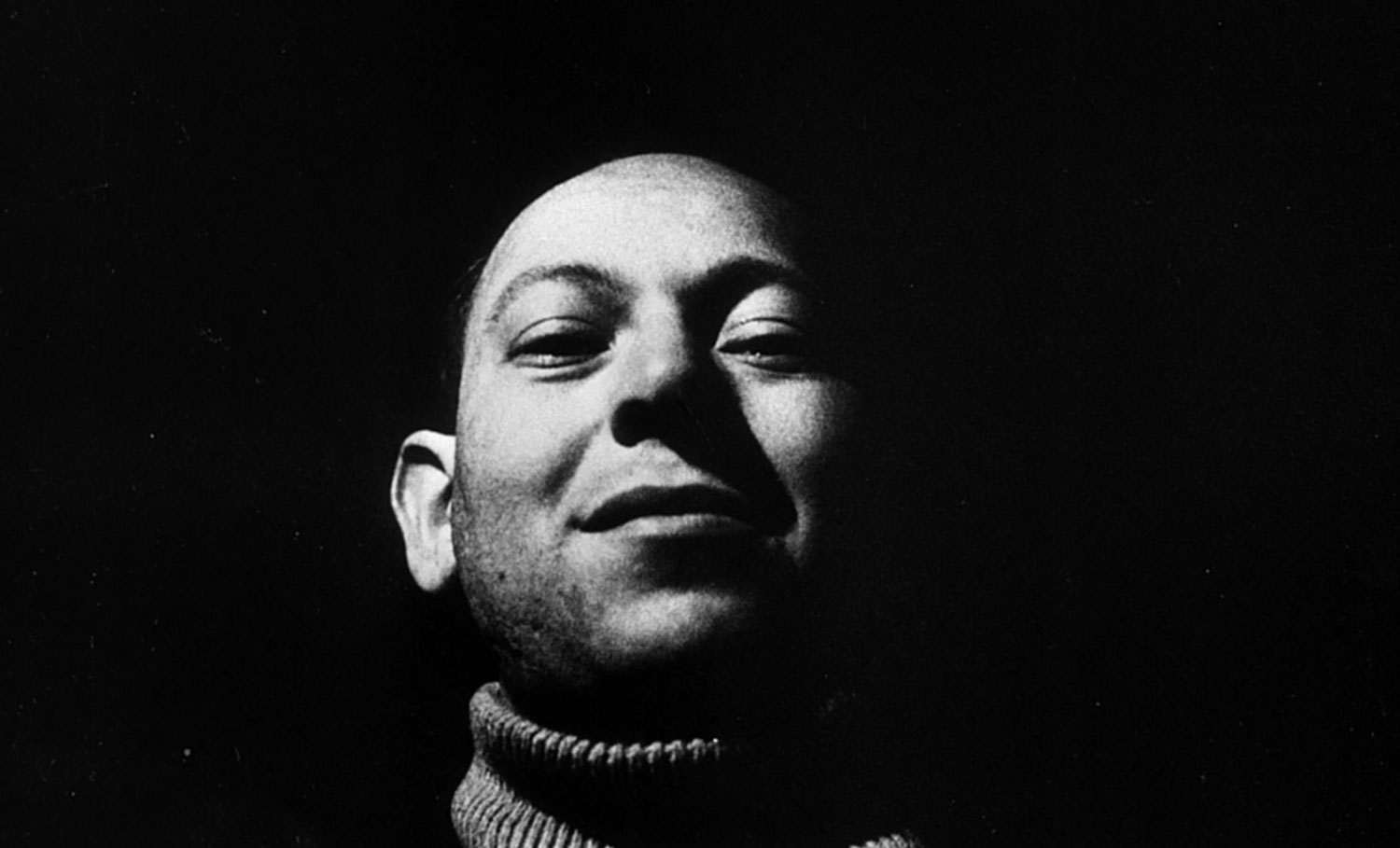
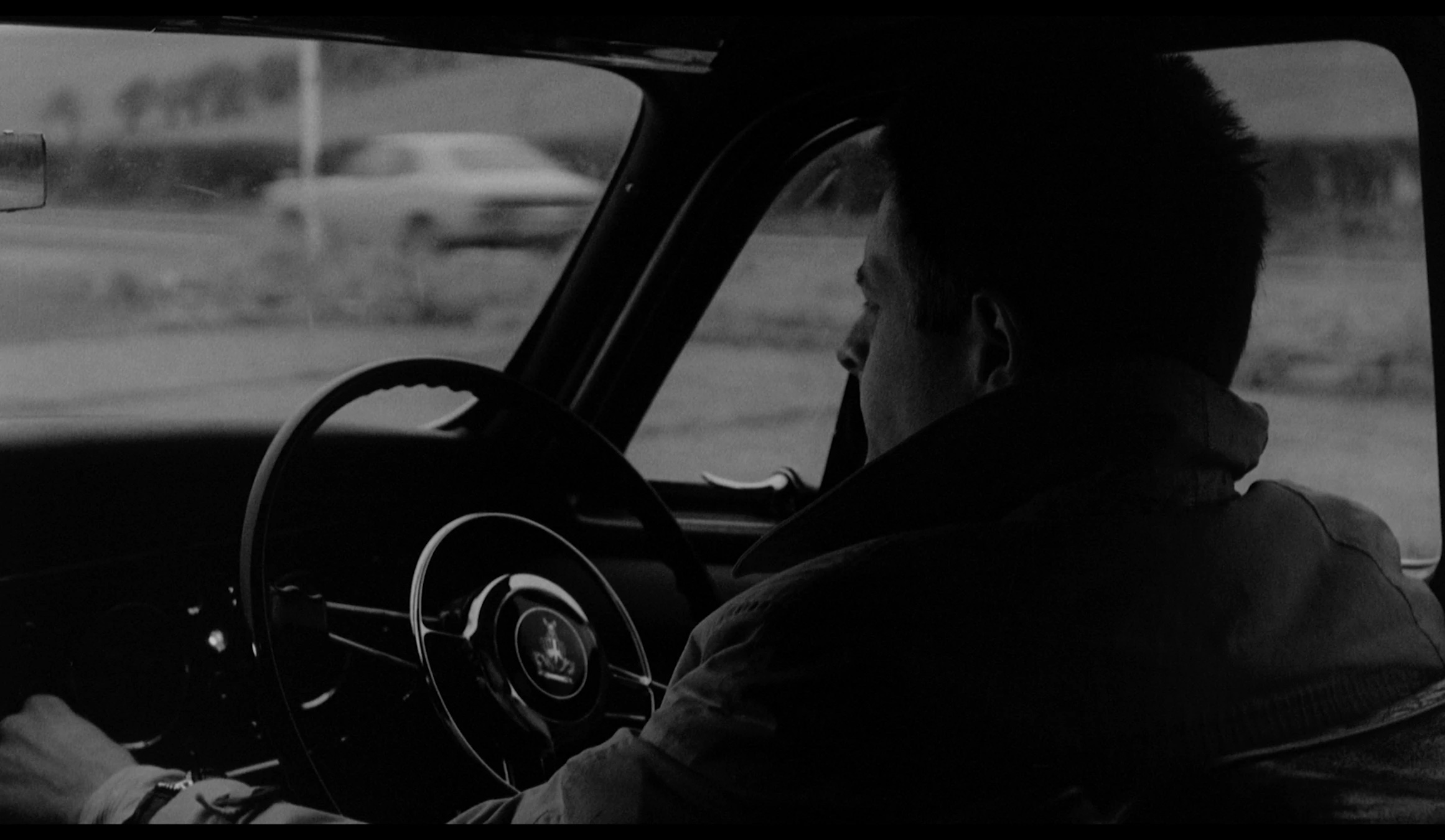
As for the film itself, it has the loosest of possible plots: a man named Robert (David Beames) who works as a DJ for a chain of biscuit (cookie) factories — yes, playing music live to workers — has to leave his empty life in London to drive to Bristol, as his brother there has committed suicide for no discernible reason. Most of the movie is simply Robert driving to — and then back from — Bristol, making this technically a (rare) British road movie.

This is literally about 90 percent of the movie.

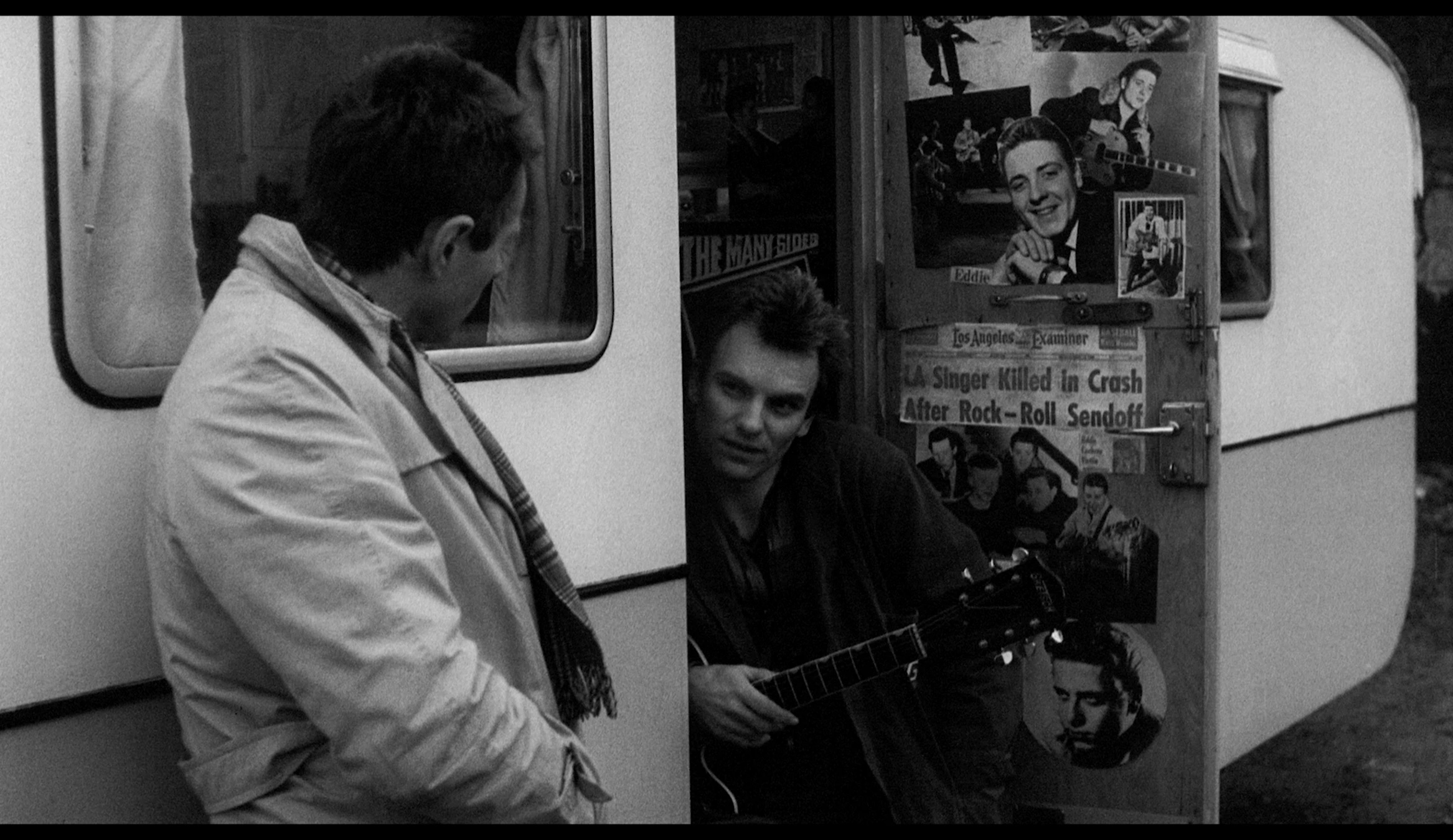
It’s shot in black and white by Martin Schäfer, best known for being Wim Wenders’ assistant cameraman — and indeed, Wenders is also involved in this. Along the journey to Bristol, he meets a few people (including Gordon Sumner, better known as Sting from The Police, who plays a homeless troubadour) and shares a few moments with various people, including a couple of girls, but nothing much actually happens.

This lack of clear story and the litany of drifting, directionless characters is undoubtedly meant to convey the post-punk generations’ alienation from “society” and general ennui and aimlessness in the aftermath of punk, heralding an ongoing emergence of a world where not much gets done, and nobody seems to care much, or commit to anything. The performances, particularly Beames’ Robert, offer moody minimalism and slacker angst, which has been the soundtrack to successive generations ever since.

As symbolism, that angst and purposlessness comes across in the film; 40+ years after Radio On was made, things haven’t changed that much, though some inconsequential music and fashion trends have periodically managed to march through in the meantime. So we get a lot of well-shot but visually-flat driving to “nowhere” and then back again.

Robert finally gets to Bristol, pokes around a bit, talks to his brother’s girlfriend/partner (who has little to say) for a few days, hangs out in Bristol a bit, then begins the journey home, none the wiser. As mentioned, he meets some people going to Bristol and on the way back, and while these encounters inject some interest and really minor amounts of insight, nothing much comes of them.

The “ending” of the film, where Robert finally must abandon his misbehaving car and take the train the rest of the way home is the most interesting point in the film, primarily in contrast to the monotony that came before it.

I don’t want to make it sound like I hated this film, I didn’t — a journey is a journey, and some scenes were filmed in specific neighbourhoods I know from my own travels, and did I mention the soundtrack? — but Radio On has little to offer beyond its great musical choices and some kind of vague statement on the desperation of living in the very late 70s as a member of the “lost” generation, which as far as I can tell are still mired in their own entropy.

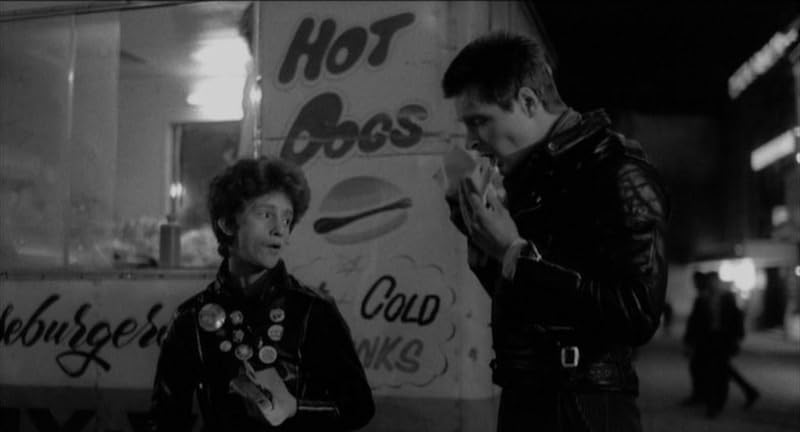
If you knew this place in 1979, you were a pretty cool kid.

Brighton Rock (1948)

Dir. John Boulting
⭐️⭐️⭐️⭐️
52-week film challenge, film 44

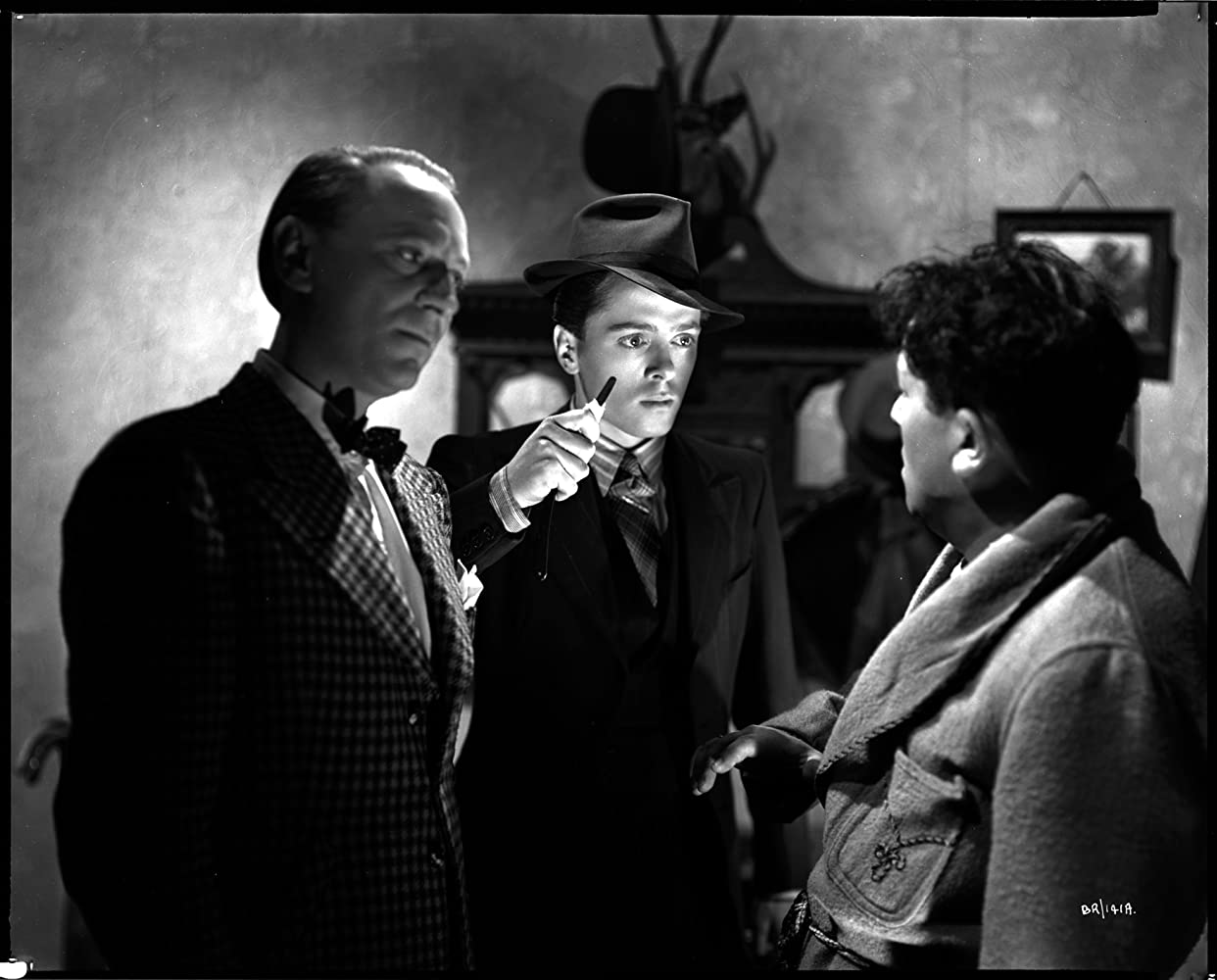
Whilst away on a quick vacation, I had an opportunity to see Brighton Rock, a Graham Greene adaption starring Sir Richard Attenborough and, yes, William Hartnell. Although all of the Doctors are fine actors, the more I see of Hartnell the more I admire the variety he brings to his parts.

I’m beginning to believe that Hartnell did actually say that the only man in England who could replace him as The Doctor would be Patrick Troughton; they both mold themselves into the part instead of (as happens too often these days) the part being effectively written especially for the one character an actor plays especially well. Hartnell is only a featured player in this one, where the lead is Sir Richard Attenborough playing “Pinkie” Brown, a ruthless small-time gangster who leads a small-time gang of crooks, of which Hartnell’s Dallow is the most loyal but least adventurous … at least at first.

They spend their time shaking down some merchants of Brighton, a popular seaside tourist town on the southwest coast of England. Having been there, I can attest that things have only changed superficially there in the decades since this was made.

The story starts after the murder of a gang leader named Kite, that the police suspect was the result of gang wars in Brighton. They couldn’t be more correct: young Pinkie Brown has just taken over Kite’s old gang, and when Brown discovers that a man named Fred Hale is in town for the day doing a newspaper promotion, Brown blames Fred (who clearly had some unshown previous dealings with the gang) for Kite’s death.

The gang confront Fred in a pub, then chase him around the area until Pinkie manages to kill him on an amusement park ride. Before that, Fred meets local busybody and brassy entertainer Ida Arnold (Hermione Baddeley) who picks up on the fact that Fred’s scared. When he is in fact killed, the police think it was a heart attack, but Ida starts trying to reveal the truth.

Pinkie shows Fred the jig is up and leads him to his death in the Haunted House ride.

Following the murder, Pinkie moves to cover up when he died, by having his lieutenant Spicer distribute the remaining contest cards as though Fred was still doing it, but Spicer was seen putting one of the cards in the cafe where Fred was seen. Pinkie decides to put a card under the table at the cafe himself, and meets the same waitress that waited on Fred, a sweet doe-eyed thing named Rose (Carol Marsh). Pinkie alternates between “flirting” with her and trying to find out what she knows.

Ida comes into the cafe, and gets a suspicious vibe off Pinkie that Rose probably sees as dark and exciting and thus attractive. Pinkie asks Rose out, but he’s not truly interested in her; she’s smart and knows he’s somehow involved in the gangs. Pinkie has designs to marry Rose purely so she cannot give evidence against him (as was English law at the time).

This sets the main plot in motion, to see how these scenarios will resolve themselves, and the answer is “not quite as you’d expect,” thanks to a number of well-done additional elements, including Pinkie’s conflict with the older boss of a rival gang; that Pinkie has no loyalty even to his own gang; a phonograph record Pinkie makes in a booth that we eagerly await the result of, which includes a great twist. The various elements really add to the story.

As with other Graham Greene works, the screenplay wrestles with the differences between Catholic morality — which is heavy on themes of damnation and forgiveness — versus individual moralities of mainly non-religious or not strongly so individuals when those moralities conflict. The film was seen as having excessive violence and thus didn’t quite break even on release, but in the US (where it was retitled Young Scarface) the violence wasn’t seen as excessive, and thus didn’t do well there either.

Ida’s got a bad feeling about this …

Brighton Rock (the title actually refers to a popular candy of the time) consistently shows up quite high in lists of the best British films, and I suspect this is mostly due to Attenborough’s incredibly strong performance as the paranoid and borderline-psychotic Pinkie. It certainly does a good job of capturing the unseemly underbelly of a resort town, and is populated with a variety of colourful British characters.

The performances, from the unnerving Pinkie to the fiercely loyal Dallow to the semi-innocent Rose and the caricaturish Ida are all “rock”-solid, and the gang fight was seen as shocking at the time. There are enough unexpected plot turns to keep even those not fond of “gangster movies” interested, and the contrasting themes of dark motives and bright, happy tourists (not extras; the tourist scenes were shot serepticiously) is a wonderful backdrop that breaks up the frequent cruelty.

Not a single person in the crowd scenes knew they were being filmed for this movie.

If you like old movies with a lot of character action but aren’t fond of US-type gangster movies, Brighton Rock might be worth a try. The twist at the end is brilliant — but made Graham Greene angry, and that’s more than enough to go on for me.

Withnail and I (1987, dir. Bruce Robinson)

⭐️⭐️⭐️½

52-week film challenge, film 43

We’re up to Doctor Who #8 on our filmic celebration of “Doctor Who”’s 60th anniversary. For those who aren’t fans of the TV show, Paul portrayed the 8th Doctor in a TV-movie in 1996, which technically I could have reviewed — I most definitely have thoughts on it — but I thought I’d get back to “proper” movies, and this is the one he’s best known for.

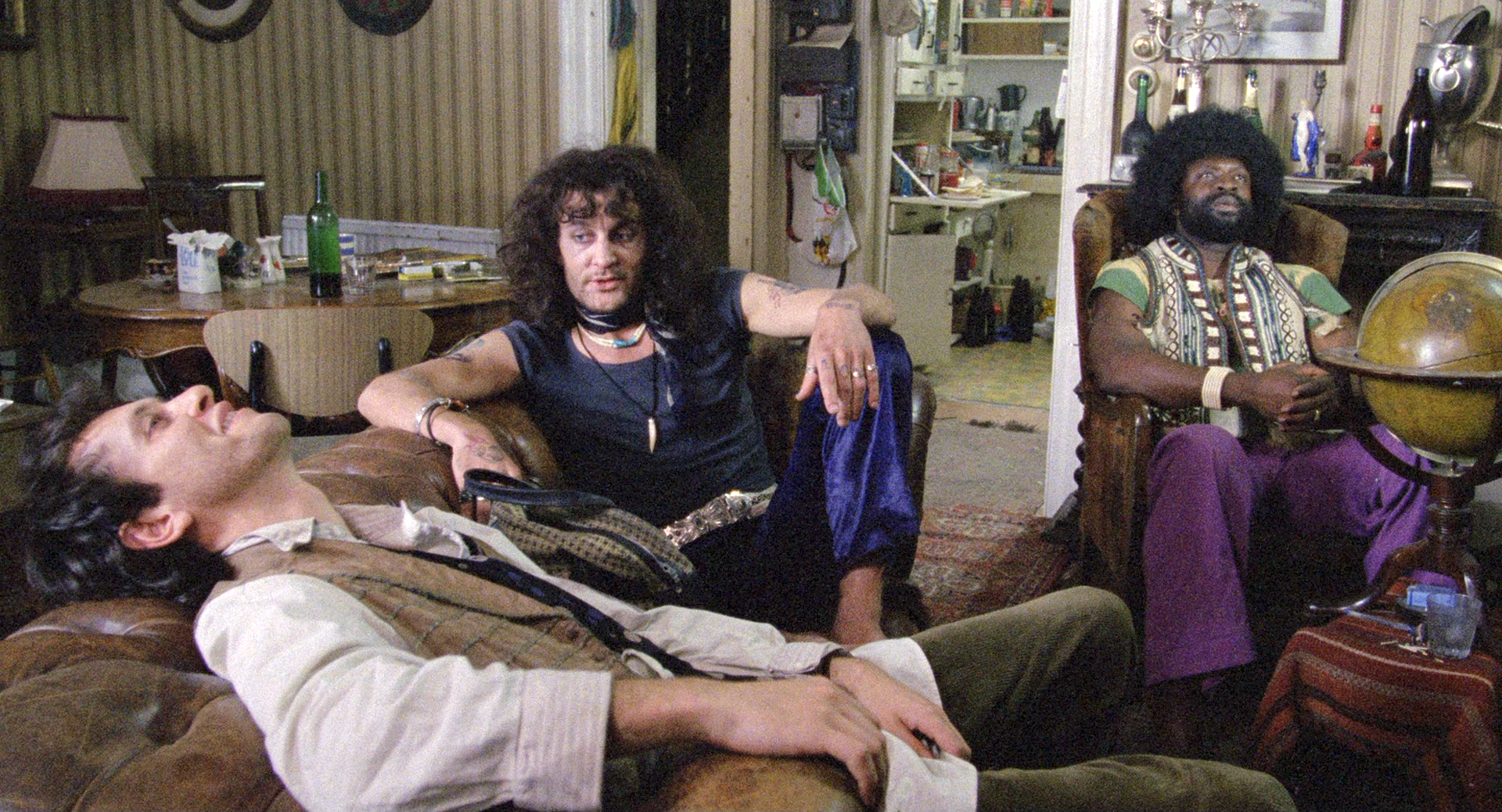
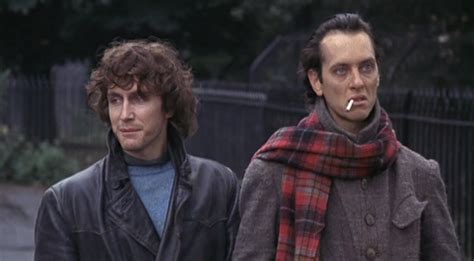
It’s an intriguing and wryly funny film written and directed by Bruce Robinson, based loosely on Robinson’s own life in Camden Town in the late 1960s. It centers around two currently-unemployed actors (Richard Grant as Withnail, and McGann as “I”, who is named “Marwood” in the script but is based on Robinson himself).

As we meet them, they are busy cross-feeding each other’s worst traits: Withnail is prone to abusing drink and drugs, Marwood is prone to bouts of paranoia. They live in a filthy flat and wait for the phone to ring, living off unemployment compensation and indulging their vices.

On a particularly going-spare sort of day, Marwood convinces Withnail to call up his eccentric Uncle Monty (Richard Griffiths) and ask for the use of Monty’s country cottage in Penrith in the Lake District for a recuperative getaway. Let’s just say things don’t go quite as planned for Withnail, Marwood, or Monty.

The film has gained a cult reputation for its realistic look at the late 60s from a particular angle, and also because of a gay subplot that never really gets fully resolved (by design). It’s a very black comedy, but there are some very serious moments as well.

Grant’s flamboyantly seething performance as Withnail is meant to be the star of the film, but McGann’s Marwood is a good foil, alternating between hopeful optimism and dark paranoia, the latter of which gets encouraged by various incidents. Both men seem unprepared for coping with the real world, let alone rural England, and each is dependent on the other to try.

Our “heroes” arrive at last at the “cottage.”

The film effectively shows the two leads in rapid descent in Act One, but Act Two is where the movie picks up steam, as the pair leave the flat, encounter the rural locals, and don’t get on too well with them. Luckily, Monty arrives by surprise (a great excuse for Marwood’s paranoia to fall into a near-breakdown), but his presence brings both relief (he brought supplies!) and tension (he had a reason for coming) that fuels the third act.

Without giving too much away, there’s a comedic return to London and then some good fortune comes Marwood’s way — an acting job in Manchester — and thus the team has to split up. What becomes of the alcoholic Withnail is left open, but it doesn’t look like it will be anything good.

The boys’ idea of “fishing”

This is a movie that could only be made based on true-life adventures of the writer-director, because no scriptwriter would have planned for this level of emotional complexity — or, for that matter, this much colloquial English and plot-moving voiceovers — in a mainstream film. Indeed, a lot of the time the story seems like it would have made a good play, given how dialog-driven it is.*

*and as I was writing this review, I discovered that it has indeed finally been turned into a play which will premiere in Birmingham in May of 2024. Called it!

All of the main characters are based on real-life people, with “Withnail” being based on a friend and housemate of Robinson’s who was indeed alcoholic. “Uncle Monty” is based loosely on Franco Zeffirelli, with whom Robinson worked as Benvolio in the 1968 film Romeo and Juliet.

A very English movie.

The film turns really dark late in the second act, and then (thankfully) lightens up and brings back the comedy. When the the lads make it back home, they find their drug dealer (Ralph Brown) and friend (who is called “Presuming Ed,” played by Eddie Tagoe) squatting in their flat, waiting for them to return.

Producer Paul Heller was able to raise some of the money needed for the film, but turned to Handmade Films (George Harrison’s company) to secure the rest of the funding. Richard Starkey (Ringo) gets a special thanks in the credits, but with no explanation as to why.

Presuming Ed (right) is worth the wait.

This film, once viewed, certainly stays with you, as there really is nothing much like it. I am still thinking about McGann’s superb performance in a long scene where Marwood must talk his way out of a challenging situation, and spins a tale that might well be more true in some ways more than he actually realizes himself.

It’s a film you will remember, fondly or not, since the truth of it rings through — even though Robinson compressed events from across two or three years into two of three weeks in the screenplay. It truly could only have been made in England.

Disrupting a tea room. Very funny stuff.

Maybe another reason this film is so memorable, apart from its honesty, is that it can easily be seen as the first slacker “buddy movie,” a lifestyle that would come into mainstream consciousness in the 90s with films like Trainspotting and TV shows like “The Young Ones,” and which plenty of young people here in the impoverished 2020s can still relate to. It has certainly influenced a number of films, such as Pineapple Express, to name but one example.

If you like your comedy to be as black as your soul, you’ve found your new favourite movie. As a time capsule of a certain time, place, lifestyle, and one man’s memories and adventures, it’s a unique film. That both would go on to worldwide fame along very different paths makes you realise how incredibly well-cast Withnail and I is, too. Take a chance, try something out of your usual. Oh, and for the love of all that’s holy do not drink lighter fluid, no matter how desperate you become.

The Airzone Solution (1993, dir. Bill Baggs)

⭐️⭐️⭐️
52-week film challenge, film 42

For those who haven’t read the previous few entries, we’re celebrating the 60th anniversary of the TV show “Doctor Who” by reviewing movies in November that feature actors who played the title role in the show. We’ve already covered the first four Doctors, and now I’m doing a bit of a cheat to get to Doctors 5, 6, and 7 (with an extended cameo by Doctor 3) in one fell swoop with The Airzone Solution, a direct to video “movie” made during the early-90s hiatus of the TV show by a friend of mine, Bill Baggs.

I should mention that one or two other friends of mine are (briefly) in it, but that won’t influence the review. In brief, it’s a competently-made ecological thriller set in the year 2091 (where retro old-school IBM type personal computers and 3.5″ floppies have made a comeback!). It gives the three main actors and some of the supporting cast (also from “Doctor Who”) something different to showcase another side to their acting abilities.

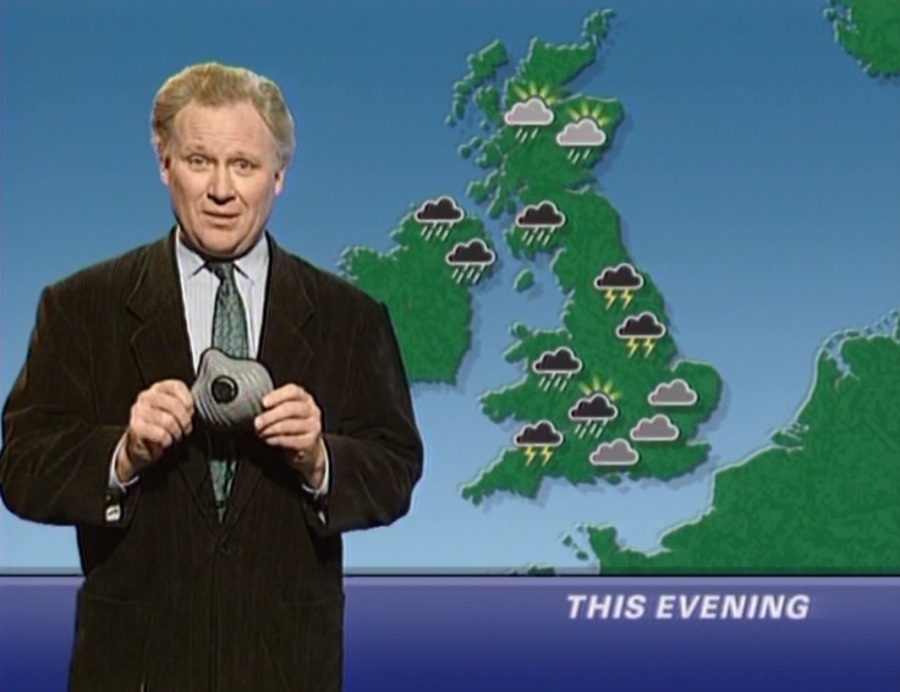
It’s quite watchable still, largely because writer Nicholas Briggs was incredibly prescient about predicting both widespread mask wearing and increasing ecological disasters, both of which have since happened/are happening; his only mistake was in combining them into one problem, and setting his story too far into the future (optimist!). He also nailed corporate responses to these sorts of problems, which if anything have only gotten even more entrenched and tone-deaf.

Publicity picture. L-R: McCoy, Pertwee, Baker, Davison

If you didn’t know the connection to “Doctor Who,” you will probably find this project a bit low-budget and occasionally cliched, but decent. If you do know the connections of the main and secondary actors to the TV show, you’ll probably enjoy this more than the general public as a whole.

The story centers around two men — indie filmmaker Al Dunbar (Peter Davison) and environmental activist Anthony Stanwick (Sylvester McCoy), who are each going their own way but occasionally cooperating — with the help of a benefactor, Oliver Thretheway (Jon Pertwee) — on suspicious activity by private company Airzone. The company CEO, Robin Archer (Bernadette Gephardt), has promised the UK government a miraculously no-pain solution to decreasing the air pollution that forces people to wear masks when they’re outside.

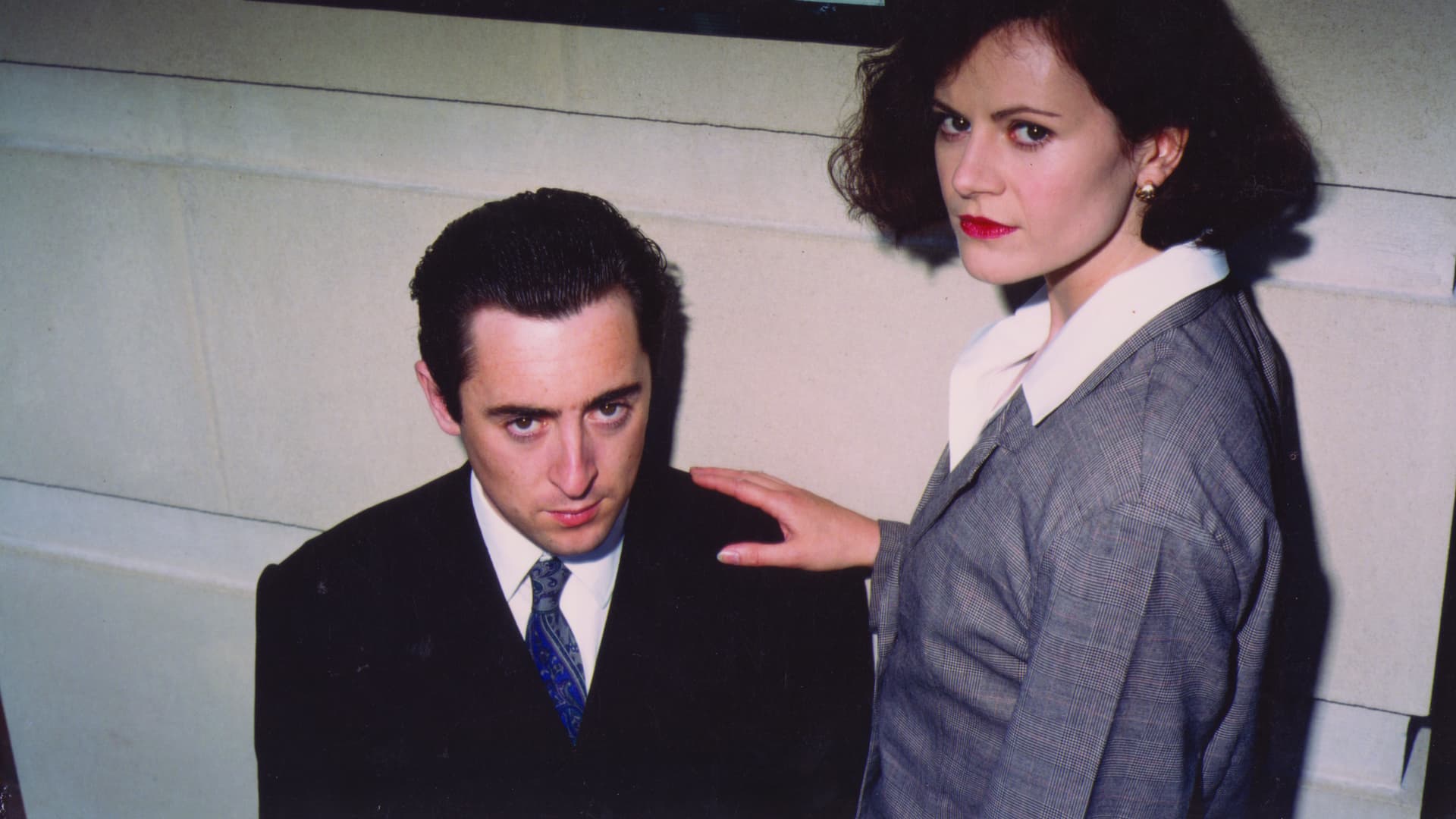
TV station exec MacNamara (L) and Airzone CEO Archer (R ) are up to something.

Airzone, however, hasn’t really got an actual plan together yet — but they’ve hit upon what might be an ace in the hole, and Dunbar and Stanwick are using an inside mole named Rachel (Heather Tracy) to get more information about this seemingly sinister option the company is considering. Due to a strange and unexplained connection, they later find and rope in popular TV weatherman Arnie Davies (Colin Baker) and his journalist girlfriend, Ellie Brown (Nicola Bryant).

Dunbar manages to infiltrate Airzone after hours and discovers the company’s secret option, but is discovered and stumbles into a secret lab where the air is so polluted he almost instantly suffocates to death. At that moment, Stanwick and Davies feel the loss, even though at this point they don’t know each other — and Davies, who never even met Dunbar before, begins seeing visions of him urging Davies to get involved.

Badly-cropped photo of Davison working with the advanced technology of the year 2091.

Thanks to Davies’ relationship with Brown, he does get drawn in, but continues to have “episodes” where he sees Dunbar and gets a few bits of key information from him, which leaves Davies very shaken, and Brown very concerned for him. When he finally meets Stanwick, who is having the same visions, and Thretheway (who can also apparently see the dead Dunbar), the plot moves into the “race against time and the evil company” phase very nicely.

The second half of the video shows the two men (and less frequently, the ghost of Dunbar), Brown, and Rachel unlocking the secret Dunbar discovered, and then racing to expose it before the government blindly agrees to fund Airzone’s plan. The standard amount of cat-and-mouse ensues before the secret is finally revealed, and the evil plan stopped in the nick of time.

Dunbar’s ghost behind Davies and Stanwick

Baker’s Davies is probably the strongest (and occasionally quite funny) performance in the film, with McCoy’s Stanwick also doing well, though prone to speaking in riddles – rather like his Doctor. Davison, who was given the smallest of the three principle parts owing to his limited availability for the project, is able to characterize Dunbar differently enough from his usual roles to show off his skill, but not much more than that.

Baker’s Davies is a weatherman and unwitting propaganda tool until he discovers the truth.

As someone who was a friend of the late Jon Pertwee, I was happy to see him in the film, though he plays Thretheway mostly as he played The Doctor — as himself, because he has a really commanding and charismatic presence on screen, even at the age he was when this was filmed (73, having played The Doctor some 20 years earlier). The problem with Thretheway is that there’s literally no reason for this part to exist except for him to interact with actors who succeeded him in “Doctor Who.” Thretheway acts as a passive and benevolent observer, but doesn’t actually do anything except for funding Dunbar’s exposé, nor does he actually move the plot along at all.

Pertwee was still a reliable performer with great charm, which saves his otherwise meaningless role.

Other actors that “Doctor Who” fans will recogize are Bryant (here as a romantic partner to Baker, which mostly gave fans the creeps when they saw the very brief love scene); Michael Wisher as Richard Allenby, a corrupt government minister; and a very young Alan Cumming playing a TV station exec named MacNamara, who is not all that he seems. Cumming didn’t actually get to play a role in “Doctor Who” until 2018, but it was worth the wait.

It’s still a pleasant and now more-relatable drama, made on a low budget but everyone seems to be having fun doing something a bit different. If you are familiar with classic “Doctor Who,” this is probably a must-watch. For everyone else, it’s not a bad way to pass an hour and four minutes, but taking a bit more time to build the big reveal, building the main characters’ backstory, and giving Thretheway more of a reason to exist would have made The Airzone Solution more watchable outside its built-in cult audience.

And don’t think I didn’t spot you in there, Gary. 🙂

Baker does a very good job of playing a confident man sincerely rattled by the visions of strangers and evil that are suddenly plaguing him.

The Golden Voyage of Sinbad

(1973, dir. Gordon Hessler)
⭐️⭐️⭐️⭐️⭐️
52-week film challenge, film 41

The quick summary: The Golden Voyage of Sinbad is as good as Sinbad movies with Ray Harryhausen effects get. This one has everything: a great actor for the title role (John Phillip Law), an intriguing and well-played villain (Tom Baker), a beautiful love interest (Caroline Munro), some comic moments alongside the race to victory, and a great selection of original Harryhausen monsters to complement a well-constructed fantasy adventure tale.

This was the second of the Columbia Sinbad movies, a revival of sorts following the first one, 1958’s The Seventh Voyage of Sinbad. While it would really be nice to someday get a mainstream Sinbad movie where the lead was played by an actual Muslim from the actual region in which these stories are set, John Phillip Law charismatically embodies the qualities of the heroic wayfarer, unlike his successor (my review of Sinbad and the Eye of the Tiger is here).

As mentioned there, for the month of November I’m reviewing movies that feature actors who also played the title role in the TV show “Doctor Who.” While Tom Baker may have one of the longer filmographies of that select group of actors, there are only a handful of films where he had such a large role, and this one is a personal favourite.

What’s great about this film is that, while it is a little slower-paced that modern films in terms of setting up the story location, major characters, and conflict, it is well-directed and tightly edited to to ensure that every scene in the film has a purpose that serves the overall story — the main failing of Eye of the Tiger, in my view.

In this tale, we find Sinbad just doing nothing in particular at sea, when along comes a strange flying creature with a shiny bauble. One of his men injures the creature via bow and arrow, causing it to drop the shiny item — a strange piece of jewelry that looks like some kind of puzzle part. Sinbad decides to wear it as a necklace, despite warnings from his crew.

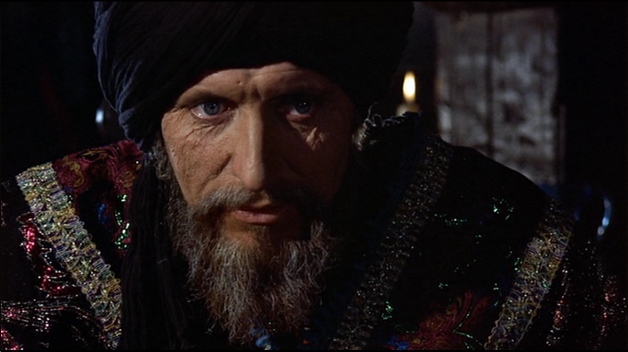
That night, he was strange dreams, including a disguised but ominous man calling his name, and a sequence involving a dancing girl with a tattoo of an eye on the palm of her hand. A storm comes out of nowhere to knock the ship off course, taking them to the land of Marabia, where Sinbad encounters the ominous man, who turns out to be the evil magician Koura (Baker).

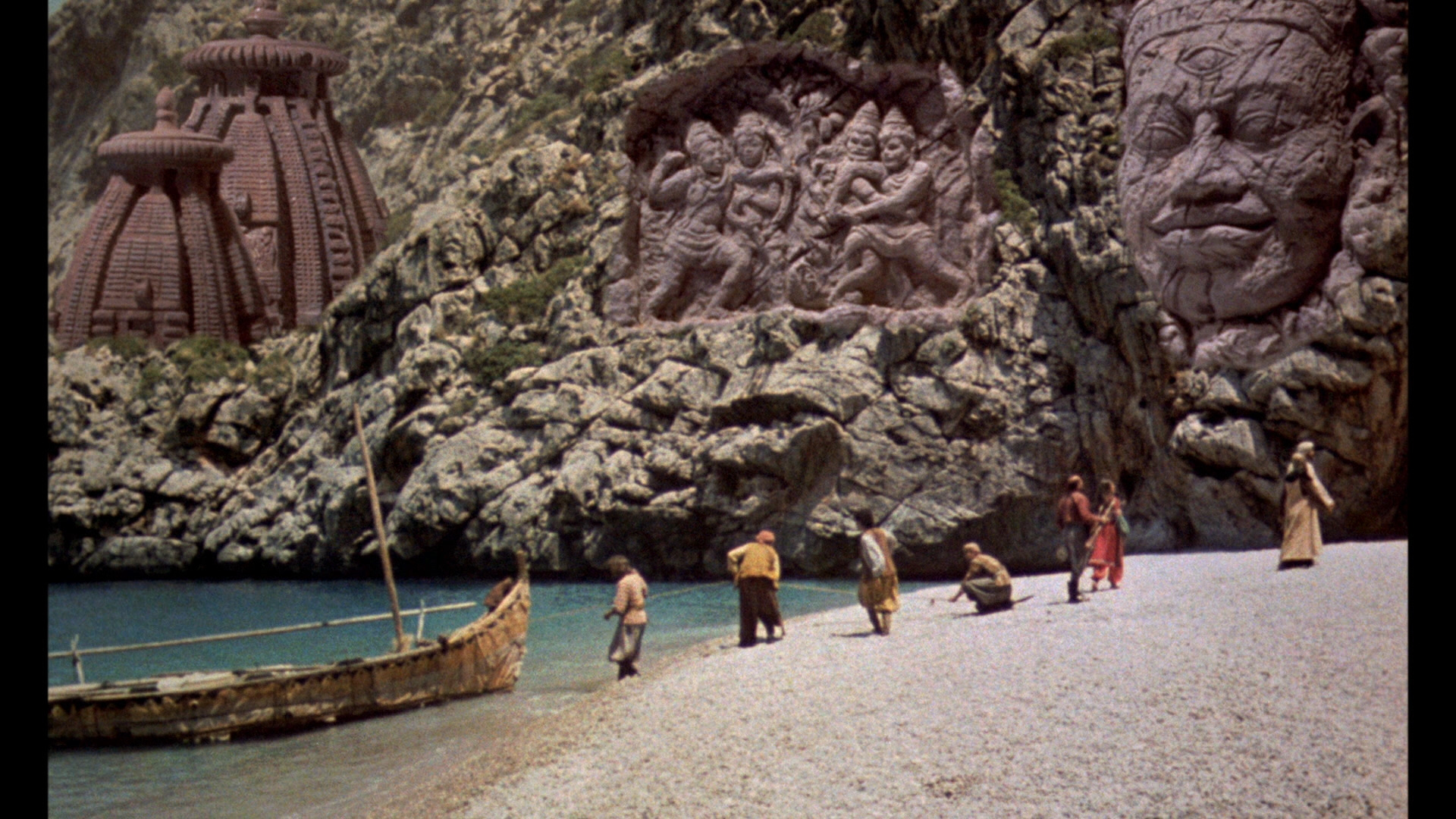
Koura demands the puzzle piece back, but Sinbad escapes with it into the city, where he meets the Grand Vizier (Douglas Wilmer), who wears a golden headdress/facemask to hide his disfigured face (from an earlier attempt by Koura to take over Marabia). The Vizier has a matching piece of the jewelry, but there is a missing third that, when matched with the other two, forms a map to the Fountain of Destiny, on the lost continent of Lemuria.

(L-R) Sinbad, Haroun, and the Grand Vizier

Those who can bring the three pieces back to the Fountain will receive youth, a “shield of darkness” (invisibility), and “a crown of untold riches.” Sinbad agrees to help the Vizier find the third piece, but unbeknownst to them, another of Koura’s flying homoculuses has seen and heard their conversation, and related it magically to Koura’s castle. They discover and kill the homoculous, but the race to Lemuria is now on.

Koura with one of his homoculus spies.

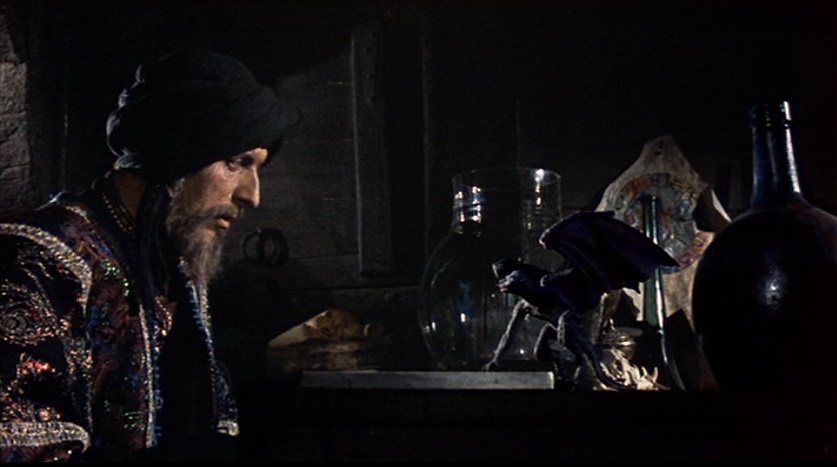
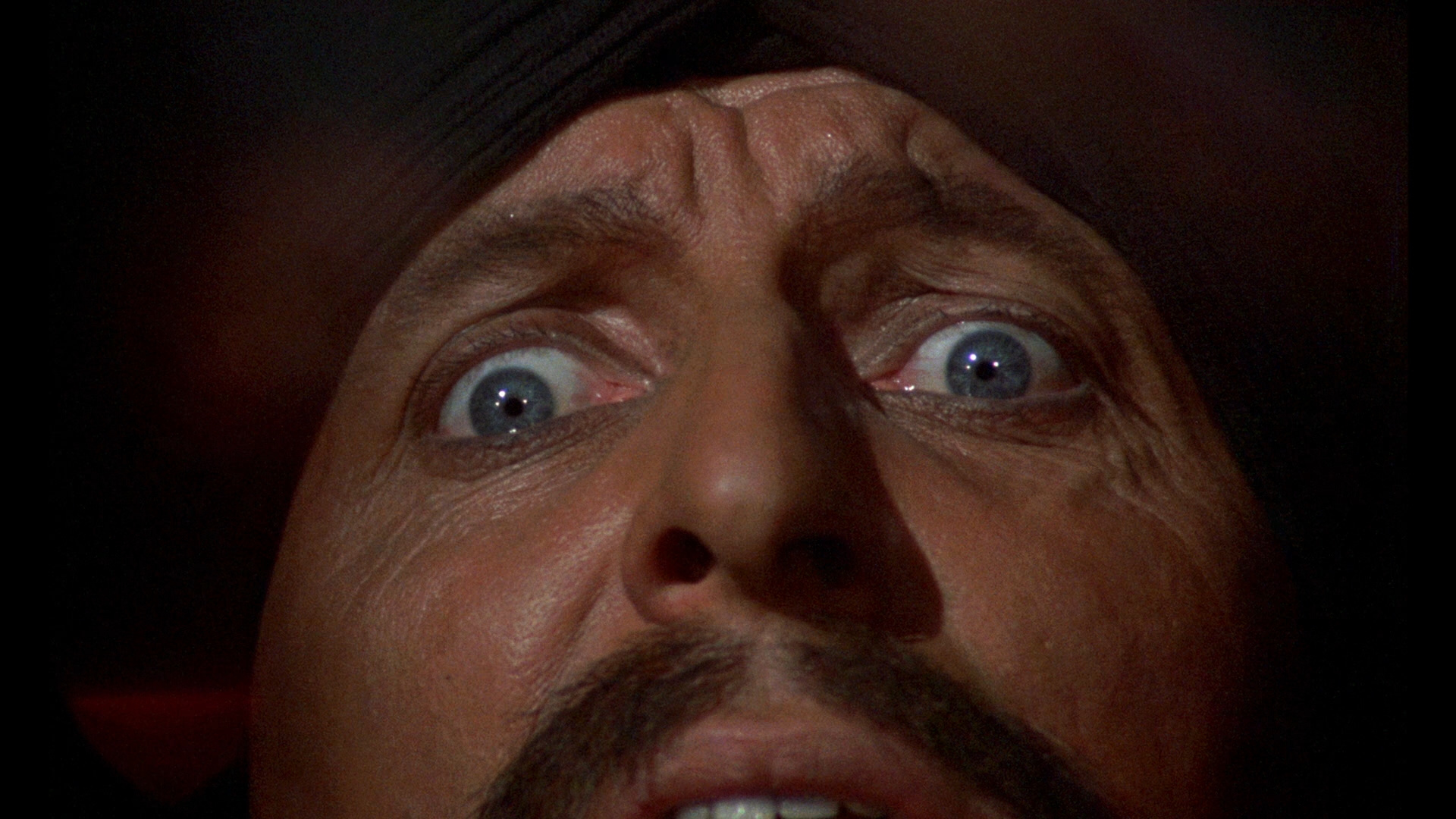
Koura is no ordinary magician; he is steeped in the black arts, and calls upon the forces of darkness for his magic — and each time he does so, the darkness takes some of his life force, visibly aging him in small or significant ways, depending upon what Koura calls for.

The aging begins, and gets worse Koura grows more desperate

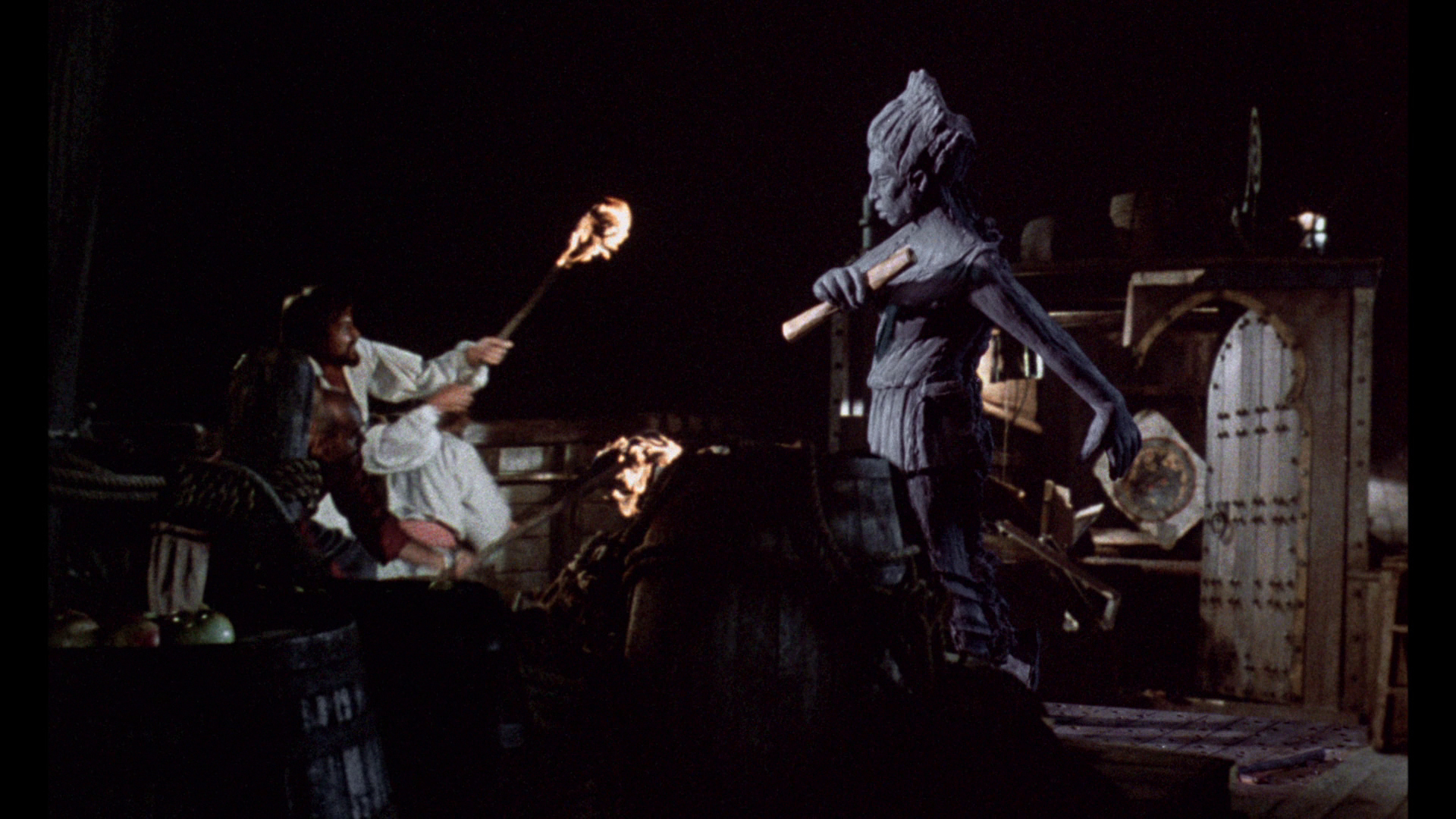
In a later scene, Koura is desperate to avoid crashing on some rocks that Sinbad knows how to navigate around, and casts a spell to bring the figurehead of Sinbad’s ship to life, so it can steal the map and bring it to Koura. This is, as you might expect, a big “ask” of magic, and when the (terrific) sequence is over, his assistant Achmed (Takis Emmanuel) is shocked to see that Koura is much visibly older.

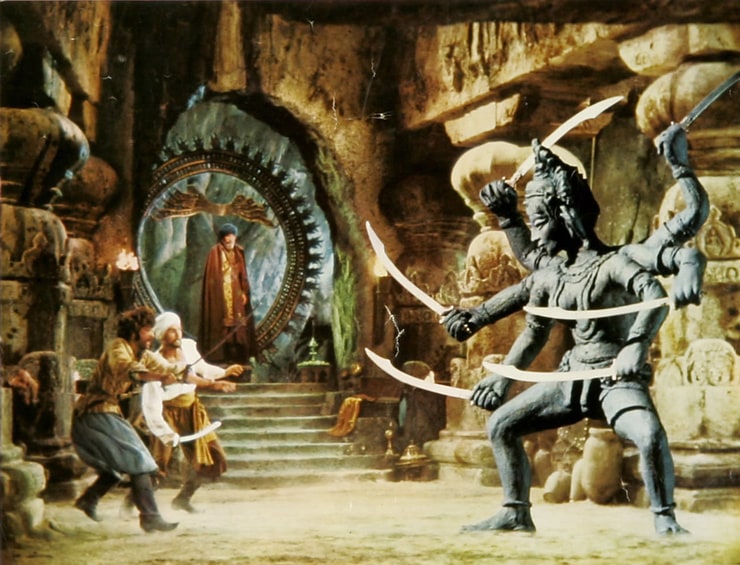
The chase continues through a series of interesting set-pieces, and the third bit of the jeweled map does at first fall into the right hands — following a magnificent bit of Harryhausen work as Kourna animates a statue of the six-armed god Kali to win over the natives, with the statue fighting Sinbad’s main crew simultaneously — but Koura steals it and takes the completed ornament to the Fountain, where he appears to win the day (going so far as to receive the youth that was promised, which restores him from the very old man he has had to become to try and stop Sinbad).

Koura also receives the shield of darkness, which prevents Sinbad’s attempt to steal the completed ornament back, but Koura makes the fatal mistake of hiding inside the fountain, where his shadow can be seen, and is then killed by Sinbad before he can claim the third prize. Sinbad thus wins the crown of many riches, but chooses to give it instead to the Vizier, where it restores his face and melts away his mask, making him the new Sultan. Now free to marry Caroline Munro’s Margiana, Sinbad and his friends sail off for Marabia.

The Vizier’s true face is restored by the Crown of Untold Riches

As I mentioned in my review of Eye of the Tiger, that film could be edited way down to reduce the padding and come out a much more exciting 90- to 110-minute film. Golden Voyage proves this theory by being much tighter and faster-paced, and clocking in at … 105 minutes.

Once you accept the (excellent) stop-motion effects work, the movie just carries you along on its quest with a rich set of characters, obstacles, and — let’s face it — cleavage (courtesy of Ms. Munro). It’s also worth noting the film’s b-plot — a merchant who enslaves Margiana begs Sinbad to take his drunken, useless son on the voyage to make a man of him, in exchange for Margiana and 400 gold coins.

Initially operating strictly as comic relief, the son Haroun (Kurt Christian, who would go on to play one of the villains in Eye of the Tiger) does complete his story. By the end of the film, he is a keen sailor who loves the thrill of adventure.

Even by today’s standards, The Golden Voyage of Sinbad is still an enjoyable Saturday afternoon adventure, anchored by Law’s credibility in the Sinbad role, the judicious use of comic moments to move the story along, and in particular Baker’s strong performance as Koura (so much so that it led “Doctor Who” producer Barry Letts to cast him for the title character in early 1974).

Baker delivers both on the evil the part requires, and his own powerful charisma to rivet attention on Koura without ever stealing the spotlight away from the story. Yet, he still gives us a markedly different performance here than he would bring to the more heroic Doctor, where he created the first truly “alien” incarnation that remains one of the all-time favourite takes on the character. It’s a pity he didn’t get the chance to do more movies, but at least in one of them he got to play Rasputin — yet another definitive interpretation, in my view.

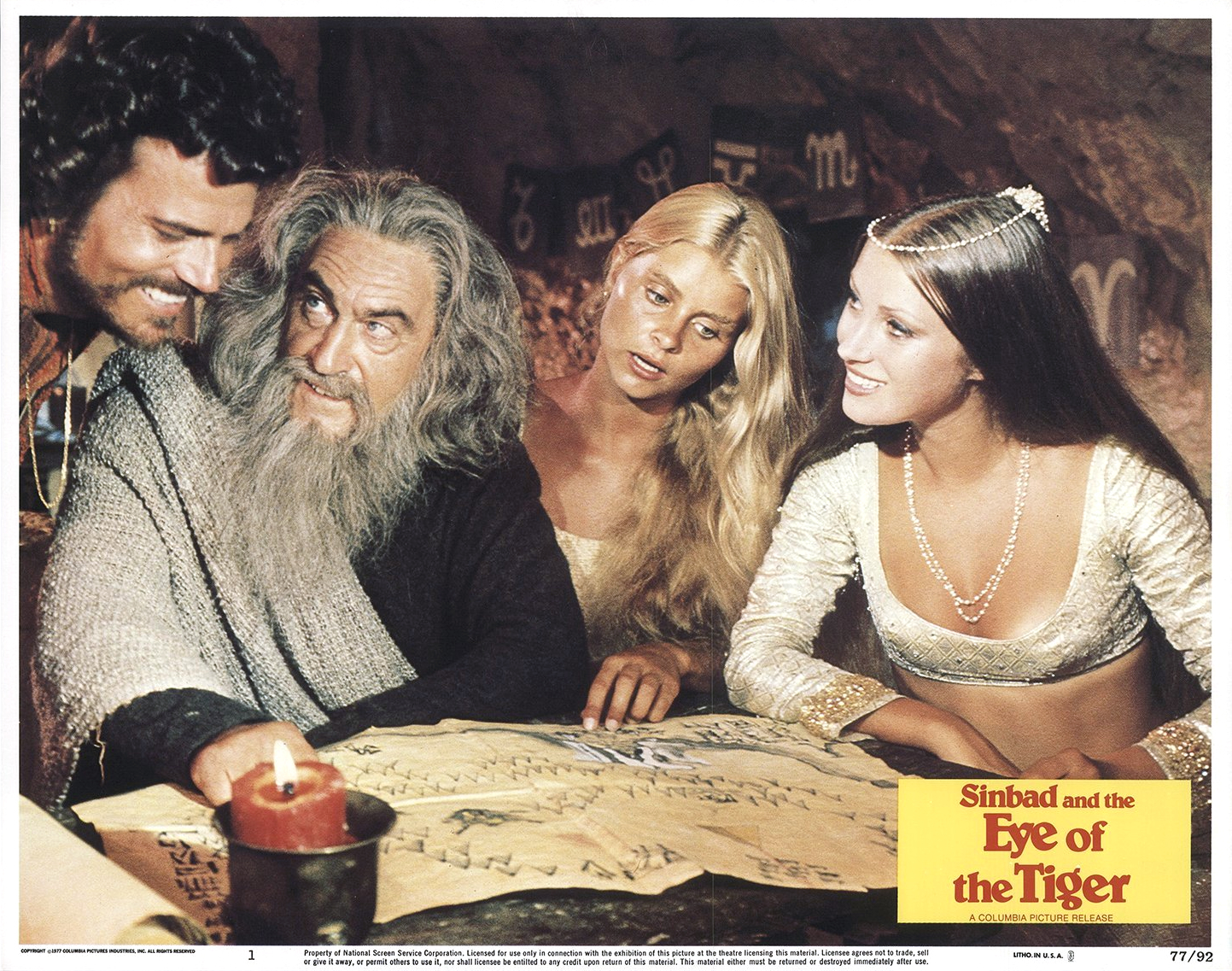
Sinbad and the Eye of the Tiger (1977)

(dir. Sam Wanamaker)

⭐️⭐️⭐️
52-week film challenge, film 40

Continuing with our theme this month celebrating the 60th anniversary of “Doctor Who,” we continue to spotlight films that feature actors who played The Doctor over the years for November. This time, it’s the last Harryhausen Sinbad movie, Sinbad and the Eye of the Tiger, featuring one of my absolute favourite Doctors, Patrick Troughton, in a major role.

It’s a pity this is probably the weakest of the three Columbia Sinbad movies, but it had a surprising amount of bad luck behind it. Patrick Wayne (son of John) is a handsome enough Sinbad, but … no charisma. He definitely puts in the work on the buckling of the swashes and such, but he never comes off as the lead of the film, or even as the hero of the story. Even Sam Wanamaker couldn’t pull a convincing performance out of him.

Another issue with this particular entry in the Sinbad series was that they literally gave animator Ray Harryhausen too much to do, resulting in a mix of excellent work and some clearly rushed and less-well-done effects. As a result, the story really drags, and has difficulty building any tension.

But the killer problem is that, as luck would have it, the film opened just three months after the truly revolutionary (and by comparison, breakneck-paced) first Star Wars movie, that instantly made Harryhausen’s mostly-great work look very dated by comparison.

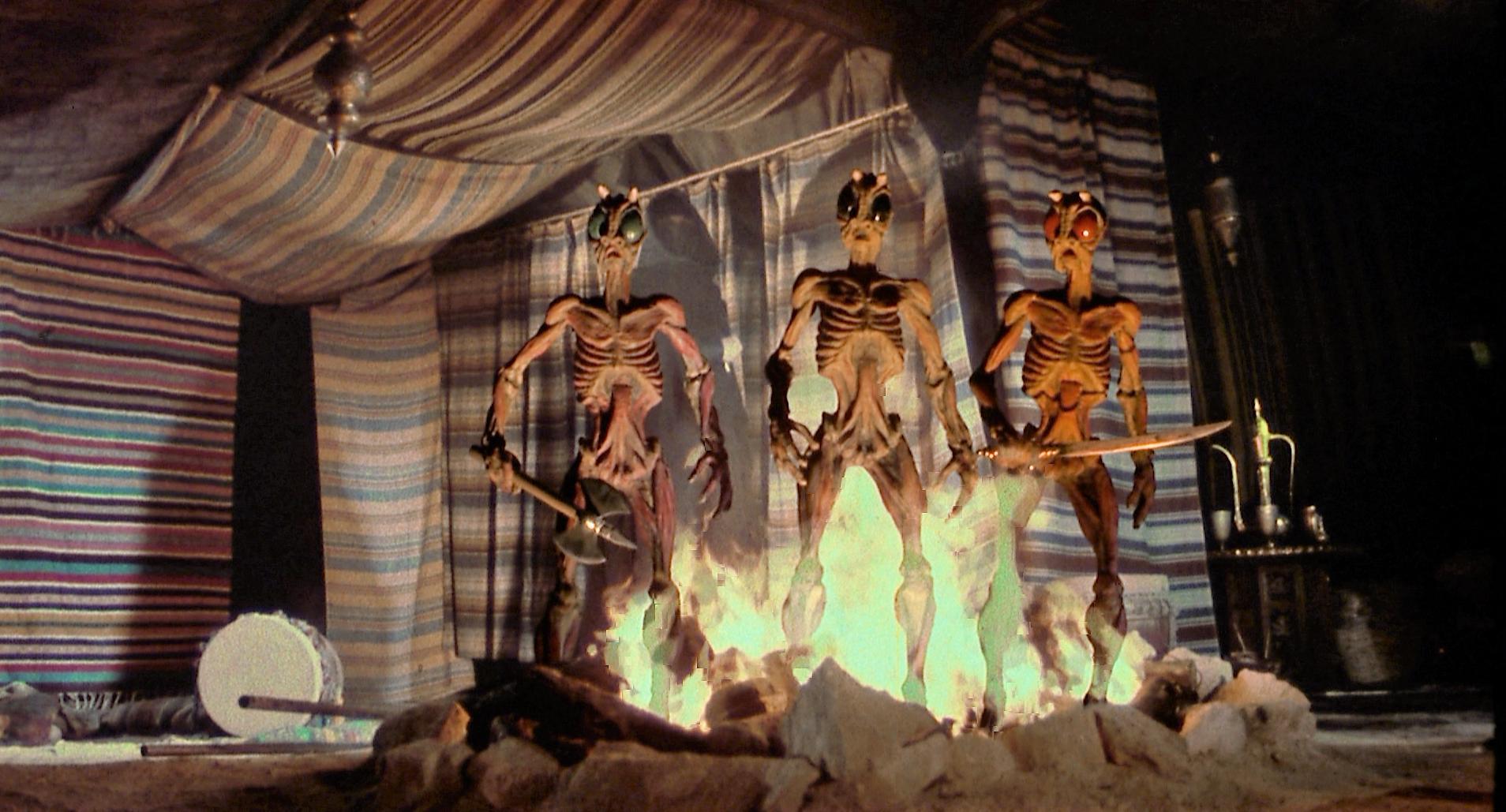
Fans of Harryhausen’s incredible stop-motion work get a feast with this picture, and point to some of the creatures as among his best work — and they’re right, so if you want to see those you kinda have to suffer through the non-animated slog. The best of these effects are really enjoyable, but there are perhaps too many sequences of them for one movie, and the ghouls we see early on seem very lazy —- since they strongly resemble repurposed skeleton soldiers from The Golden Voyage of Sinbad.

No, they’re not quite the same, but too close to the Skeleton Warriors of the previous movie for comfort.

The storyline reads well on paper: Prince Kassim is about to be crowned Caliph of the kingdom of Charak, but his evil stepmother, the witch Zenobia (Margaret Whiting), places a curse on him that turns him into a prehistoric baboon. If the curse cannot be lifted within seven (full) moons, Zenobia’s son Rafi (Kurt Christian) will become Caliph.

Sinbad enters the picture by sailing into town to seek the hand of Princess Farah (Jane Seymour), but the town is under lockdown. Farah eventually finds Sinbad, and tells him of Kassim’s curse and that Kassim must be made whole and assume the Caliph before she can marry Sinbad.

Prince Kassim sees exactly what he looks like under the curse, to his horror.

The pair set sail to find the Greek alchemist Melanthius (Troughton), who may be able to help. Zenobia and Rafi, worried that they could succeed in undoing her curse, set off in pursuit using a ship powered by a giant “Minodon,” a Bull-Man creature made of metal, brought to life by Zenobia. The Minodon can do the rowing of six men from a single master oar (an uncredited Peter Mayhew, ironically also playing Chewbacca in the competing Star Wars), so they don’t need a crew.

Our heroes eventually do find Melanthius, who can’t help them, but knows of a temple in the faraway land of Hyperborea that will be able to undo the curse, if they can get there quickly. If they can’t, Kassim will remain an ape forever, so Melanthius and his lovely daughter Dione (Taryn Power) accompany the group to help in the quest.

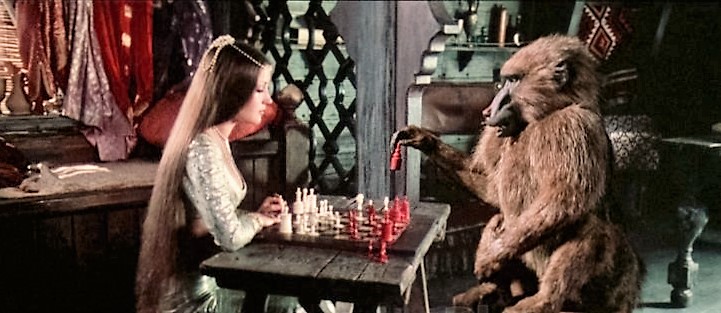
Farah and others pass the time by playing chess with Kassim, which is beautifully done.

Zenobia, who transformed herself into a seagull to go spy on the group (a really bad effect that’s really noticeable in a movie with mostly strong effects), sees enough of the map they have to navigate her own path there, but some of her potion was spilled when the crew discovered her in seagull form, so when she transforms back, she still has one foot as a seagull — a nice touch (and callback to Koura’s price to pay for his own sorcery, but that’s from another Sinbad movie).

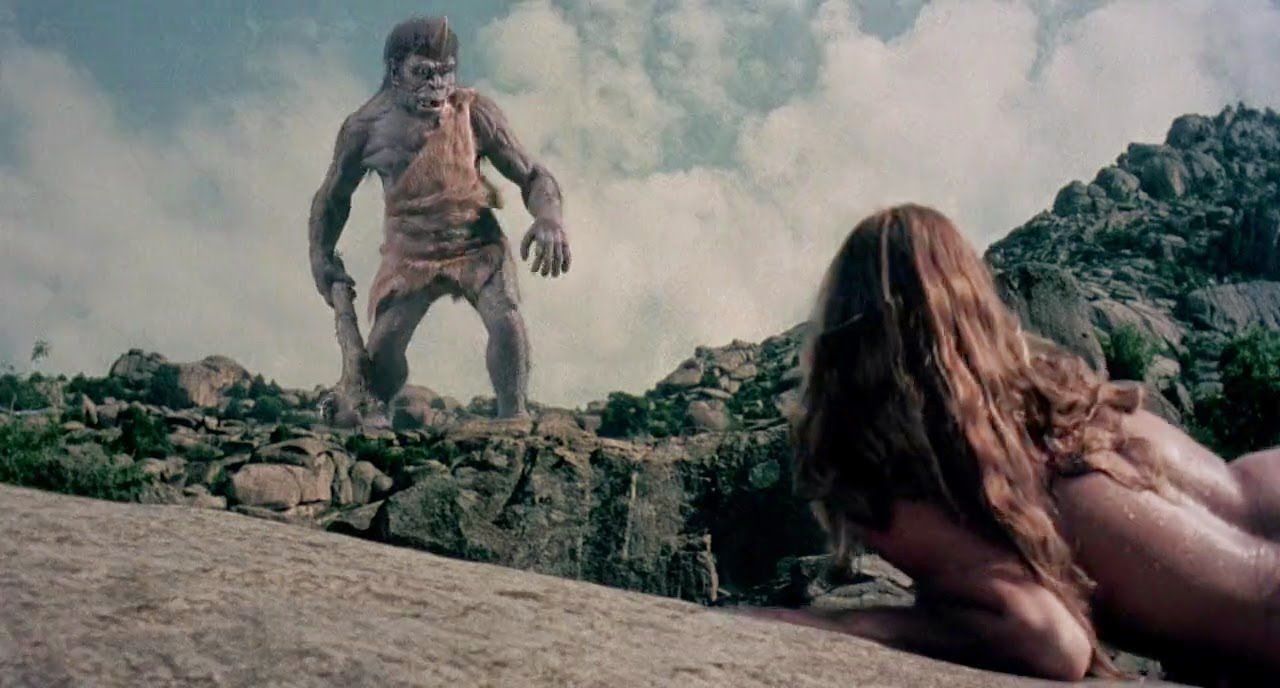
Anyway, it’s a loooonnnngggg journey to get to this mythical land, that keeps getting interrupted by stop-motion creatures (mostly quite good) and some disappointing traveling mattes that don’t quite work. Both ships finally make it to the Arctic, eventually find alternate ways into the somehow-temperate lost city, which provides the opportunity for a brief nude scene of the girls swimming — until they discover a giant troglodyte.

Well, hello there!

Finally, the two opposing crews have their big fight scene that also involve stop-motion creatures inside the temple of the lost civilization. One guess who wins (and who doesn’t end up as an ape permanently, as we were constantly warned would happen if they didn’t hurry things along), but it’s pretty well-done — and of course they make their escape just as the temple and city destroy themselves, and all ends up well for our heroes and very badly for the villains.

Kassim-ape is by far the most consistently excellent effect, almost at times convincing you that in some shots an actual ape was used. The now-friendly troglodyte and friends’ battle against Zenobia-in-smilodon-form in the climax is another standout sequence, though it’s never made fully clear why this creature threatens and then later helps our heroes, other than a weird “friendship” with Kassim-ape, maybe.

You could cut this film down, shorthand more of the interminable “here’s Sinbad’s boat … and here’s Zenobia’s boat” travel sequences, tighten the plot machinations, and have a really pretty good, exciting adventure movie that runs maybe 80-90 minutes instead of the poor pace of its actual 1h53m. It’s a pity they didn’t do that, because there’s some excellent work scattered among the overrunning parts.

I may be biased, but Troughton as Melanthius is far and away the best actor in the film, apart from the stop-motion ape which is kind of mesmerizing. I should add that the two women, Seymour and Power, do a very effective job in their stereotypical love-interest roles even if poor Jane is romancing up against a flat wall named Patrick Wayne sometimes. At least Kassim, once restored to human form, also finds a mate in Dione.

It’s a pity the Columbia Sinbad franchise finished on such an uneven note, both because of the flaws of the film and because it was mistimed to a fluke revolution in sci-fi special effects by Star Wars and Close Encounters at the box office that same summer. The earlier two Sinbad films are much better examples of the adventure genre, with the pinnacle of Harryhausen’s Sinbad work shown off in the second one, The Golden Voyage of Sinbad — which just so happens to have Fourth Doctor Tom Baker in a major role …

The Minodon (Peter Mayhew) does all the henchman work and gets no thanks whatsoever.

Will Any Gentleman …? (1953)

Dir. Michael Anderson

⭐️⭐️½

52-week film challenge, film 39

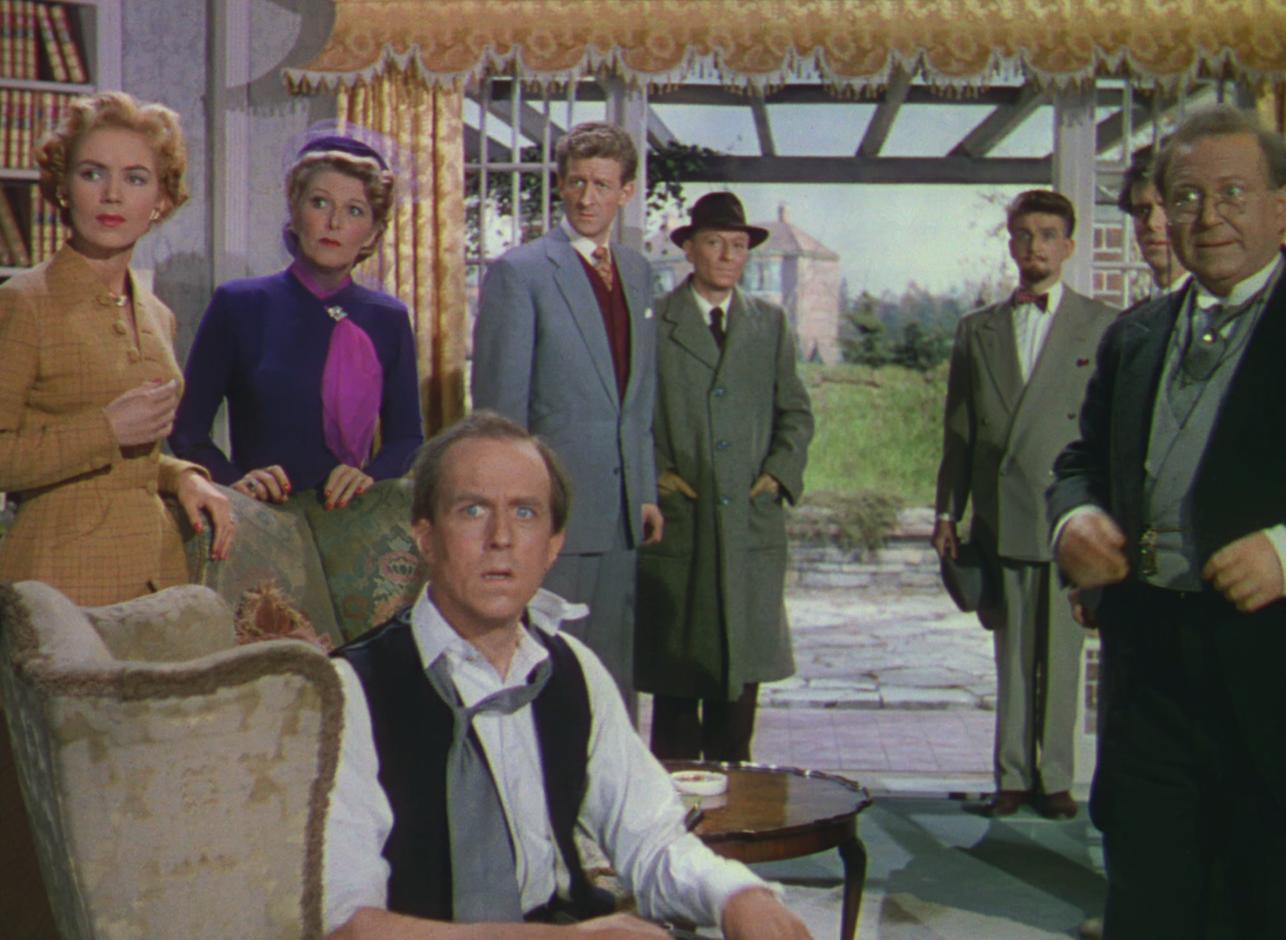
I hadn’t actually intended originally for last month’s reviews to have a theme of horror movies for October, but after the first one I just opted to keep it going. There’s really not enough Thanksgiving movies to make a theme out of that (and Thanksgiving’s not necessarily in November, Americans), but this year marks my all-time favourite TV show “Doctor Who”’s 60th anniversary, so I’ve hit upon the idea of reviewing films that have actors who played The Doctor in them, and we’ll start with a twofer: Jon Pertwee (in a big part) and William Hartnell (in a minor part) in a film adaptation of the stage farce Will Any Gentleman …?.

The problem with film adaptations of stage plays that are farces is that the energy doesn’t translate well, and of course now this 1953 film is so dated that it’s almost 100 percent laughter-free. There’s a lot of “stagey” overacting, though Pertwee and Hartnell are not among the guilty parties, and neither is lead star George Cole.

The underlying story is a simple one: mild-mannered bank clerk Henry Sterling (Cole) is trying to repay a small debt his brother Charley (Pertwee) owes the owner of a music hall. He gets roped into attending the show, gets pushed up on stage where “The Great Mendoza” (Alan Badel) hypnotizes him to remove his inhibitions. Things go a bit wrong and the show is closed before Mendoza can un-hypnotize anyone, leaving Sterling and another man with mixed personalities.

Sterling randomly alternates between his normal self and his wild playboy persona, to the consternation of most of the people in his life and the amusement of a few (including his maid). Brother Charley slowly works out what has happened and retrieves Mendoza to undo the hypnotism, but not before many shenanigans and misunderstandings have happened, almost resulting in Sterling’s marriage collapsing and being arrested for stealing money from his bank.

The other man hypnotized by Mendoza and not brought out of it turns out to be an undertaker who is hypnotized to laugh at nearly everything — one of the few genuine funny surprises in the film.

If you had seen the stage play in the early 50s, I’m sure you would have laughed a lot — farces work much better in theatre because the energy of the cast brings the audience along with them. The film version also plays things mostly very broadly, with may characters being cartoonish in nature, apart from the aforementioned future Doctors and Cole, who does an expert job switching personas.

If you’d seen the film in the 1950s being aware of the stage version, you’d probably find this one funny as well. But this type of campy, stagey comedy is tricky to get right on film, and while there are a few movies of this sort that still retain their “suspension of disbelief,” qualities this one just seems like most of the cast are trying waaaay too hard, and the comedy fizzles.

“Manic” Sterling has plans for his maid, who is more than willing as her life is otherwise dull and lonely.

At this point, the only people who would seek out Will Any Gentleman …? are likely “Doctor Who” fans who want to see what Pertwee (33 at the time) and Hartnell (45) looked like when they were much younger (though people in the 1950s all seem to look “old” all the time to me), and of course fans of George Cole, who is the best part of this movie.

Pertwee plays the rogueish brother just right, and his colourful personality keeps his performance in line with the film but not exaggerated, while Hartnell as the only truly serious part in the movie (as a police detective) just reminds me that every film I’ve seen him in, he gives each of his characters something distinct from the others — in this he is a perfect foil for Pertwee and Cole, gruff but never crossing into exaggeration.

Three of my favourite British actors in a single picture.

It’s a pity that this doesn’t quite work, but it doesn’t — in part because of changing social morés around sexism, which is really the centerpiece of this one. It is of its time and reflects its stage origins, which bodes mostly badly for modern viewers.

Almost the entire cast, L to R: Sterling’s wife, mother-in-law, frantic bank manager, brother, Detective Inspector, hypnotist, (can’t remember the half-seen fellow), and overly dotty doctor. Missing: the maid.

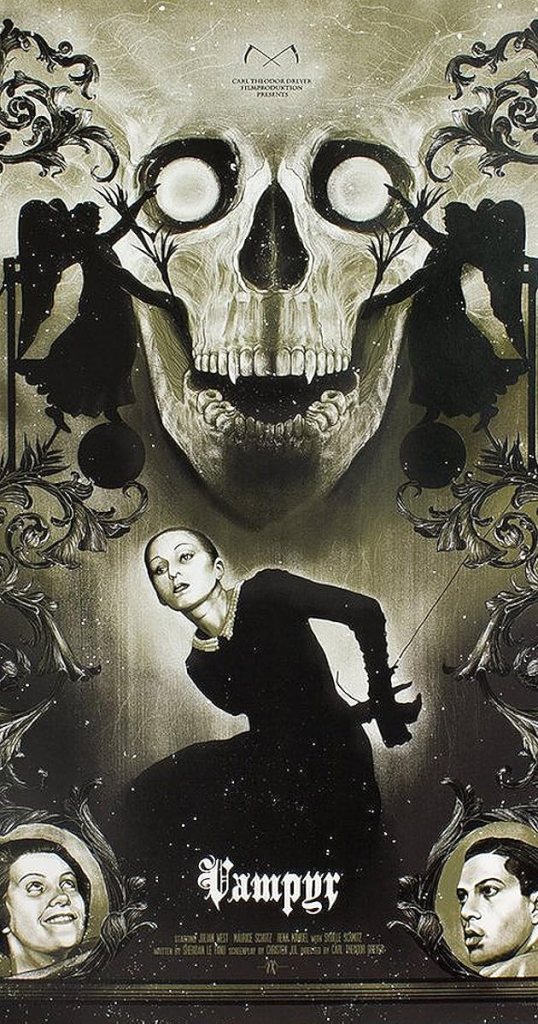
Vampyr (1932, dir. Carl Th. Dreyer)

⭐️⭐️⭐️
52-week film challenge, film 38

This film is a bit bewildering to me, I must confess. Taken as a filmic version of a horror-based dream (its clear intention), a reflection on some of the many tropes surrounding our own fear of our mortality and the ways we might depart this life, Vampyr should be considered a powerful success. If one is watching the film hoping for a coherent plot or definitive statement of meaning, you’re completely out of luck.

Given the utter brilliance of Dreyer’s previous film, 1928’s The Passion of Joan of Arc, his first sound movie — a horror movie about vampires — should have been a massive success.

Instead, it was a huge flop with audiences at first, and even after re-editing only garnered mixed reviews. This appears to be down to two main factors: his comfort in shooting movies in the silent style, along with unexpected struggles with adding sound (beyond music) to his film was the first problem.

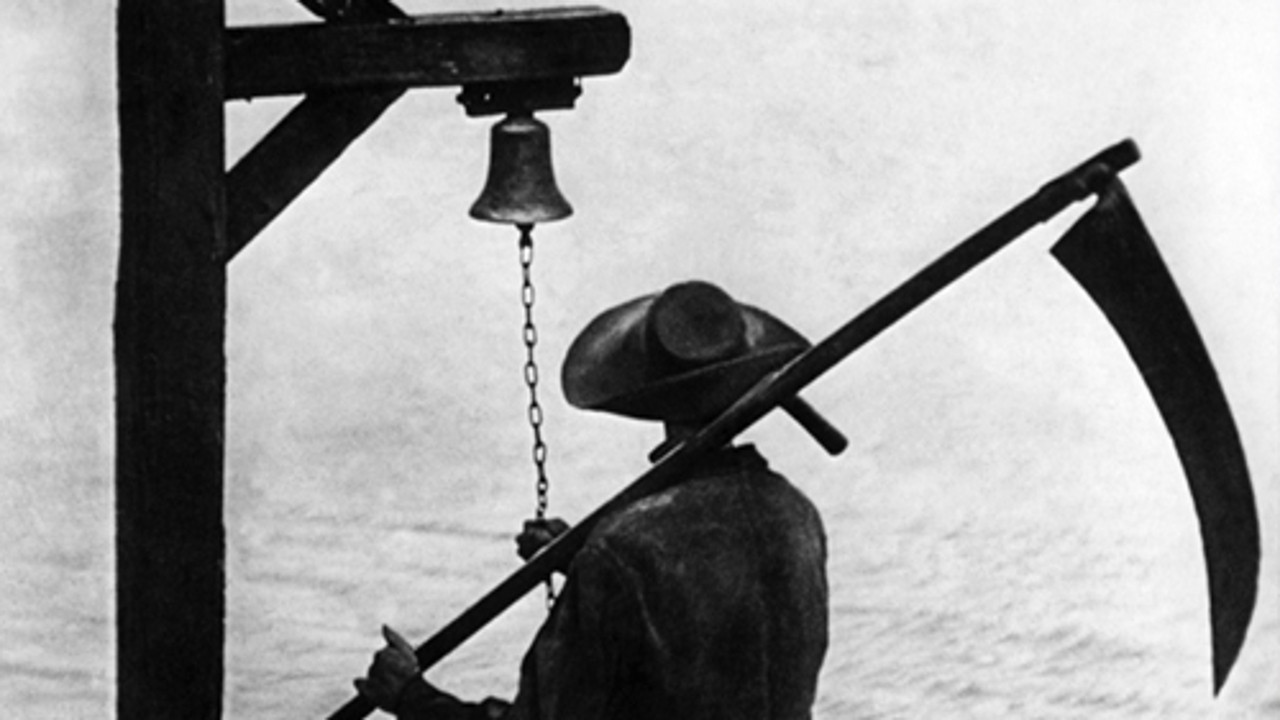
The second “flaw” of a sort was his decision to make a dreamy, soft-focus, motivation-less tale dependent on atmosphere and imagery rather than story. Vampyr is 90 percent a silent movie, shot in that style, complete with title cards to explain things some (not enough) things from time to time.

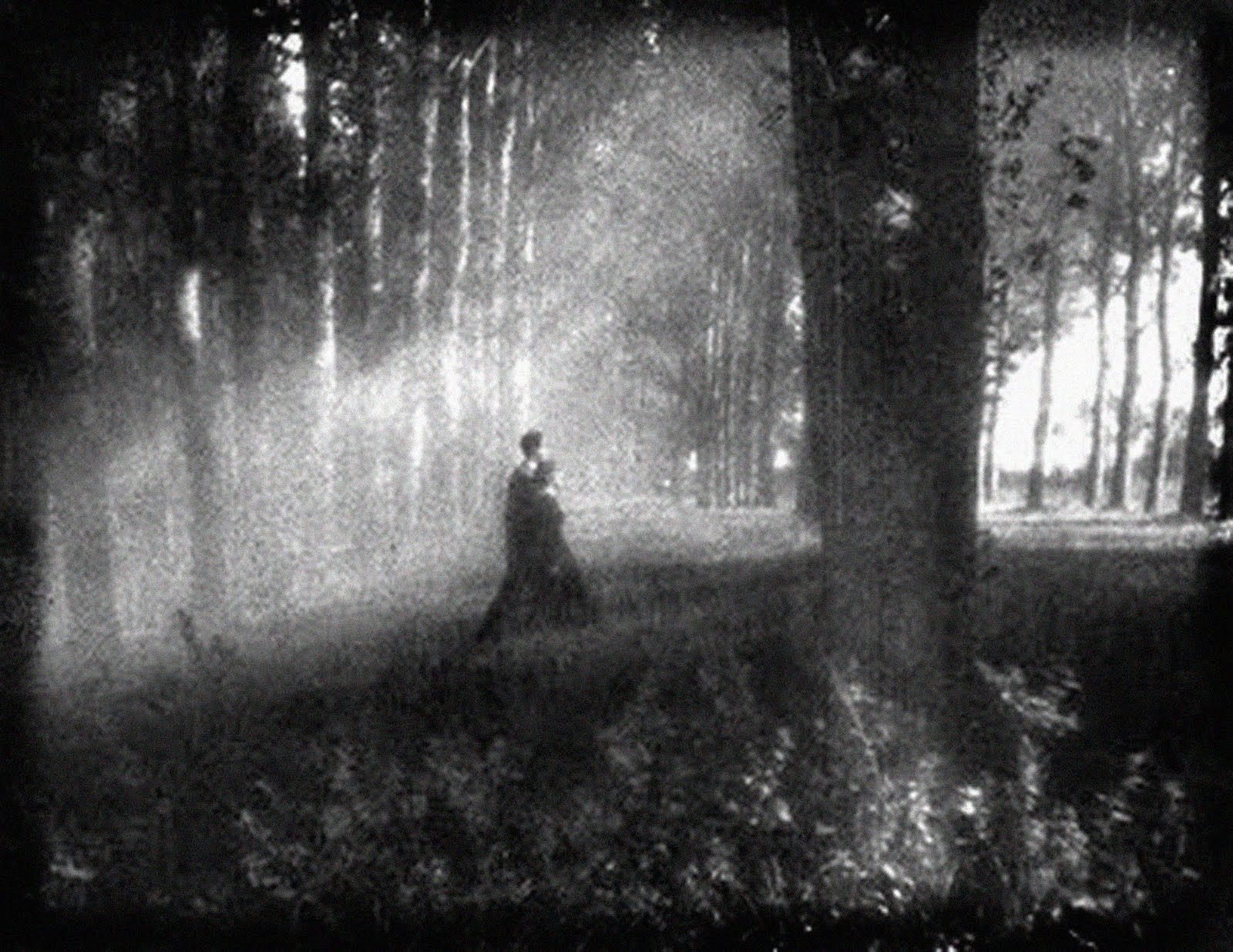
One of many haunting images in Vampyr.

The acting, likewise, is very silent-movie style, with few characters having much of anything to say on the rare occasions that they do speak. That said, there is some spoken dialogue and sound effects, which kind of gain a Bergman-like weight by their rarity.

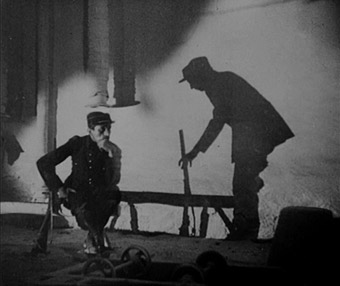
The plot, such as it is: a man named Allan Gray, who is introduced as a dreamer who is obsessed with the occult to the point where he lives in a sort of dream state comes to a town, takes a room at the inn, where a man breaks in and leaves him a book “in the event of my death.” Shadows and instinct guide him to the manor of the man, who is murdered by a shadow with a rifle (?) shortly after Gray’s arrival.

He rushes to help, but it is too late. He meets the man’s youngest daughter, Gisèle, who says that her older sister, Léone, is gravely ill. Just then, they see Léone walking outside.

As they rush out to collect her, she is found with fresh bite marks and a briefly-glimpsed older person who quickly disappears. They carry Léone inside, Gray remembers the book, and starts to read it (there’s a lot of reading this book in the film).

Turns out it’s a book about vampyrs and their powers, which leads Gray to conclude (duh) that Léone is the victim of a vampire. A very odd and suspicious local doctor shows up, looking for all the world like Mark Twain.

The doctor says Léone can only be saved by donated blood, and arranges for Gray to provide some. Tired afterwards, he falls asleep.

You’re never quite sure who’s side Mark Twain is on in this movie.

One of the servants of the house reads Gray’s book, figures out what is going on, and knows who the Vampyr must be. Gray wakes up, senses danger, and saves Léone from being poisoned by the doctor, who may or may not have been trying to prevent her becoming a Vampyr.

Gray tries to catch the fleeing doctor, who may be a servant of the Vampyr, but stops to rest and has an out-of-body experience where he has died and is about to be buried by Marguerite Chopin (the Vampyr he saw earlier) and the doctor, confirming their alliance (maybe). As he returns to his body, he sees the old servant heading to the graveyard, and accompanies him.

The incredible out-of-body effect is stunningly good and far ahead of its time.

They open the grave of Marguerite Chopin, finding her perfectly preserved. They drive an iron bar through her heart, and she dies a true death, instantly becoming a skeleton.

Léone is released from the curse, the doctor suddenly sees the face of the late lord of the manor, chasing him away from the house and killing the soldier who was helping him (?). Gray rescues the tied up Gisèle (?), while the doctor hides in the old mill, somehow becoming trapped in a grain bin.

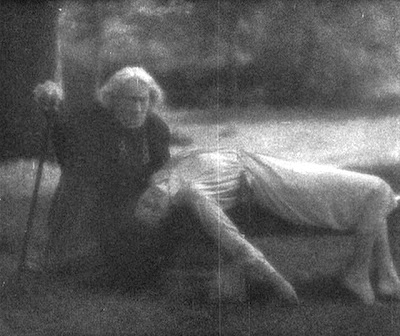
Léone under the control of the Vampyr

The old servant shows up and turns on the mill, eventually burying the doctor in grain. Gisèle, who is apparently now in love with the nearly-silent Gray, leaves with him on a boat across the river and they find a bright clearing. The end.

For a sound movie, very little is said, and the interstitial titles give us a little background but avoid explaining much of anything as the story progresses. As mentioned, Dreyer opted to film this like a dream — complete with putting gauze near the lens of the camera for all the outdoor shots.

Gisèle under threat

It’s very clear that he intended this to be a silent film, and was coerced to adding sound and really struggled with that. Thankfully, his next film, Day of Wrath (1943), received better reviews and largely found him back on course.

If you want a film that will weird you out, this might be a good candidate. Lots of gorgeous shots and symbolism give it a very disconnected dream-like effect, and I’m of little doubt that this film had a profound effect on David Lynch.

The shadows in this movie are another force of evil

That said, the overall impression is that it’s half a movie: the visuals are there, but the storytelling is severely lacking. Even worse, the “hero” (or maybe more accurately, the “subject”) of the film, Allan Gray, is a nondescript nobody who spends the entire first half silently reacting to things, and leaving little impression on anyone but Gisèle, inexplicably.

He’s not even the hero; the old servant, who we don’t even meet until halfway through the film, is the one who actually resolves things — almost as though he was waiting for Allan to do it, gave up, and decided to end the movie as quickly as possible.

I’ve given it three stars because the visuals are ahead of their time, artistically interesting, and communicate the dream-like intention extremely well. Once people stop reading books and actually start doing things, the film really picks up — but even though the film is just 73 minutes long, the first half is an awful slog of odd things happening for no reason and an ineffective subject.

To put this another way: you’d never guess this was directed by the genius that gave us The Passion and the smaller masterpiece Gertrud, his final film. Vampyr feels more like an ambitious art-college experimental film.

Night of the Living Dead (1968, dir. George A. Romero)

52-week film challenge, film 37
⭐️⭐️⭐️⭐️½

It has been a long time since I last saw this film, but even the first time I saw it I was very impressed with it, and I’m happy to report that the passing decades haven’t diluted my view of it at all. At its core, it is a very cheap but effective horror movie, but with levels and subtlety that raise it far above the rank of “cheap horror movies” into both a social statement of a very divided America at the time (and, sadly, still), and a psychological study of how people react under stress because of circumstances they cannot control.

The new restoration of the movie has given me a chance to view it in the best possible light, and it reminds me again of the conviction and authenticity of the players as well as the extras who play the zombies; this is a very well-directed film from Mr. Romero that has (by necessity) a play-like quality to it. In the wrong hands it could have been stagey and talky, but Romero’s cinematography uses the language of film to give it a tight, nimble sense of movement.

The plot is revealed in a nearly-perfect manner; a couple are attacked by a shambolic man, the woman escapes in a panic and makes her way to a nearby house, where she is nearly a zombie herself as she processes a mind-breaking trauma. She is further traumatized when she discovers the corpse of the long-dead woman who owned the house upstairs. A black man named Ben (Duane Jones) also arrives at the house, who also isn’t sure what’s happening — but has retained his wits and sets about barricading the house, understanding that the outsiders aren’t acting like humans anymore.

They are surprised to discover a small family and a young couple have been hiding in the cellar, also shell-shocked from being attacked by what turns out to be the recently-dead, turned into “ghouls” by some kind of radiation from an exploded space probe. This information is parsed out slowly across the film; at first, nobody really understands what is happening, and the sense of helplessness and confusion is increasingly relatable today, as some formerly-coherent societies break down and decay in seemingly random, disturbing ways.

As a reflection on Romero’s view of American culture at the time, the film both parses out more backstory and information as we go along, but also the ad-hoc structure of the band of survivors begins to break down, collapsing just as help finally arrives. I don’t want to say too much about the ending because it is still so powerful and upsetting, but I will say the climax of the film has lost none of its punch over the last 55 years, and that America doesn’t seem to have learned much since then.

The influence Night of the Living Dead has had on low-budget filmmaking and the horror genre specifically is also hard to summarize, except to say that this film defined what would later be commonly called “zombie movies” and changed the direction of film horror entirely to lean more into capitalizing on troubling elements in the real world.

Romero went on to direct five sequels to the film, though the most memorable one to me remains the original sequel, Dawn of the Dead. I also found his vampire movie, Martin (1977), way more thought-provoking than I expected.

Years later, when I was in college, I met and interviewed Romeo for the college newspaper. He had been invited by the film and drama instructor there to shoot a short film on location, as luck would have it — the first film he shot outside of Pittsburgh. Ironically, I never saw the resulting film, Jacaranda Joe, and I should really track that down.

We had a lively and memorable discussion about his career, waaaay more than I could have ever published in the newspaper, including a frank discussion about the social implications of many of his films. He was very generous with his time, and seemed happy to discuss his films with someone who had actually seen most of them to that point, including Season of the Witch and The Crazies.

Watching the film again after so long, I remain so impressed with the quality of his main cast, especially Jones and the real-life family that played the cellar-dwelling Coopers. Richard Burton and Elizabeth Taylor couldn’t portray a marriage on the rocks any better than Karl Hardman and Marilyn Eastman, and as for Karl’s daughter Kyra — she has a very minor role in the film until she doesn’t, and then … woah.

The “ghouls” also do a great job, really getting that shambolic, mindless walk and creepy milling about thing just right, only lightly augmented with makeup. Ironically, the “help” in the form of police and posses who figure out how to “kill” the zombies for good are the weakest acting link, though the TV presenter who delivers lots of backstory was very natural (as he should be — he was a real-life TV horror-movie show host!).

Many films from the late 1960s are very tied to the culture/style/fashion/issues of the time, and there’s nothing wrong with that, but somehow Night of the Living Dead is far more timeless, especially when it comes to the story. It holds up extraordinarily well and is well worth watching and thinking about, as one of the few horror movies with such a strong social message.

Doctor X (1932, dir. Michael Curtiz)

⭐️⭐️
52-week film challenge, film 36

Normally when someone says “wanna watch a pre-Code horror movie from the early 1930s during October?” I’d be all-in. I’m disappointed to report that I’ve finally found one that, despite a few good things going for it, completely wastes its potential.

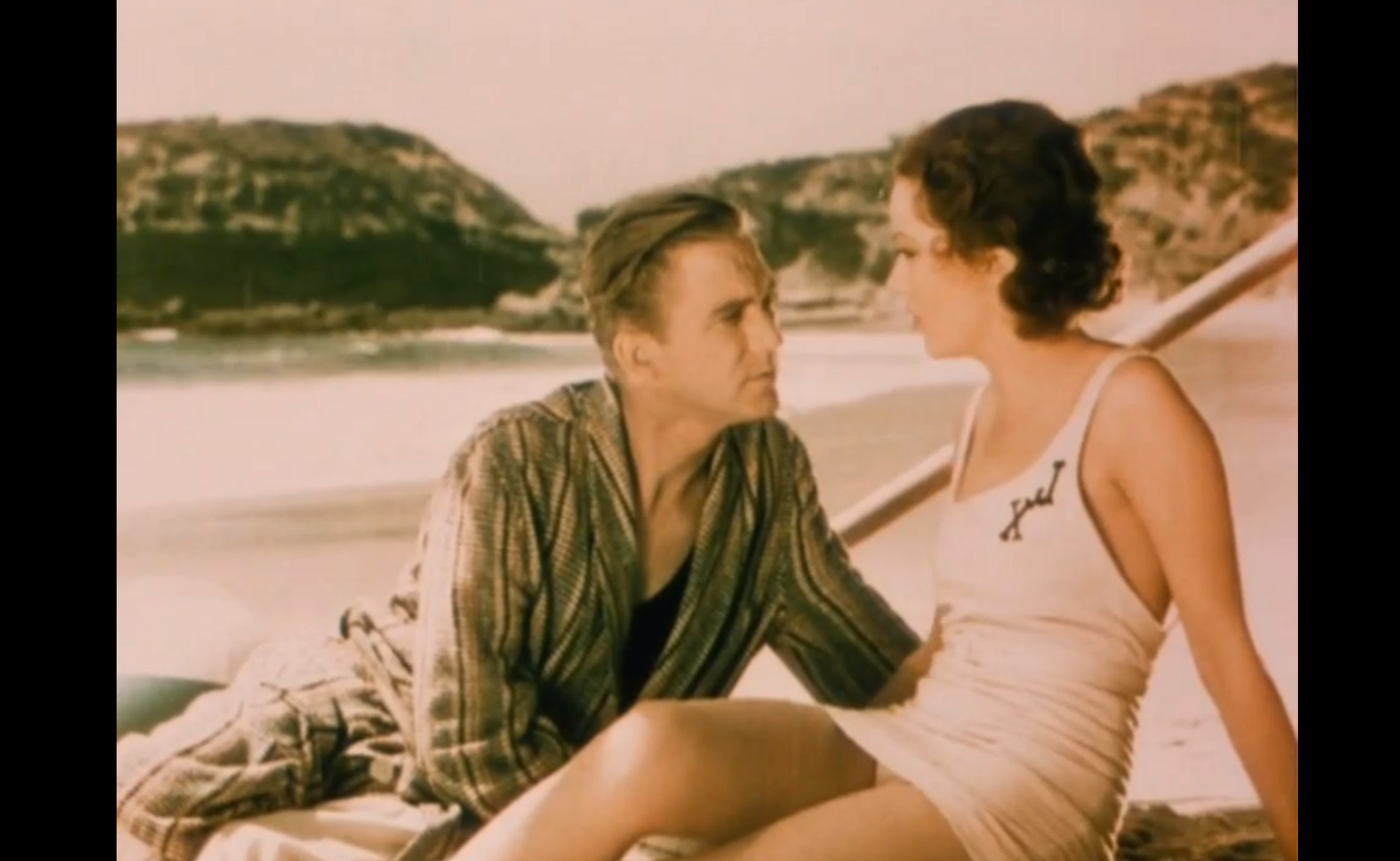
The good things first: Doctor X has a mostly-stellar cast, including Lionel Atwill, Lee Tracy, and Fay Wray. It’s in a sort of colour (more on this in a moment), which was rare for 1932. The sets are wonderful, complete with an eccentric mad-scientist lab — that oddly doesn’t belong to the mad scientist — and some downright neo-German Expressionism moments.

At the core of this movie is a plot that involves ritual murder and partial cannibalism — so yes, it’s a pre-Code horror movie all right. Despite this, almost none of what is lurid about this tale is actually shown, there’s an endless amount of talking about doing things before actually doing them, and the “comedic” element meant to lighten the tone is just irritatingly jarring, and completely amusement-free.

Intrepid reporter Taylor, caught burgling, tries turning on his nonexistant charm.

This film gets one star just for its cast, though many of the players seem off their A-game at times, occasionally having to correct their own lines as though the cost of the color filming was too expensive for second takes. It only gets a second star because the film is simply gorgeous to look at, with great sets, Max Factor makeup (!!), and the novelty of colour.

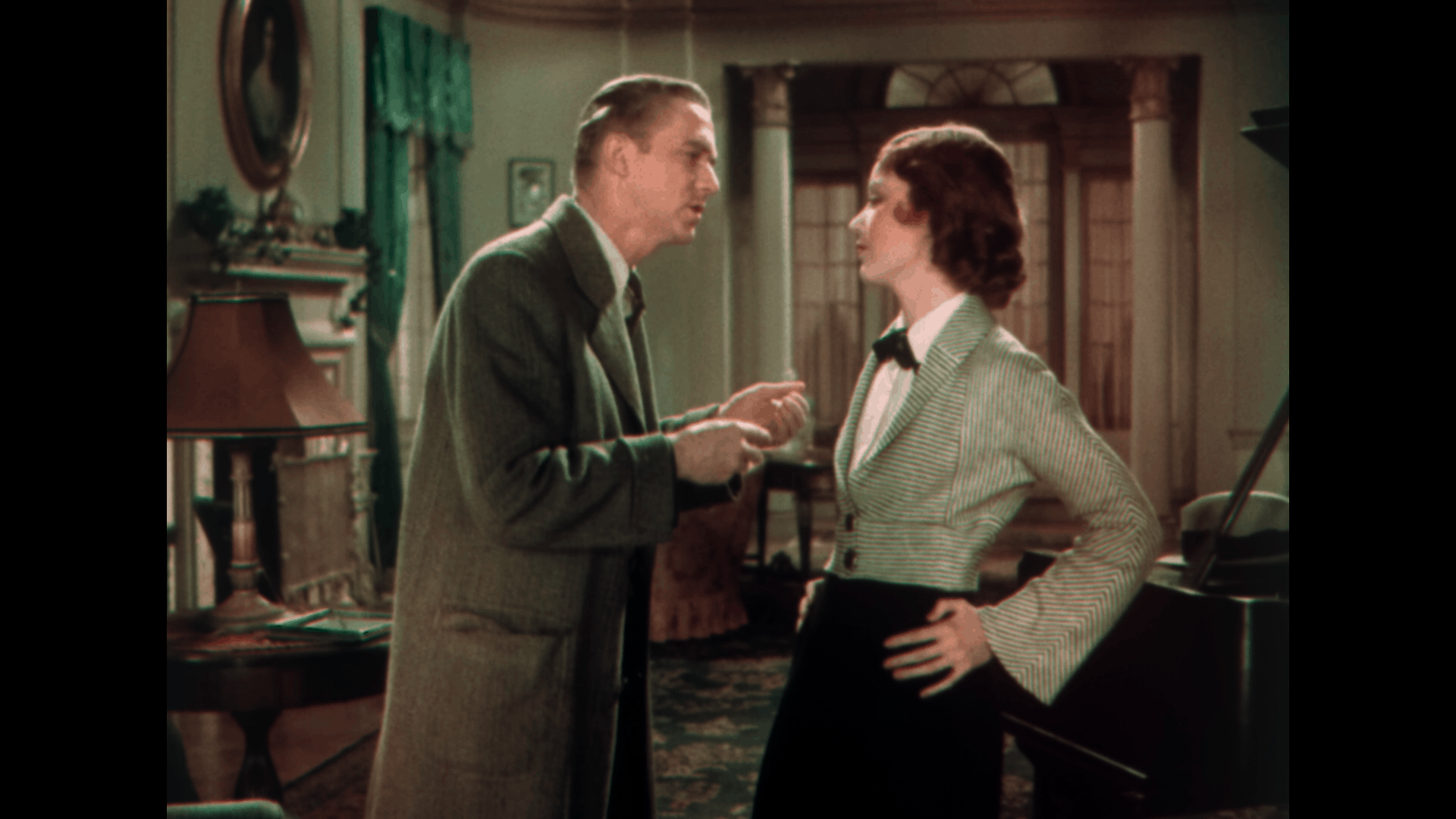
Well, as I say, sort-of colour — not quite full colour, but rather the third “process” used for two-colour Technicolor (often and incorrectly referred to as “two-strip” Technicolor). This is the same process used for the later, and more famous (but also not great) Michael Curtiz horror film, Mystery of the Wax Museum (1933).

Without getting too technical about it, anything red or green really stood out, and the filmmakers played that up here, but oddly not with blood as much as one might expect. The plot of the film belies its origins as a stage play: a handful of key sets, lots of talking, very little action.

I’m still left wondering why the movie is even called Doctor X — since the lead character, Doctor Xavier (Atwill), is not the title character, the mad killer (and that’s not really a spoiler). I suppose its because it is meant to keep you guessing who the villain is, but I picked him out around the halfway mark, and only stuck around to get the inevitable explanation of how he kept his true identity secret.

In the film itself, the series of murders that only happen under a full moon and involved a partial cannibalisation of the body means the police (and the press) refer to the murderer as the Moon Killer, which really would have been a better title. As the film opens, we find a curiously aggressive but determined reporter, Lee Taylor (Tracy), trying to find new leads on the story of the killer by quizzing police.

When that doesn’t work, he gets wind of a new victim being delivered to the morgue, and sneaks in and hides as another body in order to overhear what the coroner, police, and Dr. Xavier (called in to consult on the body) have to say. The police put the screws to Xavier quickly, pointing out that all the victims have been killed and mutilated using a special kind of scalpel found only at Xavier’s medical academy.

Xavier, fearing bad publicity that could ruin the school, persuades the police to let him conduct his own secret investigation first for the next 48 hours before telling anyone — especially the press — about this direct connection to the killer. They very reluctantly agree, and Taylor has gotten his scoop, but he also withholds some of it from his editor to see where this is all going to go.

Dr. Xavier, knowing that the scalpel connections means that the killer is one of his own colleagues, tells the other doctor/instructors of the academy of this, and arranges an experiment to determine who the killer might be — not even ruling himself out. The only doctor of the group who is pre-cleared is Dr. Wells, because he only has one hand and the killer clearly has two, and thus Wells stands in for Xavier in actually running the experiments.

Meanwhile, in the process of breaking and entering into the academy and also trying to steal a few photographs for the newspaper to use, Taylor is caught by Xavier’s daughter Joanne, thus setting up a later romantic angle — after all, how could she resist a jerk and petty criminal she caught ransacking her home in the name of a scoop?

Down in the basement, Xavier starts his investigation by having all the doctors but Wells sit in special chairs (including himself), where fantastic electrical equipment will record each man’s heart rate while they witness a staged re-creation of the last murder, using Xavier’s butler and maid to play those parts. At the height of the very Frankenstein-like electrical show, just as the readings are to reveal the killer, a blackout occurs.

Literally the killer accidentally reveals himself in this scenem, but everyone is too dumb to notice.

When the lights come back on, the doctor whose pulse was the highest, Dr. Rowitz, is found murdered by a scalpel to the brain. Later his body is discovered to have been partially cannibalised — so the killer is obviously in the room! Dun dun DUNNNNN!

While a second experiment is arranged where the suspects will all be locked down this time (except, again, Wells), we spend way too much time following up on the efforts of Taylor to romance Joanne — which slowly begins to win her over. Because that’s how you handle obnoxious jerks who might ruin your father’s academy in the 1930s apparently. Men really could behave badly back then, and still be seen as “the hero.”

What she sees in unfunny jerk Taylor, other than he’s the first man she’s not already met in this movie, I’ll never know.

We do also see that the maid and butler are getting kind of creeped out by the events, and that the police are putting even more pressure on Xavier to find the killer. We also get lots of “funny” shots of the actual killer lurking around the house, almost but never quite getting his hands on Taylor, which is a damn shame.

After the maid refuses to participate as the victim in the second staged murder recreation, she is actually killed by the killer. Under this cloud of tragedy, Joanne steps up to play the victim role, which puts Xavier on edge, but he has no options left.

With everyone strapped in, the recreation begins again, and without spoiling things we’ll just say that the killer reveals himself by entering a secret laboratory, where his disguise method is seen by us, and then he tries to kill Joanne. Finally, Taylor has a genuine heroic moment and stops the killer, since the other doctors are restrained, and the killer meets his gruesome comeuppance.

Doctor X is woefully short on any real tension (because those moments keep getting defused by Taylor’s pratfalls and dumb luck), and as a whodunnit it probably came off as fresher in 1932 than it does now. The film is only an hour and 16 minutes long, but seems to drag in places — especially the “comedy” moments.

To borrow and paraphrase a quip from another reviewer: if you love film history, the significance of Doctor X means you sorta have to see it. If you love movies for how they make you feel, you should skip this one.

“What’s that, Taylor? You’ve committed numerous misdemeanors to get the story, and you might get a date out of it? Okay, I’ll hold the presses for ya!”