This 1941 B&W fully-animated movie is considered the first Asian full-length animated film, and is certainly the first full-length Chinese animated film. While some western influence (particularly the early Looney Tunes of the 1930s and the early Disney movies like Snow White) can be seen, it is drawn from folk fables themselves inspired by a portion of a novel called Journey to the West, published in 1592.
The folk tales based on the book, we are told at the beginning of the movie, often focus on the supernatural creatures rather than the travelers and the moral of their journey — which is that life is full of trials and suffering. The filmmakers, however, wanted to emphasise the lesson of the story: that working together as a community, faith, and using everyone’s talents in harmony can overcome great obstacles, and make life better for all.
The tale is a fairly simple one: a monk trying to get to “the west” (meaning Central Asia and India) to obtain some Buddhist sacred texts (sutras), but is stopped by a mountain range full of fire. His three servants — a monkey prince, a pig-faced monk, and a stuttering but strong worker — each try to use their various magic powers to solve the problem. Specifically, they need to get a magic palm-leaf fan from an unhelpful princess in order to put out the fires, but their individual ruses and even brute force all fail.
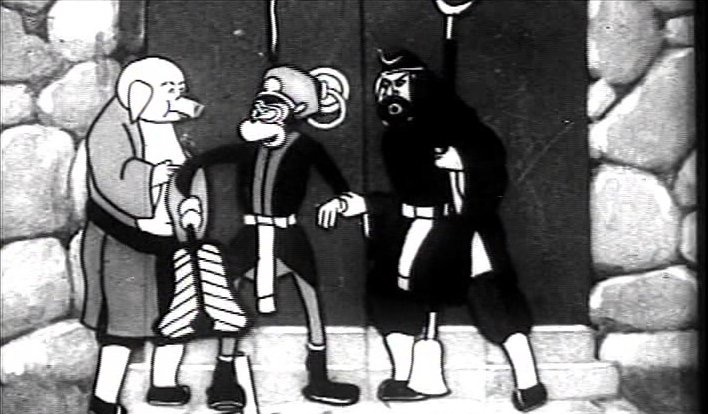
Our three “heroes,” sort of.
The servants all regroup back at the town where the monk helps them brainstorm, suggesting that the three pool their abilities with the assistance of the townspeople to overcome the trickery of the princess and her husband. This they finally do, ultimately winning the day and clearly the mountains of the fire demon that tortures them, so that they and the monk can proceed on their journey of enlightenment.
Despite the handicap of no really good print of the film being available (it is desperately in need of a major restoration), the quality of the B&W animation shines through, with many impressive moments including extensive use of rotoscoping to make some scenes much more realistic, along with smoke effects and excellent character design. The various shape-shifting and disguising powers of the three servants are well done, and the quality of the existing film print picks up a bit in the last third.
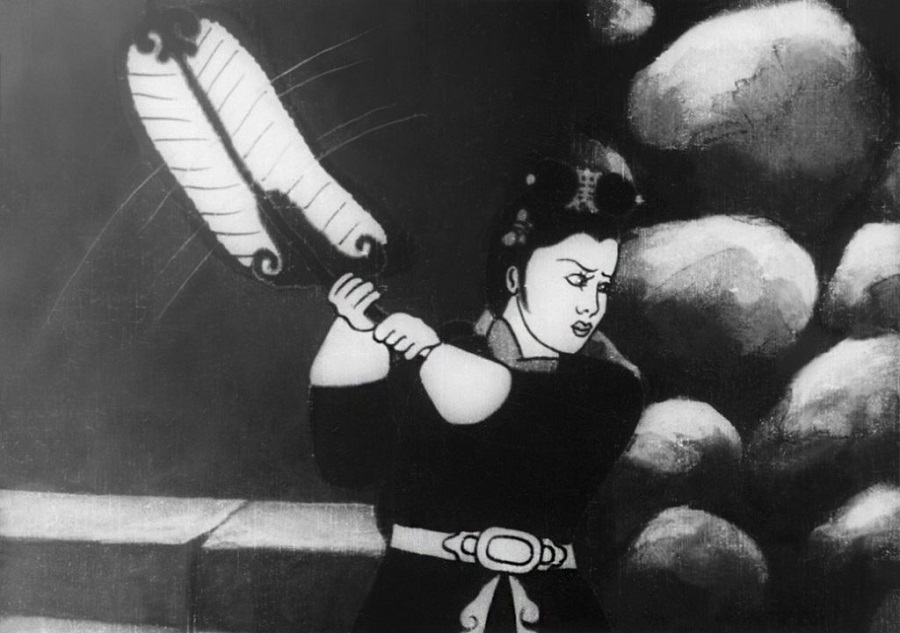
The “evil” princess, who actually has a pretty small but pivotal part in the film.
This is primarily a film that would now mainly appeal to fans of early animation, film historians, and students of Chinese history, but it is a very impressive feat of filmmaking that is only marred by the lack of a pristine print. A special mention should go to the musical score, which starts off a bit overwrought in my opinion but soon settles down when needed to accompany the story. I enjoyed it enough that I would certainly revisit it if it were ever restored.
An example of the beautiful backgrounds in the film.
I’ll be blunt — I’ve seen a fair number of superhero films, including a good sampling (though nowhere near all) of the MCU and DC superhero movies. They can certainly be fun, but I usually find myself taken out of the story by the effects and stunts (regardless of how good they are, they routinely disrespect basic physics), especially as time goes on. Black Panther is certainly the best MCU movie I’ve seen to date, but that’s because it plays to my liking of Afro-futurism as a deeply underrated movie genre.
I was very impressed that Marvel went for a movie that was a deeply and topically the African and African-American experience as they did, adding in the futuristic secret of Wakanda, and one which dealt actually quite little with the typical superhero antics, though those boxes are certainly ticked — but there is relatively little of Black Panther the action man and mostly a focus on characters. A lot of the credit has to go to the note-perfect casting throughout.
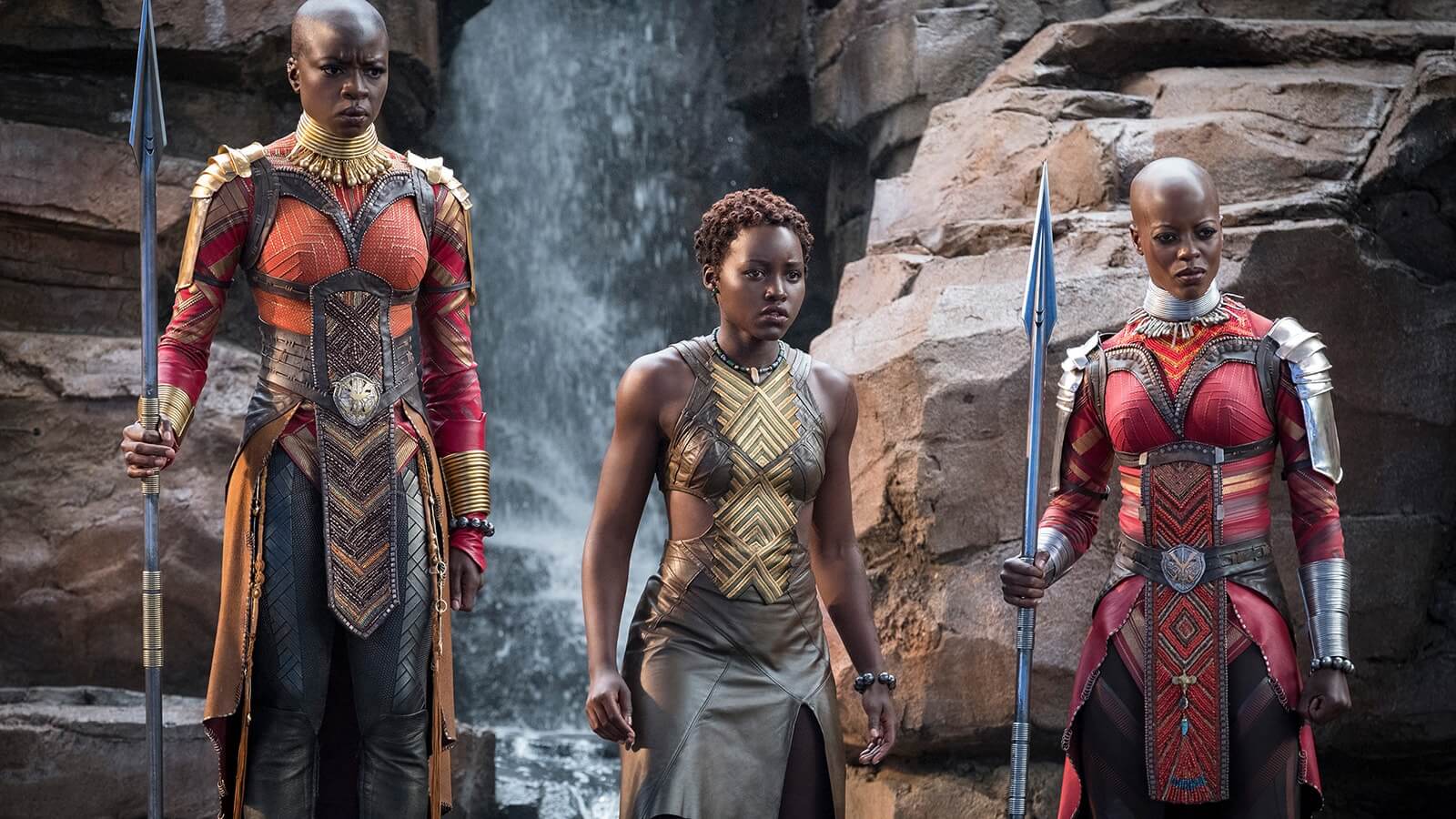
Even the established stars like Andy Serkis and Michael B. Jordan turn in solid performances, and of course Lupita Nyong’o and Danai Gurira alongside Letitia Wright and Angela Bassett get plenty of non-romantic, meaningful screen time (makes a nice change in the male-dominated superhero genre). I would be deeply remiss if I didn’t mention Chaswick Boseman’s star turn, aided by great supporting characters played by Daniel Kaluuya, John Kani, Forest Whittaker, Sterling K. Brown, and Winston Duke. Some of the most believable and fleshed-out characters in the whole of the MCU are to be found here — and even though he wasn’t quite as great as the rest of the cast, it was great fun to see Martin Freeman as the token white ally.
For a fantasy movie, this had a lot of hard truths within it — starting with the guise that has kept Wakanda’s secret: of course the rest of the world is comfortable seeing Wakanda as a poor country not worth making into a tourist destination, since it pretends to have no practical resources to exploit. The central theme of the film is actually the debate going on both internally and externally about whether Wakanda can reveal its power source, wealth, and technology to the wider world without risking colonization.
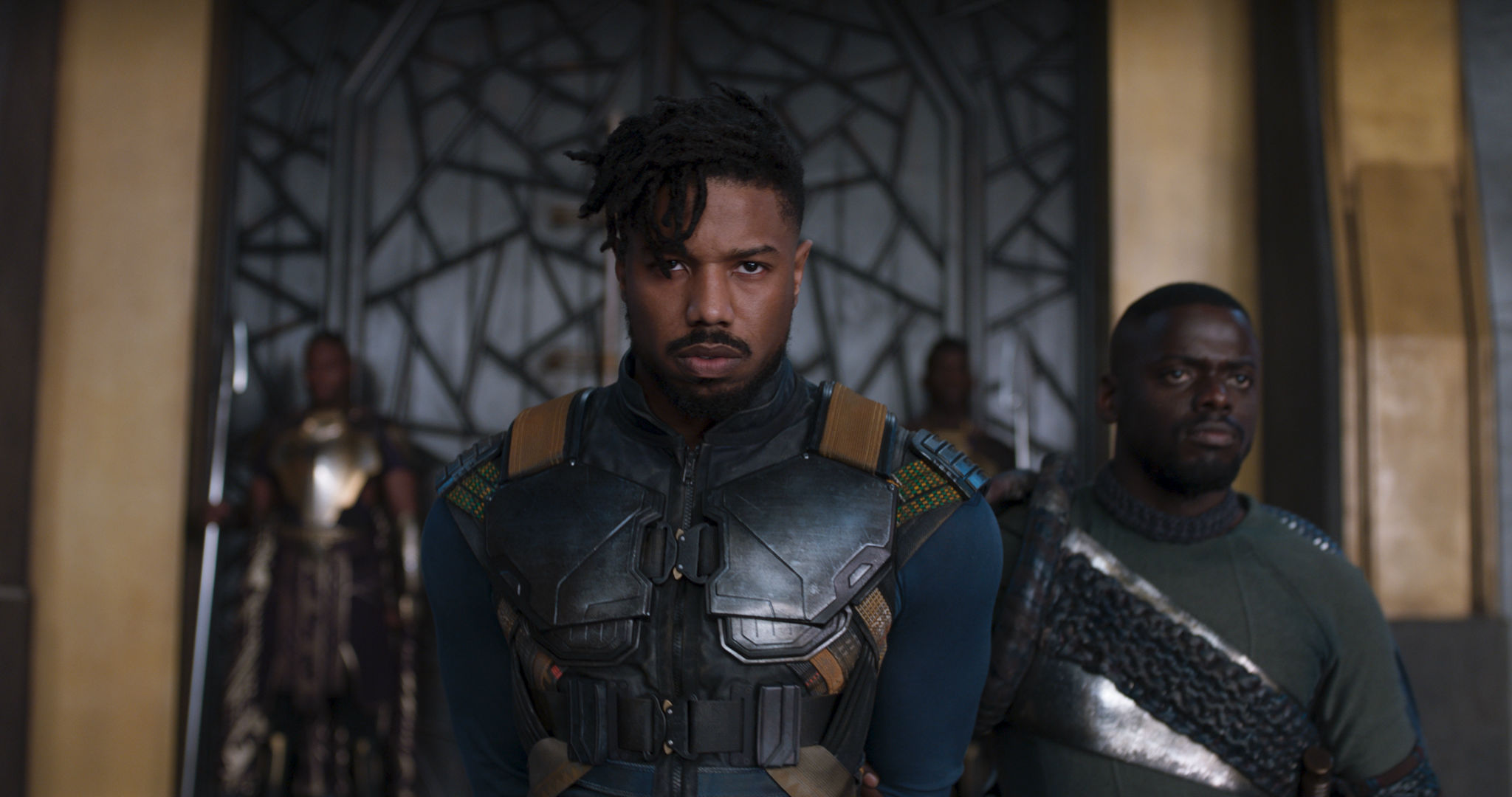
The villain of the piece, N’Jadaka/Killmonger, turns out to be T’Challa’s nephew. T’Challa’s father T’Chaka murdered his own brother, N’Jadaka’s father N’Jobu, for stealing and selling Vibranium — which some disreputable people (like Ulysses Klaue, played by Serkis) have come to understand is Wakanda’s secret.
This injustice, which T’Chaka later covered up and kept secret, causes the boy N’Jadaka to become a mercenary killer known as Killmonger. Now an adult, and having trained as a Black Ops Navy SEAL, he returns to Wakanda to challenge T’Challa for the throne. He appears to win the challenge, and immediately begins implementing the flip side of the Wakanda debate: he wants to position this secretly-superior country as the rightful ruler of all countries, turning its technology and resources into a war machine.
Killmonger finds lots of allies among the Wakandan population, and wins over the military wing. T’Challa, having disappeared and taken time to recover from near-death after the first battle with Killmonger, returns to Wakanda to reclaim his throne and must resume his battle — now with much of Wakandan might allied against him, and Killmonger now has powers and the suit the equal of the Black Panther.
As with all such movies, good eventually prevails against wrong, but unlike most other MCU films, things are not fully reset at the end. T’Challa takes on enough of the “Wakanda should be open” argument to bring his defectors back around, and starts making carefully-considered moves to let the world know about his country. It reminds me of some of the more recent, more mature Bond movies in its handling of issues, but the effects are strictly standard-issue, with a mix of fighting/action enhanced stunt work, and Sci-Fi type holo-effects abounding.
I’m reluctantly giving Black Panther three and a half stars because of the issues it raises and the focus on Afri-centric style and solid characterization, which means less time for (but still plenty of) fight/stunt/SF sequences, though certainly less stuff blows up in this one than any MCU film I’d seen thus far. I’m hoping — but not expecting — the sequel, Wakanda Forever, to keep this balancing act going. Sadly, Boseman’s premature death from cancer meant that much of what we would have expected from the sequel had to be changed.
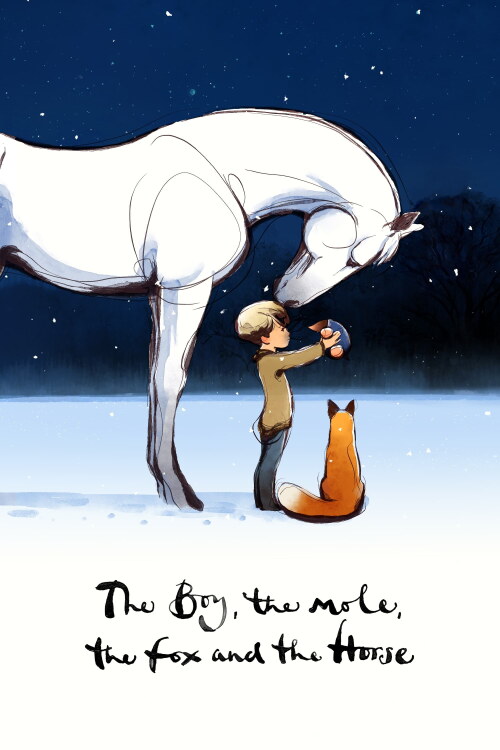
This short film (34m) won the BAFTA for Best British Short Animation, and since I have a fondness for short films (I reviewed dozens of them for Film Threat back in the day), I thought I’d have a look. The bottom line on this is that as a short film, it is deeply flawed in the story and dialogue department, but does indeed feature some lovely animation and music, along with considerable vocal talent.
Other reviews of the film — which follows the original book by Charlie Mackesey in both prose and illustration style — have been similarly mixed. The majority seem to side with me, in that a worthy project has been let down by a lack of story logic and an over-abundance of stilted aphorisms rather than dialogue.
On the other hand, I would be remiss if I didn’t mention those who liked it better than I did, because for them the film succeeded in touching them emotionally; perhaps in reflecting their feelings of having no proper place in the world, of a general sense of inadequacy or “imposter syndrome,” of longing for the emotional support in their lives that these four characters who have been brought together try to give each other on their journey.
Reading reviews like that gave me some further insight into what I think was the motivation of the filmmakers, and importantly the symbolic role each of the four characters play. The boy is the representative of those who feel lost; the mole speaks for those who are disabled in some way, or are otherwise naturally vulnerable; the fox is an anxious introvert who says little but keeps his thoughts and emotions under wraps; and the horse hides both himself and his true talents due to loneliness and depression.
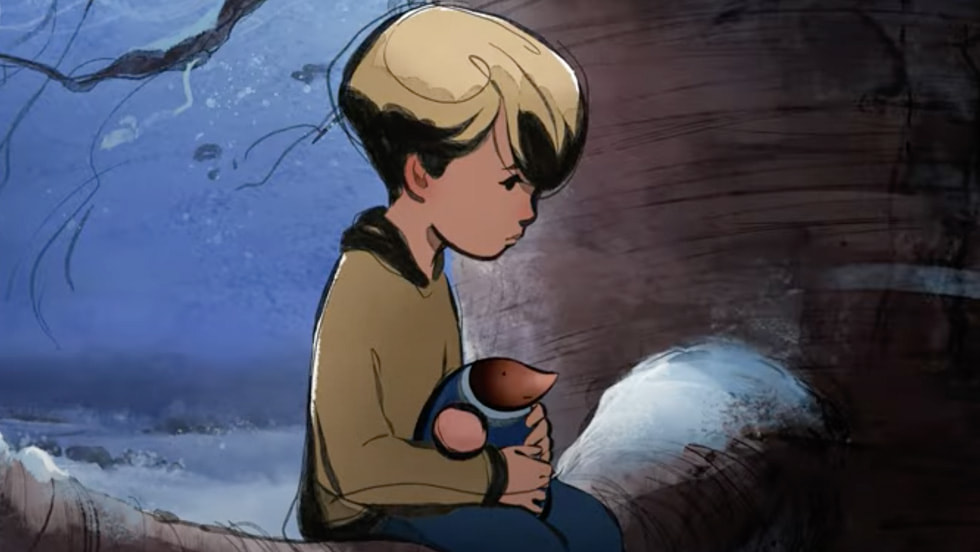
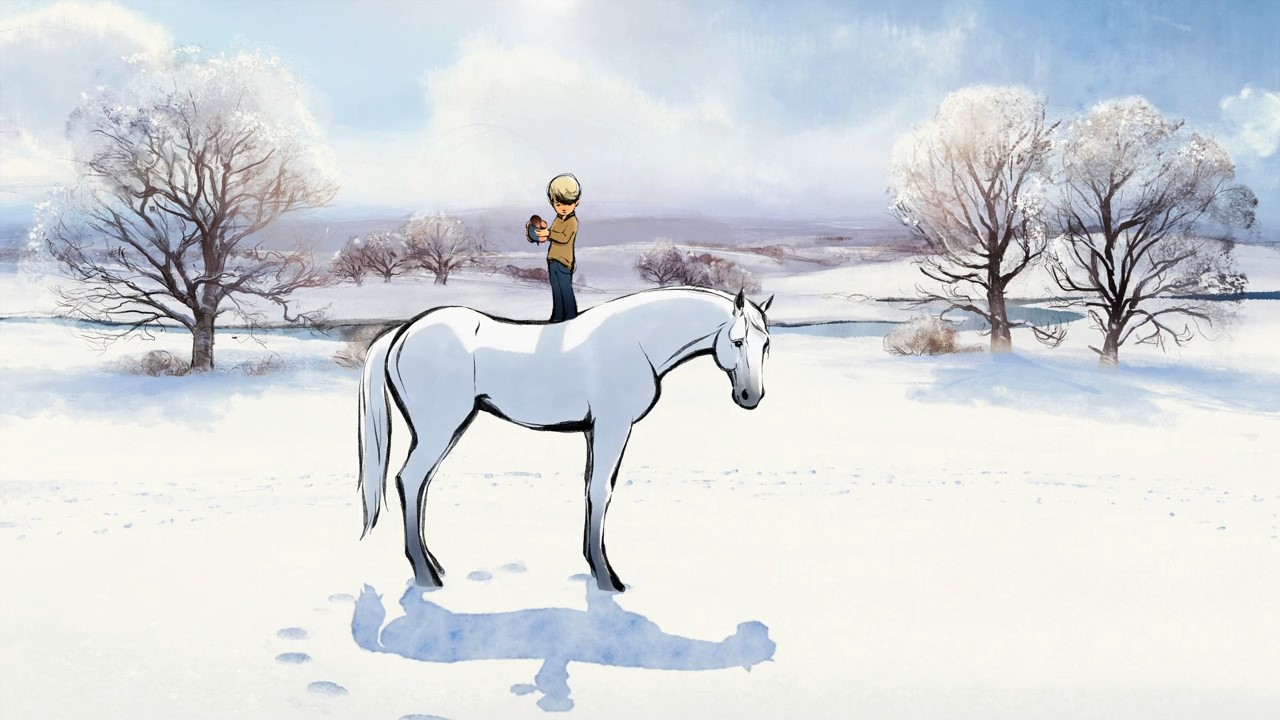
This kid wouldn’t make it through the night in the real world.
Its core audience, then, picks one of these characters to identify with, and hopes — like each member of the foursome — to gain something hopeful from the journey. However, if you don’t see yourself too strongly in any of these characters, they fall flat and don’t say much that speaks to you. That’s what happened to me.
So what I’m saying here is that I (now) “get it” a little better, and understand how some people could have such a different reaction and identification with the characters, to the point of overlooking the film’s flaws because of the power of representation. That said, in my view the filmmakers were too keen on getting these stereotypes together and badly dropped the ball on a) telling a coherent story and b) fleshing out the characters instead of turning them into walking self-help motto machines.
Since the animation, character design, camera & scenic work as well as the soundtrack are all perfectly fine, I have to focus on the near-total lack of story coherence. As the film opens, we see a boy (inadequately dressed for such weather) wandering across a lovely snowy landscape. As with any winter wonderland, the world looks new and clean and fresh. After a bit of lingering on the beauty of it all, the wandering Boy happens across a mole, who quickly befriends him with his cheerful attitude.
As they learn a bit about each other, the boy discloses that he is lost. Right at this moment, the film goes badly wrong when Mole does not simply suggest that the Boy just follow his own snow track back to wherever he came from. Further, the Boy suggests he is looking for “a” home, rather than “his” home, so right away we are as confused about where he came from as he apparently is.
Mole, who is good at burrowing but barely able to walk on the surface, first suggests climbing a nearby tree at the top of the hill they are on to get a wider view of the surroundings, and a few playful moments ensue with the Boy of course carrying Mole up with him. Before they can spot any sort of housing or town, they fall from the tree (miraculously without injury), but not before they spot a river. Mole suggests they follow the river starting tomorrow, as that invariably leads to somewhere, and the snow begins to fall again — so they retire for the night (to where?) to await the morning so as to begin their trek. There is no mention of shelter or food anywhere in the film, and no indication of how they would acquire either of those things (or survive the freezing temperatures at night), because why should this film even flirt with any degree of realism?
The next day, they get to the river and of course due to playful shenanigans, they fall in. Again, both Boy and Mole seem impervious to both the cold and being soaked, which really makes you (or at least me) wonder why this film is set in the winter at all, other than because snow is pretty. While helpless, a fox that has been following the pair since that first hill makes his play for capturing Mole, including rescuing him from the water with the aim of killing and eating him as you might expect from a fox. Indeed, Fox makes an explicit death threat to Mole once he is caught in a snare.
Mole makes the decision to chew through the snare, freeing the fox. Confused and frustrated, he runs off — but later begins not-so-secretly following the pair as they climb up another (bigger) hill to get the lay of the land. This time, at the top of the hill they spot a distant town with lights, and the trio begin their journey in earnest, with Fox still following at a discreet distance — as though he is attracted to their comraderie but doesn’t want to make it too apparent he wants to join them, although they have noticed him hanging back as it has become obvious.
To this point in the movie, the dialogue has been sparse but mostly story-driven, sprinkled with words of friendship. The dialogue aspect will soon bed almost exclusively replaced by declarations of feel-good quotables of the sort you’d hear from a self-help group leader.
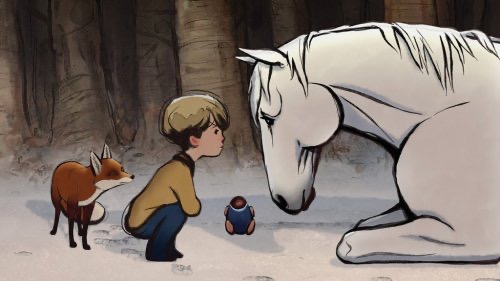
Eventually Fox approaches, says he is sorry for his past actions, and is immediately trusted and accepted into the group. After an unknown further time (presumably including at least one further night, though again no mention of food or shelter), they are ambling through a forest when they come across a horse who is attempting to hide. A few nuggets of shared wisdom later, Horse joins the party and the film’s title is now complete.
Horse gives them rides, and some merriment is had as the group continues to bond. A notable scene occurs where Fox gets a character moment to explain why he doesn’t say much compared to the others, and from here on pretty much all we get going forward are round-robin soliliqies of of love, friendship, and support.
Horse reveals his secret … he could have moved the plot along, but didn’t.
Some indeterminate time later (again, presumably nights and days in the cold have passed), the group finally seems tired and rests, whereupon Horse reveals a secret: he can fly. He has kept this talent hidden to avoid attention, for no discernible reason. In short order, the group flies the rest of the way to the entrance to the village/town, and a scene of goodbyes and further fonts of well-put wisdom are exchanged as the animals prepare to return to their previous lives.
As a reminder, this is apparently not the place the boy came from, and he doesn’t seem to know anyone there, but just assumes he will get a Home (hashtag entitled much?). It would be a more effective emotional scene if it wasn’t so littered with pull quotes from a 12-step program.
After saying goodbye to his friends, Boy begins to leave but quickly decides not to go, because he has twigged that home is where you are loved and “family” is who are enjoy being with, and so he doesn’t even give the town a chance. It would seem that the meaning of life is to love and be loved — which is a lovely idea — but the film ends there, blissfully free of any degree of realism.
The artwork is a great compliment, but a definite improvement, to the original artwork in the book.
The movie is rated 5+, which suggests it is aimed at kids — but even kids these days just aren’t this naive as to think that amassing a small group of diverse but supportive friends is the only thing you need in the world. Or perhaps I’m just a curmudgeonly old fusspot for wanting the film to have at least some tenuous connection to reality, the way the beloved films of my childhood — Charlie and the Chocolate Factory, the Wizard of Oz, Mary Poppins, the Muppet Movie, Toy Story, the Goonies, Charlotte’s Web, The Last Unicorn, The Princess Bride and so many others — did. Hell, the Roadrunner cartoons I adored as a boy were more anchored in the world I lived in than this.
I rate this movie — or at least its written in a new-age crystals store script — Bah Humbug, and no I won’t see the error of my ways later. A movie filled with amorphous affirmations where every character is wonderously wise and replete with the sort of positive pop pablum one expects to read in a Stuart Little daily calendar takes the children out of this children’s movie and reflects more accurately generations of bitter, broken grownups who long for a simple saying that will somehow hug away all of their adult life’s complications, regrets, bad luck, and bad choices.
While I appreciate the message of the importance of friendship and diversity, and again mention that many elements of this film — the animation, voice talent, and music specifically — raise it above average, it’s just overly simplistic even for a kid’s book and film. The Boy, the Mole, the Fox, and the Horse relies too heavily on superficial self-deluding sayings to rise above even a cursory set of critical thinking skills, which I happen to think most kids over the age of five have acquired in some measure.
On the very day that the Beatles performed their first US concert back in 1964, I sat down to finally watch in full a movie I had seen clips of all my life: A Hard Day’s Night, the movie debut of The Beatles that further cemented their new fan base in the USA. Somehow, I had never gotten around to watching the entire film, and seeing it in full really surprised me in how vital, innovative, and enjoyable it was as a complete work.
The film features more running than The Running Man and almost as much as Run Lola Run, mostly of the band trying to escape their shrieking fans. The film, which starts in black with the twanging opening guitar chord of the title track, features George Harrison taking a tumble almost immediately in the first chase sequence, but of course with the energy of youth and adrenaline picks himself up immediately and — like the rest of the group — has a big grin on his face as he resumes his sprint.
Director Richard Lester was determined to capture that level of youthful vigour by employing what at the time were dubbed cinema verité — innovative interminglings of hand-held, moving, and quick-intercut shots to represent the chaos of the chases. While the movie has a lot of these, there are times when the boys find respite and start to unfurl their humourous personalities and even advance a tiny bit of story — and for this, Lester reverts to somewhat more traditional camera styles, but still relies on being able to get his 16mm cameras into tight spaces for a more intimate feel.
The decision to make the film in black and white was likely a budgetary move, but it reminds me of why I like old movies (and in particular B&W films) so much: they are a window into a world that no longer exists, not just on a societal level but also presented in a way that was par for the course at the time but was nonetheless an abstract and dreamlike layer over reality. This film, even more so than usual: not only is it The Beatles as they originally presented themselves, but it’s been credited with having thrown off, once and for all, the societal straitjacket of the 1950s.
As much praise as Lester deserves for directing and editing the film, a lot of credit should also go to Alun Owen, the screenwriter. He hung out with the band for some time, and got two things absolutely right in his script: an ear for the funny banter the band effortlessly delivers, and an eye for what a rigmarole their lives were becoming as their fame exploded.
The story, such as it is, covers a period of about two days in the band’s life at the time, with some events being driven by their own harried schedule, with some being driven by the subplot: Paul’s scheming “grandfather” (Wilfred Brambell, best known for “Steptoe and Son”), who runs cons and generally complicates their already-chaotic lives.
Wilfred Brambell tries hard to steal the picture as the troublesome “John McCartney.” Isn’t he clean, though?
Thanks in part to the delightfully witty banter, frequently broken up by silent scenes of (again) mostly running about to the accompaniment of the band’s singles from their third album, and the contrivance of more songs for one of the boys’ TV appearances, the focus never lingers too long on any one scene or story element. All four of the lads convincingly look like they’re having a great time being in the film.
This film likely contributed to the “Swinging London” scene in the later 1960s as those teen Beatles fans — and the Beatles themselves — matured. Without a doubt, A Hard Day’s Nightwas a direct influence in the creation of The Monkees, and the freewheeling style of their popular US television show.
Lester is careful to give each Beatle some spotlight time, but two particular scenes stand out: a brief interlude where a woman seems to recognize John as “you’re him,” but he gently introduces doubt into both their minds until she puts on glasses and is then sure that John isn’t John, with John walking off agreeing that “she looks more like him than I do.” Another scene has Ringo escaping the chaos for a bit and having his own adventure by a river, where he meets a young boy (David Jason) and has a nice conversational scene.
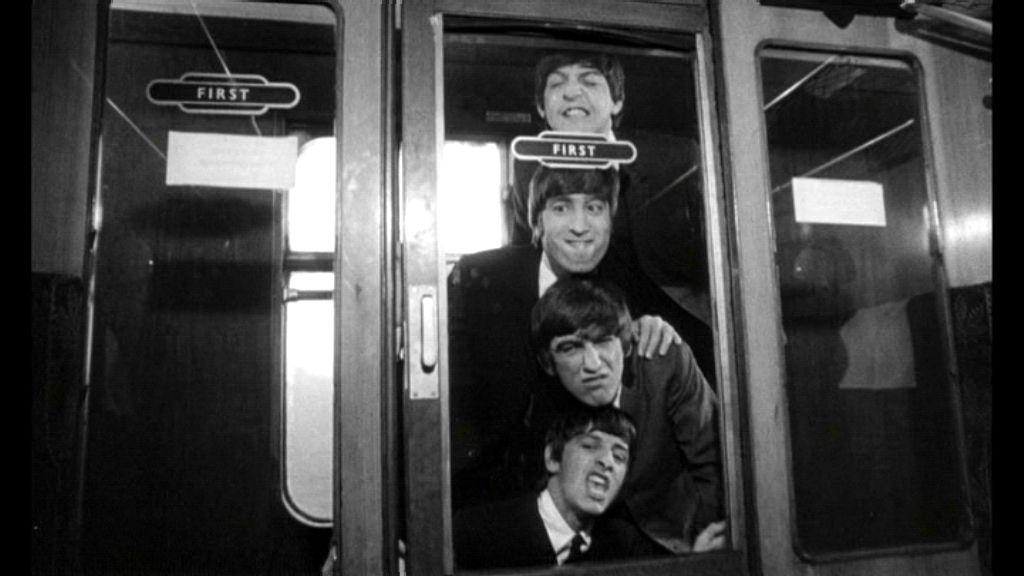
Interestingly, every teenager in the film — with an emphasis on girls, but there are plenty of boys running after them also — knows very well who each Beatle is, but the majority of adults in the picture have no idea at all. Another fun scene finds the lads in a train when a middle-aged businessman comes into their coach, creating some light tension.
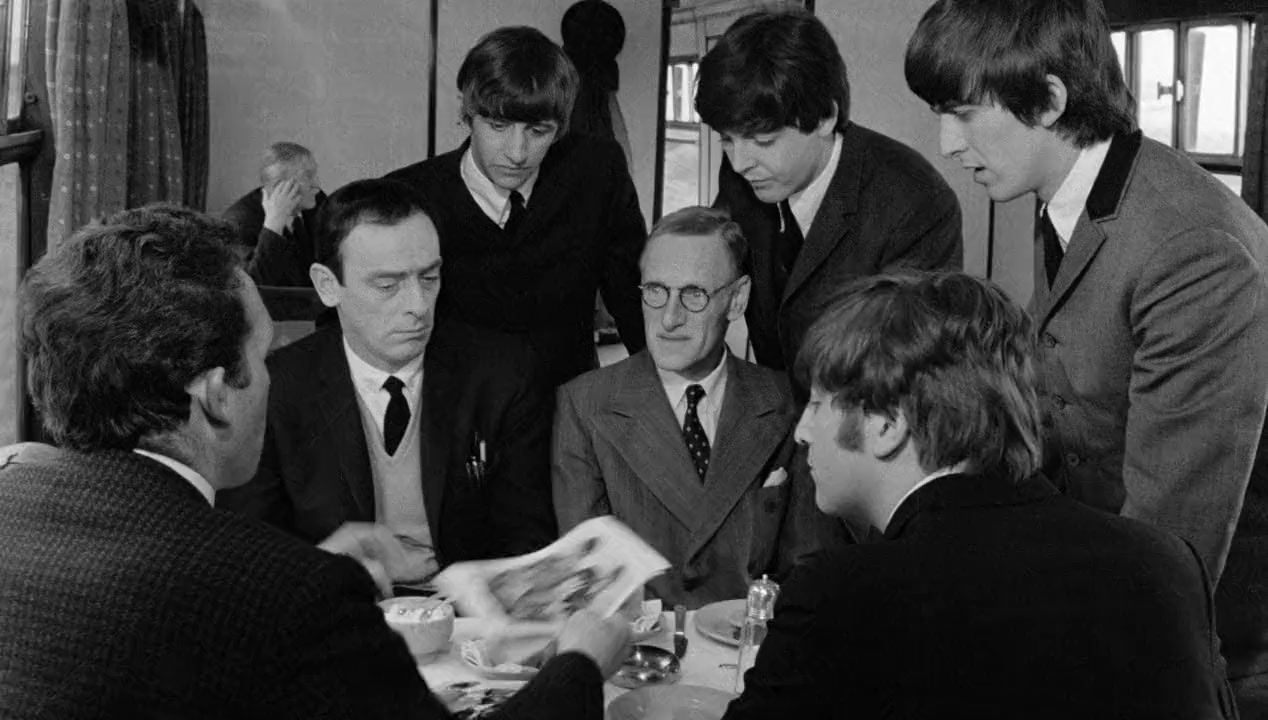
Actor Richard Vernon (of a very long career, though for me he will always be Slartibartfast in “The Hitchhiker’s Guide to the Galaxy” TV series) harrumphs his way into bullying the boys, who use their free-spirited impudence to intimidate him right back. Talk about a movie that caters to its audience.
The boys tease a stuffy British businessman who tried to bully them.
After some very mild “drama” about whether Ringo will get back to the rest of the band in time to do the live television concert and avoid giving the director of same (Victor Spinetti) a nervous breakdown, and what mischief is Paul’s grandfather up to now, everything comes back together just in time, and after playing to a screaming teen audience, they run yet again to catch a helicopter and off to whatever the next thing is.
I counted eight full Beatles songs (and several more reprises) in the film, not including some George Martin Orchestra instrumental versions near the end. The movie was a big hit on both sides of the Atlantic, and has continued to be very highly rated among critics and various “best of” lists for the past 59 years.
Prior to this, Lester had done a film with Spike Milligan and Peter Sellers called The Running, Jumping, and Standing Still Film, and it was that absurdist short that both got Lester the Beatles job as well as established the style for A Hard Day’s Night. It’s a good time and some great music spread across 90 fast-paced minutes, and gives us a loving moment in time just after the Beatles hit it big. If you aren’t tired of their early hits — and how could you be — the film still holds up really well viewed by more modern standards.
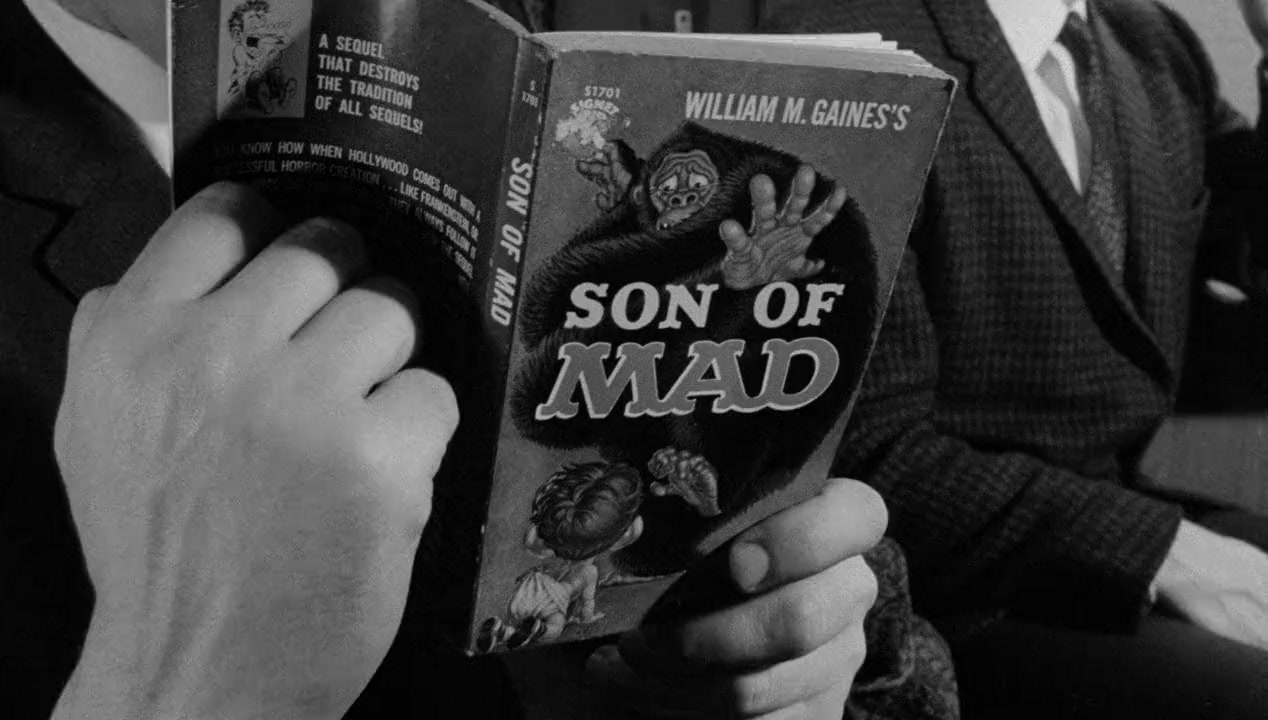
A favourite moment of mine in the film: the band’s road manager is reading a Mad Magazine anthology book.
This is one of the films that film-history majors watch, and pretty much nobody else (at least not anymore), but it’s actually a little bit fascinating.
This silent film is a non-patronizing look at life among the Kiowa and Comanche tribes — set in a time before they were herded into reservations and their previous way of life forcibly taken away from them, but acted by people this had happened to some 50 years earlier.
The story is a pretty straightforward “love triangle” story, but what’s amazing about this silent film is that the entire cast, without exception, is portrayed by Native Americans (some 300 all together), and featuring authentic outfits, props, and tepees provided by the tribes.
The acting is of course variable, but convincing enough to impart the story of one brave who feels he “deserves” the chief’s daughter and attempts to force her into marriage, while the young girl has already fallen for another brave. True love wins out, which itself is something of a radical idea given the time when the film came out.
The portrayal of the women of the tribes is surprisingly much less patronising than expected; the villain of the piece Black Wolf does have another who pines for him (Red Wing), but he callously ignores her in favor of the Daughter of Dawn (yes, that’s her name). He spends most of the movie creeping around and observing from a distance in the standard silent-movie way, helping us uncover developments, whereupon he discovers his rival While Eagle and plots his downfall.
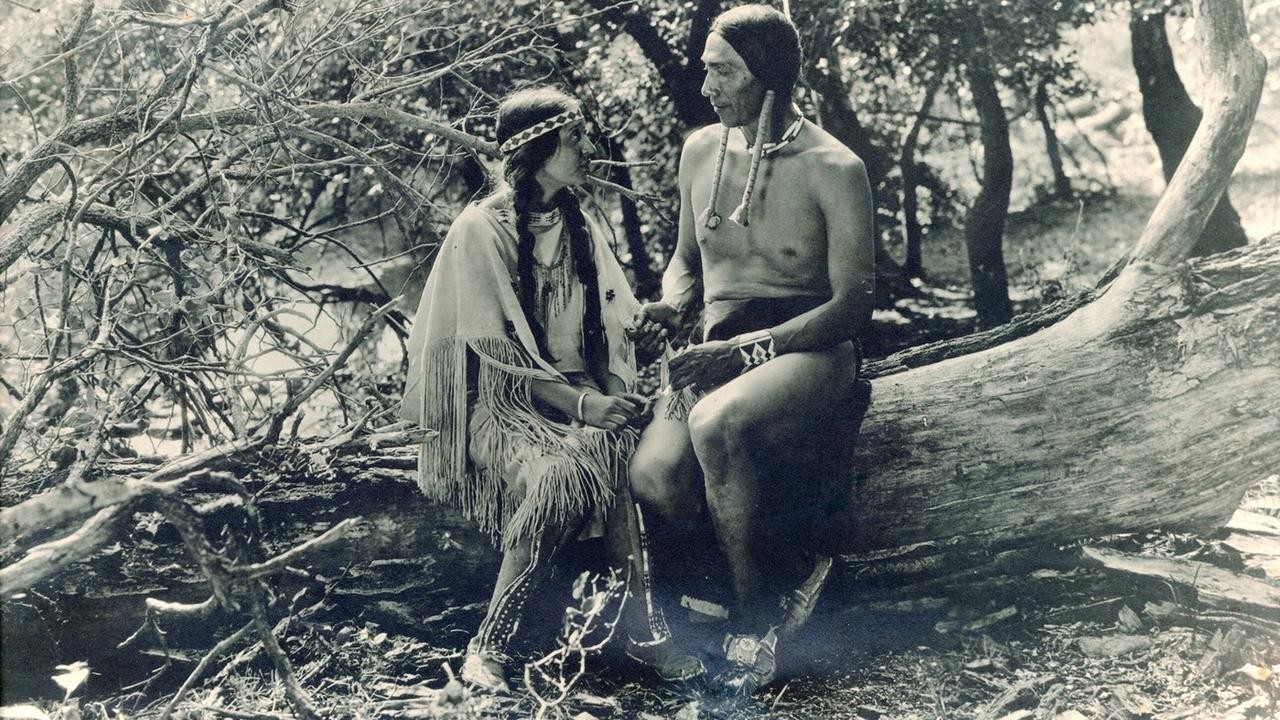
The Daughter of Dawn and her true love, White Eagle.
The simple story is kind of excuse to recreate something like pre-reservation life among two tribes, including great landscape shots of the plains (the film was made in Oklahoma), hunting scenes featuring actual wild buffalo, daring stunts, and some time spent on the day-to-day life of the people. Director Norbert Myles seems to have wanted to a documentary-style drama rather than stigmatize the “savages” as was more the style for the time.
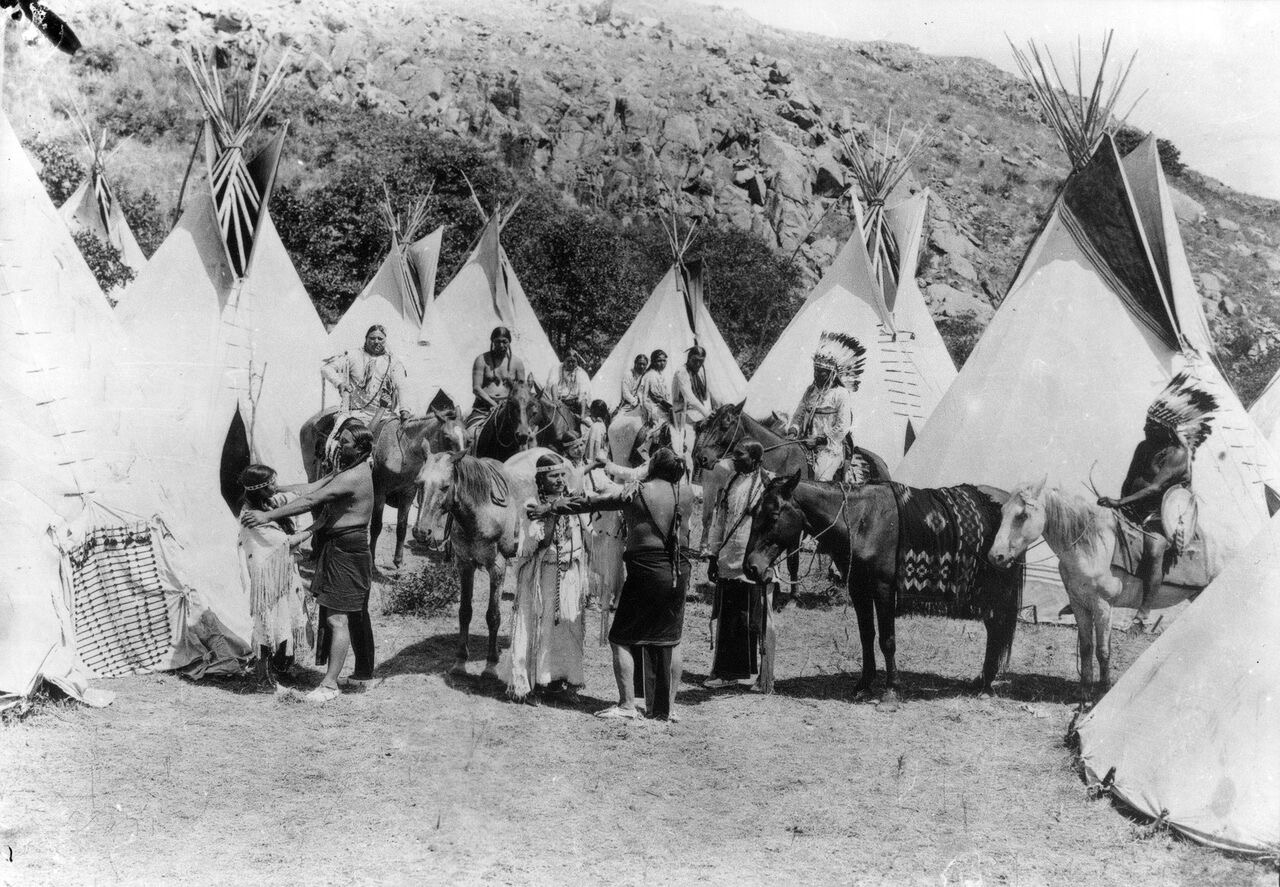
Actual First Nation peoples! Actual outfits, props, and tepees provided by the tribes themselves!
On a story level, this wasn’t that far removed from The Searchers (1954), but apart from the interesting historical context and backstory of the film itself — it was presumed lost for almost 90 years before mysteriously resurfacing in 2012 — it’s not a film most non-native people would seek out.
It’s pretty well-made and sympathetic for a 1920 silent film, and benefits strongly from an authentic Native American cast. The plot is very well-worn nowadays, but I would imagine it captured audiences’ imaginations — and maybe won over a few “paleface” hearts and minds — in its day.
I’ve been saving this film since it came out since the trailer alone told me what I needed to know about it — neo-expressionist, Escher-influenced, exceptionally-sharp B&W mixing stagecraft and filmcraft (and witchcraft) with stunning performances and visuals that I would eat up like candy.
At just over an hour and 40 minutes, this might be seen by some as an attempt to get theatre-resistant souls to give this major Shakespearean outing a fair shake —
but the substantial trimming of the text is so skillfully done that the stark and incredible visuals fill in what’s not there with great artistry. The speeches that I recalled most vividly from the many productions I have seen in theatres were still there.
About the only bad thing I can say about this is an unfair complaint: I never find Shakespeare’s lines quite as musical when they are done by American voices. That is not to, in the least, denigrate the performances of the leads — Frances McDormand as Lady MacBeth (stunningly well portrayed) and Denzel Washington as MacBeth himself, though he failed to connect with me quite as much as some of his predecessors in the part.
I liked the variations, sincerity, and styling Washington gave to his speeches, and he joins a company of fine actors, from Bertie Carvel (in a very fine turn as Banquo), to Alex Hassel as the impossibly thin, impossibly beautiful, impossibly expressive Ross, to Harry Melling as Malcolm (another good turn from this maturing actor). This being filmed entirely on a soundstage (in California, sadly) gave it a beautifully claustrophobic atmosphere, even when scenes were set outdoors. A triumph of cinematography, this.
Alex Hassell as Ross nearly steals the picture, except when Frances McDormand is on.
Visually, pacing-wise, and performance-wise, this version punches all of my buttons and while I have seen a handful of filmed MacBeths before, this one is far and away my favourite. It’s like no version of the show seen before, and combined with some sparing but incredibly clever effects to enhance the witch(es) — with a nod of awe to Kathryn Hunter for her stellar performance — it is as riveting to watch as any of Laurence Olivier’s Technicolour (or B&W) Shakespearean movies (one of which actually has Melling’s grandfather in a notable role).
Holy crap, this scene.
A mention must be made of Carter Burwell’s musical score, which is minimal and rarely calls attention to itself but which is yet another element setting the mood, which is what Coen has really brought to this production (other than some well-placed scissors to the script). Although there were a few fleeting moments when I wished a line or an actor’s look had been done a bit differently, or if a scene had lingered just a bit more, these were but quickly drowned by the glory of the effects, the sets, the cinematography, the lighting, and all the other elements.
Finally, I am not yet settled on Coen’s main addition to the tale, that being some staging that suggests a non-traditional interpretation of the third murderer. But perhaps I will drink in this sweet wine of a film again and ponder on it. This unconventional movie took some risks, and for me most of them paid off handsomely.
The late 1940s and much of the 1950s was an interesting time for the film world, particularly in the West. In addition to filmmaking advances from other countries, interest in ”foreign” films and styles of filmmaking/storytelling grew at international competitions, increasing diversity and influencing North American and European filmmakers for decades afterwards.
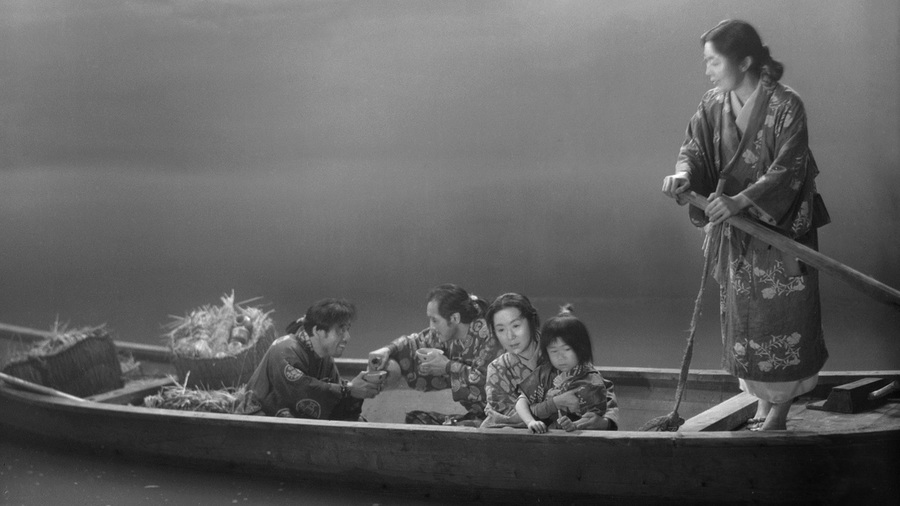
The main characters (L-R): foolish Tōbei, prideful Genjūrō, Genjūrō’s wife Miyagi, their son Genichi, and Tōbei’s wife Ohana.
This movie, usually shortened to just Ugetsu, is an interesting film because it weaves some timeless story ideas together: a clever allegorical tale of the delusions of men — and the subsequent wartime suffering of their wives and children, shown in a almost-feminist sympathetic light — alongside a more traditional Japanese ghost story, offering up a meaningful anti-war theme based on the lives of the innocent victims of war.
The story is based on tales from a book written in 1776 (when another more famous war was going on), and is set during Japan’s prolonged civil war, which finally ended in 1600.
We focus on a small family: the potter Genjūrō, his wife Miyagi, and their young son Genichi. The other two main characters are Genjūrō’s brother-in-law Tōbei and his wife, Ohama. Both of the two men have big dreams: Genjūrō dreams of having money by selling his pottery in larger towns, while Tōbei is almost feverish with a desire to become a samurai.
Genjūrō’s more modest and achievable aims at least are rewarded; Tōbei’s goal is sort-of achieved in a rather comical way, but their visions of success both drive them to leave behind their families to seek their fortunes, causing mostly suffering compared to the poor-but-happy lives they already had.
Tōbei, as is his habit, stumbles into enough dumb luck to finally get rewarded as a samurai general, complete with armor, horse, and retinue.
Genjūrō, in town to spend all his money on gifts for his new wife, slowly discovers that she and the villa don’t actually exist any longer; he has been seduced by a ghost, and living in a dream world that makes him forget his real wife and son. A priest he bumps into gives him a reality check, and paints prayers upon his body to help dispel the ghost and the dream-world.
The backdrop of all this is the civil war. Miyagi and Genichi, left behind by Genjūrō in his quest for larger towns to sell to, are forced from their village, with Miyagi robbed and stabbed by soldiers. Ohama, who loses Tōbei in the crowd of the city, must fend for herself and is eventually turned into a prostitute.
Tōbei, who finally has a little money from selling Genjūrō’s pottery, blows it on armour and tries to get into a samurai camp, only to be rejected.
Meanwhile, Genjūrō has had an encounter with lady of royalty who seduces him back to her villa, and uses her sensual regalness to trick him into marriage.
The triumphant Tōbei wants to return to his village to show his wife his new hero status, but his men persuade him to stop by a brothel for the evening first — where he finds his wife Ohama as one of the working women there. He is shocked back to reality by the discovery, and promises to give up his status in order to buy back her honour.
Genjūrō returns to the now ruined village and finds Miyagi and his son in their former house, relieved that at least his kiln has survived the soldiers’ devastation. He takes some food from the joyful Miyagi, who refuses to let him confess his sins, and quickly falls asleep beside his son.
In the morning, he awakes to find only Genichi still with him. A village elder discovers them and tells Genjūrō that Miyagi died from her injuries some time back, and is buried outside. The elder has been taking care of Genichi since.
Genjūrō and Tōbei reunite in the village, and promise to work hard for the benefit of Genichi and Ohana, who has had her honor restored via Tōbei’s giving up on his false success.
The film is shot with interesting lighting, camera angles (extensive use of crane shots, allowing for a mythical look), and extensive use of both traditional western soundtrack and spotlighting ancient Japanese music.
Although Ugetsu is mostly of interest to film history students these days, the movie is nonetheless a still-compelling tale of morality woven with supernatural elements. The clues that Lady Wakasa is not who she seems start with her Noh-theatre style and hikimayu-style “eyebrows,” while Tōbei’s story is told in traditional Japanese comic-underdog style.
The skill in the filmmaking blends these oddly-compatible journeys together well, and (surprisingly for the time) does not shirk from showing how their families suffer because of the mens’ chasing of dreams.
As an introduction to director Mizoguchi, it makes me want to check out his other international hit, Sansho the Bailiff (1954). Because of its towering international achievements in awards and screenings outside Japan, the film has consistently placed in many “all time greatest films” lists — and is still on the revered Sight&Sound top-100 list, having resided there at different rankings since the first such list in 1962.
On a suggestion from Jason A. Miller and inspired further by Drew Meyer, I’ve joined a little social challenge to watch 52 movies in 2023, at least one per week. I may or may not binge a few during relaxed periods like this one in case I can’t fulfill a given week’s goal. I’ll try to avoid any “spoilers” in my comments on them, and try instead to persuade people to look up (or avoid) the film.
First up: Battleship Potemkin (1925) by a 27-year-old (!) Sergei Eisenstein.
Although very basic and propagandistic by today’s standards, this is a masterpiece of early Russian cinema and brought the now-familiar technique of “montages” into the vocabulary of silent film, a way to show a number of shots as a summation of what was going on. Oddly, I had not actually seen the entire film previously.
It is based on the true story of the ship, which in 1905 helped kick off a revolution against the authoritarian Tsar’s government and military after a mutiny caused by the Tsarist officers’ cruelty and indifference to the suffering of the crew. The film is also noted for being among the very few that portrayed graphic violence and some gore on-screen (rather than cutting away or minimizing it) at the time.
Modern viewers may find its points laboured and the editing disruptive at times, but as a piece of military history and for the remarkable “Odessa Steps” sequence that represents the cruelty and tyranny of the Tsar’s forces, it remains an interesting look at some of the events that shaped Russia for generations. At less than 1h20m, it’s a pretty easy watch if you enjoy long-form silent movies (the score on the version I saw featured lots of Shostakovich).
Written by: Steve Kloves (screenplay) Directed by: David Yates Starring: Daniel Radcliffe, Emma Watson, Rupert Grint Running time: 146 minutes
It’s a bad sign when your mind wanders during a film. It happened a couple of times during this one, which is not to say I didn’t like it. Overall, I liked it quite a lot — in part because after six of these films they finally figured out how to make Harry Potter movies, and in part because J.K. Rowling has nicked so many “bits” from other books and movies and just twisted them a little, and there’s nothing wrong with that generally speaking.
The first thing that broke my suspension of disbelief was a moment early on in the film when Harry meets Elphias Dodge, an old friend of Dumbledore’s. Nothing against David Ryall, who’s been in everything British TV can offer at one time or another, but I would have loved to have seen Tom Baker in that part — he’s much more the kind of mad character Dumbledore would hang out with.
Later, during the sequence in the Ministry of Magic, I remember thinking “ooh they should have let Terry Gilliam direct this one.” There were several moments like that.
But what really broke my concentration was the laid-on-thick parallels to The Lord of the Rings. Now, the whole series has at this point become a “Quest” tale so bits of other quest classics are of course going to show up, from Greek mythology to Doctor Who’s The Key to Time, but Rowling really doesn’t try to terribly hard to hide it.
I come at these movies not having read the books (yes, I’m the one guy who hasn’t read any of these books bar the first one!), so I judge them as movies. From that perspective, the series has been pretty uneven; after the first delightful one, they quickly got jumbled, hurried and senseless (particularly The Prisoner of Azkaban, which was a disgraceful mess). After a slight respite in the much-better Goblet of Fire, things returned to silly, overwrought and confusing in Order of the Phoenix, which I found totally forgettable and impossible to follow.
Much of the damage finally started being repaired in 2009’s The Half-Blood Prince, helmed by David Yates who took what Mike Newell started and ran with it, focusing like a laser on the actual story buried in the details and extracting it, much to the delight of anyone who hadn’t re-read the book the week before. HBP was clear, set up new events nicely, really let the young actors shine instead of being just an endless walk-through of notable old British veterans like the first five movies were, and as a result solved the pacing issue that had really hobbled all the films from #3 onwards.
Yates returned for this one, and the two-part nature of it might have been a crass marketing ploy but I for one am grateful; the slower pace makes this the first Harry Potter movie to have any appreciable amounts of silence in it. I found myself really enjoying the slower-paced scenes, such as Harry’s kiss with Ginny to remind you that they’re still a couple, and some of the later picture-postcard scenes do allow for some genuine thoughtful acting (rather than, say, re-acting to one of the many effects shots).
There is still a certain amount of blink-and-you’ll-miss-them with the by-now enormous guest cast (and remember, half of those characters have died in the films by this point!) and there are still some introductions of people who, as in so much of Rowling’s work, walk on and then are quickly killed or thrown out never to be seen again. I was disappointed we didn’t get more of the Dursleys, but at least this time they didn’t forget about having a few lighter scenes; the Seven Harrys will get a giggle out of many.
There’s a fair amount of sexual tension in the film, though for the life of me I can’t really see how the Ron-Hermione romance actually works so their on-screen actions feel kind of forced (and the “triangle” with Harry even more so), but the kids do pretty well with the material; this movie is much less a spotlight on Radcliffe as it is on Watson and Grint, the former proving herself what I have always suspected — a reincarnated Audrey Hepburn — while Grint struggles to look like he even belongs in this movie.
I don’t fault Grint so much as Rowling — Ron is just a blah character meant to balance the other two, and in the films he’s been a total third wheel since the first one and he knows it. Of the original young cast, I think Watson and Tom Felton (Draco Malfoy) have a real shot at having genuine long film careers if they care to. Felton isn’t given that much to do in this one but he’s quite obviously going to have a bigger role in the next one, and I found the whole dynamic of the Malfoy household much more interesting in DH1 than ever before, as the family — particularly Lucius, Draco’s father — was painted in such cartoonish strokes up until the last film (and speaking of him, what the holy hell happened to Jason Isaacs? He looks terrible in this movie, like he’s aged 10 years to everyone else’s two!).
There were still sequences that didn’t make much sense, or seem to add much to the plot, but it is the scenes of the heroic trio on the run that make up the entire second half of the film, and while a nice change from the Hogwarts-bound nature of the previous movies, went too far over the LOTR-homage cliff and felt circular in nature — apart from destroying the Horcrux, they don’t actually accomplish much, and what few clues they turn up felt very Hardy Boys/Nancy Drew-ish in nature. Finally, they end up in right where they didn’t want to be — and despite their escape, they lose Dobby (I was not sorry to see him go, I considered him the Jar-Jar of this series, but at least they gave him a very good send-off) and the villain seems to have won the day.
Despite not having read the books, I have a pretty fair idea of where this is going for the wrap-up, which characters will return and which ones will redeem themselves. Why? Because while Harry Potter’s saga is imaginative — and enjoyable for that — it is not terribly original. Anyone well-versed in the Hero’s Myth, Freytag’s model and the best adventure stories that have come before it can see the general path ahead. But have we enjoyed the journey?
Though it remains entirely too dependent on the source books to make much sense without them, Harry Potter and the Deathly Hallows, like The Half-Blood Prince, at least tries to give us a coherent enough main plot to follow that we aren’t bothered too much about the details, and on that level it succeeds.
For once, I understood perfectly what the subject of the title of the film was all about, thanks mainly to a really standout bit of shadow-play homage animation to illustrate the tale of the Three Brothers, and even the racism/eugenics allegory was further explored without beating me over the head with it. It even tied back to the first movie, well there’s a nice reward for those who have grown confounded by Rowling’s tendency to throw tonnes of interesting stuff at us and then refer back to precious little of it ever again.
I have hope that the finale really will tie up at least some of the bigger loose ends and give us a satisfying conclusion. I have no doubt that Voldemort has fallen for the last of Dumbledore’s traps, that just as the brass ring is in his grasp his “family” will begin to defect, and that characters not seen in this movie (or for a while, if you get my drift) will return. Hell, I’m half-expecting Ghostly Alec Guinness — sorry, Ghostly Albus Dumbledore — to turn up at a crucial moment and tell Harry to use the Force.
Written by: Norman R. Raine & Seton I. Miller Directed by: Michael Curtiz & William Keighley Starring: Errol Flynn, Olivia De Havilland, Basil Rathbone, Claude Rains Running time: 102 minutes
The short version: this is an absolute classic of a movie, so good that I don’t even mind that a number of the cast are obvious Americans.
This is a beautifully-executed amalgamation of various legends of Robin Hood and his band of Merry Men in Sherwood Forest, a story that has evolved greatly over time (and deviated from what scant details are verifiable) but has its roots in genuine tales of a legendary archer who addressed injustices via vigilante violence from at least the 14th century.
This version presents the now-standard portrait of Robin of Loxley as a dispossessed Saxon knight forced to become an outlaw when the Normal Prince John, conniving brother of King Richard I, attempts to seize the monarchy and subjugate the Saxons while King Richard is away at the Crusades.
Very little of this squares in any way with the actual legend (itself full of disputed details) — it’s off by a mere couple of centuries, a different king and lack of nobility for a start — but who the hell cares. The setting gives us a genuine historical backdrop (Prince John really did overthrow Richard’s regent William Longchamp in an attempt to seize the throne while Richard was held prisoner), a rich and clearly-drawn cast of characters, an injustice for Robin to fight and plenty of pageantry. The 12th century never looked as good as this, and despite all the detail inaccuracy, most people consider this the definitive version of the story which, despite many subsequent attempts, hasn’t been topped (or even equalled).
The key to this movie’s enduring success — it’s still very watchable and enjoyable some 72 years after it’s release — has a lot to do with the screenplay, which is beautifully peppered with comedy and drama in perfect proportion to the action, and structured very much along the patterns of Shakespeare’s plots.
The casting must also be mentioned, as time has proven most of the choices very wise. Errol Flynn (who was actually born in Australia) gives us a passable attempt at an aristocratic English accent, convincing us he’s a Saxon lord being discriminated against by the treacherous Prince John (just this side of camp portrayal by Claude Rains), the evil Sir Guy of Gisbourne (the flawless Basil Rathbone), and the rather ineffectual and oafish Sherrif of Nottingham (a refreshingly different, Cowardly Lion-esque approach by Melville Cooper).
Strangely, however, the Merry Men are appear to mostly be made up of Americans. Excluding Robin and Will Scarlett, the main speaking roles amongst the outlaws are the frog-voiced Friar Tuck (Eugene Pallette, a former silent-movie star who’s distinctive voice made him a comic actor in the talkies) and Little John (father of “Gilligan’s Island” skipper Alan Hale Jr.), the former of which is especially jarring in 12th-century Yorkshire.
Still, all is forgiven once the characters are introduced and the action begins, including a number of breath-taking stunts (remembering that there was no technology or safety standards in those days) set against a (California!) backdrop of perfectly gorgeous technicolour, still quite the novelty in 1938 but which has definitely helped preserve interest in this film.
Flynn comes off as the perfect heroic archetype; charming, sassy, bold, witty and noble. From his first encounter with Sir Guy and particularly in his latter bold appearance in the court of Prince John, his portrayal seems natural and self-assured, like he was born to play it — the fact that his interpretation stands as definitive to this day speaks loudly of how well the script was tailored to Flynn’s personality.
Poor Olivia De Havilland has to do all her acting using almost exclusively her eyes for most of the film, only ridding herself of her maiden headdress towards the end, but she proves up to the challenge and gives a surprisingly rich and nuanced performance, even when overshadowed by the much more (shall we say) theatrical stylings of messrs. Rains, Rathbone and Cooper.
Sharp-eyed or repeat viewings of the film can yield forth all manner of continuity goofs, embarrassingly rubber clubs and swords, strange plot points (Richard and his men just “show up” in Sherwood with no explanation of how they escaped or got there, right on cue) and so forth, but these sorts of things — which would be excoriated as sloppy in most films — are swept under the rug by the an audience swept away by the pageantry and action. Directors Curtiz and Keighley boldly stage complicated fight scenes and other set pieces with huge numbers of extras and rather complicated shots and by and large it all works stunningly well.
Like Captain Blood and other high-adventure films of the period, the filmmakers have no trouble balancing slower, character-rich moments with the fast-paced action, because at all times they remember to be servants to the overall story. The comedy is always delightfully light-hearted, the dramatic moments are credible (particularly thanks to De Havilland, such as the scene in the forest where she begins to be won over to Robin’s cause), and nothing feels out of place — even the entirely-invented romance between the hunter Much and Marion’s nurse Bess. Even the small moments and throwaway lines give the story more variety and depth — careful not to make Robin less than perfectly noble, giving the Merry Men sufficient backstory, avoiding painting the Normans as all-bad or the Saxons as all-good and so on.
The Axis of Evil, circa 1166.
If you only ever see one Robin Hood film in its entirety, this is the one to see (well, actually, you should watch Mel Brooks’ Robin Hood: Men in Tights right after it). If you only watch one Errol Flynn movie in your life, this is the one to see. If you only watch one colour film from the late 1930s … okay yeah, that would be dumb because there were a number of fabulous colour movies from the late 30s, but this is definitely right up there with Gone With the Wind or The Wizard of Oz.
Historical accuracy be damned, this is Hollywood legend-making at its finest and the source of so much influence over not just later Robin Hood movies, but adventure movies in general, that it should be a staple of film schools and periodic revivals, particularly at outdoor film fests. This is genuinely among my all-time favourite films — great historical fun that holds up so well it may well last another century as a beloved fable.
Written and directed by: Floria Sigismondi Starring: Dakota Fanning, Kristen Stewart, Michael Shannon Running time: 109 minutes
The Runaways is a decidedly lopsided film about the hugely influential all-girl rock band who roared into life just on the crest of punk and combusted, as all legendary bands tend to do, before they ever reached their full potential.
The background of the film is that its screenplay is derived from (lead singer) Cherie Currie’s tell-all biography Neon Angel, but also has as one of its executive producers one Joan Jett, the leader of the band, and so we can presume that from the point of view of these two, at least, the real story of The Runaways is being told.
Fanning and Stewart are, frankly, miracle pieces of casting giving their best performances ever (Fanning we already knew was an adept actor, but who could have guess that Kristen Stewart had more to offer the world than Bella Swan?), totally submersing themselves in their roles and even actually singing most of the numbers performed. Apart from scene-stealing Michael Shannon as Kim Fowley, the two girls dominate not only the band but the entire movie.
Thus, it’s a pity that the movie focuses on only these two members of the band (and Fowley) so heavily. Drummer Sandie West (Stella Maeve) at least gets some decent screen time and a few lines, but Lita Ford (played by Scout Taylor-Compton) just comes off as a permanently disgruntled bitch with the very few lines she’s given throughout the film, and the bassist (a made-up character called Robin, since actual bassist Jackie Fox chose not to be represented in the film, played by Alia Shawkat) doesn’t get so much as a single word of dialogue! Ford and “Robin” just disappear into the background for 99% of the film, and West only fares slightly better. It’s like trying to tell the story of the Beatles while ignoring George and Ringo and instead only focusing on John, Paul and Brian Epstein.
That said, seeing the formation of the band makes for an interesting first half, showing not just Currie’s upbringing but Jett’s as well (though the film’s version of the band forming and their early practicing is an out-of-sequence and fictionalized version of what actually occurred). Frankly, Fowley still has enough life story left over to make several more films just about him.
The backstory on Currie’s disintegrating family is interesting, but by the middle of the film we see where that’s all going and would rather stick to the band members (who’ve had a very illuminating introduction into the realities of first-tour experiences), but since half of the band are little more than window dressing we get more about Marie Currie, Cherie’s long-suffering sister, left behind to take care of their alcoholic dad. After the band experience great success in Japan, things begin to fall apart with Currie taking on too many drugs (etc) to really function, even as she and Jett begin a relationship.
Before you know it, the band are in the recording studio, Currie is having a breakdown, Lita Ford gets her big bitch scene and voila, the whole thing flies apart. In reality, this process took four years and three albums (with Currie) plus a final record with Jett on lead vocals before it came crashing down. The film leaves us with Jett ruminating on a solo career, and an awkward coda years later as Jett is being interviewed by Rodney Bingenheimer on KROQ (played over-the-top, if that’s actually possible with Bingenheimer, by Keir O’Donnell); Currie, who hasn’t spoken to Jett in years, phones in and stammers through some on-air awkwardness, then goes back to her job folding napkins.
Viewers who are not familiar with the background of the band and its actual breakdown are likely to be a bit confused by the abridgement and time compression of the film, which actually helps the film feel rather short at 109 minutes, but rock n roll is as much a feeling as it is a series of actions, so this film is probably as much of the real story as you’re ever likely to get, and the soundtrack (mostly reperformed Runaways songs, but there’s also some delicious Bowie, Stooges, Gary Glitter, MC5 and even a little Suzi Quatro in there as well) is pure gold.
The film itself is efficient and well-shot, covering a lot of ground pretty smoothly overall. Although there’s more dysfunctional family life in this one than you get in most rock band biopics, it still feels at times fairly mechanical in its run-through from origins to breakup, complete with “updates” on most of the characters at the end.
Despite having little to no “message” apart from “the rock lifestyle is fun, but don’t overdo the drugs, mmmkay?”, it’s good to see big-name stars actually put some acting blood on the line and do justice to the (limited scope of) the story for a change, and the music is killer, so ultimately I recommend you see the film. I somehow just don’t see Ford, West and Fox (et al) ever getting it together to tell you their side of the story, so eat what you’re given and enjoy The Runaways.
Director: Guy Ritchie
Stars: Robert Downie Jr., Jude Law
Running Time: 129 minutes
When I was a boy, I devoured the Sherlock Holmes stories — and still credit my reasonable powers of observation and fair ability to “read” people to my studied enthusiasm for those imaginative tales.
Every few years, I get the itch to re-immerse myself in that wonderful world of Victorian crime and intrigue, intense problem-solving matched with equally intense pleasure-seeking, and the power of pure friendship and pure intellectualism. Most recently I’ve finally (after 20 years!) gotten a chance to watch Tom Baker play the world’s foremost detective from a 1982 BBC production. Baker, who’s best-known role (The Doctor of Doctor Who) is more than a little inspired by Doyle’s detective, was actually bloody marvellous in the traditional theatrical interpretation of the part, rather talky and stagey and with an emphasis on the character’s regal bearing contrasted with his inability to cope with anything beyond crime-solving. It’s available for rental and Holmes purists will probably find themselves generally delighted at this unfairly-overlooked production.
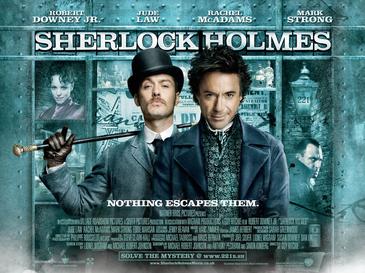
When this new Sherlock Holmes film first came around last Christmas, I had mixed feelings that ultimately kept me from seeing it in a cinema until now. I had great confidence that Robert Downey Jr would be fine in the lead, despite the alarming 80s hair he boasts in the promotional poster (thankfully not replicated in the film), but I frankly don’t care much for Guy Ritchie’s output; neither his choice of usual subjects (British gangland) or his particular directorial style (no more than 10 minutes till the next implausible action sequence) have ever sat well with me, though I’d be the first to admit the two generally go together successfully.
The trailer didn’t inspire me much, except to dare to hope that Jude Law (who plays Watson) would actually be good, something I’ve never managed to see happen before (including, most recently, in The Imaginarium of Doctor Parnassus). Holmes as a boxer? A dashing ladies man with all the right words? A Victorian London that appears to have a lot of explosions??
But one should never trust trailers. The actual film itself is, in my view, Ritchie’s most successful effort at being light-hearted, and while great liberties have been taken with the source, it is still identifiably Holmes and Watson, and makes for a solidly entertaining film that deservedly did well at the box office.
While the film is carried by the strong performance of Downey as Holmes, this is actually more Watson’s movie, a very wise move on the part of the screenwriters and director. Watson is often played (ever since Nigel Bruce ruined the part) as a bumbling fool whose only job is to provide narration and makes Holmes look good, but in this version we get something much closer to the Dr. Watson we met in the books and stories; a colleague who, after several years with Holmes, has picked up much of his power of observation, a foil who Holmes himself sees as the man he might have been, a faithful chronicler but not always so loyal a friend, often getting tricked or challenged into participating further.
Jude Law has, to my eyes, never ever been better than he is here. I have never much cared for him and find most of his performances wooden, underplayed and dull, but he clearly had a strong regard for Watson and a good chemistry with Downey, and hits exactly the right note.
As for Downey, his accent is (as Ritchie called it) “flawless” and his interpretation of the part is entirely suitable. If Doctor Who ever got made into a another big-screen movie and the current incumbent was unsuitable, Downey would be my second choice — his entire performance here might as well be one long audition piece for The Doctor. Though he lost some weight for the role to get into fighting trim, I still don’t see him as quite physically right for the role — Holmes was a wastrel in many ways, and the usual consequence of such addictions is a gauntness Downey just doesn’t possess. But he’s more than adequate in the part and apart from some occasional mumbled lines (usually spoken too quickly to be heard clearly), he provides the necessary mix of gentlemanly bearing with mischievous misanthropy, adding style and wit, particularly to his relationship with Inspector LeStrade (Eddie Marsan).
The plot is scarcely worth mentioning, in part because its not based on anything in the Conan Doyle canon and in part because apart from its overall raison d’etre — purporting to show the first meeting of Holmes with his later arch-enemy Professor Moriarty — it doesn’t matter really. The mystery is lovely and atmospheric and, as we know full well going into this, fully solved by the end. The supporting players are equally trivial to the point of the film, which is to showcase the complex relationship of Holmes and Watson. The whole film is actually structured more a Dan Brown runaround (such as The DaVinci Code) than a proper Holmes tale, for example eschewing the traditional “told after the fact” narrative angle and omitting the also-traditional part where a visitor to Baker Street sets up the entire background, one of Doyle’s most common literary devices. But it’s all been cast aside so that we may spend more time in the present moment with Holmes and Watson and watch their bromance take its roller-coaster ride through some very scenic set pieces.
Instead of all that drawing-room chat, we are dropped right into the thick of things, with Holmes and Watson stopping the ritual murder of a young girl by occult leader Lord Blackwood (bit of an in-joke, that name), played by Mark Strong. Blackwood tries his best to convince Holmes of the existence of the supernatural, even returning from the dead after three days (it’s been done), but Holmes is having none of it. Methodically and (as usual) against time and obstacles both external and internal, he unfolds the mystery and (along with the help of Rachel McAdams as an American former lover and jewel thief) saves the day.
London is of course a great place to shoot a Victorian mystery as its quite easy to use current locations with a minimum of dressing. The problem with Ritchie is that he has no concept of the word “minimum” — sets are usually over-dressed and dwelled on more than the actors. Some scenes appear to be chosen purely for their visual value rather than any practical meaning; a prolonged fight scene with Holmes bare-knuckle boxing a larger fellow exists ostensibly to show his ability to calculate his victory over an opponent, but this exact same ability was showcased in the first scene of the film — so this repeated scene is merely an excuse to show the same thing, only this time with Downey’s shirt off.
In another example, being chased by a giant French henchman (Fre-henchman?), the action allows for a large vessel to be loosed from its moorings and fall into the Thames, where it sinks entirely out of sight. The Thames, at its absolute deepest point and highest tide, wouldn’t be quite 20 metres (the spirit of Conan Doyle was notably absent during the “logical sequence of events” part of writing this screenplay). Not only that, the boat slipping from its drydock is entirely unnecessary and adds neither atmosphere nor content to the story.
The big climatic fight on the top of the still-being-built Tower Bridge was probably enjoyable to mainstream moviegoers but struck me as very unrealistic, breaking my suspension of disbelief by being so obviously green-screened. It’s no accident that it’s the only really “talky” part of the movie, the part where Holmes explains to the villain (as though he didn’t know) — and the audience — all the ways in which he’d rigged his “supernatural” tricks. I guess Richie can’t abide the idea of people just explaining things without visual drama all around them. At least he confined himself to only one huge explosion this time.
For a “Hollywood” movie (albeit shot in England), Sherlock Holmes is generally very successful at making the character more appealing to modern (read: less entertained by displays of cleverness) audiences; as a movie its good fun and I’m not surprised that the estate of Sir Conan Doyle gave its blessing, despite it being an original story. The choice of a “supernatural” villain was both genre-appropriate and created a nice contrast of styles. Hans Zimmer’s soundtrack makes use of authentic sounds and even a few period songs alongside the usual “action” soundtrack requirements, so I’d rate it above average. The editing was, as is typical of a Guy Ritchie production, rather slapshot and trendy. Like the sets, it felt overworked at times. One fears for Mr Ritchie’s ability to stay focused for any lengthy periods of time.
This interpretation of Holmes may not go down as a classic, but its well worth your ticket or rental money, features a surprisingly strong pair of leads, and preserves the colour, charm and brains of the enigmatic Sherlock Holmes. Despite the sometimes ill-fitting choice of director, I’d say this is about as good a Sherlock Holmes movie as you could possibly hope for out of a mainstream US studio.












 The Chasbah