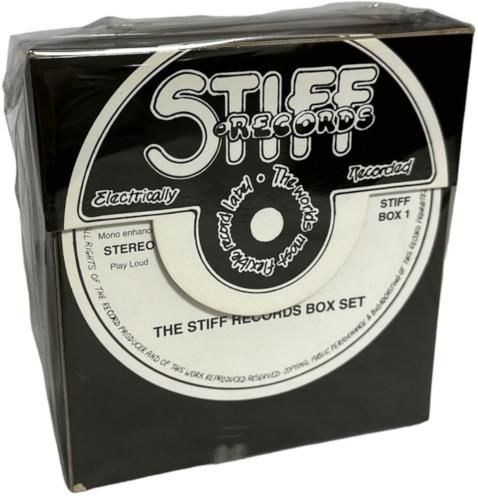
The Stiff Records Box Set – Disc 4

The Stiff Records Box Set — Disc 4
Stiff Records, 1992
4CD box set + booklet

THE PROLOGUE

Well, here we are at last, the final disc in this set, chronicling the last days of Stiff as an active record label roundabouts the mid-80s. Many of the acts Stiff first signed and/or made famous moved on to bigger record labels and more money, and Robinson and Riveria were forced to cast an ever wider net.

It’s a label that kicked off with Nick Lowe because he had already recorded to “publisher demos” at other companies’ expense, so the cost of releasing that very first Stiff single was a staggering £45. Thankfully, it did well – and the rest of the history is encapsulated here.

As mentioned previously, the tracks on these discs are in rough, rather than exact, chronological order, but on the other end of this Stiff journey we alight on the pub rock band Dr Feelgood, still going to this day as an entertainment entity but with a completely different lineup. You might wonder what a mid-70s traditionalist UK rock band is doing here, but they are part of Stiff history for two reasons.

First, singer Lee Brilleaux was the man who lent Jake Riveria and Dave Robinson the 400 quid they needed to register Stiff as the UK’s first independent record label. Second, they were a pretty damn good pub-rock band by the time they finally recorded with the label.

THE MUSIC

Things kick off with “Sign Of The Times” — a nice, poppy single from The Belle Stars, an all-female group that should have gone further than they did. I’m happy that their biggest single was one of their own originals, rather than the cover versions they had been doing for a while prior to that. Prince obviously liked the title also!

The follow-up single from the band is also included here, “Sweet Memory” as the second track on this disk, and it failed to crack the top 20 despite some pretty groove-y instrumentation. It’s certainly not as good as “Sign of the Times,” but it’s not awful either. I think the “aggressive/tough” style vocal on “Sweet Memory” is what hurt it.

Stiff was not doing as well by the time 1983-84 rolled around, and this disc is low on hits (but not without them). The label signed a bunch of new bands as their older acts left for bigger labels, and Electric Guitars is one of those. To be fair, the New Wave edge had faded by this point, but the “angular” attempts at cool had devolved into a similar style for a lot of bands.

It makes sense that the Guitars’ “Language Problems” would follow “Sweet Memory,” since it is rather similar: musically very competent, vocals rather odd.

Thankfully, the fourth song on the CD is a bona fide hit that still gets me dancing to this day: Tracey Ullman’s version of Jackie DeShannon’s “Breakaway,” a sped-up 60s girl-group song that infused extra energy and Ullman’s own sparkly vocals into an irresistible treat. Two minutes and 37 seconds of absolutely perfect pop.

This is followed by a song that might have made it but missed it by this much, Passion Puppets’ “Like Dust.” Musically, it has the moves, the vocals aren’t bad, there’s no reason this harder-rock mainstream number couldn’t have done reasonably well, and yet it didn’t. I can only imagine that the collapse of Stiff in 1984 contributed to the band’s failure to put out more than a single album.

Likewise, “Dangerous Dreams” by Jakko sounds like perfect FM radio fodder, but went nowhere just the same.

But now, time for something different: King Kurt launches “Destination Zululand” at us with a Tempole Tudor style and a bad Elvis impression. This sounds more like the happier days of the label, and it’s competently performed but silly. Not great, but certainly fun.

If you had trouble deciphering exactly what King Kurt is saying at all times on his song, wait till you get a load of poster-boy-for-dental-work Shane McGowan and the Pogues, who debut in this set at last with “The Sick Bed of Cuchulain,” a rollicking 100-proof Irish punk-folk hit complete with tinwhistle. McGowan alternately snarls and rocks it in this tale, which draws from Irish folklore based on an actual 11-century (lost) Yellow Book of Slane.

The next track is absolutely not what you might expect following The Pogues: “Pick Me Up” by the Inspirational Choir of the Pentecostal First Born Church of the Living God. True to their name, its an African-American church choir singing Christian Rock (or more accurately, inoffensive jazz-pop). It … um … certainly stands out among the songs on this disc.

A band remarkably like peak post-punk band The Jam, but they’re called Makin’ Time, borrow the bass riff from “Town Called Malice” for their own very-nearly-as-good version, “Here Is My Number.” It’s a rousing soul-infused rocker, but … you can’t get that other song out of your head when listening to it.

Three of the four members remained active in the music business into the 21st century, with Makin’ Time bassist Martin Blunt eventually joining The Charlatans.

Time to check back in with The Pogues, doing that Pogues-thing they do so well, with a catchy, bouncy Irish … lament … called “Dark Streets of London.” If you’re reading this, you must know The Pogues, even if you can’t stand McGowan’s vocal style, so you know that musically they are both firmly reflective of Ireland’s musical heritage, while infusing the music with the energy and spittle of punk.

We mentioned earlier The Belle Stars as a band that should have been bigger: well here’s another one — The Untouchables. They briefly grabbed the brass ring of exposure and US fame with a later single “Free Yourself,” but “Wild Child” is exactly the same kind of soul-powered rock stomper. I’m reminded to go back and investigate these guys more as well.

Kristy MacColl returns to give us another fantastic song of hers, “A New England.” Sparkling guitars frame a confessional song about a broken relationship and touching on teen pregnancy, bracketed by absolutely inspired lyrics.

Here’s a sample: “I saw two shooting stars last night/I wished on them, but they were only satellites/it’s wrong to wish on space hardware/I wish, I wish, I wish you cared,” and even more so “Once upon a time at home/I sat beside the telephone/Waiting for someone to pull me through/When at last it didn’t ring I knew it wasn’t you.” Genius!

One of Jamie Rae’s two singles ever released, “Pretty One” is included here, and it’s a pleasant enough pop song, but the young Scottish singer only released one other single. Though he found some considerable fame from those two records, he suddenly withdrew from pop music following the unexpected death of his mother from leukemia. Somewhere in a vault, there’s half an album more stuff from him, but as yet it’s not escaped that I know of.

Starting off with a driving groove, 60s mod styling, and a killer bass riff and wonderful call-and-response between lead singer/guitarist Clyde Grimes and the rest of the band, a ska-like touch of horns and synth organ, “Free Yourself” by The Untouchables managed to get some airplay and exposure on MTV and US radio with this irresistable track. As someone used to say back in the day, “if this don’t get in your head, check yourself — you may be dead!”

Speaking of energy, The Pogues waltz back in with another fast-paced Irish punk ballad, “Sally MacLennane.” A punk-pop take on Irish traditional music doesn’t get any better than this. The drunken-voiced callback in the chorus is the perfect finishing touch. Two minutes and 43 seconds of pure boozy bliss.

Then, suddenly, without proper warning: deep-voiced art-rock New Wave! It’s Furniture’s best single (in my opinion), “(You Must Be Out of Your) Brilliant Mind,” with extra-weird bass tomfoolery in the chorus and occasionally elsewehre, synth strings, a New York angry sax break, full of witty lyrics and oddly danceable. It’s … wait for it … brilliant.

From the “Not Really Our Thing So Much, But It Kinda Works, Mate” department, we finally get to Dr. Feelgood, a band that was a staple of the pub-rock circuit which originally formed in 1971, making them antiquated geezers by this point. The band was anchored by singer Lee Brilleaux, but had a rotating cast of other players.

For their single for Stiff, the label gave them some synths to play with, and the result is the smoky ballad “Don’t Wait Up,” which sits a little oddly with most of the other Stiff artists but is in fact a good song well-performed with just a splash of blues.

This is followed by outright bebop jazz from the Tommy Chase Quartet with a song called “Killer Joe (Right Cross)” — no chaser, just straight shots at a quick clip. As per tradition, the piano and sax get their moment of spotlight. What the huh? 50s jazz on Stiff? What the blazes is going on?

Oh wait, whew — Furniture return to get back in the zeitgeist with a return to their cool romantic artiness, courtesy another single a-side “Shake Like Judy Says.” Oddly, it’s not really a bad placement between Tommy Chase and Dr Feelgood — the song features a jazz-tinged trumpet line (and a little xylophone), which are both given some brief prominence amongst the synth/bass/drum/guitar main sounds.

Dr. Feelgood closes out the show with an unexpected redneck anthem, “Hunting Shooting Fishing,” that at least shows off how the band normally operated, and as you might have guessed, they’re not trying for high art. This is pub rock aimed squarely at working-class club audiences, complete with driving lead guitar and drums, plenty of echo on Brilleaux, and what almost manages to be a song for the monster truck crowd. ZZ Top could only wish they rocked this raucously.

THE BOOKLET

Just before we head for the exit on this review, we have to mention – at long last – the one and only thing included in this box set that is not a CD in a jewel case (which also includes an insert card with the table of contents for each disc, also reprinted on the back card) is a 20-page booklet that tries to set the stage for the creation of Stiff and the state of UK rock music at the time, impart a little data about its founders (including police mug shots!), and outline some of the label’s whacky slogans, which really gave it character. These ranged from the enigmatic “Three Nos Don’t Make a Yes” to the punkier “If It Ain’t Stiff It Ain’t Worth a Fuck” and the wry “We Came, We Saw, We Left” (or as the ancient Romans might have said, “Venimus, Vidimus, Reliquimus). Me, I always liked their on-label saying on many of their singles, “Electrically Recorded.”

We then get in the story about the early singles, starting with Nick and his costs-already-covered first single “So It Goes,” which came out on August 14th, 1976, and hit number one in the US two weeks after it was released. “Heart of the City,” the b-side, made a greater impact on the UK music papers, and between the two songs Jake and Dave were able to pay off the initial loan that started the ball rolling.

After a kerfuffle with EMI over the use of a Beatles’ “baby butcher” unused cover for a Roogalator single, Stiff got in the habit of releasing a single and then quickly “deleting” it from the catalog, which turned out to have the effect of encouraging stores to order more copies upfront. On top of that, they’d let artists or producers scratch messages in the runout groove (no, that wasn’t really a thing until Stiff came along). Genius!

The booklet continues with various tales like that, celebrating itself and writing about both its early wins and some of its early losses – for example, the classic “Alison” by Elvis Costello completely failed to chart on its debut. Luckily, the album did a bit of business (wink). It also chronicles the departure of Jake Rivera, taking Lowe, Costello, and Yachts with him to form another indie label, Radar.

It talks about the changing relationship with the ever-fickle and ever-bitchy UK music press, which once championed Stiff but quickly decided the new crop of acts were already old hat, and chronicles the Live Stiffs tours. As punk began to fade and the Two-Tone (another indie label) legend rose, Stiff signed Madness in a canny move.

By this point we’re in the early 80s, and Madness, Tenpole Tudor and Jona Lewie’s surprise hit “Stop the Cavalry” were helping keep Stiff in the charts, desperation was rolling in like fog and Stiff was throwing all kinds of … stuff … at the wall to see what stuck. Then, like a fortuitous lifeline, in 1983 Dave Robinson took an offer of being the Music Director of Island Records, and took the entire label roster with him.

This lasted until 1985 when Robinson and Island parted ways, and Stiff was back to struggling status. By 1986, Robinson could take the swinging between feast and famine anymore, and after a last short respite courtesy Cashmere (also home to the emerging ZTT label at the time), Robinson and Stiff were done.

The booklet carries on for a bit longer eulogising some of the things that made Stiff unique (such as signing Wazmo Nariz, the guy with two ties). It ends with a listing of Stiff Staff, and thank yous to those who helped put this compilation together.

THE WRAP UP

By the mid-80s, Stiff was flailing around wildly and desperate for hits. By this point, it was sailing on reputation and fumes, and the money was running out fast. That said, Discs 3 and 4 show that Stiff still had an eye for talent, and was still taking chances on an ever-increasing variety of artists even as the ship was starting to sink.

We owe this label and those two founding maniacs a great deal of gratitude for finding and publicising such a wide and clever array of new musical talent, and for helping make the very late 70s and early 80s a fookin’ great time to be a young person who loves great music. As the scores for these four CD s show, the hits outweighed the misses, and the legacy of the label is something Dave, Jake, and the artists can be proud of.

As a grave marker of sorts, this CD set is the finest tribute/chronology/potted history you’ll likely ever get of a UK indie record label. It is still a treasure box to me, 32 years (yikes!) since I first bought it. I’ve managed to buy it at least three times: my first copy was stolen in the mid-90s; another was so well-loved it fell apart; and this third one, thus far, has been treated with care. The little bit of velcro that keeps the box closed, on the other hand, has – on all my copies, and like much of this music – never failed me.

Great songs: 10
Good songs: 4
Meh songs: 7

Next time: Roxy Music!

The Stiff Records Box Set – Disc 2

The Stiff Records Box Set — Disc 2
Stiff Records, 1992
4CD box set + booklet

THE PROLOGUE

Settle in, dear readers, it’s another disc and another 25 songs spread out another hour and 17 minutes, or an average runtime per song of 3’08”. As before, there’s a mix of Stiff’s artists that went on to become famous and/or influential, and a smattering of songs and artists that … didn’t.

THE MUSIC

Disc Two kicks off with another pair of songs by Nick Lowe, just as Disc One did. This time, we get the non-album track “I Love My Label,” which is probably why he got more songs on this compilation than anyone other than his protege Elvis Costello (at four songs each).

Nick’s original of it has only ever appeared on a handful of Stiff Records compilations, of which this is of course one of them, but Wilco very faithfully covered the song as a bonus track on their 2011 album The Whole Love.

This is followed by “Marie Prevost” from his first album, Jesus of Cool, released in March of 1978. It tells the tale (inaccurately) of the silent film star’s life and death. A story had gone around that part of Prevost’s dead body was consumed by her two dogs, and this was used by Lowe in the song.

It isn’t true — she died, destitute, at age 40 from alcoholism and malnutrition due to anorexia nervosa, with her body intact. One of her dogs, in fact, caused neighbours to discover that she had died via the animal’s incessant barking.

Next up is Ian Dury & The Blockheads with “What a Waste,” a song about all his squandered opportunities in other occupations, but for that he chose “to play the fool in a six-piece band.” It’s another mildly entertaining and amusing song, as is his forte.

Elvis Costello pops up next with a live track, which he announces is written by Burt Bacharach and Hal David: “I Just Don’t Know What To Do With Myself,” one of the duo’s many pop standards. Elvis is perhaps surprisingly sincere in his performance of the 1962 number, first made famous by Dusty Springfield’s version.

You could be forgiven for thinking that the fifth track, “Whoops-A-Daisy” by Humphrey Ocean and the Hardy Annuals, was just a more twee version of Ian Dury on a lark. In fact, however, Mr. Ocean is a real person, and a noted UK painter.

The uncanny resemblance in this track stems from Ocean’s affiliation with Dury (who was his art teacher, friend, and apparently vocal coach). Ocean had played bass in Dury’s previous band, Kilburn and the High Roads. Following this music-hall type single, Ocean gave up music and returned to painting.

This is followed by a trio of well-known songs from the New Wave era, the first of which is Lene Lovich’s outstanding cover of Tommy James and the Shondell’s 1967 hit “I Think We’re Alone Now,” originally written by Ritchie Cordell and Bo Gentry. The pop hit about two young people desperately trying to find a place to “be alone” (cough) never sounded fresher, and Lovich was rewarded with helping it chart once again.

“Jocko Homo” was DEVO’s first b-side (the a-side was “Mongoloid,”) as well as Mark Mothersbaugh’s first solo writing contribution. The name comes from a 1924 anti-evolution tract called Jocko-Homo Heavenbound, and the memorable time signatures and call-and-response chant is a play on a similar one in the movie Island of Lost Souls. It’s a compelling song because of its two time tempos (from 7/8 to 4/4 for the call-and-response part), and handily established DEVO as a completely unique band and the vanguard of the post-punk landscape called New Wave.

Ian Dury returns with one of his better-known songs, “Hit Me With Your Rhythm Stick,” centered on a brilliant Chas Jankel melody and the spoken (and occasionally multi-language) poetry of Dury, not to mention an insane sax solo. One of the things that so attracts me to the New Wave movement was the incredibly size of that tent — wildly different music fit and blossomed in that tent.

“Semaphore Signals” by Wreckless Eric (one of the acts that had very limited success), is a nondescript number about lovers trying to secretly communicate. He’s a “working class” singer one might charitably say, and this is a song with a cute idea behind it but stretched too thin to support its “drunk karaoke”-style vocal performance.

Speaking of drunk performers, Jona Lewie (who did at least get one big hit out of his time with Stiff), seems like a Depression-era pianist somehow transported to the 1980s, and not sure quite what to do with himself. Thankfully, he’s pretty entertaining even when he sounds … er, relaxed, and “I’ll Get By in Pittsburgh” sounds like a closing-time tune by a pianist who’s quite relaxed about his performance. Generally I quite like Lewie’s first album, but this “Pittsburgh” was the b-side to his novelty hit “In the Kitchen at Parties” for a reason.

From there, we go to “B-A-B-Y” by Rachel Sweet. She has a powerhouse voice that you either find thrilling or its like fingers on a blackboard for you. I’m more in the former camp, though Sweet certainly missed her calling as the leader of a 60s girl group by simply having been born too late (1962).

Today, she’s a successful TV writer and producer, but back then she was Stiff’s jailbait ingenue, a veteran child star who was 16 in 1978, switching from singing country to rock music and releasing her first album, Fool Around, that same year. It’s a well-regarded album that has aged well (the musicians on it would later form the band The Records), but only the single showcased here did terribly well.

By 1982 her career as a solo artist was over, with only four original albums and a live record. That said, she later wrote and sang several songs for John Waters’ films Hairspray and Cry-Baby.

For the halfway mark on this disc, we return to the ever-reliable Lene Lovich and her first and arguably biggest hit, 1978/9’s “Lucky Number,” which managed to get substantial video play on the nascent MTV. It went Top 10 in most countries in Europe and the UK where it was released.

The Members were a group that I personally judged never quite good enough to actively collect, but that said I like what I hear from them. “Solitary Confinement” is a very witty song about how “great” it is to get out of your parents’ house and live on your own for the first time.

Or, as they put it: “You are living in the suburbs/And you have problems with your parents/So you move on up to London town/Where you think everything’s happening, going down/Living in a bedsit/Travelling on a tube train/Working all day long/And you know no one/So you don’t go out/And you eat out of tins/And you watch television/Solitary confinement.” Missle hits its target, dunnit?

This live version really captures how meaningful this song was to so many at the time.

Next up is “Frozen Years” by The Rumour (minus Graham Parker). Not everyone remembers that The Rumour put out three albums on their own. This song is a lightweight and pleasant synth-driven number with clever lyrics, sung by Brinsley Schwartz himself (though you’d be forgiven if you thought it was a very low-key Nick Lowe).

Then we’re back to Wreckless Eric with “Take the Cash.” Sound, practical advice regarding the handling of money and job protocols from our Mr. Eric. He embodies the “three chords and enthusiasm” ethic that embodied a number of Stiff acts, but as with “Semaphone Signals” it’s a very amusing but incredibly basic idea, and again he stretches it to within an inch of its life at 3’44”. If he’d get in and out much more quickly, I’d think him a comedic genius.

Following this is one of the absolute gems of the Stiff lineup with an absolute jewel of a song: Kirsty MacColl, the daughter of the revered folk singer and composer Ewan, absolutely nails her debut with the exquisitely gorgeous “They Don’t Know,” the story of a teenager who has found their true love on a level that their parents and others would just never understand.

The 50s styling, multi-tracked choral backup (learned from intently listening to Beach Boys albums), and the puncturing “BAY-bee” that climaxes the instrumental break are spot-on perfect, and the blend of pre-rock ballad style and nascent 80s instrumentation effortlessly show off both her talent and her musical lineage in three perfect minutes flat.

She and Stiff head Dave Robinson didn’t get on very well at the time, however, so he buried the 1979 single, and she wasn’t able to release her own album until 1985 (!). I’ve been a fan of hers since I first heard this in ’79, and was delighted when Tracey Ullman brought it to a wider audience in 1983, making it the hit it always should have been (Tracey herself became a Stiff artist, and appears later in this comp).

Robinson may have had some regrets about how he treated MacColl later on, or maybe he just finally understood how brilliant she actually was, so thankfully she gets two songs on this box set: we’ll get to the other one when we come to Disc Four.

Mickey Jupp was pushing 40 by the time he recorded for Stiff, having done the music scene in the 60s before leaving it. When “pub rock” became a thing in the UK, he happily signed back up for another hitch, and “You’ll Never Get Me Up in One of Those” is a good example of the good-time but rough-n-ready pub sound that dominates the first side of his album Juppanese (the second half is quite different — a trick more artists should employ).

The A-side was produced by Nick Lowe and features an uncredited Rockpile as the backing band, and sounds like it. The B-side of the album was produced by Procol Harum’s Gary Brooker, and is considerably more polished. After seven more solo albums, he took another break from music — but returned to recording in 2009 and most recently released new music in 2022 at age 78.

Rachel Sweet returns for “Who Does Lisa Like?” a nicely angular single that reinforces her under-age image with a song about high-school gossip. The album, titled Fool Around, gave her two popular singles: “B-A-B-Y” and “Stranger in the House,” the latter of which led her to masterfully cover a number of other classic pop and country songs.

“Drive Friendly” is the next song by a band called Motor Boys Motor. It’s a pretty terrible song about a killer car, and thankfully they do not appear again on this compilation — but hey, it might possibly have inspired Stephen King to write “Christine,” so maybe it has some value after all.

After their one 1982 album, the band reformulated itself and became the Screaming Blue Messiahs, another band I don’t care for.

We then get introduced to Lew Lewis Reformer, another pub-rocker but with a certain … something that makes me like him better than Mickey Jupp or Wreckless Eric. I think he manages to communicate his enthusiasm for the genre better than the others, and has a clearer, somewhat higher tone that stands out better from the instruments.

We move along to Theatre of Hate and their fifth single, “The Hop.” The band members had all been in punk bands earlier, but ToH carved out a sort of “art-punk” that didn’t fit easily into other labels, and indeed exemplified the genre by not fitting into any other existing label at the time, going away from the direction of New Wave right from their first single (“Original Sin” b/w “Legion”) in 1980.

I got and liked their first couple of albums (the live He Who Dares Wins and their first studio album, Westworld), but they didn’t appear to do anything else original beyond that for quite a while so I stopped paying attention. I’ll have to catch up on their 90s output, but after that spurt of activity they went kind of quiet again until 2016, so I have some homework to do on their later evolutions.

And the award for the band with the very best introductory single ever (at least in my view) may well go to … Madness’ “One Step Beyond,” the next track here. The heavy reverb’d voice and Camden Town accent (a place I know well), the playful video, and — for a lot of white boys — the introduction to a form of the Jamacian ska sound just hits us white kids like a tonne of very danceable bricks.

It’s one of those occasional songs that pretty much picks you up by your lapels and makes you move. Even better, it’s utterly timeless and joyful with every play. One of the best tracks on this disc, maybe even this whole compilation (which manages quite a few classics within its 96 offerings).

While we are catching our breath in recovery from the heavy heavy monster sound, The Rumour are here with what I think is their best single, “Emotional Traffic.” On paper, it’s a catchy song about avoiding extreme emotions. On record, it borrows from both traditional pop and nascent New Wave to give us something that’s not quite either one, but very pleasant indeed.

We’re on to the third Ian Dury number on this disc, and by this point you know it’s more of the similar. He’s wonderful at varying up the subject matter of his songs, but not very good at varying up his delivery, or the music. This is quite acceptable when you’re delivering singles, but has always been a point of annoyance for me with his albums.

Lew Lewis Reformer comes back to close out the disc with another slab of his well-produced, well-sung and perfectly-performed good-time rockers, “Lucky Seven.” It’s nothing innovative at all, but so well-done you don’t mind, and might even sing along with the rest of the pub regulars.

THE WRAP-UP

As always, these scores are simply my opinion. Your mileage may vary!

Great songs: 10
Good songs: 8
Meh songs: 7

Overall score: 7 out of 10

25 songs in an hour and 17 minutes continues to be value for money, and carries on representing the great, good, and “save it for the b-side” personality of this eclectic record label. Let’s hope the next two discs, moving into the later days of the label, can keep up their strong average.

Next time … Disc 3!

Dutch Discs 2024

I recently took a trip across Europe, spending the majority of my time in the Amsterdam area of The Netherlands, with smaller stops in Brussels, Paris, and Keflavik, Iceland (to see the volcano!). It was a meetup with some old and new friends to see a musical group we all deeply appreciated, Nits.


If you’ve never heard of them, fret not. They are best known in their native Holland, but tour the rest of Europe regularly to great acclaim, and release albums pretty steadily, also to great acclaim. After 50 years as a band (!), their creative well hasn’t run dry.

As for the music, “smartly-written pop with a poetic edge” might cover it, and of course being pretty old now, the tempo has gradually slowed over the decades, though I’m not sure they were ever in danger of being called a “rock-n-roll band.”

***

Anyway, that’s the background behind the trip, though far from the only thing we did. The purpose of this post is to serve as a mental bookmark for me, since I want to file the CDs and DVD I bought while I was there, but I want to remember which discs I bought while I was on that specific trip. I’m vain enough to think that someone out there would be interested in knowing also, maybe, so here it is.

Top of the list, of course, is the Nits’ latest release, Tree House Fire. At only six songs, it could be called an EP or a mini-album, but what’s important about it (besides being bought from the band directly, in Amsterdam), is that it is the group’s artistic response to a tragedy — the band’s Werf Studio, also effectively their storage locker, archive, and clubhouse — burned to the ground.

Many bands would have struggled to overcome the loss, but this group knows one main way to express how they feel, and that is through song. Not every song on it has a direct connection to that event (I think), though most of them do. I was very happy to finally be able to support the band directly, to share in their sorrow and strength to carry on, and to finally see a band I’ve been collecting since 1981 or so (!) in person, performing live on stage to an appreciative hometown audience.

***

Okay, that’s the context, here’s the list with no more commentary, not ranked in any particular order (prices included when known):

— Nits, Tree House Fire (EP), €10
Cinerama, Quick Before it Melts (CD-single), €1
— Brian Eno, Brian Eno’s Original Score for the Documentary Film about Dieter Rams (Album), €5
— The Monochrome Set, Access All Areas CD+DVD concert, €5
— Nits, Wool, (Album), €5
— David Bowie, A Reality Tour (DVD), €12

One of Us

Guest post by Jim Kerr

I first met Sinéad O’Connor in the late 80’s, not so long after she had become a mother.

Living in London at the time and she had become friendly with friends of ours, resultantly they all visited together when we were having a kids party one sunny afternoon.

Already an admirer by then, like the rest of the world I had fallen for the brilliance of her debut records. Aside from the music I was also aware of some of the publicity she had generated.

The thing I now recall mostly on meeting her that day, was the beauty of her soft spoken accent and the effect when she broke into what I can only describe as her 1,000 watt smile.
Much later, Charlie Burchill and I were fortunate enough to witness that same smile many times over within the walls of our dressing room, when Simple Minds toured with Sinéad.

Nervous before each show, then utterly relaxed in our company afterwards, the experience of that tour rewarded us with the opportunity to witness up close the magnitude of Sinéad’s exceptional talent, it was beyond colossal.
And as we do with all artists and musicians Simple Minds share a stage with, from then on we have always considered Sinéad as ‘one of us.’

It is for that reason, on the news of Sinéad’s passing, that we feel our hearts ache today.

Jim Kerr