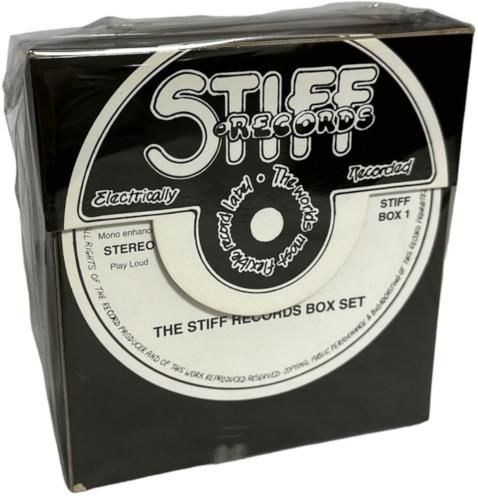
The Stiff Records Box Set – Disc 4

The Stiff Records Box Set — Disc 4
Stiff Records, 1992
4CD box set + booklet

THE PROLOGUE

Well, here we are at last, the final disc in this set, chronicling the last days of Stiff as an active record label roundabouts the mid-80s. Many of the acts Stiff first signed and/or made famous moved on to bigger record labels and more money, and Robinson and Riveria were forced to cast an ever wider net.

It’s a label that kicked off with Nick Lowe because he had already recorded to “publisher demos” at other companies’ expense, so the cost of releasing that very first Stiff single was a staggering £45. Thankfully, it did well – and the rest of the history is encapsulated here.

As mentioned previously, the tracks on these discs are in rough, rather than exact, chronological order, but on the other end of this Stiff journey we alight on the pub rock band Dr Feelgood, still going to this day as an entertainment entity but with a completely different lineup. You might wonder what a mid-70s traditionalist UK rock band is doing here, but they are part of Stiff history for two reasons.

First, singer Lee Brilleaux was the man who lent Jake Riveria and Dave Robinson the 400 quid they needed to register Stiff as the UK’s first independent record label. Second, they were a pretty damn good pub-rock band by the time they finally recorded with the label.

THE MUSIC

Things kick off with “Sign Of The Times” — a nice, poppy single from The Belle Stars, an all-female group that should have gone further than they did. I’m happy that their biggest single was one of their own originals, rather than the cover versions they had been doing for a while prior to that. Prince obviously liked the title also!

The follow-up single from the band is also included here, “Sweet Memory” as the second track on this disk, and it failed to crack the top 20 despite some pretty groove-y instrumentation. It’s certainly not as good as “Sign of the Times,” but it’s not awful either. I think the “aggressive/tough” style vocal on “Sweet Memory” is what hurt it.

Stiff was not doing as well by the time 1983-84 rolled around, and this disc is low on hits (but not without them). The label signed a bunch of new bands as their older acts left for bigger labels, and Electric Guitars is one of those. To be fair, the New Wave edge had faded by this point, but the “angular” attempts at cool had devolved into a similar style for a lot of bands.

It makes sense that the Guitars’ “Language Problems” would follow “Sweet Memory,” since it is rather similar: musically very competent, vocals rather odd.

Thankfully, the fourth song on the CD is a bona fide hit that still gets me dancing to this day: Tracey Ullman’s version of Jackie DeShannon’s “Breakaway,” a sped-up 60s girl-group song that infused extra energy and Ullman’s own sparkly vocals into an irresistible treat. Two minutes and 37 seconds of absolutely perfect pop.

This is followed by a song that might have made it but missed it by this much, Passion Puppets’ “Like Dust.” Musically, it has the moves, the vocals aren’t bad, there’s no reason this harder-rock mainstream number couldn’t have done reasonably well, and yet it didn’t. I can only imagine that the collapse of Stiff in 1984 contributed to the band’s failure to put out more than a single album.

Likewise, “Dangerous Dreams” by Jakko sounds like perfect FM radio fodder, but went nowhere just the same.

But now, time for something different: King Kurt launches “Destination Zululand” at us with a Tempole Tudor style and a bad Elvis impression. This sounds more like the happier days of the label, and it’s competently performed but silly. Not great, but certainly fun.

If you had trouble deciphering exactly what King Kurt is saying at all times on his song, wait till you get a load of poster-boy-for-dental-work Shane McGowan and the Pogues, who debut in this set at last with “The Sick Bed of Cuchulain,” a rollicking 100-proof Irish punk-folk hit complete with tinwhistle. McGowan alternately snarls and rocks it in this tale, which draws from Irish folklore based on an actual 11-century (lost) Yellow Book of Slane.

The next track is absolutely not what you might expect following The Pogues: “Pick Me Up” by the Inspirational Choir of the Pentecostal First Born Church of the Living God. True to their name, its an African-American church choir singing Christian Rock (or more accurately, inoffensive jazz-pop). It … um … certainly stands out among the songs on this disc.

A band remarkably like peak post-punk band The Jam, but they’re called Makin’ Time, borrow the bass riff from “Town Called Malice” for their own very-nearly-as-good version, “Here Is My Number.” It’s a rousing soul-infused rocker, but … you can’t get that other song out of your head when listening to it.

Three of the four members remained active in the music business into the 21st century, with Makin’ Time bassist Martin Blunt eventually joining The Charlatans.

Time to check back in with The Pogues, doing that Pogues-thing they do so well, with a catchy, bouncy Irish … lament … called “Dark Streets of London.” If you’re reading this, you must know The Pogues, even if you can’t stand McGowan’s vocal style, so you know that musically they are both firmly reflective of Ireland’s musical heritage, while infusing the music with the energy and spittle of punk.

We mentioned earlier The Belle Stars as a band that should have been bigger: well here’s another one — The Untouchables. They briefly grabbed the brass ring of exposure and US fame with a later single “Free Yourself,” but “Wild Child” is exactly the same kind of soul-powered rock stomper. I’m reminded to go back and investigate these guys more as well.

Kristy MacColl returns to give us another fantastic song of hers, “A New England.” Sparkling guitars frame a confessional song about a broken relationship and touching on teen pregnancy, bracketed by absolutely inspired lyrics.

Here’s a sample: “I saw two shooting stars last night/I wished on them, but they were only satellites/it’s wrong to wish on space hardware/I wish, I wish, I wish you cared,” and even more so “Once upon a time at home/I sat beside the telephone/Waiting for someone to pull me through/When at last it didn’t ring I knew it wasn’t you.” Genius!

One of Jamie Rae’s two singles ever released, “Pretty One” is included here, and it’s a pleasant enough pop song, but the young Scottish singer only released one other single. Though he found some considerable fame from those two records, he suddenly withdrew from pop music following the unexpected death of his mother from leukemia. Somewhere in a vault, there’s half an album more stuff from him, but as yet it’s not escaped that I know of.

Starting off with a driving groove, 60s mod styling, and a killer bass riff and wonderful call-and-response between lead singer/guitarist Clyde Grimes and the rest of the band, a ska-like touch of horns and synth organ, “Free Yourself” by The Untouchables managed to get some airplay and exposure on MTV and US radio with this irresistable track. As someone used to say back in the day, “if this don’t get in your head, check yourself — you may be dead!”

Speaking of energy, The Pogues waltz back in with another fast-paced Irish punk ballad, “Sally MacLennane.” A punk-pop take on Irish traditional music doesn’t get any better than this. The drunken-voiced callback in the chorus is the perfect finishing touch. Two minutes and 43 seconds of pure boozy bliss.

Then, suddenly, without proper warning: deep-voiced art-rock New Wave! It’s Furniture’s best single (in my opinion), “(You Must Be Out of Your) Brilliant Mind,” with extra-weird bass tomfoolery in the chorus and occasionally elsewehre, synth strings, a New York angry sax break, full of witty lyrics and oddly danceable. It’s … wait for it … brilliant.

From the “Not Really Our Thing So Much, But It Kinda Works, Mate” department, we finally get to Dr. Feelgood, a band that was a staple of the pub-rock circuit which originally formed in 1971, making them antiquated geezers by this point. The band was anchored by singer Lee Brilleaux, but had a rotating cast of other players.

For their single for Stiff, the label gave them some synths to play with, and the result is the smoky ballad “Don’t Wait Up,” which sits a little oddly with most of the other Stiff artists but is in fact a good song well-performed with just a splash of blues.

This is followed by outright bebop jazz from the Tommy Chase Quartet with a song called “Killer Joe (Right Cross)” — no chaser, just straight shots at a quick clip. As per tradition, the piano and sax get their moment of spotlight. What the huh? 50s jazz on Stiff? What the blazes is going on?

Oh wait, whew — Furniture return to get back in the zeitgeist with a return to their cool romantic artiness, courtesy another single a-side “Shake Like Judy Says.” Oddly, it’s not really a bad placement between Tommy Chase and Dr Feelgood — the song features a jazz-tinged trumpet line (and a little xylophone), which are both given some brief prominence amongst the synth/bass/drum/guitar main sounds.

Dr. Feelgood closes out the show with an unexpected redneck anthem, “Hunting Shooting Fishing,” that at least shows off how the band normally operated, and as you might have guessed, they’re not trying for high art. This is pub rock aimed squarely at working-class club audiences, complete with driving lead guitar and drums, plenty of echo on Brilleaux, and what almost manages to be a song for the monster truck crowd. ZZ Top could only wish they rocked this raucously.

THE BOOKLET

Just before we head for the exit on this review, we have to mention – at long last – the one and only thing included in this box set that is not a CD in a jewel case (which also includes an insert card with the table of contents for each disc, also reprinted on the back card) is a 20-page booklet that tries to set the stage for the creation of Stiff and the state of UK rock music at the time, impart a little data about its founders (including police mug shots!), and outline some of the label’s whacky slogans, which really gave it character. These ranged from the enigmatic “Three Nos Don’t Make a Yes” to the punkier “If It Ain’t Stiff It Ain’t Worth a Fuck” and the wry “We Came, We Saw, We Left” (or as the ancient Romans might have said, “Venimus, Vidimus, Reliquimus). Me, I always liked their on-label saying on many of their singles, “Electrically Recorded.”

We then get in the story about the early singles, starting with Nick and his costs-already-covered first single “So It Goes,” which came out on August 14th, 1976, and hit number one in the US two weeks after it was released. “Heart of the City,” the b-side, made a greater impact on the UK music papers, and between the two songs Jake and Dave were able to pay off the initial loan that started the ball rolling.

After a kerfuffle with EMI over the use of a Beatles’ “baby butcher” unused cover for a Roogalator single, Stiff got in the habit of releasing a single and then quickly “deleting” it from the catalog, which turned out to have the effect of encouraging stores to order more copies upfront. On top of that, they’d let artists or producers scratch messages in the runout groove (no, that wasn’t really a thing until Stiff came along). Genius!

The booklet continues with various tales like that, celebrating itself and writing about both its early wins and some of its early losses – for example, the classic “Alison” by Elvis Costello completely failed to chart on its debut. Luckily, the album did a bit of business (wink). It also chronicles the departure of Jake Rivera, taking Lowe, Costello, and Yachts with him to form another indie label, Radar.

It talks about the changing relationship with the ever-fickle and ever-bitchy UK music press, which once championed Stiff but quickly decided the new crop of acts were already old hat, and chronicles the Live Stiffs tours. As punk began to fade and the Two-Tone (another indie label) legend rose, Stiff signed Madness in a canny move.

By this point we’re in the early 80s, and Madness, Tenpole Tudor and Jona Lewie’s surprise hit “Stop the Cavalry” were helping keep Stiff in the charts, desperation was rolling in like fog and Stiff was throwing all kinds of … stuff … at the wall to see what stuck. Then, like a fortuitous lifeline, in 1983 Dave Robinson took an offer of being the Music Director of Island Records, and took the entire label roster with him.

This lasted until 1985 when Robinson and Island parted ways, and Stiff was back to struggling status. By 1986, Robinson could take the swinging between feast and famine anymore, and after a last short respite courtesy Cashmere (also home to the emerging ZTT label at the time), Robinson and Stiff were done.

The booklet carries on for a bit longer eulogising some of the things that made Stiff unique (such as signing Wazmo Nariz, the guy with two ties). It ends with a listing of Stiff Staff, and thank yous to those who helped put this compilation together.

THE WRAP UP

By the mid-80s, Stiff was flailing around wildly and desperate for hits. By this point, it was sailing on reputation and fumes, and the money was running out fast. That said, Discs 3 and 4 show that Stiff still had an eye for talent, and was still taking chances on an ever-increasing variety of artists even as the ship was starting to sink.

We owe this label and those two founding maniacs a great deal of gratitude for finding and publicising such a wide and clever array of new musical talent, and for helping make the very late 70s and early 80s a fookin’ great time to be a young person who loves great music. As the scores for these four CD s show, the hits outweighed the misses, and the legacy of the label is something Dave, Jake, and the artists can be proud of.

As a grave marker of sorts, this CD set is the finest tribute/chronology/potted history you’ll likely ever get of a UK indie record label. It is still a treasure box to me, 32 years (yikes!) since I first bought it. I’ve managed to buy it at least three times: my first copy was stolen in the mid-90s; another was so well-loved it fell apart; and this third one, thus far, has been treated with care. The little bit of velcro that keeps the box closed, on the other hand, has – on all my copies, and like much of this music – never failed me.

Great songs: 10
Good songs: 4
Meh songs: 7

Next time: Roxy Music!
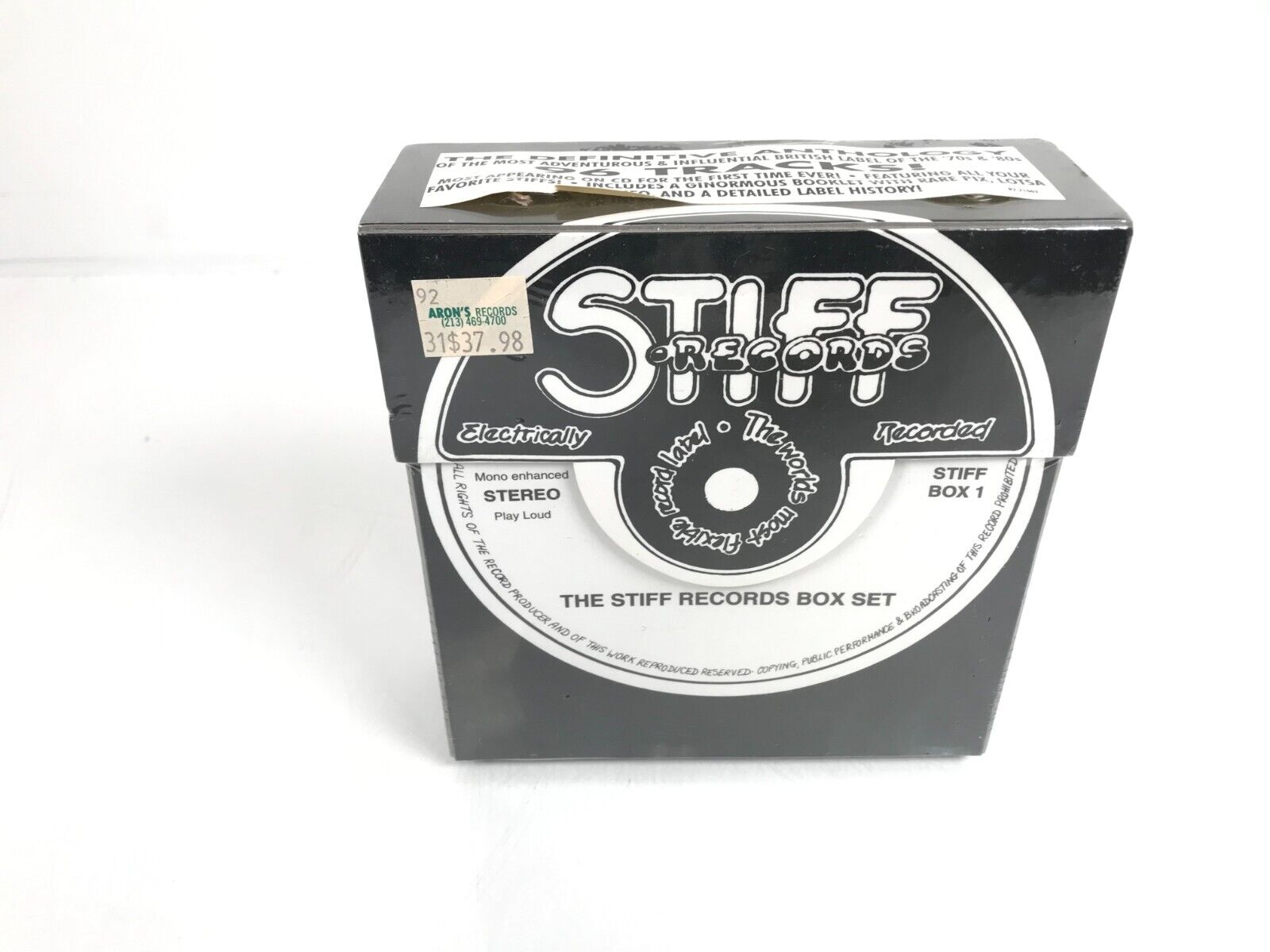
The Stiff Records Box Set — Disc 3

The Stiff Records Box Set — Disc 3
Stiff Records, 1992
4CD box set + booklet

THE PROLOGUE

We’ve already sampled 50 songs from the Stiff catalog, and my suggestion is you don’t do this in one sitting! It’s all (well, very high percentage) good-to-great stuff, and a snapshot of an era as well as a label. But will Punk-New Wave-Powerpop-Pub—Rock-Uncategorized fatigue set in? Let’s find out!

In response to some readers – yes, we’ll cover the booklet when we get to Disc 4, and yes, I probably should have done that with the Disc 1 review. Insert traditional UK two-finger wag … here.

THE MUSIC

If you were feeling a little fatigued from listening to (or just reading about) the first 50 songs, Disc 3 is here with a shot of Vitamin Groove to revive you. Stiff could hardly have picked two more energetic, get-up-and-dance-you-fool numbers than Madness’ mid-tempo-domestic-squabble-set-to-ska song “My Girl” to kick things off, and then followed it with Jamaica’s musical master Desmond Dekker’s insanely catchy 1968 reggae classic “Israelites.”

Joe “King” Carrasco (and The Crowns) has the uneviable duty to follow that, but does a decent job with his equally-partying and Wurlitzer-led Tex-Mex hit “Buena,” which of course incorporates some Spanish into the mix.

We shift gears with Graham Parker’s faux-punk rockin’ diatribe “Stupefaction,” complete with a snarling indictment of life in Los Angeles. It was the first single from his final album with the (uncredited) Rumour, The Up Escalator, and while the single didn’t chart, the album was his best-selling record to that point (1980). If you like the song and his attitude, you’ll enjoy the album.

Next up is a masterpiece of the New Wave era — a “love” song that probably could never have been written, performed, or been a success in any other era. Jona Lewie’s biggest hit, “You’ll Always Find Me in the Kitchen at Parties,” was a song I identified with in my very early teen years, until I become the social butterfly I am today (heh).

It’s minimalist, it’s low-key, it’s monotone, and I love it (and it’s not like everything else he’s done). I’m sure it was intended as a “novelty” single, but it bypassed Doctor Demento and became a surprise Top 20 hit in the UK, reaching the #3 spot in New Zealand and parking there (on both charts) for weeks on end.

To the best of my knowledge, there’s only been one “cover” of this song … in 2010, a duo called Man Like Me took the backing track, replaced Lewie’s vocals with their own, and made a video. It’s not horrible, it’s not great, and it’s on YouTube if you want to see it.

If you’ve never heard the original, good lord people — listen to it RIGHT NOW. It’s an Awkward Teenager Redemption Anthem! Plus, this particular video features bonus Kirsty MacColl!

This is followed by the joyous power-pop of Any Trouble, with the song “Trouble With Love.” The group as a whole had its ups and downs, but I have always been a fan of anything lead singer and songwriter Clive Gregson cared to put down on tape — he does a great job of marrying upbeat pop with “unlucky in love” lyrics.

Dave (L.) Stewart — not the guy from the later Eurythmics — spent his time at Stiff mostly covering old songs, as far as I can tell. He had played with bands like Hatfield and the North in the 70s, but by 1981 he was putting out singles with guest vocalists.

The first of two such collaborations we’ll hear on this disc is “What Becomes of the Broken-Hearted,” with vocals by Colin Blunstone (formerly the singer for The Zombies) with some female backing vocals. The song, from 1966, was first recorded by the great soul singer Jimmy Ruffin, who really poured a sense of genuine heartache into it.

Almost every singer who has covered the song since has hewed very close to the original arrangement, but often don’t bring the anguish Ruffin did. It’s the same problem here: Stewart’s instrumentation, while nicely departing from the Ruffin arrangement, replaces it with a cold, synthy-piano-led, clinical style. Blunstone’s singing, while pleasant, is likewise perfunctory for the most part. We’re not looking forward to more of the same later.

Since the last song was so soulless, it follows that Graham Parker would have to follow with his sarcastic takedown of his (former by this point) record label, “Mercury Poisoning,” which is a rollicking complaint letter set to music. His new record company (Arista at the time) had no issues with it, but Parker didn’t last too long there either. This live version got licensed to Stiff and they ran with it, and emerged seemingly unscathed (at least, I’m unaware of any song by Parker with a play on the name Stiff …).

Dirty Looks was one of those bands that always seemed interesting, seemed promising, but at least for me they never managed to push it over the line into being a fan. “Let Go” is a nicely energetic and tuneful number with a great pre-chorus praising the rock n roll spirit embodied in the advice of the title. It’s a good single that probably should have done better than it did — see what you think:

Madness returns with their clown car of fun ska and “nutty boys” story-songs with “Baggy Trousers,” showing that their style had legs to cover more than just their first (brilliant) album. Madness by this point is a reliable and predictable brand, beloved by skinheads and grandmas alike. Nice trick if you can pull it off!

Dave Stewart returns, this time with regular partner Barbara Gaskin in tow, for another off-beat take on a standard: this time, “It’s My Party.” This version works better than Dave’s cover of “Broken Hearted,” because the song was a torch song in the first place, and so performing it like a morose ballad technically makes it a better version that Lesley Gore’s original, but I still prefer Gore’s version. The girl-group backing vocals just put the cherry on this synth-minimalist but perceptive cake.

Speaking of covers, John Otway’s take on the old country standard “The Green Green Grass of Home” is … well hang on, who is this person anyway? I confess I’m not that familiar with him, but he appears to be simply an eccentric musician who tries to do thing in his own unique way.

So, knowing that, it’s possible to appreciate this sometimes atonal, weirdly performed, nearly acapella first minute of the cover, followed by the full band kicking in and Otway singing a raucus version in the second half. It’s certainly a “chaser” between the first half and the second half of the disc, I’ll say that.

Following that, Tenpole Tudor swing around playfully with “Three Bells in a Row,” a tuneful song about “fruit machines,” (coin-operated UK roulette machines where you try to line up three items in a row, with the big winner being three bells). Frontman Ed Tudor-Pole is just out for a good time, and pretty much all the music I’ve heard from the band is the audio equivalent of a good-time pub crawl.

It was good choice to sequence Jona Lewie’s cheery (or as cheery as his deadpan voice allows) “Stop the Calvary” as the next track, as it keeps up the good mood and suddenly turns into a Christmas single unexpectedly (and it’s still played around Christmas time on UK radio to this day).

What’s next? The two songs by Department S you’re ever likely to have heard before, “Going Left Right” and “Is Vic There?” Oh but plot twist — the version of “Is Vic There?” is the French version! Qu’elle surprise!

The former song has a driving style with a lovely swirling synth dressing and snarky lyrics about disco dancing. I still like this song very much, and wish they’d done more in this vein, even though it’s the longest song on this disc (at four and a half minutes).

“Is Vic There?” is a fragment of a phone conversation turned into another catchy, intense yet danceable single, with both French and English lyrics. I should really look into the rest of their output, but I can only think of a handful of Department S songs I’ve ever heard, and they’ve all been good.

Here’s the English-language version of the track.

Now we come to a band called the Equators that I know nothing of other than this one song. “If You Need Me,” has a ska influence to it, and there’s nothing really wrong with the song other than it being a bland love tune, lyrically. It didn’t inspire me to investigate them further.

As if in reaction to the mediocrity of the Equators, Tenpole Tudor return to overturn the table, spike the punch, and swing from the chandelier in an attempt to bring the party back to life with “Wunderbar.” It’s not as energetic as punk in the verses, but it chugs along nicely and the chorus is a big drunk gang singing the word “wunderbar” and whistling as only a big drunk gang can. As good as it is, they get one-upped in due course.

“Allamana” is a quite forgettable number by Desmond Dekker, and was likely a b-side. Nuff said.

We shift gears pretty hard from this string of ska-jacent music with the arrival of Alvin Stardust and his urgent mission to put a new spin on the traditional 50s love ballad. Blessed with the smoothest voice this side of Buddy Holly, he ups the tempo, drips with echo, and has perfectly harmonious backup singers. It’s fabulous.

Billy Bremner of Rockpile (and Nick Lowe and Dave Edmunds’ various other records) drops by with a serviceable but relaxed performance of a song called “Loud Music in Cars,” where the title is not only the subject, but the first words sung (and he has a pleasant-enough voice, though the influence of Lowe and Edmunds is keenly felt). It’s a simple Scottish pop song about a simple subject — loud music in cars is something Bremner enjoys, apparently. It somehow sticks in your head, though.

Oh, but then … Tenpole Tudor return to take us away from all that amiable-pop-rock crap with another stomper likely to be sung by football hooligans, “Throwing My Baby Out With the Bathwater,” a good-time breakup song.

This is stunningly well one-upped by a band called Pookiesnackenburger, who I am astonished to report managed not only to produce more than this one madcap song, but indeed produced two complete albums I really must investigate. “Just One Cornetto,” flatly, my favourite song on this disc by a long way.

Following some incomprehensible chatter, the song begins with a Madness-like call to action, becoming a party set to music and a delightfully mad lyric — a love song to an ice cream novelty, the beloved Cornetto. The whole thing is as delightfully mad as the band’s name, and all over in 2’26”. Love it.

Next is Via Vagabond with a driving, swinging jazz number called, brilliantly, “Who Likes Jazz.” It’s wonderfully performed with blazing piano, a touch of synth, but really driven by the drum-and-stand-up-bass 50s style tempo.

The disc concludes with Tracey Ullman with another slab of 60’s style girl-pop, with a beautifully clever title lyric — “you broke my heart in 17 places … Shepard’s Bush was only one.” The secret sauce behind Ullman was always Kirsty MacColl, and this is one of her cleverest songs.

This was part of Tracey’s debut album of the same name, mostly consisting of an eclectic array of remakes of well-known love songs, including Blondie’s “(I’m Always Touched By Your) Presence, Dear,” and a lovely cover of Jackie DeShannon’s brilliant “Breakaway.” MacColl also contributed one of her songs she’d had a hit with herself, “They Don’t Know,” and Ullman’s version was a bigger hit than MacColl’s version — reaching the top 10 in the US and peaking at number two in the UK singles chart.

THE WRAP UP

The tracks on these discs are not arranged in strictly chronological order, but they do roughly follow the progression and diversification of the label, and we’re definitely seeing that here. Thankfully, Robinson’s ear and eye for talent remained true, but the number of Stiff acts that went on to bigger labels and greater success is a remarkable testament to that.

“Punk acts” on this compilation mostly consist of The Damned and Alberto Y Lost Trios Paranoias, and they’re not heard from after the first CD here. That said, my personal rating of “great” songs goes up to a new high mark here . Here’s the score for CD number three:

GREAT SONGS: 14
GOOD SONGS: 6
MEH SONGS: 5

Next time: Disc 4 … and oh yeah, the booklet!

The Stiff Records Box Set – Disc 2

The Stiff Records Box Set — Disc 2
Stiff Records, 1992
4CD box set + booklet

THE PROLOGUE

Settle in, dear readers, it’s another disc and another 25 songs spread out another hour and 17 minutes, or an average runtime per song of 3’08”. As before, there’s a mix of Stiff’s artists that went on to become famous and/or influential, and a smattering of songs and artists that … didn’t.

THE MUSIC

Disc Two kicks off with another pair of songs by Nick Lowe, just as Disc One did. This time, we get the non-album track “I Love My Label,” which is probably why he got more songs on this compilation than anyone other than his protege Elvis Costello (at four songs each).

Nick’s original of it has only ever appeared on a handful of Stiff Records compilations, of which this is of course one of them, but Wilco very faithfully covered the song as a bonus track on their 2011 album The Whole Love.

This is followed by “Marie Prevost” from his first album, Jesus of Cool, released in March of 1978. It tells the tale (inaccurately) of the silent film star’s life and death. A story had gone around that part of Prevost’s dead body was consumed by her two dogs, and this was used by Lowe in the song.

It isn’t true — she died, destitute, at age 40 from alcoholism and malnutrition due to anorexia nervosa, with her body intact. One of her dogs, in fact, caused neighbours to discover that she had died via the animal’s incessant barking.

Next up is Ian Dury & The Blockheads with “What a Waste,” a song about all his squandered opportunities in other occupations, but for that he chose “to play the fool in a six-piece band.” It’s another mildly entertaining and amusing song, as is his forte.

Elvis Costello pops up next with a live track, which he announces is written by Burt Bacharach and Hal David: “I Just Don’t Know What To Do With Myself,” one of the duo’s many pop standards. Elvis is perhaps surprisingly sincere in his performance of the 1962 number, first made famous by Dusty Springfield’s version.

You could be forgiven for thinking that the fifth track, “Whoops-A-Daisy” by Humphrey Ocean and the Hardy Annuals, was just a more twee version of Ian Dury on a lark. In fact, however, Mr. Ocean is a real person, and a noted UK painter.

The uncanny resemblance in this track stems from Ocean’s affiliation with Dury (who was his art teacher, friend, and apparently vocal coach). Ocean had played bass in Dury’s previous band, Kilburn and the High Roads. Following this music-hall type single, Ocean gave up music and returned to painting.

This is followed by a trio of well-known songs from the New Wave era, the first of which is Lene Lovich’s outstanding cover of Tommy James and the Shondell’s 1967 hit “I Think We’re Alone Now,” originally written by Ritchie Cordell and Bo Gentry. The pop hit about two young people desperately trying to find a place to “be alone” (cough) never sounded fresher, and Lovich was rewarded with helping it chart once again.

“Jocko Homo” was DEVO’s first b-side (the a-side was “Mongoloid,”) as well as Mark Mothersbaugh’s first solo writing contribution. The name comes from a 1924 anti-evolution tract called Jocko-Homo Heavenbound, and the memorable time signatures and call-and-response chant is a play on a similar one in the movie Island of Lost Souls. It’s a compelling song because of its two time tempos (from 7/8 to 4/4 for the call-and-response part), and handily established DEVO as a completely unique band and the vanguard of the post-punk landscape called New Wave.

Ian Dury returns with one of his better-known songs, “Hit Me With Your Rhythm Stick,” centered on a brilliant Chas Jankel melody and the spoken (and occasionally multi-language) poetry of Dury, not to mention an insane sax solo. One of the things that so attracts me to the New Wave movement was the incredibly size of that tent — wildly different music fit and blossomed in that tent.

“Semaphore Signals” by Wreckless Eric (one of the acts that had very limited success), is a nondescript number about lovers trying to secretly communicate. He’s a “working class” singer one might charitably say, and this is a song with a cute idea behind it but stretched too thin to support its “drunk karaoke”-style vocal performance.

Speaking of drunk performers, Jona Lewie (who did at least get one big hit out of his time with Stiff), seems like a Depression-era pianist somehow transported to the 1980s, and not sure quite what to do with himself. Thankfully, he’s pretty entertaining even when he sounds … er, relaxed, and “I’ll Get By in Pittsburgh” sounds like a closing-time tune by a pianist who’s quite relaxed about his performance. Generally I quite like Lewie’s first album, but this “Pittsburgh” was the b-side to his novelty hit “In the Kitchen at Parties” for a reason.

From there, we go to “B-A-B-Y” by Rachel Sweet. She has a powerhouse voice that you either find thrilling or its like fingers on a blackboard for you. I’m more in the former camp, though Sweet certainly missed her calling as the leader of a 60s girl group by simply having been born too late (1962).

Today, she’s a successful TV writer and producer, but back then she was Stiff’s jailbait ingenue, a veteran child star who was 16 in 1978, switching from singing country to rock music and releasing her first album, Fool Around, that same year. It’s a well-regarded album that has aged well (the musicians on it would later form the band The Records), but only the single showcased here did terribly well.

By 1982 her career as a solo artist was over, with only four original albums and a live record. That said, she later wrote and sang several songs for John Waters’ films Hairspray and Cry-Baby.

For the halfway mark on this disc, we return to the ever-reliable Lene Lovich and her first and arguably biggest hit, 1978/9’s “Lucky Number,” which managed to get substantial video play on the nascent MTV. It went Top 10 in most countries in Europe and the UK where it was released.

The Members were a group that I personally judged never quite good enough to actively collect, but that said I like what I hear from them. “Solitary Confinement” is a very witty song about how “great” it is to get out of your parents’ house and live on your own for the first time.

Or, as they put it: “You are living in the suburbs/And you have problems with your parents/So you move on up to London town/Where you think everything’s happening, going down/Living in a bedsit/Travelling on a tube train/Working all day long/And you know no one/So you don’t go out/And you eat out of tins/And you watch television/Solitary confinement.” Missle hits its target, dunnit?

This live version really captures how meaningful this song was to so many at the time.

Next up is “Frozen Years” by The Rumour (minus Graham Parker). Not everyone remembers that The Rumour put out three albums on their own. This song is a lightweight and pleasant synth-driven number with clever lyrics, sung by Brinsley Schwartz himself (though you’d be forgiven if you thought it was a very low-key Nick Lowe).

Then we’re back to Wreckless Eric with “Take the Cash.” Sound, practical advice regarding the handling of money and job protocols from our Mr. Eric. He embodies the “three chords and enthusiasm” ethic that embodied a number of Stiff acts, but as with “Semaphone Signals” it’s a very amusing but incredibly basic idea, and again he stretches it to within an inch of its life at 3’44”. If he’d get in and out much more quickly, I’d think him a comedic genius.

Following this is one of the absolute gems of the Stiff lineup with an absolute jewel of a song: Kirsty MacColl, the daughter of the revered folk singer and composer Ewan, absolutely nails her debut with the exquisitely gorgeous “They Don’t Know,” the story of a teenager who has found their true love on a level that their parents and others would just never understand.

The 50s styling, multi-tracked choral backup (learned from intently listening to Beach Boys albums), and the puncturing “BAY-bee” that climaxes the instrumental break are spot-on perfect, and the blend of pre-rock ballad style and nascent 80s instrumentation effortlessly show off both her talent and her musical lineage in three perfect minutes flat.

She and Stiff head Dave Robinson didn’t get on very well at the time, however, so he buried the 1979 single, and she wasn’t able to release her own album until 1985 (!). I’ve been a fan of hers since I first heard this in ’79, and was delighted when Tracey Ullman brought it to a wider audience in 1983, making it the hit it always should have been (Tracey herself became a Stiff artist, and appears later in this comp).

Robinson may have had some regrets about how he treated MacColl later on, or maybe he just finally understood how brilliant she actually was, so thankfully she gets two songs on this box set: we’ll get to the other one when we come to Disc Four.

Mickey Jupp was pushing 40 by the time he recorded for Stiff, having done the music scene in the 60s before leaving it. When “pub rock” became a thing in the UK, he happily signed back up for another hitch, and “You’ll Never Get Me Up in One of Those” is a good example of the good-time but rough-n-ready pub sound that dominates the first side of his album Juppanese (the second half is quite different — a trick more artists should employ).

The A-side was produced by Nick Lowe and features an uncredited Rockpile as the backing band, and sounds like it. The B-side of the album was produced by Procol Harum’s Gary Brooker, and is considerably more polished. After seven more solo albums, he took another break from music — but returned to recording in 2009 and most recently released new music in 2022 at age 78.

Rachel Sweet returns for “Who Does Lisa Like?” a nicely angular single that reinforces her under-age image with a song about high-school gossip. The album, titled Fool Around, gave her two popular singles: “B-A-B-Y” and “Stranger in the House,” the latter of which led her to masterfully cover a number of other classic pop and country songs.

“Drive Friendly” is the next song by a band called Motor Boys Motor. It’s a pretty terrible song about a killer car, and thankfully they do not appear again on this compilation — but hey, it might possibly have inspired Stephen King to write “Christine,” so maybe it has some value after all.

After their one 1982 album, the band reformulated itself and became the Screaming Blue Messiahs, another band I don’t care for.

We then get introduced to Lew Lewis Reformer, another pub-rocker but with a certain … something that makes me like him better than Mickey Jupp or Wreckless Eric. I think he manages to communicate his enthusiasm for the genre better than the others, and has a clearer, somewhat higher tone that stands out better from the instruments.

We move along to Theatre of Hate and their fifth single, “The Hop.” The band members had all been in punk bands earlier, but ToH carved out a sort of “art-punk” that didn’t fit easily into other labels, and indeed exemplified the genre by not fitting into any other existing label at the time, going away from the direction of New Wave right from their first single (“Original Sin” b/w “Legion”) in 1980.

I got and liked their first couple of albums (the live He Who Dares Wins and their first studio album, Westworld), but they didn’t appear to do anything else original beyond that for quite a while so I stopped paying attention. I’ll have to catch up on their 90s output, but after that spurt of activity they went kind of quiet again until 2016, so I have some homework to do on their later evolutions.

And the award for the band with the very best introductory single ever (at least in my view) may well go to … Madness’ “One Step Beyond,” the next track here. The heavy reverb’d voice and Camden Town accent (a place I know well), the playful video, and — for a lot of white boys — the introduction to a form of the Jamacian ska sound just hits us white kids like a tonne of very danceable bricks.

It’s one of those occasional songs that pretty much picks you up by your lapels and makes you move. Even better, it’s utterly timeless and joyful with every play. One of the best tracks on this disc, maybe even this whole compilation (which manages quite a few classics within its 96 offerings).

While we are catching our breath in recovery from the heavy heavy monster sound, The Rumour are here with what I think is their best single, “Emotional Traffic.” On paper, it’s a catchy song about avoiding extreme emotions. On record, it borrows from both traditional pop and nascent New Wave to give us something that’s not quite either one, but very pleasant indeed.

We’re on to the third Ian Dury number on this disc, and by this point you know it’s more of the similar. He’s wonderful at varying up the subject matter of his songs, but not very good at varying up his delivery, or the music. This is quite acceptable when you’re delivering singles, but has always been a point of annoyance for me with his albums.

Lew Lewis Reformer comes back to close out the disc with another slab of his well-produced, well-sung and perfectly-performed good-time rockers, “Lucky Seven.” It’s nothing innovative at all, but so well-done you don’t mind, and might even sing along with the rest of the pub regulars.

THE WRAP-UP

As always, these scores are simply my opinion. Your mileage may vary!

Great songs: 10
Good songs: 8
Meh songs: 7

Overall score: 7 out of 10

25 songs in an hour and 17 minutes continues to be value for money, and carries on representing the great, good, and “save it for the b-side” personality of this eclectic record label. Let’s hope the next two discs, moving into the later days of the label, can keep up their strong average.

Next time … Disc 3!

John Foxx – Metamatic (3CD box set)

Disc 3 – Rarities

(2018, Metal Beat)

The third disc in the collection is the sonic equivalent of an attic clear-out: anything contemporaneous from the period around Metamatic that hasn’t already been committed to disc goes here.

There’s a fair number of instrumentals on offer, which often feel like audio notes regarding certain moods or sonic backdrops to be used elsewhere, and in some cases hinting at future ambient works. The disc finishes up with a handful of previously-rare demos made for the original album.

THE MUSIC

The overall quixotic feel of the disc is established almost immediately with the first two tracks. The curtain rises on “A Frozen Moment” — about a minute-and-a-half of beepy-boopy synth effects, a sonic notebook of wayward sounds that would later on find homes. Here, it serves as a scene-setting appetizer for the glorious steak that is track two, “He’s a Liquid (Instrumental Dub Version).”

It’s kind of hard to imagine a John Foxx karaoke event, but here’s your chance to try your hand at it. This version includes more of the echoey whistling of the original that, with the vocals not present, somehow adds a creepier effect to this already cold-wave classic.

“Mr No (Alternative Version”) is a similar but more basic version of the track we hear on Disc 2 of this set. Like some of the additional “Early Versions” we’ll hear later on this disc (and a few of the “Alternative Versions” we heard on the last one), this feels like a demo done on Foxx’s own equipment. That said, it follows the more polished official version that eventually made it as far as being a b-side pretty closely.

We now come to a section of songs not heard on any of the previous Metamatic reissues. These are some leftover sound beds, backgrounds, tone experiments and other bits of recorded emphemera, mostly without rhythm but with a sense of chasing down a set of beautiful and/or evocative synth sounds — a kind of sonic notebook that he thought might come in handy later.

We start with “The Uranium Committee.” The usual low-hum drone runs for a bit, then a cycling higher-hum wipe. This fades slowly out at the two-minute mark. It’s more like a backing sound set in search of a melody.

“A Man Alone,” however is more of a proper instrumental with a melody line, but is still mostly just synth noodling that seems to be an experiment in what sounds blend well together. This is Foxx experimenting with setting a mood before adding the beat that would drive something like this.

R2-D2 and the accompanying dark sci-fi vibe return in the aptly-titled “Terminal Zone.” This in particular would have made for some great soundtrack music in some then-future Doctor Who episode. Likewise, the fragment “Urban Code” is another mood piece of sinister machinery.

The mood lightens considerably with the melodic “A Version of You,” hinting at the romantic overtones that first showed up in the early “Like a Miracle” heard on Disc 2.

Speaking of that previous disc, we get to a proper full (albeit instrumental) song in the “Alternative Version” of “Glimmer.” The “official” version is the better of the two in my view, but both are very similar.

A synth wash drapes around the mostly-untreated piano of “Fragmentary City,” another of Foxx’s solid dreamscape soundtracks.

“Metamorphosis” is mostly some SynthFarts™ but also sounds like an early experiment with what would later become the “metal beat” sound. Listening to experimental tracks like this now, it’s helpful to recall that synths around this time had to be painstakingly hand-tweaked to produce sounds other than the pre-programmed ones.

These little recorded “workshops” are how Foxx arrived at many of the amazing sounds that finally graced the album proper, and drawings in his notebook would suggest that illustrations of the synth settings for easy re-creation were made when he was happy with what he heard.

“Approaching the Monument” is another soundscape, vaguely sound like a motorcycle revving against a backdrop of ambient low noise. It constantly threatens to turn into a further set of sounds, but never does.

The best collection of these synth experiments comes in the form of “Critical Mass,” which captures a number of key sounds — and even has some percussion! — that would later to be used to augment the songs on Metamatic.

This whole section of nerdy noodling will probably not be of interest even to most Foxx fans, but is the background research, if you will, that made the album what it became musically.

We end this section with the whimsically-titled “Alamogordo Logic,” a shorter compilation of potential synth settings.

To finish up the disc, we return to some actual pieces of music. The “Early Version” of “Touch and Go” kicks things off, in a faster but otherwise nearly-complete demo version of the song.

Foxx then moves into an almost House-like beat paired with a semi-succcessful vocal in “Miss Machinery,” a song where the vocals don’t quite work and doesn’t appear to have been developed further — despite an interesting melody — but has the great phrase “let me introduce my army.” With a bit more work, this could have made a decent b-side. It’s bursting with potential but just didn’t quite gel.

The last track is the “Early Version” demo of “No-One Driving,” remastered specifically for the White Vinyl and this version of the expanded Metamatic album.

This take is pretty awesome too, with a different opening sequence and no handclaps, some “ghost vocals” but otherwise very similar to what became the finished vocals, and exactly the same lyrics. It is, if you’ll pardon the pun, a real “high note” to end the box set on, and reminds listeners why they are fans of Foxx in the first place.

THE POSTSCRIPT

If you’ve been obsessed with the original album since it came out half a lifetime ago (!), you will want to own this box set, even the more experimental Disc 3. If you’re a more casual fan who enjoyed Metamatic but may have another Foxx solo album as your favourite, the 2007 Edsel 2CD reissue will probably tide you over very well — it has many but not quite all of the highlights found here.

If you really need all the “Alternative” and “Early” versions, though, and are willing to slog through some unfinished bits, you will want this much-superior 3CD version from 2018. The CD scores over any previous vinyl version (even if you prefer the latter format over the former) by way of the art cards, silvertone booklet, and the possibility of the autographed card.

Next time: The Neasden Queen of Soul!

John Foxx – Metamatic (3CD box set)

Disc 1 — Metamatic (original album)
(Metal Beat, 2018)

THE PRELUDE

As we begin our tale, Ultravox! (as it was then known) was at a crossroads. Their leader, John Foxx, had departed (along with guitarist Robin Simon) over creative disagreements after three critically-acclaimed but not great-selling albums. Foxx was determined to carry on as a solo act, bringing his unique voice and poetic vision, unerring pop sensibilities, and recent obsession with synthesizers/electronic music with him. He left behind a set of highly talented musicians, leaving only “Mr.X” (oh yes he did!) as a parting gift to remind fans of future Ultravox (no “!” anymore) that it was John Foxx who led them down the path that led to that highly-successful reinvention.

Foxx’s first solo outing emerged in the same year as the now Midge Ure-led Ultravox masterpiece Vienna, with Metamatic hitting the bins three months before. Foxx on his own (with a little help from some friends) and Ure’s reconfigured Ultravox both turned out years of splendid records spanning the 80s — Ultravox arguably the more commercial (but excellent), Foxx the more esoteric (but excellent), and both taking maximum advantage of the wealth of new sounds not heard before in popular music, albeit in somewhat different ways.

Arguably, Foxx’s debut solo album is the more brilliant of the two competing albums — not just because Foxx (almost) single-handedly invented the “Cold Wave” sub-genre of synthpop, but his interesting use of what I’ll call “disharmonies” mixed in amongst the fragmentary and dream-like lyrics alongside flawlessly catchy melodies and memorable poetry. All this, even before we get to the fact that he essentially put this album together by himself.*

*okay, he had Jake Durant on additional bass and John Barker on additional synths, but it was essentially a true solo project.

It’s hard to express the power and delight that Metamatic generated on original release in May of 1980. The completely alien concept of entirely electronic music I had first heard with Wendy Carlos’ Switched-On Bach and Kraftwerk’s Autobahn as a youngster — which strayed so far outside the mainstream of music and yet was so mesmerising — had blossomed into my passionate embrace of out-of-the-ordinary modern with this and Vienna into a proper musical obsession, and opened wide for the tidal wave (inside joke, that) of synth music that was to follow.

Until I heard Kraftwerk, I was largely comfortable with mainstream radio and the music it played, but only passively. Punk kicked open the door and forced me to understand and identify with other kinds of “rock” music, and subsequently I explored and loved a number of sub-genres, especially punk, ska, electronic, synthpop, New Romantic, and of course the bigger tent we called New Wave.

Nowadays, all that kind of thing has a couple of handy catch-all names — “alternative” and “post-punk” — but at the time it was like having a hurricane descend on you, tear up everything you thought you knew about music, and reassemble it in new and fascinating ways. Post 1975, we definitely weren’t in Kansas anymore.

THE BOX

Even there are only three discs in this box set, it comes in the same kind of expanded CD box made of laminated cardboard, with each album in its own cardboard sleeve with the original art (cleaned up a bit).

In 2014, a remastered version of the album (and a disc similar to what’s on Disc 2 here) was issued, but only on vinyl as a Record Store Day bonus. I was very disappointed that it hadn’t also come out on CD at the time, and consequently didn’t buy it.

Thankfully, four years later this CD version arrived, and far better packaged on top of being preserved in a superior format. Good things come to those who wait, as they say.

In my copy, the first item one sees on opening is an art card printed in silver ink with an alternate version of the cover photo and the “Metal Beat” logo. This is followed by the booklet, again printed in silver tone so it is bloody hard to read unless you have the light just right, but the only text is the lyrics from the album and some credits for the box set.

The cover of the booklet might be the most “human-like” item in this set: the cover, and a couple of other pages scattered throughout, depict handwritten lyrics straight from Foxx’s notebook — in printed handwriting. There are also some photos, synth charts, and other remnants.

(photo by and courtesy of the Post-Punk Monk)

This is followed by four more silvertone art prints, each on separate cards. These include a screen version of one of the single sleeves, a couple of paintings (presumably by the talented Mr Foxx), and another alternate take from the original photo shoot for the album cover.

Moving on from that is the silvertone sleeve for the album itself, unadorned with type or a border as it was on the original vinyl release (and the cover of this box set). The two other disc sleeves are also printed in silvertone, but look like the covers used for the master tapes (apparently the album was recorded at Pathway Studios in London).

(photo by and courtesy of the Post-Punk Monk)

For the first 750 pre-orders, a special fifth art card was included underneath the CD sleeves — revealing the synth button and level settings for “Underpass,” and signed by the great man himself. Rather than a Wonka-like “golden ticket,” this one is most definitely silver — but for fans who live outside the UK in particular, it is a very precious gift.

THE MUSIC

The original album consisted of the 10 tracks on the first disc of this box set — “Plaza” through “Touch and Go.” As far as I can tell, all the tracks are the 2014 remastered versions as mastered by Joe Caithness, regrettably getting awfully close (but “never quite touching”) to brickwalled. I don’t currently have access to a copy of my original CD or vinyl versions, but the separation and clarity are quite good on these new digital versions, as you’d expect. It’s a definite improvement on the original vinyl version.

Rather than go through song-by-song, I invite anyone reading this who never heard this album to put it on via streaming or whatever means at your disposal, and marvel at this artifact seemingly fallen from the far future that retains its timeless sound. Even if you’re familiar with Ultravox and other synth-based bands, you’ve never heard anything like this: warm singing backed with his off-kilter cold persona; acid-trip level visual lyrics describing dreams and alternate realities like a mysterious narrator who walks between worlds; oddly warm melodies with dissonant harmonies; music that really takes you to a very different place, and yet is accessible to the open mind.

Foxx is the master or marrying “cold” synths with romantic visions in a world of machines, but in a detached voice — like a robot describing your dreams. Listening carefully, his self-harmonizing is unlike anything anyone else could do easily, and yet so many of the tracks are memorable and … “catchy” isn’t quite the right word, but “perfectly crafted” will have to do.

His lyrics effortlessly paint pictures of those futuristic worldviews we never achieved, the kind of utopia/dystopia where personal hovercraft fly around the city while mystery and malice lurk just beneath the surface.

Here’s a few sample lyrics to get you into the mindset you’ll need to navigate this frozen paradise:

On the Plaza We’re dancing slowly lit like photographs Across the Plaza Toward the shadow of the cenotaph
— “Plaza”

Well I used to remember Now it’s all gone World War something We were somebody’s sons
— “Underpass”

The family’s back from long ago The voices burnt, the voices gold Vapour trails go by Voices on the lines Nothing to come back to, can’t we fade?
— “No-One Driving”

We’re fixing distances on maps And echo paths in crowds The light from other windows Falls across me now A blurred girl
— “A Blurred Girl”

It’s not just the sound of the future, he transports you to that future.

My favourites on the album are the most driving and/or urgent of the songs, so “Underpass” (the big hit single), “Metal Beat,” “No-One Driving,” “A New Kind of Man,” and “Touch and Go.” The second-tier songs (for me) are still excellent: album opener “Plaza,” “He’s a Liquid,” and the most romantic of the selections here, “Blurred Girl.”

The lesser songs (in my view) number only two: “030” and “Tidal Wave,” there to try something even more mechanical-sounding, but they feel underdeveloped as musical ideas.

There was absolutely nothing quite like this in popular music in 1980 … even Ultravox took a markedly different (and smoother) path. The metallic sound with the mostly-cold and dry-ice lyric delivery accompanied angular self-dueting vocals … even Gary Numan’s Replicas reinvention, brilliant as it was, paled in comparison.

When this 3CD box version came out in 2018, my dear friend The Post-Punk Monk reviewed it in a series of posts, with me commenting from the peanut gallery. At the time I called it the best album I’d heard that year (meaning 1980, and there was some stiff competition that year!) and the expanded version was the best purchase of the year.

Six years later, Metamatic is seriously one of my favourite hard-core-electronic albums ever.

When the Monk summed up the sound as “Kraftwerk Reggae,” a bomb of comprehension went off in my head. In addition to the unconventional sound and singing, there was so much space sonically on this record! You can find the Monk’s nine-part review of the album here, and it’s highly recommended.

The first two singles from the album got into the top 40, but didn’t go much beyond that. The initial single was by far the strongest choice, “Underpass” (or “Underpants!” as I still call it to this day, giggling). The follow-up single was a logical choice as well: “No-One Driving,” a true Ballardian panic attack of isolation and nightmarish nihilism.

“A New Kind of Man” was pressed for a third single, but never officially came out — it may have been judged a bit too discordant, or perhaps just too similar to the fever pitch of “No-One Driving.”

Next up: the B-sides, the single versions, extended mixes and alternative versions!

Dutch Discs 2024

I recently took a trip across Europe, spending the majority of my time in the Amsterdam area of The Netherlands, with smaller stops in Brussels, Paris, and Keflavik, Iceland (to see the volcano!). It was a meetup with some old and new friends to see a musical group we all deeply appreciated, Nits.


If you’ve never heard of them, fret not. They are best known in their native Holland, but tour the rest of Europe regularly to great acclaim, and release albums pretty steadily, also to great acclaim. After 50 years as a band (!), their creative well hasn’t run dry.

As for the music, “smartly-written pop with a poetic edge” might cover it, and of course being pretty old now, the tempo has gradually slowed over the decades, though I’m not sure they were ever in danger of being called a “rock-n-roll band.”

***

Anyway, that’s the background behind the trip, though far from the only thing we did. The purpose of this post is to serve as a mental bookmark for me, since I want to file the CDs and DVD I bought while I was there, but I want to remember which discs I bought while I was on that specific trip. I’m vain enough to think that someone out there would be interested in knowing also, maybe, so here it is.

Top of the list, of course, is the Nits’ latest release, Tree House Fire. At only six songs, it could be called an EP or a mini-album, but what’s important about it (besides being bought from the band directly, in Amsterdam), is that it is the group’s artistic response to a tragedy — the band’s Werf Studio, also effectively their storage locker, archive, and clubhouse — burned to the ground.

Many bands would have struggled to overcome the loss, but this group knows one main way to express how they feel, and that is through song. Not every song on it has a direct connection to that event (I think), though most of them do. I was very happy to finally be able to support the band directly, to share in their sorrow and strength to carry on, and to finally see a band I’ve been collecting since 1981 or so (!) in person, performing live on stage to an appreciative hometown audience.

***

Okay, that’s the context, here’s the list with no more commentary, not ranked in any particular order (prices included when known):

— Nits, Tree House Fire (EP), €10
Cinerama, Quick Before it Melts (CD-single), €1
— Brian Eno, Brian Eno’s Original Score for the Documentary Film about Dieter Rams (Album), €5
— The Monochrome Set, Access All Areas CD+DVD concert, €5
— Nits, Wool, (Album), €5
— David Bowie, A Reality Tour (DVD), €12

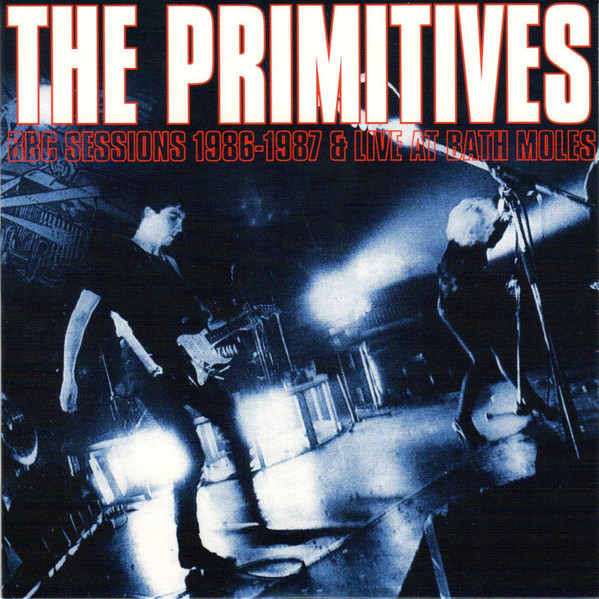
The Primitives: Bloom! The Full Story 1985-1992 (Disc 5)

BBC Sessions 1986-1987 and Live at Bath Moles
(Cherry Red, 2020)

THE PROLOGUE

We’ve arrived at the “odds and sods” basement of this five-storey structure, having gone pretty chronologically from their earliest self-made recordings and through the course of their first three official albums. While we’ve had a few “live in the studio” songs, what we haven’t had so far is any live recordings.

Owners of Everything’s Shining Bright, the previous compilation of The Primitives’ early days, had what appears to be a full summer of 1987 concert at the Institute of Contemporary Arts in London. Bloom! doesn’t include that particular concert, but replaces it with a different one, recorded live in Bath, England at the famous Moles nightclub, a club that encouraged home-grown talent and helped a shedload of popular bands get their start, from the 80s incarnation of King Crimson, to The Cure, to Eurythmics and many more contemporary acts.

I myself got to see a show there once — not of The Primitives, but another of my beloved underdog bands, Scotland’s Trashcan Sinatras. I have a taste for great indie rock bands that do great things artistically, but go almost nowhere commercially. It’s my background in high school and college radio to blame.

Moles sadly closed after a 45-year run in 2023. It was a more intimate club, with a capacity of just 220. The Primitives show included here takes up the second half of Disc 5, but before that we get various BBC Radio sessions the band did “live in the studio” across 1986 and 1987.

THE MUSIC

If you’ve made your way through these discs along with this review, or were just a fan of the band, you’ll known most of the songs done live for various BBC Radio hosts well. True to form, the group can perform these songs live nearly as well as with the luxury of a studio, with all the pop genius intact and only secondary guitar lines missing.

The set for Janice Long, in mid-June 1986, kicks off with a grunge-y take on “Really Stupid,” a fast number about a loudmouth lout that Tracy has had more than enough of. This is followed with “Nothing Left,” one of their best numbers but I’ll (still) be damned if I can quite figure out what its about — something about the joys of being unsociable is my best guess.

The band not having studio to work with makes the songs’ lyrics easier to hear (if still not always understand), and the hooks more obvious. You really gain an appreciation of the live configuration for drummer Tig Williams and bassist Paul Sampson, not to mention Tracy’s voice.

“Run Baby Run” is another song about someone leaving someone — this is an act that doesn’t want to get into specifics for some reason. “I’ll Stick With You,” by contrast, is about pairing up with someone because it’s getting dark.

A session for host Andy Kershaw exactly one month after the Janice Long get-together kicks off with “Where the Wind Blows” and its bass line, plus some echo on Tracy’s voice (supported by Paul on the sub-chorus). “Across My Shoulder” is another one of the band’s “breakup” songs, but not as catchy as “Really Stupid.”

I’ve enjoyed “Spacehead” many times, though as with most Primitives songs I’m not studying the lyrics very closely. It makes its second appearance on this box set here — a fast, snappy, almost Ramones-esque number about a strange lad that has caught Tracy’s eye.

What I didn’t mention earlier (and is even more obvious in this live version) is one of the more awkward lyrics in the band’s repertoire, with Tracy having to make “What is that boy on?/He’s a strange per-son” — pronounced as “per-sohn” — work somehow (twice!).

But never mind that, we’ve arrived at “Crash,” which is really, really missing its second guitar line when done live, along with the effective echo effect on the “shut” in “shut your mouth.” Yet another breakup song, but still an insanely good showcase of what the band is all about. This is the song you play for someone to get them into The Primitives.

For this particular performance, Tracy seems to be struggling to get the lyrics out as fast as the band wants to play, and I detect some small adjustments in tempo during the performance to accommodate.

The next session — the last for 1986 — was for the very famous DJ John Peel, well known for introducing new acts to the British public. While I have no doubt that he helped the career of The Primitives, it somehow didn’t turn out to be enough in the end. That said, we are in the early days of the band here, before they’d been signed to RCA.

This session kicks off with a very feedback-y and rockin’ version of “Stop Killing Me,” yet another song about leaving someone, that rocks very well thanks to the excellent band backup vocals and harder rock arrangement.

This is followed with “Shadow,” where Tig shifts to the tabla while Paul’s guitar is recreating the drone effect so prominent in traditional Indian music alongside Steve’s bass, fusing raga and pop very effectively with a mystical lyric.

Paul takes lead on “Buzz Buzz Buzz” as he usually does. The live version can’t take advantage of the overdubs and suffers some emphasis on the chorus because of it, but its still a wild 60’s-style number one might have imagined a young Elvis performing in one of his movies about falling head-over-heels for someone upon first meeting.

The last song for this session was a surprise — The Primitives do a Rolling Stones song, “As Tears Go By,” and despite Tracy’s gentle vocal, this version turns out to be far more danceable than the Stones’ original ballad ever imagined it could be.

We then jump to April of ‘87, and the band have been invited back onto Peel’s show for another live round. Happily, they didn’t do any of the same songs as they’d done in the previous session.

The set starts with “Dreamwalk Baby,” which follows the studio version pretty closely, and just as they sing in the chorus, the lyrics “make no sense at all” to me, at least. Something about crawling in there though.

Next up is “Ocean Blue,” and it seems that the band has invested in some fancier effects equipment since their last appearance, allowing for more echo on the drums and light vocal effects for Tracy. It remains a lovely song about (I think) a budding romance.

“Everything’s Shining Bright” is another song about a new love, and we get a chance to really appreciate the lyrics, where Tracy requests that at the end of the evening “why don’t you turn out the light/so everything is shining bright.” It’s good to know she’s not breaking up with someone for a change.

This is followed by a rarely-heard song for the band, “She Don’t Need You,” which we last heard on the “Thru the Flowers” EP and which never actually made it onto any of the albums covered here. After those two previous romantic songs, we’re back to a song about a breakup, this time told in second-person for a change.

And with that, we move seamlessly on to the gig at Moles nightclub in Bath, and the reason why this particular show was picked becomes obvious — it repeats only one song from the selections heard in the radio sessions it shares this disc with.

Not The Primitives, obviously, but a shot that gives you an idea of the size of the room.

The sound quality and mixing on this gig is excellent, and the band is using a Farisa synth to give the songs an even more 60s vibe. This version of “All the Way Down” is a faster, poppier, and much more danceable version than the one Paul sang on Pure, and it really rocks this time around. The catchiest song about chronic depression yet written, with a wild organ solo beefed up by a fuzz tone guitar effect.

We move on to another unhappy-theme-turned-groovy-pop song, “Sick of It.” A new instrumental break, a new arrangement, and the aforementioned Farisa effect keep this party charging ahead at full steam. Cynicism was never this much fun!

Tracy introduces “Give This World to You” as a “very new song,” and even with the supplemental 60’s party vibe included in this show, you can tell that the band is stretching their wings a bit. Of course, the song turns up later on the album Galore. “Ooh, I enjoyed that!” Tracy says at the end of the song.

The inclusion of the synth at this gig really adds a great new feel to the band’s performance, and I kind of wish it had been used a bit more in their album versions on some numbers. It’s mostly not present or in the background on “Outside,” and Tracy clears up a mystery in her introduction of “Slip Away,” which she brightly says is about masturbation. Again, there’s a awkward rhyme in “I’m gonna drive my soul into the setting sun/I’ve got to get away from all this tedi-um.” It’s kind of adorable.

If nothing else, this box set gives us a variety of arrangments for the song “You Are The Way,” and I am here for all of them. The live version again benefits from the low-key but present organ addition. Tracy has to hit some very high notes at the top of her range a couple of times on this one, and she nonetheless nails it.

Next up is “Earth Thing,” which had a Farisa in it in the first place, so thank heavens it’s here. I’m tempted to say this is my favourite Paul-led song, and with the adrenaline-fueled slightly faster tempo here, along with the furious playing by the band, make this a guaranteed party smash, and that’s before the “jam break” that finishes the song out, featuring the bass first, and mad organ solo second. This is the best version of this song, ever.

“See Thru The Dark” is another upbeat song about kind of a downbeat subject, using metaphors for depression to encourage its subject to “see through” the present and look ahead to brighter days.

Introduced as “quite an old one,” the band quickly launches into “Stop Killing Me,” and Tracy has no trouble spitting out the lyrics to this great song. The organ is dispensed with for this number, to try and stick to the original arrangement as much as possible, and it rocks along merrily as a result. Those “bop-bop-be-dop” backing vocals just make this song extra catchy.

The concert comes to an end with the old reliable, “Way Behind Me.” Throughout this show, Paul has mirrored Tracy’s vocal in spots to recreate a “vocal doubling” effect, and at this point he’s very good at it. Listening to this, I much regret never having caught the band in concert, but I have to wonder if the mix from the soundboard we’re getting here is clearer than what the audience experienced.

At the end of the number, the band says goodnight (so we’re not getting the encores). The gaps between songs leads me to believe we’re only getting edited highlights of a longer show — this was only about 30 minutes of music, not counting the BBC sessions, but if it’s at all representative of what they actually sounded like live, then it’s to my shame that I didn’t get a chance to experience them in person.

THE POST-MORTEM

Bloom! pretty thoroughly documents the band’s original period of activity across their own Lazy Records label before moving on to RCA for their first three albums. Although they did do well in the charts on occasion, it must have been very frustrating for a young band to work that hard and not get more recognition.

Right alongside a handful of other bands, The Primitives should have been staples of the summer tour season. Their songs are airy, poppy, and almost relentlessly upbeat, while their lyrics are allegorical enough for fans to give them their own interpretation.

Perhaps their retro-influenced sound just wasn’t in fashion yet, or their lack of “anthemic” songs like what (for example) U2 was cleaning up with was the problem. The record company appears to have given them a fair amount of support, and they got plenty of good press (especially for a band from the midlands!).

The first album made it to #6 in the charts, and “Crash” did one better in the singles ranking. By the time the second album came out a year later, however, the scene had changed — acid house music and heavier bands like My Bloody Valentine had captured the spotlight.

The Primitives still had a loyal fan following, but Pure — which indulged Court’s more psychedelic stylings — didn’t do as well with its singles, though the album itself did reasonably well. By the time 1990 rolled around and the “Madchester” movement had blossomed, The Primitives were being seen as a “throwback” band for their devotion to 1960s and 70s-style grooves.

Now with the band stretching out and exploring their psychedelic side more fully, Galore should have been perceived as a “triumphant comeback” album, but the label delayed its release by a full year, and by then the Blur-Oasis “war” was in full swing, so The Primitives just got ignored, and then dropped from their label.

The booklet included in Bloom! mentions that shortly after being dropped, the band self-released a cover of “Some Velvet Morning” under the pseudonym Starpower — and lo and behold, it got underground buzz and sold well (though it didn’t chart). RCA ironically offered this “new” band recording session money, not knowing it was the act the company had just dropped.

As a result of this, The Primitives decided not to continue. Thankfully, they reversed that decision in 2009, judging the time to be right for a reformation.

The band periodically put out new EPs and albums until 2017, but have continued to tour and are still an active touring act. They tend to play various festivals in summer, and will be touring with Hugh Cornwall and The House of Love during the winter of 2024.

Next time: Mega-Metamatic!

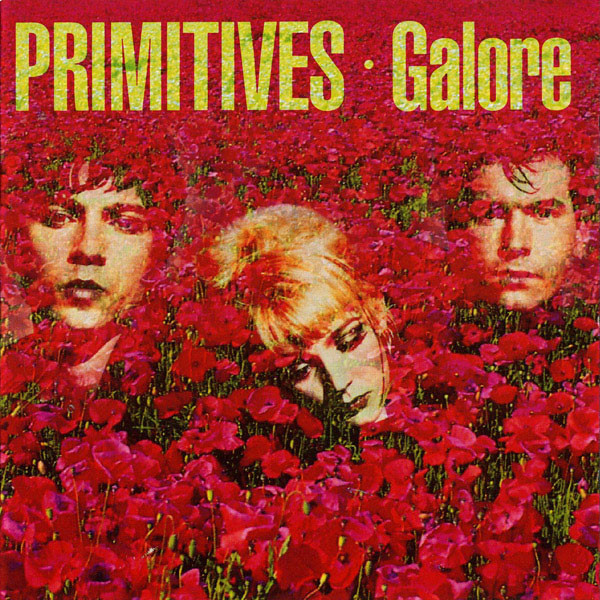
The Primitives: Bloom! The Full Story 1985-1992 (Disc 4)

Galore + Bonus Tracks
(Cherry Red, 2020)

THE OVERVIEW

Galore is a bit of a mixed bag for early Primitives fans, but that’s not to say it’s not another very good album, because it most certainly is. The group started stretching their super-catchy jangle-pop style on Pure, and while keeping the basic indie-psych-guitar sound here, they move further away from the surf-style periodically, and embrace that darker “psychedelic” side of their nature more heavily.

There also seems to be signs of paying attention to record-company dictates to be more radio friendly by making the songs longer, and having less ambiguous lyrics on the few clearly-identifiable love songs. Partial producer Ian Broudie from The Lightning Seeds co-wrote one of the best songs, “You Are The Way,” but the album suffers from “producer soup” a bit. Broudie, Ed Buller (best known for his later work with Suede and Pulp) and bassist Paul Sampson all get producer credits, along with the band in full.

Although we’ve only mentioned the not-dissimilar band The Darling Buds previously in passing, it’s worth noting that both bands progressed in similar ways across the course of their first three albums. and likewise both broke up (see below) due to a lack of record company success within a year of each other.

(They even reformed within a year of each other! You have to wonder if they ever called each other up and yelled “STOP FOLLOWING US!” down the line.)

THE MUSIC

Galore kicks off with a really strong quartet of songs: radio-friendly love songs sung by Tracy, “You are the Way” and “Lead Me Astray,” followed by more psychedelic “Earth Thing,” sung mainly by Paul (with very New Age/Zen lyrics), returning to what passes for their “typical” style with “Give This World to You.”

The guitar licks are still very satisfyingly tasty, but not so “jangly” as on the first album especially, though you get a taste of that on “Lead Me Astray.” That said, “Earth Thing” is as “heavy” as this band gets, and it’s also got a great fast tempo that makes it great driving music, and nice little bass “solo” three-quarters of the way through.

The band’s knack for writing catchy hooks has never deserted them, and part of the marvel of the group is that they keep coming up with worthwhile variations on their basic 60s/70s-influenced power pop groove.

For the fifth track, the guitars move back behind the bass to give some sonic variety to “Slip Away.” Although their songs have gotten progressively more about attraction and love as a theme, I’m not sure you can really call their stuff “love songs” in a lyrical sense so much as “hazy summer fun + flirting word pictures.”

“Cold Enough to Kill” again mixes things up, trading the driving tempo with a slightly slower, more layered and moody vibe, with a darker yet still airy tone.

And then comes “Hello Jesus.” It starts off with wind sound effects, and a few slow chords before launching the nearest thing yet to a ballad. Is it a religious song? If not, what is it about exactly?

You got me (shrug). Here’s a sample lyric:
You’re just about to fall
You know that you can’t fly
You better make that call
Hello Jesus
… and then it ends as mysteriously as it started. Certainly the oddest thing the band have yet produced.

This quieter, more thoughtful, slower-but-not-balladey groove continues with “Empathise.” Still pretty, still of a certain “evening” mood compared to their sunny mainstays, still exploring alternatives to just doing power pop.

A fan-made music video made using clips from the not-online “Earth Thing” video.

And then just as suddenly, we’re back on the beach, twisting the night away to the uptempo yet still nebulous “See Thru the Dark.” This is followed by a great echoey guitar riff and drum/bass combo that unfolds into “Kiss Mine,” which is another “positive attitude” song, as I suspect a lot of Primitives songs have been, but the real meaning of their lyrics is rarely crystal clear or obvious, with the words just blending into the music.

Boy I sure do hate it when incompetent YouTubers put the wrong cover art on their uploads, don’t you?

Another great riff kicks off the Paul-led semi-ballad “Smile,” which is more unabashedly romantic song that still manages to work in some dark notes into its romantic lyrics.

“The Little Black Egg” is a cover, and the final song of the original album, and I’ve finally given up trying to figure out what the hell this song is about. Here, you give it a try:

Here comes Nancy, here comes Lee
I’ve got what they want to see
I won’t let them stretch their necks
To see my little black egg
With the little white specks

Answers on a postcard, please. I would venture to say the band just found it as weird and folky as I do, and included for “the lolz.”

THE BONUS TRACKS

The version of Galore in this Bloom! box set has all of the bonus tracks found on the deluxe 2CD reissue of Galore from the 2015 UK reissue. That said, they’re not all on this particular disc — the live tracks finally turn up on Disc 5, the “odds and sods” cleanup disc.

The bonus tracks here kick off with “In My Dreams,” which reminds me of the Primitives of earlier albums, i.e. it’s a gorgeous number, and a bit more directly lusty than most of their other songs. Likewise, “Sunpulse” is another signature Primitives track, evoking summer and joy as so many of their songs do — and on this one, the bass gets to shine for a change.

“Flow” appears to mimic the end of “Sunpulse” at first, but very quickly you realise it’s just a portion of “Sunpulse” backwards – another odd choice, but hey we have to cover everything from the band during this period, so here it is.

We then come to an acoustic version of “Stop Killing Me” that you can perfectly picture being sung round an evening campfire on a beach somewhere. The background “bop-bop-de-bop”s are nicely underplayed until the end of the track.

Next up is “You Are The Way (September Mix),” which lays down a solid but unexpected bass-and-drum-heavy music bed that underplays the guitars so that Tracy’s vocals are even more center stage. This, like many of this band’s songs, can’t be performed or re-arranged badly.

We move on to the second of the three versions of “You Are The Way” here, this time the “Re-Ravishing Mix.” It’s a great way to sample how the band re-envisions their songs, with this version going for a longer and hypnotic percussion-led intro and a true “remix,” rearranging the vocal intro and minimizing any guitar presence (!)until a couple of minutes into this six-and-a-half (!!) minute version, and remaining a minimal presence throughout.

It’s an interesting experiment in getting as far away from the band’s “natural” sound as possible, but I doubt many people who aren’t DJs will listen to the track more than once. This is followed by yet another remix version called the “God’s Own Garage Band Mix — Alternate Version,” which is only minimally distinguishable from the “Re-Ravishing Mix.” This one is only a 4’18” mix though.

My favourite version of “You Are The Way,” though, remains the album cut – with the “September Mix” a very close second. The reason we have all these versions is clear: the song was the single, but either the band or the record companies let some others have their way with remixing it for 12-inch b-sides.

Happily, the guitars return with a vengeance (and Paul on vocal) with “Under My Spell.” This one is notable for only have a very minimal trace of Tracy on it.

The bonus tracks wrap up with “Haunted,” which could easily have been an album track. It’s a more polished number than “Under My Spell,” which barely rises above demo status.

THE POST-MORTEM

Galore continues the band’s exploration beyond just jangly guitar pop, since they perfected that form right out of the starting gate with their first major-label album. They continue to struggle with the notion of writing a bad song (a “problem” very few bands can claim to have), but they get close to the idea on this album, without ever actually achieving that “goal.”

The band, down to a threesome for this album, again failed to chart with Galore and decided to call it a day, even as they remained college-radio darlings. Fortunately for us all, this wasn’t where the story ended, but its the final album of the period covered by Bloom!.

Next time: BBC Sessions, and a live gig!

The Primitives — Bloom! The Full Story 1985-1992 (Disc 3)

Pure + Bonus Tracks
Cherry Red, 2020

THE OVERVIEW

Ah, the “difficult” sophomore album … following a batch of compelling songs as demos, refinements, and finally as their debut album, what do you do for a follow-up? Well, try to break the mold a bit while still relying on what you know you do damn well, apparently.

Released on New Year’s Day, 1989 — one year to the day after their debut album — Pure explores some different approaches, and expands their “jangly airy guitar pop” worldview a bit, but the best songs are the ones that would have sat comfortably on Lovely (and in one case, actually did).

It’s still guitar/bass/drum driven, with Tracy is trying on some new styles within her range, Paul is slowly expanding his songwriting scope, but it is recognizably the same band with — at its core — the same musical approach. Where they are changing things up is mostly to do with mood — embracing some of the darkness in style that one often finds in their lyrics.

Note, for example, the somber way Paul sings “Shine.” Or, for that matter, the world-weary tone Tracy adopts (appropriately) for “Sick Of It.” Despite these more dour choices, there’s still plenty of sunshine here for when the clouds clear away, and it’s all very good indeed.

Despite this record being so much fun to listen to, it didn’t do as well as the band’s debut. It did make into the Top 40 in the UK at number 38, but stalled at number 113 on the US charts (a year after release), and even that was solely due to college radio airplay — why this great record didn’t get mainstream radio spins at least during the summer months, fer cryin’ out loud, must have frustrated the band even more than it does me.

THE MUSIC

The album kicks off with the sing-songy “Outside,” using a simplistic riff and what seems to me like xylophone (!) and cymbal rather than their usual percussion. The floating guitar effects and plaintive singing make for a very low-key song compared to the material on Lovely, but then the ominous bass notes come in and you are served notice that this song isn’t going to suddenly “rock out.” For this band, it’s a bit depressing actually.

Luckily, the next track is what I’d call their most Cocteau Twins-like number, “Summer Rain” — a guitar bed with a lovely lead line, fresh lyrics, a catchy melody and another bit of second guitar while the percussion comes in. Tracy’s doubled vocal returns very effectively, and while the pace remains firmly at mid-tempo, the song builds to a chorus that really captures the spirit of the song.

Frankly, I think they may have outdone the Cocteau Twins on this one! It’s a perfect melding of the two bands.

“Sick of It” is about as close as this band is going to get to punk. The lyrics express their negative judgement on what I have to presume is Los Angeles (joke), while the band sets about rocking pretty hard. If the band grew on you from the first album, this one will be a hit with you.

Mimed on TOTP

Then, things take another turn with “Shine” — starting with Paul handling lead vocals, and the use of acoustic guitars. Despite the change of tone, it’s still another example of the band’s primary approach — catchy pop-rock married to ominous (or at least obscure) lyrics.

“Dizzy Heights” starts off with furious riffing and utilizing audio effects and both singers to full effect. This is a group that has a style, but really really wants to switch it up a bit to avoid being called “good, but all the songs are kinda samey.”

Paul returns to his “psychedelic” vocal style to jazz up “All the Way Down” in another catchy exercise that finally brings the bass back in fully. We then get back to Primitives basics and feel-good sunshine pop with “Secrets” — joyous workout with the band at its best. It reminds me of something the Jesus & Mary Chain might have done, especially with the faster tempo of the bonus “Beat Version,” which we’ll come back to shortly.

This is followed by another “typical” Primitives menace-shaded funfest, “Keep Me in Mind.” The melody wanders off from time to time, and the lyrics are again (like most of their songs) about not much in terms of concrete messages or story, but anything that keeps all four members busy for the duration of the number is what I’m here for.

“Lonely Streets” was a popular track on college radio, with its “ooh-ooh” cascades and driving tempo. It threatens to be another sing-songy number like “Outside,” but the tempo changes save it from being a twin to that first song.

Then we try something different again with “Can’t Bring Me Down.” Vocals right up front, with the band firmly behind her. Tracy’s “sassy” style here reminds me of the one-hit-wonder UK band Shampoo and their one hit “We’re in Trouble,” a 1994 UK single.

Following this, a surprise. A re-used song! This version of “Way Behind Me” is straight from the the later editions of the previous album, but to be fair it’s fabulous, and deserved a second spin. The mix here gives everything equal focus as it did on the last album, which hasn’t been the case for most of this album, but it works for this number, at least.

The album proper finishes up with “Never Tell,” another upbeat tune but this time with … gasp! … a carefree upbeat (and metaphorical) lyric with only the lightest touch of vagueness! What the …?

To sum up the album as simply as possible, the group was paying attention to what was going on around them musically (like the “shoegaze” style), and adapted some of their songwriting to bring expanded versatility and influences into their core skill set. The result is varied and excellent.

THE BONUS TRACKS

The original CD version of the album had four bonus tracks — “Noose,” a cover of the Velvet Underground’s “I’ll Be Your Mirror,” a “Beat Version” of “All the Way Down,” and a new song from Paul (at the time going by PJ Court), “I Almost Touched You.” The cassette (!) version of the album only included “Noose” as a bonus song.

Bloom!, on the other hand, includes as many bonus tracks as their were songs on the original album — a whopping 11 extra tracks, kicking off with the far-superior “Beat Version” of “All the Way Down,” which brings the tempo and energy up to the normal Primitives’ enthusiasm levels. This version sounds like something The House of Love (or indeed, many other bands of the very late 80s) would have loved to have covered, rather than the more morose album version.

The organ and handclaps added to the song here really bring it to life and transport it back to the psychedelic 60s, the band’s touchstone influence.

This is followed by an acoustic new version of “Way Behind Me,” similar to the album version but without the (missed) “bop-bop-be-doo” intro. I’ve said it before, but this has “hit” written all over it, and it was in fact on a single — paired (oddly) with the morose version of “All The Way Down,” and the a-side was the album version of the A-Side and the superior “Beat Version” of “All the Way Down.”

“Noose” was such a totally different number from the band that it makes an odd choice for the “lead” bonus track, but that’s not to say it’s bad. Alternating vocals from Paul and Tracy (coming together at points throughout) sound like they wrote and recorded the track immediately after viewing some old-school “spaghetti westerns” — particularly for the opening chords and beginning percussion.

As the song gets going properly, the mood then evolves into their idea for a soundtrack to the 60s Italian “high stakes caper” movie Danger Diabolik!, complete with synth strings! If you’re not familiar with John Phillip Law’s 1968 Italian action movie masterpiece, watch that first before you put this on — your enjoyment of it will be doubled!

The mash-up of vintage video works oddly well with this song.

Switching up the mood, the next track is that remake of the Velvets single I mentioned. The Primitives’ respectful version of “I’ll Be Your Mirror” is more upbeat and frankly better in most respects, and sounds very credibly like a cover single made around the same time by a girl group of the the original’s era. It’s hard to beat the groundbreaking original version and Nico’s striking vocal, but The Primitives manage to hold their own with an excellent choice of a song to cover.

Following that cover, we’re treated to another — the Rolling Stones’ classic ballad “As Tears Go By” — but rather than pay homage to the original, the band effortlessly turns the song into … a number you might have sworn The Primitives wrote themselves! This should have been put into the original album’s track list — the mood, style and arrangement give a whole new dimension to the song as one of the band’s own “upbeat music with downbeat lyrics” signature style.

The next track, “I Almost Touched You,” really tries hard to be a different sort of number, getting back to the bass dominance we haven’t heard for a while, married to a lyric about an (unsuccessful) creeper and his quest.

The next three tracks offer alternative versions of the album track “Secrets.” The first is the original demo, which grooves just as well, but lacks the nicer intro of the album version. Godlike producer and remixer Zeus B Held finally got his hands on a Primitives track, and his 12” inch keeps the original intents while bringing Paul’s backing vocals up in places, but otherwise keeps the original’s speedy, 60s style intact. He drops some instruments out periodically for showcasing effects, and breaks out some lyrics for repeating/highlighting, squeezing an extra 42 seconds in compared to the original.

The 12” Dub mix of the song gives the rest of us a chance to karaoke this fun number at our next groovy party. For best results, you’d better have your own harmonizing boy-and-girl singers to try and hold your own against the (completely absent) original vocals.

The bonus tracks draw to a close with another fabulous cover, this time the 1957 Lieber-Stroller number “You’re So Square (Baby I Don’t Care),” originally made famous by that Elvis Presley fellah. That bassline must have proven irresistable to new bassist (and producer) Paul Sampson, and he certainly brings the low notes to life. Tracy sometimes has to fight to be heard over the bass-and-guitar attack, but the song works well with her lower register and points back to the influences the band wears on their sleeve.

Next time: tracks Galore!

The Primitives – Bloom! The Full Story 1985-1992 (Disc 1)

The Lazy Years (Cherry Red, 2020)

THE PREFACE

Okay, this one is an ambitious 5-CD undertaking, and needs a little bit of backstory before we can get into it properly. The Primitives kickstarted their career by recording singles on their own record label, Lazy Records. This lasted from 1985 to 1987. They achieved enough success to get signed by RCA in ‘87, which released their past and subsequent material until their (first) breakup in 1992.

Jump ahead to 2013, and Cherry Red released a two-CD compilation of that early material called Everything’s Shining Bright: The Lazy Recordings 1985-1987. That set covered all the singles and b-sides, some live demos, some previously-unreleased sessions from ‘87, one bonus track they cut for UK mag Sounds, and a 15-song concert at the Institute of Contemporary Arts called “Live at the ICA 15-Aug-87.”

The reason I mention this is that all of the material on Everything’s Shining Bright — except for the 15-track live gig — are also on Bloom!’s first CD of the box set, which has been dubbed “The Lazy Years.” The running order is slightly rearranged, but it’s the same material. If you’re an obsessive Primitives collector, you’ll want both ESB and Bloom. If you can live without the live gig, skip ESB and just buy Bloom.

THE MUSIC

Disc 1 kicks off with five demo tracks, three of which were re-done for Lovely: “Crash,” “Spacehead,” and “Nothing Left.” “Crash” is quite basic but still insanely catchy, and was improved to perfection for the eventual album version. The demos for “Across My Shoulder,” “Spacehead,” and “Really Stupid” are similarly basic, but the production quality steps up noticeably for the demo of “Nothing Left.”

The band then put out a four-track EP called Through the Flowers, and the improvement in production heard in the “Nothing Left” demo is heard in these tracks. Paul Court’s guitar lines are more dominant — equal to, rather than buried by, Steve Dulligan’s bass lines. Peter Tweedie’s drums weren’t quite so “thuddy” anymore, and Tracy Tracy’s (Tracy Cattell) vocal were were more prominent, though still playing second fiddle to the guitar and bass.

The EP kicked off with the catchy title track, Tracy doing her own backing vocals as well as lead. “Across My Shoulder” was also improved, but “She Don’t Need You” is a fairly forgettable entry — only notable by the first appearance of Court as backup singer.

Court went further on the final track “Lazy” by taking lead himself. Tracy backs him up only on the song’s final lyric.

On balance, it was a pretty strong recorded debut. At this stage of the game, the band can’t really be called “jangly guitar pop” as the might have be labeled further down the road; they sound much more like C86 contemporaries The Wedding Present or even a happier version of Joy Division, only with a pixieish female singer instead of those two bands’ more dour male vocalists.

A three-track single showcased the first “proper” version of “Really Stupid,” complete with a nice touch of echo on Tracy’s voice. The second “A-Side” of the single, “We Found a Way to the Sun” is the song where the band starts to sound like the RCA studio band they would become.

“Where the Wind Blows” joins the other two tracks in sounding like a fully-gelled combo that can’t stop writing and realizing great guitar-driven songs. It also caused the music press to sit up, take notice, and fall in love with the band.

The next three-track single lead off with “Stop Killing Me,” and continued the party with “Buzz Buzz Buzz,” which brought in a hyperactive bit of twang to the mix (!). The b-side, “Laughing Up My Sleeve” starts with a bit of studio noise and a count-in, with Court taking lead vocal once again, with Tracy duetting in parts, ending with a rave-up and guitar freak-out on the last line.

It’s pretty amazing to hear a band come together this well before they’d even been signed to a proper label, but the group could already do no wrong with the ever-fickle UK music press at the time, which — again — is kind of astonishing.

The next single, “Ocean Blue” b/w “Shadow (Guitar Version)” were, amazingly, given away to attendees at a gig at the London Astoria. The a-side is a languid wash of voice and music that actually does remind me a bit of the later band known by that moniker, which formed not long after the Primitives.

The b-side is exactly what it says on the tin — the vocals are there, but the guitar is the star of this show. Some nice whisper and echo effects on this version, and then … it goes all 60s Bollywood on us with sitar and such! Super cool. I can’t believe I’d never heard this version until I bought Everything’s Shining Bright!

The 1986 “Thru the Flowers” self-recorded single got a re-do in ‘87 with a “New Version,” which again strongly reflects their sound getting refined and production style defined — gone is the “wall of guitar,” and now all the elements play nicely together — with even a touch of (synth) strings (!) .

The b-side of the new single was “Everything Shining Bright,” and it shifted gears for a more driving sound, pushing Tracey back in the mix (with Frank on backing vocals), but we still get clear separation of the guitar tracks, with the bass and drums operating as a single unit.

In a promotional effort, the band recorded another version of “Nothing Left” for a vinyl EP put out by UK mag Sounds. This is a considerably better effort than the more crudely-recorded demo version, but there’s no way for this band to perform the song poorly, they know its a hit in the making, and they persued it.

Possibly inspired by the Sounds EP opportunity, the band opted to re-record seven of their songs as an self-produced “demo package” on their own label, Lazy Records. This included some all-new songs, and a new version of “Buzz Buzz Buzz” and yet another version of “Nothing Left.”

The effort paid off — they got signed to RCA on the polish of the material and the strength of their trade-paper praise.

The demo package (referred to here as “1987 version(s)” kicks off with the debut of “I’ll Stick with You,” which puts Tracy up front and properly mixes the bands instruments and backing vocals. Also debuting here is “Dreamwalk Baby” (notable for the return of synth string touches). Both have nice touches of vocals from Court and Tracy doubling herself here and there.

The new version of “Buzz Buzz Buzz” isn’t really new at all, though Court’s vocal is mixed more prominently (Tracy is just barely present). Sonically the mix is much clearer, but seems identical to the version we previously heard on this disc.

Not quite likewise, “Nothing Left” (‘87) is clearly a new version, with doubled Tracy vocals, and some nicer guitar strumming. It’s similar to, but distinct from, the Sounds version, and of course much improved from the original demo. It’s still lacking some magic though, which we’ll have wait until the version from Lovely to get.

Future hit “Out of Reach” gets its debut in this ‘87 package, and is still not quite what it could be but all the ingredients are there. It’s easy to see why RCA execs jumped on this band.

Also debuting here is “Carry Me Home,” with Paul on lead. At this point, the music being good is a given, and the difference between “pleasant album track” and “potential single” is solely in how well the lyrics fit the music. Likewise, new song “Don’t Want Anything to Change” has some elements going for it (like more piano than we’ve heard thus far), but it’s definitely not a single, and even ends on kind a confused chord, like a question mark asking “so are we signed or not?”

Thankfully for us all, the answer was “yes.”

Next time: Lovely plus bonus tracks!