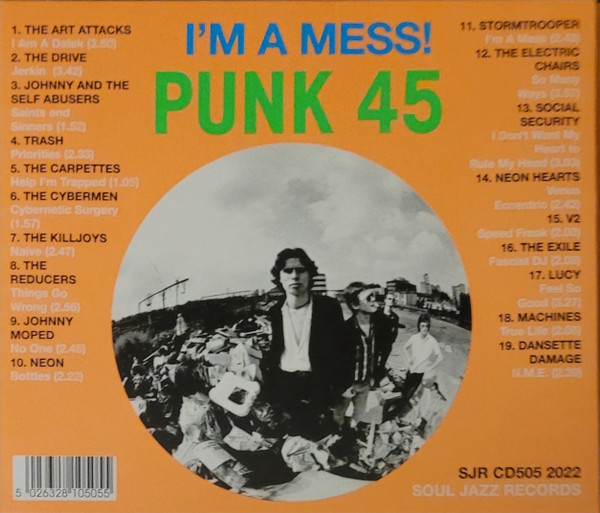
Punk 45: I’m a Mess! (Various Artists)

D-I-Y or Die! Art, Trash, & Neon
Punk 45s in the UK 1977-78
(2022, CD, Soul Jazz Records)
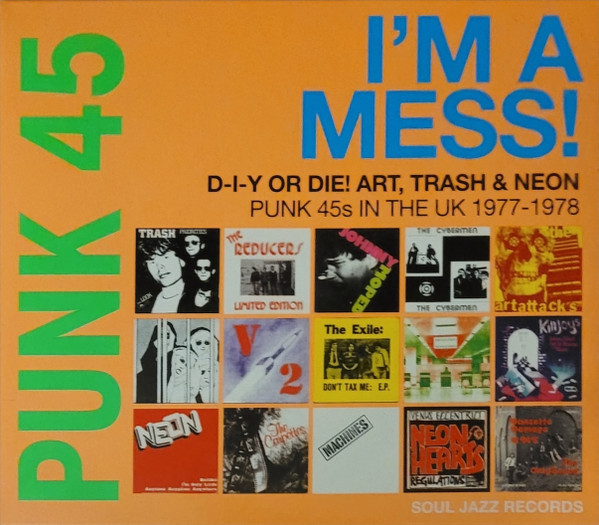
Recently, I have discovered that this compilation is in fact part of a series of punk compilations from Soul Jazz Records that started in 2013 under the “brand” name of “Punk 45,” with each release given a title borrowed from one of the songs on the disc, a subtitle describing the overall style, and a sub-subtitle covering the specific period.

The one we’re reviewing in this case, for example, is the most recent original compilation, though the label reissued the first disc in the Punk 45 series, “Kill the Hippies! Kill Yourself!” on vinyl only in 2024, which I view as symbolic of society’s general regression but is more honestly probably an attempt to lift the comp series out of obscurity.

Before we dive in, a brief clarification: the track listing on the back of I’m a Mess! might have been the actual running order at one point in the production process, but it’s not the one we actually get — a truly DIY sort of error, you might say. The correct song order is reflected below.

Overall, this is a compilation of indie punk singles released in the UK in 1977 and 1978, a sampler rather than a comprehensive collection. Now that the background is out of the way, let’s dive in.

The Art Attacks – “I am a Dalek”
Well you know this title is going to grab my attention, given my lifetime love of the TV show “Doctor Who.” And indeed, what’s more punk than a Dalek? Their entire worldview is that everyone but themselves are unworthy and should either be subjugated or killed. It defines punk rock right from the start with three chords, a cloud of dust from furious playing, barely-tuneful singing and multi-tracked Dalek chanting.

The Drive – “Jerkin’”
Rock has a history of songs about masturbation, which is funny because people often join rock bands as much to get hooked up with groupies as they do to make music. This one is far more tuneful than “I am a Dalek” and has a more polished rock sound that betrays their pub rock background.

A lot of bar bands devolved into punk rockers when they observed which way the wind was blowing, and went right back to their usual styles a year or two later, let’s be honest

Jonny & The Self Abusers* – “Saints and Sinners”
Speaking of masturbation, this band is the forerunner of Simple Minds, a band you generally don’t think of when the work “punk” is in the conversation. But by damn, they do a nice job of putting the bass up front on their take on fast punk. The song matter is simple, but well sung and with a bit of harmony thrown in. Nice drop-dead ending also, the first on this album but a common exit for many punk songs.

(*this is how the band’s name is spelled on this compilation; I have seen the name spelled a bit differently elsewhere)

Trash – “Priorities”
Trash have a pretty good vocalist and (gasp!) backing vocals. Like Jonny and the Self Abusers — the bass is the anchor here, alongside the (talented) drummer. Punk is about very simple song structures and simple messages, and this embodies that principle.

The Carpettes – “Help, I’m Trapped”
Speaking of backing vocals, this one is so fast it’s almost punk rapping, with the chorus handled by the rest of the band (with a bit of echo) to give it a distinct sound. A good example of a song that doesn’t outstay the strength of its concept, like a few others here.

Stormtrooper – “I’m a Mess”
The title track of the compilation. The backdrop of chords gives us some under-melodies to add a bit of sophistication (just a bit) to the usual wall of guitar, drum, and vocals. This is an example of punk as being reflective of what was going on in Thatcher’s England.

The Electric Chairs – “So Many Ways”
Wait, what’s this?? GIRLS?? Well I never! And the guitar isn’t the lead instrument, rather a drum machine is? And is that … a sitar? What the blazes is going on? A hint of synth? Robotic “singing”? Did this band time-travel back four years from 1981?

Clearly this is where DIY ethic mentioned in the title comes in. One has to remember that sounding like robots was a fresh take on a punk vocal at the time. I do actually believe I can detect a hint of melody in here as well. Seven singles in, and punk is already evolving! I’m happy to see some female representation at this early stage.

Social Security – “I Don’t Want My Heart to Rule My Head”
Things are just going from bad (as in amateurish) to worse (not very punk, really) with this ahead-of-its-time New Wave-ish anti-love lament. Our narrator really, really wants you to know he’s not interested in a long-term relationship, so his idea here is that this must be anti-rock music, in that he’s not doing this pull groupies — or, apparently, get famous.

Neon Hearts – “Venus Eccentric”
Finally, frenetic sax makes its punk debut. The song consists of the singer complaining about what a bad relationship he’s in, but apparently the sex is great, so I have to give him points for broaching what would become a universal theme in rock music. Bonus points for a fast-paced but distinctive guitar solo.

The Cybermen – “Cybernetic Surgery”
Some punters with ambition and cultural references to Doctor Who (again) provide us what the punks always said they were like emotionally. There is some early vocoder use to make a sort of “cyber” vocal here and there. Musically quite catchy, with a sax break in the middle. As ruthlessly efficient as the monster they are named after.

The Killjoys – “Naive”
Now here’s a real punk song — the singer blaming other people and society in general for his ills. There’s some female vocals supporting the chorus of “I’m bitter” which sadly devolves into various moaning/screaming.

The Reducers – “Things Go Wrong”
More women! And another song about blaming others for the world’s ills, or your specific ills. It doesn’t have the frenetic pace of first-wave punk songs, but it certainly has the attitude and “bad relationships with various entities” subject matter down pat.

Johnny Moped – “No One”
This song takes the opposite approach — its message is that I am no one, and no one is going to make me feel bad. The lead singer brings a distinct northern accent to the party. Punk failed to get away from the “guitar player needs a solo, however short it might be” mentality of rock pretty early on, but this one finishes with a more typical hard-rock ending.

Neon – “Bottles”
Strange sounds in a loop a the beginning, possibly produced by bottles on guitar strings (GET IT?). Vocals pushed back in the mix on the verses, but not on the chorus — hmmm — and they sound like hippies that have been ordered to go punk. It’s not very good, but at least it’s short.

V2 – “Speed Freak”
Air raid sirens enter the chat as a song intro .. at last. A fast rap of verses followed by the simple chorus of (mostly) “Speed freak yeah.” Not the first song here that has been poorly mixed, either.

The Exile – “Fascist DJ”
A complaint rant about a club DJ who wouldn’t take requests. Literally, that’s it.

Lucy – “Feels So Good”
Now here we have a song tailor-made for pogoing, with an urgent beat and a DIY lyric about the DIY ethic. Moves along at a fast clip, which makes the guitar solo more work (and shorter) than it would otherwise be.

Machines – “True Life”
Old-school punk/rap with a lyric about facing up to the fact that the world sucks and it won’t get any better. Nihilist, maybe, but not wrong.

Dansette Damage – “N.M.E.”
Ah, yes, the old “song starts at one tempo in the intro, then picks up a different tempo when the lyrics start” trick. As you might guess, this song is about a fellow obsessed with the New Musical Express newspaper (I guess you could say it was his “enemy” — thank you, thank you, I’ll be here all week). The title eventually becomes all, and the song devolves from there, as is proper and correct for obsession songs.

Is this compilation worth your time? If you have an interest in unsung OG punk rock, then yes — there are some gems here amongst the mediocrity. It hasn’t aged poorly, I will say that for it, but I’ll also say it is mostly pretty clear why these bands didn’t advance within the movement.

One last note: the vinyl version of this compilation featured a bonus single for Record Store Day 2022 that included a b-side which is not part of the CD version. Both the a- and b-side of the single contained songs by the band Stormtrooper. The a-side was the title song in the compilation, “I’m a Mess.” The extra song on the b-side is “It’s Not Me.”
Roxy Music – Roxy Music (box set) – Disc 4

1972/2018
Disc 4 – DVD video + 5.1 album mix

THE PROLOGUE

At last, it is time for a (short) break from the audio tracks, and a lateral move into video clips. The fourth disc of this set is in fact a DVD that includes some UK and French television appearances to promote the album.

It also includes a full 5.1 DTS 96/24 or Dolby AC3 Sound remix of the album for those of you with 5.1 surround sound setups. I lack such a home theatre setup, but that said even listening to it with a “spatial audio” assist via AirPods Pro reveals obvious improvements.

THE VIDEOS

Naturally, video clips from 1972 are sometimes hard to find, as videotape oxidizes over time and the tapes are often buried in archives. Thankfully, the band (or their record company) got copies of the tapes and preserved them well enough for presentation here.

The first “track” is a version of “Re-Make/Re-Model” performed live and filmed at the Royal College of Art in London on 6-June, 1972, intended as a promotional video rather than taken from a live show.

The sound is muddy mono as you’d expect, and the video is “marred” by an excess of 70s-era video effects that are so hokey and old they’ve come around to being cool again. The effects get excessive, but the visual and audio message gets delivered nonetheless.

From there we move to the venerable TV music show “The Old Grey Whistle Test,” a BBC show that ran from 1971 to 1988. This appearance was on 24-August of ’72. The video of this performance opens with an out-of-focus disco ball slowly spinning before dissolving into the quiet intro to “Ladytron” being played by the band.

Sleepy-eyed Bryan is off in the corner. The video of the band performing is beautifully sharp and clear, though the sound is of course still mono. Andy effortlessly shifts from oboe to sax with cover from the rest of the band. Manzenera’s bug-eye specs get a fair amount of focus, as well as his and Eno’s interplay of guitar effects vs. electronic efforts.

An extended guitar-and-electronics jam follows, and ends with some video feedback. If you were watching this while high, I can only imagine the either panicked or euphoric reception you gave this.

Likewise, “Top of the Pops” started off with blurry psychedics before sharpening up and focusing on the band in their full splendor for a version of “Virginia Plain.” Bryan is resplendent in his spangly green dress suit, Paul Thompson has now formally adopted (or perhaps this is the debut of) his “long-haired caveman with one black eye” look. Manzenera still relies on his shiny track suit and bug-eye glasses, while Eno is rocking a black ostrich-feather jacket, and the crowd are not quite sure how to dance to this, but they give it a go anyway.

Another live but more echoey (and very brief) performance of “Re-Make/Re-Model” is done for “Full House” on 25-November, with the band also doing “Ladytron” for the show on the same day. The band are positioned on a circular stage, with the camera slowly swooping in over the audience (who are seated).

The camera pans around behind the stage, and the band stops suddenly after the end of the first verse to applause. Yes, just one minute of the song! I believe this was used at the top of the show as a “teaser” for the bands that would be performing.

The (more complete) performance of “Ladytron” starts off with a close-up angle of one of Eno’s synth knobs. He kicks things off with some ambient noise while MacKay does a slightly-shortened oboe intro. Ferry and the band kick into the song proper, with more echo than normal because of the studio.

Manzenera is shown without his bug-specs. You can actually (gasp) see his eyes! Every instrument is clearly heard, so the sound mix is impressive. After Phil’s guitar solo and Eno’s stylings, the song comes to a quick close.

We then move on to a filmed performance at the Bataclan, in Paris, in front of a very large and enthusiastic audience. The set kicks off with “Would You Believe,” and the band are engaging in a bit of 50s style choreography. The song is unfortunately interrupted by an announcer telling the television audience (in French) about the venue and the band.

Eno is shown among those singing backing vocals, and while the sound mix is muddy and shifting, Bryan’s vocals are, as always, very clear. The 16mm film cuts into the instrumental break and second verse of “If There is Something.” This is clearly from towards the end of the concert, as Bryan is very sweaty but still very into it.

We do get the full “Sea Breezes,” with Manzenera doing his impressive “weeping guitar” style as heard on the album. Again, one is reminded that both Ferry’s vocals and the basic direction of the band are very polished and consistent with the album verison, allowing for only minor variations (mostly due to Eno’s electronic squelchiness).

The film cuts slightly to the opening of “Virgina Plain,” which the audience are clearly familiar with, clapping the count-in. Again, the band engages in a little synchronized movement while Ferry pounds that repeating chord. The song returns in full force for the sudden ending, the band waves goodnight and the crowd goes wild.

THE 5.1 MIX(ES)

Finally we arrive at the album once again, only this time a little different: a newly-created “surround sound” mix done by Stephen Wilson from the master tapes. Right away, you notice the crowd sound is floating around before the piano kicks in.

Even using just conventional headphones, there is stronger stereo separation and clear positioning of the players: Ferry in the center with MacKay’s oboe, Manzenera and Simpson on the left side (probably with Manz in front of Simpson front), Thompson on the center “back,” Eno and MacKay’s sax mostly on the right. Backing vocals are likely positioned in the back center, but on normal headphones they just sound a bit distant, like Thompson’s drums.

At the time of this review, I don’t have access to a full 5.1 surround system where I can listen to this mix in the way it is intended; that said, some headphones and earbuds (such as the AirPods Pro) do their best to simulate the experience, doing a good job at the separation but unconvincing when it comes to sounds that are intended to becoming from behind you.

If I can find a way in the near future to put this on at some stereo boutique or some friend’s home with 5.1, I’ll amend the review to include those impressions.

Naturally, the bass can only be as woofer-y as your headphones allow, and cranking up the bass on your stereo doesn’t really replace a true subwoofer. In my experience, however, owners of home theatres tend to crank the subwoofer up somewhat higher than they should, because of the novelty of truly having room-shaking bass at last.

The conventional headphone experience still rates as a novel and “different” way to experience the record, with the two rather different types of “surround” experiences and the appropriate amount of bass if you keep the levels even. For those who are long familiar with the album already, the 5.1 mixes might also be a good place to start, especially if you actually have the setup needed for it.

There’s probably less difference when experienced on a proper 5.1 setup, but to my ears the DTS option seems to give conventional headphone listeners more distinct separation, while the Dolby AC3 version draws it lines fuzzier, with most of the instruments having a better grouping, if you will. The sounds sometimes travel from one “side” to another, though the transitions are very smooth; some sounds seem further away, while others are perceived as being “closer.”

I’m just sorry I’m not getting the full experience. Yet.

THE CONCLUSION

This box set could be called a lab on how to experience the same album in a few different ways, but for me working my way through it, it was more about rediscovering what a remarkably fresh-sounding and original album it was at the time, not to mention re-appreciating a few songs that once forgets about compared to the singles. As a debut album, this thing is damn hard to top.

On top of that, the entire album sounds like it fell through a time warp from the first wave of post-punk “New Wave” bands that started using synths, and at least some of that obviously goes to Brian Eno’s contribution. Take him out of the picture and the band still rocks, but it wouldn’t have that “futuristic” vibe that makes the band stand so far apart from their 1972 contemporaries.

Roxy Music would certainly be a strong candidate for the honour of being “the first New Wave record.”

As someone who certainly hasn’t listened to every possible debut album from that year to compare but is broadly familiar with stuff came out back then, I’d still say Roxy Music is likely to be one of the absolute best and most innovative records. That Roxy Music emerged this fully-formed gives a lot of credit to Ferry as a superb songwriter, as a bandleader, and as an incredible talent-spotter.

Roxy Music – Roxy Music (box set) – Disc 3

1972/2018
CD 3

THE PROLOGUE

Following what has become convention for these multi-disc box sets covering a classic album, Disc 3 is generally the odds-and-sods package, and that’s also true in this case. We get the entire album yet again (except for “Bitter’s End,” oddly enough) in the form of sessions recorded for UK DJ John Peel’s radio show, albeit out of album order, and across several sessions.

We also get a “BBC in Concert” recording with five songs from the album, and this time there is audience reaction noise, which is gratifying. There’s more to come on the live and semi-live front, but that will have to wait for the DVD that makes up the fourth disc in this package.

THE MUSIC

The first five songs hail from the band’s first meetup with Peel — on January 4th, 1972 — and the session is an interesting artifact from David O’List’s time as the guitarist for the band. The session starts with “If There is Something,” featuring a pretty similar vocal from Ferry and a few mistaken notes here and there but otherwise very impressive — this is a very well-rehearsed band that’s not afraid to play around the song a bit but is mostly very tight.

Eno’s synth work here occasionally reaches duck-warbling levels, but is mostly great. The song retreats to just drums and piano, with some fine backing vocals, for a bit before the band fully returns for the finish.

The second track is “The Bob (Medley)” which reinforces its war theme with air sirens and a menacing bass synth undertone ahead of Ferry and the band kicking in. The sax is made prominent in the instrumental break, which gives the middle section a nice lift. O’List proves himself a skilled guitarist, if prone to stick to conventional licks and hard-rock phrasing.

Next up is “Would You Believe?” which is the most direct throwback to the 1950s style and that is played up here. The band vocals, other than Ferry, are noticeably different than the album original, but the instrumention sticks to the script. This song is especially well-suited to MacKay’s sax and O’List’s guitar.

“Sea Breezes” starts off with an honest-to-god Tiny Tim vocal from Ferry, who sometimes skates too close to the thin-yet-warbly vocal line that separates them. We get a very drawn-out version of the song, running 8’15” and threatening to turn into a Grateful Dead jam in the middle.

Almost identical to the album version, “Re-Make/Re-Model” shows off again how tight the band has become under Ferry’s musical direction. Eno’s parts are more prominent here, but apart from that the performances are remarkably similar. This performance, live in the studio as it is, might be my favourite of the three versions we’ve heard so far.

The second Peel Session came in late May, and featured just three songs, but with new bassist Rik Kenton, who would be present for the remaining Peel Sessions. He was let go at the end of ’72 and went to a long career as a session musician.

By contrast to the album version, “2HB” is a little disappointing, in that the edit here cuts off the dreamlike opening that set the mood in the album version, and goes directly into the first verse. Beyond that, the song manages to recapture that feel in the instrumental break, where everyone except Bryan is playing together. There’s a weird channel shift near the end that kills most of the right side in the last 10 seconds or so, but that’s live radio for you.

Thankfully, we do get the dreamy mood-setting instrumental that starts off “Ladytron.” The jam section in the middle is always a treat, and the mix here is just different enough to keep things fresh while still being very similar to the album version.

After hearing these different versions of “Ladytron” in this box (with three more to go!), it’s clear that the key to this song is Kenton’s throbbing, insistent bassline. Unlike most of the songs, which are anchored by either Ferry’s piano or Paul Thompson’s incredibly good, solid drumming, in “Ladytron” it’s the bass that is the foundation everyone else builds on.

“Chance Meeting” is such a mannered song, sung in a clipped manner and based on an almost “Chopsticks”-like chord progression (but Ferry likes those chords, as we heard in “Virginia Plain”). The delivery is so stiff-upper-lip and the band so restrained, it makes for a nice mood break from the other tracks, but it’s still one of my least favourites on this album.

The final track for the Peel Sessions on this disc is of course their killer hit, “Virginia Plain.” Thompson’s bass drum teams up with Kenton’s bass, while MacKay’s oboe and Manzanera’s guitar take turns swooping around like daredevil stunt pilots, while Eno’s sonic decorations dance about wildly.

The remaining five tracks are from a “BBC In Concert” live event from August 3rd, 1972. It kicks off with “The Bob (Medley),” an odd choice for an opener in my view but around the same length as the album version, as compared to the drawn out jam we got on Disc 2’s outtakes.

Naturally, a live performance is going to have a different mix, but Eno really gets into his performance of war effects and sonic warbling early on here, with the band right behind him. After the first part, the band jams out in a now-familiar way that is close to what we’ve heard on previous versions. There’s the brief spoken-word moment, then things get heavy again before the finale, and we finally hear some audience appreciation.

“Sea Breezes” has a different but similar arrangment to the album version, and provides a sombre contrast to the more-bombastic previous opus. I think the problem I have with this song is that it meanders, and — as nice as the second half turns out to be — it never really pays off. That said, Eno goes wild at the three-quarters mark of this seven-minute opus, which makes it really quite different to the album version. Following the ever-shifting “The Bob (Medley),” I have to wonder if the audience thought this would be what every song is like.

Thankfully, the next song is a very good live version of “Virginia Plain.” It still sounds a little restrained from the other versions, but it still rocks along nicely and follows the album version pretty closely. Eno’s magnificent synth riff in the middle eight is nice and LOUD as it should be. The audience clearly liked this one a lot.

Then we come to the more formal “Chance Meeting.” Once again, Eno is more prominent here than he was on the album or Peel Sessions. The instrumental break is nicely mixed and sounds great here.

The last track is “Re-make/Re-Model,” and again the band is back in top form with a fantastic sonic attack, though the band’s vocals caught the sound man napping for a few seconds until he brought their mic levels up. MacKay’s sax is amazing in a live setting, and the whole band are really on fire here — it’s clearly something they love playing.

At the three-quarters mark, Eno really gets to shoot his shot, but all the band members get to show off their chops really nicely, which is one of the reasons I like the song — it’s obvious why this was the concert ender; they are throwing the (sonic) kitchen sink at the audience, and they are are loving it, breaking out into a chant for more at the end that regrettably just fades away.

THE VERDICT

If you’ve listened to the box set in disc order, you’ve heard the album, the demos and out-take versions of the songs on the album, and now the “live in studio” and “actually live” versions, and you’re not done yet (more on that later).

The highlight of this disc, for me, is comparing guitarists O’List and Manzanera (which is like comparing Monet to Jackson Pollack), and judging Rik Kenton’s bass playing to Graham Simpson’s (both quite good, so a more difficult compare — and neither stayed with the band past this album). It’s also been fun to hear the band rehearsed but live on radio and in an audience environment — and very gratifying to hear that Roxy Music found an enthusiastic audience very quickly, given how bold the album was.

That said, the reason this album found its audience relatively easily is because there was a hell of a lot of new sounds coming out around this time. King Crimson was around, Kevin Ayers was around, John Cale and Terry Riley had put out an experimental minimalist album, and there was more of that as the move away from folk-rock had begun.

Audiences were looking for something different from the late 60s sounds, and in Roxy Music they found it. On the very same day it was released, a bubbling-under folk-rocker named David Bowie took a hard turn with a rock concept album (thanks to Mick Ronson) with The Rise and Fall of Ziggy Stardust and the Spiders From Mars, and achieved superstar status.

Bowie won out in the UK album rankings, peaking at #6 while Roxy Music managed a very respectable #10 position. More importantly, it launched Roxy as a huge success right from the start, and has remained a strong influence for art-rock and New Wave bands across the decades.

Just as an example: earlier in 2024, acclaimed folk-rocker Linda Thompson released a successful album called Proxy Music, aping the cover of Roxy’s debut perfectly. Thompson has recently lost the ability to sing or speak due to spasmodic dysphonia, so she recruited others to sing the songs she wrote for the album.

Next time: the DVD (video portion)!

Roxy Music – Roxy Music (box set) – Disc 1

1972/2018, 3CD + 1 DVD
CD 1 of 3

So now that we’ve already covered the packaging in detail, we can dig into the album proper — but it’s worth remembering that the packaging singularly used “sex” to sell the record. The complete lack of any information about the band (apart from the name) or what the music might sound like — there was just “the girl” — on the front or back cover ensured that only the most curious and intrigued of parties would buy it, if they wanted — or needed — to learn more.

THE PROLOGUE

Luckily for us all the trick worked: the first single was (wisely) chosen as “Virginia Plain,” which served as a calling-card for their elegant, innovative, and varied rock stylings. It went to number four in the UK singles chart, and that pushed the album (which at the time did not include the single) to number 10 in the charts.

This was something different: neither the swamp-rock of Creedence Clearwater Revival, nor the hippie music of George Harrison, and not the R&B white soul sound of Van Morrison, the funk and soul of Gladys Knight or Aretha or Sly Stone, or the gentle pop of Neil Diamond. It was new and different, borrowing from the 50s but adding in sounds of the future and a decidedly eclectic crooner style — and thankfully it caught on with an eclectic group of buyers who took a chance and were richly rewarded.

I used to call the first album “the first New Wave record,” and while I was basing that assessment on my favourite tracks rather than the album as a complete work, I still stand by that description. It took a nearly decade, and the reactionary mid-70s revolution of punk, to create a movement that followed in Ferry and company’s footsteps.

Before we get started, though, a radical rethink: don’t start here. Go directly to Disc 2, do not pass Go, do not collect $200. You will thank me later.

You see, the packagers of this comp (presumably Ferry and various execs) have made a hideous mistake — we should hear how the album came together (aka Disc 2), warts and all, and <em>then</em> you should go back and listen to Disc 1 with enlightened new ears. As I mentioned earlier, if you bought this box then you’ve heard the first album, maybe a hundred times or more.

The real find here is the demos and outtakes, which haven’t been heard before. While the songs (and especially the lyrics) are still familiar, they are cut short, redone, tooled around with, argued over with the engineer, and generally … <em>fresh</em>. Listen to Disc 2 first, then come back to Disc 1 with completely new ears for this album you know so well.

No? Oh all right then …

THE ALBUM

Disc 1 of this set starts off with some false advertising: it’s billed as the “original” album, but it’s not: the original vinyl release in 1972 contained nine songs. The CD version, first released in 1984, inserted the pre-album hit single “Virginia Plain” between “If There is Something” and another popular song, “2 H.B.”

Don’t get me wrong, I’m glad the first disc here exactly matches the first CD version, but it’s not the “original” release, is it? And yes, there’s more quibbles to come!

On to my second (minor) gripe: the version used on CD1 here is in fact 1999 remastered edition, which was cleaner and brighter than the original 1984 CD issue. I would kind of liked to have had a Stephen Wilson stereo remix instead — which exists, but isn’t present in this box set.

Most people who would buy this deluxe edition likely already have or had the ’99 remastered version, and the technology has moved on considerably in the last 25 years. Using the 2.1 Stephen Wilson version would have given most buyers something “new” there – if you’re not going to give us the 1984 original CD version – and it would been a thoughtful gesture for those lacking the equipment to properly play back the DVD’s 5.1 SW mix.

Still, for those who bought (and still have) the original CD on first issue, the ’99 remaster is clearly the superior version of the CD.

The single sleeve disc’s front cover does, of course, faithfully preserves the original eye-catching outer cover, while the back lists the album’s contents, players, and production personnel. Thankfully, the “art book” portion of the presentation gives us gatefold’s original interior art, with more information about the band and songs — at the same size as the original LP release.

If you’re reading this, you are very likely to have heard Roxy’s debut album already, so we’ll stick mostly to my refreshed impressions, listening to it again after a few years’ gap from my last listen; we’ll get into more detail once we move on to the discs with the previously rare-or-unreleased material.

Re-Make/Re-Model: the short silence (six seconds) before the crowd noise, which we get for another few seconds followed by a sharp cut and Ferry’s piano, then Thompson’s drum start and the band joining fully just two seconds later … what a way to announce “this isn’t your typical band.” While the bass and drum hold down the basic rhytms, guitar and sax go wild in almost jazz-like improv, with short bursts of Ferry’s vocal, and the band backing him by reciting a license plate number between verses.

There’s no chorus (apart from, I suppose, the license plate thing), and the long instrumental section is like nothing else: a bit of the full band, then a suddent stop and breakout spot by each instrument that feels very on-the-spot improvised, as if the direction given was “you get a five-second solo. Go!”

First drums, then a cheeky bass rip-off of The Beatles’ “Day Tripper” riff, then Eno’s sputting screech noise box, then a shot of sax that flows right back into the music stream, ditto with the guitar, and finally some madcap piano, one last drum break, and then all of them at the same time for a bit before it falls apart and winds down. The way the weird synth noises snake through the deteriorating band and finally signals the end.

By this point, the listener in 1972 must have been wondering what planet these guys were from. What an opening number! After all these years, I still say “wow.” This is just as fresh and wild as it was the day it was released … and there’s not a lot of 1972 albums you could possibly say that about.

Ladytron: With barely time to take a breath, we take another short break of seeming silence (about four seconds) before we begin to perceive a soft electronic bed emulating wind, with an oboe softly winding its way around a melody, accompanied by synth sound effects kind of emulating a lonely wind. The oboe part partially repeats, then Ferry comes in with “You’ve got me girl on the runaround, runaround/Got me all around town/You’ve got me girl on the runaround/And it’s gettin’ me down, gettin’ me down,” as the bass moves in ahead of the full band coming in fully.

Naturally, you get absolutely no clue as to why the song is called “Ladytron,” and the song about a ladykiller gent playing cat-and-mouse with his latest target. After the first full verse, we again take a break to highlight a fabulous echo-drenched oboe. Ferry returns, now double-tracked, and we get that first taste of Ferry’s famous warble.

Without changing the tempo, the furious drums return with fast bass, horns and guitars double-tracked guitars, piano trying to keep up, shakers and the kitchen sink thrown in for good measure. Imagine Elton John playing “Saturday Night’s All Right for Fighting” with his full band, and all of them having a nervous breakdown – with Brian Eno aggravating matters – as the instrumental break just floats off into the sunset after a minute, and the song is over.

These first two tracks firmly established that this music was something new to the world of the early 70s, acknowledging influences of jazz, soul, and rock while melding it together into Dali-esque impossible structures and jams, where the singer was not the focus but still riveting when he did appear. Vocals were just another instrument, occasionally contributing something that might sound like a lyric, or words intended more for texture, and then step aside to let the band show off.

If There is Something: The above is what makes the third track all the more confusing: after two incredible tracks, suddenly Roxy Music becomes a country-rock bar band (?!). Something about Ferry wanting to settle down with a young girl and grow potatoes, showing off his vocal quaver — and with nothing for Eno to do until halfway through, then mutating the song into a slow jam?

It’s a little portent of the second half, and while it’s not bad at all, it’s certainly a letdown from the first two killer tracks. Okay, there’s an argument to be made that after two (for the time) bizarre tracks, you might want to give the listener something akin to music they’ve heard before, and I get that.

It’s not until Eno’s synth counter-melody, though, that “Something” reverts to the kind of interesting and non-mainstream sound it has been cultivating so far. Thanks to the sinister undertone of the song after its initial riffs and Eno’s contribution, I can see why Bowie’s Tin Machine wanted to take a stab at it … but frankly, I think Bowie did a better job with it.

Virginia Plain: As “Something” meanders off, the first single pulls up in a new sports car with style and energy to spare, thanks to its playful lyrics: “You’re so sheer, you’re so chic/Teenage rebel of the week” is just a sample of the joy that permeates this song. Wrap it around another fast-tempo’d melody featuring frantic piano and drumming, steady bass with schizophrenic horn, and a motorcycle taking off for good measure. This track is a solid-gold winner, with a brilliantly-framed synth coda before the final lyric, which beautifully brings the song to a flying stop. It was an obvious choice for the first single.

Spoiler! This is the new official music video for “Virginia Plain,” taken from the bonus DVD in the box set.

2 H.B.: This is followed (finally) by a breather, a somewhat-gentler tribute to Humphrey Bogart. Ferry puts on an even thicker Ferry-esque style for this one, which includes a nice long multitracked sax-oboe instrumental break.

The chorus of “Here’s looking at you, kid” ties back to the title so nicely and the repeated line of “failing me never” which fades off as the instruments retreat is a lovely finish. On the original vinyl, that concluded a pretty much all-star Side One.

The Bob (Medley): Now we start off back in ominous synth town for a bit before the band comes in and disrupts whatever mood the opening was going for. It’s like a parody of the indulgent slogs that The Grateful Dead put out, meandering from one musical idea to another with little connective tissue.

We’re clearly in for a rougher ride on the second side, kids. It’s not until the middle of the piece and all the gunfire that you get the idea its about war (specifically, the Battle of Britain). It’s like a notebook of barely-started lyrical and musical ideas, poorly glued together.

Chance Meeting: We transition away from “The Bob”’s car wreck with a slow, beat-less piano-and-guitar first verse, which describes exactly that happening. During the instrumental break, the bass is allowed back in the room for a bit before it quickly fades out.

Would You Believe: Just when you think the second half is going to be the (almost) “all filler” counterpoint to Act I’s “all killer,” this track finally gets us back to the Roxy we thought we were getting based on side A. The soft, falsetto, double tracked Ferry starts off with a ballad verse, then the band breaks out with a 50s-styled main tune, the band shows off their sax-and-piano chops before Ferry returns to his crooning.

It comes off like a real tribute to the kind of music they grew up listening to, and it’s the highlight of the second half.

Sea Breezes: Following that, the next song literally opens with the sound of (synthesized) crashing waves, and then Ferry crosses fully into Tiny Tim territory with his delivery; we’re just missing a ukulele here to complete the effect in this very quiet number. There was so much energy and verve on the first half of the album, listeners might be wondering what the hell happened to the band when they recorded the second side.

Just in the nick of time, however, the second part of “Sea Breezes” sees the return of Ferry’s normal singing voice, far better lyrics, and some lovely contrasting instruments in our left and right ears, which is a fun effect. Sadly, then the finale of the song reverts to the catatonic style that is so inert you want to check the band’s collective pulse, complete with the return of the falsetto. The band seems to have something of a schizophrenic personality.

Bitters End: While maintaining a barely-above-ballad tempo, “Bitters End” returns to the tribute 50-style doo-wop number with a dropped in crowd effect, and works well. Given the lack of pulse present in most of the second side, it was very wise to finish with this number.

It’s Noel Coward as a 50’s ballad, and I do particularly love the occasional background chorus of “Bizarre” to frame Ferry’s amusing lyrics. Once again, a sudden change-up (in this case, Ferry reverting to his lower register) to a sudden stop makes this clever homage into a strong ending for a mostly-disappointing second part.

THE VERDICT

Like Longfellow’s little girl who had a little curl, when this is good it is very, very good, and great respect is earned for continuing to sound so contemporary after more than 50 years since its release … but to rewrite the poet a little bit, when it is bad it is somewhat disappointing.

Few are the albums that can maintain a consistently great standard across 10 tracks, and Ferry’s love of slower ballads will eventually pay off in later albums. But in this case, the flip side just seems laboured and leaden most of the time, or maybe I just don’t have enough of an appreciation for languid love songs. I think it’s fair to say that Roxy Music’s debut is strong, but uneven.

Next time: Demos and Out-takes!

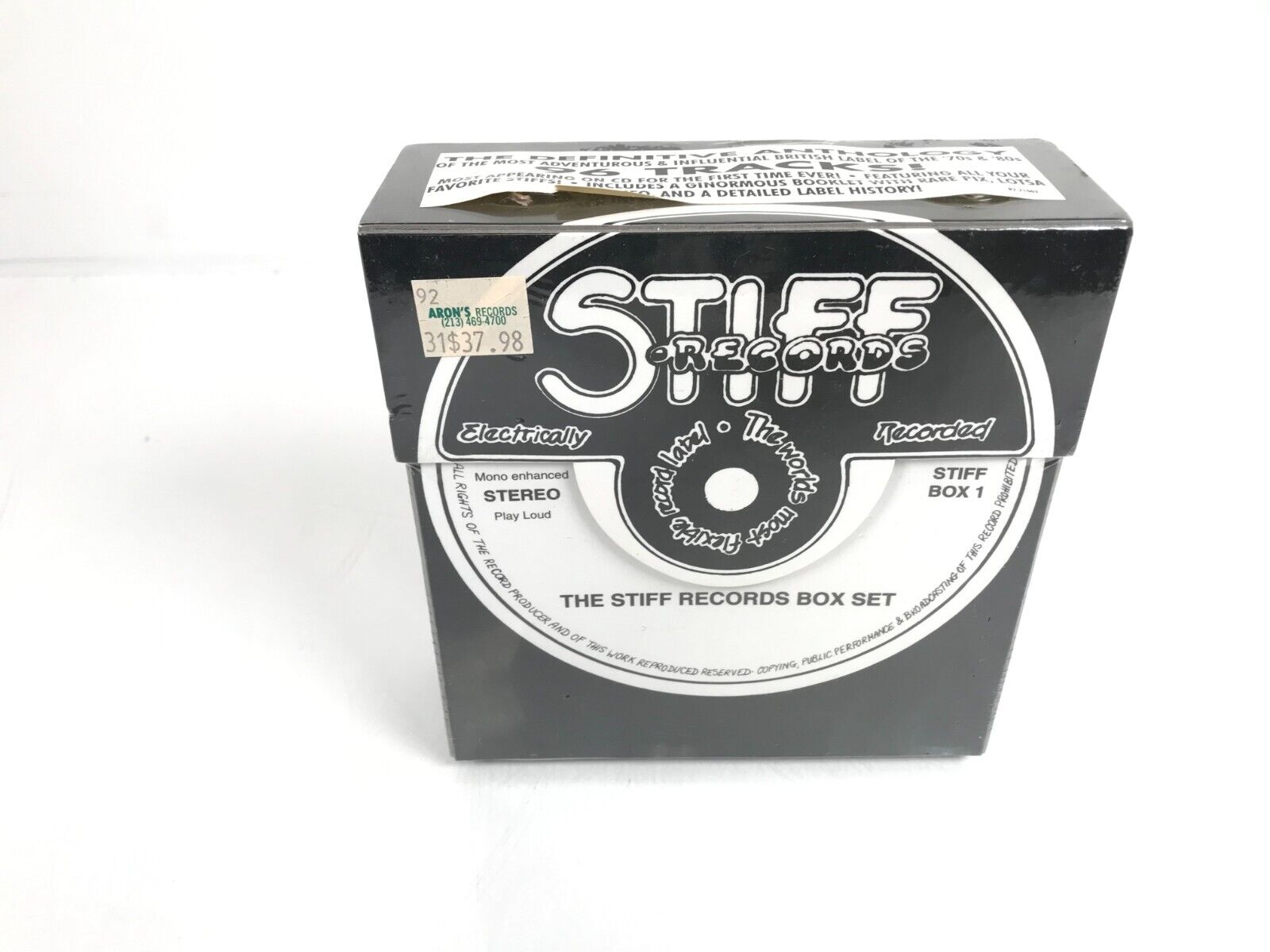
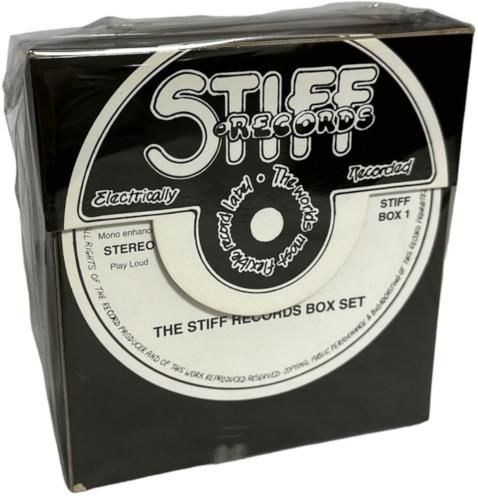
The Stiff Records Box Set — Disc 3

The Stiff Records Box Set — Disc 3
Stiff Records, 1992
4CD box set + booklet

THE PROLOGUE

We’ve already sampled 50 songs from the Stiff catalog, and my suggestion is you don’t do this in one sitting! It’s all (well, very high percentage) good-to-great stuff, and a snapshot of an era as well as a label. But will Punk-New Wave-Powerpop-Pub—Rock-Uncategorized fatigue set in? Let’s find out!

In response to some readers – yes, we’ll cover the booklet when we get to Disc 4, and yes, I probably should have done that with the Disc 1 review. Insert traditional UK two-finger wag … here.

THE MUSIC

If you were feeling a little fatigued from listening to (or just reading about) the first 50 songs, Disc 3 is here with a shot of Vitamin Groove to revive you. Stiff could hardly have picked two more energetic, get-up-and-dance-you-fool numbers than Madness’ mid-tempo-domestic-squabble-set-to-ska song “My Girl” to kick things off, and then followed it with Jamaica’s musical master Desmond Dekker’s insanely catchy 1968 reggae classic “Israelites.”

Joe “King” Carrasco (and The Crowns) has the uneviable duty to follow that, but does a decent job with his equally-partying and Wurlitzer-led Tex-Mex hit “Buena,” which of course incorporates some Spanish into the mix.

We shift gears with Graham Parker’s faux-punk rockin’ diatribe “Stupefaction,” complete with a snarling indictment of life in Los Angeles. It was the first single from his final album with the (uncredited) Rumour, The Up Escalator, and while the single didn’t chart, the album was his best-selling record to that point (1980). If you like the song and his attitude, you’ll enjoy the album.

Next up is a masterpiece of the New Wave era — a “love” song that probably could never have been written, performed, or been a success in any other era. Jona Lewie’s biggest hit, “You’ll Always Find Me in the Kitchen at Parties,” was a song I identified with in my very early teen years, until I become the social butterfly I am today (heh).

It’s minimalist, it’s low-key, it’s monotone, and I love it (and it’s not like everything else he’s done). I’m sure it was intended as a “novelty” single, but it bypassed Doctor Demento and became a surprise Top 20 hit in the UK, reaching the #3 spot in New Zealand and parking there (on both charts) for weeks on end.

To the best of my knowledge, there’s only been one “cover” of this song … in 2010, a duo called Man Like Me took the backing track, replaced Lewie’s vocals with their own, and made a video. It’s not horrible, it’s not great, and it’s on YouTube if you want to see it.

If you’ve never heard the original, good lord people — listen to it RIGHT NOW. It’s an Awkward Teenager Redemption Anthem! Plus, this particular video features bonus Kirsty MacColl!

This is followed by the joyous power-pop of Any Trouble, with the song “Trouble With Love.” The group as a whole had its ups and downs, but I have always been a fan of anything lead singer and songwriter Clive Gregson cared to put down on tape — he does a great job of marrying upbeat pop with “unlucky in love” lyrics.

Dave (L.) Stewart — not the guy from the later Eurythmics — spent his time at Stiff mostly covering old songs, as far as I can tell. He had played with bands like Hatfield and the North in the 70s, but by 1981 he was putting out singles with guest vocalists.

The first of two such collaborations we’ll hear on this disc is “What Becomes of the Broken-Hearted,” with vocals by Colin Blunstone (formerly the singer for The Zombies) with some female backing vocals. The song, from 1966, was first recorded by the great soul singer Jimmy Ruffin, who really poured a sense of genuine heartache into it.

Almost every singer who has covered the song since has hewed very close to the original arrangement, but often don’t bring the anguish Ruffin did. It’s the same problem here: Stewart’s instrumentation, while nicely departing from the Ruffin arrangement, replaces it with a cold, synthy-piano-led, clinical style. Blunstone’s singing, while pleasant, is likewise perfunctory for the most part. We’re not looking forward to more of the same later.

Since the last song was so soulless, it follows that Graham Parker would have to follow with his sarcastic takedown of his (former by this point) record label, “Mercury Poisoning,” which is a rollicking complaint letter set to music. His new record company (Arista at the time) had no issues with it, but Parker didn’t last too long there either. This live version got licensed to Stiff and they ran with it, and emerged seemingly unscathed (at least, I’m unaware of any song by Parker with a play on the name Stiff …).

Dirty Looks was one of those bands that always seemed interesting, seemed promising, but at least for me they never managed to push it over the line into being a fan. “Let Go” is a nicely energetic and tuneful number with a great pre-chorus praising the rock n roll spirit embodied in the advice of the title. It’s a good single that probably should have done better than it did — see what you think:

Madness returns with their clown car of fun ska and “nutty boys” story-songs with “Baggy Trousers,” showing that their style had legs to cover more than just their first (brilliant) album. Madness by this point is a reliable and predictable brand, beloved by skinheads and grandmas alike. Nice trick if you can pull it off!

Dave Stewart returns, this time with regular partner Barbara Gaskin in tow, for another off-beat take on a standard: this time, “It’s My Party.” This version works better than Dave’s cover of “Broken Hearted,” because the song was a torch song in the first place, and so performing it like a morose ballad technically makes it a better version that Lesley Gore’s original, but I still prefer Gore’s version. The girl-group backing vocals just put the cherry on this synth-minimalist but perceptive cake.

Speaking of covers, John Otway’s take on the old country standard “The Green Green Grass of Home” is … well hang on, who is this person anyway? I confess I’m not that familiar with him, but he appears to be simply an eccentric musician who tries to do thing in his own unique way.

So, knowing that, it’s possible to appreciate this sometimes atonal, weirdly performed, nearly acapella first minute of the cover, followed by the full band kicking in and Otway singing a raucus version in the second half. It’s certainly a “chaser” between the first half and the second half of the disc, I’ll say that.

Following that, Tenpole Tudor swing around playfully with “Three Bells in a Row,” a tuneful song about “fruit machines,” (coin-operated UK roulette machines where you try to line up three items in a row, with the big winner being three bells). Frontman Ed Tudor-Pole is just out for a good time, and pretty much all the music I’ve heard from the band is the audio equivalent of a good-time pub crawl.

It was good choice to sequence Jona Lewie’s cheery (or as cheery as his deadpan voice allows) “Stop the Calvary” as the next track, as it keeps up the good mood and suddenly turns into a Christmas single unexpectedly (and it’s still played around Christmas time on UK radio to this day).

What’s next? The two songs by Department S you’re ever likely to have heard before, “Going Left Right” and “Is Vic There?” Oh but plot twist — the version of “Is Vic There?” is the French version! Qu’elle surprise!

The former song has a driving style with a lovely swirling synth dressing and snarky lyrics about disco dancing. I still like this song very much, and wish they’d done more in this vein, even though it’s the longest song on this disc (at four and a half minutes).

“Is Vic There?” is a fragment of a phone conversation turned into another catchy, intense yet danceable single, with both French and English lyrics. I should really look into the rest of their output, but I can only think of a handful of Department S songs I’ve ever heard, and they’ve all been good.

Here’s the English-language version of the track.

Now we come to a band called the Equators that I know nothing of other than this one song. “If You Need Me,” has a ska influence to it, and there’s nothing really wrong with the song other than it being a bland love tune, lyrically. It didn’t inspire me to investigate them further.

As if in reaction to the mediocrity of the Equators, Tenpole Tudor return to overturn the table, spike the punch, and swing from the chandelier in an attempt to bring the party back to life with “Wunderbar.” It’s not as energetic as punk in the verses, but it chugs along nicely and the chorus is a big drunk gang singing the word “wunderbar” and whistling as only a big drunk gang can. As good as it is, they get one-upped in due course.

“Allamana” is a quite forgettable number by Desmond Dekker, and was likely a b-side. Nuff said.

We shift gears pretty hard from this string of ska-jacent music with the arrival of Alvin Stardust and his urgent mission to put a new spin on the traditional 50s love ballad. Blessed with the smoothest voice this side of Buddy Holly, he ups the tempo, drips with echo, and has perfectly harmonious backup singers. It’s fabulous.

Billy Bremner of Rockpile (and Nick Lowe and Dave Edmunds’ various other records) drops by with a serviceable but relaxed performance of a song called “Loud Music in Cars,” where the title is not only the subject, but the first words sung (and he has a pleasant-enough voice, though the influence of Lowe and Edmunds is keenly felt). It’s a simple Scottish pop song about a simple subject — loud music in cars is something Bremner enjoys, apparently. It somehow sticks in your head, though.

Oh, but then … Tenpole Tudor return to take us away from all that amiable-pop-rock crap with another stomper likely to be sung by football hooligans, “Throwing My Baby Out With the Bathwater,” a good-time breakup song.

This is stunningly well one-upped by a band called Pookiesnackenburger, who I am astonished to report managed not only to produce more than this one madcap song, but indeed produced two complete albums I really must investigate. “Just One Cornetto,” flatly, my favourite song on this disc by a long way.

Following some incomprehensible chatter, the song begins with a Madness-like call to action, becoming a party set to music and a delightfully mad lyric — a love song to an ice cream novelty, the beloved Cornetto. The whole thing is as delightfully mad as the band’s name, and all over in 2’26”. Love it.

Next is Via Vagabond with a driving, swinging jazz number called, brilliantly, “Who Likes Jazz.” It’s wonderfully performed with blazing piano, a touch of synth, but really driven by the drum-and-stand-up-bass 50s style tempo.

The disc concludes with Tracey Ullman with another slab of 60’s style girl-pop, with a beautifully clever title lyric — “you broke my heart in 17 places … Shepard’s Bush was only one.” The secret sauce behind Ullman was always Kirsty MacColl, and this is one of her cleverest songs.

This was part of Tracey’s debut album of the same name, mostly consisting of an eclectic array of remakes of well-known love songs, including Blondie’s “(I’m Always Touched By Your) Presence, Dear,” and a lovely cover of Jackie DeShannon’s brilliant “Breakaway.” MacColl also contributed one of her songs she’d had a hit with herself, “They Don’t Know,” and Ullman’s version was a bigger hit than MacColl’s version — reaching the top 10 in the US and peaking at number two in the UK singles chart.

THE WRAP UP

The tracks on these discs are not arranged in strictly chronological order, but they do roughly follow the progression and diversification of the label, and we’re definitely seeing that here. Thankfully, Robinson’s ear and eye for talent remained true, but the number of Stiff acts that went on to bigger labels and greater success is a remarkable testament to that.

“Punk acts” on this compilation mostly consist of The Damned and Alberto Y Lost Trios Paranoias, and they’re not heard from after the first CD here. That said, my personal rating of “great” songs goes up to a new high mark here . Here’s the score for CD number three:

GREAT SONGS: 14
GOOD SONGS: 6
MEH SONGS: 5

Next time: Disc 4 … and oh yeah, the booklet!

The Stiff Records Box Set – Disc 2

The Stiff Records Box Set — Disc 2
Stiff Records, 1992
4CD box set + booklet

THE PROLOGUE

Settle in, dear readers, it’s another disc and another 25 songs spread out another hour and 17 minutes, or an average runtime per song of 3’08”. As before, there’s a mix of Stiff’s artists that went on to become famous and/or influential, and a smattering of songs and artists that … didn’t.

THE MUSIC

Disc Two kicks off with another pair of songs by Nick Lowe, just as Disc One did. This time, we get the non-album track “I Love My Label,” which is probably why he got more songs on this compilation than anyone other than his protege Elvis Costello (at four songs each).

Nick’s original of it has only ever appeared on a handful of Stiff Records compilations, of which this is of course one of them, but Wilco very faithfully covered the song as a bonus track on their 2011 album The Whole Love.

This is followed by “Marie Prevost” from his first album, Jesus of Cool, released in March of 1978. It tells the tale (inaccurately) of the silent film star’s life and death. A story had gone around that part of Prevost’s dead body was consumed by her two dogs, and this was used by Lowe in the song.

It isn’t true — she died, destitute, at age 40 from alcoholism and malnutrition due to anorexia nervosa, with her body intact. One of her dogs, in fact, caused neighbours to discover that she had died via the animal’s incessant barking.

Next up is Ian Dury & The Blockheads with “What a Waste,” a song about all his squandered opportunities in other occupations, but for that he chose “to play the fool in a six-piece band.” It’s another mildly entertaining and amusing song, as is his forte.

Elvis Costello pops up next with a live track, which he announces is written by Burt Bacharach and Hal David: “I Just Don’t Know What To Do With Myself,” one of the duo’s many pop standards. Elvis is perhaps surprisingly sincere in his performance of the 1962 number, first made famous by Dusty Springfield’s version.

You could be forgiven for thinking that the fifth track, “Whoops-A-Daisy” by Humphrey Ocean and the Hardy Annuals, was just a more twee version of Ian Dury on a lark. In fact, however, Mr. Ocean is a real person, and a noted UK painter.

The uncanny resemblance in this track stems from Ocean’s affiliation with Dury (who was his art teacher, friend, and apparently vocal coach). Ocean had played bass in Dury’s previous band, Kilburn and the High Roads. Following this music-hall type single, Ocean gave up music and returned to painting.

This is followed by a trio of well-known songs from the New Wave era, the first of which is Lene Lovich’s outstanding cover of Tommy James and the Shondell’s 1967 hit “I Think We’re Alone Now,” originally written by Ritchie Cordell and Bo Gentry. The pop hit about two young people desperately trying to find a place to “be alone” (cough) never sounded fresher, and Lovich was rewarded with helping it chart once again.

“Jocko Homo” was DEVO’s first b-side (the a-side was “Mongoloid,”) as well as Mark Mothersbaugh’s first solo writing contribution. The name comes from a 1924 anti-evolution tract called Jocko-Homo Heavenbound, and the memorable time signatures and call-and-response chant is a play on a similar one in the movie Island of Lost Souls. It’s a compelling song because of its two time tempos (from 7/8 to 4/4 for the call-and-response part), and handily established DEVO as a completely unique band and the vanguard of the post-punk landscape called New Wave.

Ian Dury returns with one of his better-known songs, “Hit Me With Your Rhythm Stick,” centered on a brilliant Chas Jankel melody and the spoken (and occasionally multi-language) poetry of Dury, not to mention an insane sax solo. One of the things that so attracts me to the New Wave movement was the incredibly size of that tent — wildly different music fit and blossomed in that tent.

“Semaphore Signals” by Wreckless Eric (one of the acts that had very limited success), is a nondescript number about lovers trying to secretly communicate. He’s a “working class” singer one might charitably say, and this is a song with a cute idea behind it but stretched too thin to support its “drunk karaoke”-style vocal performance.

Speaking of drunk performers, Jona Lewie (who did at least get one big hit out of his time with Stiff), seems like a Depression-era pianist somehow transported to the 1980s, and not sure quite what to do with himself. Thankfully, he’s pretty entertaining even when he sounds … er, relaxed, and “I’ll Get By in Pittsburgh” sounds like a closing-time tune by a pianist who’s quite relaxed about his performance. Generally I quite like Lewie’s first album, but this “Pittsburgh” was the b-side to his novelty hit “In the Kitchen at Parties” for a reason.

From there, we go to “B-A-B-Y” by Rachel Sweet. She has a powerhouse voice that you either find thrilling or its like fingers on a blackboard for you. I’m more in the former camp, though Sweet certainly missed her calling as the leader of a 60s girl group by simply having been born too late (1962).

Today, she’s a successful TV writer and producer, but back then she was Stiff’s jailbait ingenue, a veteran child star who was 16 in 1978, switching from singing country to rock music and releasing her first album, Fool Around, that same year. It’s a well-regarded album that has aged well (the musicians on it would later form the band The Records), but only the single showcased here did terribly well.

By 1982 her career as a solo artist was over, with only four original albums and a live record. That said, she later wrote and sang several songs for John Waters’ films Hairspray and Cry-Baby.

For the halfway mark on this disc, we return to the ever-reliable Lene Lovich and her first and arguably biggest hit, 1978/9’s “Lucky Number,” which managed to get substantial video play on the nascent MTV. It went Top 10 in most countries in Europe and the UK where it was released.

The Members were a group that I personally judged never quite good enough to actively collect, but that said I like what I hear from them. “Solitary Confinement” is a very witty song about how “great” it is to get out of your parents’ house and live on your own for the first time.

Or, as they put it: “You are living in the suburbs/And you have problems with your parents/So you move on up to London town/Where you think everything’s happening, going down/Living in a bedsit/Travelling on a tube train/Working all day long/And you know no one/So you don’t go out/And you eat out of tins/And you watch television/Solitary confinement.” Missle hits its target, dunnit?

This live version really captures how meaningful this song was to so many at the time.

Next up is “Frozen Years” by The Rumour (minus Graham Parker). Not everyone remembers that The Rumour put out three albums on their own. This song is a lightweight and pleasant synth-driven number with clever lyrics, sung by Brinsley Schwartz himself (though you’d be forgiven if you thought it was a very low-key Nick Lowe).

Then we’re back to Wreckless Eric with “Take the Cash.” Sound, practical advice regarding the handling of money and job protocols from our Mr. Eric. He embodies the “three chords and enthusiasm” ethic that embodied a number of Stiff acts, but as with “Semaphone Signals” it’s a very amusing but incredibly basic idea, and again he stretches it to within an inch of its life at 3’44”. If he’d get in and out much more quickly, I’d think him a comedic genius.

Following this is one of the absolute gems of the Stiff lineup with an absolute jewel of a song: Kirsty MacColl, the daughter of the revered folk singer and composer Ewan, absolutely nails her debut with the exquisitely gorgeous “They Don’t Know,” the story of a teenager who has found their true love on a level that their parents and others would just never understand.

The 50s styling, multi-tracked choral backup (learned from intently listening to Beach Boys albums), and the puncturing “BAY-bee” that climaxes the instrumental break are spot-on perfect, and the blend of pre-rock ballad style and nascent 80s instrumentation effortlessly show off both her talent and her musical lineage in three perfect minutes flat.

She and Stiff head Dave Robinson didn’t get on very well at the time, however, so he buried the 1979 single, and she wasn’t able to release her own album until 1985 (!). I’ve been a fan of hers since I first heard this in ’79, and was delighted when Tracey Ullman brought it to a wider audience in 1983, making it the hit it always should have been (Tracey herself became a Stiff artist, and appears later in this comp).

Robinson may have had some regrets about how he treated MacColl later on, or maybe he just finally understood how brilliant she actually was, so thankfully she gets two songs on this box set: we’ll get to the other one when we come to Disc Four.

Mickey Jupp was pushing 40 by the time he recorded for Stiff, having done the music scene in the 60s before leaving it. When “pub rock” became a thing in the UK, he happily signed back up for another hitch, and “You’ll Never Get Me Up in One of Those” is a good example of the good-time but rough-n-ready pub sound that dominates the first side of his album Juppanese (the second half is quite different — a trick more artists should employ).

The A-side was produced by Nick Lowe and features an uncredited Rockpile as the backing band, and sounds like it. The B-side of the album was produced by Procol Harum’s Gary Brooker, and is considerably more polished. After seven more solo albums, he took another break from music — but returned to recording in 2009 and most recently released new music in 2022 at age 78.

Rachel Sweet returns for “Who Does Lisa Like?” a nicely angular single that reinforces her under-age image with a song about high-school gossip. The album, titled Fool Around, gave her two popular singles: “B-A-B-Y” and “Stranger in the House,” the latter of which led her to masterfully cover a number of other classic pop and country songs.

“Drive Friendly” is the next song by a band called Motor Boys Motor. It’s a pretty terrible song about a killer car, and thankfully they do not appear again on this compilation — but hey, it might possibly have inspired Stephen King to write “Christine,” so maybe it has some value after all.

After their one 1982 album, the band reformulated itself and became the Screaming Blue Messiahs, another band I don’t care for.

We then get introduced to Lew Lewis Reformer, another pub-rocker but with a certain … something that makes me like him better than Mickey Jupp or Wreckless Eric. I think he manages to communicate his enthusiasm for the genre better than the others, and has a clearer, somewhat higher tone that stands out better from the instruments.

We move along to Theatre of Hate and their fifth single, “The Hop.” The band members had all been in punk bands earlier, but ToH carved out a sort of “art-punk” that didn’t fit easily into other labels, and indeed exemplified the genre by not fitting into any other existing label at the time, going away from the direction of New Wave right from their first single (“Original Sin” b/w “Legion”) in 1980.

I got and liked their first couple of albums (the live He Who Dares Wins and their first studio album, Westworld), but they didn’t appear to do anything else original beyond that for quite a while so I stopped paying attention. I’ll have to catch up on their 90s output, but after that spurt of activity they went kind of quiet again until 2016, so I have some homework to do on their later evolutions.

And the award for the band with the very best introductory single ever (at least in my view) may well go to … Madness’ “One Step Beyond,” the next track here. The heavy reverb’d voice and Camden Town accent (a place I know well), the playful video, and — for a lot of white boys — the introduction to a form of the Jamacian ska sound just hits us white kids like a tonne of very danceable bricks.

It’s one of those occasional songs that pretty much picks you up by your lapels and makes you move. Even better, it’s utterly timeless and joyful with every play. One of the best tracks on this disc, maybe even this whole compilation (which manages quite a few classics within its 96 offerings).

While we are catching our breath in recovery from the heavy heavy monster sound, The Rumour are here with what I think is their best single, “Emotional Traffic.” On paper, it’s a catchy song about avoiding extreme emotions. On record, it borrows from both traditional pop and nascent New Wave to give us something that’s not quite either one, but very pleasant indeed.

We’re on to the third Ian Dury number on this disc, and by this point you know it’s more of the similar. He’s wonderful at varying up the subject matter of his songs, but not very good at varying up his delivery, or the music. This is quite acceptable when you’re delivering singles, but has always been a point of annoyance for me with his albums.

Lew Lewis Reformer comes back to close out the disc with another slab of his well-produced, well-sung and perfectly-performed good-time rockers, “Lucky Seven.” It’s nothing innovative at all, but so well-done you don’t mind, and might even sing along with the rest of the pub regulars.

THE WRAP-UP

As always, these scores are simply my opinion. Your mileage may vary!

Great songs: 10
Good songs: 8
Meh songs: 7

Overall score: 7 out of 10

25 songs in an hour and 17 minutes continues to be value for money, and carries on representing the great, good, and “save it for the b-side” personality of this eclectic record label. Let’s hope the next two discs, moving into the later days of the label, can keep up their strong average.

Next time … Disc 3!

Mari Wilson – The Neasden Queen of Soul — Disc 2

(3CD box set, Cherry Red, 2022)

THE PROLOGUE

It can be said (fairly) that an entire second disc of material very similar to what appeared on the first album proper might end up overstaying its welcome — unless you really enjoy full-band-and-singers 60s style love songs as a genre. In hindsight, this set should have started with this second disc — another great batch of similar material that was mostly made prior to the production of Showpeople, and thus serves better as a primer on what Tot and Mari were going for.

If you heard the material here first and then heard the resulting album, it would make for a more interesting contrast between their initial approach — sure-fire crowd-pleaser songs for concerts, for the most part — and what Showpeople ended up being, which is more of a showcase of all types of genre song styles for Mari.

These are singles (A and B sides), along with some rarities and leftovers. The big mystery with this material is “why didn’t the leftovers here constitute a second album?” These are very solid numbers that stand perfectly aside the songs that made the cut. How on earth she could ever afford such a large band (as this style of music requires) before getting a record deal is an even bigger mystery!

THE MUSIC

The first three tracks are all that kind of bombastic high-energy full-band affair that I enjoy, and all three — “Love Man,” “If That’s What You Want,” and “Dance Card” — could have easily been on the album if there had been room for more of that.

We finally get to something more focused on Mari along with track 4, “She’s Had Enough of You.” Another great track and breakup song, with a nice variation of style from the previous three “rave up” tracks. Track 5 is another winner, the original “Beat the Beat” single that is kind of a calling card for her style, again with a focus on Mari’s singing rather than so much of a group effort.

“Glamourpuss” (track 6) opens exactly like a classic noir crime drama score, and surprisingly the band introduce themselves before bringing “on” Mari. This time, her “real voice” offers both spoken and sung lyrics, and the band sing on the chorus. It’s a delightful “show” number and I can only imagine it was a big hit at the live gigs.

Finally, the original version “Baby It’s True” shows up as Track 7, and as expected it’s a tighter, introduction-less, straight-to-the-point version of the song first heard on Disc 1, without two full minutes of pointless DJ blather. The drums are still oddly leaden, but getting into the song itself is much quicker, and improves the tune a great deal. I still think this could have been a stone-cold classic in the hands of someone like Dr. Robert of the Blow Monkeys.

Wurlizer organ (!) shows up prominently on “Woe, Woe, Woe” (track 9). There’s a cute wanna-be boyfriend banter bit at the end. Mari’s later career — where she focused more on jazz as herself rather than the early-60’s person she originally projected — is foreshadowed in “Beware Boyfriend,” (track 10) a successful fusion of the 60s song style with some jazzier arrangements. Singing in her natural register also stregthens her delivery.

“It’s Happening” (track 11) and “Rave” (track 12) both seem a bit like filler tracks. The former is like another high-energy upbeat song played at 16rpm instead of 45. There’s nothing wrong with the track except that its thin material stretched out s-l-o-w-l-y simply for change-of-pace reasons.

“Rave (with The Wilsations, Live Version)” features Mari mostly speaking rather than singing with the band, showing off the interplay that was a highlight of her concerts of the period. You’d often see numbers exactly like this in 60s movie musicals. It’s a nice homage.

The original version of the cover “Ain’t That Peculiar” (track 13) is exactly what you want from this song — a torchy, bouncy number with playful instrumentation, a sparing amount of background vocals, and a great lead from Mari.

I also enjoyed track 14, “The Maximum Damage” — it’s not what you think it’s about, which I like a lot, and has some limited (but nice) call-and-response.

“Let’s Make This Last (De Lorean Style)” (track 15) is a rare number that completely abandons any pretense of faux-60s style — it’s very much of the early 80s. It “breaks the mood” a bit, but as referees and judges sometimes say about exceptions with strong arguments, “I’ll allow it.” 🙂

Track 16, “Would You Dance With a Stranger,” is a fabulous little 1950s jewel of a ballad featuring Mari’s soft and seductive tones. If the title sounds familiar, it’s because it was a hit in 1952 for Peggy Lee, and Mari’s version is a very faithful cover in terms of both music and vocal styling. It was an Italian song originally, with English lyrics by Ray Miller, and used again (sung by Miranda Richardson) in the 1985 film Dance With a Stranger, which is set in the 1950s.

This is followed by another cover, this time of Marvin Gaye’s “What’s Going On” now oddly done in the swinging girl-group style. It mostly works, but it’s a little discombobulating to follow a 50s-style ballad with a political early-70s anthem. Who did the track sequencing here, a wheel of fortune?

We finally set the TARDIS back to the proper 60s period with track 18, “Stop and Start,” very much something I could hear Diana Ross and the Supremes singing. A lot of this album would convince people the material was all written in the emulated time period, rather than (mostly) by Tot in the 80s.

And speaking of the 60s, track 20 is a cover of The Beatles’ “I’m Happy Just to Dance With You,” originally appearing on 1964’s A Hard Day’s Night soundtrack album. In this case, it’s done as a guitar-and-voice-only ballad, which is a nice take on the idea. Mari makes mention in the liner notes that this was the first time she had recorded without Tot Taylor and her usual coterie, and gave her the vision to go further in her musical career.

The final (21st) track on Disc 2 is called “Let Me Dream,” and is only the second track on the disc credited to “Mari Wilson featuring The Wilsations,” the first of course being the “Live Version” of “Rave” (track 12). It certainly has a “live in the studio” feel, but I can only guess that the reason for the different credits on these two tracks compared to most of the tracks here was because the latter were recorded with session musicians until they got the band together.

Next time: 2022 remixes and bonus tracks!

Mari Wilson — The Neasden Queen of Soul (3CD box set)

Disc 1 of 3 – Showpeople (1983 album)

(Cherry Red, 2022)

THE PROLOGUE

Approximately 20 years after the musical and social period that inspired her as a pre-teen, recording artist Mari Wilson hit the UK scene with a pair of 60s-style singles, a beehive hairdo, and a talented backing band. She had actually dipped her perfectly-manicured toe into the water first in 1980 with a pair of non-charting singles (with the Imaginations).

Undeterred, she took another, more successful stab at it with another pair of singles in 1982 that did get into the charts: “Beat the Beat,” which peaked at #59, and “Baby It’s True,” which did better but stalled at #42. The backing band was now called the Wilsations, and the pieces were moving into place.

For those early singles, every song was a mission statement; a declaration of love for a bygone style that had broken a lot of women into the charts back in the day, and established women in rock and pop as a force to be reckoned with – most prominently in the early 1960s and the rise of the girl groups. Like those groups, there’s a svengali behind Mari Wilson — songwriter and producer Tot Taylor.

The backstory on her career, told by Wilson herself in the liner notes, is a good one — starring a struggling artist/backup singer with a vision (and a day job in an office in Perivale). She gets called in to sing lead on a “Motown” type song from a group of three guys, and ends up being so brilliant that Taylor (then going by the name “Teddy Johns”) flips the script and makes them the band and her the star.

Taylor quickly secured a singles deal on the strength of her vocal and the song, and they then re-record “If That’s What You Want” in a real studio. It was a while before the whole act came together (and a few friends like Kirsty McColl and Julia Fordham lending a hand), but eventually they had a commitment from a record company, an advocate in A&R at GTO Records, and a stack of faux-60s tracks, and shortly after the A&R guy formally joined the fold, an official record deal with London Records.

By 1983, most music lovers were focused on emerging artists in rock that had been part of the “New Wave” scene in final years of the 70s and first years of the 80s, now seasoned acts with an album or three under their belts. Chart-toppers in the UK in ’83 included New Romantic act Spandau Ballet, Australia popsters Men at Work, former faux-punkers The Police, ambitious New Wavers Duran Duran, the accurately-named Culture Club, and reggae devotees UB40.

A “throwback/nostaglia” type act like Mari Wilson should have been as “popular” as Sha Na Na in a market focused on a new generation of radio-friendly mainstream acts, but Kinder’s faith was eventually justified — somehow the young adults of the 80s had a soft spot for those smart and stylish 60s sounds.

Combine that influence with some clever production and a killer riff, and “Just What I Always Wanted” became one of the surprise hits of the year, getting into the Top 10 on the first try. Combined with Mari’s beehive and cinched one-piece day dress, the perfect matching of the look and the sound pushed her into the charts and the public consciousness .

THE MUSIC

With her debut album Showpeople, the first disc in this expanded 3CD set, every song is a mission statement. It’s always fun to revisit a long-forgotten genre and give it new life, and Mari has the pipes, sensibility, and style to do so (alongside svengali songwriter Taylor). Her main vocal style is nightclub-singer in nature, but with more (synth) strings.

The record kicks off with “Wonderful to Be With” — a riff on early-60s girlpop that clearly sets forth the rules of this game. Right from the kickoff, it’s a big love song number with layered vocals, (synth) strings, and a perfect composite of the style, even throwing in a few “space” synth sounds for good measure.

We shift gears pretty hard on the second track, “The End of the Affair” with a bolder vocal style and a big change in mood. This is a “I’m gonna win him back” type song that is often the subject fodder for country music, but here it is a classic “begging her man to break up with his side piece” number, with the requisite “band guys” vocal interjections. Even just two songs in, you can tell that Taylor has a masterful grip on this entire genre.

Yet another style is trotted out for “One Day is a Lifetime,” with busy horn work and a sultrier vocal from Mari expressing how she misses her man (presumbably not the same man as from “The End of the Affair”). Bonus: great guitar work from Keith Airey (who was known as Gary Wilsation for concert purposes)

“Dr. Love” brings the distinctly 80s Linn drums to the fore, slightly breaking the illusion of pure early-60s sentiments, but the band-guys vocal interjections redeem it, not to mention having a lot of energy for a “I’ll prove my love” type song.

Likewise, “Remember Me” rocks harder than a tragic song about finding out your love is cheating on you should. Thankfully, this one is made whole by having the smarts to include the title of the song whispered when mentioned, giving it the needed drama.

“Cry Me a River,” the classic Arthur Hamilton torch song, was another charting hit for Mari, reaching #24. Better still, this was a nice ballad-y change of pace after the last three more energetic numbers. This one goes straight-up stings-n-sax, with very little percussion.

And so we come to “Just What I Always Wanted,” a complete stomper of a rave-up the brings back the 60s go-go energy back in force, using the bass to drive the rhythm (not to mention so strong back-up singers). Mari never opts for a truly straight “girl-group” vibe, more of a Diana Ross-oh-and-yes-The-Supremes-back-there-somewhere approach.

It certainly works here, and is difficult to believe this isn’t a cover of an actual 60s single or a track from a period musical. There’s even room for a nice trumpet solo, and I absolutely love the drop-dead stop ending.

“This Time Tomorrow” starts off with violin and piano, a fresh opening for this record so far. It turns into a dramatic ballad with strings, followed by drums finally. It includes a very quizzical line, where Mari sings “I will stay tonight … tomorrow,” which … even as a Doctor Who fan, I’m not sure how you pull off that bit of time-paradox.

Mari returns to the infrequently-used lower register for “Are You There with Another Girl?” for another “man is cheating on me” song, this time by no less that Burt Bacharach and Hal David. There are some nice synth touches here and there, and a flute solo no less! Mari double-tracks her vocals on this and a number of the other songs, which isn’t really necessary as much as its deployed in my view.

We head back to quite a high register (and a Synclavier piano opener) for “I May Be Wrong,” another “I’m making a mistake but I can’t help myself, I want you back” song that doesn’t quite work, in part because the chorus seems overly busy, which undermines the ballad-y verses.

The bass-lead energetic soul love song groove is back for “Ecstasy (US Version),” which is also one of the few numbers where Mari’s vocal isn’t doubled at all. I find it a very catchy albeit busy number (with a nice spoken middle-eight) that could have been a single.

The original UK and European versions of this album ended with “This is It” (the US version didn’t include this song, and ended with “Cry Me a River”). This is another overly-busy number that sabotages itself like “Dr. Love” did, with various “big/busy” musical phrases and vocal styles forcibly joined together.

Taylor’s just not quite got this “big musical” type number style quite down, plus it repeats itself a lot and thus goes on for a minute or two too long. At least there’s a funny (unintentional) ending with a froggy-sounding synth for a few bleeps at the very end.

“Just What I Always Wanted (Extended)” begins the “bonus tracks” section of this version of the album. not to knock on Tot too much, but this is a recipe for how you take a perfect single and ruin it. First, make the instrumental opener so long (almost two minutes!) that the listener thinks its a karaoke version, but just as one starts to sing it, finally they bring in the vocals on … the chorus!

Second, edit the first verse (badly and obviously) down to just two lines, so it goes right back into the chorus. Thankfully after that, the song gets back on track and flows as it did originally for the rest of the number.

“Cry Me a River (Smooth Remix),” by contrast, is a perfection of the original version of the number. The piano-synth bits stay, the other synth parts go, the sax and Mari’s superb vocal (now clearer than the original as well) really bring the spotlight where it belongs.

You can practically smell the cigarette smoke in the nightclub in your mind, and nice little touches of violin and synth strings are thoughtfully and discreetly blended in. Tot, I didn’t know you had it in ya!

Sadly, this short interlude of sheer ballad perfection wasn’t to last too long. It’s followed by a “Discotheque Arrangement” of “Baby It’s True” (this original to be found on Disc 2). A long warm up break includes a wretched “strip club DJ” type intro which is pretty awful and goes on seemingly forever.

Nearly three minutes later (at least including “naming” the band), Mari finally appears. It’s a pity the song is pretty lightweight, with the first verse spoken. The chorus is fine, the music is okay, but this goes on way too long at seven minutes total.

We finish this disc with an “Extended Version” of “Ain’t That Peculiar,” which again features an overlong extended intro and some oddly discordant guitar (not heard elsewhere on this disc, thank goodness). Once the song actually gets going, it’s … okay … but seems awfully stretched out. Thankfully, the “real version” is on Disc 2, so we’ll reserve judgement.

John Foxx – Metamatic (3CD box set)

Disc 3 – Rarities

(2018, Metal Beat)

The third disc in the collection is the sonic equivalent of an attic clear-out: anything contemporaneous from the period around Metamatic that hasn’t already been committed to disc goes here.

There’s a fair number of instrumentals on offer, which often feel like audio notes regarding certain moods or sonic backdrops to be used elsewhere, and in some cases hinting at future ambient works. The disc finishes up with a handful of previously-rare demos made for the original album.

THE MUSIC

The overall quixotic feel of the disc is established almost immediately with the first two tracks. The curtain rises on “A Frozen Moment” — about a minute-and-a-half of beepy-boopy synth effects, a sonic notebook of wayward sounds that would later on find homes. Here, it serves as a scene-setting appetizer for the glorious steak that is track two, “He’s a Liquid (Instrumental Dub Version).”

It’s kind of hard to imagine a John Foxx karaoke event, but here’s your chance to try your hand at it. This version includes more of the echoey whistling of the original that, with the vocals not present, somehow adds a creepier effect to this already cold-wave classic.

“Mr No (Alternative Version”) is a similar but more basic version of the track we hear on Disc 2 of this set. Like some of the additional “Early Versions” we’ll hear later on this disc (and a few of the “Alternative Versions” we heard on the last one), this feels like a demo done on Foxx’s own equipment. That said, it follows the more polished official version that eventually made it as far as being a b-side pretty closely.

We now come to a section of songs not heard on any of the previous Metamatic reissues. These are some leftover sound beds, backgrounds, tone experiments and other bits of recorded emphemera, mostly without rhythm but with a sense of chasing down a set of beautiful and/or evocative synth sounds — a kind of sonic notebook that he thought might come in handy later.

We start with “The Uranium Committee.” The usual low-hum drone runs for a bit, then a cycling higher-hum wipe. This fades slowly out at the two-minute mark. It’s more like a backing sound set in search of a melody.

“A Man Alone,” however is more of a proper instrumental with a melody line, but is still mostly just synth noodling that seems to be an experiment in what sounds blend well together. This is Foxx experimenting with setting a mood before adding the beat that would drive something like this.

R2-D2 and the accompanying dark sci-fi vibe return in the aptly-titled “Terminal Zone.” This in particular would have made for some great soundtrack music in some then-future Doctor Who episode. Likewise, the fragment “Urban Code” is another mood piece of sinister machinery.

The mood lightens considerably with the melodic “A Version of You,” hinting at the romantic overtones that first showed up in the early “Like a Miracle” heard on Disc 2.

Speaking of that previous disc, we get to a proper full (albeit instrumental) song in the “Alternative Version” of “Glimmer.” The “official” version is the better of the two in my view, but both are very similar.

A synth wash drapes around the mostly-untreated piano of “Fragmentary City,” another of Foxx’s solid dreamscape soundtracks.

“Metamorphosis” is mostly some SynthFarts™ but also sounds like an early experiment with what would later become the “metal beat” sound. Listening to experimental tracks like this now, it’s helpful to recall that synths around this time had to be painstakingly hand-tweaked to produce sounds other than the pre-programmed ones.

These little recorded “workshops” are how Foxx arrived at many of the amazing sounds that finally graced the album proper, and drawings in his notebook would suggest that illustrations of the synth settings for easy re-creation were made when he was happy with what he heard.

“Approaching the Monument” is another soundscape, vaguely sound like a motorcycle revving against a backdrop of ambient low noise. It constantly threatens to turn into a further set of sounds, but never does.

The best collection of these synth experiments comes in the form of “Critical Mass,” which captures a number of key sounds — and even has some percussion! — that would later to be used to augment the songs on Metamatic.

This whole section of nerdy noodling will probably not be of interest even to most Foxx fans, but is the background research, if you will, that made the album what it became musically.

We end this section with the whimsically-titled “Alamogordo Logic,” a shorter compilation of potential synth settings.

To finish up the disc, we return to some actual pieces of music. The “Early Version” of “Touch and Go” kicks things off, in a faster but otherwise nearly-complete demo version of the song.

Foxx then moves into an almost House-like beat paired with a semi-succcessful vocal in “Miss Machinery,” a song where the vocals don’t quite work and doesn’t appear to have been developed further — despite an interesting melody — but has the great phrase “let me introduce my army.” With a bit more work, this could have made a decent b-side. It’s bursting with potential but just didn’t quite gel.

The last track is the “Early Version” demo of “No-One Driving,” remastered specifically for the White Vinyl and this version of the expanded Metamatic album.

This take is pretty awesome too, with a different opening sequence and no handclaps, some “ghost vocals” but otherwise very similar to what became the finished vocals, and exactly the same lyrics. It is, if you’ll pardon the pun, a real “high note” to end the box set on, and reminds listeners why they are fans of Foxx in the first place.

THE POSTSCRIPT

If you’ve been obsessed with the original album since it came out half a lifetime ago (!), you will want to own this box set, even the more experimental Disc 3. If you’re a more casual fan who enjoyed Metamatic but may have another Foxx solo album as your favourite, the 2007 Edsel 2CD reissue will probably tide you over very well — it has many but not quite all of the highlights found here.

If you really need all the “Alternative” and “Early” versions, though, and are willing to slog through some unfinished bits, you will want this much-superior 3CD version from 2018. The CD scores over any previous vinyl version (even if you prefer the latter format over the former) by way of the art cards, silvertone booklet, and the possibility of the autographed card.

Next time: The Neasden Queen of Soul!

John Foxx – Metamatic (3CD box set)

Disc 2 — Metamatic (B-sides, remixes, extended, etc)
(Metal Beat, 2018)

THE PROLOGUE

This disc is almost entirely the b-sides of the singles, remixed or early versions of some songs, and three “new” extended mixes of the original versions made decades after the original album for a 2007 2CD reissue of the album. The sleeve, as seen and mentioned when discussing Disc 1, bears the “artwork” of a master reel tape (Reel 2, as it happens), recorded in June 1979 and engineered by Gareth Jones, with Foxx himself acting as producer.

One’s esteem for the artist grows even more when one recognises that yes, Foxx did almost everything here himself except for a few musical touches and a technical job he couldn’t do, primarily because he’s only one (new kind of) man. The first 10 tracks on Disc 2 comprises most of the second CD of the 2007 DLX RM, a mix of non-LP a-sides and b-sides for the singles.

Following those 10 tracks, we are treated a radio edit and single version of two a-sides that weren’t present on the 2007 box. This is followed by three “alternative versions” (not demo tracks, but probably home studio recordings still much more in the Ultravox! style – including one very special one), and then the aforementioned reworks of three album tracks, two of which are again from the 2007 2CD second disc.

THE MUSIC

The disc leads off with “Film One,” which I first heard as the b-side of the single “Underpass.” One first hearing all those years ago, I wasn’t very big on it. It was dark and heavy and dour compared to the A-side, but I’m glad I revisited it when this box set came out (and again when writing this review).

Now to my ears it sounds more like a symphonic expression of the whole “industrial” music genre. You want heavy metal? This is more like the sonic expression of heavy metals.

“This City” ended up being the third a-side track for the 12-inch “Burning Car” maxi-single, when it should have been the b-side for “Underpass” in my view. Similar to “No-One Driving,” “This City” has an urgency to it that I think would have paired nicely with the a-side.

Instead we got six songs on the 12-inch in total: “Burning Car,” “20th Century” and “This City” on the a-side, and “Miles Away” (another future album track), “A Long Time” (not included on this box set, because it appeared on The Garden), and “Mr. No,” an almost-jazzy instrumentalwith an undercurrent of discord and menace. The periodic “singing” from R2-D2* on the track ties it in nicely to the at the time just-released film The Empire Strikes Back.

*not really, but the same synth used for the film’s famous bot-voice.

The fourth track “CinemaScope,” uses a basic Foxx-ian music bed, adding in his speaking/singing voice and bleeping synths set against a shimmering audio backdrop.

Next up is the non-LP a-side “Burning Car,” a Ballardian masterpiece that should have been a hit single. Deceptively simple due to it’s short chorus (“It’s a burning car!”), the song unfolds its story in the verses.

I played this once in a middle of DJ set at a club called Visage a great long time ago, and although the crowd thinned a bit since it wasn’t a familiar ‘New Wave’ song to them, the people who were really there to dance embraced it with their tribal dance moves. One passionate dancer of my acquaintance in particular seemed thrilled that something “obscure” — compared to the reliable 80s dance favourites — had made it into the set list.

This was followed with “Glimmer,” the first hint we’ve had thus far of Foxx’s growing interest in ambient music. “Glimmer” doesn’t really qualify per se, but it casts a serenity spell with its backing curtain of sound. The simple but building melody and the lack of vocals proved, very satisfactorily, that Foxx doesn’t need his vocals to take you to another place.

Speaking of which, the next track, “Mr. No,” is also an instrumental — a curious choice to bunch them together a third of the way through this disc, but I’ll take it. This one was very different, with kind of an “electronic jazz” feel (another “new” sound style at the time), with Foxx’s reliable undercurrent of discord and menace.

The periodic “singing” from R2-D2 on the track (not really, but the same synth used for that bot’s “voice”) ties it nicely to the concurrently-released The Empire Strikes Back.

“Young Love” ends the instrumental break with a roaring return to the Ultravox! days, and it is a glorious return to form. Maybe it’s the phrase “rockwrok” and the rhyming couplets, maybe it’s the full-throated singing we very rarely get here among this album’s many associated tracks, but at a guess I’d say this was a song from his notebook they didn’t get to before his departure from the band, and … well, why waste it? It might well have benefitted further from a proper band treatment, but I think it’s perfect just as it is.

Then, “20th Century” goes in a different direction — John Foxx does a John Lydon (!!) style vocal on a track that had an “underdeveloped demo” feel, given the minimal lyrics — essentially just the title, with an occasional “It’s the” thrown in before it from time to time. It’s got a great hammering bass line, an urgent beat, and a nice mix of what I’ll call SynthFarts™. If “Young Love” had been a single, this probably would have been the b-side.

Speaking of underdeveloped demos, “My Face” is a song that later got reworked into the superior “No-One Driving.” This version is obviously rougher, but we finally get what seems like some uncredited Robin Simon treated guitar in another number that could have ended up with Ultravox! in an alternate reality. Lyrically it’s quite thin, but the beat and guitar are great to hear.

This moves us along into another small but notable “room” in this exhibition — single and radio edit versions.
The radio edit of “Underpass” gets an entire minute shaved off, which seems like vandalism but makes it even more urgent. The melody for this dystopian hymn is so simple a child with any level of harmonic understanding could play it on a toy piano, and yet 43 years later, the haunting effect of the synth wash and performance combine to give it an aura that never leaves you.

For the single version of “No-One Driving,” there’s been some work done on it that amounts to a notable variation, so I’m very glad it’s here. Compared to the album version, the single sports doubled vocals for harmony, and a synthetic female wail matched to the synth sounds in spots.

There’s also a more treated use of the “handclap” sounds here, and some more-prominent piano in places. Overall, it’s considerably clearer and brighter than the album version — perfect for AM radio.

This version also uses the more radio-acceptable line “Someone’s gone missing in the sheets,” rather than “liquid.” It’s an overall improvement in most areas, retaining that relentless beat, apart from the ending.

Both the album and single version end with a piano effect like a bell tolling, but the single version finale is sparser and slower; Foxx beefed it up with more echo, sped it up a little, and added some treated “drone” effect to the end for the album version. This means the “single” is three seconds shorter.

We now move into the “alternative version” room for the final third of the disc. For me, noting that this CD set had the “alternative” (read “early”) version of “Like a Miracle” was the most exciting single entry apart from the third disc’s considerable list of previously-unheard songs.

Foxx later turned this into quite a masterpiece a couple of albums after this one, in 1983’s The Golden Section, and this “rough sketch” of it isn’t a patch on the finished version. For starters, Foxx speaks it more than sings it except for the chorus, and the vocal seems very pulled back compared to the passion of the future album version.

It also has a different “oh-ho-ho” call, and the arrangement heard here wouldn’t have been past Jona Lewie to create if Lewie’d had more and better synth gear. It’s still clearly a great song, so I’m glad it got held back and polished for later release. I should mention that the version heard here is identical to the “demo version” I first heard many years ago, but considerably cleaned up for this CD release!

“A New Kind of Man (Alternative Version)” was another treat. You get more of a “spy” vibe from this thanks to the “Peter Gunn” riff, and honestly had it existed at the time, it would have made a good theme tune for the late-60s Patrick Magoohan equally-brilliant TV series “The Prisoner.” This also has a fully different vocal performance, with more urgency and darkness to it.

The last of the “Alternative Versions” on this disc is “He’s a Liquid,” which starts identically to the released version, and its not until the end of the first verse that we hear a significant difference: ethereal background vocals (from John) following the melody line, along with a somewhat different lead performance, not to mention a brighter EQ setting.

The last three tracks are marginally “extended” mixes of the songs “Plaza,” “Underpass,” and an “extended fade” version of “Blurred Girl,” the latter of which is appearing here for the very first time, as far as I’m aware. More of any of these great tracks is welcome, but I think “Underpass” benefits the most, because it’s just a song I don’t want to end, ever.

Next time: NOW how much would you pay? But wait, there’s more!

John Foxx – Metamatic (3CD box set)

Disc 1 — Metamatic (original album)
(Metal Beat, 2018)

THE PRELUDE

As we begin our tale, Ultravox! (as it was then known) was at a crossroads. Their leader, John Foxx, had departed (along with guitarist Robin Simon) over creative disagreements after three critically-acclaimed but not great-selling albums. Foxx was determined to carry on as a solo act, bringing his unique voice and poetic vision, unerring pop sensibilities, and recent obsession with synthesizers/electronic music with him. He left behind a set of highly talented musicians, leaving only “Mr.X” (oh yes he did!) as a parting gift to remind fans of future Ultravox (no “!” anymore) that it was John Foxx who led them down the path that led to that highly-successful reinvention.

Foxx’s first solo outing emerged in the same year as the now Midge Ure-led Ultravox masterpiece Vienna, with Metamatic hitting the bins three months before. Foxx on his own (with a little help from some friends) and Ure’s reconfigured Ultravox both turned out years of splendid records spanning the 80s — Ultravox arguably the more commercial (but excellent), Foxx the more esoteric (but excellent), and both taking maximum advantage of the wealth of new sounds not heard before in popular music, albeit in somewhat different ways.

Arguably, Foxx’s debut solo album is the more brilliant of the two competing albums — not just because Foxx (almost) single-handedly invented the “Cold Wave” sub-genre of synthpop, but his interesting use of what I’ll call “disharmonies” mixed in amongst the fragmentary and dream-like lyrics alongside flawlessly catchy melodies and memorable poetry. All this, even before we get to the fact that he essentially put this album together by himself.*

*okay, he had Jake Durant on additional bass and John Barker on additional synths, but it was essentially a true solo project.

It’s hard to express the power and delight that Metamatic generated on original release in May of 1980. The completely alien concept of entirely electronic music I had first heard with Wendy Carlos’ Switched-On Bach and Kraftwerk’s Autobahn as a youngster — which strayed so far outside the mainstream of music and yet was so mesmerising — had blossomed into my passionate embrace of out-of-the-ordinary modern with this and Vienna into a proper musical obsession, and opened wide for the tidal wave (inside joke, that) of synth music that was to follow.

Until I heard Kraftwerk, I was largely comfortable with mainstream radio and the music it played, but only passively. Punk kicked open the door and forced me to understand and identify with other kinds of “rock” music, and subsequently I explored and loved a number of sub-genres, especially punk, ska, electronic, synthpop, New Romantic, and of course the bigger tent we called New Wave.

Nowadays, all that kind of thing has a couple of handy catch-all names — “alternative” and “post-punk” — but at the time it was like having a hurricane descend on you, tear up everything you thought you knew about music, and reassemble it in new and fascinating ways. Post 1975, we definitely weren’t in Kansas anymore.

THE BOX

Even there are only three discs in this box set, it comes in the same kind of expanded CD box made of laminated cardboard, with each album in its own cardboard sleeve with the original art (cleaned up a bit).

In 2014, a remastered version of the album (and a disc similar to what’s on Disc 2 here) was issued, but only on vinyl as a Record Store Day bonus. I was very disappointed that it hadn’t also come out on CD at the time, and consequently didn’t buy it.

Thankfully, four years later this CD version arrived, and far better packaged on top of being preserved in a superior format. Good things come to those who wait, as they say.

In my copy, the first item one sees on opening is an art card printed in silver ink with an alternate version of the cover photo and the “Metal Beat” logo. This is followed by the booklet, again printed in silver tone so it is bloody hard to read unless you have the light just right, but the only text is the lyrics from the album and some credits for the box set.

The cover of the booklet might be the most “human-like” item in this set: the cover, and a couple of other pages scattered throughout, depict handwritten lyrics straight from Foxx’s notebook — in printed handwriting. There are also some photos, synth charts, and other remnants.

(photo by and courtesy of the Post-Punk Monk)

This is followed by four more silvertone art prints, each on separate cards. These include a screen version of one of the single sleeves, a couple of paintings (presumably by the talented Mr Foxx), and another alternate take from the original photo shoot for the album cover.

Moving on from that is the silvertone sleeve for the album itself, unadorned with type or a border as it was on the original vinyl release (and the cover of this box set). The two other disc sleeves are also printed in silvertone, but look like the covers used for the master tapes (apparently the album was recorded at Pathway Studios in London).

(photo by and courtesy of the Post-Punk Monk)

For the first 750 pre-orders, a special fifth art card was included underneath the CD sleeves — revealing the synth button and level settings for “Underpass,” and signed by the great man himself. Rather than a Wonka-like “golden ticket,” this one is most definitely silver — but for fans who live outside the UK in particular, it is a very precious gift.

THE MUSIC

The original album consisted of the 10 tracks on the first disc of this box set — “Plaza” through “Touch and Go.” As far as I can tell, all the tracks are the 2014 remastered versions as mastered by Joe Caithness, regrettably getting awfully close (but “never quite touching”) to brickwalled. I don’t currently have access to a copy of my original CD or vinyl versions, but the separation and clarity are quite good on these new digital versions, as you’d expect. It’s a definite improvement on the original vinyl version.

Rather than go through song-by-song, I invite anyone reading this who never heard this album to put it on via streaming or whatever means at your disposal, and marvel at this artifact seemingly fallen from the far future that retains its timeless sound. Even if you’re familiar with Ultravox and other synth-based bands, you’ve never heard anything like this: warm singing backed with his off-kilter cold persona; acid-trip level visual lyrics describing dreams and alternate realities like a mysterious narrator who walks between worlds; oddly warm melodies with dissonant harmonies; music that really takes you to a very different place, and yet is accessible to the open mind.

Foxx is the master or marrying “cold” synths with romantic visions in a world of machines, but in a detached voice — like a robot describing your dreams. Listening carefully, his self-harmonizing is unlike anything anyone else could do easily, and yet so many of the tracks are memorable and … “catchy” isn’t quite the right word, but “perfectly crafted” will have to do.

His lyrics effortlessly paint pictures of those futuristic worldviews we never achieved, the kind of utopia/dystopia where personal hovercraft fly around the city while mystery and malice lurk just beneath the surface.

Here’s a few sample lyrics to get you into the mindset you’ll need to navigate this frozen paradise:

On the Plaza We’re dancing slowly lit like photographs Across the Plaza Toward the shadow of the cenotaph
— “Plaza”

Well I used to remember Now it’s all gone World War something We were somebody’s sons
— “Underpass”

The family’s back from long ago The voices burnt, the voices gold Vapour trails go by Voices on the lines Nothing to come back to, can’t we fade?
— “No-One Driving”

We’re fixing distances on maps And echo paths in crowds The light from other windows Falls across me now A blurred girl
— “A Blurred Girl”

It’s not just the sound of the future, he transports you to that future.

My favourites on the album are the most driving and/or urgent of the songs, so “Underpass” (the big hit single), “Metal Beat,” “No-One Driving,” “A New Kind of Man,” and “Touch and Go.” The second-tier songs (for me) are still excellent: album opener “Plaza,” “He’s a Liquid,” and the most romantic of the selections here, “Blurred Girl.”

The lesser songs (in my view) number only two: “030” and “Tidal Wave,” there to try something even more mechanical-sounding, but they feel underdeveloped as musical ideas.

There was absolutely nothing quite like this in popular music in 1980 … even Ultravox took a markedly different (and smoother) path. The metallic sound with the mostly-cold and dry-ice lyric delivery accompanied angular self-dueting vocals … even Gary Numan’s Replicas reinvention, brilliant as it was, paled in comparison.

When this 3CD box version came out in 2018, my dear friend The Post-Punk Monk reviewed it in a series of posts, with me commenting from the peanut gallery. At the time I called it the best album I’d heard that year (meaning 1980, and there was some stiff competition that year!) and the expanded version was the best purchase of the year.

Six years later, Metamatic is seriously one of my favourite hard-core-electronic albums ever.

When the Monk summed up the sound as “Kraftwerk Reggae,” a bomb of comprehension went off in my head. In addition to the unconventional sound and singing, there was so much space sonically on this record! You can find the Monk’s nine-part review of the album here, and it’s highly recommended.

The first two singles from the album got into the top 40, but didn’t go much beyond that. The initial single was by far the strongest choice, “Underpass” (or “Underpants!” as I still call it to this day, giggling). The follow-up single was a logical choice as well: “No-One Driving,” a true Ballardian panic attack of isolation and nightmarish nihilism.

“A New Kind of Man” was pressed for a third single, but never officially came out — it may have been judged a bit too discordant, or perhaps just too similar to the fever pitch of “No-One Driving.”

Next up: the B-sides, the single versions, extended mixes and alternative versions!

The Primitives: Bloom! The Full Story 1985-1992 (Disc 5)

BBC Sessions 1986-1987 and Live at Bath Moles
(Cherry Red, 2020)

THE PROLOGUE

We’ve arrived at the “odds and sods” basement of this five-storey structure, having gone pretty chronologically from their earliest self-made recordings and through the course of their first three official albums. While we’ve had a few “live in the studio” songs, what we haven’t had so far is any live recordings.

Owners of Everything’s Shining Bright, the previous compilation of The Primitives’ early days, had what appears to be a full summer of 1987 concert at the Institute of Contemporary Arts in London. Bloom! doesn’t include that particular concert, but replaces it with a different one, recorded live in Bath, England at the famous Moles nightclub, a club that encouraged home-grown talent and helped a shedload of popular bands get their start, from the 80s incarnation of King Crimson, to The Cure, to Eurythmics and many more contemporary acts.

I myself got to see a show there once — not of The Primitives, but another of my beloved underdog bands, Scotland’s Trashcan Sinatras. I have a taste for great indie rock bands that do great things artistically, but go almost nowhere commercially. It’s my background in high school and college radio to blame.

Moles sadly closed after a 45-year run in 2023. It was a more intimate club, with a capacity of just 220. The Primitives show included here takes up the second half of Disc 5, but before that we get various BBC Radio sessions the band did “live in the studio” across 1986 and 1987.

THE MUSIC

If you’ve made your way through these discs along with this review, or were just a fan of the band, you’ll known most of the songs done live for various BBC Radio hosts well. True to form, the group can perform these songs live nearly as well as with the luxury of a studio, with all the pop genius intact and only secondary guitar lines missing.

The set for Janice Long, in mid-June 1986, kicks off with a grunge-y take on “Really Stupid,” a fast number about a loudmouth lout that Tracy has had more than enough of. This is followed with “Nothing Left,” one of their best numbers but I’ll (still) be damned if I can quite figure out what its about — something about the joys of being unsociable is my best guess.

The band not having studio to work with makes the songs’ lyrics easier to hear (if still not always understand), and the hooks more obvious. You really gain an appreciation of the live configuration for drummer Tig Williams and bassist Paul Sampson, not to mention Tracy’s voice.

“Run Baby Run” is another song about someone leaving someone — this is an act that doesn’t want to get into specifics for some reason. “I’ll Stick With You,” by contrast, is about pairing up with someone because it’s getting dark.

A session for host Andy Kershaw exactly one month after the Janice Long get-together kicks off with “Where the Wind Blows” and its bass line, plus some echo on Tracy’s voice (supported by Paul on the sub-chorus). “Across My Shoulder” is another one of the band’s “breakup” songs, but not as catchy as “Really Stupid.”

I’ve enjoyed “Spacehead” many times, though as with most Primitives songs I’m not studying the lyrics very closely. It makes its second appearance on this box set here — a fast, snappy, almost Ramones-esque number about a strange lad that has caught Tracy’s eye.

What I didn’t mention earlier (and is even more obvious in this live version) is one of the more awkward lyrics in the band’s repertoire, with Tracy having to make “What is that boy on?/He’s a strange per-son” — pronounced as “per-sohn” — work somehow (twice!).

But never mind that, we’ve arrived at “Crash,” which is really, really missing its second guitar line when done live, along with the effective echo effect on the “shut” in “shut your mouth.” Yet another breakup song, but still an insanely good showcase of what the band is all about. This is the song you play for someone to get them into The Primitives.

For this particular performance, Tracy seems to be struggling to get the lyrics out as fast as the band wants to play, and I detect some small adjustments in tempo during the performance to accommodate.

The next session — the last for 1986 — was for the very famous DJ John Peel, well known for introducing new acts to the British public. While I have no doubt that he helped the career of The Primitives, it somehow didn’t turn out to be enough in the end. That said, we are in the early days of the band here, before they’d been signed to RCA.

This session kicks off with a very feedback-y and rockin’ version of “Stop Killing Me,” yet another song about leaving someone, that rocks very well thanks to the excellent band backup vocals and harder rock arrangement.

This is followed with “Shadow,” where Tig shifts to the tabla while Paul’s guitar is recreating the drone effect so prominent in traditional Indian music alongside Steve’s bass, fusing raga and pop very effectively with a mystical lyric.

Paul takes lead on “Buzz Buzz Buzz” as he usually does. The live version can’t take advantage of the overdubs and suffers some emphasis on the chorus because of it, but its still a wild 60’s-style number one might have imagined a young Elvis performing in one of his movies about falling head-over-heels for someone upon first meeting.

The last song for this session was a surprise — The Primitives do a Rolling Stones song, “As Tears Go By,” and despite Tracy’s gentle vocal, this version turns out to be far more danceable than the Stones’ original ballad ever imagined it could be.

We then jump to April of ‘87, and the band have been invited back onto Peel’s show for another live round. Happily, they didn’t do any of the same songs as they’d done in the previous session.

The set starts with “Dreamwalk Baby,” which follows the studio version pretty closely, and just as they sing in the chorus, the lyrics “make no sense at all” to me, at least. Something about crawling in there though.

Next up is “Ocean Blue,” and it seems that the band has invested in some fancier effects equipment since their last appearance, allowing for more echo on the drums and light vocal effects for Tracy. It remains a lovely song about (I think) a budding romance.

“Everything’s Shining Bright” is another song about a new love, and we get a chance to really appreciate the lyrics, where Tracy requests that at the end of the evening “why don’t you turn out the light/so everything is shining bright.” It’s good to know she’s not breaking up with someone for a change.

This is followed by a rarely-heard song for the band, “She Don’t Need You,” which we last heard on the “Thru the Flowers” EP and which never actually made it onto any of the albums covered here. After those two previous romantic songs, we’re back to a song about a breakup, this time told in second-person for a change.

And with that, we move seamlessly on to the gig at Moles nightclub in Bath, and the reason why this particular show was picked becomes obvious — it repeats only one song from the selections heard in the radio sessions it shares this disc with.

Not The Primitives, obviously, but a shot that gives you an idea of the size of the room.

The sound quality and mixing on this gig is excellent, and the band is using a Farisa synth to give the songs an even more 60s vibe. This version of “All the Way Down” is a faster, poppier, and much more danceable version than the one Paul sang on Pure, and it really rocks this time around. The catchiest song about chronic depression yet written, with a wild organ solo beefed up by a fuzz tone guitar effect.

We move on to another unhappy-theme-turned-groovy-pop song, “Sick of It.” A new instrumental break, a new arrangement, and the aforementioned Farisa effect keep this party charging ahead at full steam. Cynicism was never this much fun!

Tracy introduces “Give This World to You” as a “very new song,” and even with the supplemental 60’s party vibe included in this show, you can tell that the band is stretching their wings a bit. Of course, the song turns up later on the album Galore. “Ooh, I enjoyed that!” Tracy says at the end of the song.

The inclusion of the synth at this gig really adds a great new feel to the band’s performance, and I kind of wish it had been used a bit more in their album versions on some numbers. It’s mostly not present or in the background on “Outside,” and Tracy clears up a mystery in her introduction of “Slip Away,” which she brightly says is about masturbation. Again, there’s a awkward rhyme in “I’m gonna drive my soul into the setting sun/I’ve got to get away from all this tedi-um.” It’s kind of adorable.

If nothing else, this box set gives us a variety of arrangments for the song “You Are The Way,” and I am here for all of them. The live version again benefits from the low-key but present organ addition. Tracy has to hit some very high notes at the top of her range a couple of times on this one, and she nonetheless nails it.

Next up is “Earth Thing,” which had a Farisa in it in the first place, so thank heavens it’s here. I’m tempted to say this is my favourite Paul-led song, and with the adrenaline-fueled slightly faster tempo here, along with the furious playing by the band, make this a guaranteed party smash, and that’s before the “jam break” that finishes the song out, featuring the bass first, and mad organ solo second. This is the best version of this song, ever.

“See Thru The Dark” is another upbeat song about kind of a downbeat subject, using metaphors for depression to encourage its subject to “see through” the present and look ahead to brighter days.

Introduced as “quite an old one,” the band quickly launches into “Stop Killing Me,” and Tracy has no trouble spitting out the lyrics to this great song. The organ is dispensed with for this number, to try and stick to the original arrangement as much as possible, and it rocks along merrily as a result. Those “bop-bop-be-dop” backing vocals just make this song extra catchy.

The concert comes to an end with the old reliable, “Way Behind Me.” Throughout this show, Paul has mirrored Tracy’s vocal in spots to recreate a “vocal doubling” effect, and at this point he’s very good at it. Listening to this, I much regret never having caught the band in concert, but I have to wonder if the mix from the soundboard we’re getting here is clearer than what the audience experienced.

At the end of the number, the band says goodnight (so we’re not getting the encores). The gaps between songs leads me to believe we’re only getting edited highlights of a longer show — this was only about 30 minutes of music, not counting the BBC sessions, but if it’s at all representative of what they actually sounded like live, then it’s to my shame that I didn’t get a chance to experience them in person.

THE POST-MORTEM

Bloom! pretty thoroughly documents the band’s original period of activity across their own Lazy Records label before moving on to RCA for their first three albums. Although they did do well in the charts on occasion, it must have been very frustrating for a young band to work that hard and not get more recognition.

Right alongside a handful of other bands, The Primitives should have been staples of the summer tour season. Their songs are airy, poppy, and almost relentlessly upbeat, while their lyrics are allegorical enough for fans to give them their own interpretation.

Perhaps their retro-influenced sound just wasn’t in fashion yet, or their lack of “anthemic” songs like what (for example) U2 was cleaning up with was the problem. The record company appears to have given them a fair amount of support, and they got plenty of good press (especially for a band from the midlands!).

The first album made it to #6 in the charts, and “Crash” did one better in the singles ranking. By the time the second album came out a year later, however, the scene had changed — acid house music and heavier bands like My Bloody Valentine had captured the spotlight.

The Primitives still had a loyal fan following, but Pure — which indulged Court’s more psychedelic stylings — didn’t do as well with its singles, though the album itself did reasonably well. By the time 1990 rolled around and the “Madchester” movement had blossomed, The Primitives were being seen as a “throwback” band for their devotion to 1960s and 70s-style grooves.

Now with the band stretching out and exploring their psychedelic side more fully, Galore should have been perceived as a “triumphant comeback” album, but the label delayed its release by a full year, and by then the Blur-Oasis “war” was in full swing, so The Primitives just got ignored, and then dropped from their label.

The booklet included in Bloom! mentions that shortly after being dropped, the band self-released a cover of “Some Velvet Morning” under the pseudonym Starpower — and lo and behold, it got underground buzz and sold well (though it didn’t chart). RCA ironically offered this “new” band recording session money, not knowing it was the act the company had just dropped.

As a result of this, The Primitives decided not to continue. Thankfully, they reversed that decision in 2009, judging the time to be right for a reformation.

The band periodically put out new EPs and albums until 2017, but have continued to tour and are still an active touring act. They tend to play various festivals in summer, and will be touring with Hugh Cornwall and The House of Love during the winter of 2024.

Next time: Mega-Metamatic!