Well here we are with a completely amazing episode from April of 1993 — its so good in fact that I’m having to split it up into two parts so you get the full glory!
Your old pal Chas had caught the Nash Vegas fever of Webb Wilder’s incredible root-rock-a-tronic southpaw music, and he pops up a couple of times in a show dominated by the great New Wave and Art Rock songs that weren’t the biggest hits but scored a lot of points.
You can listen to the episode below, download it from the web site or subscribe to it in iTunes for free. Let us know what you, the loving public, think at crustyoldwave@me.com, and keep an ear out for part two of this shindig, coming soon!
Here’s another all-new episode of Chas’ Crusty Old Wave, this time recorded on the 13th of May, 2013 live at WPRK. With our dear friend Phantom Third Channel behind the board, we once again took to the air to bring out the long-lost and beloved treasures of the New Wave era — but this time we did things a little differently.
Just to change things up, Phantom and I took turn playing the kind of music that normally plays on our show when I’m not taking over the place. Naturally I brought my early 80s-centric songs, and he brought his avant-garde selection of eclectic thrift-store finds, lost gems from bygone decades and enough oddball curveballs to win a baseball game. It made for an interesting mix that saw John Foxx followed by Robert Johnson, Captain Beefheart opening for Lesley Gore and Roky Erikson going head-to-head with Steeleye Span. This episode is a wild one, to be sure.
You can listen to the episode below, download it from the web site or subscribe to it in iTunes for free. Enjoy.
Annnnd here we are with another fun-filled episode of Chas’ Crusty Old Wave! This episode (#38) comes to us from the first of May, 1992 is serves not only as a two-hour testament to how great some of the music of the 80s was, but also to showcase a little of the wonderful cast of characters that I was privileged to work with on WPRK at Rollins College in the 90s.
This episode has some unusual selections. You’ll hear obscurities from Noel’s Cowards, Gina X Performance, Jerry Harrison, Landscape, and Seattle group Uncle Bonsai alongside album cuts from XTC, Adrian Belew, Falco, They Might Be Giants, the Rutles, the Pet Shop Boys, Adam Ant and many more. It’s a party in the basement, and you’re invited! Let’s kick it off with a little sauciness from Duran Duran, and listen out for a cut from Sesame Street. Yes, Sesame Street.
You can listen to the episode below, download it from the web site or subscribe to it in iTunes for free. Enjoy.
Here it is, the latest episode of Chas’ Crusty Old Wave, fresh out of the oven! It’s a humdinger as well if I do say so myself, with lots of killer tunes. Heck, any episode with both They Might Be Giants and Weird Al Yankovic is bound to be good, plus you throw in lots of original punk, an interview and music from Orlando band Potential Frenzy, some particularly brilliant but less-heard music from Bruce Woolley, Bill Nelson, Modern English, Joe Jackson, The Assembly, the Buzzcocks, Paul Collins’ Beat, and Georgia bands The Woggles and Hillbilly Frankenstein.
Oh wait, there’s more! How about a rare remix from Yazoo, some ska from the Toasters and Madness, and more great local music from The Hatebombs? And did I mention a bit from Monty Python? It’s all here, friends, in two hours of delightful fun.
Get your dancing shoes on — by the time Malcolm McLaren’s “Double Dutch” shows up, you’ll already be out of your chairs and dancing down the stairs! Enjoy.
A lot of people had kind of given up on David Bowie, presuming he’d retired from the business we call “show” after a heart scare during the “Reality” tour in 2004. Reality (2003) was his most recent album and it was, like the previous five or six albums before it, a mixed bag. Some good stuff, some not-so-good stuff, nothing as dire as Tonight (1984) or Never Let Me Down (1987) but no one record that was a mind-melting as Lodger (1979) or as thoroughly A-material as Scary Monsters (1980).
After the nadir of Never Let Me Down (which let everyone down) and the diverting-but-just-not-right Tin Machine experiment (1989-1991), Bowie seemed to start finding his way back to the 50s-influenced-but-artrock-filtered niche he excelled at. By the time he got to Hours (1999), he was back on track — though no longer the cutting edge of art-rock, more a follower. But he had regained his vision and spent much of the next eight years honing it with a great band and more enjoyable albums that contained at least enough fine songs to be worth the purchase.
Then, suddenly, in 2004 the lights went out. No more Bowie. A lot of us hung on for a long time, waiting for the return. After nearly a decade, all but the most die-hard had given up, wished Bowie well, and resigned themselves that Reality and perhaps a few more scraps like the iSelect compilation (2008, which had a few re-recorded parts for the version of the best song off Never Let Me Down, “Time Will Crawl”), Bowie was done. He had a new kid and a new wife, he’d certainly earned his legend status, leave him alone.
I never gave up. Every month or so I would hunt for new pictures of Bowie, any scrap to indicate what he was up to, how he was doing. There wasn’t much — it was more like nostalgically looking up photos of a long-dead friend. So on January 8th, 2013, I finally understood what it might feel like to Christians if Jesus returned. I felt my faith finally rewarded.
So, what of this Second Coming? Well, after listening to it (the deluxe version of the album) for a couple of weeks, and on the eve of its official release, here’s the bottom line: it’s great. It’s just like the cream of his last few albums, with almost all strong songs done in his 2000’s style. It’s like the 10 years hadn’t passed, though I do detect a slightly rougher voice than previously.
But the thing most of the other reviews I’ve seen of this record have completely missed is that this is not a dour or contemplative mope-fest from an aging rock star back from a death scare — not at all. This is Bowie having a great time doing something he obviously missed doing: putting together an album in the studio. Yes, there are a lot of mentions of death (and life) on this record — but no more so than, say, a Decemberists album. Our Bowie has a black-humour streak, people! How can you not have noticed this?
I’m sure David takes the ponderous reviews of his “looking back on his life and output in a reflective mood” or “a dance through his greatest albums” blather and has a good laugh … all the way to the bank. As I write this, The Next Day is #1 in 34 countries before its even in the shops. “Where Are We Now?” aside, this is a joyous record that revels in its own style and exudes friends having a good time singing about the end of the world. Why can’t some of these critics see the joy that’s written all over this record — or the obviously gleeful mischief in the way he announced it and has (lack of) publicized it? It’s a mystery to me — the video for “The Stars (Are Out Tonight)” is a total knee-slapper. This is not an album made by a wistful recluse — he’s only 66 for heaven’s sake, not 86 with terminal cancer!
The album opens with a solid, kick-open-the-door thump that serves as notice that Bowie is back, and the opening number — the title track to the album — even goes so far as to tackle the long-time absence head-on, bellowing “Here I am, not quite dying” in the chorus. It’s a jammy, kicky anthem with a cocky, sleazy Bowie announcing proudly that he’s not interested in spending his golden years warbling sell-out remakes of the Great American Songbook, thank you very much. This is an energetic, balls-out rocker that I’ll bet Robert Palmer would have loved to have covered back in his Power Station days.
Quickly shifting gears, we suddenly find ourselves in a dark New York underground nightclub, full of honking saxophones and a crime scene/beat noir vibe. Vocal effects, verses in a (for Bowie) bluesy growl and a higher-key chorus, this song prowls around and lets us know we’re in for a ride. It’s followed by the slicker, but much more “typical” (for this period of Bowie’s career) number, “The Stars (Are Out Tonight),” which I liked a lot better listening to the album than when I first saw the video. Like a lot of Bowie’s material, this one grows on you — and could have been written for Iggy Pop (probably everything you need to know about the song right there).
The video is very amusing — Bowie and Tilda Swindon swanning suburban while their youthful doppelgangers do the rock-star routine and stalk them in their subconscious. Watching Bowie as the “empty nester” reminds you of what a great actor he is, and the song is a more direct stab at social commentary than we’ve seen (not counting “Where Are We Now?”) in quite a while. Again, great energy and the video shows off the great humour behind it.
This rollercoaster really starts to gain altitude, however, with “Love is Lost” — an ode to teenage angst delivered credibly without a hint of either cynicism or creepiness. This is us starting the clanky climb up the first hill — building some tension we know is going to get released later. A snarky line — “Your country’s new, your friends are new, your house and even your eyes are new, your maid is new, and your accent too — but your fear is as old as the world” — promises great things to come. The song itself tells the tale of a 22-year-old girl who thinks “is this all there is” at the height of her youth and beauty, like we all did after our first heartbreak — not able to see that there’s so much more ahead, instead seeing only decline and eventually death. The quick fading calls of “what have you done” make a brilliant ending.
This is followed by Bowie’s initial release “Where Are We Now?” — a red herring that is as out of place on this album as it was for a first song release. It set the stage for a lonely, wistful walk down memory lane — exactly what this album isn’t! It’s a stunningly beautiful piece, mind you — I absolutely love it, and it brought me to tears the first time I heard it after such a long wait.
It’s full of loss and resignation — but beautiful like a funeral in a cathedral. It’s built like a Roy Orbison song, an unconventional structure that builds to a climax and then adds a lovely denouement. The finale hits like a burst of sun on a cold, cloudy day. This is the final moment on that roller coaster before you plummet down, that catching of the breath, the height of anticipation — and it is a beautiful thing. A great song to accompany a good cry, and a genuine reflection on a world — and man — that’s changed so much since those days in Berlin.
“Valentine’s Day” is the plummet down that first giant hill — not the ultimate release, Bowie’s saving that for later — but as rootsy a Bowie song as he’s done in ages. It really pulls from his 50s-influenced style of songwriting, throws in a black tale of a crushed character and dresses the whole thing in teenage-angst drag, right down to his “Hunky Dory” (1971) voice. It’s that bit when the front of the roller coaster is over the edge, but the back end is still coming over the hill.
“If You Can See Me” is the full-on plummet, a welcome return to Earthling-esque drum ‘n’ bass laced with medieval metaphors and beat poetry. It’s even got a bit of vari-pitched “Laughing Gnome” vocal in spots (what the –??). Stripped of it’s jungle pretensions, the song isn’t that far from the sort of thing he was doing in Labyrinth or Absolute Beginners. If you liked Earthling (and I did), you’ll like this.
Act Two of this record begins with the lightweight and obvious radio single “I’d Rather Be High,” which will remind his long-term fans of Hours. A pitch-perfect blend of “contemporary retro,” with a lovely military-themed lyric. I could totally see John Foxx doing this number, influenced as he is (as Bowie is) with a good Beatles-esque turn of a chorus every now and then. “Brilliant and naked, just the way that lovers look” is such a great line.
And if that song fails to chart, there’s always Plan B — the encroaching-back-into-Let’s-Dance-territory “Boss of Me,” again with the honking saxes and a full complement of backup singers. It’s a bit crunchier than anything he did in the early 80s, but it’s definitely a mainstream number — complete with a killer mid-eight, a touch of Nile Rodgers, and a sprinkle of Thin White Duke. It’s a clever take on a love song, and continues the radio-friendly theme of this “side” of the album.
Which takes us to “Dancing Out in Space” — you can tell from that title that this is meant as helium-filled fun. No death, no military, no literary allusions. Hell, with some work this could almost be a B-52’s number, that’s how fluffy it is. But unlike his failed attempts way back when, today’s commercial-pimping Bowie is a lot smarter about this stuff. He’s catchy without being pablum or ordinary. It may rub some of his art-rock fans the wrong way, but it’s again very 50s influenced and, well, fun. Natural fun. Like a Ringo track on a Beatles album, you know?
He goes a lot darker with “How Does the Grass Grow” — the title and chorus of which are based on a chant from bayonetting soldiers — but the song is still relentlessly sunny and catching, framing the kill-call chorus with The Shadows’ “Apache” and plenty of ya-ya-yas. Despite the black tone, this is another song I can picture the Goblin King singing to his muppet-filled court. From the drums to the vocals, it’s all very 60s — this is probably Bowie’s idea of a dance number, and even has a faux-Fripp opening! One of my favourites on the album.
Putting all the cards on the radio table, we come to “You Will Set the World on Fire” — a perfect artifact from the 70s, with Bowie posing as the LA-sleazebag promoter promising some young starlet the moon and stars. “I can work the scene, babe, I can see the magazines” — this comes free with fantastic visuals in your mind of the ultimate rock movie, plus Bowie hits some impressively high notes here. It’s a total rave-up just this side of glam, with tons of energy. A perfect cross of his 70s and 80s work — and that works a lot better than you might think. Fabulous.
And now, the non-finale: the stunning, fragile, haunting “You Feel So Lonely You Could Die.” I know why this wasn’t the last song on the regular edition of the album — it’s too much of a sign-off, too emotional to be the last ringing chord, might have led to some suicides. Yeah, seriously.
It’s his signature Ziggy ballad all over again — Tim Curry is dying that he didn’t get to sing this in The Rocky Horror Picture Show. You can feel the searing spotlight, the ghost of Marc Bolan, and hear where the Nits get so much of their magic. This is the most purely glam thing since Bowie had Spiders for friends, featuring acoustic guitars to balance the sound flawlessly. This is perfect. Utterly perfect — it doesn’t get any better than this.
The regular edition of the album ends instead with “Heat,” a Scott Walker tribute. It’s a typical Bowie move to end the album on an enigmatic note. “Heat” is a lot like “The Electrician” and would have been comfortable on Outside, or maybe The Buddha of Suburbia. Brings the curtain right down.
The extended edition of the album adds three further tracks. The first, “So She” is another lightweight but catchy number that’s more synth-heavy than the rest of the record. It is neither great nor bad — pleasant and good, and a minute or so shorter than the average song running time up to this point. Reminds me of the group Komeda, but with Bowie vocals. To be frank, it’s a b-side. The second bonus track, “Plan,” is an instrumental and again is not unpleasant, but doesn’t take us anywhere and just kind of … lays there. An odd choice for an album track.
Luckily, the last bonus track redeems it all. A sound that recalls Scary Monsters beautifully, “I’ll Take You There” is another straight-ahead rave-up that rocks as hard as bands a third his age, just one more catchy, fabulous reminder that Bowie ain’t laying down just yet. You reach the end of the record recharged and ready for more. But another replay will have to do. This is an album that lives up to its hype, and hopefully marks the beginning of a new period of productivity. For 51 minutes, all is right with the world.
WPRK threw a party and invited me … and, by proxy, you … to a celebration of 20 years since the first episode of what would become Chas’ Crusty Old Wave. I returned to Florida for the first time in nearly two years, and we did not one but two two-hour shows featuring the music we all love so much — the red-headed stepkids of the 80s!
Today, three months after the event, we present the first of the two anniversary shows, hosted by Phantom Third Channel and myself. We get on terribly well and giggle like schoolgirls reading Tiger Beat magazine when we talk about music and bands and records and stuff, and this shows in our several extended conversation breaks — but don’t worry, there’s lots of great music there, with an emphasis on Brian Eno, David Bowie and Elvis Costello. A lot of the tunes on this episode slot neatly into that all-too-brief era between the fall of UK punk and the rise of commercial “alternative” music. For a bit there, before MTV and in a few cases even before punk rock, there was a period where Weird Was Good. We touch on a lot of that with things like the Stiff Records single You’ll Always Find Me in the Kitchen at Parties by Jona Lewie, or Bruce Woolley’s original take on Video Killed the Radio Star, or Bow Wow Wow’s call for sonic revolution, C30 C60 C90 Go!.
We also hit some songs that are sheer nostalgia for me personally, within and without the New Wave movement — such as Love and Loneliness the most over-produced record in the world, and Monochrome Set’s odd little B-I-D Spells Bid, one of the very few songs written by and about the lead singer of the band. There’s also some Ultravox from both “eras” of the band, some bona-fide classics like Gary Numan’s Me! I Disconnect From You and more. You can grab your copy from the website or directly from iTunes.
Written by: Steve Kloves (screenplay) Directed by: David Yates Starring: Daniel Radcliffe, Emma Watson, Rupert Grint Running time: 146 minutes
It’s a bad sign when your mind wanders during a film. It happened a couple of times during this one, which is not to say I didn’t like it. Overall, I liked it quite a lot — in part because after six of these films they finally figured out how to make Harry Potter movies, and in part because J.K. Rowling has nicked so many “bits” from other books and movies and just twisted them a little, and there’s nothing wrong with that generally speaking.
The first thing that broke my suspension of disbelief was a moment early on in the film when Harry meets Elphias Dodge, an old friend of Dumbledore’s. Nothing against David Ryall, who’s been in everything British TV can offer at one time or another, but I would have loved to have seen Tom Baker in that part — he’s much more the kind of mad character Dumbledore would hang out with.
Later, during the sequence in the Ministry of Magic, I remember thinking “ooh they should have let Terry Gilliam direct this one.” There were several moments like that.
But what really broke my concentration was the laid-on-thick parallels to The Lord of the Rings. Now, the whole series has at this point become a “Quest” tale so bits of other quest classics are of course going to show up, from Greek mythology to Doctor Who’s The Key to Time, but Rowling really doesn’t try to terribly hard to hide it.
I come at these movies not having read the books (yes, I’m the one guy who hasn’t read any of these books bar the first one!), so I judge them as movies. From that perspective, the series has been pretty uneven; after the first delightful one, they quickly got jumbled, hurried and senseless (particularly The Prisoner of Azkaban, which was a disgraceful mess). After a slight respite in the much-better Goblet of Fire, things returned to silly, overwrought and confusing in Order of the Phoenix, which I found totally forgettable and impossible to follow.
Much of the damage finally started being repaired in 2009’s The Half-Blood Prince, helmed by David Yates who took what Mike Newell started and ran with it, focusing like a laser on the actual story buried in the details and extracting it, much to the delight of anyone who hadn’t re-read the book the week before. HBP was clear, set up new events nicely, really let the young actors shine instead of being just an endless walk-through of notable old British veterans like the first five movies were, and as a result solved the pacing issue that had really hobbled all the films from #3 onwards.
Yates returned for this one, and the two-part nature of it might have been a crass marketing ploy but I for one am grateful; the slower pace makes this the first Harry Potter movie to have any appreciable amounts of silence in it. I found myself really enjoying the slower-paced scenes, such as Harry’s kiss with Ginny to remind you that they’re still a couple, and some of the later picture-postcard scenes do allow for some genuine thoughtful acting (rather than, say, re-acting to one of the many effects shots).
There is still a certain amount of blink-and-you’ll-miss-them with the by-now enormous guest cast (and remember, half of those characters have died in the films by this point!) and there are still some introductions of people who, as in so much of Rowling’s work, walk on and then are quickly killed or thrown out never to be seen again. I was disappointed we didn’t get more of the Dursleys, but at least this time they didn’t forget about having a few lighter scenes; the Seven Harrys will get a giggle out of many.
There’s a fair amount of sexual tension in the film, though for the life of me I can’t really see how the Ron-Hermione romance actually works so their on-screen actions feel kind of forced (and the “triangle” with Harry even more so), but the kids do pretty well with the material; this movie is much less a spotlight on Radcliffe as it is on Watson and Grint, the former proving herself what I have always suspected — a reincarnated Audrey Hepburn — while Grint struggles to look like he even belongs in this movie.
I don’t fault Grint so much as Rowling — Ron is just a blah character meant to balance the other two, and in the films he’s been a total third wheel since the first one and he knows it. Of the original young cast, I think Watson and Tom Felton (Draco Malfoy) have a real shot at having genuine long film careers if they care to. Felton isn’t given that much to do in this one but he’s quite obviously going to have a bigger role in the next one, and I found the whole dynamic of the Malfoy household much more interesting in DH1 than ever before, as the family — particularly Lucius, Draco’s father — was painted in such cartoonish strokes up until the last film (and speaking of him, what the holy hell happened to Jason Isaacs? He looks terrible in this movie, like he’s aged 10 years to everyone else’s two!).
There were still sequences that didn’t make much sense, or seem to add much to the plot, but it is the scenes of the heroic trio on the run that make up the entire second half of the film, and while a nice change from the Hogwarts-bound nature of the previous movies, went too far over the LOTR-homage cliff and felt circular in nature — apart from destroying the Horcrux, they don’t actually accomplish much, and what few clues they turn up felt very Hardy Boys/Nancy Drew-ish in nature. Finally, they end up in right where they didn’t want to be — and despite their escape, they lose Dobby (I was not sorry to see him go, I considered him the Jar-Jar of this series, but at least they gave him a very good send-off) and the villain seems to have won the day.
Despite not having read the books, I have a pretty fair idea of where this is going for the wrap-up, which characters will return and which ones will redeem themselves. Why? Because while Harry Potter’s saga is imaginative — and enjoyable for that — it is not terribly original. Anyone well-versed in the Hero’s Myth, Freytag’s model and the best adventure stories that have come before it can see the general path ahead. But have we enjoyed the journey?
Though it remains entirely too dependent on the source books to make much sense without them, Harry Potter and the Deathly Hallows, like The Half-Blood Prince, at least tries to give us a coherent enough main plot to follow that we aren’t bothered too much about the details, and on that level it succeeds.
For once, I understood perfectly what the subject of the title of the film was all about, thanks mainly to a really standout bit of shadow-play homage animation to illustrate the tale of the Three Brothers, and even the racism/eugenics allegory was further explored without beating me over the head with it. It even tied back to the first movie, well there’s a nice reward for those who have grown confounded by Rowling’s tendency to throw tonnes of interesting stuff at us and then refer back to precious little of it ever again.
I have hope that the finale really will tie up at least some of the bigger loose ends and give us a satisfying conclusion. I have no doubt that Voldemort has fallen for the last of Dumbledore’s traps, that just as the brass ring is in his grasp his “family” will begin to defect, and that characters not seen in this movie (or for a while, if you get my drift) will return. Hell, I’m half-expecting Ghostly Alec Guinness — sorry, Ghostly Albus Dumbledore — to turn up at a crucial moment and tell Harry to use the Force.
Written by: Norman R. Raine & Seton I. Miller Directed by: Michael Curtiz & William Keighley Starring: Errol Flynn, Olivia De Havilland, Basil Rathbone, Claude Rains Running time: 102 minutes
The short version: this is an absolute classic of a movie, so good that I don’t even mind that a number of the cast are obvious Americans.
This is a beautifully-executed amalgamation of various legends of Robin Hood and his band of Merry Men in Sherwood Forest, a story that has evolved greatly over time (and deviated from what scant details are verifiable) but has its roots in genuine tales of a legendary archer who addressed injustices via vigilante violence from at least the 14th century.
This version presents the now-standard portrait of Robin of Loxley as a dispossessed Saxon knight forced to become an outlaw when the Normal Prince John, conniving brother of King Richard I, attempts to seize the monarchy and subjugate the Saxons while King Richard is away at the Crusades.
Very little of this squares in any way with the actual legend (itself full of disputed details) — it’s off by a mere couple of centuries, a different king and lack of nobility for a start — but who the hell cares. The setting gives us a genuine historical backdrop (Prince John really did overthrow Richard’s regent William Longchamp in an attempt to seize the throne while Richard was held prisoner), a rich and clearly-drawn cast of characters, an injustice for Robin to fight and plenty of pageantry. The 12th century never looked as good as this, and despite all the detail inaccuracy, most people consider this the definitive version of the story which, despite many subsequent attempts, hasn’t been topped (or even equalled).
The key to this movie’s enduring success — it’s still very watchable and enjoyable some 72 years after it’s release — has a lot to do with the screenplay, which is beautifully peppered with comedy and drama in perfect proportion to the action, and structured very much along the patterns of Shakespeare’s plots.
The casting must also be mentioned, as time has proven most of the choices very wise. Errol Flynn (who was actually born in Australia) gives us a passable attempt at an aristocratic English accent, convincing us he’s a Saxon lord being discriminated against by the treacherous Prince John (just this side of camp portrayal by Claude Rains), the evil Sir Guy of Gisbourne (the flawless Basil Rathbone), and the rather ineffectual and oafish Sherrif of Nottingham (a refreshingly different, Cowardly Lion-esque approach by Melville Cooper).
Strangely, however, the Merry Men are appear to mostly be made up of Americans. Excluding Robin and Will Scarlett, the main speaking roles amongst the outlaws are the frog-voiced Friar Tuck (Eugene Pallette, a former silent-movie star who’s distinctive voice made him a comic actor in the talkies) and Little John (father of “Gilligan’s Island” skipper Alan Hale Jr.), the former of which is especially jarring in 12th-century Yorkshire.
Still, all is forgiven once the characters are introduced and the action begins, including a number of breath-taking stunts (remembering that there was no technology or safety standards in those days) set against a (California!) backdrop of perfectly gorgeous technicolour, still quite the novelty in 1938 but which has definitely helped preserve interest in this film.
Flynn comes off as the perfect heroic archetype; charming, sassy, bold, witty and noble. From his first encounter with Sir Guy and particularly in his latter bold appearance in the court of Prince John, his portrayal seems natural and self-assured, like he was born to play it — the fact that his interpretation stands as definitive to this day speaks loudly of how well the script was tailored to Flynn’s personality.
Poor Olivia De Havilland has to do all her acting using almost exclusively her eyes for most of the film, only ridding herself of her maiden headdress towards the end, but she proves up to the challenge and gives a surprisingly rich and nuanced performance, even when overshadowed by the much more (shall we say) theatrical stylings of messrs. Rains, Rathbone and Cooper.
Sharp-eyed or repeat viewings of the film can yield forth all manner of continuity goofs, embarrassingly rubber clubs and swords, strange plot points (Richard and his men just “show up” in Sherwood with no explanation of how they escaped or got there, right on cue) and so forth, but these sorts of things — which would be excoriated as sloppy in most films — are swept under the rug by the an audience swept away by the pageantry and action. Directors Curtiz and Keighley boldly stage complicated fight scenes and other set pieces with huge numbers of extras and rather complicated shots and by and large it all works stunningly well.
Like Captain Blood and other high-adventure films of the period, the filmmakers have no trouble balancing slower, character-rich moments with the fast-paced action, because at all times they remember to be servants to the overall story. The comedy is always delightfully light-hearted, the dramatic moments are credible (particularly thanks to De Havilland, such as the scene in the forest where she begins to be won over to Robin’s cause), and nothing feels out of place — even the entirely-invented romance between the hunter Much and Marion’s nurse Bess. Even the small moments and throwaway lines give the story more variety and depth — careful not to make Robin less than perfectly noble, giving the Merry Men sufficient backstory, avoiding painting the Normans as all-bad or the Saxons as all-good and so on.
The Axis of Evil, circa 1166.
If you only ever see one Robin Hood film in its entirety, this is the one to see (well, actually, you should watch Mel Brooks’ Robin Hood: Men in Tights right after it). If you only watch one Errol Flynn movie in your life, this is the one to see. If you only watch one colour film from the late 1930s … okay yeah, that would be dumb because there were a number of fabulous colour movies from the late 30s, but this is definitely right up there with Gone With the Wind or The Wizard of Oz.
Historical accuracy be damned, this is Hollywood legend-making at its finest and the source of so much influence over not just later Robin Hood movies, but adventure movies in general, that it should be a staple of film schools and periodic revivals, particularly at outdoor film fests. This is genuinely among my all-time favourite films — great historical fun that holds up so well it may well last another century as a beloved fable.
Written and directed by: Floria Sigismondi Starring: Dakota Fanning, Kristen Stewart, Michael Shannon Running time: 109 minutes
The Runaways is a decidedly lopsided film about the hugely influential all-girl rock band who roared into life just on the crest of punk and combusted, as all legendary bands tend to do, before they ever reached their full potential.
The background of the film is that its screenplay is derived from (lead singer) Cherie Currie’s tell-all biography Neon Angel, but also has as one of its executive producers one Joan Jett, the leader of the band, and so we can presume that from the point of view of these two, at least, the real story of The Runaways is being told.
Fanning and Stewart are, frankly, miracle pieces of casting giving their best performances ever (Fanning we already knew was an adept actor, but who could have guess that Kristen Stewart had more to offer the world than Bella Swan?), totally submersing themselves in their roles and even actually singing most of the numbers performed. Apart from scene-stealing Michael Shannon as Kim Fowley, the two girls dominate not only the band but the entire movie.
Thus, it’s a pity that the movie focuses on only these two members of the band (and Fowley) so heavily. Drummer Sandie West (Stella Maeve) at least gets some decent screen time and a few lines, but Lita Ford (played by Scout Taylor-Compton) just comes off as a permanently disgruntled bitch with the very few lines she’s given throughout the film, and the bassist (a made-up character called Robin, since actual bassist Jackie Fox chose not to be represented in the film, played by Alia Shawkat) doesn’t get so much as a single word of dialogue! Ford and “Robin” just disappear into the background for 99% of the film, and West only fares slightly better. It’s like trying to tell the story of the Beatles while ignoring George and Ringo and instead only focusing on John, Paul and Brian Epstein.
That said, seeing the formation of the band makes for an interesting first half, showing not just Currie’s upbringing but Jett’s as well (though the film’s version of the band forming and their early practicing is an out-of-sequence and fictionalized version of what actually occurred). Frankly, Fowley still has enough life story left over to make several more films just about him.
The backstory on Currie’s disintegrating family is interesting, but by the middle of the film we see where that’s all going and would rather stick to the band members (who’ve had a very illuminating introduction into the realities of first-tour experiences), but since half of the band are little more than window dressing we get more about Marie Currie, Cherie’s long-suffering sister, left behind to take care of their alcoholic dad. After the band experience great success in Japan, things begin to fall apart with Currie taking on too many drugs (etc) to really function, even as she and Jett begin a relationship.
Before you know it, the band are in the recording studio, Currie is having a breakdown, Lita Ford gets her big bitch scene and voila, the whole thing flies apart. In reality, this process took four years and three albums (with Currie) plus a final record with Jett on lead vocals before it came crashing down. The film leaves us with Jett ruminating on a solo career, and an awkward coda years later as Jett is being interviewed by Rodney Bingenheimer on KROQ (played over-the-top, if that’s actually possible with Bingenheimer, by Keir O’Donnell); Currie, who hasn’t spoken to Jett in years, phones in and stammers through some on-air awkwardness, then goes back to her job folding napkins.
Viewers who are not familiar with the background of the band and its actual breakdown are likely to be a bit confused by the abridgement and time compression of the film, which actually helps the film feel rather short at 109 minutes, but rock n roll is as much a feeling as it is a series of actions, so this film is probably as much of the real story as you’re ever likely to get, and the soundtrack (mostly reperformed Runaways songs, but there’s also some delicious Bowie, Stooges, Gary Glitter, MC5 and even a little Suzi Quatro in there as well) is pure gold.
The film itself is efficient and well-shot, covering a lot of ground pretty smoothly overall. Although there’s more dysfunctional family life in this one than you get in most rock band biopics, it still feels at times fairly mechanical in its run-through from origins to breakup, complete with “updates” on most of the characters at the end.
Despite having little to no “message” apart from “the rock lifestyle is fun, but don’t overdo the drugs, mmmkay?”, it’s good to see big-name stars actually put some acting blood on the line and do justice to the (limited scope of) the story for a change, and the music is killer, so ultimately I recommend you see the film. I somehow just don’t see Ford, West and Fox (et al) ever getting it together to tell you their side of the story, so eat what you’re given and enjoy The Runaways.
Director: Guy Ritchie
Stars: Robert Downie Jr., Jude Law
Running Time: 129 minutes
When I was a boy, I devoured the Sherlock Holmes stories — and still credit my reasonable powers of observation and fair ability to “read” people to my studied enthusiasm for those imaginative tales.
Every few years, I get the itch to re-immerse myself in that wonderful world of Victorian crime and intrigue, intense problem-solving matched with equally intense pleasure-seeking, and the power of pure friendship and pure intellectualism. Most recently I’ve finally (after 20 years!) gotten a chance to watch Tom Baker play the world’s foremost detective from a 1982 BBC production. Baker, who’s best-known role (The Doctor of Doctor Who) is more than a little inspired by Doyle’s detective, was actually bloody marvellous in the traditional theatrical interpretation of the part, rather talky and stagey and with an emphasis on the character’s regal bearing contrasted with his inability to cope with anything beyond crime-solving. It’s available for rental and Holmes purists will probably find themselves generally delighted at this unfairly-overlooked production.
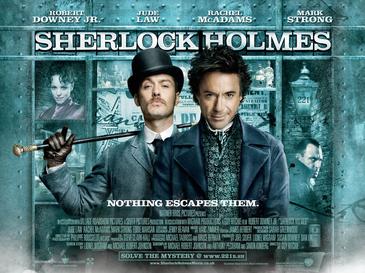
When this new Sherlock Holmes film first came around last Christmas, I had mixed feelings that ultimately kept me from seeing it in a cinema until now. I had great confidence that Robert Downey Jr would be fine in the lead, despite the alarming 80s hair he boasts in the promotional poster (thankfully not replicated in the film), but I frankly don’t care much for Guy Ritchie’s output; neither his choice of usual subjects (British gangland) or his particular directorial style (no more than 10 minutes till the next implausible action sequence) have ever sat well with me, though I’d be the first to admit the two generally go together successfully.
The trailer didn’t inspire me much, except to dare to hope that Jude Law (who plays Watson) would actually be good, something I’ve never managed to see happen before (including, most recently, in The Imaginarium of Doctor Parnassus). Holmes as a boxer? A dashing ladies man with all the right words? A Victorian London that appears to have a lot of explosions??
But one should never trust trailers. The actual film itself is, in my view, Ritchie’s most successful effort at being light-hearted, and while great liberties have been taken with the source, it is still identifiably Holmes and Watson, and makes for a solidly entertaining film that deservedly did well at the box office.
While the film is carried by the strong performance of Downey as Holmes, this is actually more Watson’s movie, a very wise move on the part of the screenwriters and director. Watson is often played (ever since Nigel Bruce ruined the part) as a bumbling fool whose only job is to provide narration and makes Holmes look good, but in this version we get something much closer to the Dr. Watson we met in the books and stories; a colleague who, after several years with Holmes, has picked up much of his power of observation, a foil who Holmes himself sees as the man he might have been, a faithful chronicler but not always so loyal a friend, often getting tricked or challenged into participating further.
Jude Law has, to my eyes, never ever been better than he is here. I have never much cared for him and find most of his performances wooden, underplayed and dull, but he clearly had a strong regard for Watson and a good chemistry with Downey, and hits exactly the right note.
As for Downey, his accent is (as Ritchie called it) “flawless” and his interpretation of the part is entirely suitable. If Doctor Who ever got made into a another big-screen movie and the current incumbent was unsuitable, Downey would be my second choice — his entire performance here might as well be one long audition piece for The Doctor. Though he lost some weight for the role to get into fighting trim, I still don’t see him as quite physically right for the role — Holmes was a wastrel in many ways, and the usual consequence of such addictions is a gauntness Downey just doesn’t possess. But he’s more than adequate in the part and apart from some occasional mumbled lines (usually spoken too quickly to be heard clearly), he provides the necessary mix of gentlemanly bearing with mischievous misanthropy, adding style and wit, particularly to his relationship with Inspector LeStrade (Eddie Marsan).
The plot is scarcely worth mentioning, in part because its not based on anything in the Conan Doyle canon and in part because apart from its overall raison d’etre — purporting to show the first meeting of Holmes with his later arch-enemy Professor Moriarty — it doesn’t matter really. The mystery is lovely and atmospheric and, as we know full well going into this, fully solved by the end. The supporting players are equally trivial to the point of the film, which is to showcase the complex relationship of Holmes and Watson. The whole film is actually structured more a Dan Brown runaround (such as The DaVinci Code) than a proper Holmes tale, for example eschewing the traditional “told after the fact” narrative angle and omitting the also-traditional part where a visitor to Baker Street sets up the entire background, one of Doyle’s most common literary devices. But it’s all been cast aside so that we may spend more time in the present moment with Holmes and Watson and watch their bromance take its roller-coaster ride through some very scenic set pieces.
Instead of all that drawing-room chat, we are dropped right into the thick of things, with Holmes and Watson stopping the ritual murder of a young girl by occult leader Lord Blackwood (bit of an in-joke, that name), played by Mark Strong. Blackwood tries his best to convince Holmes of the existence of the supernatural, even returning from the dead after three days (it’s been done), but Holmes is having none of it. Methodically and (as usual) against time and obstacles both external and internal, he unfolds the mystery and (along with the help of Rachel McAdams as an American former lover and jewel thief) saves the day.
London is of course a great place to shoot a Victorian mystery as its quite easy to use current locations with a minimum of dressing. The problem with Ritchie is that he has no concept of the word “minimum” — sets are usually over-dressed and dwelled on more than the actors. Some scenes appear to be chosen purely for their visual value rather than any practical meaning; a prolonged fight scene with Holmes bare-knuckle boxing a larger fellow exists ostensibly to show his ability to calculate his victory over an opponent, but this exact same ability was showcased in the first scene of the film — so this repeated scene is merely an excuse to show the same thing, only this time with Downey’s shirt off.
In another example, being chased by a giant French henchman (Fre-henchman?), the action allows for a large vessel to be loosed from its moorings and fall into the Thames, where it sinks entirely out of sight. The Thames, at its absolute deepest point and highest tide, wouldn’t be quite 20 metres (the spirit of Conan Doyle was notably absent during the “logical sequence of events” part of writing this screenplay). Not only that, the boat slipping from its drydock is entirely unnecessary and adds neither atmosphere nor content to the story.
The big climatic fight on the top of the still-being-built Tower Bridge was probably enjoyable to mainstream moviegoers but struck me as very unrealistic, breaking my suspension of disbelief by being so obviously green-screened. It’s no accident that it’s the only really “talky” part of the movie, the part where Holmes explains to the villain (as though he didn’t know) — and the audience — all the ways in which he’d rigged his “supernatural” tricks. I guess Richie can’t abide the idea of people just explaining things without visual drama all around them. At least he confined himself to only one huge explosion this time.
For a “Hollywood” movie (albeit shot in England), Sherlock Holmes is generally very successful at making the character more appealing to modern (read: less entertained by displays of cleverness) audiences; as a movie its good fun and I’m not surprised that the estate of Sir Conan Doyle gave its blessing, despite it being an original story. The choice of a “supernatural” villain was both genre-appropriate and created a nice contrast of styles. Hans Zimmer’s soundtrack makes use of authentic sounds and even a few period songs alongside the usual “action” soundtrack requirements, so I’d rate it above average. The editing was, as is typical of a Guy Ritchie production, rather slapshot and trendy. Like the sets, it felt overworked at times. One fears for Mr Ritchie’s ability to stay focused for any lengthy periods of time.
This interpretation of Holmes may not go down as a classic, but its well worth your ticket or rental money, features a surprisingly strong pair of leads, and preserves the colour, charm and brains of the enigmatic Sherlock Holmes. Despite the sometimes ill-fitting choice of director, I’d say this is about as good a Sherlock Holmes movie as you could possibly hope for out of a mainstream US studio.
Director: Wes Anderson Stars: George Clooney, Meryl Streep, Owen Wilson, Bill Murray Running Time: 87 minutes
Wes Anderson’s films are very hit-and-miss with me, in part because he tries very hard not to make the same movie over and over, for which I thank him. I’m always a little amazed at how generally well his films do considering they have a distinctly “indie/art house” air to them; he’s the kid who somehow gets to make largely uncompromised movies on the studio’s dime, never having a megahit but always paying off the investors sufficiently that he gets to make another one. In some ways, he’s this generation’s Woody Allen.
So I have my reasons for wanting to like what I see from him, and by and large I have — although he’s very rarely moved me to be terribly enthusiastic. Such is also the case with his latest movie, Fantastic Mr. Fox — or as I call it, Not At All Bad Mr. Fox. I enjoyed it, not least because it certainly doesn’t look like any other movie on the screen this year — but it didn’t thrill me all that much, and I was a little disappointed to find the well-remembered Roald Dahl book quite tinkered with.
Still, it’s important to remember that I’m not the target audience for this — it’s a kid’s movie based on a kid’s book, and on that level I think the film works pretty well. I hope it inspires kids to read more Roald Dahl. The all-hand-done, stop-motion animation is a really nice change from the surplus of 3-D computer animation we’ve gotten, and although it uses the same technique as the Wallace & Gromit series it does have a distinct look and “feel” (what Ebert would call “texture”). The story works out pretty well despite Anderson’s (unnecessary) addition of a sub-plot and character that don’t end up making a big impression. As a children’s movie, I can recommend it at least as much as the book.
I can’t help but be disappointed by two key decisions, the first of which I’ve already alluded to: Anderson’s decision to (literally) wedge in a “young men who are rivals then bond” subplot that doesn’t actually go anywhere unexpected and seems to exist solely to “mark his territory” in the movie. The second mistake (in my opinion) was casting George Clooney as the lead. Certainly Mr. Fox is a smug sonofabitch and Clooney is terribly good at playing that sort of character, but there’s a reason why Mr. Clooney isn’t constantly swamped with voice work: it’s because he’s not a voice actor. A voice actor is someone who has great range in his voice and can hide, exaggerate his audible personality and usual range with aplomb. Clooney either can’t do this or was directed not to, which means you spend the entire movie looking at Mr. Fox but hearing (very obviously) George Clooney, which hurts the suspension of disbelief.
By contrast, Meryl Streep (who plays Mrs. Fox) is unrecognisable till the end credits (in part because the role is rather beneath her, quite frankly), as is Willem Dafoe. Even Owen Wilson, who sports a pretty recognisable voice and is of course to be expected to appear in every Wes Anderson film any more, manages to inject some actual character into his role. Not George — he just puts on that smug tone he employs in every Oceans movie and phones it in from there.
The aforementioned subplot is Anderson’s weakness — he just has to find a way to stick in some non-conformist dork character who refuses to stop being a odd little twerp, but at the exact same time longs to be accepted by the mainstream. To give Mr. Fox’s son Ash that title, it was necessary to invent a foil who starts off as a rival but then ends up as a friend, thus the invention of Ash’s “cousin” Kristofferson (what an original name!). Kristofferson is “acceptably odd” with his meditation and his quiet nature, versus Ash’s “unacceptable” lack of physicality and grace (bad qualities for a fox, I’m sure you’ll agree). Everyone else in the film is endearingly (but acceptably!) odd as well, except strangely enough for Mrs. Fox, an artist who just comes off stupid and rather gullible in the film.
The film diverges from the book in an number of important ways, some sensible and some insensible. In the movie, Mr. Fox is an expert thief who steals (primarily) chickens and such from the three local farmers just for the fun of it. In the book, he does this to feed his family (as every fox does). In the book, Mr. Fox has four children; in the movie, his “reformation” from a chicken thief to a newspaper columnist (who presumably now pays for food? It’s never explained) is brought on by a close escape and the revelation that his wife is pregnant (with their one son Ash).
Twelve years later (in fox years, a delightful invention that pops up periodically), Ash is feeling his oats again and conspires with the super of his tree-home, the opossum Kylie to start pulling heists of chicken, ducks, geese, turkeys and alcoholic cider. Mrs. Fox is extremely slow to notice. Mr. Fox’s thefts lead to a war of attrition with the mean old farmers, who use increasingly strong methods to try and flush Mr. Fox out, displacing all the other animals in the nearby land. Eventually, the Fox family as well as the the Badgers, rats and other animals are forced very far underground and are in danger of starving. Amazingly, the animals (including most incredibly Mrs. Fox) get only mildly annoyed with Mr. Fox for getting them all into this mess when everything was perfectly fine before by nothing more than his sheer avarice and lack of willpower. He is quickly forgiven, however, when he comes up with a plan to dig into the farmers’ storehouses while they are distracted by trying to flush him out.
From here, the rest of the film is largely a Roadrunner cartoon in stop-motion; the farmers try something, Fox miraculously figures out a way to outsmart them. Repeat. Lather. Rinse. Repeat. In the book, Mr. Fox takes some responsibility for his actions, and his plans are borne of a sense of guilt about what has happened to the other animals while he was just trying to feed his own family. In the film, you never get that; you get instead an arrogant prick with no real willpower who takes more than he needs, gets into entirely predictable trouble, but manages to weasel (heh) his way out of one self-created jam after another, aided by enabling co-dependents. I was almost rooting for the farmers by the end of it …
I read somewhere that during pre-production, Henry Selick (James and the Giant Peach, Nightmare Before Christmas, Coraline) was going to be involved, and you have to wonder how that would have turned out, but in some way the art direction on this (done without him) is one of the things that really shines; a few scenes don’t quite “look right,” but that’s part of the charm of hand-made stop-motion.
In 10 or 20 years when nobody remembers George Clooney, this film will be seen for what it actually is; a charming, perhaps a little sloppy, but ultimately human adaptation of Dahl’s story of “wild animals” in a refreshing style that’s enjoyed by children (there were a fair number of laughs at the screening I went to, which had a healthy kid contingent).
At the moment, however, (particularly with Clooney being in every third film out in 2009), the film seems more like an animated version of that funny Captain Kirk “motivational poster” going around the net that says “I’m sorry, I can’t hear you over the sound of how awesome I am.” I can’t help but think that sticking a little closer to the book and using a better vocal actor for Mr. Fox would have made the film a classic.

 After the nadir of Never Let Me Down (which let everyone down) and the diverting-but-just-not-right Tin Machine experiment (1989-1991), Bowie seemed to start finding his way back to the 50s-influenced-but-artrock-filtered niche he excelled at. By the time he got to Hours (1999), he was back on track — though no longer the cutting edge of art-rock, more a follower. But he had regained his vision and spent much of the next eight years honing it with a great band and more enjoyable albums that contained at least enough fine songs to be worth the purchase.




 The Chasbah