The 1st Annual (Almost) Totally Blind Oscar™ Predictions!

POST-AWARDS UPDATE: Well that went well … I finished the evening with a 12-4 record, my best ever score. Turns out you can predict the Oscars by just watching the machinations of the hype machine! And here I’ve been wasting all this time actually watching the films. Lesson learned! 🙂

I’m actually shocked at how few films I’ve seen this year, but my usual film employer spent the last few months being bought and then rebuilding, so I didn’t get to see my usual 50-70 or so movies this year (unless you count Turner Classic Movies!). I did go out and see some films in cinema that personally interested me, but by that count this was an off year; there are some films out now that I would like to take in (and probably will over time), but very few I absolutely had to see. Of the nominees listed, I actually did see Up, Julie & Julia, Star Trek, The Imaginarium of Dr. Parnassus, and Harry Potter and the Half-Blood Prince.

Thus, I’m in a good position to make Academy Award predictions, because I can go by almost nothing but the hype. I’m not even going to read Ebert’s predictions this year. I feel this frees me from the slavery of actually having to watch these films, at least some of which I might not enjoy, and allows me to discover the zen of pure movie criticism. I learned that from Helmut Spargle.

So, with a few measly drops of LSD and my critic’s intuition, I’ll stake my claims today, and find out how well I did tomorrow. Glory or shame will be mine!

Original Song: “The Weary Kind” from Crazy Heart. Because Hollywood wants you to know they love country music too. Yeah right.

Original Score: I will be pulling for Michael Giacchino for Up, but I actually think it will go to Avatar (James Horner). Nope, Giacchino won. I’m happy to be wrong on this one.

Sound Editing: This will be The Hurt Locker’s first of many Oscars.

Sound Mixing: I actually think Star Trek should get this one, as this is one area where I thought the film hung together (since it didn’t in terms of plot, continuity, direction or design …), but it will probably go to Avatar. Got it for sound editing, missed it for this one, it was The Hurt Locker again. Riff-Raff lookin’ good!

Cinematography: My bet is on Avatar for this one, which is a shame because computer-generated pictures shouldn’t be eligible for cinematography awards. It really ought to go to Inglorious Basterds.

Art Direction: Unless the Academy is feeling extraordinarily ornery, this will go to Avatar as well.

Animated Feature Film: For no reason I can make out, the Academy hates Pixar (probably because they are a clique), nevertheless I will be like Charlie Brown and kick the ball for Pixar’s Up. But if I’m right about the Academy, expect it to go to Fantastic Mr. Fox.

Original Screenplay: Well, Tarentino’s out of this one, since Inglorious Basterds is about as original as an episode of Hogan’s Heroes; Up won’t get it because the Academy hates Pixar; and The Hurt Locker won’t get it because there have been charges that the story is stolen. That leaves  The Messenger and A Serious Man. From what little I know of these two films, I’m going with the Coen Brothers on this one. Dang it, missed this one. It was The Hurt Locker yet again.

Adapted Screenplay: Precious. That is all.

Foreign Language Film: Based completely on wild-assed guessing, I’ll pick The White Ribbon (Germany). Nope, it was the Argentinian film El Secreto de sus Ono.

Directing: Kathryn Bigelow for The Hurt Locker, though perhaps we’ll get an upset win with Lee Daniels for Precious — he certainly seems to be able to pull performances out of actors that other directors can’t get.

Supporting Actress: Mo’nique, Precious.

Supporting Actor: It’s between Christopher Plummer for The Last Station and Christoph Waltz for Inglorious Basterds. I’ll be rooting for Plummer, but my gut says headline writers everywhere have already got it: “Christoph WALTZES Away With Award,” har-de-har-har.

Actress: I would love to see a total newcomer like Carey Mulligan or Gabourney Sidibe win it, but nah, it’ll be either Meryl Streep or Sandra Bullock. My guess: Sandra, even though Streep was actually much better. I personally thought Julie & Julia was awful (well, the Julie part anyway), but Streep was absolutely amazing as Julia Child, whereas Sandra Bullock is being rewarded for taking a risk outside her comfort zone (but wasn’t actually at all convincing IMHO). If Gabourney Sidibe pulls an upset, that will be the big story of the night.

Actor: I actually think Jeff Bridges could pull an surprise here.

Best Picture: Everyone thinks it will be The Hurt Locker, and they’re probably right, but I’m going with Precious for the upset. I was half-right on this, so I’m counting it. 🙂

Whether I’m right, wrong or somewhere in-between, I will say this: 2009 was a good year for variety of stories in movies, even if a number of them weren’t to my taste. I can think of many years where the nominees for Best Picture were mostly dramas with a token comedy, but this year we have a real buffet of styles and stories to choose from. I’m also seeing a pleasing trend back towards what I’ll call “sophisticated adult fare” like Up in the Air, An Education, A Serious Man and A Single Man (among others).

And in my world, the first 10 minutes of Up would receive a special award for Perfection in Computer Animation — that sequence is a summation of every element of a film coming together.

Movies For (Film) Lovers

(This guest article I wrote is reprinted with permission from Liz Langley’s “Lust Never Sleeps,” an excellent but NSFW blog on all things erotic. Highly recommended.)

The films you saw at the early stages of your romantic life can have an enormous impact on your perceptions of love, the opposite sex, and life in general. Further, because most people tend to see movies on the big screen only once — those thoughts and impressions and visual memories work their way deeper into our subconscious than something we can see on-demand any old time via the cable box or the internets.

Thanks to a local art-house cinema in my youth, my fantasy love life was longer and much richer than my actual love life for quite some little while, but I used that time learning from the Masters of Romance, from Rudolph Valentino to Errol Flynn. The main thing I learned from them is that their pick-up lines don’t work as well if you’re not as rich or good-looking — or living in the 1940s.

Sexually-charged scenes always made an impact on me and the first I can recall was in Zefferelli’s 1968 Romeo & Juliet when the sun rose and the lovers gently bickered about the nightingale and the lark. It wasn’t just the nudity, I had seen that before — there was a beauty and a tender emotional connection, between the lovers and between them and us — that a movie hadn’t given me before. To this day, I get dreamy-eyed just thinking about this film.

Around that time I snuck into a showing of Fellini’s Satyricon and received a mind-blowing vicarious thrill of teen love and decadent lust that fueled a powerful fire indeed, one that drove me to accelerate my indoctrination into the forbidden worlds of adult pleasures. I happened to catch The Rocky Horror Picture Show on its earliest “cult” runs and recall vividly how Frank N. Furter — particularly in the scene where he disguises himself and seduces both Brad <and Janet — took my notions of “normal” and traditional sexual roles and blew them as sky-high as that spaceship mansion of theirs (it’s the sheer curtain that really does it for me).

Blue balls from unsatisfied lust has nothing on the pain of a pure and broken heart, and as I transitioned away from the raw thrills of sexually-charged films, I found (no doubt due in part to the early influence of Romeo & Juliet) that sad films often produced the most romantic feelings, as tragedy often reminds you of the importance of appreciating what you have when you have it. Films such as The Elephant Man and Requiem for a Dream, The Very Long Engagement or In America have all those elements — but most to be honest, most romances are trumped by the first 10 minutes of Pixar’s Up; that such a charming, effective and utterly perfect portrait of love and loss and everything that is important about life should be the preamble of a children’s “wacky misadventure” type movie makes it all the more amazing.

It still must be said that if you made a movie of my love life it could only be a comedy. The romantic bits of Monty Python’s Life of Brian come to mind: I’m not the Messiah, I’m a very naughty boy!

One type of movie I can’t recommend if you’re serious about making Valentine’s Day something special is the so-called “Romantic Comedy.” There are a few good ones, certainly — but as a whole, the genre is pretty swamped with Lifetime-esque cliche and unsatisfying junk. I suggest – as always – that you dig up movies with genuine emotion as much as wits or tits. A shared laugh is an often-overlooked but insanely powerful bonding agent. For all the yuks and sight gags, Airplane! is actually a really sweet love story. Young Frankenstein has nothing but love at its heart when you think about it. Still, my favourite commedia di amore is a classic in the “war between the sexes” genre – combining sagacity and sexuality, mischief and misdirection, exotic locations and erotic elocution; songs and words and deeds in praise of a love based on genuine friendship – 1993’s Much Ado About Nothing. Indeed, it was the theme of my wedding.

So give up that Ghost DVD and pass the porn on to your bachelor buddy – for true love, the play is the thing.

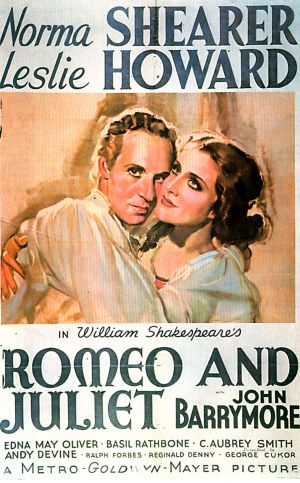
Romeo & Juliet (1936)

Director: George Cukor
Starring: Leslie Howard, Norma Shearer, John Barrymore
Running time: 126 minutes

One of my favourite movies of all time is the 1968 Franco Zefferelli version of Romeo & Juliet.

Today on TCM (February is always a great month to watch, it’s all Oscar winners all month long), they ran the 1936 version of the classic story. Having not seen it, and being interested in some of the cast — Basil Rathbone as Tybalt, John Barrymore as Mercutio (a role I have played myself), Leslie Howard and Norma Shearer in the title roles etc. — I gave it a whirl.

Not as good. Appalling by today’s standards, in fact.

In large part this is due to how old the leads were at the time — in 1936 it was probably considered immodest to actually cast young adults in teenage roles — but Leslie Howard was 43 YEARS OLD playing Romeo (Shearer was 34!). Most of the rest of the company were equally far too old to be in their parts, with the curious exception of the actors playing actual old people (!).

Throw in some truly diabolical overacting by 54 YEAR OLD John Barrymore as Mercutio (admittedly I’m biased), Edna May Oliver as Juliet’s nurse and a completely unwatchable “performance” by Andy Devine as the lummox Peter (idiot servant of Capulet), and even the rest of the production (some parts of which are actually quite excellent) becomes quite unbelievable. Did I mention the awkward male leotards with their Scottish-esque sporrans, by the way?

The American accents in most of the cast don’t help much either … I think we all know that if Shakespeare set the play in Verona Italy, he meant it to be performed in the the King’s English! Hmph and all that! 🙂

The movie isn’t worthless by any means — obviously we’re still talking the beautiful rhyming language of Shakespeare here (except when Andy Devine is speaking), and director Cukor (who went on to do many outstanding films) does good work overall, particularly in the larger scenes (the street fight between the families, the soirée where Romeo first lays eyes on Juliet and so on), and despite their great age Howard and Shearer do the roles justice, but still — a Romeo with a receding hairline is pretty hard to get past.

Some have said that Barrymore was deliberately playing Mercutio as an older guy who just won’t grow up (or, more cynically, likes to hang out with young men), but I’m not buying it. He’s a comic character, yes — but comparing Barrymore’s campiness to Reginald Denny’s much more finely-judged Benvolio shows off which of the two is the better actor, at least in this movie.

The sets, costumes and score are all excellent, but I have to admit that even as big a fan of B&W movies as I am, the story of Romeo and Juliet demands so much passion and exuberance to pull off all that flowery language that the movie not being in colour hurts it (in my eyes, particularly since I’m so enamoured of the 1968 version). Not only that, but the film is very “stagey” rather than naturalistic, which in 1936 might have been perfectly acceptable but looks terribly stiff today.

If you can get past The World’s Oldest Teenagers as the leads, there is obviously more than enough here to commend a viewing of the film if for no other reason than to compare it to the many other versions out there. Basil Rathbone as Tybalt in particular is easily the best version of the character of any film version in my opinion — he’s just flatly terrific in the role of an eager young buck spoiling for a fight, and completely dominates every scene he’s in. But Shearer, despite a fine performance, didn’t get the role based solely on her talents — she was the wife of producer Irving Thalberg, and it was perhaps her casting that made it necessary to make Romeo so old (etc).

Fundamentally flawed in a modern context but still based on what is arguably one of Shakespeare’s most universally-appealing stories (since he nicked it from Tristan & Isolde), this version is lavish and beautiful to watch — but it’s fairly bit hard to listen to.

The Maltese Falcon (1941)

Director: John Huston
Stars: Humphrey Bogart, Mary Astor, Peter Lorre, Sidney Greenstreet
Written By: Dashiell Hammett and John Huston

I recently got to see this film again for the first time in many years at the CineCenta theatre with a near-capacity crowd. Watching old movies — particularly familiar classics — takes on a lot of new meaning when you have a crowd, a fine print, excellent sound and such a big screen. Changes the whole dynamic.

When people refer to “film noir,” this is one of the archetypes of that whole genre. Many people today believe it refers to crime films taking place largely at night, but it actually has less to do with the stylised B&W look and a lot more to do with characters who have ambiguous motivations, secrets, and sexual agendas (well downplayed thanks to the Hays Office, but represented in other ways).

Bogart’s character Sam Spade is the perfect example: he’s in business with his partner Miles Archer but doesn’t like him, and at some point in the past was seeing Archer’s wife (though he has since lost interest). He doesn’t mourn Archer’s death when it happens, but he gives up a promising love affair to see his murderer brought to justice. He plays both sides of the law like a hopscotch court, alternately cooperating with then abusing the local police; and he admits that money sways him, although he (barely) ends up the hero. “Hard-boiled” is too weak a description for this guy: he drinks and smokes like a fiend, is blatantly greedy, is abusive to the people who are the most help to him, and his moral compass swings around like its at the North Pole.

The colourful supporting characters, and Bogart’s interaction with them, is what really holds the film together and why this version (and not the two previous film versions) is so well-remembered. Although each character (but one) is a delight, it’s Bogart deftly adapting to each one that is the real magic: Sam Spade is a consummate judge of character, knowing exactly how far he can push each person till they give.

Of course, this is the long-gone world of the early 1940s, and the interaction of characters as seen now gave for many moments of laughter as Spade steamrollers his devoted Miss Moneypenny secretary, smacks Peter Lorre around and tells him he’ll like it, intimidates the hapless police and brushes off Archer’s now-available widow in favour of the more dangerous Brigid O’Shaughnessy, among others. The laughter came naturally from a combination of awareness at how social morés had changed, along with the sharply written and rapid-fire banter. There’s a lot of really good lines in this film.

It doesn’t hurt that the movie is well-stocked with a diverse range of well-drawn characters, from the relentlessly civilised crime boss Kasper Gutman (Sidney Greenstreet) to the rage-filled gunsel (that term used quite deliberately it would seem) Wilmer Cook (Elisha Cook Jr) to Peter Lorre’s unforgettable clever weasel, Joel Cairo. Even Spade’s office moll Effie (Lee Patrick), forever to become a caricatured stereotype in later films, projects a lot of heart into what we would today call a hopeless enabler. The only person really miscast in my view was Mary Astor, trying too hard to match Bogey’s machine-gun delivery until in some scenes it resembles an episode of Dragnet, and carrying off an Irish immigrant grifter about as well as Queen Elizabeth would have. She’s too stiff and too upper-class to really pull off the constant turns of softness and hardness the character needs, alternating from victim to gangster in a flash. Astor is just naturally glamourous and while some of that is called for, it never cracks enough for us to see if there’s anything underneath.

First-time (at the time) director Huston makes up for his inexperience by cleverly planning out every sequence and shooting almost totally in chronological order, making it easy for the actors to keep their performances consistent and keeping the crew on high efficiency (almost no dialogue was cut from the raw footage to the final edit). There are still short bits where the story gets into a bit of a muddle, but overall this is a very sharply-directed film.

There are several long sequences that appear to have been shot in a single take, including the finale which is over seven minutes of uninterrupted single camera angle, but my own favourite scene in the protracted struggle between Spade and Cairo in Spade’s office; motivations and fortunes change several times in the course of a five minute scene, with brilliant dialogue as punchy as the violence. Indeed, The Maltese Falcon is a far less violent film than you would expect; ultimately only two people actually die, and one of those is off a character who never actually appears in the film.

The elaborate plot unfolds rather deliciously, with the viewer led on a number of false starts; this is still a refreshing change from the hamfisted spell-it-all-out-complete-with-flashbacks approach too many modern mysteries indulge in. With almost all of the characters, there’s so much we’ve clearly not been told that could flesh them out, but instead Hammett and Huston leave them as they are, and we accept them as they are — even though we’d love to know more. We get enough of their essential personas to let our imaginations fill in the gaps, and the sexual innuendo and tension laid on thick thanks to the censorship of the times actually helps give these characters more mystery than they would have had otherwise.

I was particularly re-impressed (as I always am) with the various scenes of Spade’s love/hate relationship with the police; there were gasps from the audience during moments where Spade takes command and browbeats the fuzz into submission, not once but several times.

Music, sound effects, incidental characters and establishing shots are similarly concise and economical, letting the characters and dialogue have the day over much action or violence — all in service to the story, which is how it ought to be for a movie like this.

Despite some now-unintentional comedy due to the customs of the day, the tale and particularly its players bring a still-modern sense of complexity and ambiguity to their parts that still works to keep our interest; its only in the climax of the film that we finally find out of Bogart is going to sacrifice all for love, fall in with the villains or — as it turns out — find a nifty third way out of the whole mess.

Well-cast, well-played, shot in a workmanlike style and directed with great economy of tone, memorable characters and a multi-level story make The Maltese Falcon not just the first, but one of the best, of a just-minted genre. Guys should take their dolls out to this one; it’s not only a classic, it’s a San Francisco Treat.

The Imaginarium of Doctor Parnassus (2009)

Director: Terry Gilliam
Stars: Heath Ledger, Christopher Plummer, Tom Waits, Lily Cole
Written By: Terry Gilliam & Charles McKeown

Despite the rich visual imagination of Terry Gilliam and an all-star cast that mostly turns in good work, The Imaginarium of Doctor Parnassus collapses a lot like the rag-tag stage show the doctor puts on, mainly due to some pretty woeful character development — or more accurately, none at all. If a good movie is a satisfying meal, then this film is a box of chocolates — decadent and delicious, certainly, but fulfilling? Not so much.

As I sat watching this, I kept thinking “gad, what I’d give to have Gilliam handle a Harry Potter movie!” Without doubt it would be the one that audiences hated and critics treasured forever, that would smash and burn the franchise in the most luxurious manner possible. Ah well.

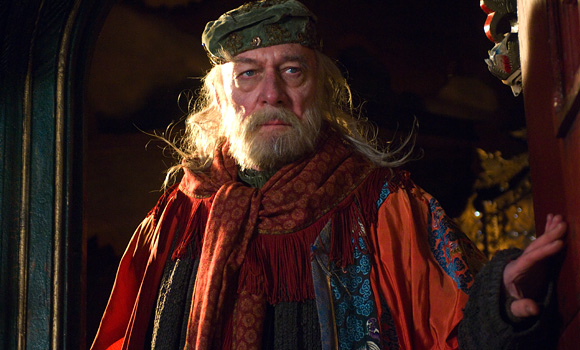
Among the many things to like in this movie are the visuals (even the CGI), the humour (which is curiously thin), the casting (most everyone brings their best, or in Colin Farrell’s case, the best he can do) and the moral dimensions to the story. Christopher Plummer as a drunken Dumbledore, Heath Ledger doing his best Johnny Depp impersonation (which Depp later has to recreate!), Tom Waits as a surprisingly believable and effective Old Scratch, Lily Cole as a ravishing bit of jailbait, and (to my great surprise) the best non-silent performance from Verne Troyer on record.

The plot opens up brilliantly; a bunch of drunken louts in London tease and torture the travelling gypsy show Doctor Parnassus puts on. One of them falls inside his magical mirror and is transported to (singing) “A World of Pure Imagination.” Not the last Willie Wonka reference you’ll get in this review, I should hasten to add. He is presented with a moral dilemma, chooses unwisely and pays the price. A fantastic setup.

Following this is about 90 minutes of patchy mish-mash that is at least very easy on the eye. As a tale about the choices we make and their consequences, Parnassus succeeds. As a film in which Heath Ledger turns in his final performance, I think he largely succeeds (which is to say he does a good job with the character, no career-changing high like Dark Knight and his accents is shall we say a bit dodgy in places but he holds the audience). But despite having the same team that gave us the brilliant morality of Brazil, and the same visual feast (better, in some ways) that made Munchausen so extraordinary (and to which this film is a definite kin), this one has a fatal weakness; key characters that are poorly-drawn and fail to bring the audience along with them.

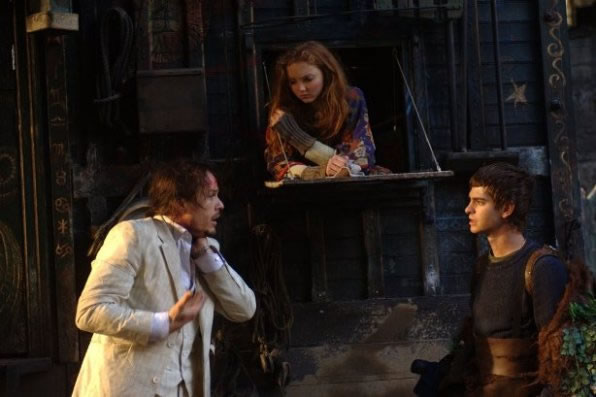
The biggest failure in Parnassus is the character of Anton, a fellow player who seems utterly incapable of holding on to the same emotion for more than 10 seconds. I’ve seen the actor (Andrew Garfield) in other things and know this isn’t on his shoulders; the blame falls squarely on the screenplay. Garfield flails around as an indecisive pussy most of the time, first rescuing Ledger’s character (Tony) from certain death, then torturing him as a romantic rival, then befriending him, then hating him out of jealousy, then exposing his true character, but then … quite ridiculously … failing to be any sort of hero, and yet he gets the girl for completely unexplained reasons. You just never do understand why he reacts the way he does, where he’s “coming from,” or the motivation behind his countless mood shifts. He’s just fabulously wishy-washy and indecisive, but not played for laughs as he should be, making him unloveable to the viewer.

Tony himself is not a very clear-cut character, but at least it feels like that aspect is more deliberate with him. Did Tony ever have amnesia? Why is he so accepting of the bizarre (real) world he finds himself in with this odd company of players? Is he his own man or an agent of the devil? As they might say on Coronation Street, “what’s his game?” Even his backstory unravels in uneven layers, leaving the final revelations about his past as something of a damp squid that fails to be meaningful as it could easily have been. Tony also fails at being the hero, even when he tries, leaving the plot with a resolution, but not really an ending.

Plummer, Waits, Troyer and (surprisingly) Cole all just waltz right through it beautifully; if the film had really focussed on Parnassus — this dusty, broken shadow of Prospero — and relegated Tony to the obligatory “rogue who redeems himself as a hero in the end,” this movie would have worked. Instead, nobody really wins at all. The movie is ostensibly about Plummer’s interaction with Waits’ Satan, with Troyer’s Percy acting as a (conscience? An angel?) foil to Parnassus, and his daughter Valentina being literally made love to by the camera. These four were actually enough to make the movie work, in the same way that Lord of the Rings is richer for the hobbits and Gollum, but really its about Gandalf versus Sauron (via Saruman). Another failure of the film: if Tony and Anton would have formed a genuine triangle for the love of Valentina, we’d again have had ourselves a movie. No such luck. No wonder she wants to run away.

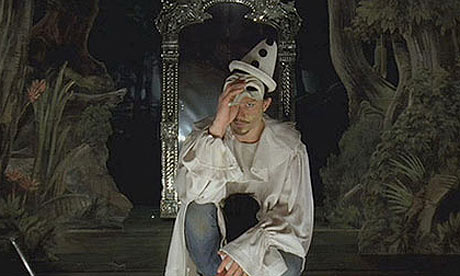
The effects, particularly early on, are pure Gilliam, inching ever closer to achieving digitally what his drawings have always reached for, a bright surrealism that blends Dali with Hello, Dolly!. The pinnacle of the “mirror world” is actually a nearly effects-less surprise music number that serves no purpose but is nevertheless purely joyful. Still, it only rarely rises above Tim Burton’s remarkably similar-looking work in his recent Willy Wonka (and forthcoming Alice in Wonderland). Gilliam’s films are famous for showing every dollar on screen, but this one also shows the pain of a sharply reduced $45M budget, which is just plain inadequate for a film of this scope — but these days its the best he can get. It may be (literally) a million times more money than he had to work with at the BBC, but he has simply lost the ability to care about anything smaller-scale than “beyond epic.”

Most other reviews will fixate on the swapping out of Tony with other actors for the “inside the mirror” scenes. Given that Tony ultimately makes little contribution to the story, it hardly matters — but for the record, Depp was quite good (given that Ledger was basically imitating him in the first place), Jude Law nearly pulls it off, and Colin Farrell is, as always, completely unwatchably awful. I would dearly love to shoot him in the face and have done with him, and he only reinforces that malice here by never making the slightest attempt to pretend he is playing a role also played by Heath Ledger (who I’m not a big fan of either, for the record) and thus trying to make his performance compatible with his. Seriously, I would love to shoot him in the face.

Perhaps the real problem is the meta-story most people seem to miss, that Parnassus is a thinly-veiled Gilliam doppelganger, a man with fantastic stories of rich imagination to tell who has tremendous difficulty finding an audience (handled so much less obviously in Munchausen), a relic of the old ways who refuses to change his beliefs in light of obvious evidence who revels in arcane minutia while the rest of us are busy shopping and texting. On this level, Parnassus comes off bitter, and Gilliam’s deliberate refusal to make the supporting characters support anything or adhere to the basic lines of archetypes all of human storytelling is built on can be seen as a kind of sad, ineffectual rage against both the corporate film-making profession and the rut of a “normal” life that everybody but him, he seems to think, crave to distraction. This film certainly brings into sharper focus why Gilliam is obsessed with colourful eccentrics like Don Quixote.

Ah, but I’ve made it sound like you shouldn’t see this film. On the contrary, it’s one of the best films of the entire year (honest!). Even unsatisfying, deeply bitter, under-budgeted Gilliam is better than most movies, and apart from Up this probably ranks as the most visually delightful film of 2009. There are many other films that have one element that utterly fails like this one does — it’s just that, because it’s Gilliam, we expect more. This one promises much but fails to fully deliver, which is almost worst than no film at all from a talent like Terry. And he’s made worse than this — much worse, if you believe the critics — but like an alcoholic’s empowering wife, we keep excusing his failures by pointing to his (artistic) successes, we keep overlooking his lesser efforts because his best ones are in point of fact cinematic masterpieces. Parnassus, though, finally rips away some of the facade; some of Terry Gilliam’s misfires are genuinely due to external factors, but most of them are actually flaws of the man himself.

Because this is Ledger’s last bow, a lot of people who wouldn’t normally ever see a Gilliam film are going to take a chance on this. Most of them will walk away shrugging, convinced that he is on drugs as least as strong as whatever actually killed Ledger. Ironically, nothing could be further from the truth.

In a just world, the money we throw away on a piece of shit star vehicle based on some 80s toy should be given to Gilliam, for only thus can his avaricious muse be properly fed and nourished. Sadly, I think the reality that he’ll always lose out to the crap peddlers when it comes to money, to freedom, to resources has driven him mad — doomed to keep tilting at Hollywood windmills, even after everyone points out to him that Hollywood doesn’t have any windmills.

IMDB’s “Top 15 Movies This Millenium”

Harnessing the power of the omnimind (and perhaps a little groupthink), the Internet Movie Database compiled ratings on films made this century. Since their userbase is far more massive than the sample size used in most polls (and contains entirely self-selected film lovers), I do in fact give more weight to their choices than I would a poll produced using the usual methods, so I was happy to see it.

On the whole, I think the results are really quite strong. There is still a bias here, in that American users of IMDB outweigh users from other countries, so naturally the results favour US or English speaking movies, but apart from that inherent problem, I think you’ve got a good guide — broadly speaking — to some of the best films anyone’s actually heard of in the last nine years. Certainly this is a list of films I can recommend most people try and see. The only film on the list I myself haven’t seen is The Departed, since that genre’s not really my cuppa, but I’m willing to take the word of the assembly that it’s a winner.

But, inasmuch as I’m a critic, I have to pedantically point out that IMDB have made a dreadful error which I simply must correct; two of the entries are from the year 2000, and as such don’t qualify to be in a list of Best Films of the New Millenium, since as every calendar geek knows, the new millenium didn’t start until 2001. To be sure, Memento and Requiem for a Dream are very fine films indeed, but I’m nonetheless going to use their rightful omission as an occasion to throw in two films I think should be on the list, because they were made in this new century of ours.

Before we get to that, however, let’s look at what is properly on the list, and also what’s noticeable by its absence. For example, all three Lord of the Rings films made the cut, but not a single Harry Potter movie. Half the films Pixar has put out this decade are mentioned, but not a single Dreamwerks or non-Pixar Disney movie (no surprise to me, but might come as a shock to some). Some are on the list not because they’re great (though they are) so much as because they are recent (Wall•E is better than The Incredibles or Finding Nemo? The Departed is better than Gangs of New York or No Direction Home? The Dark Knight is better than everything else on the list? Sorry, don’t think so).

Kudos to the userbase, however, for the remarkable scope of the films they’ve picked. Light-hearted entertainment and big epics always do well in these sorts of round-ups (as evidenced by Pixar and LOTR, as well as The Dark Knight in the #1 slot — to be fair, Heath Ledger’s reinvention of the Joker turned out to be culture-changing moment, not just a great performance), but they went beyond that and chose some excellent foreign-language films like the intense drama The Lives of Others, the visual feast that is Amelie, and the Japanese anime film Spirited Away, none of which fit the mould of a Hollywood blockbuster. There’s also nods given to The Pianist and City of God, both high-quality films that didn’t get a huge audience during their theatrical run. And downright quirky but effective films were also given a shot; in addition to the aforementioned Amelie, we have The Eternal Sunshine of the Spotless Mind, which somehow did score significant box-office largely on the strength of word-of-mouth, the only way you can really explain a film like that to enough people to have it be a hit.

I certainly would have ranked these films in a different order, and changed a number of the choices to suit my own tastes, but I see no need to reinvent the wheel when a list comes out that actually gets it mostly right. My only real qualm is the complete lack of documentaries on the list, though admittedly a few of the films (The Lives of Others, City of God and The Pianist) kind of fulfill that role.

So, my first nomination to fill the two “holes” in the list is Fahrenheit 9/11 (2004), the top-grossing documentary of all time, first to win a non-specialty Oscar, first to win the Palm D’Or and so on and so forth. Building on the strength of the revolutionary Bowling for Columbine, Moore continues his exposé of the marriage of the corporate media and power politics, though I think most of the people who dismissed it thought it was just a personal vendetta against George W. Bush, the unelected president. But it wasn’t — Bush (being an idiot) merely tore down the curtain and revealed the ugly elitism behind it — that America (or at least the Republican part) had long ago given up fighting for a better tomorrow and had instead decided that raw, naked capitalism was the new science, sure to solve every problem with “truthiness” and that the public were just a herd to be managed, set against one another for the pleasures of the rich. Fiddles, Rome, you get the idea.

Moore’s documentaries are a call for the public to wake up and take (metaphorical) arms against leaders who no longer care about them, and yes he’s ultimately tilting at windmills — but like Quixote before him, Moore is at least engaged in a noble if ultimately futile battle. The film got the powerful (and their enablers) a little hot under the collar for a while, and while it’s about all Moore is able to accomplish, it was enough. He didn’t get Bush thrown out of office (Diebold saw to that), but he punctured the balloon of the administration’s infallibility myth and slowly let the air out, slowing (perhaps) America’s determined march to obsolescence and irrelevance. He woke a lot of people up.

Filling the first “gap” was easy, but filling the second one is difficult. Trying to pick just one film of the many, many (too many) I’ve seen over the past few years, even among the dozen or so I would call “the absolute best” of their years of release, you feel like you’re insulting the ones that you leave out.

So finally I came to the conclusion that the last spot should be filled with with a movie that gave me utter and absolute joy to be watching it. One such movie, Pixar’s Up (2009), is already on the list, and I thought long and hard about giving that spot to In America (2002), a completely moving and amazing take on the struggles of the immigrant that almost nobody reading this has seen. I thought about giving it to Monster (2003), a film who’s Florida-set tale is as unnerving as Charlize Theron’s performance, or to The Dreamers (2003), a fabulous erotic adventure that never dips into porn, never falls short of exquisite, and never fails to impress.

But, oh we really should give that spot to another documentary as they’re so criminally neglected amongst IMDB voters. What about Spellbound (2002), the utterly charming story of the drama within the National Spelling Bee (and which kicked off a whole wave of like-minded docs about our love affair with language)? Or perhaps An Inconvenient Truth (2006), the ultimate slideshow lecture that reinvented Al Gore and brought climate change to the mainstream? What about 49 Up (2005), the seventh entry in a series of documentaries chronicling the lives of a handful of British kids every seven years, presumably until death? It’s one of the greatest ideas for a film series ever, and it’s proven amazingly illuminating and … well, human as it’s gone along. What originally started as an experiment to see how soci-economic class influences your life has turned into a diary of change and growth, and a mirror of ourselves.

Finally, inspiration. I would give the sole remaining slot to a documentary, yes, but one that made me squeal with delight the whole time I was watching it. I was a young man in the late 1970s, and that was a good time to be such if I do say so myself. So when The King of Kong (2007) came out, the number of buttons in the pleasure centre of my brain that it pushed can only be surpassed by certain kinds of orgasms.

This incredible documentary, which detailed the life-or-death struggle of two arcade-game champions to be the biggest fish in an incredibly small and nerdy pond, was a vision of pitch-perfect fantasy made reality. The people involved — “new kid in town” Steve Wiebe (a dork name if ever there was one), “the champ who refuses to let go” and comically arch-villainish Billy Mitchell, plus the über-dork who built his own fantasy empire (and then proceeded to turn it into a tawdry soap opera) Walter Day are just too perfect to be real, but there they are. If there’s such a thing as the ultimate documentary, this might be it (at least for me). I’ll admit that I saw this on a triple-bill with Air Guitar Nation and If It Ain’t Stiff (about Stiff Records), so that was one of the greatest evenings of my life (while sitting down, anyway), but the fact that King of Kong went on to win actual honest-to-gosh mainstream distribution, cult status and became one of the few documentaries to make any money at the box office says that others of my generation saw it like I did.

Really, this exercise could have waited another year or so and become “Best Films of the Decade,” but I guess IMDB were eager to play with their new-found data-mining toy. But we’re just seeing the tip of the iceberg — again it should be stressed that ultimately the greatest purpose of the internet will be to redefine polling forever, giving us new and much more accurate insights about ourselves through the power of enormous sample sizes. Well, that and making porn ubiquitous, but you already knew about that part.

It’s undeniably fun to be at the beginning of a new century, though, if for no other reason than list-makers like IMDB and myself get to say that this or that thing is “the (blank) of the century!”, at least for a while. As far as you know, it’ll be true forever. 🙂

A Remarkable Bit of History

A hat tip to Roger Ebert, who pointed me to this delicious find on YouTube: a 10-minute colour (sort of) film of London from 1927, yes, 1927. They didn’t have sound, but at least one man had invented a process called BioColour (straining B&W film through red and green filters) to produce a painted colour look.

You might wish to pair this with some music (some have suggested that Stephen Baystead’s “The Long Road” repeated to fill the full time works well), but if you’ve ever been to London you will be surprised at how little the city really has changed:

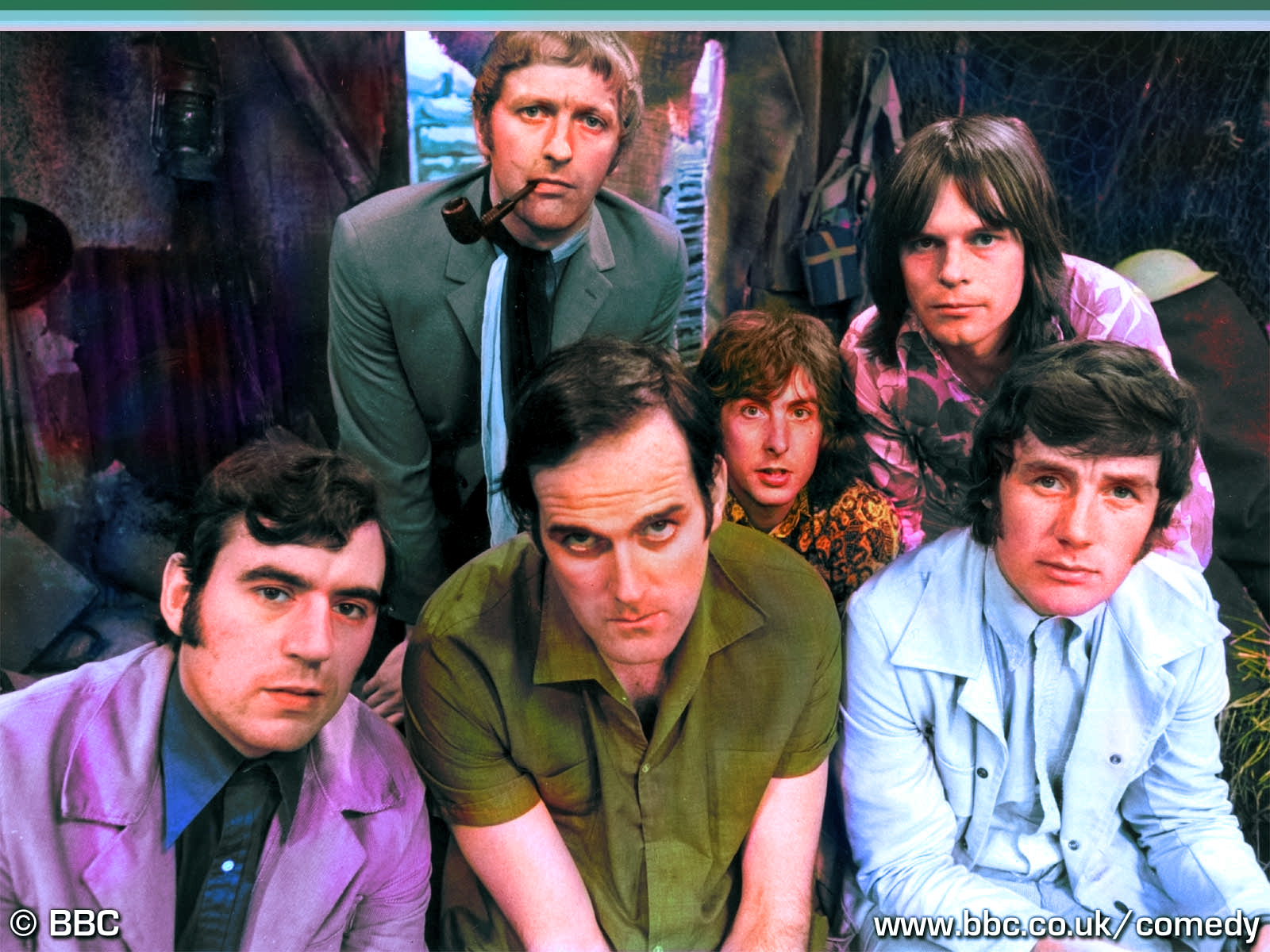
Monty Python: Almost the Truth(The Lawyer’s Theatrical Cut-Down Version) (2009)

Running Time: 107 min.
Directors: Bill Jones, Ben Timlett, Alan Parker
Stars: Cleese, Idle, Palin, Gilliam, Jones and Chapman (in absentia)

Most people will see this ambitious documentary in its DVD or television formats, but in addition to that it was also offered as a two-hour “special event” beamed into cinemas around the world shortly after the New York premiere. I watched this version, then the six-hour (with commercials) television version as it aired on Bravo a week later.

The “theatrical” version, even as cut-down as it was and preceded by mostly-useless additional footage of the surviving Pythons (and friends etc) being interviewed on their way into the NYC premiere, was well worth the money. Most of the Pythons were good sports about being asked really quite insipid questions in the hubbub outside the NYC theatre (where they were also to receive a BAFTA award for their contribution to comedy), but occasionally the weariness of the promotional “circus” (sorry) they’d been on in the weeks leading up to the NYC event was discernible in their answers. As a comic person myself, it’s quite difficult to be funny “on demand,” which is of course what interviewers always want. Nobody ever asks a ballerina being interviewed to answer the questions while doing a perfect pas de deux, do they? No, they do not.

But on to the documentary itself: as a lifelong student of the Pythons, I found the most interesting parts were the bits I was less familiar with — their lives growing up and their work prior to joining together to form the Circus. The use of clips to illustrate their stories was handled with more aplomb than we have seen in the previous documentaries, and you got more info about their interpersonal relationships. I was particularly pleased to see more footage of their Canadian tour featured, as that was quite a pivotal event in the group’s history on a variety of levels but has until now been little more than a footnote.

But, even after watching the “almost full Monty” as it were (the six-hour version shown on Bravo here), I’m left quite dissatisfied. With all that time, you’d think we’d get a bit more insight into each members’ own creative process, ie exactly where many of their brilliant inventions came from, or how things went from basic idea to polished script. I was surprised that other successful troupe comedians clearly influenced by Python, such as the SCTV crew or the Kids in the Hall, were not involved in this, instead featuring a run of current-crop British comedians (not nearly enough Eddie Izzard, a spiritual Python if ever there was one, and way too much drugged-up Russell Brand, sounding more than a little like the UK’s Sarah Palin).

I was also annoyed that only very selective attention was paid to the post-Python careers of the members, given that having been in Python played a huge role in much of what they did after that. No mention at all of “Out of the Trees” (with Douglas Adams, no less!), “Rutland Weekend Television,” “Ripping Yarns,” Dr. Fegg’s Nasty Book for Boys and Girls, The Odd Job Man, Video Arts, A Liar’s Autobiography, Starship Titanic, Labyrinth, Erik the Viking and a dozen other pre-and-post-Python ventures that played a role in making these men who they are today.

Even more surprising was that there was barely any mention of “Fawlty Towers,” Michael’s travel programmes, or the many films released under the Handmade Films banner, most of which featured at least two Pythons if not more (I still can’t believe there was no mention of Jabberwocky, the film that launched Gilliam as a serious film director!). Nothing about Yellowbeard either, which is a shame since Graham is (naturally) underrepresented. They didn’t even use that famous “final shot” of him in the closet with the rest of the Pythons at the end of the Showtime documentary Parrot Sketch Not Included, though I must give the makers (and broadcasters) credit for including the full-frontal nude shot he did for Life of Brian.

Overall, this is an excellent addition to the considerable amount of documentary work done on Python, but still unsatisfyingly short on minutia and cannot be considered the definitive Python documentary — a real shame, since this is likely to be the last one they ever do. Perhaps “the full Monty” (ie the DVD release) will cover these topics in further detail, but I don’t hold much hope on that score.

Still, as Monty Python are considerably full of awesome, there is plenty to enjoy here, both the classic clips as well as the interviews, which are naturally charming and funny as well. The clips actually work even better viewed in isolation sometimes, especially for younger people who grew up in a post-surrealist society and don’t fully understand the cultural impact Python made on nearly every aspect of the world they now live in. In the theatre I still found myself laughing, even at stuff I’ve seen a thousand times (literally) — there’s not a lot of things in the world you can say that about. Monty Python changed the world far more than I think even they know, and I’m so glad to have been around for the original impact they made on life, the universe, and everything.

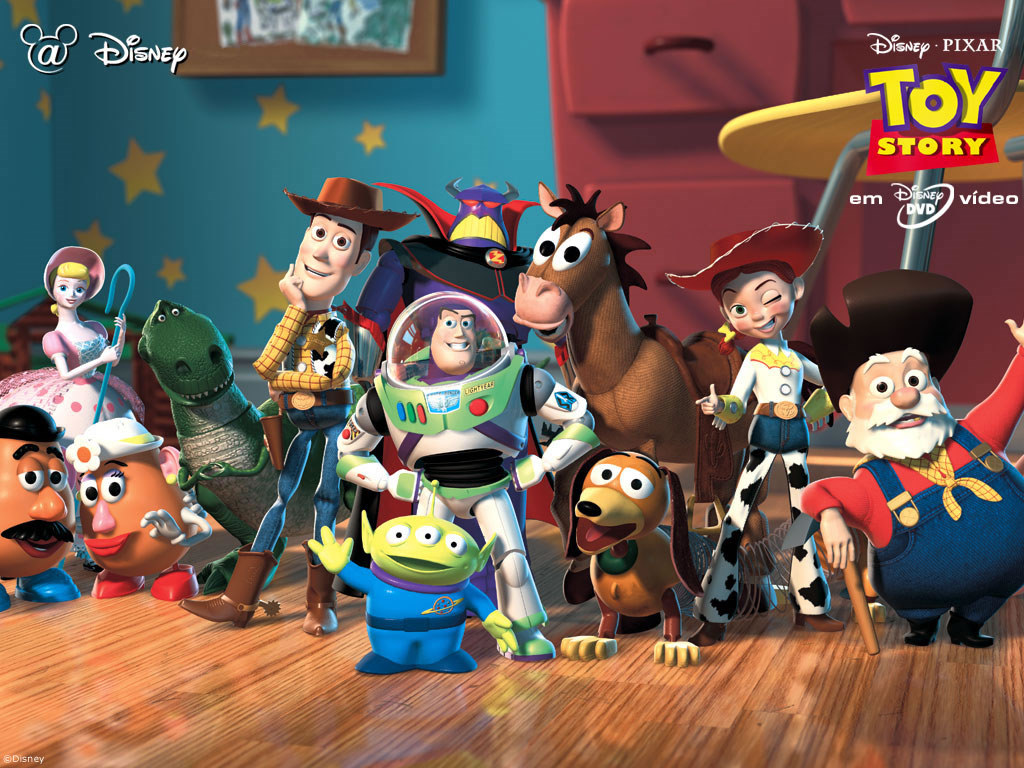
Toy Story (1995) and Toy Story 2 (1999)

Running Time: 180 min. (approx)
Director: John Lasseter (TS), John Lasseter and Lee Unkrich (TS2)
Stars: Tom Hanks, Tim Allen

Roger Ebert has been leading an online discussion among film buffs about the recent spate of 3-D movies. Is it just a gimmick to get people into the cinemas, or are films actually benefiting from the process?

Ebert’s position, which I broadly agreed with, was that it’s still fairly pointless and prone to being (mis)used as a gimmick. I didn’t mind watching Bolt and Up in 3-D — computer animated films do seem to benefit the most from the treatment, as they are modelled in 3D in the first place — but both were just as enjoyable to me in 2-D. And you still have to wear those stupid glasses.

That said, I think retrofitting 3-D onto Toy Story 2 actually made it a better picture. We may have found the first exception to Ebert’s Rule.

As you probably know, TS and TS2 are back in theatres in a new 3-D edition as a family double-feature (a great idea, with a wonderful little “intermission” in-between, including some new voicework, fun quizzes and so forth) to refresh people’s memories prior to the release of Toy Story 3 later this year.

Most people have seen TS and TS2 either “back in the day” or a hundred times on DVD since then, so I won’t go over the story so much as my impressions of getting re-acquainted with the films. Though I remembered the overall plot and themes (particularly of TS2, which as a collector myself resonated with me a bit more), the specifics of the tales had slipped my mind and it was a delight to find that neither film has become too dated. The jokes still work, the overarching theme of the eventual fate of childhood toys (and the power of friendship) are still moving, the performances shine and the “nods” to adults are perhaps even a bit more shocking since they’re the least-remembered aspect, at least for me.

Even better, since the film was created on 3D software in the first place, both benefit greatly from the 3D process, with TS2 coming off better mainly because of the improvement in the quality of the animation (and the greater range of locations).

The best part of both movies is that the details hold up very well. TS’s animation is definitely flatter, but no less lacking in facial expressions and strong vocal performances. There were a few moments in the 1995 original that reminded me how far computer animation has come — a few moments where you see a shot executed poorly and think “ooh, that’s a bit videogamey,” but a number of sequences actually improve with the addition of perspective, particularly any flying Buzz Lightyear does. Re-living all the specifics again, from the decor and manner of Andy’s house to the contrast of Sid’s, from the nightmarish mutant toys (which you’d never see a Pixar film do now!) to the extended “chase” seen of the moving truck (reprised in essence in TS2) is a lot of fun, particularly when you can compare how much more advanced Pixar’s skills were just four years later when TS2 came out. Compare Scud (Sid’s dog in TS) to Buster in TS2 (a character I’d completely forgotten about) and you’ll see the great strides in technology and art the company managed in that short span of time.

TS2’s wider scope really allows the 3D to shine. Emperor Zurg, the elevator shaft and Al’s Toy Barn literally never looked better, and the action sequences are just so much more “immersive” than before. Joan Cusack as Jessie really makes the second half work, though I wasn’t as fond of Kelsey Grammer’s over-erudite Stinky Pete the Prospector (not really in line with the look and nature of the character, and too recognisable IMHO). The other guest voices were great, including  Jodi Benson as the Barbies (again, another detail I’d totally forgotten about!) and the “regulars” like Don Rickles as Mr. Potato Head and Wallace Shawn as Rex. Hopefully as many of these as possible can be in TS3. I know I’ll be keenly watching for a rematch between the Red and Blue Rock Em Sock Em Robots …

There’s not a lot more to say. What Apple is to computers, Pixar is to computer animation — a clearly superior, reliably excellent product that may not always be the most popular or the most talked-about brand, but consistently sets the bar for story, detail, elegance and emotion. Go see it if you can, and if you miss it in theatres, let’s hope the Blu-Ray release comes with a few sets of special glasses.

Capitalism: A Love Story (2009)

Running Time: 120 min.
Director: Michael Moore
Stars: Michael Moore and a cast of crooks

Michael Moore (and his films) are believed to be a “known commodity,” mostly by his enemies rather than his fans. In other words, people who don’t actually watch his movies think they know exactly what they’re going to get from all/any of them, so they don’t bother watching. Conservative circular logic at its finest. They use their favourite (and most effective) ploy of reducing him (or anyone they don’t like) to a caricature; they paint Moore as a fat narcissist liberal who hates everything conservative and particularly that very model of a modern capitalist general, General Motors.

But, you’ll notice, they rarely take on his ideas directly. The reason for this is because although Moore may rub you the wrong way, in point of fact, he’s turned out to be right — and nothing infuriates a conservative more than having to confront this.

So before we get into the movie, let’s address this directly. Yes, Moore is a pretty chunky guy — though since making Sicko two years ago, he’s dropped 70 pounds, and plans to lose another 70. Have you done that? No? Then STFU.

Narcissist? Maybe. He does feature a lot of himself in his films, and I once asked him specifically about that. To summarize his longer answer, he feels strongly that it’s important that he make these movies personal, particularly in the narration. As for the “stunts” as some call them, he prefers the term “citizen confrontation” and asserts that he is acting the part of the audience if they had a chance to speak truth to power. The fact that these events are not always effective or realistic doesn’t make them irrelevant; Moore wants to show that ordinary people can still make their feelings known through such actions, and indeed would be more effective than just him doing it. When he puts crime scene tape around Wall Street, he’s not just making a statement, he’s inviting you to do something similar — because Moore still sees himself as the average joe. Seriously.

Truthfully, it’s the media itself that has made Moore’s image narcissistic. They consistently prefer to focus their stories on him rather than any of the unsettling ideas actually in his films, because then they would have to tacitly acknowledge that he’s factually correct.

So, finally, we get to “liberal.” This term (like “conservative”) has rather different meanings depending on where you are (both physically and politically), but I personally have never thought of Moore as being nearly as “liberal” as his critics allege. He’s much more an angry (but not all that far from centrist) Democrat and pragmatist with honestly mixed feelings about a lot of things, such as guns and yes, capitalism. He actually comes very much from the type of background that usually breeds conservatives, the small-town midwestern, sleepily and happily middle-class and stay-at-home world — and in fact he pines for more Americans to have that sort of background again! He reminds me very much of a lapsed Catholic (though he isn’t one, as it turns out) in that he is very shaped by the middle-class, pretty conservative (small “c”) background he came from, but has seen the ugly underbelly and wants it made right rather than swept under the rug. It’s the fault of the rich and their abusive policies towards the poor and union workers that has turned Moore into an alleged “super-liberal”; had the US maintained a respect for honest work and the middle class, Moore would probably have been at worst the local gadfly at the City Council meetings. Just by looking at him you can tell that he’d be no more comfortable at some Gay Pride-themed SoHo gallery opening than Newt Gingrich would.

So what about capitalism? Does Moore hate it?

I’d have to say “no, but he hates what it has become.” When describing his own upbringing and the world of good capitalism did for everyone back when it was in sync with and intermingled with the love of country and community that feeds and nurtures democracy, young Master Moore was probably capitalism’s biggest fan. It gave him a life and opportunities of incredibly high quality, better in fact than most people have available today — which is part of the point. Life really was pretty good for the majority of Americans, at least by comparison with now, in the late 50s and early 60s.

Along came the Reagan Administration in 1980, however, and they (specifically Don Regan, who was head of Goldman Sachs and then became Treasury Secretary, essentially handing the keys of the vault to Wall Street) allowed capitalism to become a very mean and heartless drunk, slurring his “I love you, maaaan” odes to the rich while ignoring his wife and kids (the middle class and poor, respectively) at home. Like a bad marriage, the family tried to ignore what was happening, tried to put on a brave face for the neighbours, and for a while that worked, but the façade began to crack, the abuse became difficult to hide, but it careened almost always out of control for far longer than you’d have expected and then eventually he drove himself into a ditch. Capitalism divorced itself from both the middle class and reality, gave up its egalitarian ideals and became a meth whore to the rich and powerful, ignoring everything else and letting the house it built (America) crumble.

Twenty years ago, Moore was just a schlub outraged by the poor treatment of workers vs. shareholders at General Motors, and identified the root problem: a de-humanisation of the employees and customers in favour of making the rich richer in the belief that they — the rich — would take care of the little people (this idea is often expressed as “trickle down economics”) by providing them jobs (but nothing else really).

At the time Roger & Me came out, Moore thought GM was some kind of rogue corporation, bending government to their will and putting their endless need for profit ahead of the people’s need for basic survival; 20 years on, Moore has discovered that pretty much all corporations have abandoned the democratic and moral principles of supporting the communities they profit from, and rushed headlong into a feeding frenzy for money that never gets sated, powered by a foolish Congress that gave them not just rights on par with actual people, but rights and access that superseded that of ordinary citizens.

It’s irony at its very finest that the very groups of people who profess to be skeptical of Darwin’s evolutionary theories are largely the same ones who turned capitalism into a pure Darwinian exercise, replacing democracy and patriotism with the worship of profit and a “survival of the fittest richest” mantra.

You read that right, by the way: democracy has been replaced by corporatocracy, and most of us never even noticed. A cynical few will yawn and act unsurprised, but the joke is on them: a “plutonomy,” as Citibank itself described it, will eventually make life very unpleasant for anyone not in the top one or two percent of earners. That means you.

The 2006 Citibank memo that calmly and horrifically describes — to its wealthy clients, until it was leaked to Moore — a system of government that is now solely defined by its ability to produce economic benefit to the wealthy, and even questions how much longer the rich will let the concept of “one man, one vote” stand — is at best a treatise of treason, at worst a victory speech of the triumph over democracy, a war that was won through marketing, convincing people that having an XBox and a plasma TV equaled a higher standard of living.

This is just one of the jaw-dropping revelations that will even shock and surprise lefties who consider themselves well-informed. Have you heard of a “Dead Peasant Policy”? You will in Moore’s film, and you may literally want to grab a torch and head for the mansions when you find out what it is.

Or consider Capt. Ted “Sully” Sullenberger, the hero of the Hudson. He went to Congress to testify about the working conditions of the nation’s pilots. Don’t remember that? That’s because the networks refused to air what he said. When Moore shows you the (stolen) footage of his testimony, and then backs it up with interviews of working pilots, you may never want to set foot on an airplane again (which is not Moore’s intent; he wants you to help him do something about it, not stick your head in the sand).

In addition to these revelations, made up mostly of “liberated” news footage that has been actively suppressed by corporate-owned media, Moore injects a surprising new voice beyond his own, or those of the victims of rampant corporate greed; the Catholic Church. As a practicing Catholic, Moore’s discontent with capitalism as a substitute for democracy has its roots in the Bible, and so he interviews a number of Catholic priests and bishops, who all enthusiastically agree that capitalism runs directly contrary to the teachings of Jesus and the words of God, and is a force of evil in the world (which even Moore is not ready to fully embrace). If this film does nothing else beyond Moore’s usual level of box office, I would love to see this film spark a real dialogue in the mainstream media featuring the religious view of where the West is headed these days, and how its model is something Jesus would run screaming from.

Some critics have said that Moore’s ability to deliver such a huge indictment results in him being less focused, less “entertaining” and less cohesive in this film than in some of his previous ones where the subject was more narrow. With this I must agree, Capitalism as a piece of filmmaking is not Moore’s best work. But it is as important a documentary as anything he’s done, because it shows not only the growth of the corporatocracy, but also how the truths he uncovered in Flint, Michigan 20 years ago have now been exported to every corner of the US, from “condo vultures” in Miami to partying Wall Street executives, from bankrupt California (which is, by the way, one-seventh of the US economy) to the corporate infil-traitors in Washington DC.

One does wish, especially in the early portion of the film, that Moore would zero in on his thesis and not throw everything and the kitchen sink up there; he cuts dizzingly between crying remnants of the working poor and the eviscerated middle class struggling and failing to keep even their dignity as they lose everything they’ve worked for, to his now-old-hat “stunts” to the shocking footage that either never aired or didn’t make it past the right-wing noise machine, to images from his typical American upbringing to the wasteland that is Flint (and a thousand small towns like it) today, to priests calmly telling us that our very way of life is intrinsically evil and ungodly. If Moore were a lawyer, I’m sure he’d get a hung jury every time, and his “citizen confrontations” have lost most of their novelty and effectiveness and now only serve to give his critics something to distract their audiences from the actual points raised in the film.


But his winning, earnest, honest personality (which is precisely what he has, his defamers be damned) does eventually bring the disparate points together, not so much calling for the destruction of everything we know as its reformation; a return to the sensible, community-driven democracy that kept corporations and governments in their place (as servants to the greater good of the public) as it did for a while in the post-Depression America middle 20th century. The film strikes a cautiously optimistic tone regarding the election of Obama as a force for change and good, but doesn’t shy away from noting that Larry Summers and Tim Geithner are part of the same crooked crowd that overdid the champagne during the wealthy’s victory dance and thus wrecked the economy in the first place. Only time will tell if they’ve had a “come to Jesus” moment and are working for the taxpayers now, or if Obama and any noble intentions he once had will ultimately be eaten by the money and power of the corporate dragons he seeks to tame.

Finally, after taking us back to Roman times in the film’s opening and his own childhood in the middle, he ends the film with yet another piece from a simpler time, which is also another piece of previously-suppressed footage: a sickly Franklin Roosevelt, in a never-before aired bit of newsreel footage, calling for and outlining his plan for a “Second Bill of Rights.” The truths and values Roosevelt lays out are simply stunning to modern audiences, and a powerful reminder that America once had truly great leaders who fought hard for the little guy, who considered the dispossessed and the disenfranchised when making their decisions, who weighted the benefit of the many ahead of the benefit of the few when spending their political capital. It’s clear that Moore hopes Obama will be another Roosevelt, but as he sternly warns us at the end, if we don’t get off the couch and reward good behaviour from our leaders, he — and those of us who fight for justice, peace and equality — will likely throw in the towel and let the forces of evil prevail. Why lead the charge if nobody is willing to take a break from playing WoW long enough to write their congressperson?

I will allow that Moore does seriously need to refresh his schtick, if for no other reason to confound his enemies and re-energise his fans. But as a truth-teller, an investigative journalist and a thorn in the side of the corporatists, Moore is still the Elvis of documentarians and we should try to follow his example of looking more at the message and less at the real or imagined faults of the messenger.

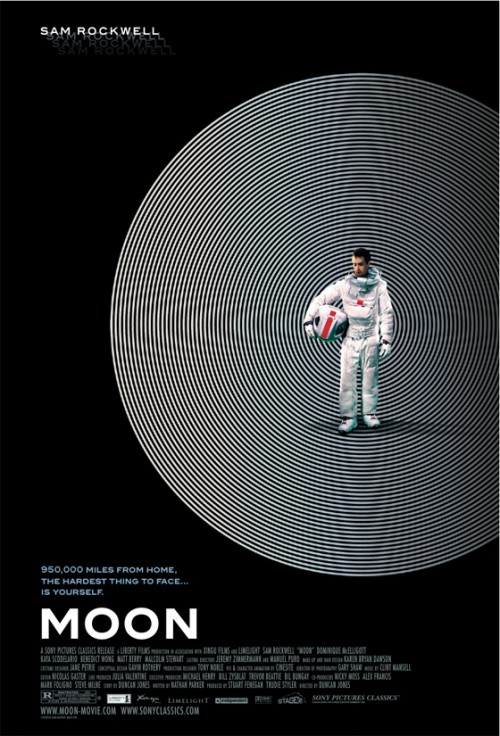
Moon (2009)

Running Time: 97 min.

Director: Duncan Jones
Stars: Sam rockwell

If you’re like me, you’ve probably seen a fair few (if not all, repeatedly) of the Great Science Fiction Movies. I’m not talking about your capitalist fluff like Star Wars and Star Trek*, I’m talking about the serious SF movies.

Alien.


Brazil.


Metropolis.


2001.


Silent Running.


Blade Runner.

and most important of them all (at least for the purposes of this review), the now-forgotten classic Dark Star.

Duncan Jones, the son of a guy a who starred in another of the all-time great SF movies The Man Who Fell to Earth, has seen these films and many more. But I mention these particular classics not because they’re the first ones that came to mind, but because they have elements in common with each other. The first is isolation and loneliness. All of these films, the protagonist is a person isolated from the mainstream of society in one way or other, often by the vacuum of space.

The second theme is madness. The question of the sanity of either the protagonist or the antagonist is left open. In the case of Brazil or 2001, it’s left wide open.

Finally, we have a fight for one’s own (or humanity’s collective) soul. Now, to be fair, it should be said that a lot of movies have these three elements in varying degrees — but if you were to stick the aforementioned SF movies into a blender, garnish with some Space: 1999 and add a huge extra helping of Dark Star, I believe you would have something very akin to Moon, the film debut of writer/director Zowie Bowie (sorry, Joey Bowie. Sorry again, Duncan Jones).

This is not to say that Moon is unoriginal or a rip-off; I think Jones brings enough originality to the story to make it work, particularly for a generation not as deeply versed in some of the “classics” as maybe they ought to be. But if you’re like me, you will spend a lot of your time noticing little things, ideas consciously or unconsciously nicked from other films.

The main influences are clearly Dark Star, Blade Runner, 2001 and Space: 1999 (and before some wag puts it out there, I’ll add that the budget for this film was clearly inspired by mid-70s Doctor Who). You notice it even before we get to the friendly, calm-voiced computer named GERTY (which is well done by Kevin Spacey, but his voice is so recognisable that you notice it’s Kevin Spacey).

Sam Rockwell (in a much stronger performance than 2005’s Hitchhiker’s Guide to the Galaxy) plays Sam Bell, the sole human inhabitant of a mining station on the far side of the moon. The work is mostly automated, but needs a caretaker — and Sam is itching to get home after have served his contract of three long years away from his wife and daughter.

The time has taken its toll on Sam, and one day while out in a rover doing inspections, he hallucinates and crashes, injuring himself badly.

This part of the film is clear. The rest of it is a little murky.

Some time later, Sam wakes up in the infirmary, informed by GERTY that he has suffered injuries and some memory loss. As he recovers he wishes more and more to get back to work, the only thing that gives him a sense of feeling. Finally tricking GERTY into letting him outside the base, Sam returns to the scene of the accident and makes an unsettling discovery — the injured Sam still alive inside the vehicle.

At no point are we as the audience absolutely certain that what we’re seeing is reality, and Jones’ strength here is to keep us focused on that mystery. Is this all a dream of the dying Sam #1? Is the presence of a second Sam an indication of madness? Further along in the film we get a “logical” explanation of how this situation came to be, and we eventually return to what we assume is the real timeline, but we cannot be certain, particularly early on. Watching the two Sams warily interact proves very entertaining and the story unfolds more-or-less logically from there. Eventually Sam(s) realise the truth of their situation, that they are being manipulated. But why exactly, and how can he (they) beat the odds?

I suspect that a lot of the raves given this film are due as much to its obvious borrowing (sorry, homage) to its influences, and due to it being a rare example of a slow-paced story in this genre. There are few explosions or action sequences; largely it is (apart from the first quarter and climax) a psychological play. Plot revelations are drawn out, actions are very constrained, the feel is deliberately claustrophobic, and the minor supporting roles are minimal. Hopefully it will find (and seems to have found) an audience mature enough to be able to deal with the Kubrick-esque pacing and really savour the performance and atmosphere. If Moon is a modest hit, it will be good news for low-budget and serious SF filmmakers everywhere. To be able to take your time and really get into a story will come as something of a revelation to the twitchy video-game generation, for whom “sci-fi” in movies has largely meant huge explosion, whizzy spaceships, thrilling headgear and odd-coloured alien women to romance.

Rockwell gives a fairly low-key performance (for him) as both Sams, doing a very effective job of showing us Sam at various stages of his experience on the moon, and interacting with “himself” quite effectively. The special effects are quite modest (very Gerry Anderson!) but they do the job, and the moonbase while obviously cheap removes us from our own world well enough to allow us to sink into the mind(s) of the characters. Throw in a modest twist to the “us versus them” countdown and you end up with a satisfying story (with kind of an open ending) that doesn’t try to keep you thrilled/amazed/scared/titillated the entire time. For me that’s kind of refreshing, for some leaving the theatre with me I got the impression they were surprised to be so thoughtful after a “sci-fi” movie. Some were just plain perplexed. A few seemed underwhelmed.

Points off for being so completely blatant in his borrowings, but overall Jones has made an effective, well-directed “little” SF film, something the world could probably use more of. The sparse soundtrack by Clint Mansell is as unobtrusive as a fine waiter, and Gary Shaw’s cinematography makes the most of the limited sets (also helping the “moon surface” shots be more convincing). If you’re the type who enjoys discussing movies over drinks after the screening, Moon will probably be the first in a long time to provide you with more than just “what’d you think?” to ponder.

*Apart from “Star Trek II: The Wrath of Khan,” which is actually a great sci-fi movie.

My New Cinema BFF: CineCenta in Victoria BC

Whenever we talk about the things we miss from our lives in Florida, our first breath on the subject is always devoted to the great people there: not just family and the smaller circles of close friends, but the many, many fascinating/insane/beautiful folks we knew on one level or another. But after that, you’ll often hear us talk about the great places of the metro Orlando area. Right at the top of that list is a miraculous movie theatre called the Enzian.

If you haven’t been there, it’s not like any other cinema. Period, full stop. I’ve been to many great movie houses of yesteryear, like the insanely beautiful Fox Theatre in Atlanta. Enzian is nothing like them. I’ve been to many modern art-house cinemas. Again, no. I’ve been to my share of “Cinema Drafthouse” type places, and you’re getting warmer but still far off the mark. The Enzian is really quite individual in this world, and not even the many warm memories I have of the Rhodes Cinema in Atlanta or the Grove Cinema in Coconut Grove or the other film dives that came alive only when the lights went down and the movie came up can erase my love of the Enzian, it’s owners and staff, it’s festivals and events but of course it’s wholistic movie experience, which goes far beyond just the good stuff on the screen.

Having said all that, the Enzian has a rival. They don’t even know about it (till some of them read this post and I know they will!), but it too flirts for my affection. It is called CineCenta, a part of the University of Victoria, and it is different from the Enzian, but in a kind of “kid brother” way. I’ve been lazy in not finding it till recently, trying out the other cinemas in town both mainstream and off-beat; Victoria has a strong art-film sensibility and you can find foreign and highbrow works all over town, particularly during the Victoria Film Festival. I am ashamed to have avoided driving “all the way across town” (15 minutes) to the UVic campus for almost two years.

Like Enzian, the prices at CineCenta are insanely low. They offer memberships in the society, they frequently mix “revival” prints and other curiosities into the mix, they host mini-fests of their own and yes, Enzian — they put real butter on their popcorn.

Oh, there are differences, to be sure. CineCenta operates on a shoestring, their theatre is smaller (300 seats), their advertising is virtually non-existant off-campus and they don’t serve wine or beer.

What they do have, though, is an appealing “student” atmosphere, a frankly fantastic sound system that squeezes the sweetest highs and shakes the bottoming bass with astonishing clarity; the pre-screening jazz we heard was melting my brain with audiophile delight, and of course, a plethora of wildly diverse but mostly amazing movies.

As I write this, the 60th anniversary print of De Sica’s Bicycle Thieves (see my review here) has given way to Rocksteady: The Roots of Reggae, which will be replaced this weekend by showings of Pixar’s Up and Duncan Jones’ Moon, with an almost obligatory screening of The Rocky Horror Picture Show next week. And much, much more. Wow.

I’m now down to missing mostly Enzian’s rolling, reclining chairs and tables, their high-quality menu and their wonderful staff, because CineCenta is meeting my needs on most of the other fronts pretty nicely now.

I feel a bit like a cat who’s gone to live down the street, where they feed me more yum-yums. 🙂