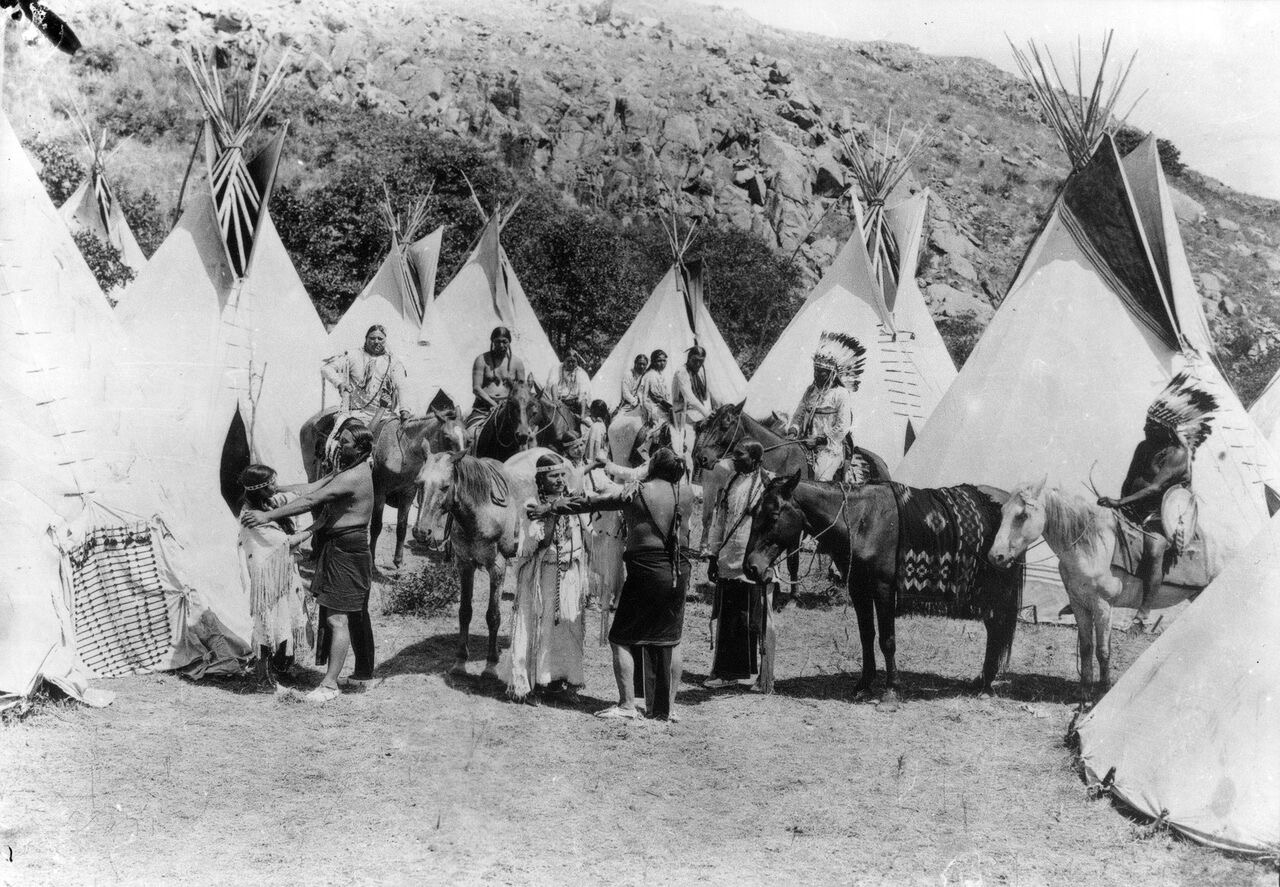
The Testament of Orpheus (Le Testament d’Orphée)


1960, Dir. Jean Cocteau
⭐️⭐️⭐️½

52-week film challenge, film 13

Now this here is perhaps the ultimate example of what most “normal” people think of when they think of “art-house cinema snob” highbrow movies: a B&W (mostly) film made by some furriner where you have to read subtitles, starring some old dude who says things that sound weighty but are incomprehensible to “normal” people; long, slow-paced shots of people walking around things in odd ways; very little action; obvious erotic overtones without any of “the good stuff”; obscure back-references to other films or Greek tragedies nobody saw; self-directed and pretentious, and of course no attempt at a linear, relatable plot. 🙂

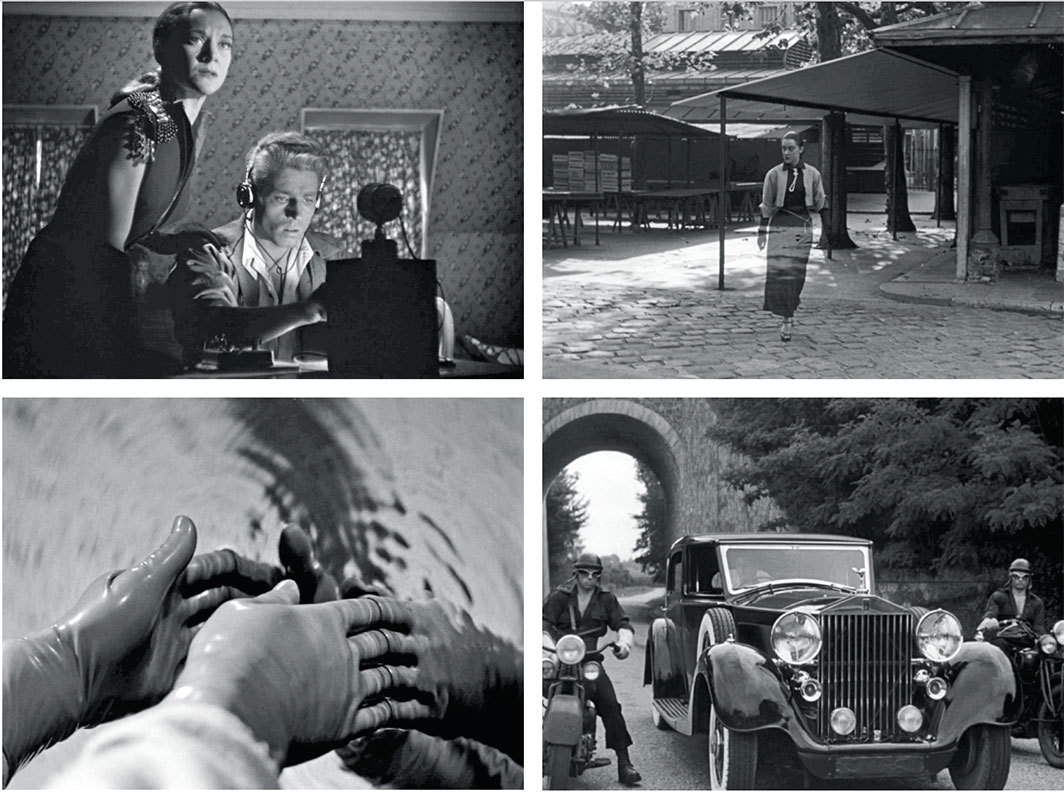
Cocteau’s final film (and almost his final anything: he would die just three years later) seems — at least to me — like an attempt to fuse the ideas of The Blood of a Poet and Orpheus into one final statement, weighted by the additional weight of mortality that increases as we grow older. It is 100 percent guilty of everything I mentioned in the paragraph above, but as I watched it for the first time Cocteau still managed to work his ingenious magic on me: couldn’t take my eyes off the thing because I literally could not guess what was going to happen next.

Even though the film does indeed strike a self-assessing tone, there is playful humour sprinked throughout — some of Cocteau’s answers to questions or dialogue from his characters to him are quite witty. As usual, the film puts layers on layers, and slathers on the symbolism. This time around, though, Cocteau himself is the star, though viewers of his 1950 film Orpheus may be surprised and certainly delighted to see several cast members not that classic in key roles in this one — though Cocteau did not credit any of the players for fear of misleading his audience.

This is also your chance to see cameos from Pablo Picasso and Charles Aznevore, and a small but important role for Yul Brynner, who helped finance the film, among other notable names of the time. This one is also in black and white, which by 1960 was all but gone from cinema screens, but like Orpheus is utterly gorgeous.
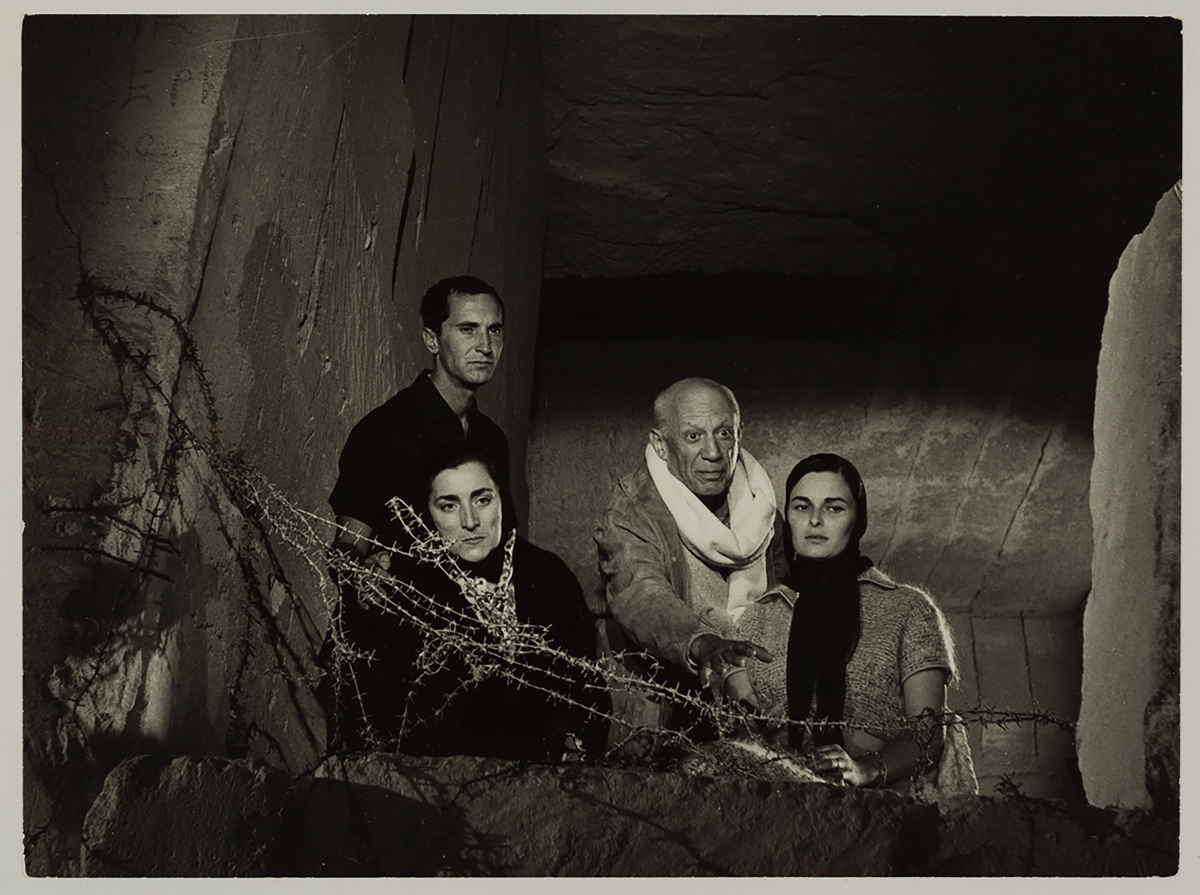
Cocteau plays … well, at some points he is clearly playing himself (billed as The Poet), and at some points (particularly early on), he is playing a character … a mysterious poet and scientist dressed as a 17th-century dandy who appears like a ghost to a colleague (Henri Crémieux, the first of many from Orpheus to be in this, albeit in a slightly different role) to release him from the error of his time-travel experiment by shooting him, whereupon he “snaps back” to the present day and becomes “himself,” i.e. the “real” Cocteau — though he does occasionally catch a glimpse of doppelgängers of himself still moving through this faux-dreamscape, like reflections in a mirror.

I found it particularly interesting that these scenes (and others later) are obviously filmed in a small portion of a bare, empty film studio … no sets or any form of artifice to set the scene, just basic walls and plain tables and chairs, and no attempt to “fool” the viewer as to where they are, or even to create a “void” space. This is a film, we’re in a small studio with minimal resources, and you can see all of that. As the film progresses, it relies more heavily on location filming, which is (as always with Cocteau) mostly ruins or symbolic sets placed in the ruins, symbols for the messiness of life but also for those moments where something meaningful is achieved.

As for what it all means, Cocteau later wrote about this in the most art-y way possible: “The Testament of Orpheus is simply a machine for creating meanings. The film offers the viewer hieroglyphics that he can interpret as he pleases so as to quench his inquisitive thirst for Cartesianism.” There, that clears it up!

Cocteau plays extensively with the “mythology” he created for Orpheus, and in effect some of this is a — kind of? — sequel to that film, in that Cégeste (his real-life adopted son, Edouard Dermit) , The Princess of Death (María Casares), and Huertebise (François Périer) have substantive roles to show what happened to them. Cégeste, sometimes reminding Cocteau that that’s only his character name, is his guide to the underworld; and true to the ending of Orpheus, The Princess and Huertebise have indeed been “sentenced” to become judges of the newly-dead, and now they are subjecting their creator, Cocteau, to an inquisition.

Cocteau mounts a “defense” by defending his need to create, to review his life, and to put his inner discoveries into visual language on screen or in writing for others to hopefully gain some enlightenment. After an inconclusive end to the “court” case, Cocteau wanders through mysterious ruins, occasionally running into men dressed as horses, until finally a Greek warrior of some sort kills him again. His friends rally to resurrect him yet again — the sort of immortality Cocteau hoped for — and he resumes his wanderings.

And in case you are wondering, as a sort of joke, Jean Marais (who played Orpheus in that film) briefly appears here — as another classic Greek figure, Oedipus (post eye-gouging). Eurydice (although played by a different actor, Alice Heyliger) is also seen briefly. Some others from Orpheus are likely in there too, but those are the ones I spotted.

A lengthy section of the film, with the motif repeated a few times, is that of Cocteau destroying a flower and then rebuilding it. In the decade between Orpheus and this final film, the French New Wave of cinema has bloomed, in no small part thanks to Cocteau’s influence — just as surrealist filmmaking became a thing after his first film (and the first film in this “trilogy”), The Blood of a Poet (1930).

Cocteau made a number of other films between that first one and this last one, but he clearly intended this one to be his last statement to the general public. I have to borrow a bit from Ken Phipps’ review of Testament for the AV Club, since he has summed up the film’s meaning about as well as it can be: “In the end, Cocteau takes comfort in the immortality of art, and therefore his own immortality, a sentiment that would seem far less moving and far more egotistical if it weren’t true.”

You’ll laugh, you’ll cry, Yul Brynner.

Orpheus (Orphée), (1950, dir. Jean Cocteau)

52-week film challenge, film 12
⭐️⭐️⭐️⭐️

As I watched Cocteau’s previous take on the idea of chaining the mythological tale of Orpheus to the struggle artists go through to create and realise their art, The Blood of a Poet, I kept getting flashbacks of some other film I had seen decades ago that featured some of the same inventive visual effect and angst-y performances, but I couldn’t quite place it. I’ve seen more than my fair share of arty and experimental films, so I imagined that it was simply some film that had been influenced by Cocteau, as many have been.

I turned out to be right — it was Orpheus, Cocteau’s own second attempt at some of the visual ideas and concepts he expressed in Blood of a Poet. I had seen the second part of this prolonged trilogy many years ago, and remembered more the story and contemporary setting than the effects and other bits he borrowed and polished up from his earlier film. My scholastic impression of Orpheus was that I liked the urgent, modern (at the time), beatnik tone of the first half, and was less impressed with the slower-paced second half.

Now that I’ve rewatched it after all these years, I’m even more impressed with it (though I still think the second half could have used better editing). Cocteau was a pioneer of shorthand storytelling, and of deliberately leaving a lot of elements unresolved — I’m still working out the full meaning of the character Cégeste (Édouard Dermit), though I think he may represent the image of a writer at his peak, and be sort of a representation of Orpheus’ (Jean Marais) image of himself.

Poor Cégeste spends nearly all of the movie either dead or as a zombie servant.

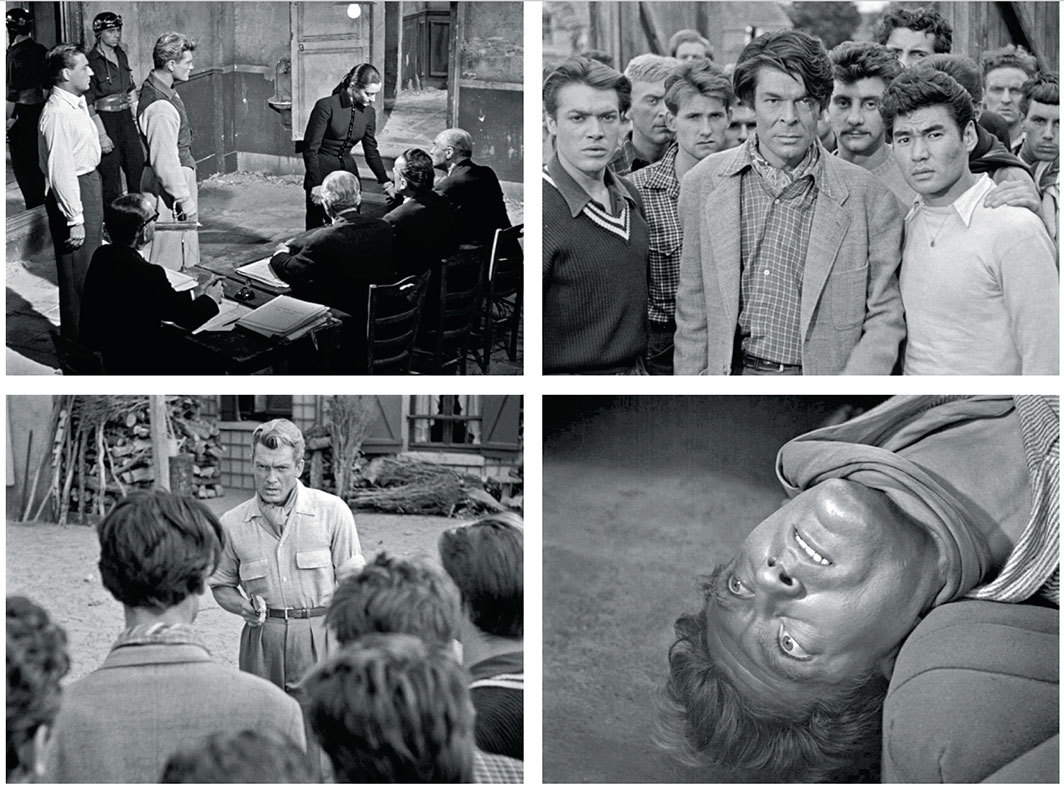
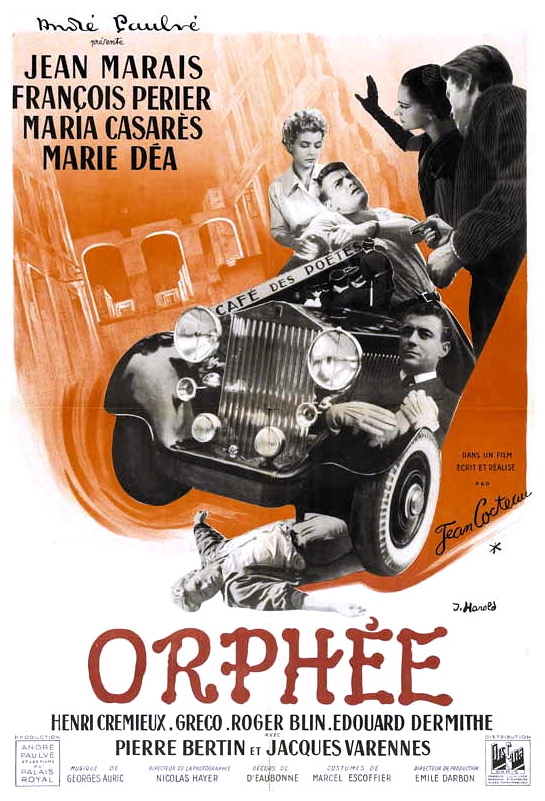
In the film, Orpheus is a famous poet, hanging out in a bar for poets, being kind of an ass until a Princess (a memorable performance by Maria Casares) and her boy toy Cégeste arrive. Orpheus is mesmerised by the Princess, while Cégeste starts a brawl, dropping some of his own poetry in the fracas. Cégeste starts to flee, but is run over by two mysterious motorcycle riders.

The Princess persuades the arriving police that she will take Cégeste to hospital, and drags a willing Orpheus along into her limo “as a witness.” Along the way, Orpheus discovers that Cégeste is actually dead, and the Princess is some otherworldly creature. His instincts make him fall in love with her as they ride to her ruined chateau, accompanied by the motorcylists who killed Cégeste. Abstract poetry begins to play on the radio (which is later revealed to be Cégeste’s own poetry, read by him: time is meaningless in the underworld).

Cégeste is resurrected by the Princess, and the riders exit the chateau through a mirror (a direct steal from The Blood of a Poet, and only one of several in this movie). Orpheus, who is isolated in another room, eventually wakes up the next morning far from home, with the Princess’ limo driver Heurtebise (François Périer) waiting for him to take him home. Orpheus offers Heurtebise room and board in his home and space in the garage to hide the limo, which everyone in the village would recognise and alert police.

Heurtebise (l) and Orpheus (r) receive a threat from the underworld.

Orpheus refuses to discuss his all-night disappearance or what happened to Cégeste with his wife Eurydice (Marie Déa), and really behaves in a self-centered, brutish manner — even as she tries to tell him she is pregnant. As Heurtebise starts to fall in love with Eurydice, all Orpheus wants to do is sit in the limo and transcribe some strange poetry mixed with meaningless other oration — that mysteriously only comes through on the limo’s car radio.

The Princess visits Orpheus while he is asleep, and influences his dreaming. She eventually has Eurydice killed in the same fashion as Cégeste, as she is in love with Orpheus. We learn that both the Princess and Heurtebise are themselves spirits, and servants of Death (who is not personified in the film).

The Princess in her Death uniform as she watches Orpheus sleep.

Orpheus is shocked out of his defensive state by the news, and Heurtebise reveals himself as an agent of Death, noting that the Princess accidentally left a pair of gloves behind. He offers to lead Orpheus into the underworld to retrieve the unjustly killed Eurydice. Orpheus confesses his secret to Heurtebise: he is in love with the Princess, but agrees to travel with Heurtebise to undo Eurydice’s murder.

Orpheus is able to enter the underworld through the mirror by donning the Princess’ gloves, and Heurtebise and Orpheus move through a ruined city until arriving at a barren room where other agents conduct an investigation of Eurydice’s murder, questioning the Princess, Cégeste, Orpheus, and Heurtebise before concluding that the Princess overstepped her authority.

They agree to return Orpheus and Eurydice to the land of the living, on one impossible condition: Orpheus may never look upon her again, or Eurydice will disappear from this world and return to being dead. Forced to agree, Heurtebise, Orpheus, and Eurydice return to the living world, but find the restriction very difficult to avoid. Ultimately, Orpheus errs, and Eurydice disappears.

At that moment, a gang from the poet’s cafe arrives, angry that Orpheus has refused to reveal what happened to Cégeste and his missing body. In a violent confrontation, Orpheus takes a pistol but is quickly disarmed and himself shot dead. This of course causes Orpheus to reappear in the underworld, where he finds the Princess and declares his undying love for her.

The Princess seems to know that this affair was her own doing, and regretfully decides to sacrifice herself to Death so that Orpheus might be returned to life and become “an immortal poet.” After another tribunal hearing, the decision is made to return Eurydice and Orpheus to life with no memory of previous events. With no recollection of his love for the Princess, Orpheus returns to his true nature and loves Eurydice again, excited for his forthcoming child.

The Princess and Heurtebise, having caused this mess, are sentenced to a fate worse than death: they must replace the tribunal members who judge the dead. The sadness in the Princess’ eyes at the end is a powerful image, and the audience is left wondering if the crowd at the poet’s cafe has also had their memories wiped of these events.

Taken as a whole, my initial impressions on first viewing were not wrong, but very incomplete: having known the story of Orpheus already — thank you, Edith Hamilton — I mostly ignored that part of the film (while enjoying the visuals, some of which return to the same locations as in The Blood of a Poet). Now, I see more of what Cocteau was going for — again comparing the difficulty of true artistic creation of going to hell and back and forcing one’s self to confront one’s angels and demons.

It’s true the second half is slower-paced, at times becoming a cosmic version of a police procedural — but the performances, the passionate flow of emotions, and the gorgeous filming — particularly of the ruins of the underworld — kept me more attentive to the mystical aspects of the story this time around.

Orpheus is not quite as good as Cocteau’s earlier Beauty and the Beast, but it is a classic and it is a stunning accomplishment that still feels fresh in many ways. The influence of the film in later works by others is now obvious, though somehow Cocteau’s films remain singular in style and vision.

There have been many variations on the Orpheus & Eurydice story, and I haven’t seen all of them, but I’m confident that this remains one of the most original and interesting versions. The conclusion of his “trilogy” around this tale — The Testament of Orpheus, in which the director himself is the star — is next on my list, and I encourage anyone with an interest in classic French cinema to investigate this incredible artistic achievement.

The Blood of a Poet (1930, dir. Jean Cocteau)

⭐️⭐️⭐️⭐️

2023 52-week film challenge, film 11

Jean Cocteau, renaissance man and “poet” of film, theatre, writing (including poetry), designing and more was a truly remarkable human being, a leader in the surrealist and art movements, and one of the most influential men in the arts of the 20th century. Among his numerous other achievements, he really helped advance the idea of film as an art form and not just a storytelling form.

Probably best known among cinephiles for his 1946 film of Beauty and the Beast, until recently I was unaware that his two later Orpheus films were intended as the middle and end of a three-film trilogy, beginning with his first film, The Blood of a Poet.

It is a very experimental and surrealist film that broke a lot of ground in its day for special effects; some have aged less well than others, but a lot of this remains impressive and frankly more effective than zillion-dollar CGI jobs you know aren’t at all real. The work involved in pulling off some of this at the time must have been painstaking.

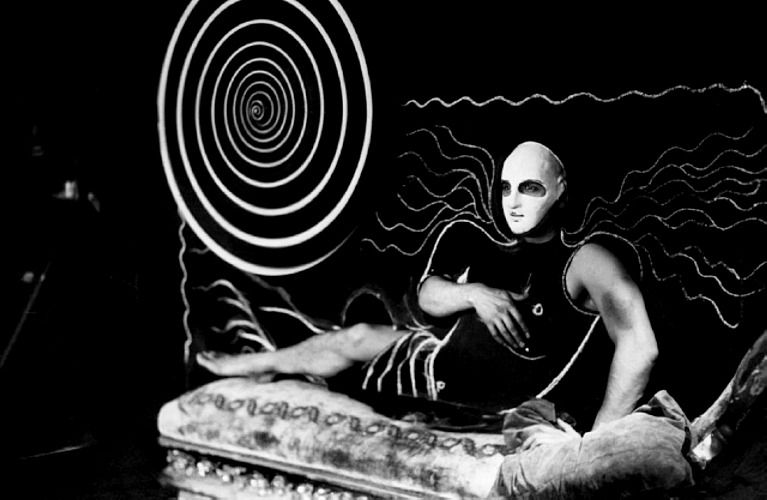
The “story,” such as it is, is that of a handsome and perennially shirtless male artist who is invited by one of his statues to fall into the mirror and pass through to the other side, where a series of strange tableaus unfold. I suspect it is meant as a metaphor for the creative inspiration process, both the downside where the ideas aren’t coming or don’t work, alongside the chasing of inspiration and realisation.

It’s gorgeous to look at, if hard to quite grasp. It’s certainly a surrealist film, and the only one I’ve seen that has an occasional narrator. Cocteau explores several techniques and ideas himself over the course of this 51-minute film, making it rather disjointed and occasionally confusing — but it’s hard to take your eyes off it.

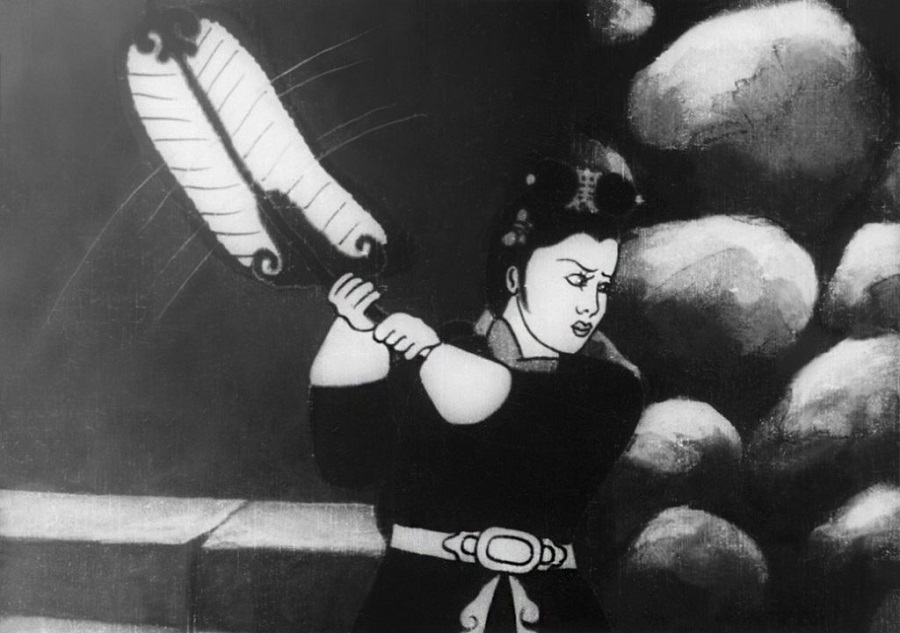
Princess Iron Fan 鐵扇公主 (1941, dirs. Wan Guchan, Wan Laiming)

⭐️⭐️⭐️

52-week film challenge 2023, week 10

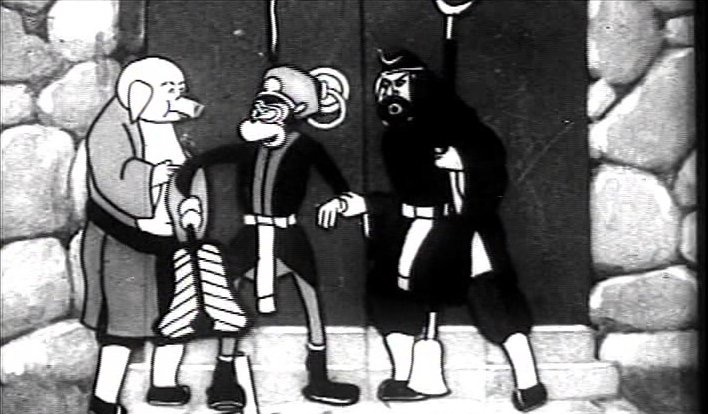
This 1941 B&W fully-animated movie is considered the first Asian full-length animated film, and is certainly the first full-length Chinese animated film. While some western influence (particularly the early Looney Tunes of the 1930s and the early Disney movies like Snow White) can be seen, it is drawn from folk fables themselves inspired by a portion of a novel called Journey to the West, published in 1592.

The folk tales based on the book, we are told at the beginning of the movie, often focus on the supernatural creatures rather than the travelers and the moral of their journey — which is that life is full of trials and suffering. The filmmakers, however, wanted to emphasise the lesson of the story: that working together as a community, faith, and using everyone’s talents in harmony can overcome great obstacles, and make life better for all.

The tale is a fairly simple one: a monk trying to get to “the west” (meaning Central Asia and India) to obtain some Buddhist sacred texts (sutras), but is stopped by a mountain range full of fire. His three servants — a monkey prince, a pig-faced monk, and a stuttering but strong worker — each try to use their various magic powers to solve the problem. Specifically, they need to get a magic palm-leaf fan from an unhelpful princess in order to put out the fires, but their individual ruses and even brute force all fail.

Our three “heroes,” sort of.

The servants all regroup back at the town where the monk helps them brainstorm, suggesting that the three pool their abilities with the assistance of the townspeople to overcome the trickery of the princess and her husband. This they finally do, ultimately winning the day and clearly the mountains of the fire demon that tortures them, so that they and the monk can proceed on their journey of enlightenment.

Despite the handicap of no really good print of the film being available (it is desperately in need of a major restoration), the quality of the B&W animation shines through, with many impressive moments including extensive use of rotoscoping to make some scenes much more realistic, along with smoke effects and excellent character design. The various shape-shifting and disguising powers of the three servants are well done, and the quality of the existing film print picks up a bit in the last third.

The “evil” princess, who actually has a pretty small but pivotal part in the film.

This is primarily a film that would now mainly appeal to fans of early animation, film historians, and students of Chinese history, but it is a very impressive feat of filmmaking that is only marred by the lack of a pristine print. A special mention should go to the musical score, which starts off a bit overwrought in my opinion but soon settles down when needed to accompany the story. I enjoyed it enough that I would certainly revisit it if it were ever restored.

An example of the beautiful backgrounds in the film.

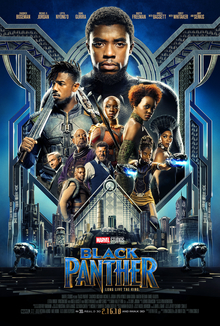
Black Panther (2018, dir. Ryan Coogler)

⭐️⭐️⭐️½

52-week challenge, week 9

I’ll be blunt — I’ve seen a fair number of superhero films, including a good sampling (though nowhere near all) of the MCU and DC superhero movies. They can certainly be fun, but I usually find myself taken out of the story by the effects and stunts (regardless of how good they are, they routinely disrespect basic physics), especially as time goes on. Black Panther is certainly the best MCU movie I’ve seen to date, but that’s because it plays to my liking of Afro-futurism as a deeply underrated movie genre.

I was very impressed that Marvel went for a movie that was a deeply and topically the African and African-American experience as they did, adding in the futuristic secret of Wakanda, and one which dealt actually quite little with the typical superhero antics, though those boxes are certainly ticked — but there is relatively little of Black Panther the action man and mostly a focus on characters. A lot of the credit has to go to the note-perfect casting throughout.

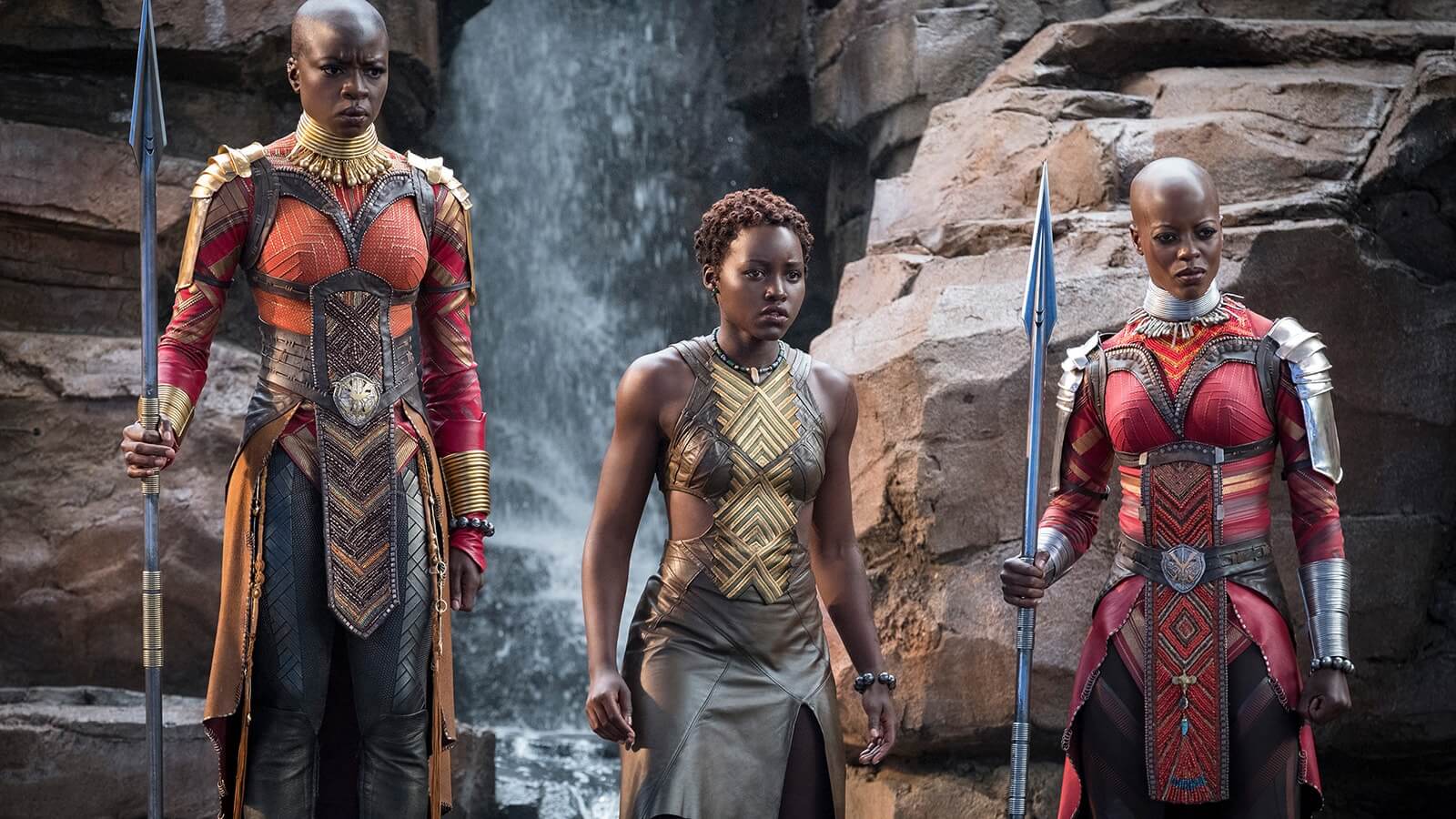
Even the established stars like Andy Serkis and Michael B. Jordan turn in solid performances, and of course Lupita Nyong’o and Danai Gurira alongside Letitia Wright and Angela Bassett get plenty of non-romantic, meaningful screen time (makes a nice change in the male-dominated superhero genre). I would be deeply remiss if I didn’t mention Chaswick Boseman’s star turn, aided by great supporting characters played by Daniel Kaluuya, John Kani, Forest Whittaker, Sterling K. Brown, and Winston Duke. Some of the most believable and fleshed-out characters in the whole of the MCU are to be found here — and even though he wasn’t quite as great as the rest of the cast, it was great fun to see Martin Freeman as the token white ally.

For a fantasy movie, this had a lot of hard truths within it — starting with the guise that has kept Wakanda’s secret: of course the rest of the world is comfortable seeing Wakanda as a poor country not worth making into a tourist destination, since it pretends to have no practical resources to exploit. The central theme of the film is actually the debate going on both internally and externally about whether Wakanda can reveal its power source, wealth, and technology to the wider world without risking colonization.

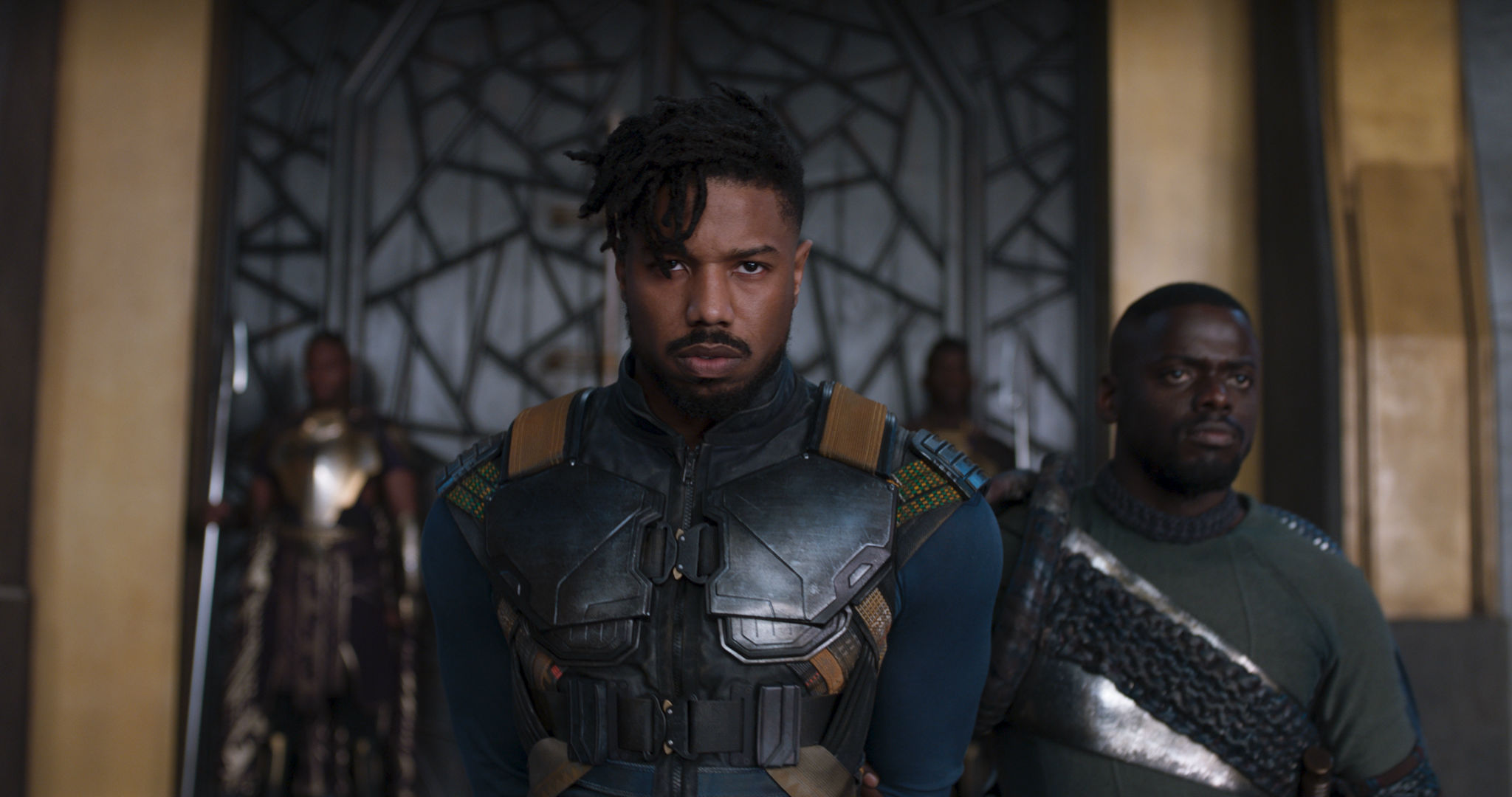
The villain of the piece, N’Jadaka/Killmonger, turns out to be T’Challa’s nephew. T’Challa’s father T’Chaka murdered his own brother, N’Jadaka’s father N’Jobu, for stealing and selling Vibranium — which some disreputable people (like Ulysses Klaue, played by Serkis) have come to understand is Wakanda’s secret.

This injustice, which T’Chaka later covered up and kept secret, causes the boy N’Jadaka to become a mercenary killer known as Killmonger. Now an adult, and having trained as a Black Ops Navy SEAL, he returns to Wakanda to challenge T’Challa for the throne. He appears to win the challenge, and immediately begins implementing the flip side of the Wakanda debate: he wants to position this secretly-superior country as the rightful ruler of all countries, turning its technology and resources into a war machine.

Killmonger finds lots of allies among the Wakandan population, and wins over the military wing. T’Challa, having disappeared and taken time to recover from near-death after the first battle with Killmonger, returns to Wakanda to reclaim his throne and must resume his battle — now with much of Wakandan might allied against him, and Killmonger now has powers and the suit the equal of the Black Panther.

As with all such movies, good eventually prevails against wrong, but unlike most other MCU films, things are not fully reset at the end. T’Challa takes on enough of the “Wakanda should be open” argument to bring his defectors back around, and starts making carefully-considered moves to let the world know about his country. It reminds me of some of the more recent, more mature Bond movies in its handling of issues, but the effects are strictly standard-issue, with a mix of fighting/action enhanced stunt work, and Sci-Fi type holo-effects abounding.

I’m reluctantly giving Black Panther three and a half stars because of the issues it raises and the focus on Afri-centric style and solid characterization, which means less time for (but still plenty of) fight/stunt/SF sequences, though certainly less stuff blows up in this one than any MCU film I’d seen thus far. I’m hoping — but not expecting — the sequel, Wakanda Forever, to keep this balancing act going. Sadly, Boseman’s premature death from cancer meant that much of what we would have expected from the sequel had to be changed.

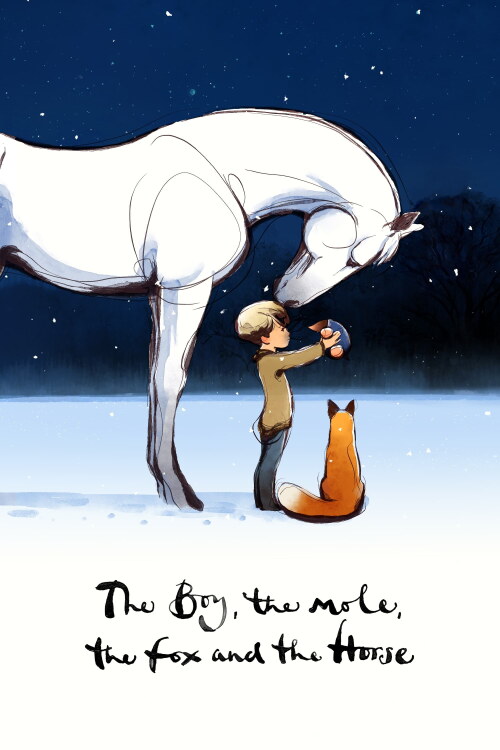
The Boy, the Mole, the Fox, and the Horse (2022, dirs. Peter Baynton & Charlie Mackesey)

⭐️⭐️½

52-week film challenge, week 8

This short film (34m) won the BAFTA for Best British Short Animation, and since I have a fondness for short films (I reviewed dozens of them for Film Threat back in the day), I thought I’d have a look. The bottom line on this is that as a short film, it is deeply flawed in the story and dialogue department, but does indeed feature some lovely animation and music, along with considerable vocal talent.

Other reviews of the film — which follows the original book by Charlie Mackesey in both prose and illustration style — have been similarly mixed. The majority seem to side with me, in that a worthy project has been let down by a lack of story logic and an over-abundance of stilted aphorisms rather than dialogue.

On the other hand, I would be remiss if I didn’t mention those who liked it better than I did, because for them the film succeeded in touching them emotionally; perhaps in reflecting their feelings of having no proper place in the world, of a general sense of inadequacy or “imposter syndrome,” of longing for the emotional support in their lives that these four characters who have been brought together try to give each other on their journey.

Reading reviews like that gave me some further insight into what I think was the motivation of the filmmakers, and importantly the symbolic role each of the four characters play. The boy is the representative of those who feel lost; the mole speaks for those who are disabled in some way, or are otherwise naturally vulnerable; the fox is an anxious introvert who says little but keeps his thoughts and emotions under wraps; and the horse hides both himself and his true talents due to loneliness and depression.

This kid wouldn’t make it through the night in the real world.

Its core audience, then, picks one of these characters to identify with, and hopes — like each member of the foursome — to gain something hopeful from the journey. However, if you don’t see yourself too strongly in any of these characters, they fall flat and don’t say much that speaks to you. That’s what happened to me.

So what I’m saying here is that I (now) “get it” a little better, and understand how some people could have such a different reaction and identification with the characters, to the point of overlooking the film’s flaws because of the power of representation. That said, in my view the filmmakers were too keen on getting these stereotypes together and badly dropped the ball on a) telling a coherent story and b) fleshing out the characters instead of turning them into walking self-help motto machines.

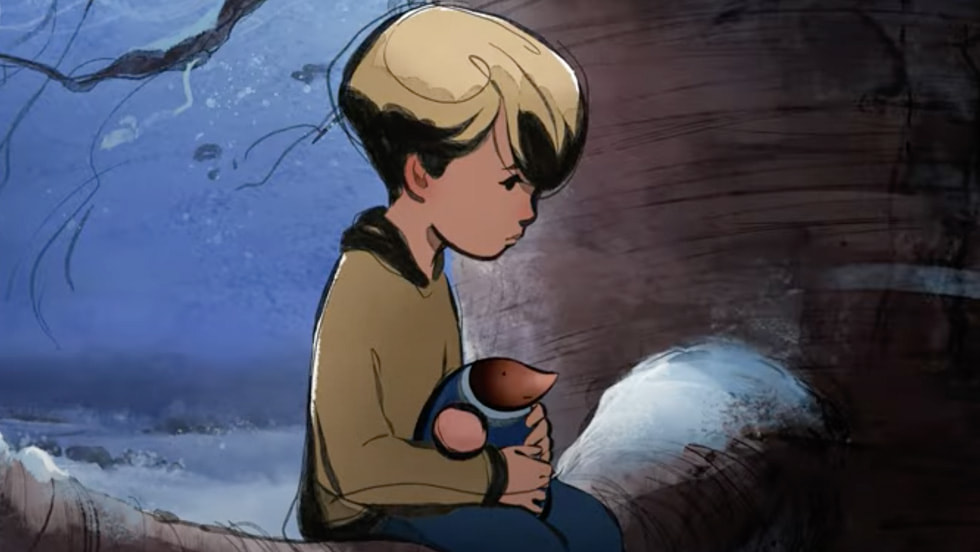
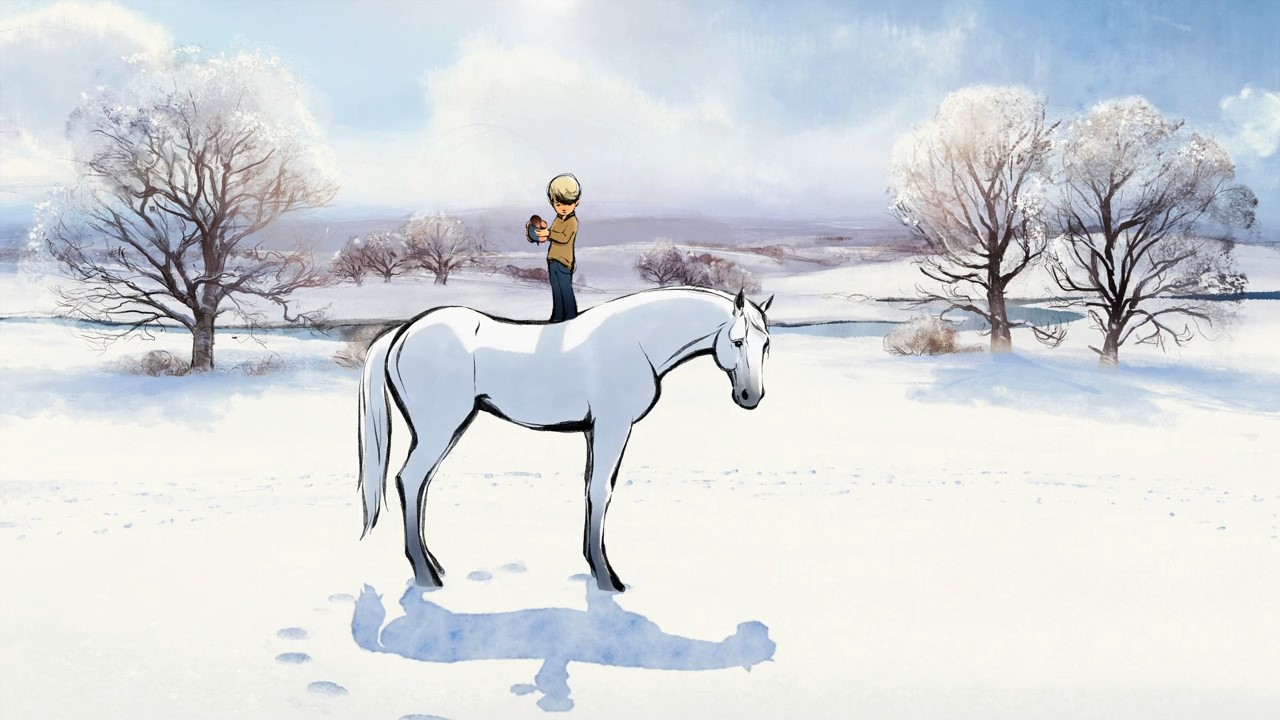
Since the animation, character design, camera & scenic work as well as the soundtrack are all perfectly fine, I have to focus on the near-total lack of story coherence. As the film opens, we see a boy (inadequately dressed for such weather) wandering across a lovely snowy landscape. As with any winter wonderland, the world looks new and clean and fresh. After a bit of lingering on the beauty of it all, the wandering Boy happens across a mole, who quickly befriends him with his cheerful attitude.

As they learn a bit about each other, the boy discloses that he is lost. Right at this moment, the film goes badly wrong when Mole does not simply suggest that the Boy just follow his own snow track back to wherever he came from. Further, the Boy suggests he is looking for “a” home, rather than “his” home, so right away we are as confused about where he came from as he apparently is.

Mole, who is good at burrowing but barely able to walk on the surface, first suggests climbing a nearby tree at the top of the hill they are on to get a wider view of the surroundings, and a few playful moments ensue with the Boy of course carrying Mole up with him. Before they can spot any sort of housing or town, they fall from the tree (miraculously without injury), but not before they spot a river. Mole suggests they follow the river starting tomorrow, as that invariably leads to somewhere, and the snow begins to fall again — so they retire for the night (to where?) to await the morning so as to begin their trek. There is no mention of shelter or food anywhere in the film, and no indication of how they would acquire either of those things (or survive the freezing temperatures at night), because why should this film even flirt with any degree of realism?

The next day, they get to the river and of course due to playful shenanigans, they fall in. Again, both Boy and Mole seem impervious to both the cold and being soaked, which really makes you (or at least me) wonder why this film is set in the winter at all, other than because snow is pretty. While helpless, a fox that has been following the pair since that first hill makes his play for capturing Mole, including rescuing him from the water with the aim of killing and eating him as you might expect from a fox. Indeed, Fox makes an explicit death threat to Mole once he is caught in a snare.

Mole makes the decision to chew through the snare, freeing the fox. Confused and frustrated, he runs off — but later begins not-so-secretly following the pair as they climb up another (bigger) hill to get the lay of the land. This time, at the top of the hill they spot a distant town with lights, and the trio begin their journey in earnest, with Fox still following at a discreet distance — as though he is attracted to their comraderie but doesn’t want to make it too apparent he wants to join them, although they have noticed him hanging back as it has become obvious.

To this point in the movie, the dialogue has been sparse but mostly story-driven, sprinkled with words of friendship. The dialogue aspect will soon bed almost exclusively replaced by declarations of feel-good quotables of the sort you’d hear from a self-help group leader.

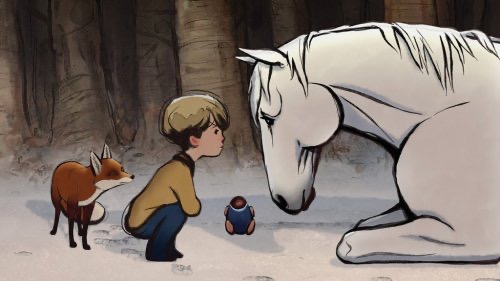
Eventually Fox approaches, says he is sorry for his past actions, and is immediately trusted and accepted into the group. After an unknown further time (presumably including at least one further night, though again no mention of food or shelter), they are ambling through a forest when they come across a horse who is attempting to hide. A few nuggets of shared wisdom later, Horse joins the party and the film’s title is now complete.

Horse gives them rides, and some merriment is had as the group continues to bond. A notable scene occurs where Fox gets a character moment to explain why he doesn’t say much compared to the others, and from here on pretty much all we get going forward are round-robin soliliqies of of love, friendship, and support.

Horse reveals his secret … he could have moved the plot along, but didn’t.

Some indeterminate time later (again, presumably nights and days in the cold have passed), the group finally seems tired and rests, whereupon Horse reveals a secret: he can fly. He has kept this talent hidden to avoid attention, for no discernible reason. In short order, the group flies the rest of the way to the entrance to the village/town, and a scene of goodbyes and further fonts of well-put wisdom are exchanged as the animals prepare to return to their previous lives.

As a reminder, this is apparently not the place the boy came from, and he doesn’t seem to know anyone there, but just assumes he will get a Home (hashtag entitled much?). It would be a more effective emotional scene if it wasn’t so littered with pull quotes from a 12-step program.

After saying goodbye to his friends, Boy begins to leave but quickly decides not to go, because he has twigged that home is where you are loved and “family” is who are enjoy being with, and so he doesn’t even give the town a chance. It would seem that the meaning of life is to love and be loved — which is a lovely idea — but the film ends there, blissfully free of any degree of realism.

The artwork is a great compliment, but a definite improvement, to the original artwork in the book.

The movie is rated 5+, which suggests it is aimed at kids — but even kids these days just aren’t this naive as to think that amassing a small group of diverse but supportive friends is the only thing you need in the world. Or perhaps I’m just a curmudgeonly old fusspot for wanting the film to have at least some tenuous connection to reality, the way the beloved films of my childhood — Charlie and the Chocolate Factory, the Wizard of Oz, Mary Poppins, the Muppet Movie, Toy Story, the Goonies, Charlotte’s Web, The Last Unicorn, The Princess Bride and so many others — did. Hell, the Roadrunner cartoons I adored as a boy were more anchored in the world I lived in than this.

I rate this movie — or at least its written in a new-age crystals store script — Bah Humbug, and no I won’t see the error of my ways later. A movie filled with amorphous affirmations where every character is wonderously wise and replete with the sort of positive pop pablum one expects to read in a Stuart Little daily calendar takes the children out of this children’s movie and reflects more accurately generations of bitter, broken grownups who long for a simple saying that will somehow hug away all of their adult life’s complications, regrets, bad luck, and bad choices.

While I appreciate the message of the importance of friendship and diversity, and again mention that many elements of this film — the animation, voice talent, and music specifically — raise it above average, it’s just overly simplistic even for a kid’s book and film. The Boy, the Mole, the Fox, and the Horse relies too heavily on superficial self-deluding sayings to rise above even a cursory set of critical thinking skills, which I happen to think most kids over the age of five have acquired in some measure.

A Hard Day’s Night (1964, dir. Richard Lester)

★★★★
52-week challenge, week 7

On the very day that the Beatles performed their first US concert back in 1964, I sat down to finally watch in full a movie I had seen clips of all my life: A Hard Day’s Night, the movie debut of The Beatles that further cemented their new fan base in the USA. Somehow, I had never gotten around to watching the entire film, and seeing it in full really surprised me in how vital, innovative, and enjoyable it was as a complete work.


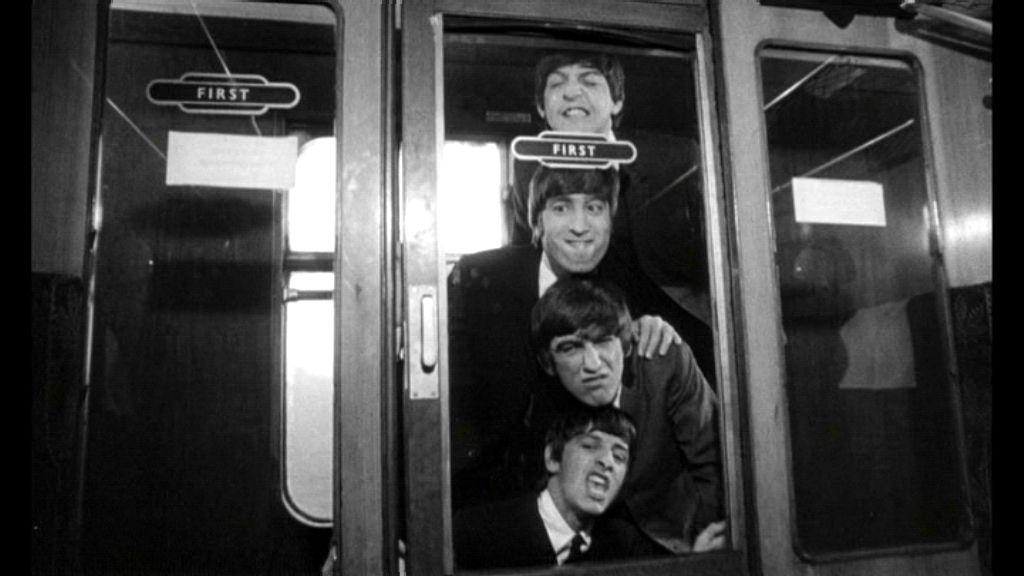
The film features more running than The Running Man and almost as much as Run Lola Run, mostly of the band trying to escape their shrieking fans. The film, which starts in black with the twanging opening guitar chord of the title track, features George Harrison taking a tumble almost immediately in the first chase sequence, but of course with the energy of youth and adrenaline picks himself up immediately and — like the rest of the group — has a big grin on his face as he resumes his sprint.


Director Richard Lester was determined to capture that level of youthful vigour by employing what at the time were dubbed cinema verité — innovative interminglings of hand-held, moving, and quick-intercut shots to represent the chaos of the chases. While the movie has a lot of these, there are times when the boys find respite and start to unfurl their humourous personalities and even advance a tiny bit of story — and for this, Lester reverts to somewhat more traditional camera styles, but still relies on being able to get his 16mm cameras into tight spaces for a more intimate feel.

The decision to make the film in black and white was likely a budgetary move, but it reminds me of why I like old movies (and in particular B&W films) so much: they are a window into a world that no longer exists, not just on a societal level but also presented in a way that was par for the course at the time but was nonetheless an abstract and dreamlike layer over reality. This film, even more so than usual: not only is it The Beatles as they originally presented themselves, but it’s been credited with having thrown off, once and for all, the societal straitjacket of the 1950s.

As much praise as Lester deserves for directing and editing the film, a lot of credit should also go to Alun Owen, the screenwriter. He hung out with the band for some time, and got two things absolutely right in his script: an ear for the funny banter the band effortlessly delivers, and an eye for what a rigmarole their lives were becoming as their fame exploded.

The story, such as it is, covers a period of about two days in the band’s life at the time, with some events being driven by their own harried schedule, with some being driven by the subplot: Paul’s scheming “grandfather” (Wilfred Brambell, best known for “Steptoe and Son”), who runs cons and generally complicates their already-chaotic lives.

Wilfred Brambell tries hard to steal the picture as the troublesome “John McCartney.” Isn’t he clean, though?

Thanks in part to the delightfully witty banter, frequently broken up by silent scenes of (again) mostly running about to the accompaniment of the band’s singles from their third album, and the contrivance of more songs for one of the boys’ TV appearances, the focus never lingers too long on any one scene or story element. All four of the lads convincingly look like they’re having a great time being in the film.

This film likely contributed to the “Swinging London” scene in the later 1960s as those teen Beatles fans — and the Beatles themselves — matured. Without a doubt, A Hard Day’s Nightwas a direct influence in the creation of The Monkees, and the freewheeling style of their popular US television show.

Lester is careful to give each Beatle some spotlight time, but two particular scenes stand out: a brief interlude where a woman seems to recognize John as “you’re him,” but he gently introduces doubt into both their minds until she puts on glasses and is then sure that John isn’t John, with John walking off agreeing that “she looks more like him than I do.” Another scene has Ringo escaping the chaos for a bit and having his own adventure by a river, where he meets a young boy (David Jason) and has a nice conversational scene.

Interestingly, every teenager in the film — with an emphasis on girls, but there are plenty of boys running after them also — knows very well who each Beatle is, but the majority of adults in the picture have no idea at all. Another fun scene finds the lads in a train when a middle-aged businessman comes into their coach, creating some light tension.

Actor Richard Vernon (of a very long career, though for me he will always be Slartibartfast in “The Hitchhiker’s Guide to the Galaxy” TV series) harrumphs his way into bullying the boys, who use their free-spirited impudence to intimidate him right back. Talk about a movie that caters to its audience.

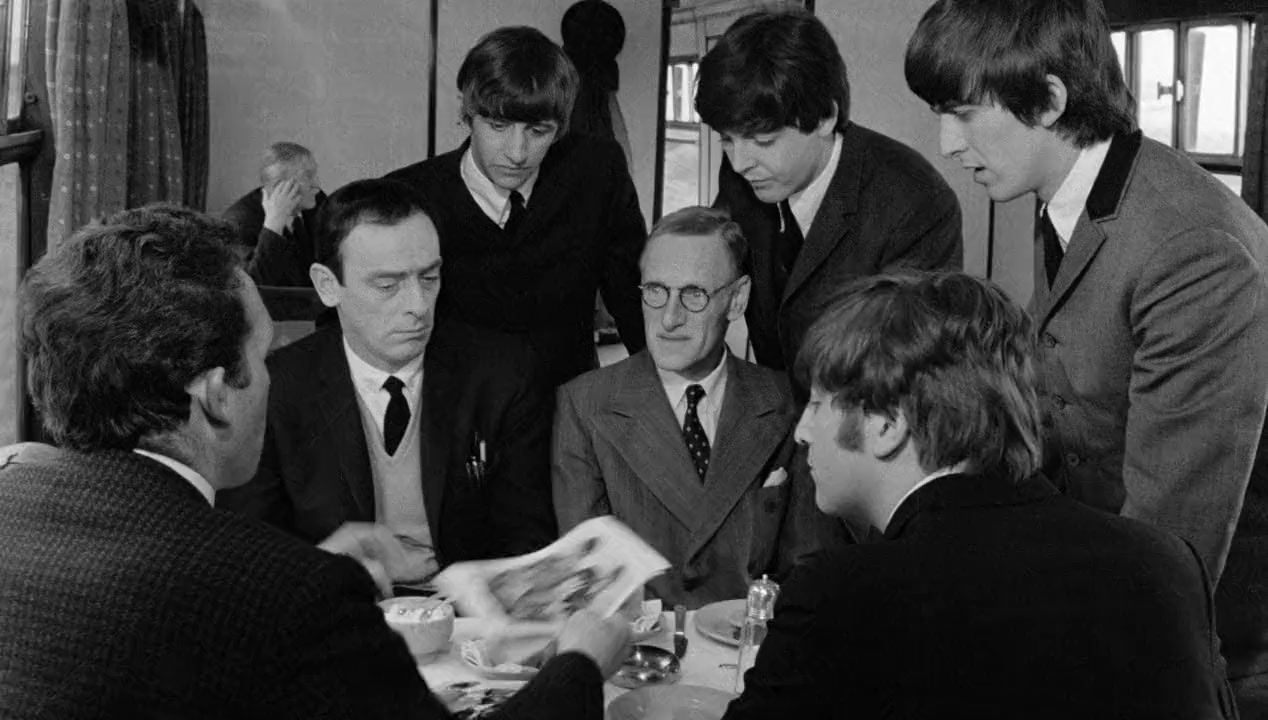
The boys tease a stuffy British businessman who tried to bully them.

After some very mild “drama” about whether Ringo will get back to the rest of the band in time to do the live television concert and avoid giving the director of same (Victor Spinetti) a nervous breakdown, and what mischief is Paul’s grandfather up to now, everything comes back together just in time, and after playing to a screaming teen audience, they run yet again to catch a helicopter and off to whatever the next thing is.

I counted eight full Beatles songs (and several more reprises) in the film, not including some George Martin Orchestra instrumental versions near the end. The movie was a big hit on both sides of the Atlantic, and has continued to be very highly rated among critics and various “best of” lists for the past 59 years.

Prior to this, Lester had done a film with Spike Milligan and Peter Sellers called The Running, Jumping, and Standing Still Film, and it was that absurdist short that both got Lester the Beatles job as well as established the style for A Hard Day’s Night. It’s a good time and some great music spread across 90 fast-paced minutes, and gives us a loving moment in time just after the Beatles hit it big. If you aren’t tired of their early hits — and how could you be — the film still holds up really well viewed by more modern standards.

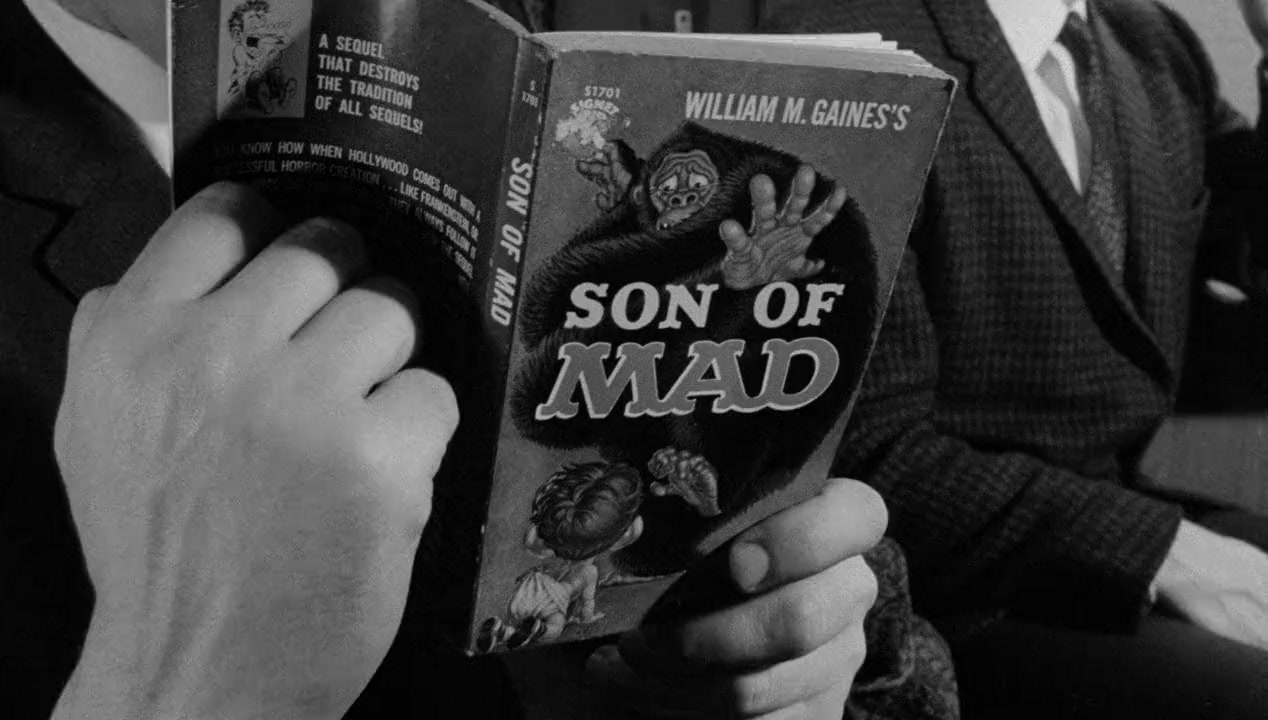
A favourite moment of mine in the film: the band’s road manager is reading a Mad Magazine anthology book.

La Passion de Jeanne d’Arc/The Passion of Joan of Arc (1928, dir. Carl Theodor Dreyer)

⭐️⭐️⭐️⭐️⭐️
52-week film challenge, week 6

If you only watch one silent movie from the 1920s in your life … well, you’re really cheating yourself out of some amazing filmmaking. But The Passion of Joan of Arc is one of the most riveting ones, lovingly restored and enhanced to 4K from a nitrite copy found in a Danish archive in 2005. It is — by far — the sharpest and clearest silent movie you’ll ever see, with a deep focus on faces, from its star, Maria Falconetti, and across the entire cast. You can count the pores on everyone’s faces in the close ups — that’s how amazing the restoration has been.

I’ve seen the film twice: once at a screening in Tampa accompanied by a live chorus and chamber orchestra many years ago, and just recently the slightly-abridged 4K version with the Gregory and Utley score from 2010. Both times, the film’s visuals grab you immediately and do not let you go — you scarcely want to blink for fear you will miss another pin-prick sharp facial close-up or tear falling from Falconetti’s face.

The film is based on the actual record of the trial of Jeanne d’Arc from 1431. Being a silent film, Falconetti spends most of her many close-ups portraying her suffering, her passion, her holiness, her hope, and her despair — her performance is often praised as one of the greatest ever. The evocative faces of her judges, prosecutors, pious church officials, and spectators are an astonishing gallery of human emotions, especially the uglier ones.

Eventually, Jeanne is convicted of heresy and nearly put to death before she finally agrees to recant at the last minute, whereupon she is sentenced to life in prison. Very shortly thereafter, she accepts the truth of her fate and takes back her recanting, finally understanding that her mission is to be a martyr and that her promised “release” from her suffering is her death.

Dreyer doesn’t shy away from filming the alarmingly violent and gruesome burning at the stake, with the villagers helplessly trying to revolt in anger at the betrayal of the church, and the murder of a saint. Following an hour of the trial, the change of pace of Jeanne in prison and then executed makes for a horrifying but fulfilling climax to the film.

The clarity of the restored print coupled with the skill of the filmmaking really makes you wonder if other silent-era classics that still have that softer, more cartoonish cast to them might also be able to get this level of restoration and enhancement, as the combination of interstitial titles, heroic music, and the riveting performances really make the silent era more relevant to modern audiences. In Dreyer’s relentless use of close-ups (combined with some surprisingly inventive shots during the final action sequences), his influence on many future filmmakers, particularly Fellini, is keenly felt.

In the most recent poll from Sight & Sound on the greatest movies thus far, La Passion de Jeanne d’Arc ranked 21st (tied with Late Spring). It has always been somewhere on the top 100 list since the first version in 1962. Yes, you really ought to see it — preferably with a live chorus & orchestra, if possible. This is an essential film that should be seen by anyone who prizes film as its own unique art form.

Playtime (1967, dir. Jacques Tati)

⭐️⭐️⭐️⭐️⭐️

52-film Challenge, week 5

I have seen many (though also not nearly enough) of the films often ranked in the top 100 of the “greatest films of all time” — as though time was over (or making films was over) and a final judgement could be rendered.

Playtime, made by and starring Jacques Tati, is a bona-fide masterpiece and visually one of the greatest films made … thus far. Forget Avatar, this 70mm exploration of humanity versus modernity blends several distinct film genres into one, with both deep philosophical and funny results.

In its way, it is a silent movie. Not literally of course, but dialogue is generally not viewed as that important and often pushed into the background. Actions take center stage and often key “gags” are performed simultaneously, meaning viewers have to keep their eye on virtually everything happening in the (wide) picture frame, and their ears open for any snippets of important “story” detail.

It is a film that demands, and rewards, your full attention.

Mostly, Playtime doesn’t really have a story as such: it is structured more like a “day in the life of” type film. That said, we do more-or-less follow a couple of key characters around a few city blocks over the course of around 18 hours — Tati himself, playing the hapless everyman of Monsieur Hulot (which appeared in some of Tati’s earlier films, most notably Mon Oncle), and the American tourist Barbara, who came to Paris to see the famous sights, but can’t seem to find them except for glimpses and moments.

The theme of the film seems to be that Paris is modernizing, and losing its character — but that humanity (at least as embodied by the Parisians in the film) fight back with chaos against the new, bland, glass-and-steel city they find themselves in.

Anyone who enjoys architecture as a topic of sometimes-appreciation, sometimes-debate — like me — will be positively swimming in the gigantic custom-built set of ultra-modern (and still uncannily relevant, 55 years later) “Tativille,” where traditional Paris is only seen in reflections in the endless glass doors or symbolised by a lonely flower shop on one of the exceptionally-clean street corners.

It doesn’t matter if you already know M. Hulot from the earlier films, his character is a universal silent-film comic archetype: a good person who continually falls into comedic misfortune or unwittingly helps drive events in the film through his difficulty in this unfamiliar environment.

Where nearly everyone wears smart suits or fashionably bland dresses, Hulot primarily wears a mack (overcoat), a traditional hat, ill-fitting clothes, and carries a pipe. He is a person living in the mid-60s, but not at ease with the pace of change and modernisation. The influence this must have had on Rowan Atkinson’s Mr Bean can scarcely be overstated.

Barbara, the tourist, often separates herself from the sheep-like tourist group she is with, determined to see the area on her own terms — but like a lost lamb she is often rounded up again and herded along to wherever the next encounter is supposed to be. When she sees only the reflection of the Eiffel Tower, she turns to gaze at it longingly — but she is miles away, in this concrete jungle.

Hulot stumbles around the film — seen more often than any other single character, but likewise often disappears for a while — bouncing from one hapless round of mostly-visual sight gags to another, all within a jungle of beautiful but sterile steel-and-glass storefronts and offices. One of the early scenes shows M. Hulot attempting to meet with an official of some sort, but the two only rarely intersect in the rat’s maze of a corporate cubicle farm (predicting that trend over 20 years early).

Barbara and M. Hulot do run across each other increasingly as the film goes on, because they are nearly always in what feels like about a four-block radius of each other. Unlike most films that feature strangers meeting, it never threatens to become a romantic comedy, and this is refreshing.

As mentioned, sound (and music) happens in this film to distinguish it from a silent film, but in the early scenes it’s used more like a paintbrush to set tones or support the visual language, and only much later in the film do both sound and human dialogue really come forward as equal elements.

Things build slowly, focusing on sight gags early on (and again, you have to pay nearly as much attention to the background as the foreground to get a feel for everything that is happening), but over time the film slyly shifts from being fascinated by the buildings and settings to focusing on the increasingly-chaotic humans as the action turns to the opening night of a not-quite-ready nightclub opening.

Eventually, full-blown chaos explodes among both the established characters and the myriad newcomers into the tale, but there isn’t really a climax in the traditional sense: things hit a peak, but as the dawn breaks we follow the climb-down and emerging calm that will reset the picture back to nearly the beginning, as the club empties, people find their way home, and Barbara gets back on the bus to go back to the airport — but not without spending just a bit of time with the old-fashioned gentleman that she’s been running into all evening.

At two hours, I’m not sure if modern attention spans will have as much love for Playtime as I do –– but the payoff on this film is enormous, and on multiple levels. It is a masterclass in visual comedy, multi-focus direction, sound as a background rather than foreground tool, societal commentary, and a celebration of messy humanity against a sterile, unfeeling backdrop.

Shot with 65mm film for a 70mm release, Playtime is ideal for HD and 4K TVs because everything, all the way back, is in focus. This gives Tati the opportunity to have lots of “business” happening throughout the entire frame, compared to the usual focusing on the main thing the director wants you to notice. This director wants you to notice it all.

The colour hues and theme of automation uber alles are stunningly gorgeous and, unlike most films of this period, would easily convince some viewers that it was made much closer to the current year than it was. Its contrast of de-humanising and re-humanising themes is endearing and still relevant.

The prolonged pre-production, wildly expensive full-size sets and clever illusions, the perfectionistic direction of almost every actor in shot and much more establish this film as a beautifully synchronised machine with only small moments of anarchy at the beginning, but by the end the wheels have completely come off in joyous defiance of sharp angles, and a smooth-running society.

It is a joyous movie that absolutely bankrupted and ruined Tati’s reputation, but he felt it had to be made at all costs — and he was right. It is an utter masterpiece, and nearly as relevant today as it was in 1967.

I’ll avoid talking about the ending of the film, but after (finally) some actual human moments in the denouement, Tati saves his best and most withering (visual) comment for the final scene. If viewers have tapped into Playtime’s zeitgeist and stayed with it, they are richly rewarded as it fades to black.

The Daughter of Dawn (1920, dir. Norbert Myles)

52 film challenge (week 4)
⭐️⭐️⭐️

This is one of the films that film-history majors watch, and pretty much nobody else (at least not anymore), but it’s actually a little bit fascinating.

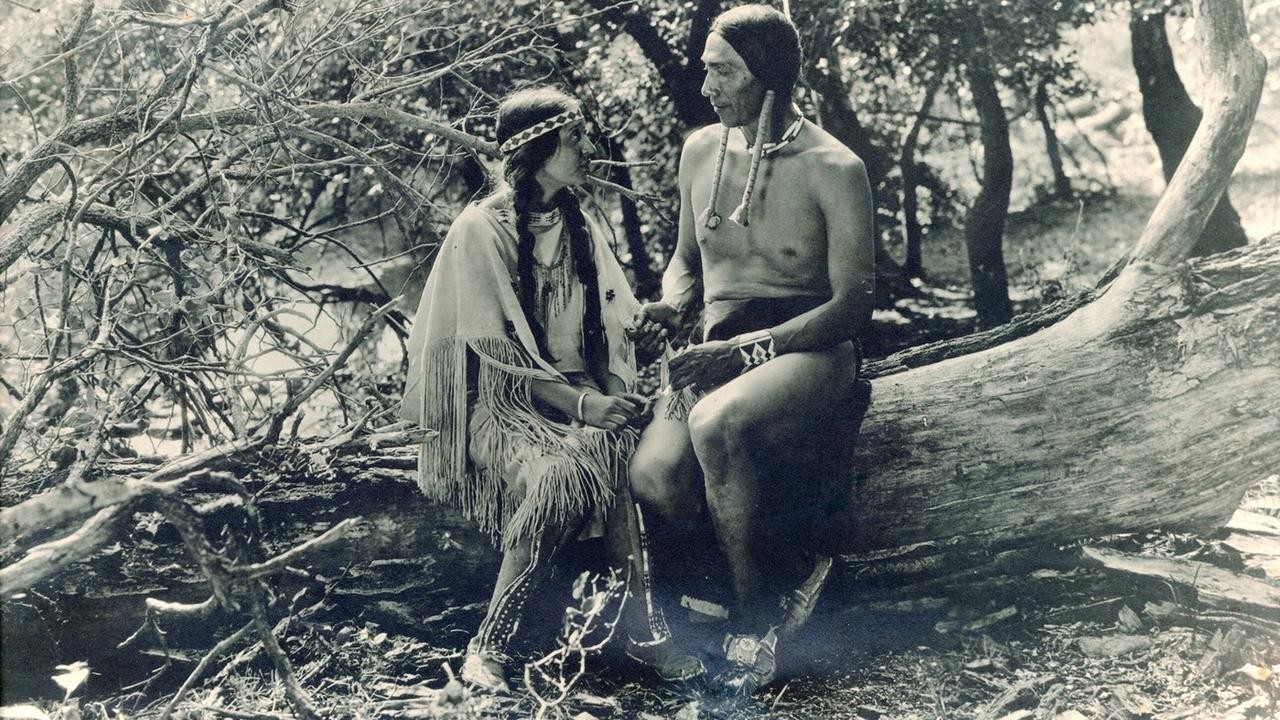
This silent film is a non-patronizing look at life among the Kiowa and Comanche tribes — set in a time before they were herded into reservations and their previous way of life forcibly taken away from them, but acted by people this had happened to some 50 years earlier.

The story is a pretty straightforward “love triangle” story, but what’s amazing about this silent film is that the entire cast, without exception, is portrayed by Native Americans (some 300 all together), and featuring authentic outfits, props, and tepees provided by the tribes.

The acting is of course variable, but convincing enough to impart the story of one brave who feels he “deserves” the chief’s daughter and attempts to force her into marriage, while the young girl has already fallen for another brave. True love wins out, which itself is something of a radical idea given the time when the film came out.

The portrayal of the women of the tribes is surprisingly much less patronising than expected; the villain of the piece Black Wolf does have another who pines for him (Red Wing), but he callously ignores her in favor of the Daughter of Dawn (yes, that’s her name). He spends most of the movie creeping around and observing from a distance in the standard silent-movie way, helping us uncover developments, whereupon he discovers his rival While Eagle and plots his downfall.

The Daughter of Dawn and her true love, White Eagle.

The simple story is kind of excuse to recreate something like pre-reservation life among two tribes, including great landscape shots of the plains (the film was made in Oklahoma), hunting scenes featuring actual wild buffalo, daring stunts, and some time spent on the day-to-day life of the people. Director Norbert Myles seems to have wanted to a documentary-style drama rather than stigmatize the “savages” as was more the style for the time.

Actual First Nation peoples! Actual outfits, props, and tepees provided by the tribes themselves!

On a story level, this wasn’t that far removed from The Searchers (1954), but apart from the interesting historical context and backstory of the film itself — it was presumed lost for almost 90 years before mysteriously resurfacing in 2012 — it’s not a film most non-native people would seek out.

It’s pretty well-made and sympathetic for a 1920 silent film, and benefits strongly from an authentic Native American cast. The plot is very well-worn nowadays, but I would imagine it captured audiences’ imaginations — and maybe won over a few “paleface” hearts and minds — in its day.

The Tragedy of MacBeth (2021, dir. Joel Cohen)

52 Film Challenge, week 3
⭐️⭐️⭐️⭐️⭐️

I’ve been saving this film since it came out since the trailer alone told me what I needed to know about it — neo-expressionist, Escher-influenced, exceptionally-sharp B&W mixing stagecraft and filmcraft (and witchcraft) with stunning performances and visuals that I would eat up like candy.

At just over an hour and 40 minutes, this might be seen by some as an attempt to get theatre-resistant souls to give this major Shakespearean outing a fair shake —

but the substantial trimming of the text is so skillfully done that the stark and incredible visuals fill in what’s not there with great artistry. The speeches that I recalled most vividly from the many productions I have seen in theatres were still there.

About the only bad thing I can say about this is an unfair complaint: I never find Shakespeare’s lines quite as musical when they are done by American voices. That is not to, in the least, denigrate the performances of the leads — Frances McDormand as Lady MacBeth (stunningly well portrayed) and Denzel Washington as MacBeth himself, though he failed to connect with me quite as much as some of his predecessors in the part.

I liked the variations, sincerity, and styling Washington gave to his speeches, and he joins a company of fine actors, from Bertie Carvel (in a very fine turn as Banquo), to Alex Hassel as the impossibly thin, impossibly beautiful, impossibly expressive Ross, to Harry Melling as Malcolm (another good turn from this maturing actor). This being filmed entirely on a soundstage (in California, sadly) gave it a beautifully claustrophobic atmosphere, even when scenes were set outdoors. A triumph of cinematography, this.

Alex Hassell as Ross nearly steals the picture, except when Frances McDormand is on.

Visually, pacing-wise, and performance-wise, this version punches all of my buttons and while I have seen a handful of filmed MacBeths before, this one is far and away my favourite. It’s like no version of the show seen before, and combined with some sparing but incredibly clever effects to enhance the witch(es) — with a nod of awe to Kathryn Hunter for her stellar performance — it is as riveting to watch as any of Laurence Olivier’s Technicolour (or B&W) Shakespearean movies (one of which actually has Melling’s grandfather in a notable role).

Holy crap, this scene.

A mention must be made of Carter Burwell’s musical score, which is minimal and rarely calls attention to itself but which is yet another element setting the mood, which is what Coen has really brought to this production (other than some well-placed scissors to the script). Although there were a few fleeting moments when I wished a line or an actor’s look had been done a bit differently, or if a scene had lingered just a bit more, these were but quickly drowned by the glory of the effects, the sets, the cinematography, the lighting, and all the other elements.

Finally, I am not yet settled on Coen’s main addition to the tale, that being some staging that suggests a non-traditional interpretation of the third murderer. But perhaps I will drink in this sweet wine of a film again and ponder on it. This unconventional movie took some risks, and for me most of them paid off handsomely.

“Low” at 45

Guest post by Tony Visconti:

It’s anniversary time for David Bowie’s Low album. I’ve commented on it before, but certain elements of it are worth repeating.

For me it started with a phone call from Switzerland, where David was living at the time. He said that he and Brian Eno were working on a certain concept for a radically new album idea (and it was about time somebody did that). He briefly described the minimalist approach and plans for instrumental tracks, a first for him, but relying heavily on Brian’s great sonic landscape compositions. He asked me to join them in the ‘Honky Chateau’ in the outskirts of Paris, France, and cautioned that as it was experimental I might be wasting a month of my life for nothing.

I replied that spending a month of my life with you and Eno was worth it!!!

We sequestered ourselves for the first two weeks. I ended up not shaving or wearing shoes as my life consisted of dining room three times a day and studio most of the day, then the ‘haunted’ bedroom at night (but that’s another story).

Amazingly all of the tracking was done in two weeks, first with the band of Carlos Alomar, Dennis Davis and George Murray. In the second week Brian and David laid down the bed of the ‘ambient music’ tracks. My new fangled Eventide Harmonizer 910 had a lot to do with the sonic nature of the tracks, not only the snare drum sound, but in the instrumental compositions too. David and I spent two more weeks with the overdubbing and mixing.

On the day of the final mix David asked for a cassette of all the mixes. He had quite a lot to drink. When I handed the cassette to him he waved it in the air and exclaimed, “We have an album,” considering we were never sure we did have an album until the final days of mixing.

David left the control room very excited, but we quickly heard a rumbling sound immediately afterwards and ran to the staircase. David had fallen down and was lying at the bottom in pain, but holding the cassette over his head. He was fine the next morning.

We never wavered from the decisions to make the album as radical as it sounded, even though critics panned it for the most part. Okay, so it wasn’t Ziggy Stardust II, but the influence it had on musicians, to open up more, gave birth to new genres and Pop music as an Art form.