The Black Pirate (1926)

Director: Albert Parker
⭐️⭐️⭐️⭐️⭐️

I like to think I’ve seen most or all of the “key” early/silent movies, and I’m sure I’ve covered a fair few of the essentials, but every now and again I come across one I somehow missed. The Black Pirate is a masterpiece I somehow overlooked — a Douglas Fairbanks movie, no less! — and it is magnificent.

This was a very early film done in “two strip” Technicolour, so it was probably pretty shocking to audiences in its day for a number of reasons, and a recent remastering means we have a lovely, clear print of it to enjoy now. Although Fairbanks had previously done swashbuckler films, I think The Black Pirate is the primary seed of all future pirate movies.

Comin’ at ya with both barrels!

This is the one they all draw from in one way or another, because its so well done, and while I only have one real criticism of it, so much of what we think of when we think of a “pirate movie” or “high seas adventure film” is all present and accounted for, right here. When it comes to cinematography, music, stunt work, performances, and pacing, this movie is pretty much without flaw.

The main focus, as with Thief of Bagdad and other Douglas Fairbanks adventure films is of course Fairbanks and his enthusiastically physical stunt work, including swinging from ropes, climbing up things with incredible vigour, lowering himself from high up in the mast by sticking a knife in a sail and “riding” it down, and — needless to say — swashing his buckles impressively.

Avast ye swabs! We be a silent movie in colour! Shiver me timbers!

Lest this degenerate into a Fairbanks fan fest, I should mention that the noted actor and director Donald Crisp plays McTavish, who assists our hero even in his darkest hours. Crisp had directed Fairbanks in Don Q, Son of Zorro a year earlier, and their chemistry is very obvious here.

McTavish (left), a shipload o’ scalawags, and The Black Piraten (right)

The story is credited to Fairbanks, who used a pseudonym and essentially cobbled a Cliff Notes version of Howard Pyle’s The Book of Pirates and their archetypal illustrations. The plot moves along surprisingly speedily for a film from the 1920s, and the film’s 94 minutes go by very easily thanks to minimal plot breaks between action scenes.

The film opens immediately to one of those action scenes, where pirates have already taken over a ship and are plundering it before setting fire to the gunpowder in a manner that gives them time to get away before the ship blows up. Two survivors wash ashore on a deserted island, a father and son. As the father dies, the son (Fairbanks) vows revenge on the pirates.

When the pirates park their own ship on the opposite side of the island, Fairbanks appears as the boastful “Black Pirate” and demands to join their crew, setting himself two challenges that he completes that impresses everyone but the second-in-command Pirate Lieutenant, which sets up the conflict.

The soon-to-be-dead Pirate Captain and his first mate, the Pirate Lieutenant.
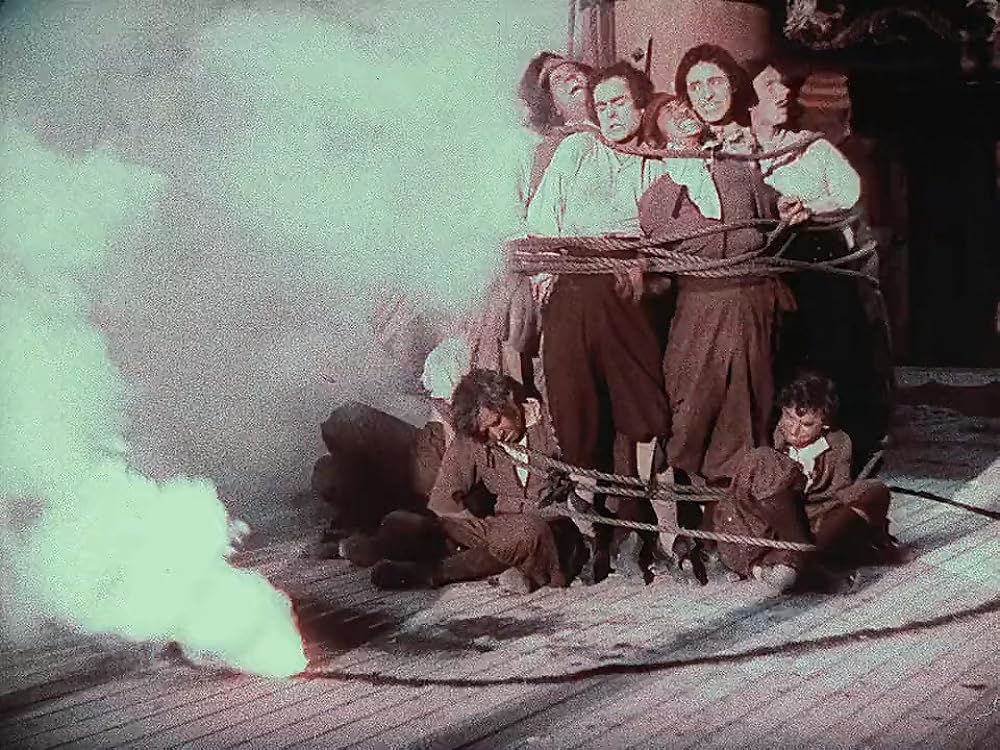
The pirates tie up the crew and use a gunpowder trail to give them time to get off the ship before it blows up — ingenious and cruel all at once.

When the Black Pirate leads the ship to another successful raid (but cleverly prevents them from blowing up the ship), the crew are pretty much ready to make him Captain but for the Lieutenant. When a woman (Billie Dove) is discovered on board the raided ship, the Lieutenant claims her as his prize, but the Black Pirate — who has fallen in love with her on first sight — claims she is a princess they can hold for hostage as long as she remains “spotless and unharmed,” i.e. no raping!

After a few twists, Fairbanks saves the day and the dame, of course, with the help of troops who successfully rout the pirates. Luckily for him, the “princess” has fallen for him as well, and it turns out he’s actually a Duke, and she a noblewoman! How incredibly convenient (nobody cares, it’s the action scenes that are important).

One amusing note of trivia: apparently Fairbanks’ wife Mary Pickford insisted on doubling for Dove for the scene were the Black Pirate kisses the Princess. Jealous much, ma’am?

The one criticism I have is that, although the pirates do get busted, the Black Pirate does in fact lead a raid on another ship, allowing the pirates to steal all the passengers’ valuables (but preventing their mass murder) and takes a hostage who really has no choice but to fall in love with him because otherwise she’ll be raped by the Lieutenant and likely the rest of the crew. I must also point out that the TV show “Mythbusters” also tested the “riding down a split sail” trick and declared it implausible — this hasn’t stopped it being used repeatedly in pirate movies since 1926, though.
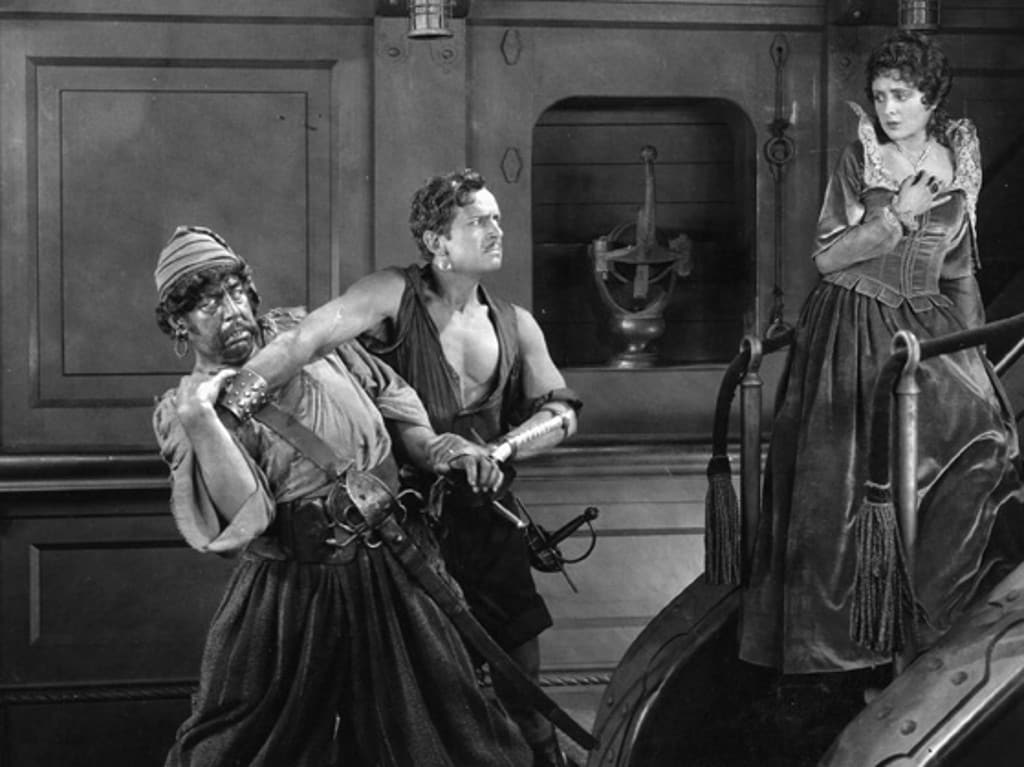
Yes, the one woman in the film is completely treated as an object and under threat of rape, but Fairbanks’ altruistic love and protection saves the day and of course causes her to fall in love with him.

Add The Black Pirate to your list of enjoyable popcorn action movies. The sort-of colour helps, but this is really a stunt movie that sets the tone for the genre of seafaring adventure, and so even if the plot is a bit lightweight, it remains a great film.
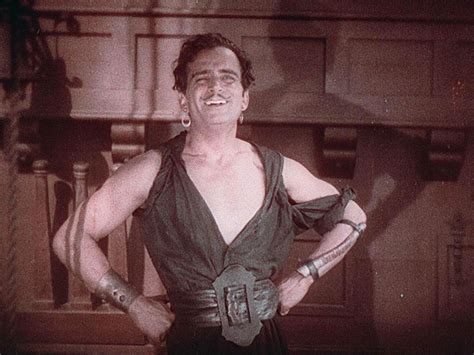
Ha! Ha! I win!

The General (1926, dirs. Buster Keaton, Clyde Bruckman)

⭐️⭐️⭐️⭐️⭐️
52-week film challenge, film 23

Blah blah blah Tom Cruise blah blah stunts blah blah Mission Impossible blah blah blah. You want stunts? You want life-threatening risks? You want thrills? Buster Keaton had Tom Cruise beat, handily, nearly 100 years ago with The General. Not only that, but you’ll learn at least a dozen new ways to stop a train you probably never thought of before.

Some of what he accomplishes in this 79-minute film seriously could have killed or severely injured him, and in fact he was knocked unconscious on one occasion during the filming. Several of the spike-pulling moments in the film would have put his life in severe danger if he had mistimed his actions, and there’s a lot of cow-catcher stunt work performed with the train and boxcars moving at speeds that added a great deal of risk to the shots.

The plot is pretty typical Keaton: there’s a girl he wants, but there’s an obstacle or set of obstacles in the way, and by a combination of dumb luck and reckless foolhardiness he blunders his way into overcoming the obstacles and gets the girl. The film is based on a true story of a Civil War locomotive chase, though Keaton for reasons unclear switched the sides, believing the public would be more sympathetic to the Confederate side, thus making the Union soldiers the villains.

Perhaps this contributed to the film’s poor performance at the box office at the time, despite having an exceedingly high budget (much to the studio’s consternation). But, to be fair, every dollar of it is on screen).

In The General, Keaton is Johnnie Gray, the engineer of his beloved locomotive, and is wooing a girl from the Lee family of Marietta, Georgia (having spent a fair amount of time in Marietta, this has always been an added bonus in the film for me). When the Civil War breaks out, the father and brother of Annabelle Lee rush to enlist, as does Keaton.

When he tells the clerk he is a railroad engineer, he is deemed too valuable in that role and turned away, though he is not told why. He comes across the Lee men after being rejected, but turns down their offer to join the line, branding him a coward in their minds.

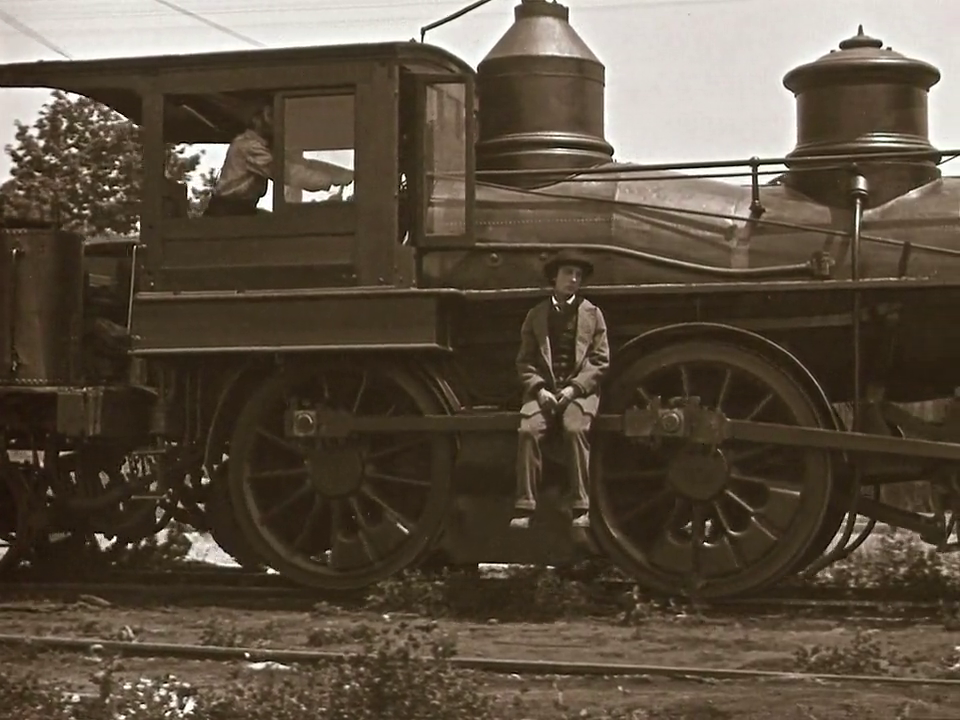
Despondent Johnnie rides the literal rail after being rejected by his girl and her family.

They tell Annabella of his cowardice, and she rejects him “until I see you in uniform.” A year later — a time lapse not made explicitly clear in the film — a gang of disguised Union operatives plan to hijack a Confederate train (guess which one) and use it to destroy bridges behind them as the travel north, cutting off the Confederate supply lines.

The ruse succeeds and strands Keaton, but he quickly finds both another locomotive and a group of Confederate soldiers to give chase — but as he pulls out, he fails to realise that the locomotive was not attached to the rail cars full of soldiers, so now it is just him chasing The General and its carful of Union saboteurs to get his train back.

And now, the plot wrinkle: Annabella was on the train being hijacked to go see her wounded-in-battle father, and unlike her fellow passengers, did not disembark the train during the dinner break, instead heading to the luggage car to retrieve something. She is thus captured by the Union hijackers, and held prisoner aboard The General.

After losing his second locomotive, he continues the chase anyway he can.

Once Johnnie discovers this some time later, he becomes determined not just to get his own locomotive back, but to rescue his girl and stop their dastardly plan. Before and up to that point, the film engages in a series of incredible stunts as the rogues engage in a series of gambits to slow or stop Keaton’s chase, believing Keaton’s train is full — once they discover it’s just the engine and him, the stunts get even more impressive, and occasionally some malarkey goes on in other locations besides the two trains.

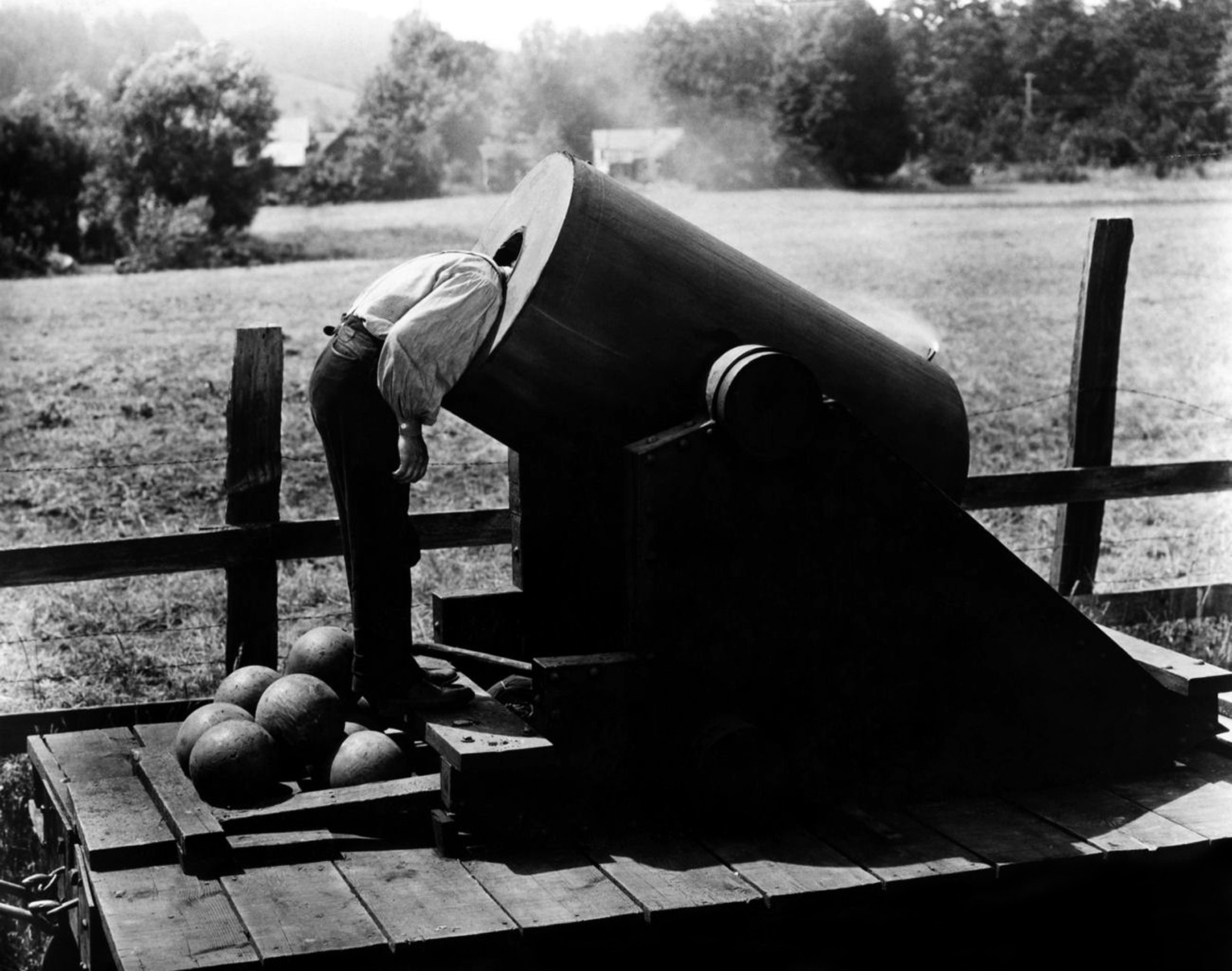
Checking to see if the canon he was towing in his earlier attempt to catch The General was working.

Keaton’s physical stunt-work is just mind-blowing to watch, especially considering that films in those days didn’t have the luxuries of safety considerations (though they did have stunt people for some long shots, those are much fewer than you’d expect — it’s mostly all Keaton). He climbs all over that locomotive like a spider, all while the train is in motion. If you’ve seen any of his films, you know he is the undisputed master of the thrilling-comedy-stunt moment, and there’s nothing Tom Cruise or anyone else can do about it.

The rail-thin Johnnie follows the raiders to a dinner where they reveal their plan.

I don’t think I’m spoiling anything by saying it all resolves in the end, Johnnie goes from civilian engineer to decorated leiutenant thanks to a field promotion, changes his occupation to “soldier” and finally enlists properly. Of course, the Lee family witness the finale and are deeply impressed, none more so than Annabelle.

Johnnie and Annabelle after he frees her from captivity by pretending to be a Union soldier.

Although it didn’t do well at its initial box-office debut, the film has risen steadily in the minds of both critics and cinephiles, and is now widely regarded as a true classic — and still routinely places very highly in lists of the all-time greatest movies, and still boasts the single most-expensive stunt shot in silent-movie history, which forms the spectacular climax of the film. While I’m still confused as to why Keaton reversed the sides to make it a peculiarly pro-Confederate film, the stellar filmmaking and Keaton’s performance overcome that one lapse in judgement.

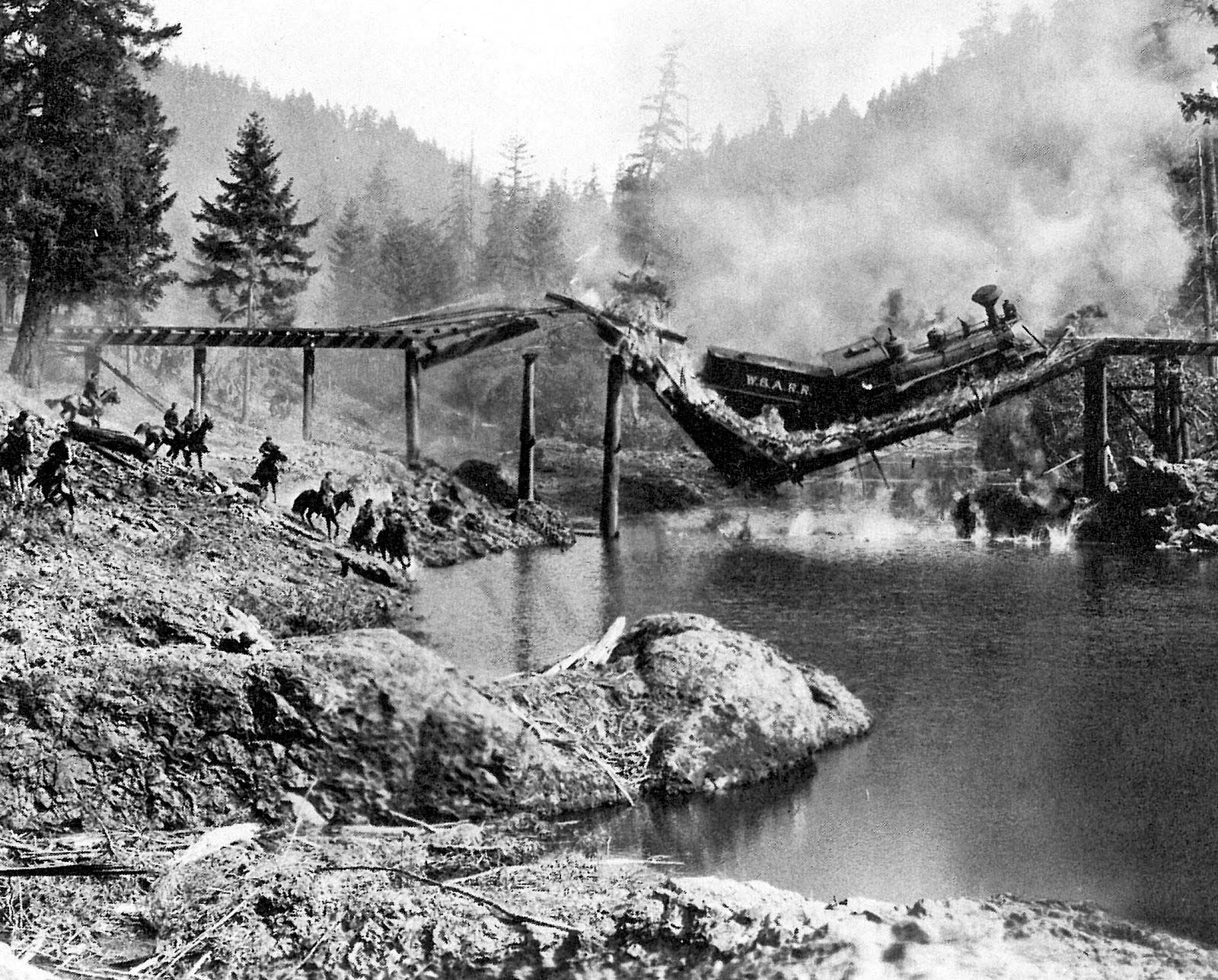
You will hardly believe your eyes as a full-on steam locomotive (in real life, the “Texas”) crosses a burning bridge and crashes into the river below; this is not a model shot, nor were any special effects used or needed — director Clyde Bruckman just left the wreckage there in the river bed until it was finally salvaged for scrap during WWII.

They really did build a bridge, set it on fire, then drive a train across it and plunge it into the river. For realz! No wonder it went over budget!

Apart from crowd scenes where a lot of running or marching is required, the film is mostly speed-corrected to show the actors in natural motion, and this really brings the sophisticated nature of late-silent era filmmaking to the fore. The recreated original score is also a treat, though alternative and more modern scores exist for the 4K Blu-ray release (the first silent movie released on Blu-ray, and a wise choice among many good options).

Apart from being in B&W, I believe you could show this to modern audiences and they would still find the pacing to be attention-holding, the story layered enough for today’s audiences, the humour still funny, and the stunt-work disbelieved to be as real as it actually was. It’s a mystery to me why the film isn’t a regular visitor to revival-house cinemas, or better known to this generation’s cinephiles.

I’m just glad nobody’s been dumb or reckless enough to try and remake it, because The General is truly a unique example of the best the reckless early days of American filmmaking has to offer that really holds up across its nearly 100-year history. Plus it’s a better movie than any of the Mission: Impossible series. There, I said it.