Brighton Rock (1948)

Dir. John Boulting
⭐️⭐️⭐️⭐️
52-week film challenge, film 44

Whilst away on a quick vacation, I had an opportunity to see Brighton Rock, a Graham Greene adaption starring Sir Richard Attenborough and, yes, William Hartnell. Although all of the Doctors are fine actors, the more I see of Hartnell the more I admire the variety he brings to his parts.

I’m beginning to believe that Hartnell did actually say that the only man in England who could replace him as The Doctor would be Patrick Troughton; they both mold themselves into the part instead of (as happens too often these days) the part being effectively written especially for the one character an actor plays especially well. Hartnell is only a featured player in this one, where the lead is Sir Richard Attenborough playing “Pinkie” Brown, a ruthless small-time gangster who leads a small-time gang of crooks, of which Hartnell’s Dallow is the most loyal but least adventurous … at least at first.

They spend their time shaking down some merchants of Brighton, a popular seaside tourist town on the southwest coast of England. Having been there, I can attest that things have only changed superficially there in the decades since this was made.
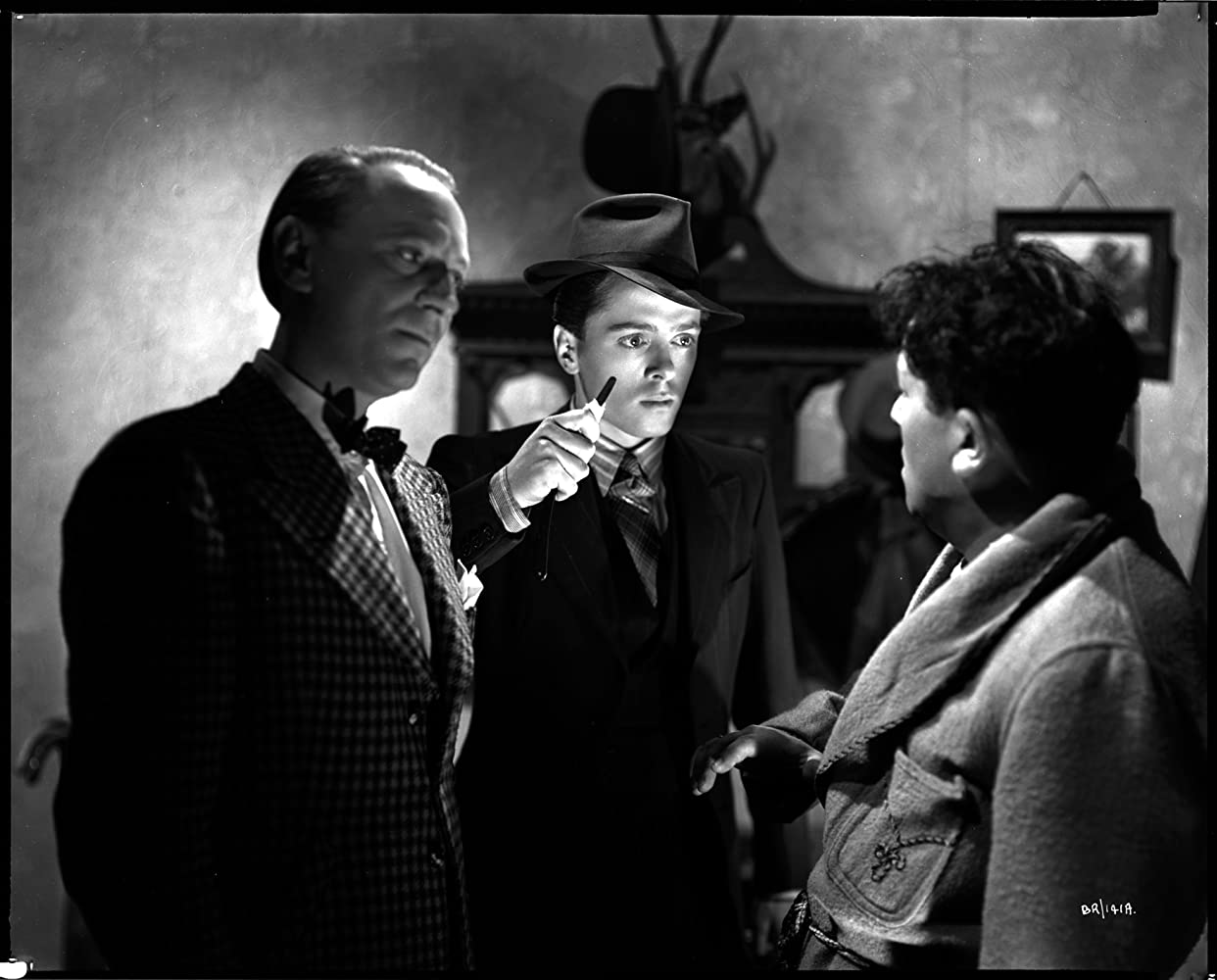
The story starts after the murder of a gang leader named Kite, that the police suspect was the result of gang wars in Brighton. They couldn’t be more correct: young Pinkie Brown has just taken over Kite’s old gang, and when Brown discovers that a man named Fred Hale is in town for the day doing a newspaper promotion, Brown blames Fred (who clearly had some unshown previous dealings with the gang) for Kite’s death.

The gang confront Fred in a pub, then chase him around the area until Pinkie manages to kill him on an amusement park ride. Before that, Fred meets local busybody and brassy entertainer Ida Arnold (Hermione Baddeley) who picks up on the fact that Fred’s scared. When he is in fact killed, the police think it was a heart attack, but Ida starts trying to reveal the truth.

Pinkie shows Fred the jig is up and leads him to his death in the Haunted House ride.

Following the murder, Pinkie moves to cover up when he died, by having his lieutenant Spicer distribute the remaining contest cards as though Fred was still doing it, but Spicer was seen putting one of the cards in the cafe where Fred was seen. Pinkie decides to put a card under the table at the cafe himself, and meets the same waitress that waited on Fred, a sweet doe-eyed thing named Rose (Carol Marsh). Pinkie alternates between “flirting” with her and trying to find out what she knows.

Ida comes into the cafe, and gets a suspicious vibe off Pinkie that Rose probably sees as dark and exciting and thus attractive. Pinkie asks Rose out, but he’s not truly interested in her; she’s smart and knows he’s somehow involved in the gangs. Pinkie has designs to marry Rose purely so she cannot give evidence against him (as was English law at the time).

This sets the main plot in motion, to see how these scenarios will resolve themselves, and the answer is “not quite as you’d expect,” thanks to a number of well-done additional elements, including Pinkie’s conflict with the older boss of a rival gang; that Pinkie has no loyalty even to his own gang; a phonograph record Pinkie makes in a booth that we eagerly await the result of, which includes a great twist. The various elements really add to the story.

As with other Graham Greene works, the screenplay wrestles with the differences between Catholic morality — which is heavy on themes of damnation and forgiveness — versus individual moralities of mainly non-religious or not strongly so individuals when those moralities conflict. The film was seen as having excessive violence and thus didn’t quite break even on release, but in the US (where it was retitled Young Scarface) the violence wasn’t seen as excessive, and thus didn’t do well there either.

Ida’s got a bad feeling about this …

Brighton Rock (the title actually refers to a popular candy of the time) consistently shows up quite high in lists of the best British films, and I suspect this is mostly due to Attenborough’s incredibly strong performance as the paranoid and borderline-psychotic Pinkie. It certainly does a good job of capturing the unseemly underbelly of a resort town, and is populated with a variety of colourful British characters.

The performances, from the unnerving Pinkie to the fiercely loyal Dallow to the semi-innocent Rose and the caricaturish Ida are all “rock”-solid, and the gang fight was seen as shocking at the time. There are enough unexpected plot turns to keep even those not fond of “gangster movies” interested, and the contrasting themes of dark motives and bright, happy tourists (not extras; the tourist scenes were shot serepticiously) is a wonderful backdrop that breaks up the frequent cruelty.

Not a single person in the crowd scenes knew they were being filmed for this movie.

If you like old movies with a lot of character action but aren’t fond of US-type gangster movies, Brighton Rock might be worth a try. The twist at the end is brilliant — but made Graham Greene angry, and that’s more than enough to go on for me.

The Thief of Bagdad (1940, multiple directors)

⭐️⭐️⭐️½
52-week film challenge, film 24

I had previously seen clips from this version of the story, but never saw the entire film until now. I have to say I like it a great deal less than the 1924 version with Douglas Fairbanks (Senior), but this first colour production was a huge technological achievement for its time, even though — what with the breakout of World War II, and no less than five directors, along with various other issues — this version is mostly successful at what it sets out to do, but is also a bit of a hot mess.

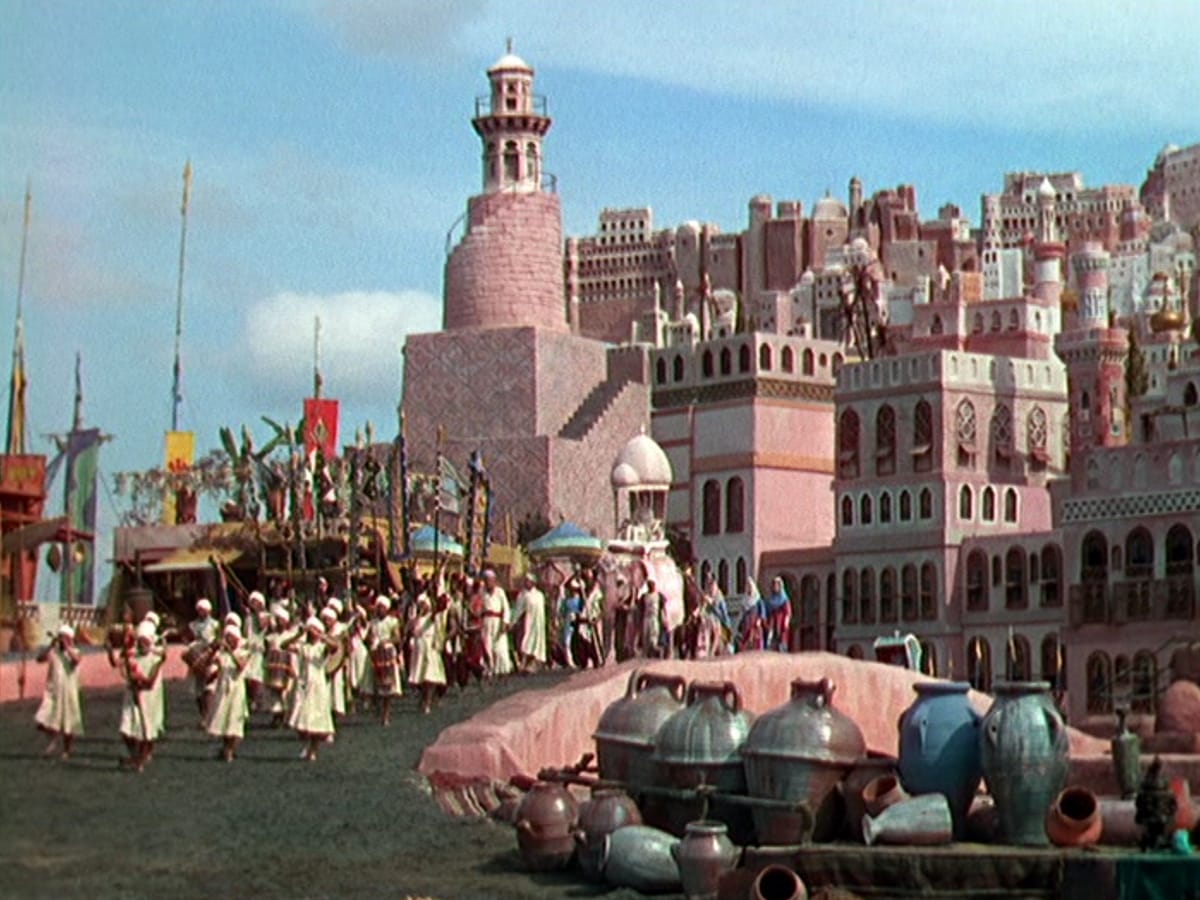
You have to respect the ground-breaking effects (including the first use of what is now called Chromakey), the brilliant sets, the beautiful location photography (a mix of London and California, the latter being used after the war broke out), the lovely set pieces, and the gorgeous three-strip Technicolour process. It won Academy Awards for cinematography, art direction, and special effects, and was nominated for its music (the latter by the great Miklós Rózsa after a false start by Oscar Straus).

Because of the various problems during production, original director Ludwig Berger and Berger’s choice of composer (Straus) were eventually replaced primarily by Michael Powell. Powell also had to leave the production before its completion due to the war, and American Tim Whelan directed nearly all of the latter half’s outdoor scenes in California with assistance from the Korda brothers. You can already see why the film, as entertaining and gorgeous as it turned out, doesn’t always hang together.

The story, which has also gone by the name Aladdin and variations thereof for many film versions, was first made into a film in 1905 and across the 20th century (and into the 21st, with Disney’s live action remake of its own 1992 animated Aladdin). The core story is often said to be drawn from the medieval collection of Middle Eastern tales known as One Thousand and One Nights, but this is somewhat inaccurate. The Aladdin tale specifically (along with the Ali Baba tales) was added to the collection from other sources by the 17th-century European translator of the tales, Antoine Galland.

Producer Alexander Korda was inspired to do this movie by the 1924 silent version, but changed the story pretty substantially — as just one example, making the thief and the King two separate characters. If you don’t know the 1924 version like I do, this is a mostly-successful telling that tries to combine some variations of the tale into a coherent whole, and mostly does it quite well.

It is certainly a fine family film with enough fantasy to hold its audience even now, though I’m very glad they changed direction from its intended “full blown musical” idea. Three songs are still in the film, but apart from Abu’s solo song, they don’t disrupt the story.

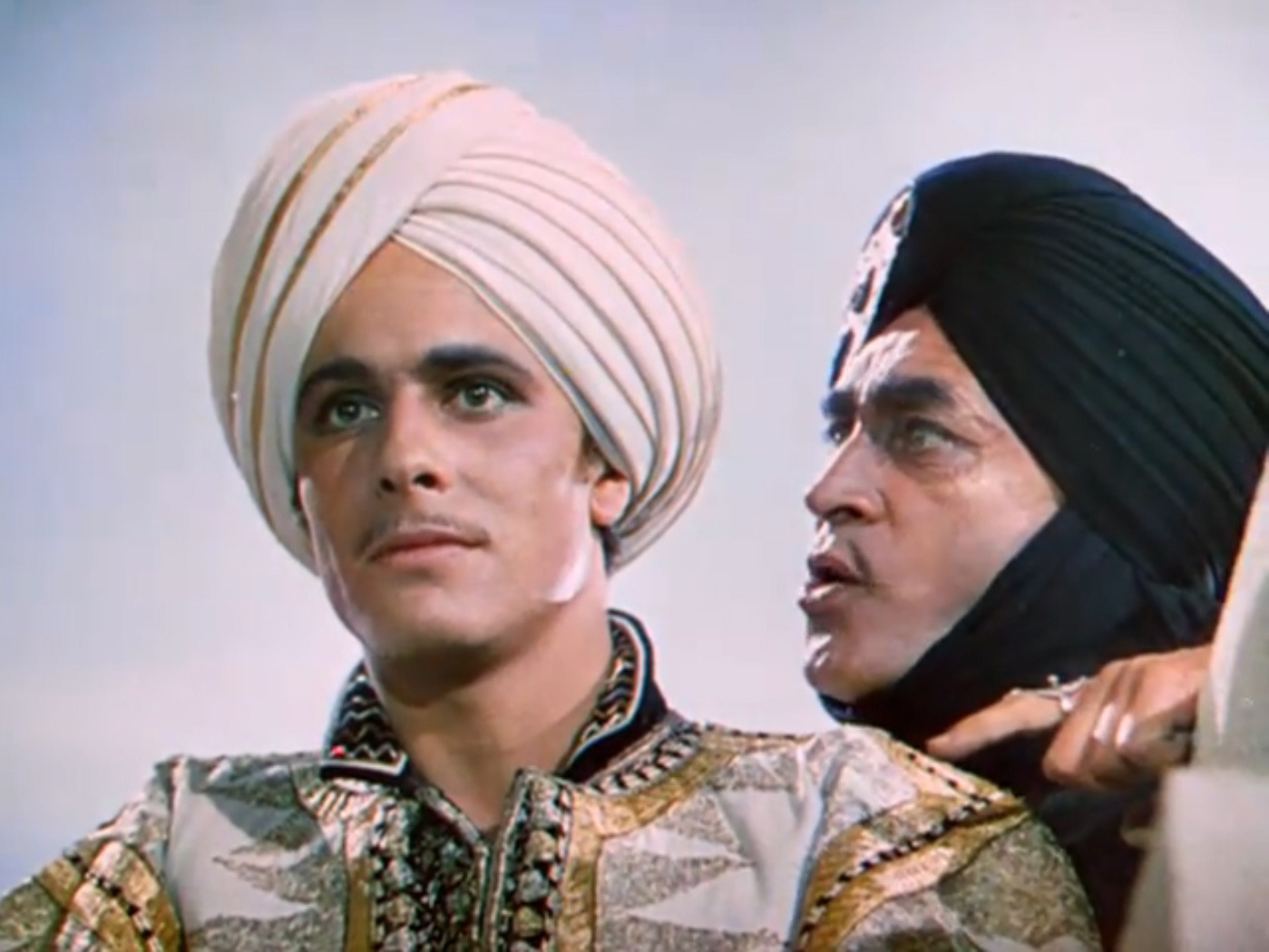
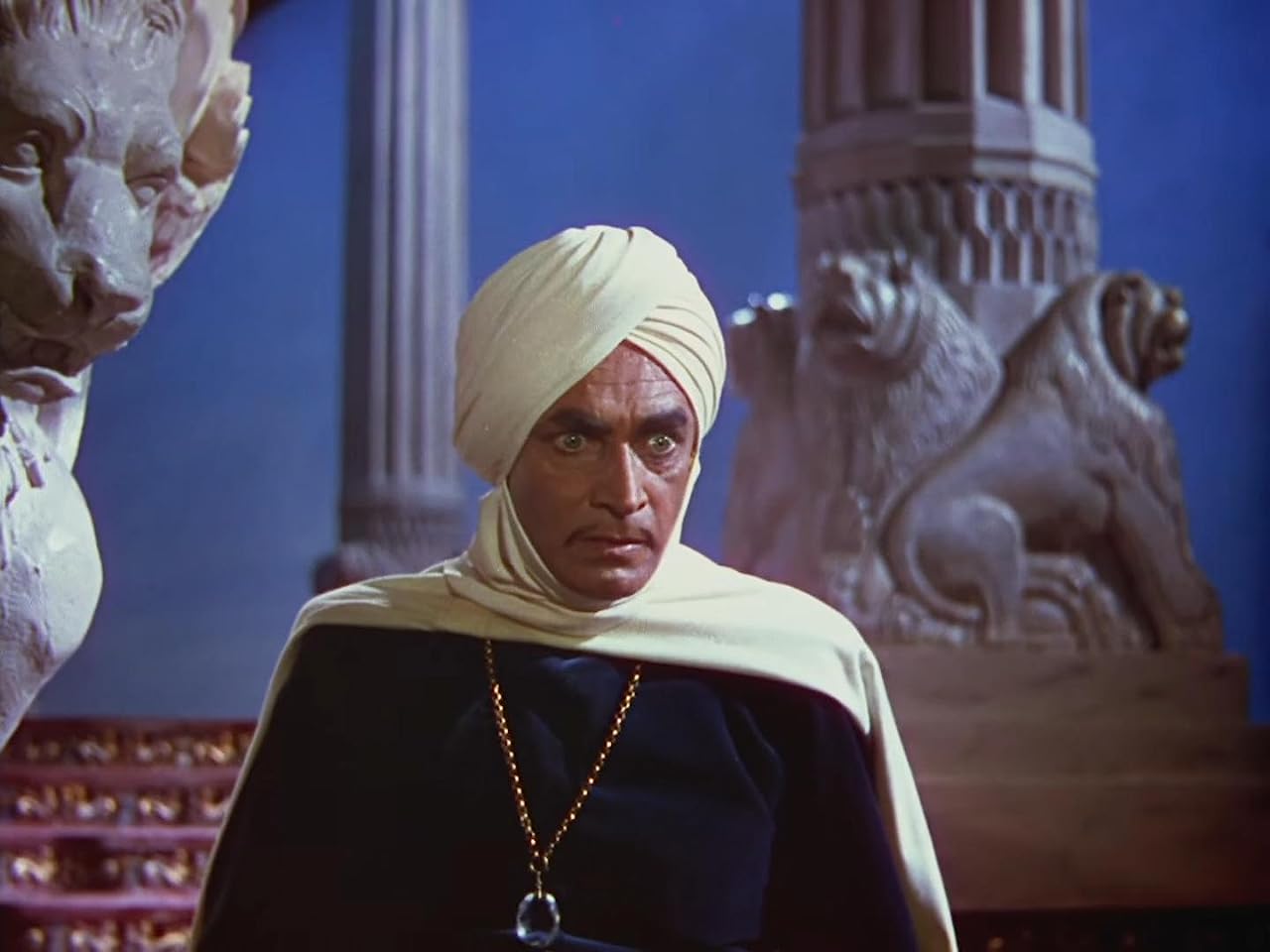
The film opens brilliantly, as a blind beggar in ancient Basra along with his faithful dog companion tells the first part of the film’s tale in flashback. He tells of a young and naive King Ahmad of “Bagdad” (John Justin), who wants to learn more about the people he rules, so he is persuaded to go undercover by his evil Grand Vizier, Jaffar ((the great Conrad Veidt, who completely steals every scene he’s in).

King Ahmad (John Justin) and Jaffar (Conrad Veidt), his Grand Vizier

Once Ahmad is out of the castle and pretending to be a humble beggar, Jaffar has him arrested, and thrown in prison — later telling the people that Ahmad died, so Jaffar can claim the throne. Ahmad meets a young thief while in his cell called Abu (played by then 15-year-old Sabu Dastagir, who just went by “Sabu” in his film career).

Abu, a carefree youth, disbelieves his cell mate is the king at first, but befriends Ahmad — and pickpocketed the key to the cell so they could escape. They flee to Basra, where Ahmad spots the princess (June Duprez) and immediately falls in love with her. However, Jaffar is also in Basra and trying to win the Princess through other means — flattering her father, the Sultan (Miles Malleson, also one of the writers of the film), with life-size toys — the Sultan’s obsession. Malleson is another highlight, a wonderfully child-like old man played to perfection.

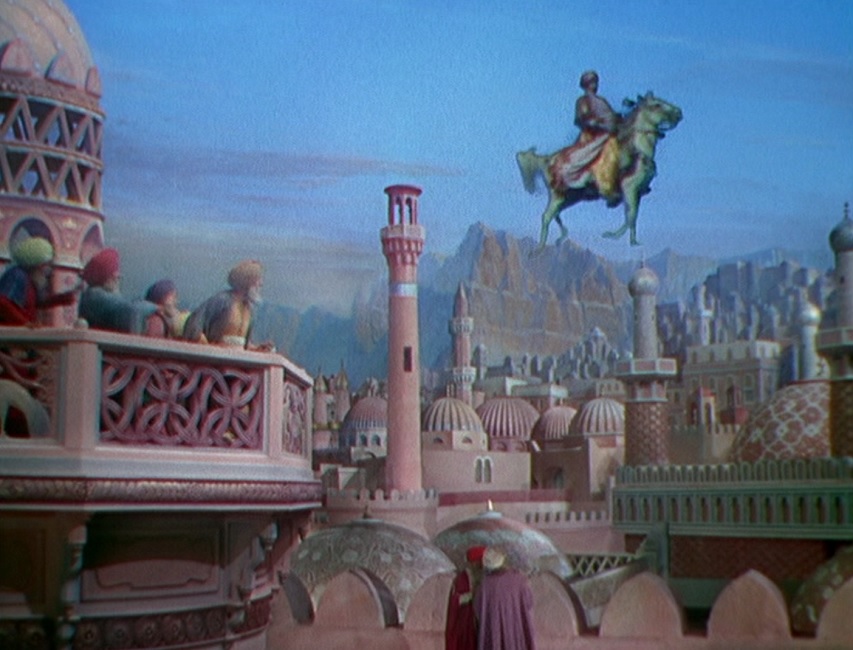
Jaffar seals the deal by giving the Sultan a mechanical flying horse, but in the meantime the princess and Ahmad have met, and the attraction is now mutual and she escapes the palace. Enraged, Jaffar uses his magical powers to blind Ahmad, and turn Abu into a dog. The princess is recaptured, but falls into “a deep sleep” and cannot be awakened.

You can see here how the Chromakey stuff is VERY primitive and doesn’t always match well.

Ahmad, still blind, is eventually tricked into returning to the palace, where he awakens the princess, and is then dismissed, along with his dog Abu. We return to the dock where we first met them, as he concludes his story — but the adventure quickly continues as the Princess is tricked into boarding Jaffar’s ship.

Now a prisoner, Jaffar tells her that his curses on Ahmad and Abu can only be lifted by her embracing him, which she very reluctantly does out of love for Ahmad. The spells are lifted, and Ahmad spots her and sets after the ship along with the now-human-again Abu. Jaffar sees them a bit later, and raises a storm that shipwrecks their small dinghy, then returns to Basra and uses a mechanical dancing goddess toy to kill the Sultan before returning to Baghdad.

He does TRY to woo Princess Noname, but ultimately has to resort to threats and hypnosis, of course.

Meanwhile, by sheer lucky coincidence, Abu finds a bottle on the deserted beach and opens it, revealing a very temperamental and gigantic genie (Rex Ingram). Ingram handles the role as best he can, but he’s just not very convincing — and the effects regarding the size differences between him and Abu, though imaginative, aren’t generally carried off well enough to continue the suspension of disbelief.

The scaling effects work reasonable well, but Genie’s performance is uneven (and you should see his toenails! Ayieee!)

Still, the influence of this film on later filmmakers like Ray Harryhausen simply cannot be overstated — this is the blueprint he and others followed for decades to come when it came to imaginative tales of fantasy. In addition to Harryhausen, Terry Gilliam’s best films are also clearly influenced by this movie.

The genie helps Abu steal a magical jewel from a faraway temple (with a Keystone Kops-esque guard squad) that helps him find and reunite with Ahmad, all of which is really well done. Abu and Ahmad use the jewel to see Jaffar hypnotizing the Princess to forget her love for Ahmad, and our hero loses hope and angers Abu — until Abu accidentally uses his third and final wish to send Ahmad back to Baghdad.

Abu then breaks his giant jewel out of anger, which introduces a handy plot device to get him also back to Baghdad via a flying carpet (very well done compared to the flying horse effects), the appearance of which triggers the population into overthrowing Jaffar, who is then killed by Abu, restoring Ahmad to power and allowing him to marry the Princess, who never did get an actual name.

Abu is offered the position of Grand Vizier to King Ahmad, but shuns any form of responsibility, re-steals the flying carpet, and heads out to more adventure. Everyone laughs, and the film concludes happily. You can almost forget how bad Sabu’s song was (he was otherwise generally excellent).

The flying carpet sequences, both in Chromakey and physical effects, work much better.

In its day, the film was a wonder and did very well at the box office. It maintains a good reputation (now as a children’s movie) to this day.

This version of The Thief of Bagdad was the template for most future special-effects-heavy fantasy films for decades to come, largely due to Larry Butler’s invention of ChromaKey, which with some later polish became the successor to the “traveling matte” techniques used in prior films.

Viewed as an adult, the physical effects are mostly great — and while the Chromakey effects are often so obvious it takes you out of the film, the alterations to the tale and a few handy plot machinations do not. Watched bearing in mind its technological and historical importance, it is still enjoyable, and well worth the 108 minute runtime.

Conrad Veidt does more acting with his eyeballs alone than most actors do with their whole body.

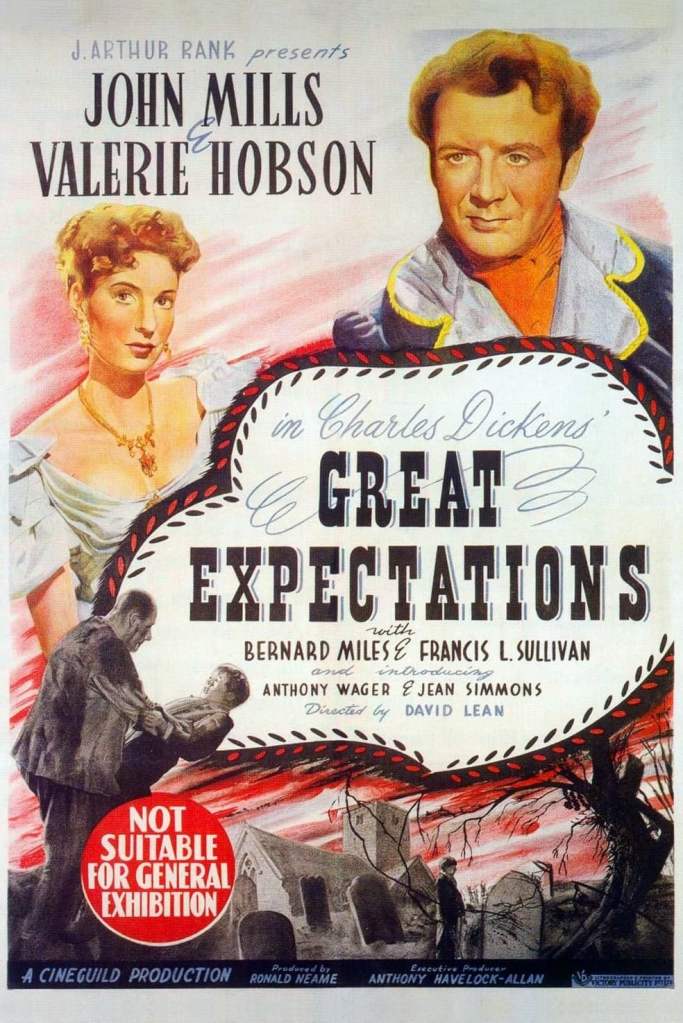
Great Expectations (1946, dir. David Lean)

⭐️⭐️⭐️⭐️
52-week film challenge, film 21

Whether you are a fan of Dickens, or you’ve not read any of his work beyond A Christmas Carol, this is a fantastic film adaptation to offer insight into Dickens’ other work, full of strong visual language to put you in the authors’ mindset and life experiences. Great Expectations covers poverty, the working class, and injustice, but contrasts this with power, privilege and good old British eccentricity; themes Dickens constantly came back to in his other works.


As an adaptation of the book, Lean and his fellow screenwriters condense and cut some plot strands in order to make for a followable two-hour film, and made the deliberate choice to make the film in B&W rather than colour to further establish the film as being part of a bygone age. As a single film, no other version since has surpassed it.

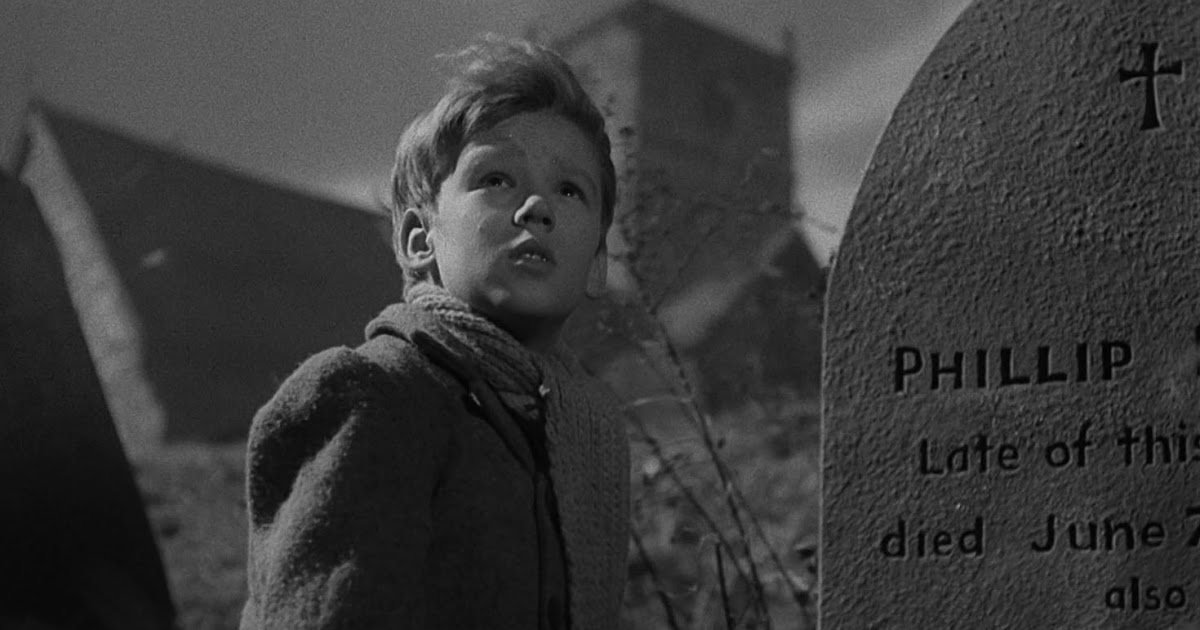
Without trying to rehash the entire plot, an orphan named Philip Pirrup, whom absolutely everyone calls “Pip” as a single first and last name, is living with his older sister and her husband Joe, a kindly blacksmith. A chance encounter with the desperate escaped convict Abel Magwich in the graveyard of Pip’s parents and an act of kindness on Pip’s part sets in motion plot lines that will only show up much later.

In the meantime, Pip falls into the orbit of an eccentric patron, Miss Havisham, who has a macabre backstory and a young adopted daughter Estella, who is seemingly impervious to love and rather cold (and occasionally brusque), though of course young Pip falls in love with her anyway. As an adult, Estella does take on a beau but is, as Pip observes, simply using him. She explains matter-of-factly (again) to Pip that she has no heart and does this to all men — except Pip. It is a beautifully understated moment of foreshadowing where Pip finally “gets” her and what Miss Havisham has done to her.

As Pip turns 20, he discovers he has a mysterious benefactor (whom he assumes is Miss Havisham) who wants Pip trained in London to become a proper gentleman of society. Leaving his family, his patron, Estella and all he has known, he travels and meets up with a boyhood colleague, Herbert Pocket, who becomes his roommate and friend. A year later, matters come to a head as the benefactor reveals himself, setting in motion the means to resolve the various plot lines (and finally some action scenes!).

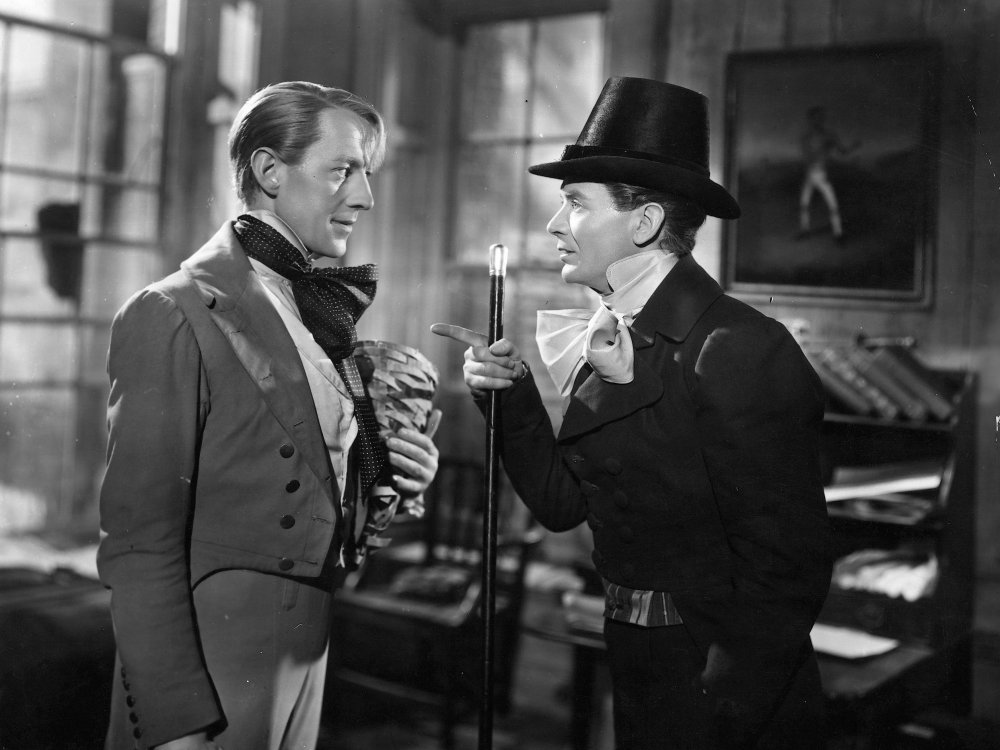
Pip (right) recognises schoolboy acquaintance Herbert Pocket, played by Alec Guinness.

A David Lean film is always beautifully shot and extremely well-directed, and this one is no exception. The B&W cinematography, apart from the opening sequence, was shot by Guy Green, who also worked with Lean on his other Dickens’ film, the even more memorable 1948 Oliver Twist. Both Alec Guinness and Martita Hunt had played their respective roles (Herbert Pocket and Miss Havisham) in a stage adapterion of the tale Guinness wrote, which prompted Lean to make the film in the first place (though he did not use Guinness’ stage script).

Lean definitely had a talent for picking and working with child actors, as both the young Pip (Anthony Wager) and the boy Herbert (John Forrest) are great in their parts, and a young Jean Simmons beautifully played the young Estella, with Valerie Hobson seamlessly taking on the adult Estella. Also of note is the ageless Frances L. Sullivan, who flawlessly played the lawyer Mr Jaggers in perfect Victorian style, but to be fair he had experience in the part — he had played the same role in a 1934 film version of Great Expectations as well!

There are only two serious errors in this film in my opinion, one of which was unavoidable: you can’t film the entire story, it would have likely doubled the running length of the film. Lean does his best to choose the best plot strands to follow, and resolves them all satisfactorily, but in truth Dickens’ lengthy storyline — it was originally written as a serial for a magazine, and the novel was originally published in three volumes — doesn’t lend itself to anything less than a mini-series.

The other flaw (and this was a big one) was casting a 38-year-old John Mills as the adult (21 year-old) Pip. I have no quibble with Mills’ excellent and emotional performance, but the age jump between the boy Pip and the (mature!) man Pip is just not credible on-screen. In a rare foot wrong, Lean should have cast a younger actor — at times, Mills looks more like 26-year-old Alec Guiness’ father than his contemporary.

A trip back to the mannered and class-centric world of Dickens’ time is probably not for everyone, even as beautifully realised as it is here, but as a picture of a bygone age (and Dickens’ clever way of pointing out the injustices and flaws of it), Great Expectations puts you right into the author’s imagination. The resolution of the film is a bit fast and tidy, but not before a series of memorable scenes in which Pip first (accidentally) destroys Miss Havisham and then forcibly prevents Estella from becoming Havisham’s prisoner — a powerful statement on the importance of finding your own way in the world, regardless of your circumstances or background.

Pip tries to love the cold, quixotic Estrella.