The Magnetic Monster (1953)

dirs. Curt Siodmak and Herbert L. Strock
⭐️⭐️⭐️
52-week film challenge, film 51
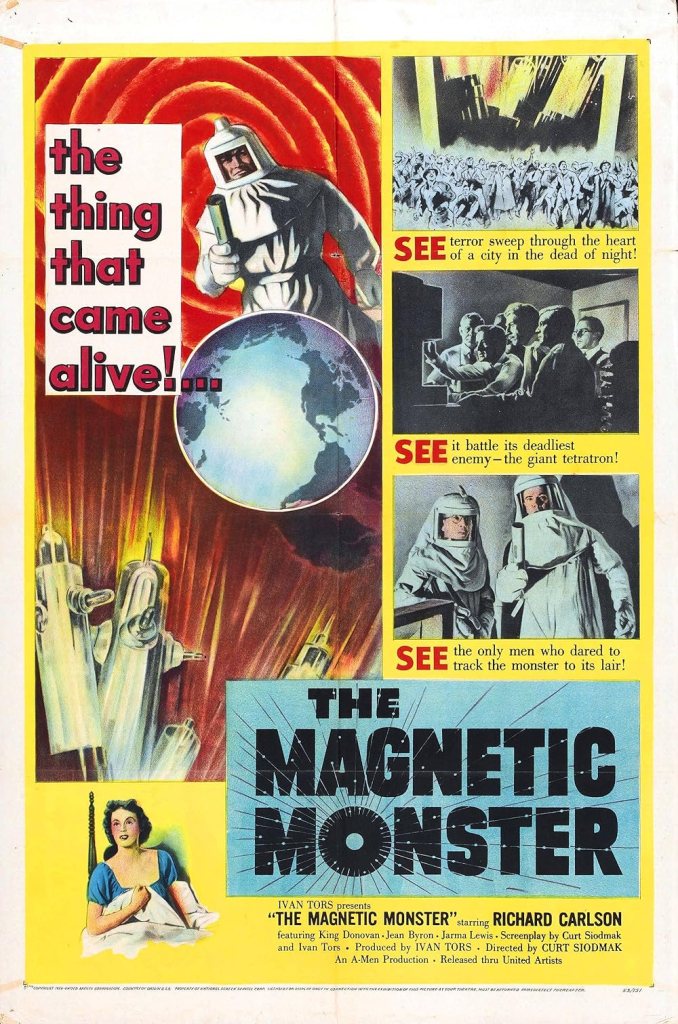
Despite some laughably bad science in much of it, no actual monster in the traditional sense of the term, and an effects-heavy climactic scene borrowed from another movie entirely, this Atomic Age film ends up being better (and surprisingly suspenseful) than you’d expect.

The investigation begins.

In 1953, America’s veterans had returned home, and the country had collectively forged a new direction: confident, industrious, lots of new inexpensive housing, the GI bill to get college-educated or trade-skilled, and basically hope for a bright future for nearly everyone. That said, there was the shadow of the coming nuclear arms race, and an understanding that scientific exploration isn’t always for the betterment of mankind.

There’s a lot of magnetism in this flick, but sadly none between Drs Stewart (center left) and Forbes (center right)

That’s the mindset needed to better understand this picture, the first of a trilogy (!) of adventures involving the Office of Scientific Investigation (OSI), a group of scientists who investigate possible irresponsible uses of … SCIENCE! (Cue Thomas Dolby music here). Richard Carlson, also seen in It Came From Outer Space and many other cult pictures, stars as Dr Jeff Stewart.

His partner in this one is Dr Dan Forbes (King Donovan, another fantasty-film actor), and the first half of this film is basically a more-scientific police procedural — there’s a business in town that suddenly has all kinds of weird things happening, specifically things getting magnetised (as we quickly find out). The effect appears to be coming from a flat above the magnetised store, but by the time they work this out, the “culprit” has fled the scene, taking whatever it was that was causing this with them.

Oh yeah, we should remember to wear these protective suits from time to time!

The sub-plot, such as it is, is that Stewart’s wife is pregnant but not showing (a constant source of conversation between them — “why aren’t you fat yet?” for example), and Stewart is inspired to buy a house for what he is sure will be a baby boy, but can barely afford it because apparently OSI officials are in it for the love of … SCIENCE! Bonus points for a now-hilarious breakdown of what it will take to buy a house in the early 50s on their basic budget.

“Why aren’t you fat yet?” patronizes Dr. Stewart.

Drawn-out story short, Stewart and Forbes track down an irresponsible scientist, Dr Howard Denker (Leonard Mudie) who was fooling around with making unstable elements and accidentally created a whopper — a radioactive isotope that, every 11 hours, uses magnetism to create energy from every available source in order to double its mass. While the problematic element is still small enough to fit in a briefcase, its exponential needs and growth means it will very quickly become a huge problem that threatens to destroy Earth, aka uncontained nuclear fusion.

Stewart and Forbes confront Dr Denker, who has brought this element on board a commercial plane (!) to try and get it to a university in California to make it their problem to solve, as he is dying from radiation poisoning. Literally in his dying breaths, Denker absolves himself from any responsibility for creating this world-eating thing, saying that he wasn’t responsible for the consequences of his experimentation.

Amoral dying scientist is also irresponsible at handling dangerous materials!

Thus, the second half of the movie is a race against time. Even though the element is still of a size that is portable, it will continue to cause havoc every 11 hours when it needs to be “fed” — and its appetite is also exponetionally growing. The OSI convinces the town to undergo a blackout so that all available electricity can be diverted to the next “feeding” of the element so as to minimize the consequences — but now they have 11 hours until this thing is going to need 600 million watts of power for its next “meal.”

Stewart consults with various other scientists (more doctors per square inch in this movie than any other I can think of!) and eventually comes up with a theory: if he “over feeds” the element, it should split up into two stable elements, ending the threat to earth. But where to get that kind of power?
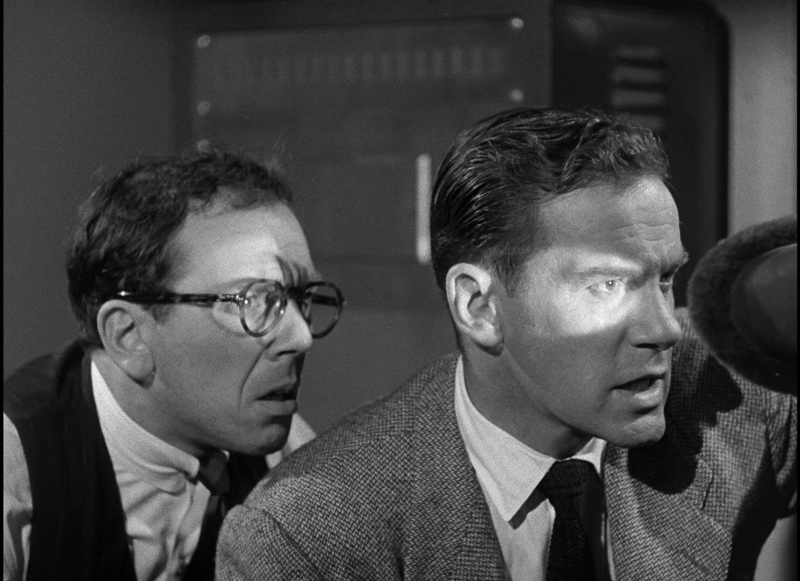
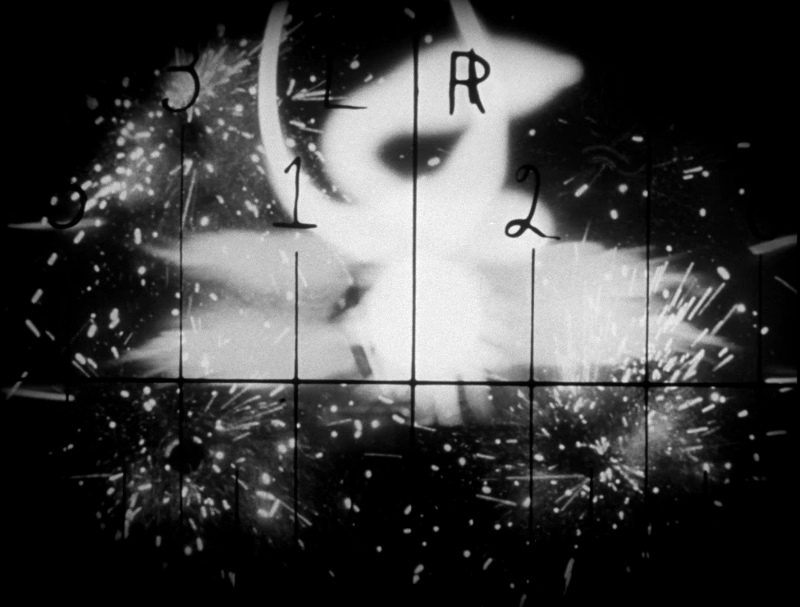
Stewart and Forbes witness the element drawing energy out of thin air (above), creating micro-explosions and growth.

A US general blabs about a top-secret energy facility deep underground off the coast of Nova Scotia in Canada, and can provide the 600 million watts, but may not be able to be pushed much beyond that. Stewart and Forbes take the risk, fly as quickly as possible to the base, and make it just in time for the start of the magnetisation cycle that starts the “feeding” frenzy of energy collection.

The underground base and its magnetron/cycletron (not sure) are huge and impressive — and come from another movie, the 1934 silent German film Gold, very much in the mold of Metropolis’ special effects. Nearly-seamless editing puts Stewart at the controls of the machine as he pushes it well beyond its tolerances to “overfeed” the element, eventually causing the machine’s destruction — and a few tense moments of magnetisation where Stewart — who has barely escaped with his life — thinks he may have failed, and the world is doomed.

Happily, the magnetised things suddenly fall off the walls, and Earth is saved. The taxpayers of Canada are on the hook for replacing a now-dead power station, but let’s not talk about that! Quick, back to domestic bliss, patronising sexism, and house-buying!

Dr Stewart saves the world … but not this power station … by pushing it into the Danger Zone.

Despite the all-over-the-place levels of scientific credibility, The Magnetic Monster is actually a surprisingly gripping film that holds audience suspense, still. It’s that 1950s earnestness of “we can do anything” spirit that foreshadows the space program and other great accomplishments of the following decades, I think, but it still works.

The OSI’s own computer (seen here) is called “M.A.N.I.A.C,” and it’s dancing like it never danced before.

Scrooge (1951)

dir. Brian Desmond Hurst
(US title: A Christmas Carol)
⭐️⭐️⭐️⭐️⭐️
52-week film challenge, film 50

Naturally we have to do at least one Christmas movie in the 52-week challenge, and for me of course it would be this one. I watch this movie every year, and never get bored of it — always admiring something new, like the lighting of certain shots, the long shadows Scrooge casts, details of Bob Cratchit’s family and so on endlessly.

There are many decent-to-excellent film versions of “A Christmas Carol,” but this one is far and away my favourite, in large part because of its marvelous casting, superb performances (particularly from Alastair Sim as Scrooge), and striking B&W cinematography. Every single member of the cast is on point, camera angles are uniformally well-chosen, the musical score is quite striking (more about that later), the supporting characters are also very memorable, and in short this film is perfect in all the ways — even the additions to Dickens’ story are so well-done you’d hardly believe, for example, that there’s no Mr. Jorkin (Jack Warner) in the original novella.

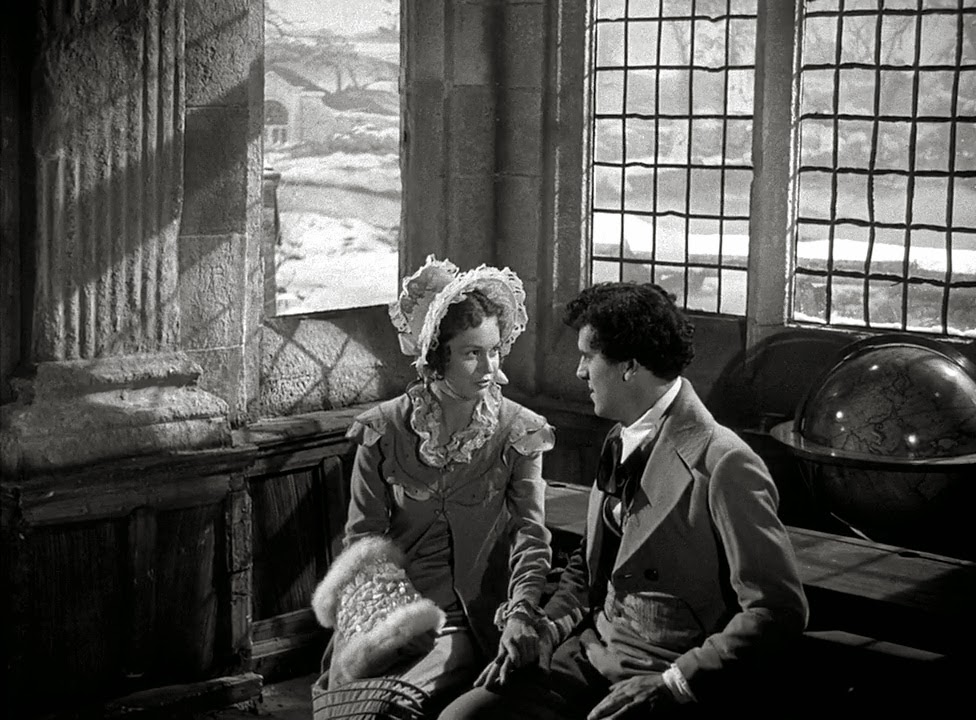
Mr Jorkin (Jack Warner, middle) introduces Young Scrooge (George Cole, right) to his future partner, Jacob Marley (the film acting debut of Patrick McNee, left).

I sincerely believe that if Dickens could be brought forward in time to watch his story on film, this one would be the one most likely to meet with his approval. Certainly he’d like it better than either of the two best-known previous attempts, the comical short silent version from 1910 or the mediocre full-length version starring Reginald Owen from 1938.

Everyone thinks they know the story of “A Christmas Carol,” but relatively few have ever actually read the original work. Changes required to make the story more visual in the various film versions have added elements to the original story, and so does Scrooge, but it is a testament to the skill of screenplay writer Noel Langley that the joins are largely seamless to anyone this side of a Dickens scholar.

Scrooge wasn’t always a jerk: he was always kind and tender to his sister Fanny (Carol Marsh)

In particular, Dickens’ original social commentary is strongly intact in this version, and resonated deeply in postwar Britain of the early 1950s, when the country struggled with crushing debt from the war, and continuing rationing and austerity. Also preserved is traces of Dickens’ Christian faith, and while explicit in some moments it doesn’t overshadow the message of social justice and the responsibility of the the well-off to alleviate the suffering of the poor.

Marley’s ghost (Michael Hordern) tries to show Scrooge the suffering of the poor, but it’s not (yet) effective.

Aside from the radiant performance of Alastair Sim, who set a bar of believability in both pre- and post-reformation Scrooge that no other actor has equaled, special mention should be made of Mervyn Johns as Bob Cratchit, Hermione Baddeley as Mrs. Cratchit, Michael Hordern as Jacob Marley, the incredible Ernest Thesinger as the mortician, Miles Malleson as Old Joe, and of course Kathleen Harrison as Mrs. Dilber, another performance that will never be bettered. There are a wealth of character actors in this, all doing their British Character Actor thing to an absolutely flawless standard.

Special mention too must go to Richard Addinsell, who gave the film a very booming, menacing score that softens all the way to down to music box-like Victorian lullaby in places, and throws in a traditional ballad (“Barbara Allen”) for the film’s climax. Finally, the combination of Ralph W. Brinton (the art director) and C. M. Pennington-Richards (the cinematographer) produce a detailed but very dark style where the shadows are long, the lighting is sparse (until Scrooge’s reformation), and the harshness of life in Dickens’ fable is not shied away from — it is simply gorgeous to look at, and downright spectacular if you have a OLED high-definition television.

Glyn Dearman as Tiny Tim, enjoying a splendid display of Victorian toys.

In these current days of increasing western poverty and misery, with inflation making the working class ever poorer and more angry, the film again becomes more relevant to complement its timeless moral. To quote Bob Cratchit, “it is a perfect pudding!”

Will Any Gentleman …? (1953)

Dir. Michael Anderson

⭐️⭐️½

52-week film challenge, film 39

I hadn’t actually intended originally for last month’s reviews to have a theme of horror movies for October, but after the first one I just opted to keep it going. There’s really not enough Thanksgiving movies to make a theme out of that (and Thanksgiving’s not necessarily in November, Americans), but this year marks my all-time favourite TV show “Doctor Who”’s 60th anniversary, so I’ve hit upon the idea of reviewing films that have actors who played The Doctor in them, and we’ll start with a twofer: Jon Pertwee (in a big part) and William Hartnell (in a minor part) in a film adaptation of the stage farce Will Any Gentleman …?.

The problem with film adaptations of stage plays that are farces is that the energy doesn’t translate well, and of course now this 1953 film is so dated that it’s almost 100 percent laughter-free. There’s a lot of “stagey” overacting, though Pertwee and Hartnell are not among the guilty parties, and neither is lead star George Cole.

The underlying story is a simple one: mild-mannered bank clerk Henry Sterling (Cole) is trying to repay a small debt his brother Charley (Pertwee) owes the owner of a music hall. He gets roped into attending the show, gets pushed up on stage where “The Great Mendoza” (Alan Badel) hypnotizes him to remove his inhibitions. Things go a bit wrong and the show is closed before Mendoza can un-hypnotize anyone, leaving Sterling and another man with mixed personalities.

Sterling randomly alternates between his normal self and his wild playboy persona, to the consternation of most of the people in his life and the amusement of a few (including his maid). Brother Charley slowly works out what has happened and retrieves Mendoza to undo the hypnotism, but not before many shenanigans and misunderstandings have happened, almost resulting in Sterling’s marriage collapsing and being arrested for stealing money from his bank.

The other man hypnotized by Mendoza and not brought out of it turns out to be an undertaker who is hypnotized to laugh at nearly everything — one of the few genuine funny surprises in the film.

If you had seen the stage play in the early 50s, I’m sure you would have laughed a lot — farces work much better in theatre because the energy of the cast brings the audience along with them. The film version also plays things mostly very broadly, with may characters being cartoonish in nature, apart from the aforementioned future Doctors and Cole, who does an expert job switching personas.

If you’d seen the film in the 1950s being aware of the stage version, you’d probably find this one funny as well. But this type of campy, stagey comedy is tricky to get right on film, and while there are a few movies of this sort that still retain their “suspension of disbelief,” qualities this one just seems like most of the cast are trying waaaay too hard, and the comedy fizzles.

“Manic” Sterling has plans for his maid, who is more than willing as her life is otherwise dull and lonely.

At this point, the only people who would seek out Will Any Gentleman …? are likely “Doctor Who” fans who want to see what Pertwee (33 at the time) and Hartnell (45) looked like when they were much younger (though people in the 1950s all seem to look “old” all the time to me), and of course fans of George Cole, who is the best part of this movie.

Pertwee plays the rogueish brother just right, and his colourful personality keeps his performance in line with the film but not exaggerated, while Hartnell as the only truly serious part in the movie (as a police detective) just reminds me that every film I’ve seen him in, he gives each of his characters something distinct from the others — in this he is a perfect foil for Pertwee and Cole, gruff but never crossing into exaggeration.

Three of my favourite British actors in a single picture.

It’s a pity that this doesn’t quite work, but it doesn’t — in part because of changing social morés around sexism, which is really the centerpiece of this one. It is of its time and reflects its stage origins, which bodes mostly badly for modern viewers.

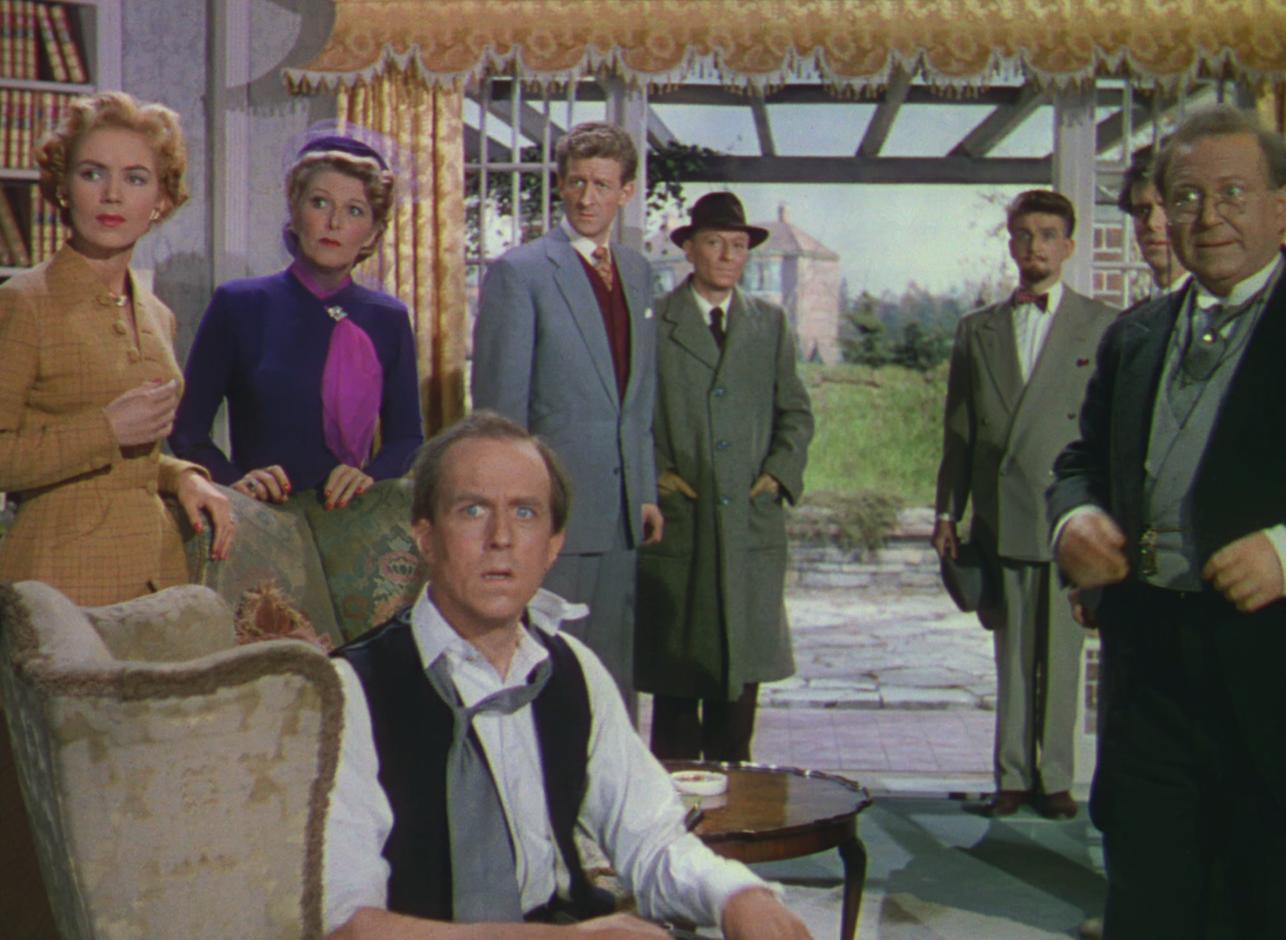
Almost the entire cast, L to R: Sterling’s wife, mother-in-law, frantic bank manager, brother, Detective Inspector, hypnotist, (can’t remember the half-seen fellow), and overly dotty doctor. Missing: the maid.

Godzilla ゴジラ (1954, dir. Ishiro Hōnda)

⭐️⭐️⭐️⭐️½
52-week film challenge, film 32

I don’t think I’ve ever seen the full Japanese version of Godzilla before, certainly not as an adult, but of course I’ve seen the Americanised “Raymond Burr” version — Godzilla: King of the Monsters! — a time or 10. Like many people, I climbed aboard the kaiju train as a kid, when all these great monster movies started showing up on TV on the weekends, so I caught most of them back then. TV stations at the time of course tended to show the later colour films which were more aimed at kids, so I don’t think I’ve even gotten around to seeing Godzilla Raids Again (1955) either, a grievous mistake that should be corrected soon.

The first Godzilla is most definitely not a kid’s movie: it is a lightly-abstracted but still powerful statement on the horrors of nuclear weapons, and a philosophical exercise pondering where Japan (and the world) goes from here. In this film, Godzilla is the spawn of the atomic bomb — and wreaks similar terror on Tokyo as the bombs dropped on Hiroshima and Nagasaki did, with incredible loss of life and property.

When the film was made, postwar Japan was still wrestling with the consequences of its own actions in WWII, just eight years earlier, as well as the devastating and overwhelming American response, which was to destroy entire cities full of innocent civilians (about a quarter million in total) — the greatest act of deliberate mass-murder had seen at the time, until the full horror of the Holocaust was revealed. The Godzilla creature in this first movie was intended to be seen as an utterly terrifying and unstoppable force, even though even I have to admit the face they gave it is … unintentionally kind of cute.

Hi kids! It’s your old pal, Godzilla! Don’t do drugs, and stay in school! See ya later!

The B&W cinematography of Godzilla is terrific, and the cast are first-rate: from venerated actor Takashi Shimura (best known as the leader of The Seven Samurai, but also featured in Roshomon, Ikiru, Yojimbo, The Hidden Fortress and many more classic films, here playing the pacifist scientist Kyohei Yamane) to relative newcomer Akira Takarada (playing the hero role of Ogata), Akihiko Hirata as the anti-hero scientist Serizawa, and the radiant Momoko Kôchi as Emiko Yamane, Kyohei’s daughter — a role she reprised in her last film, 1995’s Godzilla vs. Destroyah. All the players, from the greatest to the smallest roles, are played with deep conviction and seriousness.

I will take an indulgent moment here to note my deep fondness for the fashion of the 1950s — everyone in the film looks fantastic, with the men in suits or lab coats, police and military in sharp uniforms, and Emiko in fashionable garments of the time, with everyone looking smart and well-groomed. It’s a reminder of one element of the world gone by I wish would make a comeback, even as I myself fail to adhere to it.

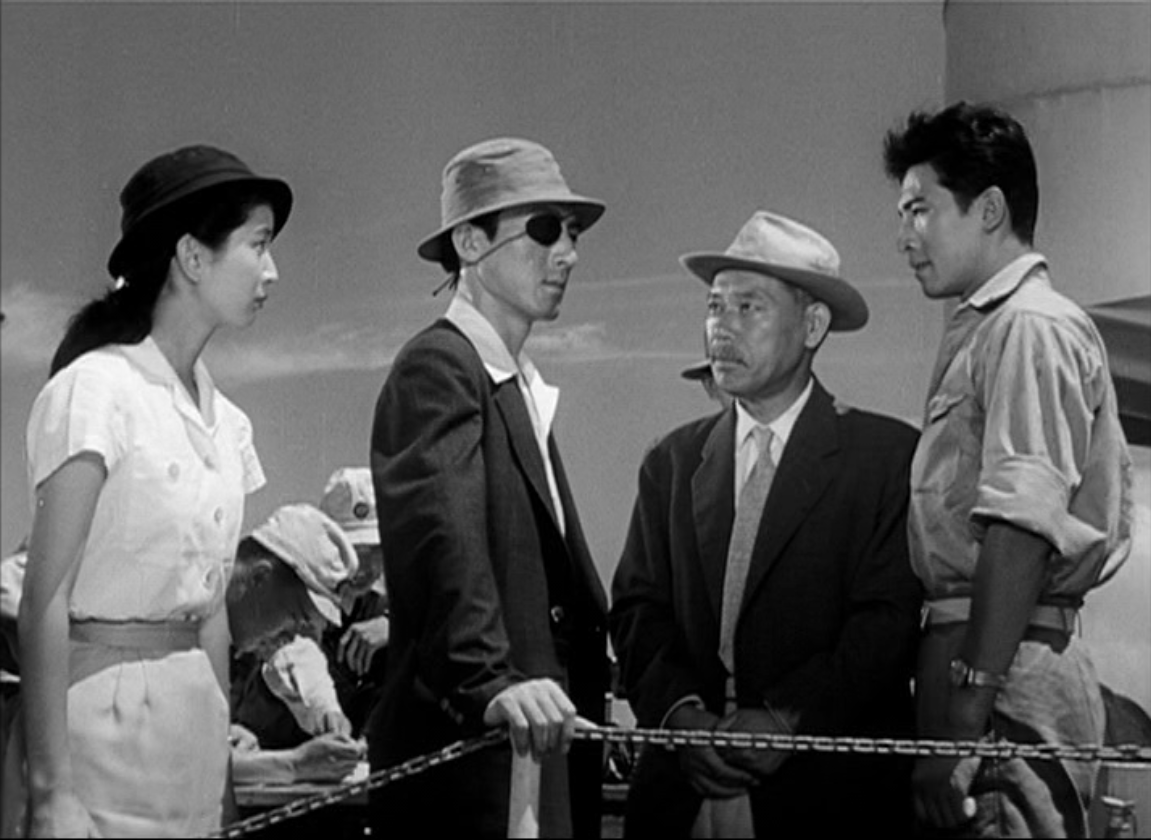
(L-R) Emiko, Dr Serazawa, Dr Yamane, Ogata

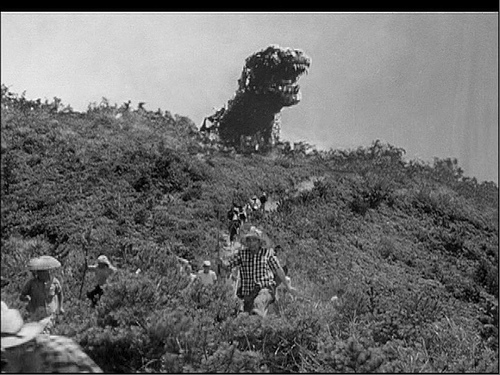
The compositing in the film should also be noted, as it is considerably above-average for the time. I caught only one moment in the film where the effect wobbled a bit — some power-line fortifications meant to stop Godzilla — but was otherwise nearly flawless. The moment when Godzilla’s head pops up over a mountain being approached by scientists is a perfect example: though it might be seen as amusing now, it was undoubtedly surprising and convincing in showing Godzilla’s scale early on in the film.

The analogy of the war that had recently devastated Japan couldn’t be more clear: while the authorities work feverishly to stop this new threat (also featuring lots of scenes of how Japan has rebuilt its civil defenses), nothing is effective against Godzilla. Dr Yamane is the lone voice calling for a less militaristic approach and for studying the creature, but doesn’t really have an answer on how to balance his wishes against the safety of the population. Emiko discovers that her other admirer, Serizawa, may have a way to stop Godzilla — but is too scared to use it, lest the secret of his super-destructive weapon fall into the wrong (or anyone else’s) hands.

This film has a lot of tension and conflict in it, with no comedic elements at all, and a lovely slow buildup of the conflict. Godzilla first attacks some ships at sea while remaining hidden underwater, eventually emerges to wreak havoc on land, and with no effective defense, the country is helpless as many are killed or injured (the scenes of attack survivors in hospital are pretty heart-rending), unveiling not only huge size and strength, but also “atomic breath” that incinerates everything on contact (oh wait, now I get it — Godzilla is the US!).

Emiko and her true love interest Ogata eventually convince the very conflicted Serizawa to use his “Oxygen Destroyer” technology to attack Godzilla underwater (also killing all sea life in the area), but you can see where the film is going from here — there is no solution without great tragedy and wasted opportunities. In the end (in real life, not the film), the point of view of Dr Yamane won out — Japan today strongly embraces nuclear power for its energy needs, but has shunned becoming a nuclear (weapon) power as you might expect, despite being surrounded by countries that do have nukes.

This film, thought of today as the start of the “giant monster movie” genre, was so powerful and effective in its analogy that it may well have helped convince the west to avoid using atomic weapons thereafter. The original Japanese version of Godzilla is a much darker, more thoughtful, and overall deeper film than the lighter, more entertaining genre it spawned, and was undoubtedly effective on both sides of the Pacific in its day. It was a serious attempt to illustrate the terror of atomic weapons — which thankfully haven’t been used since, though the world is still plagued with senseless wars.

Hell Drivers (1957, dir. Cy Endridge)

⭐️⭐️⭐️½
52-week film challenge, film 26

Is this a movie you need to see? Maybe, if you like star-gazing. There are an astonishing number of people in this otherwise slightly-above-average late 50’s Pinewood Studios kitchen-sink drama who would go on to greater fame both internationally and/or just in the UK film industry. Here’s a partial list:

  • This was only Sean Connery’s second credited film role, and its a minor but distinctive one. Five years after this film, he would be the first and most memorable James Bond.
  • Stanley Baker, who played the lead role of Tom, also found worldwide fame a few years later with 1961’s The Guns of Navaronne.
  • William Hartnell, who plays the truck company manager Cartley awfully smartly, would be the original “Doctor Who” six years later.
  • Patrick McGoohan, well known for “The Prisoner” and many film roles now, was one of the leads in this film. Again, just six years later, he would star in Dr.Syn, or The Scarecrow.
  • David McCallum had an early part as Tom’s handicapped brother and the reason he went to jail, and was a well-established film actor by this point, but seven years later he would co-star in “The Man From U.N.C.L.E” on US TV and become a household name with a long (and continuing) illustrious career.
  • Jill Ireland is unrecognizable as the waitress at the Pull In Diner. She married McCallum as a result of them meeting on this film, divorced him 10 years later, and famously married Charles Bronson a year after that following her meeting him on a film he and McCallum worked on together (The Great Escape).
  • Marianne Stone was never a huge star, but holds a Guinness Book of World Records title for “Actress with the Most (Film) Screen Credits,” with over 200 movies on her resume.
  • John Kruse, who wrote the original short story, went on to write for “The Avengers” and more famously “The Saint,” among other shows of that genre.
  • Cy Endfield was forced to relocate his career to the UK thanks to the McCarthy hearings in the early 50s, but was nominated for a BAFTA for Hell Drivers and went on to later acclaim for exotic war movies like Zulu (1964).
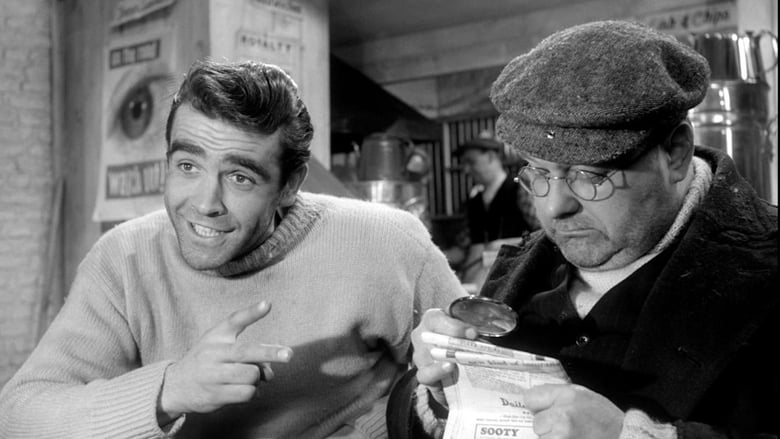
Hallo! Ish me, Sean Connery! Check out my “aye” brows!

The rest of the cast also contains many other names familiar to 1950s and 60s UK film fans. Nearly everyone who had a speaking part in this film (not to mention a couple of the background artists) can also be found in literally dozens of other movies.

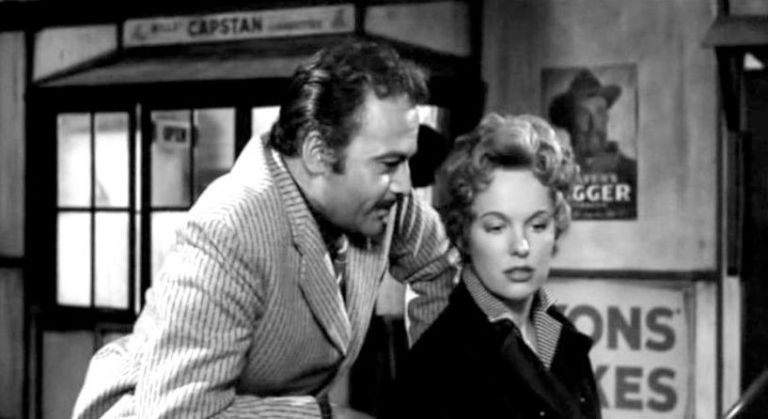
But anyway, what about this movie? It’s a well-shot and well-directed tale of a shady trucking company that hires a motley set of drifters, hobos, and ex-cons as ballast haulers who must drive big trucks like crazy people in order to meet the nearly-impossible schedule set out by the management. Ruggedly handsome ex-con Tom Yately (Baker), in desperate need of a job, gets drawn in to this rabbit hole and decides to take on the borderline-psychotic Red (McGoohan), befriends the only decent person among the drivers, Gino (Lom), and attracts the ladies with his rugged good looks and reluctance to share too much information (Cummings and Ireland).

Red (L) threatens Tom and Gino.

As the title suggests, Hell Drivers is a very macho film with a whole crew of manly men who do man things, mannishly. The work is hard and dangerous, and the company knows full well that anyone they lose to an accident or death is easily replaced.

This is a lovely scene as Tom learns the ropes from the mechanic, Ed (Wilfred Lawson)

The drivers are attracted by the good money, but responsible for the cost of any mechanical faults, accidents, speeding tickets (which oddly never happens to any of them in the course of the film), or absences. As mentioned, in order to meet even bare-minimum 12-run quota they pretty much have to drive like maniacs, and attract much honking of horns and a load of near-misses. Red, the “pace setter” does 18 runs a day and holds a solid-gold cigarette case as a prize for anyone brave enough to beat him.

The film isn’t all crazy truck-racing sequences shot on overcranked film, though, and the story is nicely balanced between the job and what the drivers do off the job, which is mostly limited to eating at the Pull In Diner, sleeping in their rented rooms at a boarding house, and occasionally disrupting the local church social. We also spend quality time with Tom and Gino getting to know each other, the love triangle that ensues with Peggy, and Tom’s increasingly-hostile social time with Red and the other drivers.

Gino loves Lucy, but Lucy loves Tom (for no clear reason other than she finds him hot).

Matters of the heart and of the fists as well as of the reckless driving come to a simultaneous head in the lead up to the climax and subsequent denouement, executed even better than I expected from such a workmanlike film. While Baker gruffs his way through most of the film, there is a surprising off-shoot of the plot where he returns home to his family, only to be cruelly rejected by his own mother.

Beatrice Varley as Tom’s mother, who has let the bitterness of her son’s folly consume her.

While the entire backstory of that scene is never fully explained, we gather that the reason Tom is an ex-con is that he served a year in jail for reckless driving, which resulted in the crippling of his young brother Jimmy (McCallum). Beatrice Varley as Tom’s mother is pure, unforgiving ice water, with a perfect delivery of a chilling line: “For you it was a year, for me and Jimmy it is a life sentence!”

A very young David McCallum as Jimmy, Tom’s crippled brother.

Speaking of that, the film does have its moments of sparkling dialogue, and the friendship between Gino and Tom is a touching and multi-layered sub-plot with some nice twists. I don’t think it will be giving anything away by saying that of course one of the drivers dies in the film, but there’s a nice twist even in that.

I should also mention the solid music score by Hubert Clifford, which comes to prominance in the racing sequences and is far more subtle elsewhere. Jim Groom as sound designer offers some nice touches with notes of nature sounds amongst all the engine noise. If you’ve seen the 1953 film The Wages of Fear, this has a similarly macho character-driven story of desperate men driving, but the two are distinctly different nonetheless.

William Hartnell’s scenes, though brief, really show off his acting chops.

So, in the end, it worth a watch? If you like gritty realism in your late-50s domestic-drama UK films, this one will likely win you over. The overcranked speed shots of the trucks get annoying, but there is still some genuinely hair-raising moments in them, and just seeing McGoohan at his most unhinged, along with a jokey yet already distinct Sean Connery and a young David McCallum (among others), is just as entertaining as the story.

There is a hell of a lot of crazy-ass truck driving in this thing. Take that, Convoy!