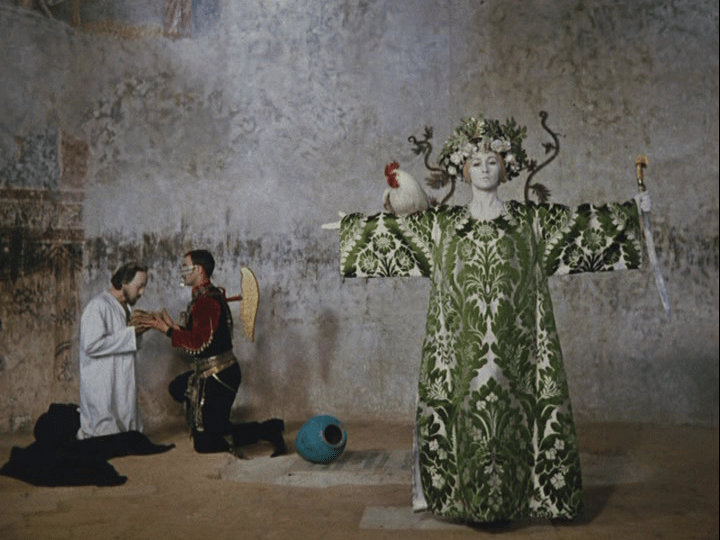
Yellow Submarine (1968)

Director: George Dunning

⭐️⭐️⭐️⭐️
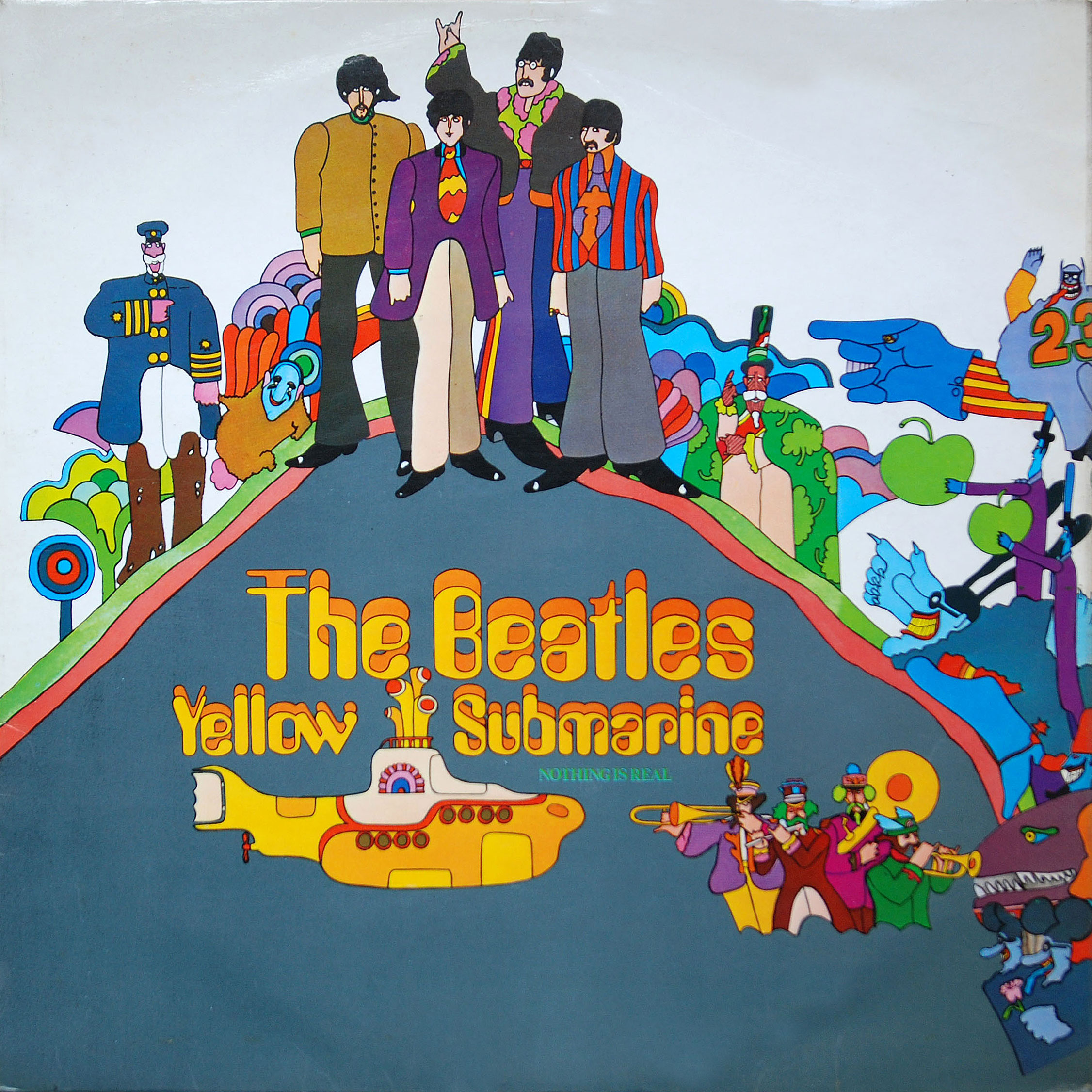
I’ve seen this film quite a number of times in my life, but until now I haven’t written about it because I still think of its as a “kid’s movie,” since I first saw it as a child myself. My affection for it meant I bought the DVD release when that came out in 1999, though I haven’t yet gotten (and should get) the later 4K/Blu-Ray version at some point.

The adult in me is always, always disappointed that the Beatles themselves did not play a bigger role in the film, though they do appear in a short and kind of awkward live-action sequence at the very end — and of course those are their real voices in all the songs. Voice actors portrayed them in all the film’s dialogue for some reason, though the impersonators do a credible enough job making the four Liverpudlians sound (mostly) distinct from each other.

The Lord High Mayor thanks “The Beatles” for their help. I’m not sure why “George” is consistently shown as somewhat darker-skinned than the other Beatles.

John Clive portrayed John Lennon’s speaking voice, and Geoffrey Hughes played Paul McCartney pretty accurately. A completely uncredited Paul Batten did most of George Harrison’s voice.

There’s a reason Batten didn’t complete his role in the film, or get credited for it — midway through it, he was arrested for being a deserter from the British Army!

Special kudos to Paul Angelis for his very spot-on Ringo — he (unlike most of the other voice actors) played multiple roles, including the narrator, and the Chief Blue Meanie, with great variety — and following Batten’s arrest, Angelis took on the rest of the George Harrison dubbing as well.

The Blue Meanies gather their forces to invade Pepperland.

Comedian Dick Emory was the only other actor to voice multiple roles (he did Max, the Lord Mayor, and the principal add-on character of Jeremy Hillary Boob, who acts as a kind of guide through the adventure. As near as I can tell, he’s the only main character entirely original to the film, in the sense of the fact that he’s not inspired by or referenced by any Beatles lyric.

The unique animation of the film is very influenced by Peter Max and the general mod/psychedelic tone of the late 60s, but I was suprised to later learn that Max actually had nothing to do with the film. Looking at the artwork now, it’s an obvious influence of course — but not up to the standards of Max’s print work.
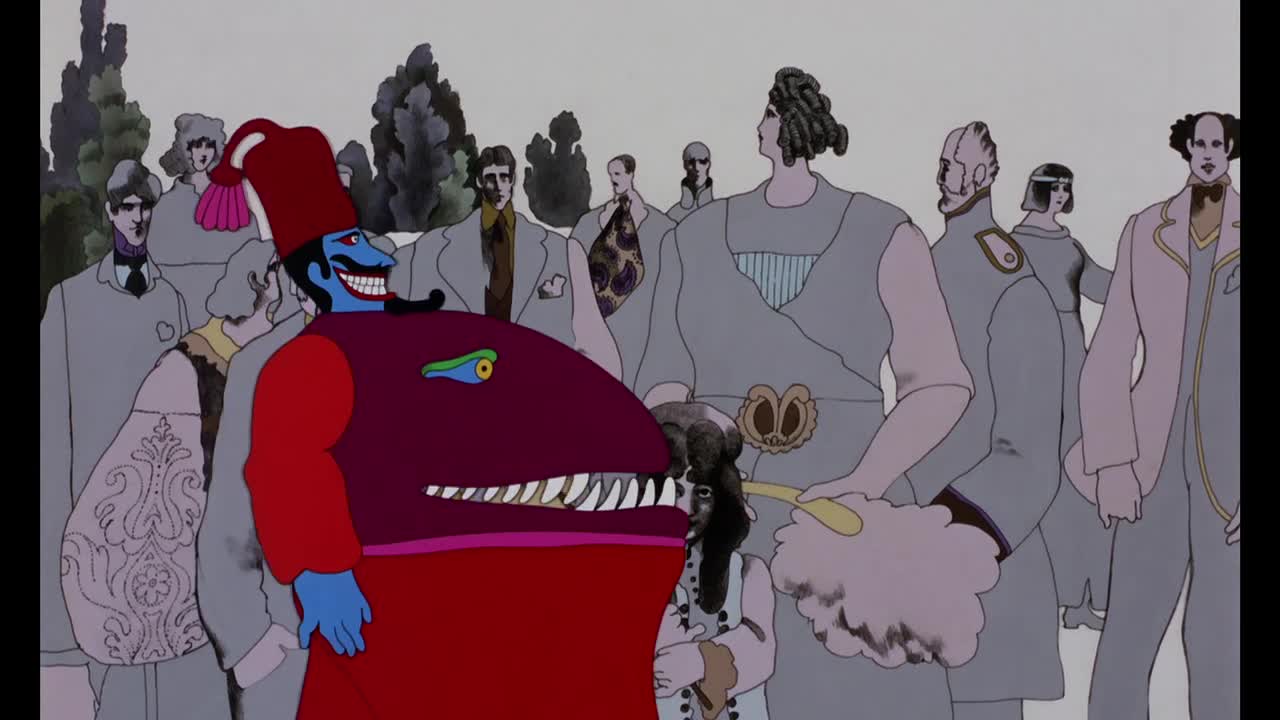
One of the Meanies’ underlings enforces the music ban to suppress any acts of rebellion.

The 1999 DVD release boasts “frame by frame hand restoration” and does indeed look terrific. It also included a 5.1 surround sound remix, as well as the original stereo and mono audio as options. The version I have also offered reproduction film cells, stickers, and an expanded booklet — the latter featuring an introduction by Disney and Pixar’s John Lassiter.

Lassiter points out that the mixed-media animation of Yellow Submarine undoubtedly was influenced by then-recent UK immigrant Terry Gilliam, who brought his style of mixed-media animation to early shows like “Do Not Adjust Your Set” before ending up in “Monty Python’s Flying Circus.” The images in Yellow Submarine subsequently influenced cartoons for US kid’s shows like “Sesame Street” and “The Electric Company,” and even “Schoolhouse Rock.”

Was Gilliam’s work influenced by this, or did Gilliam influence it? Gilliam was already doing this style of image before he was a part of Monty Python, so I think it was the latter.

As for the film itself: what it lacks in plot complexity, it more than makes up for with this visual feast. The rich imagination and style of the original characters in “Pepperland,” from the Lonely Hearts Club Band to the supporting characters of Sgt. Pepper, Old Fred, the Blue Meanies, the Apple Bonkers, and the helpful Jeremy Boob are all interesting enough to keep the film moving along between musical numbers.

Jeremy Hillary Boob, a new friend they meet in the Sea of Holes.

It might have been good to not have so much of the film’s background be completely white, but I guess they opted to put the main artwork front and center — to say nothing of saving money on background animators.

That’s not to say the backgrounds aren’t imaginative, such as the Sea of Holes and the Sea of Science (among others), which do a good job holding viewers’ attention across the thin plot. There’s even time for a classic “hall of doors” comedy bit during one of the numerous musical numbers.

Another of the many “seas” our heroes pass through on their way back to Pepperland.

It is helpful to bear in mind when watching the film that much of this Beatles music would have been brand new or very recently released to the original cinema audience and fans of the band, including “Only a Northern Song,” “Hey Bulldog.” Of course, the foundational musical score outside of the songs came from George Martin, and remains excellent and memorable as his soundtrack work generally is.
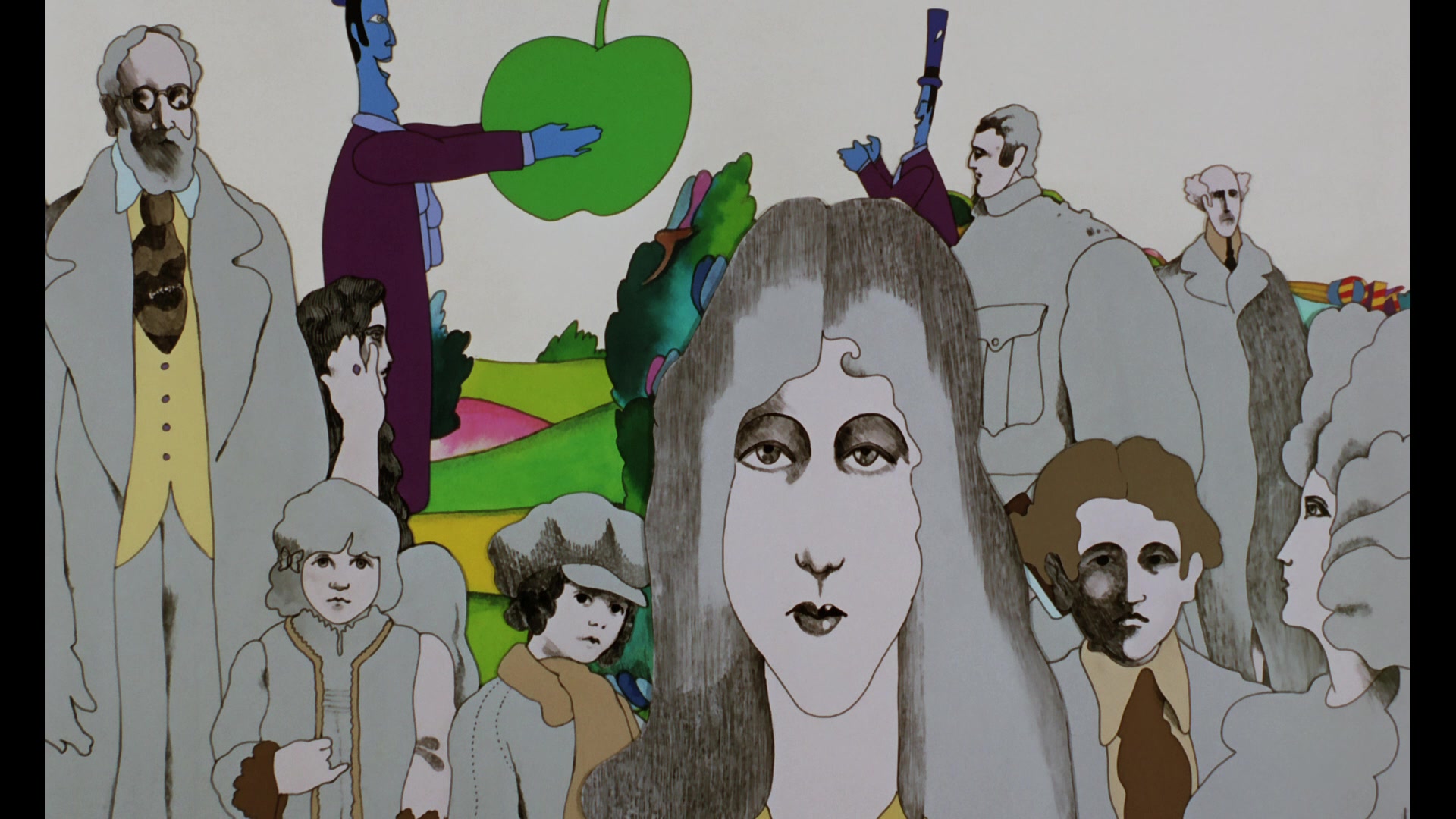
The lifeless, frozen people of Pepperland as the Blue Meanies and the Apple Bonkers invade.

Some of the best animation takes place at the beginning and end of the film: the population of Pepperland being attacked and frozen, drained of all colour — and the restoration of Pepperland at the conclusion. The plot, such as it is, is that the Blue Meanies decide to be evil and come over the hill to steal all the music that brings joy to the people of Pepperland.

They starting by attacking Sgt. Pepper’s Lonely Hearts Club Band, the main source of the music there. The incredibly elderly Lord High Mayor sends his lieutenant, Old Fred, to get help.

Sgt. Pepper (right) and Old Fred (left) climb the stairs to get to the Yellow Submarine.

Fred manages to outrun the Meanies, commandeering the handy artifact of the Yellow Submarine, and travels through strange lands before coming across the Beatles, whom he persuades to help him.

They cross those and other “lands” in trying to return to Pepperland, with occasional stops to explore. Once back in Pepperland, our heroes evade the Meanies and Bonkers before the Beatles can finally take the place of the original Sgt. Pepper’s band, using their own music to unfreeze Pepperland and defeat its enemies and restore the original Lonely Hearts Club band.
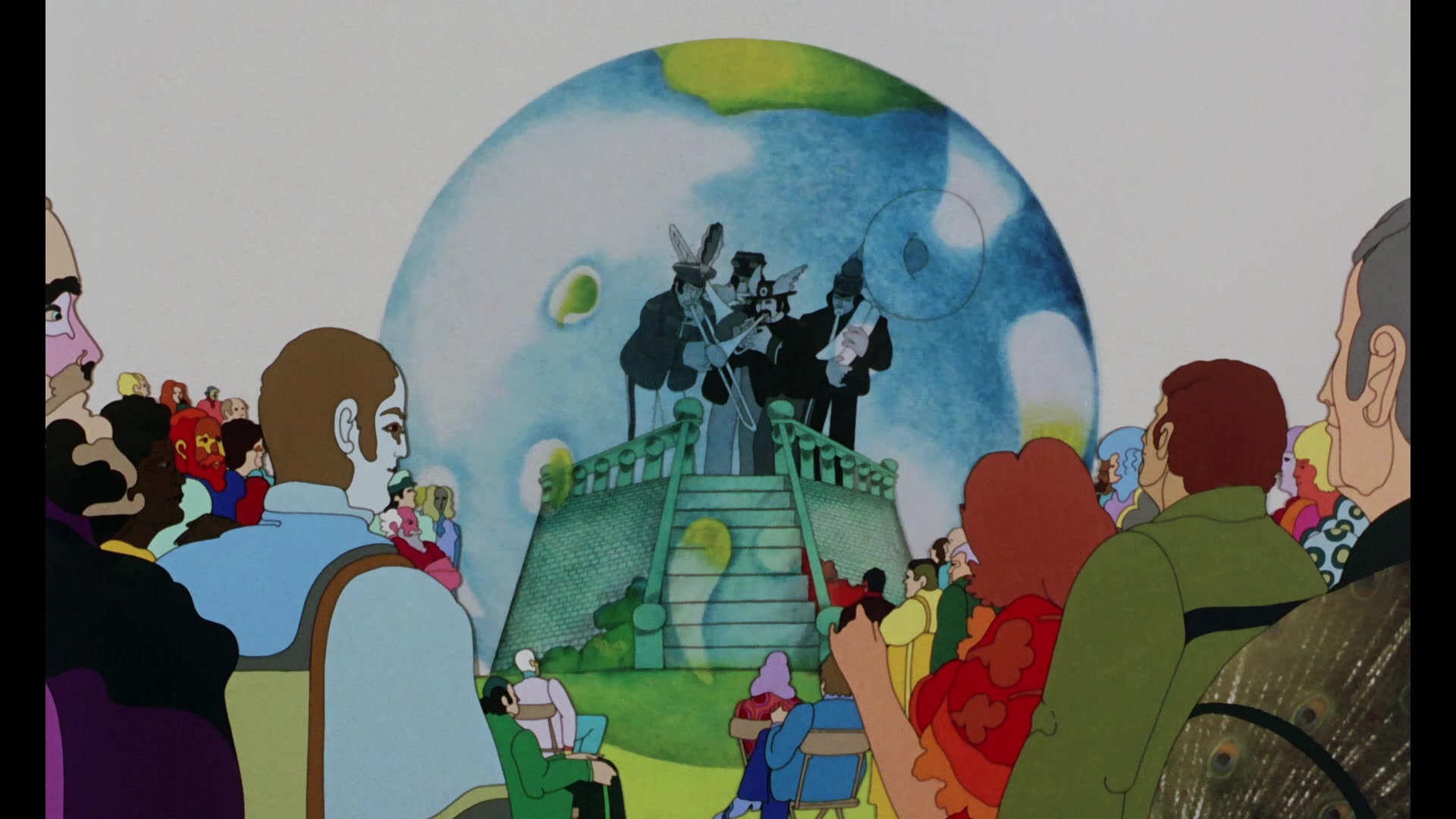
The (original) Lonely Hearts Club band after being stopped from making music at the beginning of the invasion.
The band finally get restored and live to play another day.

By today’s pacing standards, some viewers will feel it a bit drawn out (which it is). However, if you appreciate the Beatles’ late-60s output and the changes the band itself was going through, watching the beautiful artwork (still like no other animation I can think of) and listening to the songs will help the 90-minute length go by pleasurably.

It remains a unique film, both in the history of animated films and as the only non-live action Beatles movie. It also remains effective as a time capsule of a short moment in history where this look, sound, and style was all the rage.

Yellow Submarine reminds me a lot of episodes of TV comedy “Laugh-In,” which adopted a very similar look and feel for its whimsical and fashionable late-60s comedy show.

The inside of the Yellow Submarine.

You never knew what was going to happen next in that TV show, and likewise you mostly don’t know what you’ll be seeing next in Yellow Submarine. There are some 17 (!) Beatles songs heard in whole or in part, so if you are one of the few that really don’t like the Beatles’ music, this film is most definitely not for you.

For everyone else, more than five decades after its original release, it’s a musical and visual treat that blends fab (four) pop-rock tunes and simple but stylish animation to make for a pleasant animated adventure musical. The fact that there’s (still!) nothing else much like it all these years later is a testament to the originality of the approach.

After initially not wanting to be a part of the film, the Beatles were won over by the artwork, and appeared in a short cameo at the end of the film after all.

If the Beatles had done their own voices for the dialogue, I’d have rated it the second-best of the Beatles’ five-film music career, with number one being their whimsical debut A Hard Day’s Night, which I reviewed in 2023.

Sadly they didn’t, so I think it gets knocked down to third place, with the uneven but wonderfully weird Magical Mystery Tour in second (for me), the straight performance film and breakup documentary Let It Be in fourth, and the witless Help! a nearly-undisputed clunker at the bottom of the list.
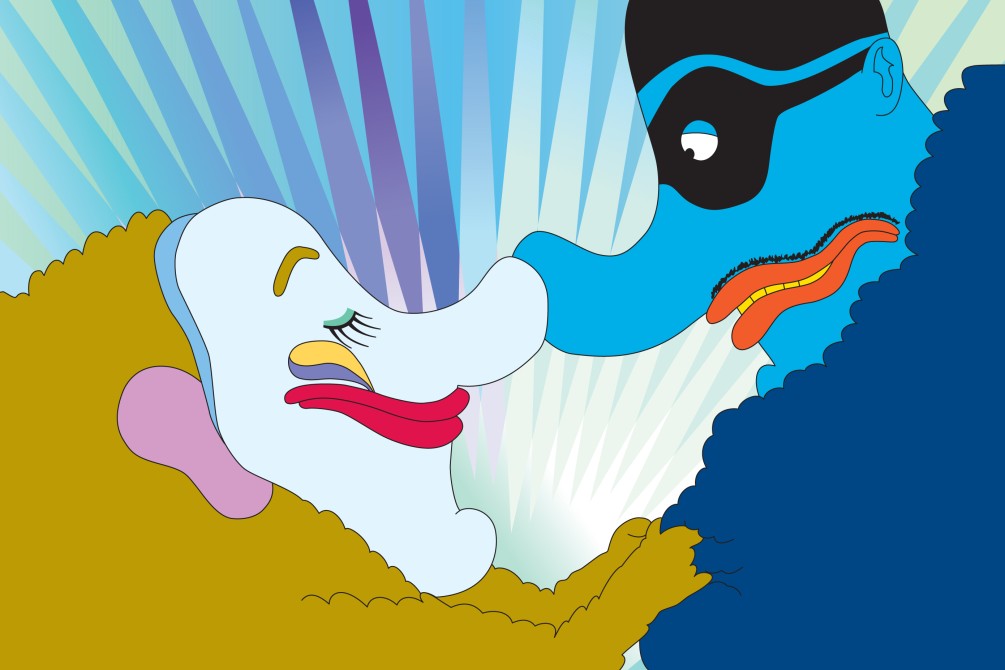
Love always finds a way.

La Jetée (1962)

dir. Chris Marker
⭐️⭐️⭐️⭐️⭐️
52-week film challenge, film 46

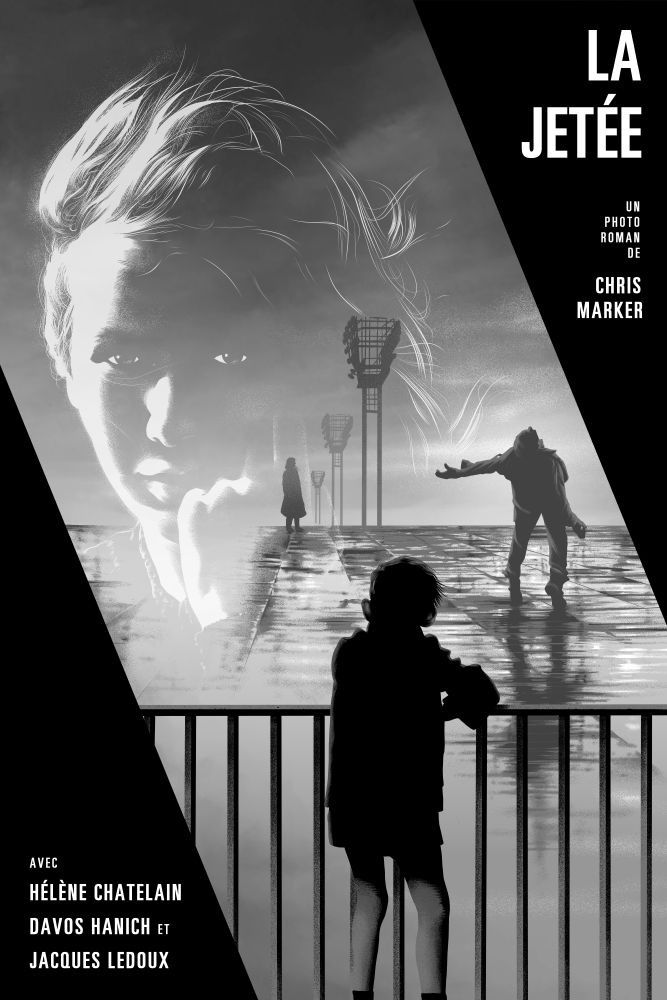
I believe I am correct in saying that La jetée, at only 28 minutes long, is the shortest film in “Sight & Sound” magazine’s listing of the greatest films in history (currently ranked at #67 in the critics’ poll, but #35 in the directors’ poll). Nonetheless, its impact on the medium of film, on storytelling, and on the notion of “science fiction” is significant.

Some wag once called it “a slide show with an IQ of 180,” and they’re … not wrong. Except for a small moment of moving images, the film is composed almost entirely of photographic still images, where the viewer must study what’s briefly on screen carefully to extract as much information as possible, combining the visual information with the audio cues and narration. Of course the medium of film is itself a series of photographed still images, but show quickly enough that the illusion of movement, of synchronised sound, of emotion and performance, is fluid.

Here, director Marker slows down the flow to create an irony, rendering it as a unique method from which we get our information; we infer, rather than see, the passage of time between each image — that interesting process in our minds where our vague memories and our dreams cross each others’ paths.

The “story,” such as it is, is stark and minimal: in a bleak post-nuclear dystopia sometime after World War III, a man is selected by a small group of scientists (German, it seems, given the whispering that occasionally appears behind Jean Négroni’s vital and nearly poetic narration), to engage in an experiment to save the present by calling on the past and the future to provide a solution — induced psychological “time travel”

The man has always held some strong mental images to keep his memories intact, and these scientists can see into people’s minds, so they have picked him. While being held captive, he is injected with something to prompt his (mental) return to the past, before the current situation, where he meets a woman not unlike “The Time Traveller’s Wife” — a figure not part of his memories, who accepts each new visit without question, calls him “her ghost” and builds a bond of trust and friendship with him.

Having successfully sent him into the past, the scientist then attempt to send him into the future, with far more obscure results. The man, seduced by the woman of his “dreams,” appears to “escape” his present and live permanently within his memories with this woman — combining the hazy glow of happy memories with this new dream-like woman, forging his own personal paradise.

Despite the vagueness that is part and parcel of this story, there is a definite ending I won’t spoil. The narration acts as a hypnotic element drawing the viewer in alongside the score — the visuals, the narration, the score, and the still-image juxtaposition of past, present, and future all interplay with each other to create a remarkable journey that is likely to stay with viewers as they reassess their own recollections, dreams, and reality.

Yes, the Terry Gilliam film 12 Monkeys is something of an expanded and re-envisioned remake of La jetée, but I’d encourage anyone who hasn’t seen that (or even if they have) to sit with La jetée and let it mess with your own head a little bit.

Even the title is a bit of a mind-slip: Literally, it refers to the jetway at Orly airport (which we repeatedly come back to), but it’s been pointed out to me that the could be seen as a play on là j’étais, which translates to “there I was.”

The Raven (1963, dir. Roger Corman)

⭐️⭐️½
52-week film challenge, film 31

From the 50s and into the early 60s, Roger Corman was churning out hit-or-miss exploitation films and grind house movies. In 1960, having established a reliable reputation, he opted to do something a little different — making House of Usher based on the book by Edgar Allan Poe. The screenplay was written by Richard Matheson, art direction by Daniel Haller, and the film starred Vincent Price.

It was a critical and commercial hit, and thus the same team made another Poe-based film in 1961, The Pit and the Pendulum, and again it was a hit. In all, Corman made eight movies based on the works of Poe, with only one of them (The Premature Burial, made for a different production company) not starring Vincent Price, but rather Ray Milland.

When making Tales of Terror in 1962, the tale “The Black Cat” inspired Corman and his team to make a movie out of Poe’s famous poem, “The Raven.” In a signature move, he re-used the sets created for The Raven in his next film, The Terror (which was not part of the Poe Cycle, as the Poe-based films became known collectively). Once again, Matheson provided a script, Haller the art direction, and Vincent Price the lead — though this time, Corman brought in Boris Karloff as one of the villains, with Peter Lorre as a rival to both.

Because the segment “The Black Cat” in Tales was comedic in nature, Matheson and Corman opted to make “The Raven” a comedy as well. Although there are amusing moments throughout the film, the comedy largely falls flat because, in my view, Corman was, at least at this point, not competent at comedic timing.

Price plays Dr Erasmus Craven, a wizard and expert at “gesture magic,” who has rejected the Brotherhood of Magicians in preference to leading a quiet, nearly solitary life. His only company is his daughter Estelle (Olive Sturgess), and a coachman he employs. One evening, a raven raps at the window, Craven lets him in, and discovers the raven can talk — and is in fact another wizard, the pugnacious (and, as it turns out, alcoholic) Dr Bedlo (Lorre). With Bedlo’s nagging, Craven crafts a potion to restore him to human form, having been transformed in the first place by Dr Scarabus (Karloff), another wizard of gesture magic and other skills.

The trained raven in this film is *amazing*.

Bedlo recruits a reluctant Craven to return to Scarabus’ castle (the exterior itself reused from House of Usher, and very visibly composited into this film) to help him finish the duel. Craven’s coachman is taken over by Scarabus from afar and attacks the party, but recovers after a protracted axe-attack scene. Instead, Bedlo enlists his son Rexford (Jack Nicholson) to be the coachman, but as the journey begins Rexford is also controlled by Scarabus and nearly drives the coach off the cliffs. He recovers in time to bring the carriage to Scarabus’ castle.

Scarabus greets his guests as a perfect gentlemen, trying to undo his reputation and greeting Craven as a long-lost colleague. Bedlo, who has been rude, aggressive, and belligerent throughout the picture, demands that the duel resume, and sets about demonstrating his style of artifact-based magic, calling up a storm. Scarabus secretly gestures to intensify the storm, eventually directing a lightning bolt to strike Bedlo, destroying him.

Literally the only “magical” thing Dr Bedlow is seen to do in the entire movie.

The shocked party adjourn for the evening, being offered hospitality by Scarabus until the storm passes. Rexford, who saw what Scarabus did to bring about Bedlo’s destruction, hides in Estelle’s room, but they quickly find themselves prisoner when the door is magically locked. Rexford uses a window and the castles ledges to make his way over to Craven’s room, convincing him that Scarabus is not the charming and gentle man he seems to be.

On the way to confront Scarabus, Rexford discovers his father still alive, unharmed, and hiding. Bedlo confesses the entire plot thus far was staged to bring Craven to Scarabus so that the latter could duel against his closest rival, Craven. Meanwhile, Craven discovers that his “dead” wife Lenore (Hazel Court), for whom he has been grieving for two years, is in fact not dead, but feigned death to become Scarabus’ mistress.

Utterly not-dead Lenore (Hazel Court).

Thus, the duel is on, with the two wizards seated in fancy chairs, attacking each other magically in turn. This is by far the best part of the picture, with various practical as well as optical effects (but not really much in the way of imagination) used effectively. Bedlo, who has now decided to become a raven again, redeems his treachery by aiding Craven, leaving his son Rexford to woo the fair Estelle, and despite Scarabus’s castle and magic being destroyed as a result, even he and Lenore survive (for no good reason). All’s well that ends well.

This movie isn’t terrible, but it is … not good. Lorre’s character is just plain obnoxious, and apparently the actor ad-libbed himself a few extra lines throughout the film, leading to he and “son” Jack Nicholson not getting along, and rubbing the ailing Karloff the wrong way as well. Karloff and Price are excellent, with Price in particular showing off his effortless style and charm, which is why he’s the star of nearly all of these Poe films.

Although there are some occasional moments that might bring a smile, mostly from Lorre’s rude outbursts, there is not one single laugh to be found in this “comedy” at all, and I’m putting that on Corman’s very flat and hands-off direction. The plot is convoluted and contrived, and its pretty shocking to think that Richard Matheson had anything to do with it, but as with Corman, movie comedy just didn’t seem to be his strong suit at this point.

I often found myself watching the sets (which make the film look at lot more expensive than it was) as much as the actors, though some of the dead-body effects (for Craven’s father in particular, but also for the fake dead “Lenore”) were quite effective. Sturgess and Nicholson are merely perfunctory in their roles, while Hazel Court chews the scenery whenever she gets the chance.

Once the scene shifts to Scarabus’ castle, the film becomes more watchable, particularly the duel, but it doesn’t overcome the “failed attempt at camp humour” vibe of the overall film. The other Corman Poe films, such as Masque of the Red Death, are much better and still recommended, despite being very much of their filmmaking era.

The Color of Pomegranates (1969, dir. Sergei Parajanov)

⭐️⭐️⭐️½
52-week film challenge, film 25

With most commercial movies, you can walk into the cinema not needing to know much about the subject and still enjoy (or hate) them, either because they explain the story within the film or some portion of needed background knowledge is communicated to you through the promotion or trailer or title of the film. Most movies touch on universal themes in their tales, or reference moments in time that are reflective of those periods, and what I’m trying to say here is that most of us have some frame of reference heading into a given film.

Not so much with The Color of Pomegranates. I watched this thing completely cold. Big mistake. After viewing it, I then had to go back and watch no less than five short documentaries about it to really get a fix on what the hell it was I’d seen.

So why did I watch it at all? Because it kept showing up on Sight & Sound’s list of some of the greatest movies ever made, that’s why. If you’ve seen another such film, the unconventional sci-fi flick La Jetée, this might remind you of it in its unconventional, idiosyncratic presentation — but that’s where the comparison ends.

With as many films as I’ve watched at this point (hundreds, maybe even a thousand), it’s pretty shocking when one comes along that throws me a complete curveball. Not an unpleasant shock, mind you; more intriguing than annoying. This is a really innovative and thus important use of film as art, but if you don’t have the aforementioned frame of refererance to understand where it’s coming from, it’s pretty bewildering for its hour and 20-minute run time.

So what we have here is an attempt by director Sergei Parajanov to illustrate the life and times of a heroic 18th-century Armenian poet, who went by the name Sayat-Nova (though he was born as Harutyun Sayatyan). To give you the shortest possible backstory, he was mostly an ashugh — a poet and bard who recites or sings their poetry while accompanying themselves on an instrument; similar to a troubadour. He remains a very influential cultural figure in Armenian history, though he is celebrated also in the countries of Georgia and Azerbaijan, since he spoke and composed in all three languages, and wandered freely among them.

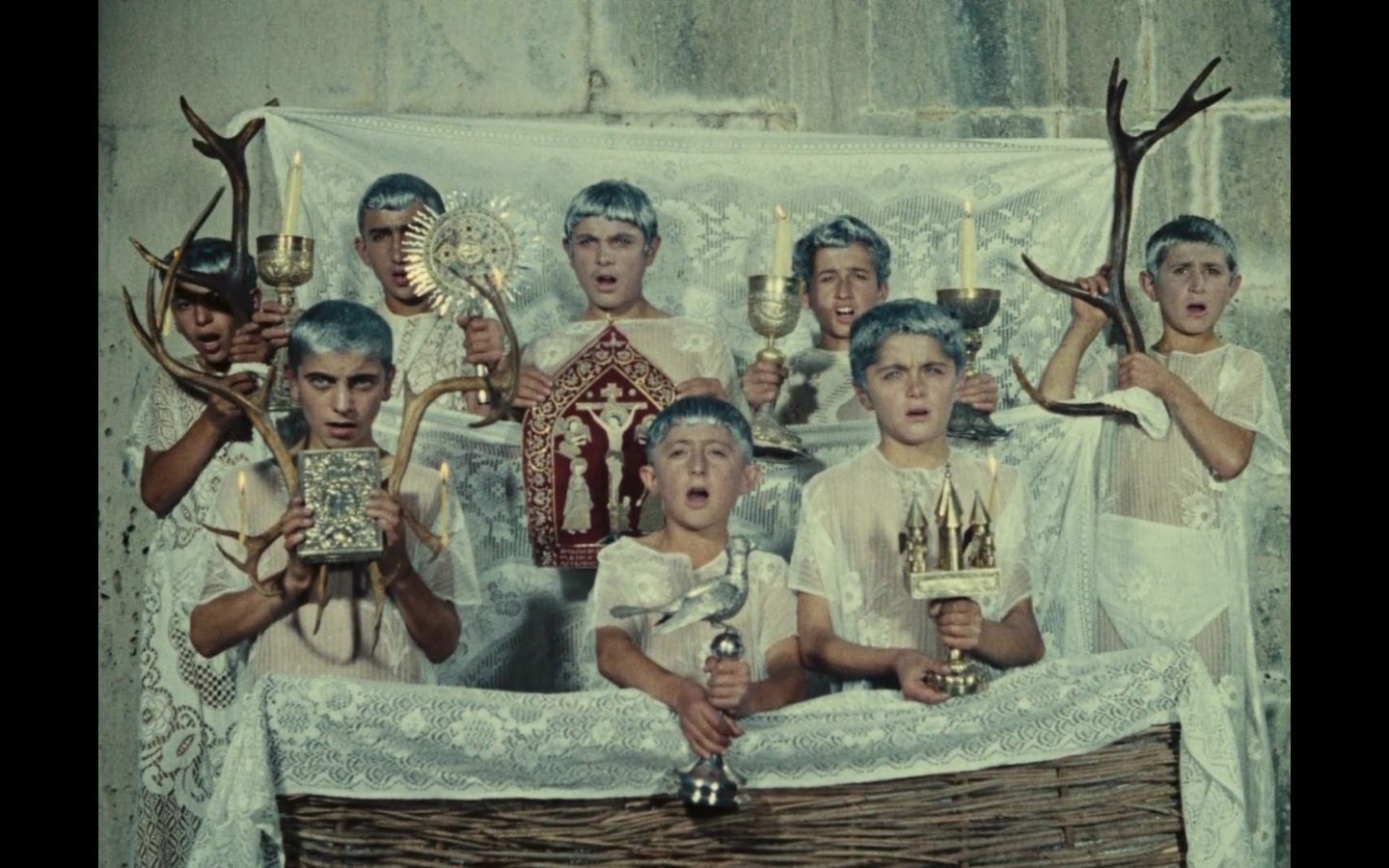
What Parajanov did that makes this film so flummoxing to anyone not steeped in both Armenian culture as well as the dominant Catholicism in that region of the world is that he didn’t attempt any sort of conventional narrative film structure at all. Instead, Parajanov attempts to illustrate “the mind of the poet” through a series of active tableaux, some virtually still and others in motion, illustrating ideas and motifs taken from both Sayat-Nova’s life as well as his compositions. Living photographs, dripping with symbolism but also reminding me of artful dreams.

So you kinda have to take at least a crash-course on this tri-national folk hero and his writings before any of this is imbued with meaning. Thankfully, Parajanov does follow the life of Sayat-Nova pretty much linearly, starting with his birth and going to through to the end of his life, utilizing his own visual symbology to accompany Sayat-Nova’s own poetic metaphors and allegories.

The areas covered include Childhood, Youth, the Prince’s Court (where Sayat-Nova falls in love for the first time), The Monastery, The Dream, Old Age, The Angel of Death, and Death. There are title cards that let you know where you are in his life story, but again you still need to have a knowledge and appreciation of Sayat-Nova’s life and work to translate what you are seeing.

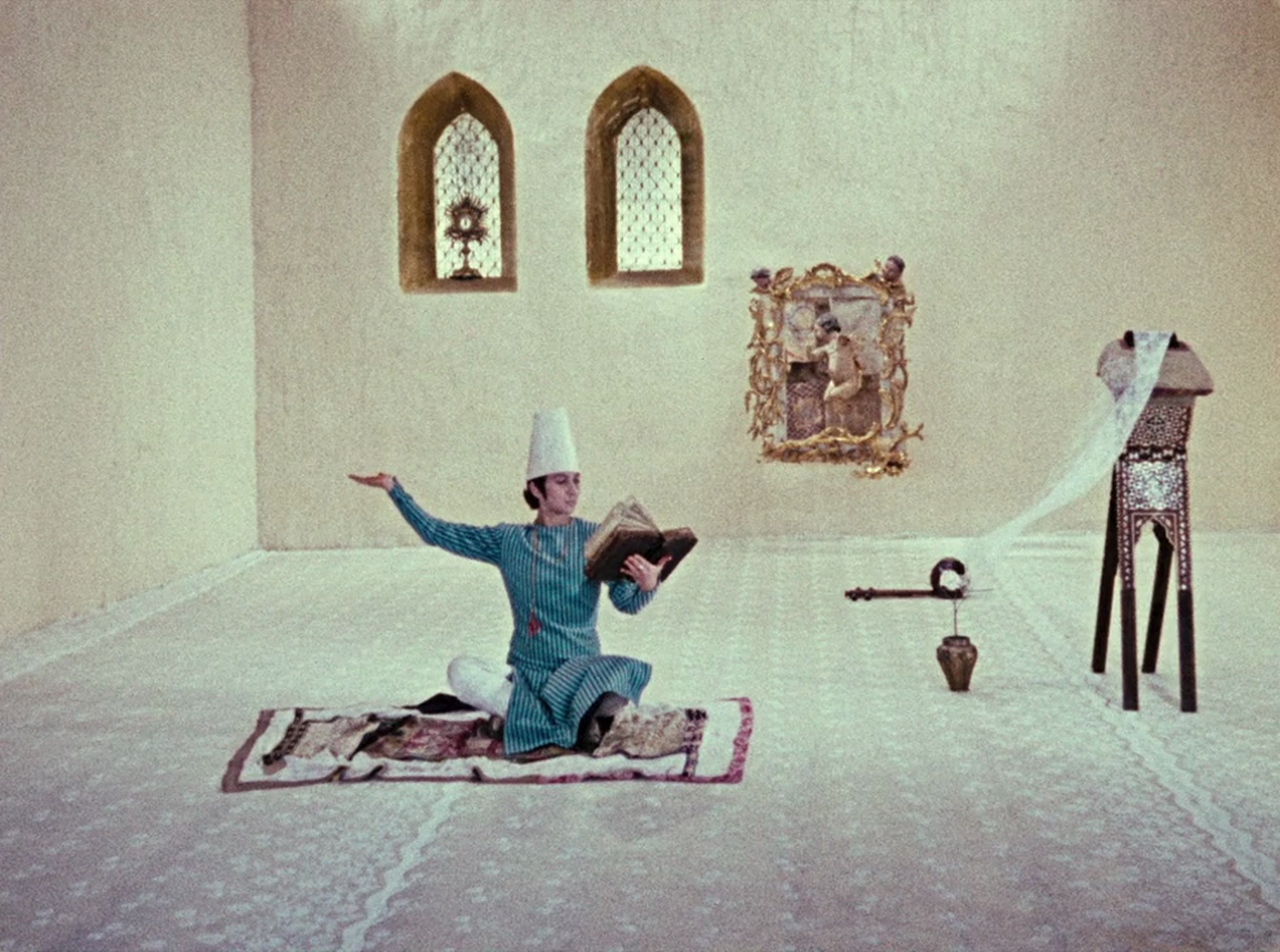
So what are you seeing? Artfully-created scenes, usually without dialogue at all, of actors dressed in beautiful Aremenian costumes, posed or interacting with other symbolic objects. Many are shot on a box-like set meant to represent Armenian illuminated miniatures, which are little hand-crafted, three-dimensional picture boxes. It would seem dreadfully pretentious if it wasn’t all so earnest.

There is sound throughout, and some singing later on, and as the subject of the film moves into adulthood, the film relies more heavily on location shooting around various ancient monasteries in the three countries where Sayat-Nova mostly lived, including the one where he spent the last 20 years of his life (and where he is buried).

As an almost unique cinematic language, Parajanov should get five stars, but I originally deducted two of them for a couple of reasons. The fifth star went for having to know so very much backstory before you should even be allowed to watch this film — let’s just say it wasn’t intended for the wider distribution it eventually got. The fourth star was removed for the lack of clues as to how to interpret what you’re seeing — there’s no explanation at the beginning that Sayat-Nova’s story will be told in visual metaphors and allegories, only that the film is about him.

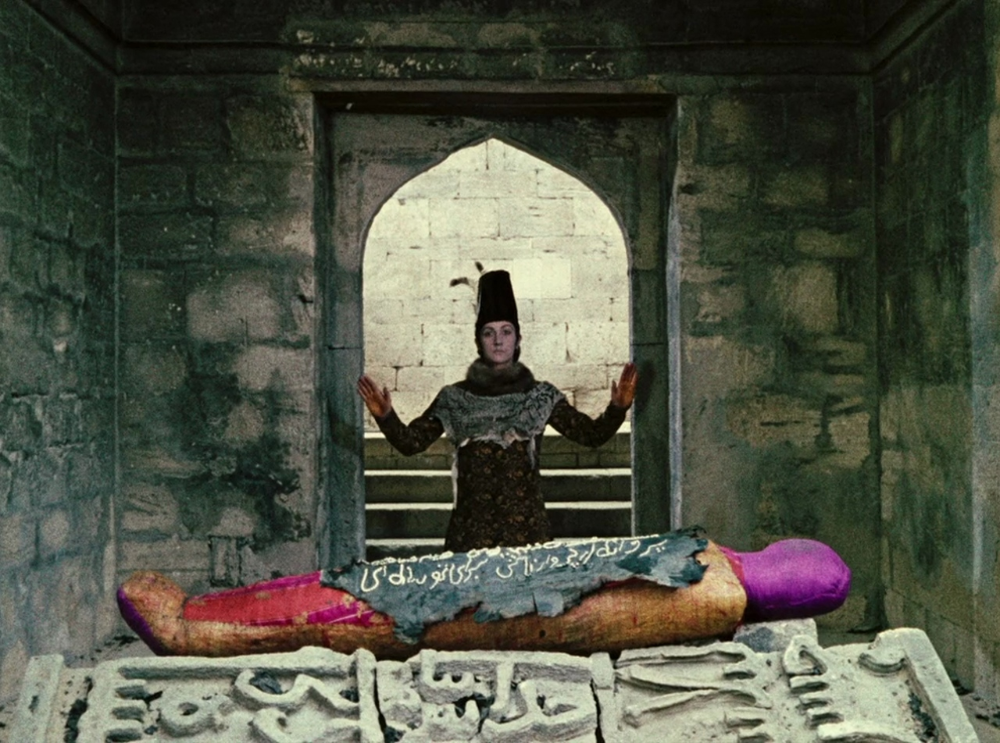
One of the most striking images in the film, and that’s saying a lot because there are many memorable images in this film.

I put a half-star back because, despite the requirements to understand the film, a story about a poet of such influence probably should be told in an unconventional way. Once you finally understand what Parajanov is doing, and what some of the symbolism means, it still doesn’t make full sense, but you appreciate much better the use of a completely different visual “language” within this visual medium.

Thankfully, I discovered after screening the film that the Criterion Channel has what they call a “collection” to go with the movie, including a commentary track on the film which I will avail myself of if I ever re-watch it, and the previously-mentioned documentaries that range from a profile of the director, to a potted history of Sayat-Nova, to a literal “decoding” video to help with the translation of the visual imagery.

It must be said that those documentaries helped me enormously in moving from “what the hell was that?” to an appreciation for the unconventional way I learned a lot about the central subject, his poetry, his background, and some core Armenian-Georgian-Azerbaijanian history and cultural influence, both from Sayat-Nova and his religion of choice. My brain feels bigger now.

It turns out the film was originally titled simply Sayat-Nova, but the title was changed when Russian censors thought the style of filmmaking was a little too difficult, though they only cut a small portion of the film and rearranged a few scenes. Indeed, Parajanov was later jailed by the Russians for his later work.

That said, pomegranates do indeed contribute meaningful metaphors that are less difficult to understand, especially in the clever use of their blood-red juice. I did not know until afterwards that the flow of the juices in some white-linen tabletop scenes are deliberately controlled to “draw” a map of the region, and in other instances to make a commentary on sexual desire, and on war.

As glad as I am to have been challenged in this way, and to have seen a film this unusual, I find it very difficult to recommend it to most others. I can think of a few academic friends (and one particular Russian history buff I know) who might be interested, but this is absolutely not a film the average person not familiar with that region of the world would want to just put on because one enjoys the aforementioned fruit.