Roxy Music – Roxy Music (box set) – Disc 4

1972/2018
Disc 4 – DVD video + 5.1 album mix

THE PROLOGUE

At last, it is time for a (short) break from the audio tracks, and a lateral move into video clips. The fourth disc of this set is in fact a DVD that includes some UK and French television appearances to promote the album.

It also includes a full 5.1 DTS 96/24 or Dolby AC3 Sound remix of the album for those of you with 5.1 surround sound setups. I lack such a home theatre setup, but that said even listening to it with a “spatial audio” assist via AirPods Pro reveals obvious improvements.

THE VIDEOS

Naturally, video clips from 1972 are sometimes hard to find, as videotape oxidizes over time and the tapes are often buried in archives. Thankfully, the band (or their record company) got copies of the tapes and preserved them well enough for presentation here.

The first “track” is a version of “Re-Make/Re-Model” performed live and filmed at the Royal College of Art in London on 6-June, 1972, intended as a promotional video rather than taken from a live show.

The sound is muddy mono as you’d expect, and the video is “marred” by an excess of 70s-era video effects that are so hokey and old they’ve come around to being cool again. The effects get excessive, but the visual and audio message gets delivered nonetheless.

From there we move to the venerable TV music show “The Old Grey Whistle Test,” a BBC show that ran from 1971 to 1988. This appearance was on 24-August of ’72. The video of this performance opens with an out-of-focus disco ball slowly spinning before dissolving into the quiet intro to “Ladytron” being played by the band.

Sleepy-eyed Bryan is off in the corner. The video of the band performing is beautifully sharp and clear, though the sound is of course still mono. Andy effortlessly shifts from oboe to sax with cover from the rest of the band. Manzenera’s bug-eye specs get a fair amount of focus, as well as his and Eno’s interplay of guitar effects vs. electronic efforts.

An extended guitar-and-electronics jam follows, and ends with some video feedback. If you were watching this while high, I can only imagine the either panicked or euphoric reception you gave this.

Likewise, “Top of the Pops” started off with blurry psychedics before sharpening up and focusing on the band in their full splendor for a version of “Virginia Plain.” Bryan is resplendent in his spangly green dress suit, Paul Thompson has now formally adopted (or perhaps this is the debut of) his “long-haired caveman with one black eye” look. Manzenera still relies on his shiny track suit and bug-eye glasses, while Eno is rocking a black ostrich-feather jacket, and the crowd are not quite sure how to dance to this, but they give it a go anyway.

Another live but more echoey (and very brief) performance of “Re-Make/Re-Model” is done for “Full House” on 25-November, with the band also doing “Ladytron” for the show on the same day. The band are positioned on a circular stage, with the camera slowly swooping in over the audience (who are seated).

The camera pans around behind the stage, and the band stops suddenly after the end of the first verse to applause. Yes, just one minute of the song! I believe this was used at the top of the show as a “teaser” for the bands that would be performing.

The (more complete) performance of “Ladytron” starts off with a close-up angle of one of Eno’s synth knobs. He kicks things off with some ambient noise while MacKay does a slightly-shortened oboe intro. Ferry and the band kick into the song proper, with more echo than normal because of the studio.

Manzenera is shown without his bug-specs. You can actually (gasp) see his eyes! Every instrument is clearly heard, so the sound mix is impressive. After Phil’s guitar solo and Eno’s stylings, the song comes to a quick close.

We then move on to a filmed performance at the Bataclan, in Paris, in front of a very large and enthusiastic audience. The set kicks off with “Would You Believe,” and the band are engaging in a bit of 50s style choreography. The song is unfortunately interrupted by an announcer telling the television audience (in French) about the venue and the band.

Eno is shown among those singing backing vocals, and while the sound mix is muddy and shifting, Bryan’s vocals are, as always, very clear. The 16mm film cuts into the instrumental break and second verse of “If There is Something.” This is clearly from towards the end of the concert, as Bryan is very sweaty but still very into it.

We do get the full “Sea Breezes,” with Manzenera doing his impressive “weeping guitar” style as heard on the album. Again, one is reminded that both Ferry’s vocals and the basic direction of the band are very polished and consistent with the album verison, allowing for only minor variations (mostly due to Eno’s electronic squelchiness).

The film cuts slightly to the opening of “Virgina Plain,” which the audience are clearly familiar with, clapping the count-in. Again, the band engages in a little synchronized movement while Ferry pounds that repeating chord. The song returns in full force for the sudden ending, the band waves goodnight and the crowd goes wild.

THE 5.1 MIX(ES)

Finally we arrive at the album once again, only this time a little different: a newly-created “surround sound” mix done by Stephen Wilson from the master tapes. Right away, you notice the crowd sound is floating around before the piano kicks in.

Even using just conventional headphones, there is stronger stereo separation and clear positioning of the players: Ferry in the center with MacKay’s oboe, Manzenera and Simpson on the left side (probably with Manz in front of Simpson front), Thompson on the center “back,” Eno and MacKay’s sax mostly on the right. Backing vocals are likely positioned in the back center, but on normal headphones they just sound a bit distant, like Thompson’s drums.

At the time of this review, I don’t have access to a full 5.1 surround system where I can listen to this mix in the way it is intended; that said, some headphones and earbuds (such as the AirPods Pro) do their best to simulate the experience, doing a good job at the separation but unconvincing when it comes to sounds that are intended to becoming from behind you.

If I can find a way in the near future to put this on at some stereo boutique or some friend’s home with 5.1, I’ll amend the review to include those impressions.

Naturally, the bass can only be as woofer-y as your headphones allow, and cranking up the bass on your stereo doesn’t really replace a true subwoofer. In my experience, however, owners of home theatres tend to crank the subwoofer up somewhat higher than they should, because of the novelty of truly having room-shaking bass at last.

The conventional headphone experience still rates as a novel and “different” way to experience the record, with the two rather different types of “surround” experiences and the appropriate amount of bass if you keep the levels even. For those who are long familiar with the album already, the 5.1 mixes might also be a good place to start, especially if you actually have the setup needed for it.

There’s probably less difference when experienced on a proper 5.1 setup, but to my ears the DTS option seems to give conventional headphone listeners more distinct separation, while the Dolby AC3 version draws it lines fuzzier, with most of the instruments having a better grouping, if you will. The sounds sometimes travel from one “side” to another, though the transitions are very smooth; some sounds seem further away, while others are perceived as being “closer.”

I’m just sorry I’m not getting the full experience. Yet.

THE CONCLUSION

This box set could be called a lab on how to experience the same album in a few different ways, but for me working my way through it, it was more about rediscovering what a remarkably fresh-sounding and original album it was at the time, not to mention re-appreciating a few songs that once forgets about compared to the singles. As a debut album, this thing is damn hard to top.

On top of that, the entire album sounds like it fell through a time warp from the first wave of post-punk “New Wave” bands that started using synths, and at least some of that obviously goes to Brian Eno’s contribution. Take him out of the picture and the band still rocks, but it wouldn’t have that “futuristic” vibe that makes the band stand so far apart from their 1972 contemporaries.

Roxy Music would certainly be a strong candidate for the honour of being “the first New Wave record.”

As someone who certainly hasn’t listened to every possible debut album from that year to compare but is broadly familiar with stuff came out back then, I’d still say Roxy Music is likely to be one of the absolute best and most innovative records. That Roxy Music emerged this fully-formed gives a lot of credit to Ferry as a superb songwriter, as a bandleader, and as an incredible talent-spotter.

Roxy Music – Roxy Music (box set) – Disc 3

1972/2018
CD 3

THE PROLOGUE

Following what has become convention for these multi-disc box sets covering a classic album, Disc 3 is generally the odds-and-sods package, and that’s also true in this case. We get the entire album yet again (except for “Bitter’s End,” oddly enough) in the form of sessions recorded for UK DJ John Peel’s radio show, albeit out of album order, and across several sessions.

We also get a “BBC in Concert” recording with five songs from the album, and this time there is audience reaction noise, which is gratifying. There’s more to come on the live and semi-live front, but that will have to wait for the DVD that makes up the fourth disc in this package.

THE MUSIC

The first five songs hail from the band’s first meetup with Peel — on January 4th, 1972 — and the session is an interesting artifact from David O’List’s time as the guitarist for the band. The session starts with “If There is Something,” featuring a pretty similar vocal from Ferry and a few mistaken notes here and there but otherwise very impressive — this is a very well-rehearsed band that’s not afraid to play around the song a bit but is mostly very tight.

Eno’s synth work here occasionally reaches duck-warbling levels, but is mostly great. The song retreats to just drums and piano, with some fine backing vocals, for a bit before the band fully returns for the finish.

The second track is “The Bob (Medley)” which reinforces its war theme with air sirens and a menacing bass synth undertone ahead of Ferry and the band kicking in. The sax is made prominent in the instrumental break, which gives the middle section a nice lift. O’List proves himself a skilled guitarist, if prone to stick to conventional licks and hard-rock phrasing.

Next up is “Would You Believe?” which is the most direct throwback to the 1950s style and that is played up here. The band vocals, other than Ferry, are noticeably different than the album original, but the instrumention sticks to the script. This song is especially well-suited to MacKay’s sax and O’List’s guitar.

“Sea Breezes” starts off with an honest-to-god Tiny Tim vocal from Ferry, who sometimes skates too close to the thin-yet-warbly vocal line that separates them. We get a very drawn-out version of the song, running 8’15” and threatening to turn into a Grateful Dead jam in the middle.

Almost identical to the album version, “Re-Make/Re-Model” shows off again how tight the band has become under Ferry’s musical direction. Eno’s parts are more prominent here, but apart from that the performances are remarkably similar. This performance, live in the studio as it is, might be my favourite of the three versions we’ve heard so far.

The second Peel Session came in late May, and featured just three songs, but with new bassist Rik Kenton, who would be present for the remaining Peel Sessions. He was let go at the end of ’72 and went to a long career as a session musician.

By contrast to the album version, “2HB” is a little disappointing, in that the edit here cuts off the dreamlike opening that set the mood in the album version, and goes directly into the first verse. Beyond that, the song manages to recapture that feel in the instrumental break, where everyone except Bryan is playing together. There’s a weird channel shift near the end that kills most of the right side in the last 10 seconds or so, but that’s live radio for you.

Thankfully, we do get the dreamy mood-setting instrumental that starts off “Ladytron.” The jam section in the middle is always a treat, and the mix here is just different enough to keep things fresh while still being very similar to the album version.

After hearing these different versions of “Ladytron” in this box (with three more to go!), it’s clear that the key to this song is Kenton’s throbbing, insistent bassline. Unlike most of the songs, which are anchored by either Ferry’s piano or Paul Thompson’s incredibly good, solid drumming, in “Ladytron” it’s the bass that is the foundation everyone else builds on.

“Chance Meeting” is such a mannered song, sung in a clipped manner and based on an almost “Chopsticks”-like chord progression (but Ferry likes those chords, as we heard in “Virginia Plain”). The delivery is so stiff-upper-lip and the band so restrained, it makes for a nice mood break from the other tracks, but it’s still one of my least favourites on this album.

The final track for the Peel Sessions on this disc is of course their killer hit, “Virginia Plain.” Thompson’s bass drum teams up with Kenton’s bass, while MacKay’s oboe and Manzanera’s guitar take turns swooping around like daredevil stunt pilots, while Eno’s sonic decorations dance about wildly.

The remaining five tracks are from a “BBC In Concert” live event from August 3rd, 1972. It kicks off with “The Bob (Medley),” an odd choice for an opener in my view but around the same length as the album version, as compared to the drawn out jam we got on Disc 2’s outtakes.

Naturally, a live performance is going to have a different mix, but Eno really gets into his performance of war effects and sonic warbling early on here, with the band right behind him. After the first part, the band jams out in a now-familiar way that is close to what we’ve heard on previous versions. There’s the brief spoken-word moment, then things get heavy again before the finale, and we finally hear some audience appreciation.

“Sea Breezes” has a different but similar arrangment to the album version, and provides a sombre contrast to the more-bombastic previous opus. I think the problem I have with this song is that it meanders, and — as nice as the second half turns out to be — it never really pays off. That said, Eno goes wild at the three-quarters mark of this seven-minute opus, which makes it really quite different to the album version. Following the ever-shifting “The Bob (Medley),” I have to wonder if the audience thought this would be what every song is like.

Thankfully, the next song is a very good live version of “Virginia Plain.” It still sounds a little restrained from the other versions, but it still rocks along nicely and follows the album version pretty closely. Eno’s magnificent synth riff in the middle eight is nice and LOUD as it should be. The audience clearly liked this one a lot.

Then we come to the more formal “Chance Meeting.” Once again, Eno is more prominent here than he was on the album or Peel Sessions. The instrumental break is nicely mixed and sounds great here.

The last track is “Re-make/Re-Model,” and again the band is back in top form with a fantastic sonic attack, though the band’s vocals caught the sound man napping for a few seconds until he brought their mic levels up. MacKay’s sax is amazing in a live setting, and the whole band are really on fire here — it’s clearly something they love playing.

At the three-quarters mark, Eno really gets to shoot his shot, but all the band members get to show off their chops really nicely, which is one of the reasons I like the song — it’s obvious why this was the concert ender; they are throwing the (sonic) kitchen sink at the audience, and they are are loving it, breaking out into a chant for more at the end that regrettably just fades away.

THE VERDICT

If you’ve listened to the box set in disc order, you’ve heard the album, the demos and out-take versions of the songs on the album, and now the “live in studio” and “actually live” versions, and you’re not done yet (more on that later).

The highlight of this disc, for me, is comparing guitarists O’List and Manzanera (which is like comparing Monet to Jackson Pollack), and judging Rik Kenton’s bass playing to Graham Simpson’s (both quite good, so a more difficult compare — and neither stayed with the band past this album). It’s also been fun to hear the band rehearsed but live on radio and in an audience environment — and very gratifying to hear that Roxy Music found an enthusiastic audience very quickly, given how bold the album was.

That said, the reason this album found its audience relatively easily is because there was a hell of a lot of new sounds coming out around this time. King Crimson was around, Kevin Ayers was around, John Cale and Terry Riley had put out an experimental minimalist album, and there was more of that as the move away from folk-rock had begun.

Audiences were looking for something different from the late 60s sounds, and in Roxy Music they found it. On the very same day it was released, a bubbling-under folk-rocker named David Bowie took a hard turn with a rock concept album (thanks to Mick Ronson) with The Rise and Fall of Ziggy Stardust and the Spiders From Mars, and achieved superstar status.

Bowie won out in the UK album rankings, peaking at #6 while Roxy Music managed a very respectable #10 position. More importantly, it launched Roxy as a huge success right from the start, and has remained a strong influence for art-rock and New Wave bands across the decades.

Just as an example: earlier in 2024, acclaimed folk-rocker Linda Thompson released a successful album called Proxy Music, aping the cover of Roxy’s debut perfectly. Thompson has recently lost the ability to sing or speak due to spasmodic dysphonia, so she recruited others to sing the songs she wrote for the album.

Next time: the DVD (video portion)!

Roxy Music – Roxy Music (box set) – Disc 1

1972/2018, 3CD + 1 DVD
CD 1 of 3

So now that we’ve already covered the packaging in detail, we can dig into the album proper — but it’s worth remembering that the packaging singularly used “sex” to sell the record. The complete lack of any information about the band (apart from the name) or what the music might sound like — there was just “the girl” — on the front or back cover ensured that only the most curious and intrigued of parties would buy it, if they wanted — or needed — to learn more.

THE PROLOGUE

Luckily for us all the trick worked: the first single was (wisely) chosen as “Virginia Plain,” which served as a calling-card for their elegant, innovative, and varied rock stylings. It went to number four in the UK singles chart, and that pushed the album (which at the time did not include the single) to number 10 in the charts.

This was something different: neither the swamp-rock of Creedence Clearwater Revival, nor the hippie music of George Harrison, and not the R&B white soul sound of Van Morrison, the funk and soul of Gladys Knight or Aretha or Sly Stone, or the gentle pop of Neil Diamond. It was new and different, borrowing from the 50s but adding in sounds of the future and a decidedly eclectic crooner style — and thankfully it caught on with an eclectic group of buyers who took a chance and were richly rewarded.

I used to call the first album “the first New Wave record,” and while I was basing that assessment on my favourite tracks rather than the album as a complete work, I still stand by that description. It took a nearly decade, and the reactionary mid-70s revolution of punk, to create a movement that followed in Ferry and company’s footsteps.

Before we get started, though, a radical rethink: don’t start here. Go directly to Disc 2, do not pass Go, do not collect $200. You will thank me later.

You see, the packagers of this comp (presumably Ferry and various execs) have made a hideous mistake — we should hear how the album came together (aka Disc 2), warts and all, and <em>then</em> you should go back and listen to Disc 1 with enlightened new ears. As I mentioned earlier, if you bought this box then you’ve heard the first album, maybe a hundred times or more.

The real find here is the demos and outtakes, which haven’t been heard before. While the songs (and especially the lyrics) are still familiar, they are cut short, redone, tooled around with, argued over with the engineer, and generally … <em>fresh</em>. Listen to Disc 2 first, then come back to Disc 1 with completely new ears for this album you know so well.

No? Oh all right then …

THE ALBUM

Disc 1 of this set starts off with some false advertising: it’s billed as the “original” album, but it’s not: the original vinyl release in 1972 contained nine songs. The CD version, first released in 1984, inserted the pre-album hit single “Virginia Plain” between “If There is Something” and another popular song, “2 H.B.”

Don’t get me wrong, I’m glad the first disc here exactly matches the first CD version, but it’s not the “original” release, is it? And yes, there’s more quibbles to come!

On to my second (minor) gripe: the version used on CD1 here is in fact 1999 remastered edition, which was cleaner and brighter than the original 1984 CD issue. I would kind of liked to have had a Stephen Wilson stereo remix instead — which exists, but isn’t present in this box set.

Most people who would buy this deluxe edition likely already have or had the ’99 remastered version, and the technology has moved on considerably in the last 25 years. Using the 2.1 Stephen Wilson version would have given most buyers something “new” there – if you’re not going to give us the 1984 original CD version – and it would been a thoughtful gesture for those lacking the equipment to properly play back the DVD’s 5.1 SW mix.

Still, for those who bought (and still have) the original CD on first issue, the ’99 remaster is clearly the superior version of the CD.

The single sleeve disc’s front cover does, of course, faithfully preserves the original eye-catching outer cover, while the back lists the album’s contents, players, and production personnel. Thankfully, the “art book” portion of the presentation gives us gatefold’s original interior art, with more information about the band and songs — at the same size as the original LP release.

If you’re reading this, you are very likely to have heard Roxy’s debut album already, so we’ll stick mostly to my refreshed impressions, listening to it again after a few years’ gap from my last listen; we’ll get into more detail once we move on to the discs with the previously rare-or-unreleased material.

Re-Make/Re-Model: the short silence (six seconds) before the crowd noise, which we get for another few seconds followed by a sharp cut and Ferry’s piano, then Thompson’s drum start and the band joining fully just two seconds later … what a way to announce “this isn’t your typical band.” While the bass and drum hold down the basic rhytms, guitar and sax go wild in almost jazz-like improv, with short bursts of Ferry’s vocal, and the band backing him by reciting a license plate number between verses.

There’s no chorus (apart from, I suppose, the license plate thing), and the long instrumental section is like nothing else: a bit of the full band, then a suddent stop and breakout spot by each instrument that feels very on-the-spot improvised, as if the direction given was “you get a five-second solo. Go!”

First drums, then a cheeky bass rip-off of The Beatles’ “Day Tripper” riff, then Eno’s sputting screech noise box, then a shot of sax that flows right back into the music stream, ditto with the guitar, and finally some madcap piano, one last drum break, and then all of them at the same time for a bit before it falls apart and winds down. The way the weird synth noises snake through the deteriorating band and finally signals the end.

By this point, the listener in 1972 must have been wondering what planet these guys were from. What an opening number! After all these years, I still say “wow.” This is just as fresh and wild as it was the day it was released … and there’s not a lot of 1972 albums you could possibly say that about.

Ladytron: With barely time to take a breath, we take another short break of seeming silence (about four seconds) before we begin to perceive a soft electronic bed emulating wind, with an oboe softly winding its way around a melody, accompanied by synth sound effects kind of emulating a lonely wind. The oboe part partially repeats, then Ferry comes in with “You’ve got me girl on the runaround, runaround/Got me all around town/You’ve got me girl on the runaround/And it’s gettin’ me down, gettin’ me down,” as the bass moves in ahead of the full band coming in fully.

Naturally, you get absolutely no clue as to why the song is called “Ladytron,” and the song about a ladykiller gent playing cat-and-mouse with his latest target. After the first full verse, we again take a break to highlight a fabulous echo-drenched oboe. Ferry returns, now double-tracked, and we get that first taste of Ferry’s famous warble.

Without changing the tempo, the furious drums return with fast bass, horns and guitars double-tracked guitars, piano trying to keep up, shakers and the kitchen sink thrown in for good measure. Imagine Elton John playing “Saturday Night’s All Right for Fighting” with his full band, and all of them having a nervous breakdown – with Brian Eno aggravating matters – as the instrumental break just floats off into the sunset after a minute, and the song is over.

These first two tracks firmly established that this music was something new to the world of the early 70s, acknowledging influences of jazz, soul, and rock while melding it together into Dali-esque impossible structures and jams, where the singer was not the focus but still riveting when he did appear. Vocals were just another instrument, occasionally contributing something that might sound like a lyric, or words intended more for texture, and then step aside to let the band show off.

If There is Something: The above is what makes the third track all the more confusing: after two incredible tracks, suddenly Roxy Music becomes a country-rock bar band (?!). Something about Ferry wanting to settle down with a young girl and grow potatoes, showing off his vocal quaver — and with nothing for Eno to do until halfway through, then mutating the song into a slow jam?

It’s a little portent of the second half, and while it’s not bad at all, it’s certainly a letdown from the first two killer tracks. Okay, there’s an argument to be made that after two (for the time) bizarre tracks, you might want to give the listener something akin to music they’ve heard before, and I get that.

It’s not until Eno’s synth counter-melody, though, that “Something” reverts to the kind of interesting and non-mainstream sound it has been cultivating so far. Thanks to the sinister undertone of the song after its initial riffs and Eno’s contribution, I can see why Bowie’s Tin Machine wanted to take a stab at it … but frankly, I think Bowie did a better job with it.

Virginia Plain: As “Something” meanders off, the first single pulls up in a new sports car with style and energy to spare, thanks to its playful lyrics: “You’re so sheer, you’re so chic/Teenage rebel of the week” is just a sample of the joy that permeates this song. Wrap it around another fast-tempo’d melody featuring frantic piano and drumming, steady bass with schizophrenic horn, and a motorcycle taking off for good measure. This track is a solid-gold winner, with a brilliantly-framed synth coda before the final lyric, which beautifully brings the song to a flying stop. It was an obvious choice for the first single.

Spoiler! This is the new official music video for “Virginia Plain,” taken from the bonus DVD in the box set.

2 H.B.: This is followed (finally) by a breather, a somewhat-gentler tribute to Humphrey Bogart. Ferry puts on an even thicker Ferry-esque style for this one, which includes a nice long multitracked sax-oboe instrumental break.

The chorus of “Here’s looking at you, kid” ties back to the title so nicely and the repeated line of “failing me never” which fades off as the instruments retreat is a lovely finish. On the original vinyl, that concluded a pretty much all-star Side One.

The Bob (Medley): Now we start off back in ominous synth town for a bit before the band comes in and disrupts whatever mood the opening was going for. It’s like a parody of the indulgent slogs that The Grateful Dead put out, meandering from one musical idea to another with little connective tissue.

We’re clearly in for a rougher ride on the second side, kids. It’s not until the middle of the piece and all the gunfire that you get the idea its about war (specifically, the Battle of Britain). It’s like a notebook of barely-started lyrical and musical ideas, poorly glued together.

Chance Meeting: We transition away from “The Bob”’s car wreck with a slow, beat-less piano-and-guitar first verse, which describes exactly that happening. During the instrumental break, the bass is allowed back in the room for a bit before it quickly fades out.

Would You Believe: Just when you think the second half is going to be the (almost) “all filler” counterpoint to Act I’s “all killer,” this track finally gets us back to the Roxy we thought we were getting based on side A. The soft, falsetto, double tracked Ferry starts off with a ballad verse, then the band breaks out with a 50s-styled main tune, the band shows off their sax-and-piano chops before Ferry returns to his crooning.

It comes off like a real tribute to the kind of music they grew up listening to, and it’s the highlight of the second half.

Sea Breezes: Following that, the next song literally opens with the sound of (synthesized) crashing waves, and then Ferry crosses fully into Tiny Tim territory with his delivery; we’re just missing a ukulele here to complete the effect in this very quiet number. There was so much energy and verve on the first half of the album, listeners might be wondering what the hell happened to the band when they recorded the second side.

Just in the nick of time, however, the second part of “Sea Breezes” sees the return of Ferry’s normal singing voice, far better lyrics, and some lovely contrasting instruments in our left and right ears, which is a fun effect. Sadly, then the finale of the song reverts to the catatonic style that is so inert you want to check the band’s collective pulse, complete with the return of the falsetto. The band seems to have something of a schizophrenic personality.

Bitters End: While maintaining a barely-above-ballad tempo, “Bitters End” returns to the tribute 50-style doo-wop number with a dropped in crowd effect, and works well. Given the lack of pulse present in most of the second side, it was very wise to finish with this number.

It’s Noel Coward as a 50’s ballad, and I do particularly love the occasional background chorus of “Bizarre” to frame Ferry’s amusing lyrics. Once again, a sudden change-up (in this case, Ferry reverting to his lower register) to a sudden stop makes this clever homage into a strong ending for a mostly-disappointing second part.

THE VERDICT

Like Longfellow’s little girl who had a little curl, when this is good it is very, very good, and great respect is earned for continuing to sound so contemporary after more than 50 years since its release … but to rewrite the poet a little bit, when it is bad it is somewhat disappointing.

Few are the albums that can maintain a consistently great standard across 10 tracks, and Ferry’s love of slower ballads will eventually pay off in later albums. But in this case, the flip side just seems laboured and leaden most of the time, or maybe I just don’t have enough of an appreciation for languid love songs. I think it’s fair to say that Roxy Music’s debut is strong, but uneven.

Next time: Demos and Out-takes!

Roxy Music – Roxy Music (box set) – Box & Book

Virgin/EMI Records, 1972/2018
3CD + 1 DVD, book

THE PROLOGUE

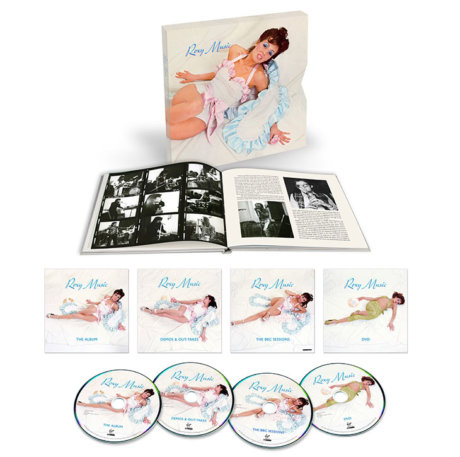
Although Roxy Music as we know it began in 1970, it was two further years before the concept became a recording act, providing evidence of what they were up to in the form of their debut album. For this super deluxe box set, founder Bryan Ferry emptied his vaults for material well beyond the original album, including the early demos, album out-takes, radio sessions, and a DVD of mostly short television appearances, capped (on the DVD) by a new 5.1 DTS and Dolby AC3 mix of the album by Steven Wilson.

Billed as a 45-anniversary deluxe box set — even though it actually came out a year late, in 2018 — this weighty box includes three CDs and one DVD, the latter of which contains both visual and audio-only information (more on that later).

Where the weight gets put on is in the incorporated 136-page book documenting the band’s formation by The Guardian journalist and author Richard Williams, who first wrote about the group for the music paper Melody Maker in 1971. It features a plethora of previously rare or unpublished photos from those early days, along with a Ferry-approved essay on the founding and early days of the band. Everything is on a heavy stock glossy paper, surrounded by a glossy, high-grade cover.

We’ll begin our examination with the packaging and book before diving into the music. The set’s presentation, from the outside, suggests that you might be buying a five-disc vinyl box set and/or a coffee-table art book of the sort you find in museums, but thankfully this hefty tome devotes itself as much to sound as to vision. While there’s no vinyl to be found here, there are three CDs, 1 DVD, and the book on to very pleasurably work your way through.

THE BOX AND THE BOOK

The box is a three-sided slipcase box for the book, and the discs are tucked away in individual sleeves in the back of the book. The box reproduces the cover of the book, which in turn is a recreation the outside cover of the album. On the back of the box is a “removable” — if one is patient and careful — spot-glued paper outsert that shows the band logo, a brief blurb explaining the contents, the covers of the four discs in miniature, and the contents of each one.

This is the only spot on the outside where you will see all the requisite industry logos for the material inside, including the DVD logo, the all-region logo, and a couple of others. Given how radical a departure this album was from the mainstream in 1972, that “exempt from classification” MPAA “E” logo feels very appropriate.

The sound recording and other copyright logos and text are first seen on the stuck-on paper, as well as discreetly placed on the bottom of the slipcase. If one chooses to remove the paper to appreciate the full cover reproduction, the legally-required info is still there — a classy touch.

As packaged, the book spine is showing on the “open” side of the outer box, reproducing the gatefold spine. This of course means that as you pull the book out, you’ll be seeing Kari-Ann Muller’s lower leg and the gold record side of the cover.

If there’s one thing you can count on from a Bryan Ferry-led project, it’s that it should look, feel, and sound like no expense was spared, and that it is an important release. There’s only so much you can do to make a CD or vinyl album into a luxury item — though in the 70s, making it a gatefold album design was one sure way of transmitting that feel to the buyer, and indeed this debut album got the gatefold treatment in its original release.

The inside front and back cover and first and last endsheets showcase film positives of the many alternate takes and poses of Ms. Muller. There’s a title page with just the band’s logo, of course, and then the essay begins on the following page with yet another reproduction of the iconic cover.

A few of the many, many, many alternate images from the cover photoshoot.

Within the first few paragraphs, we learn that the two-tone Roxy Music logo uses a blue and pink that exactly matches the shade of Muller’s eye shadow and lipstick — again a mark of a premium product and that the carefully-constructed image with Muller’s “sultry” gaze was “an explicit taunt to the new rock establishment” that had come to dominate the form in the late 1960s.

Author Richard Williams notes that Elvis Presley had used a similarly bold two-tone logo and provocative photo for his debut album in 1956, and that eight years later, the Rolling Stones used an “unheard of” at the time stark photo with no text other than the Decca logo on the cover — another daring move for a debut album.

Eight years after that, Roxy Music made used the provocative and daring swimsuit-clad Muller, in a “glamour” type shot in a wraparound style, as their attention-grabbing debut cover. Compared to most the album covers of the time, Roxy’s cover was bold and wildly sexy for the time: “a signpost to a future of exotic promise,” as the essay describes it.

The book is a collaborative effort between Ferry, Wilson, Puxley, and a small army of mostly-uncredited photographers, although Ferry himself is among them (his are likely the photos of the other band members in rehearsal rooms). Without delving much into specifics and glossing over any conflicts, it outlines the history of the band, starting with Ferry’s idea for it, with his friend Graham Simpson providing some musical foundation, and the process of recruiting the others — including some, like Roger Bunn and Dexter Lloyd, who didn’t last past the demo tape.

Andy Mackay was an early addition who made the grade, though, and he was the one who the world must thank for bringing in Brian Eno. Eno was initially brought in to play Andy’s synthesizer and mix the sound, meaning he would be at the mixing desk rather than onstage with the band. The group rehearsed at the home of Ferry’s girlfriend Susie Cussins, to whom the first album is dedicated.

Phil Manzerera had been part of that round of auditions, but had been passed over initially, and then called back when Ferry’s first choice — David O’List — eventually didn’t pan out. O’List went on to a fairly illustrious career playing with a bunch of bands, including The Nice, Jet, Jethro Tull, Pink Floyd and others. He has two solo albums out in the 21st century.

Davy O’List’s prior band, The Attack, from 1966. He’s the curly-haired chap.

By May 1971, “Roxy” was finally deemed ready to cut a demo to shop to record labels. Ironically, the big obstacle with the first round of record companies didn’t turn out to be the band — it was Ferry.

His singing was very out-of-fashion for the rock of the time, with a mannered upper-class style and sort of anguished general tone, as if he is straining to not just say the lines rather than sing them. No hint of blues or soul style could be detected, and he had a rather fey quavering falsetto that was sparingly used.

That first demo tape, which we’ll get to hear on Disc 2, is all pre-Eno, and mostly features the “Mark 1” version of the band, with the early musicians and rougher sketches of the songs they would become, some with different titles.

They had to change the name to “Roxy Music” since there was already a band named “Roxy” in the US. The demo helped solidify the band, specifically helping attract Paul Thompson as the new (and permanent) drummer, replacing Lloyd, and of course eventually adding the mystery ingredient that was Brian Eno and his cutting-edge electronic wizardry.

This lineup, and a dash of glam and glitter and sequins all over the place, got them invited to a lot of events. Eventually, they met the legendary DJ John Peel, who had heard the demo. With the help of John Walters, Peel’s producer, they got a couple of live guest spots on Peel’s popular radio show.

This got them the thing they needed most: some positive press in the mainstream and music papers. From there, everything started to fall into place, and the band we know and love was cemented and offered the chance to make an album.

The essay itself is peppered with early images, and after the words we get many pages of more photos from live gigs and in the studio, some candid shots and a handful of formal pics. Even in these, we see also the band’s visual sense: Ferry’s formality, Eno’s glitter bombing, Mackay’s sequins, Manzanera’s bizarre eyewear. Thompson, who occasionally favored leopard-print and caveman-type clothing when he wasn’t shirtless but for a sequined vest, was the least-photographed member in these as he’s always in the back, of course.

This is followed by pages of lyrics (accompanied by more photos), the typewritten original lyric sheets (with a few scratch-throughs and notes), a page of quotes reflecting on the album by Ferry, a few pages of Puxley’s eccentric descriptions of the songs and key lyrical phrases, a few more pages of Keri-Ann photos including one in a completely different outfit).

This goes on to show images of the master-tape boxes, early press releases and bios, many pictures from the Lincoln Festival in May of ’72 (their first festival show), the UK tour of ’72 program book cover and dates (with a few photos), a brief tour diary, an ad for the album, a montage of small venue notices, want ads the band took out looking for a drummer and guitarist (“for avant-rock group”, single covers and posters from various countries, newspaper notices (mostly positive, but a few not quite complimentary), the US tour listing, and — finally — big colour pictures and stills from TV appearances, and the US and UK shows.

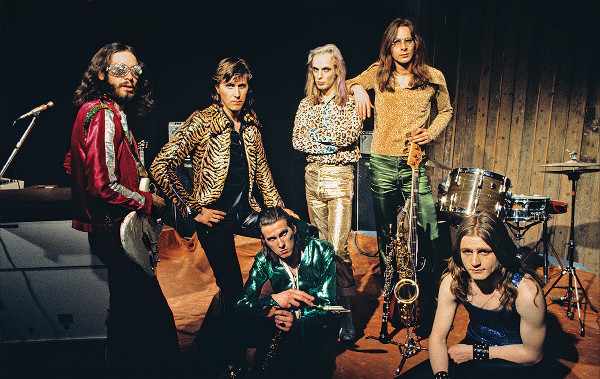
L-R: Mazenera, Ferry, Mackay, Eno, Rik Kenton (who replaced Graham Simpson for the first tour), Thompson

The book wraps with a two-page spread of the CD covers and their contents, a page of credits for the book, the CDs and some of the photos, and another page of Keri-Ann outtakes.

Next time: Disc 1 — the “original” album!