This review is dedicated to Don Smith, a recently-deceased podcaster on one of my favourite podcasts (Watchers of the Fourth Dimension), who loved this movie.
The early 70s covered a lot of cultural ground, but one of the weirder cul-de-sacs was the emergence of the Rock Opera, in which pop composers attempted to Do Something Meaningful by combining multiple rock songs into a (sometimes semi-) cohenent plot line. The form began in either 1968 (with S.F. Sorrow by The Pretty Things) or 1969 (The Who’s Tommy), depending on who you ask.
It hit big first with Jesus Christ Superstar in ‘70, Bowie’s album The Rise and Fall of Ziggy Stardust and the Spiders From Mars in 72, and the original stage production of The Rocky Horror Show in ’73. Movies of some of these efforts followed on, peaking in the mid–70s: Jesus Christ Superstar in late ‘73, Phantom of the Paradise in ‘74, and arguably the most successful examples, The Rocky Horror Picture Show in ‘74 and The Who’s Tommy in ‘75.
Of these films, all but one was a well-polished and long-running stage musical, and it was Phantom of the Paradise. In my view, it is less successful as a rock opera because of this — but on the other hand it borrows liberally from two great sources: the 1909 novel and 1925 classic film The Phantom of the Opera and Lon Chaney’s memorable performance, and of course Faust.
Brian De Palma’s second commercial film, seen now, will remind people of Rocky Horror in some ways — over-the-top camp, rollickin’ rock music, and the eccentric camerawork. It’s an amusing movie, particularly as a parody of Faust (and for pre-Muppets Paul Williams) but the humour is probably boosted if you are already enjoying some recreational substances, as people surely did at the time this came out. There’s no doubt in my mind that De Palma saw Rocky Horror on stage, and spotted the future filmic potential, though I’d love to verify that.
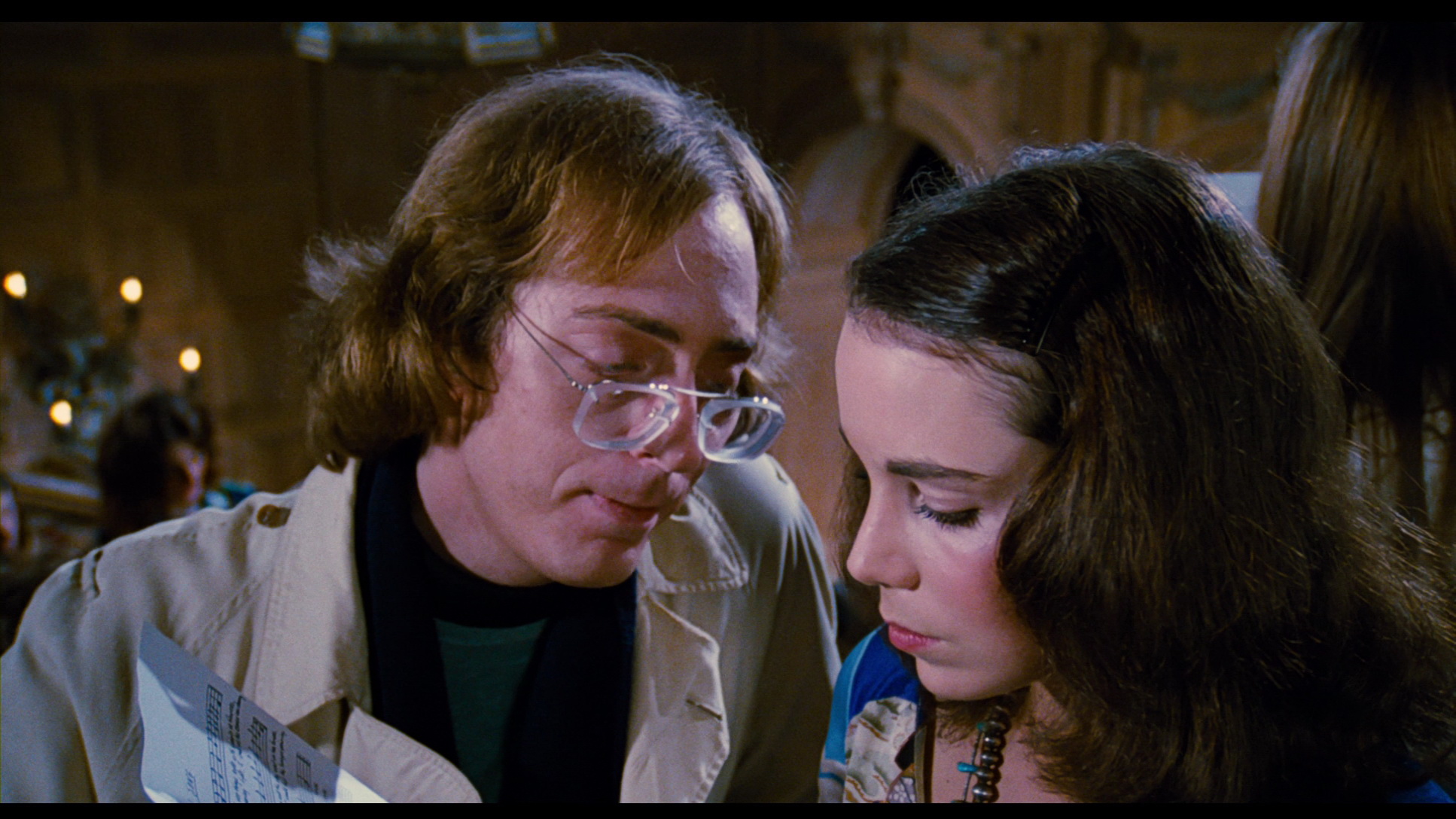
Winslow, soon to become the Phantom, and Phoenix.
The plot, basically: a singer-songwriter named Winslow Leach (William Finley) creates a cantata based on Faust, and this gets heard by a rich record producer named Swan (Paul Williams). Swan thinks the cantata will be perfect for the opening of his new concert hall, and has his henchman Arnold Philbin (George Memmoli) steal it.
Leach, expecting to hear back from Swan, makes repeated attempts to get back in touch but keeps getting thrown out. On one of these visits, he hears Phoenix (Jessica Harper) singing a portion of his work and falls in love.
This time, Leach is framed for drug possession, is sent to prison for life, and has his teeth forcibly replaced with a steel set. A few months later, he hears that Swan’s band The Juicy Fruits have covered part of his music, goes berserk and escapes prison, breaks into Swan’s record-pressing plant as is severely disfigured when he falls into one of the record-pressing machines.
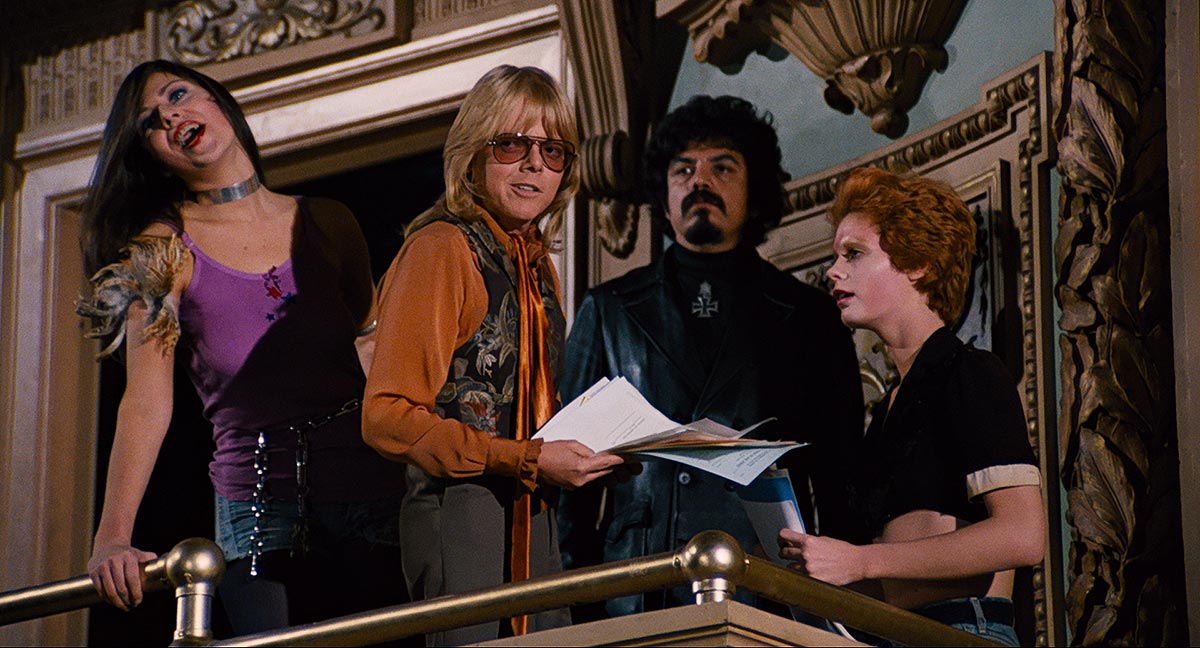
Yes, various tricks are used to keep Paul Williams’ actual (lack of) height obscured.
Seeking revenge, he breaks into the Paradise club itself, hiding in the costume department and finding a stylish silver owl mask and cape to complete his transformation into the Phantom (these bird metaphors are already laid on kind of thick). He hears the Beach Bums (formerly the Juicy Fruits) rehearsing a reworked version of his music and nearly kills them all, which attracts Swan’s attention.
Swan tracks Leach down and proposes a deal: finish the cantata and record it in a custom built recording studio. Swan gives Leach a voice box to (kind of) replace his destroyed vocal cords, promises that Phoenix will be the lead, and makes him sign a contract in blood.
The Phantom and Swan are the original frenemies.
Leach completes the cantata at the point of exhaustion, allowing Swan to steal it and replace Phoenix as the lead with (I’m not kidding) a glam rock prima donna named Beef (Gerrit Graham). Swan orders the studio sealed up with bricks.
Leach recovers, and in a fit of adrenaline smashes his way out of the bricked-up exit, makes his way to the Paradise, and confronts Beef in his shower, threatening him not to perform the lead.
If this image looks a bit familiar, you might be a film buff.
Beef agrees, but is forced by Swan and Philbin to return and perform for the rehearsal. Leach’s Phantom is in the rafters, and when he see this repeated betrayal he sends a neon lightning bolt down, which fries Beef.
Beef.
Philbin, understanding that the Phantom is behind this, promotes Phoenix to do the next song, and — surprise! — everyone loves her, including Swan. Swan promptly begins seducing Phoenix, and the Phantom tries briefly to warn her, but she is panicked and doesn’t recognize Leach.
Later, the Phantom spies on Swan and Phoenix as they prepare to make love. He tries to kill himself out of despondence, but Swan appears on the roof to tell Leach he cannot die until Swan dies because of their contract. So Leach attempts to kill Swan, but Swan points out that “I’m under contract too,” explicitly revealing he made a pact with the devil 20 years earlier to stay eternally young.
Swan announces to the press that he and Phoenix will marry during the finale of his production of Faust. Leach realizes that Swan plans to have Phoenix assassinated as the wedding concludes, as she has also signed a blood contract with him. He goes to Swan’s vault, destroying the tapes and Swan’s filmed and blood-signed contracts, then hastens to prevent the assassination during the wedding.
Because of this, Swan is starting to deteriorate, and dons a mask for the wedding. The Phantom, arriving just in time, swings onto the stage, removes Swan’s mask, and stabs the now-vulnerable Swan again. As a result, they both are now dying, but the now-saved Phoenix finally sees who the Phantom is, and stays with him as he dies.
So yeah, pretty convoluted, with a little “Picture of Dorian Gray” thrown in for good measure. It’s very well-shot in most places, with a bright colour palette and some fish-eye shots and other moments that remind me of A Clockwork Orange.
The Juicy Fruits (the best-sounding incarnation of this band)
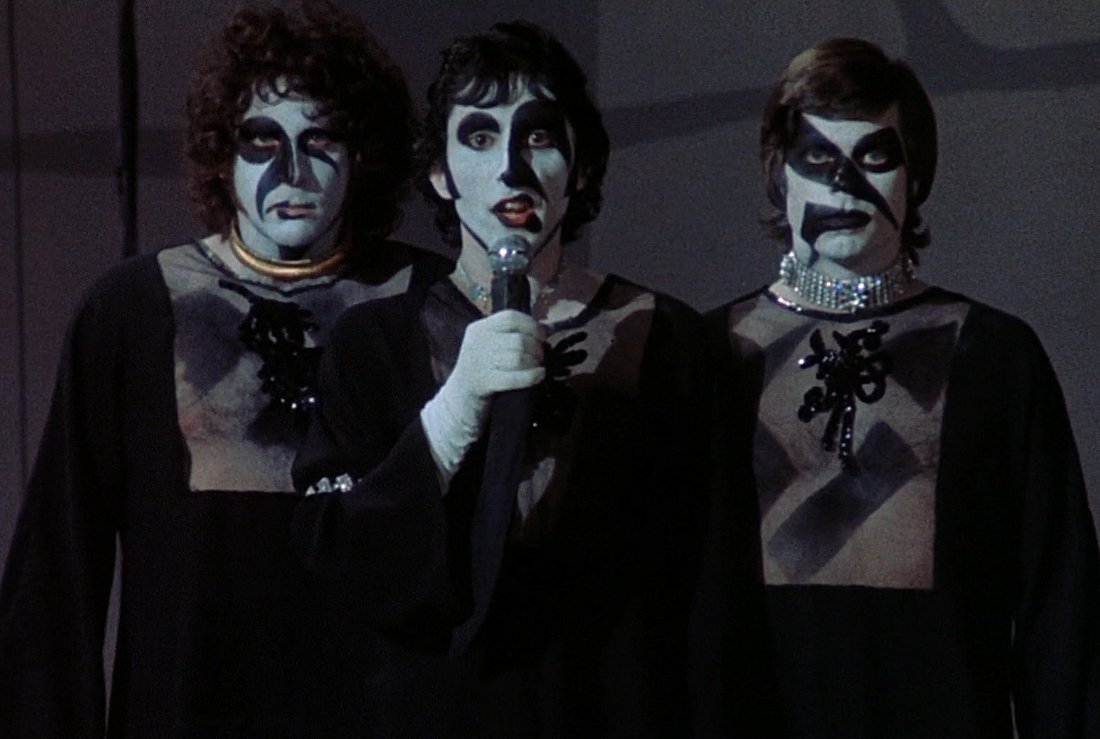
Williams wrote all the music, and performs as the Phantom’s singing voice, and it should be mentioned that the staging of the actual in-film Faust is a glorious tribute to The Cabinet of Doctor Caligari, with the Juicy Fruits/Beach Bums now performing as goth-y Greek chorus The Undead. I should mention that Williams’ songs are not at all bad, but as catchy as they are (at times), they never hit the level of “memorable” the way the aformentioned started-as-a-stage-musical songs do.
As a horror/comedy/drama, it kind of works, but it’s a stew with too many ingredients in my view. Luckily, the film improves as it goes on, and the ending is really very satisfying.
The Juicy Fruits become the Beach Bums …
I can see why some people love this film, as it is as bombastic, in-your-face and over-the-top as a rock musical perhaps should be. If it had been polished and honed as a stage show first, I have little doubt that I’d love it like that as well. By the way — why hasn’t this film gotten a proper stage treatment yet?
Rocky Horror, which came out a year later, is frankly a better example of a sex/drugs/rock musical on film on every level. That said, Phantom of the Paradise has its charms, and remains an upstanding denizen of the “midnight movie” genre.
The Beach Bums become Kiss (actually, The Undead)!
From an “offical release” point of view, the 2020 Record Store Day drop of I’m Only Dancing (The Soul Tour 74) appears to complete a kind of “live album trilogy” for those of us interested in this key development period (while on tour, no less!) of Bowie’s transformation from rock-n-roller to lily-white ambassador of the pleasures of soul music. Sure, it’s also a diary of his growing cocaine use – but it was a pretty remarkable reinvention, at least to the public – though Bowie himself probably thought of it as getting back into the Black-led music he had enjoyed as a teen.
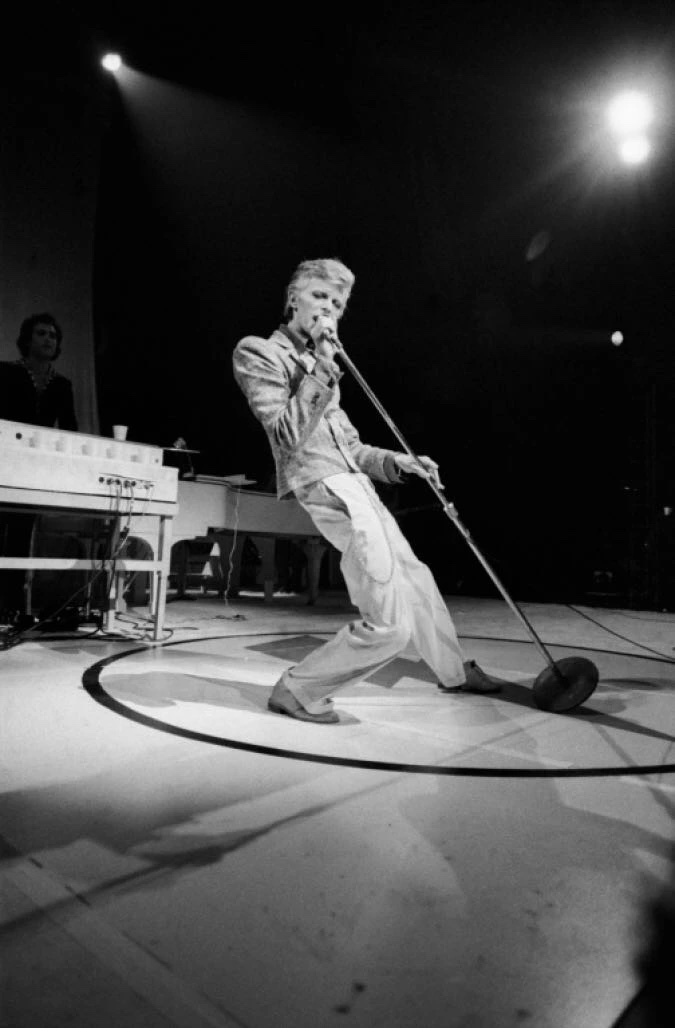
The original late 1974 release of David Live, as previously mentioned, was recorded in July of 1974 in Philidelphia and was mostly Diamond Dogs/1984 and Ziggy songs with a few other gems thrown in, largely staged and played like a rock musical (complete with elaborate sets, props, costumes, and lighting cues). During a break in the tour, Bowie went into the studio to record what would become Young Americans, and seems to have been ecstatic with the results – obviously so proud of the new material that he was bursting to play it on the tour.
Thus, at ridiculous expense, he trashed the sets and most of the props, abandoned the whole “1984” dystopia concept that had been the theme, replaced most of the band and song arrangements, and cut a few numbers from the previous setlists to make room for some new songs from his not-yet-released next album.
The Cracked Actor album (released in 2017, and reviewed here) documents the recommencing of the renamed “Soul Tour” in early September ’74, with an obviously happier David and also a more integrated band, some feeling their way into the live arrangements of the new material and some quickly having to figure out how to do justice to the earlier stuff – to grow a new show out of the roots of the earlier part of this tour.
About the only thing approaching “funk” on the first run of the tour was the closer “Knock on Wood.” By early September, after the YA recording sessions, the live show now had no less than four songs destined for Young Americans, and altered arrangements on just about all the previous songs — in some cases, now dramatically different from the album versions. The entire show had a looser, more organic feel to it.
I’m Only Dancing (The Soul Tour 74), recorded live in Detroit (with some bonus tracks from an even later Nashville date), showcases the band about six weeks later, and by this point the transformation of the show complete. More covers, more soulful arrangements, and yet more material intended for Young Americans (some of which didn’t actually make it onto the final album until later reissues). So from that perspective, this release — while just a straight soundboard boot with none of the mixing and post-production you’d get with an “official” release — is another interesting chapter of the rapid evolution in both the tour and Bowie himself over the course of some six months in this career-altering year.
Having said that, in addition to the lack of “production” on the record, the coke and the rigor of the tour have very audibly taken their toll on Bowie: he sounds hoarse, his high end completely gone, at times reaching for the old smoothness but mostly pretty gruff. As one begins to listen to this new release, right from the opening it is obvious he is struggling; his voice warms up a bit more by the last third of the show, but his range is quite limited and despite his enthusiasm, the crowd did not get the performance they paid for, at least from him.
John, I’m Only Dancing (Again) from the new live album – you can hear how rough Bowie’s voice is here
The “mix” on Dancing, such as it is, is straight off the soundboard, and so the vocals (both Bowie’s and the background singers) are right up front and occasionally clashing, no more so than right on his opening number. While the music is still audible, much of it is far softer than it properly ought to be. This is a pity, as there’s clearly some great playing going on there. David Sanborn’s sax continues to shine, and the addition of Dennis Davis on drums (replacing Greg Errico from Cracked Actor) really added some magic to the band, along with Emir Kasan on bass (replacing Doug Rauch). Poor Earl Slick and Carlos Alomar – the guitars are often backgrounded by the vocals, but careful listening shows that they were bringing a fair bit of firepower to the proceedings as well.
At this point in the tour, Bowie’s army of backing vocalists had been pruned back to six (down from seven). Their equal volume in the mix with the star of the show demonstrates, even more so than Cracked, a truly smooth unit that added a great deal of cover to the struggling frontman, and really keeps the slower songs exciting. It’s a treat to hear them at full force, even at the cost of other band members at times.
Despite its lack of polish Dancing is very different to the previous live records – David Live had technical issues that resulted in substandard sound, an uneven mix and some post-session overdubbing. These were later mostly fixed by Tony Visconti for the reissue. Cracked Actor was far better mixed due to better source material by Visconti for the official release, but I’m Only Dancing is the only one of the three (at least compared to the reissues) that still feels like a bootleg, and has no Visconti involvement. While there’s a lot of overlap in the set lists between them, each offers new arrangements and material, with Dancing in particular including more new songs and some covers/medley interplay not previously heard in these official releases. So if you’re into this period, you should probably own all three of the live albums.
Dancing opens with 30 seconds of the band (billed as the Mike Garson Band – Garson being one of the few who made it through the entire tour), doing the tail end of “Memory of a Free Festival,” an ingenious way to warm up the band while the crowd awaited the star, and immediately you wish more of that was included here. Garson quickly introduces Bowie as “Festival” is wrapping up, and we’re instantly into “Rebel Rebel.” This is the “alternate” and more Latin-feeling “Rebel” version, with lots of Garson and chorus, and some nice separation of Sanborn’s (quite muted) sax. The busier bass work is muddy but detectable, as is the percussion, but the guitars are almost lost by comparison.
A sharp stop and immediately we’re moved on to “John I’m Only Dancing (Again),” and the funk has officially been broken out. Even more so than on his first song, Bowie’s struggle to get his voice out is painfully obvious — so much so that he’s barely recognizable as the Bowie we’ve heard on the other live records. That said, he’s still willing to be even more playful with the lyrics. The overall energy, even here, is absolutely furious. Throughout the album, the crowd are very much in the background, but what you can hear of them indicates that they were thrilled to be there.
Bowie and Cherry sing “Sorrow,” with a different arrangement to make it more of a duet with Cherry, and we finally get Slick’s guitar up front, not to mention some nice echoplex on Sanborn’s sax. The song abruptly runs straight into “Changes,” with especially “caberet” piano from Garson, before finally breaking out the rock on the chorus. It’s the first time the band have had to slow down for the first 12 minutes; they‘ve been balls-to-the-wall to this point.
Once again with no break, the soul wrecking ball smashes straight in with the ultimate 70s cop-show intro for “1984.” This is the first place you really notice both how Bowie can’t hit any high notes, and what an absolute machine the backing vocal unit and the band have become. Garson and Alomar in particular seem to have embraced the change of direction and run with it. A short keyboard segue throws us into a jazzier new interpretation of “Moonage Daydream,” which retains its psych roots but flirts with both soft rock and prog stylings. Slick bathes in the echoplex effects while percussionist Pablo Asano and the rest of the band keep the vibe flowing.
As if the group were afraid to stop playing for more than a second lest the spell be broken, we’re plunged straight into a similar but different arrangement of “Rock N Roll With Me.” Whereas on Cracked Actor the tone was cabaret tinged with gospel, this version restores some of the rock-ballad power but firmly puts the song in R&B territory – foreshadowing more new material to come.
Finally, at the end of the song, the band actually stops playing for the first time in at least solid half-hour, and Bowie says a few words of appreciation. Then, things get weird. Bowie spontaneously claims that the song he’d just performed, co-written with his friend and backing vocalist Geoff McCormack (aka Warren Peace) was “written in Detroit … I dunno if it’s about Detroit, but it was certainly inspired by you.” This is patently not true (it was written in Bowie’s UK home by McCormack, with Bowie contributing lyrics and the bridge), though it might be fair to say it was “inspired” by the soul sounds of the US in the early 70s – especially Bill Withers’ hit “Lean on Me.”
Perhaps due to tape editing or nervousness, Bowie immediately pulls out a harmonica and starts playing “Love Me Do,” a song this writer can definitively state was not written in, or influenced by, Detroit. At the end of the first verse, the beat changes into a swinging version of “Jean Genie.” Bowie’s early love of Anthony Newley shows itself until the chorus, when we get back into the hard rock proper. Slick and Alomar finally both come to the fore here and it is lo-fi glorious. Any concert-goers who had to this point been disappointed by the lack of raw crunchy guitars to this point would have been sated by the extended instrumental, which builds to a satisfying end.
With the briefest of brief pauses for applause, the first disc (record or CD of this two-disc set) ends with a plunge back into the white soul in the form of “Young Americans.” Bowie’s voice by this point is stronger but still strained – his backup singers are outperforming him with ease, and sticking close to the yet-to-be-released album version. Sanborn, pushed into the background on recent numbers, comes again to the fore as Bowie croaks (seriously) “do you remember”s and the spoken-word bits, and goes low on the “break down and cry” line, which is just criminal. It’s a bit hard to listen to, knowing how much better he can perform it.
Disc Two kicks off with Bowie telling the crowd that “Young Americans” and the next two tracks are all from the new album “out next year sometime” (in fact, March). The band goes into 100 percent R&B mode with “Can You Hear Me?” and its laid-back groove. His ragged voice hovers on the edge of James Brown on occasion, but the band is on a flawless slow boil. What I’d give for a properly mixed and “produced” version of this, but of course if Bowie were still with us he would never have allowed this performance to see the light of day, given his subpar vocals.
Bowie introduces Carlos Alomar, who takes the lead bluesy guitar on “It’s Gonna Be Me,” which did not make the final cut of Young Americans, but the studio version was finally added back in for the 1991 reissue. After a minute or so, someone at the board decides his voice needs a touch of echo, and indeed it helps sell the song. Naturally, Bowie introduces “Mr. Sanborn” for the echoplexed sax break. A brief call-and-(drum) response adds a dramatic note, but overall it has to be said that its not one of Bowie’s stronger soul numbers, and one can hear why it was originally cut.
The groove picks up some steam with the much superior “Somebody Up There Likes Me,” The band’s volume has slowly been creeping up in the mix throughout the course of disc two, and here everything is more or less in its proper balance. A brief “thank you!” at the end of the song, and we jerk over to a pretty joyous take on “Suffragette City,” with honky-took keyboards and the return of Earl Slick’s (mixed too low but rockin’) guitar, and the crowd goes appropriately wild at the end of it.
Over Garson’s gospel intro, Bowie thanks the crowd and launches into the soft intro to “Rock n Roll Suicide.” The band (minus the background singers) join in after the first verse, Sanborn joining in last. Again, Bowie’s voice lets him down in spots, but he soldiers on with passion, and finally the singers come in after “you’re not alone” but stay farther in the background than they’ve been at any point heretofore. Rough as he is, this is a Bowie singing spotlight and he gamely makes it work. With a “bless you, goodnight”, the main set is over.
The encore starts off with a great treat, an Alomar-led take on “Panic In Detroit.” By this point and with this type of song, Bowie is starting to sound more Springsteen than British, but he’s clearly happy to carry on. For the first of the three “bonus tracks” from a later show in Nashville, Alomar is also front and center on Eddie Floyd & Steve Cropper’s “Knock on Wood,” which also makes good use of Sanborn and the bass-percussion combos that have been the gas in this engine all night long. If Bowie had recorded a version of the song similar to this arrangement, he might have pre-emptied Amii Stewart with a hit version of his own. The crowd clearly thought it was great.
The band then sounds like its cranking up for “Fame,” but as that hasn’t been written yet, it turns out to be a medley of “Foot Stompin’” and “I Wish I Could Shimmy Like My Sister Kate,” the former a 1961 beat-combo song by The Flares, while the latter was an oft-covered uptempo jazz number first made famous by Shel Silverstein, but also covered by the Beatles in their Hamburg Star Club days. It is joyously done, with the guitar riff soon to be borrowed for “Fame.”
The CD and vinyl versions wrap up with another oddball medley: “Diamond Dogs” segueing into the chorus of the Rolling Stones’ “It’s Only Rock and Roll (But I Like It).” Again, as with the beginning of the album, I’m Only Dancing finishes on a note of high energy and a beautiful rock/soul fusion that leaves the audience cheering for still more. Of note: Bowie’s voice on these Nashville tracks is stronger than on the Detroit ones, but he’s still quite ragged. That drug habit was great for the enthusiasm, but bad for his performance. That said, how else do you write and record an entirely new album featuring a complete change of direction while doing a heavy US tour of your present album, and still make it all work? For Bowie, things go better with coke – at least for while yet.
So should I buy it? And if so, which version?
If you’re a Bowie collector, than grab it while you can still get it for reasonable prices. While it wasn’t an RSD exclusive, it seems to have been a limted edition, so the average selling price is slowly going up. If you’re not a collector but you’d like a good live Bowie album, the one from this era I’d recommend is Cracked Actor, since Tony Visconti did a great job capturing the beginning of the revised tour this album also documents. There are fewer covers and Young Americans songs on Cracked than on I’m Only Dancing, but otherwise Cracked is sonically and technically a superior live record.
As for the question of CD versus vinyl, on this one we’re going to strongly recommend the CD version. Numerous reports in forums and other music outlets complain of receiving damaged or warped records with little to no recourse for returns or exchanges. It appears to be only a modest percentage have problems with the vinyl, but why take the chance?





 I’m Only Dancing (The Soul Tour 74), recorded live in Detroit (with some bonus tracks from an even later Nashville date), showcases the band about six weeks later, and by this point the transformation of the show complete. More covers, more soulful arrangements, and yet more material intended for Young Americans (some of which didn’t actually make it onto the final album until later reissues). So from that perspective, this release — while just a straight soundboard boot with none of the mixing and post-production you’d get with an “official” release — is another interesting chapter of the rapid evolution in both the tour and Bowie himself over the course of some six months in this career-altering year.
 At this point in the tour, Bowie’s army of backing vocalists had been pruned back to six (down from seven). Their equal volume in the mix with the star of the show demonstrates, even more so than Cracked, a truly smooth unit that added a great deal of cover to the struggling frontman, and really keeps the slower songs exciting. It’s a treat to hear them at full force, even at the cost of other band members at times.
 A sharp stop and immediately we’re moved on to “John I’m Only Dancing (Again),” and the funk has officially been broken out. Even more so than on his first song, Bowie’s struggle to get his voice out is painfully obvious — so much so that he’s barely recognizable as the Bowie we’ve heard on the other live records. That said, he’s still willing to be even more playful with the lyrics. The overall energy, even here, is absolutely furious. Throughout the album, the crowd are very much in the background, but what you can hear of them indicates that they were thrilled to be there.
 The groove picks up some steam with the much superior “Somebody Up There Likes Me,” The band’s volume has slowly been creeping up in the mix throughout the course of disc two, and here everything is more or less in its proper balance. A brief “thank you!” at the end of the song, and we jerk over to a pretty joyous take on “Suffragette City,” with honky-took keyboards and the return of Earl Slick’s (mixed too low but rockin’) guitar, and the crowd goes appropriately wild at the end of it.
 The encore starts off with a great treat, an Alomar-led take on “Panic In Detroit.” By this point and with this type of song, Bowie is starting to sound more Springsteen than British, but he’s clearly happy to carry on. For the first of the three “bonus tracks” from a later show in Nashville, Alomar is also front and center on Eddie Floyd & Steve Cropper’s “Knock on Wood,” which also makes good use of Sanborn and the bass-percussion combos that have been the gas in this engine all night long. If Bowie had recorded a version of the song similar to this arrangement, he might have pre-emptied Amii Stewart with a hit version of his own. The crowd clearly thought it was great.
 The Chasbah