Tetsuo, the Iron Man (1989)

Director: Shinya Tsukamoto
⭐️⭐️⭐️⭐️

If you’ve seen this film, there’s not a lot I can say apart from some small bits of trivia that you might not already know. If you haven’t seen it, this is the first and perhaps the greatest Japanese cyberpunk/body horror/indie metal/sex comedy film of all time. I haven’t seen either of the two sequels, but that’s the only reason I say “perhaps.”

Perfectly timed with a youth-cultural rising tide of nihilism, low-budget renegade filmmaking, steampunk fashion, and the emergence of “industrial” music, Tetsuo combines it all into a movie that was very much of its moment. I first saw the film at and independent cinema in central Florida a few months after it premiered, and I was simply not prepared for the onslaught of sight and sound I witnessed.

It was in some ways traumatic, in other ways compelling — and it haunted me for a while with a mixture of revulsion and wonder at the time. I have finally dared to take a second look, and I squirmed in places — but could still could hardly bear to blink.
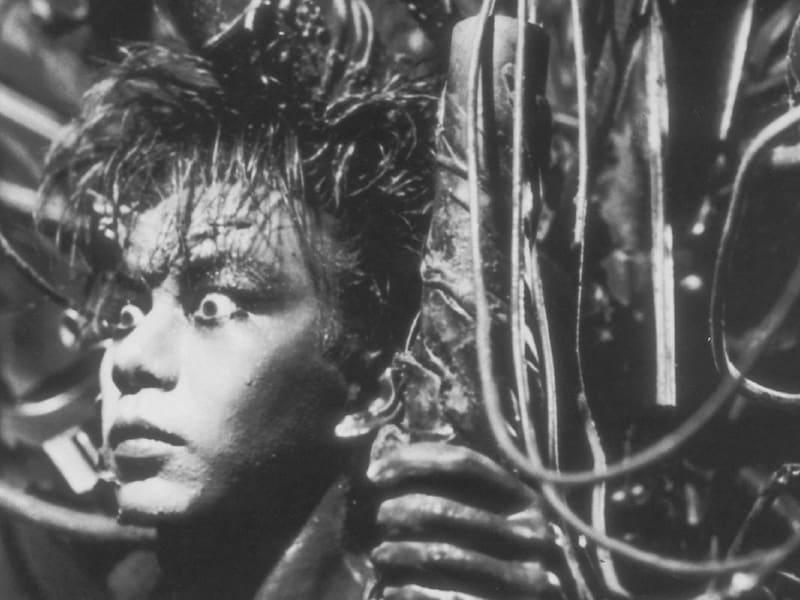
The film is in B&W, and doesn’t look quite as absurdly cheap as it is most of the time thanks to ludicrously frenetic stop-motion effects, brilliant editing, and mesmerizing performances, while still mostly giving its audiences only glimpses of what’s fully happening. The assault of hard music contributes to the urgency and raw emotions on display throughout.

The film went on to be an enormous influence on both musicians and indie directors, and makes those Godzilla movies look like pastoral landscape paintings for children by comparison.

The plot is weird yet simple: we start with meeting a young man (played by director Tsukamoto) who is cutting his thigh open so he can insert some metal into it. His surroundings are composed of lots of scrap metal, and this is a fetish of his apparently.

It goes very wrong, and maggots begin to feed on the wound. Driven mad with disgust, he runs out of his tiny room and into the night, and is soon run down by a “salaryman” (businessman) — played by Tomorowo Taguchi — and his girlfriend (Kei Fujiwara).

The pair investigate the corpse, are revolted, and dispose of the body. Not long after, the businessman notices that he is growing metal out of his body, and soon the girlfriend is transmuting as well.

Slowly but surely the metal is taking over their bodies (mostly done using stop-motion animation), turning them both into metal-human hybrids. This takes a while, and is documented in beautiful detail in the grainy B&W cinema verité style, augmented with the hardened edges of industrial music.

Once it starts, it is a relentless onslaught, and the victims here are bewildered, terrified, and powerless to stop it.

To this point, the film is a hyperactive low-budget body horror escapade, but strangely compelling. We know where this story is going, but it is clever enough to make us want to see it through.

The salaryman’s transformation is much further along by the time the girlfriend turns up, equally starting to transform. They end up being compelled to have what I’ll just call “drillsex,” which at this point provides a much-needed moment of relative levity.

Others have described the film as something of a mash-up between Un Chien Andalou (1925), Videodrome (1983), and Eraserhead (1977) in Japan, and I have to nod and say “yes, but with all these films thrown in a blender while you’re watching them.” Tetsuo vibrates with energy and intensity, never relents from its breakneck pace, and cranks the music up to 11.

Since it’s release, we’ve all started down its path: rare is the moment now where you don’t see someone glued to their smartphone, to the point where we treat it as an extension of “ourselves.” The messages of the film regarding societal sexual repression, industrialized alienation, body dysmorphia, work-life imbalance, and are alternately sublimated and beaten over your head.

Being so hyperkinetic and, well, metal is likely to be overwhelming for any casual viewer, even though the film clocks in at a mere 67 minutes (and thank heavens its not any longer). By the end, you’re not sure if the salaryman and his girl likes what has ultimately become of them or not.

It reminds of a rollercoaster you’ve never been on before: terrifying, exhilarating, and you’re relieved you survived it — and then, knowing that you did, you want to go back and do it again.

Tsukamoto served as writer, director, producer, art director, lighting director cinematographer and editor of the film. A number of the other crew members who worked on the film quit in disgust or in dispute with what Tsukamoto was doing.

It is a visionary, hugely influential and eye-popping film in many ways, but I think most people whose idea of a horror movie is Friday the 13th would probably turn down a second opportunity to see it. That said, a little of that metal fetishism stays with you, in the sense that you can’t unsee it.

Maestro (2003)

⭐️⭐️⭐️
Writer/Director: Josell Ramos

Only in New York would you find people who brag about inventing Chicago house music. 🙂

But more seriously, this is a video documentary covering some of the origins of DJ culture that grew out of predominately gay-oriented clubs in New York City in the late 1970s and into the 80s. Ramos talks to the now-legends of that era, the DJs at clubs like The Loft and The Paradise Garage and that sound did indeed make its way to Chicago to blossom in the Windy City.

What’s interesting and important about this documentary is that it brings together people who danced their night away at those clubs and the DJs behind that music, and how the magic of the sound opened the (closet) door of these gay clubs to women, straight people, and 24-hour party people of all races. Aside from the music itself, the diversity was a very special thing in the 70s and 80s, particularly the largely black, white, and Hispanic crowds.

As the world was grower darker as the 80s began with the election of Reagan and the dawn of the AIDS epidemic, people — especially those in the LGBT+ community — went looking for the sound and the fury, and were drawn by word of mouth alone to a trio of clubs across the years that held out the opportunity for escape and ecstasy of all sorts. In hindsight, it is unsurprising that straight people who got told about the scene found it irresistible.

Everybody, Everybody

These were bold DJs who experimented beyond the standard mixing two records with similar tempos together. People like Larry Levan, David Mancuso, Frankie Knuckles, Nicky Siano, and Francis Grasso (Nu Yoik names if ever I’ve heard some) had an open-door and open-mind policy, and dared to mix rhythms and sounds, created a form of manipulating the vinyl that would lead to hip-hop’s “scratching” in the 90s, and would build the music, over the evening, into non-stop ecstatic dancing.

That said, the production/direction is mostly fine but occasionally the camera work is a bit ham-fisted, as one might expect from a first-time director. That said, Ramos has to rely heavily on interviews conducted between 1999 and 2003 with the former DJs and patrons.

This probably couldn’t really be avoided: there isn’t much surviving video from the clubs from that era (though a bit more than you might suspect), and thus the audience is bounced back and forth between footage from the time and 2003-era interviews with the movers (DJs) and shakers (club-goers) who patronised these clubs, and some of them frankly go on too long. I spotted the late artist Keith Haring dancing in some of the footage, and a later section of the doc spotlighted him.

The DJs, now middle-aged guys, recollect their glory days with real fondness, especially Levan, and paint themselves as friends and colleagues using music as a weapon against the mainstream and it’s close-minded attitudes.

The interviews are mostly good (particularly with the DJs) but get a bit more repetitive with the club-goers, though Ramos wisely mixes single-person and group interview comments. If I have to complain about something, I’ll pick two things: first, I really wish this had been shot on film, though I completely understand why it wasn’t.

Second, there are not enough clips of still-famous DJs like Jellybean Benitez, Dimitri from Paris, and UK DJ Pete Tong singing the praises of these innovative pioneers, and I’m not sure there’s a good excuse for that apart from budget.

As a club patron in those days myself, though not of course in NYC, I recognized a song or three from the soundtrack, like Booker T and MG’s “Melting Pot,” Chocolette’s “It’s That Easy Street Beat” and Sylvester’s “Over and Over.” Here, the song “Release Yourself” by Aleems is used very effectively to relate a story about how a DJ can remix the music to build, and then release, tension.

I’m not personally a huge fan of house music, but I know very, very well that the combination of alcohol, certain recreational substances, fabulous light shows, and attractive people overwhelmed by screamingly loud beat music being built to a frenzy and then cooled back down can be the closest thing to sex you can have while (barely) clothed (and sweating like a pig). The video feels a bit long but is only 88 minutes. The “survivors” of those days, the club goers and DJs, seem to have established a friendly bond that comes from knowing you were a part of something special.

Ramos’ focus on the music means that he has left an opportunity to explore the tight-knit gay community that fostered these club on the table, and that’s a bit of a shame (though it’s certainly a subject that has been covered elsewhere). If you remember your clubbing days, particularly if they were in the late 70s into the 90s, you may want to seek this video out — the DVD version includes a second DVD of more material, and a CD of some of the music featured in the film.

Mari Wilson — The Neasden Queen of Soul — Disc 3

(3CD box set, Cherry Red, 2022)

THE PROLOGUE

So if Disc 1 was the Showpeople album and a handful of bonus tracks, and Disc 2 was a lot of the pre-album demos and some live tracks recorded before and around the first album, what could Disc 3 possibly hold for us?

The answer is: the best of the rest. In particular, these 2022 remixes (and in one case, a 2021 remix), remastered from the original tapes by Tot Taylor himself are just the bee’s knees. You think you’ve heard “Baby It’s True” and “Beat the Beat” enough times already, but you my friend are wrong.

Sadly, there aren’t any YouTube versions of any of the 2022 remixes, so instead the videos we include will be some rare items and later appearances (so don’t be alarmed by the change in hairstyle!)

Our first choice was a stop of the 2016 Heaven 17 UK tour (which we got to see two dates of, but sadly not this one in Bury St. Edmonds), where Mari performed two songs you along side Martyn Ware and the band. So enjoy.

So the first half of Disc 3 is just these fabulous new remixes , with the second half being the “odds-n-sods” collection — a US remix here, an alternate take there, a Spanish version found in the rumpus room, and a 7-inch edit balanced precariously on the liquor cabinet.

There’s even an instrumental version in here somewhere. Let’s dive in, shall we?

THE MUSIC

The disc kicks off with sonically wider, cleaner, and “glow-up” 2022 remix versions of Showpeople tracks “Baby It’s True,” “Beat the Beat,” and “Ecstasy.”

There’s also new remixes of “Glamourpuss” (two remixes, in fact, in different years!) “Rave,” “She’s Had Enough of You,” “You Look So Good,” and the US remix of “Just What I Always Wanted.” There’s also the original UK version of “Ecstasy,” just thrown in for good measure.

For the 2022 remixes of the album tracks, the new version beats the original every time — with one exception. The 2022 version of “Ecstasy,” replaces the 80s drums of the album version with traditional ones, but quickens the pace considerably — it might actually be a little too fast. The UK original version elsewhere on this disc keeps that same manic speed, so I have to bow to the wisdom of the US record company that made them re-do the song at a sensible tempo.

The 2022 remix of “Rave” is really a cleaned-up and slightly re-edited version of the “live in the studio” version heard on Disc 2. Oddly, the Wilsations are not co-credited on the Disc 3 version, though of course they are still there.

Likewise, the 2022 remix of “She’s Had Enough of You” is a notable improvement on the original we heard on Disc 2. It seems like it is pitch-shifted a little from the other version, which only benefits the song.

This brings us to the 2021 remix of “Glamourpuss,” here given the subtitle “(Scenario).” The piano intro is completely different, and jazzier, just for starters, and then the sax comes in. Sadly, this version keeps the corny b-side “band introduces the singer” gimmick, and then the original piano comes in and the song gets underway.

Give me the 2022 remix version on this one any day.

The “U.S. Remix” version of “Just What I Always Wanted” starts off with the whispered “Let’s Go,” then proceeds to drag out the intro of the song and ruin the energy of the original until Mari finally shows up and gets the number going properly after the first minute. Of the three versions found on this box set, the original album cut is the best, in my opinion.

Note to Tot Taylor and/or Tony Mansfield: when you have someone say in a song “let’s go,” there needs to be a burst of energy that follows that. I’m not quite sure how you missed that, but them’s the rules.

So now we move into the second half of Disc 3, which offers no remixes but more alternate versions. We start with a song only heard on Disc 1, “One Day is a Lifetime.”

This time, The Wilsations are credited, even though we don’t hear a peep out of them vocally. It’s listed as an “Alternate Version,” and apart from correcting an editing error at the very beginning of the original Showpeople track, the main change is the band’s presence is felt throughout the track rather than only sporadically.

“Tu No Me Llores” is “Cry Me a River” in Spanish, and a classic is a classic in any language. The middle-eight reverts back to English, but the verses have been rewritten slightly to rhyming purposes. After the instrumental break, we come back to Spanish.

This is followed by an instrumental version of “Would You Dance With a Stranger.” A solo sax starts us off for a few bars, then the piano softly comes in behind the sax.

Finally the upright bass arrives, and the disc officially earns its Apple Music and Spotify classification of “Jazz” with no qualifiers. It’s a beauty in either version, but as lovely as it is the lack of Mari is keenly felt.

The 7-inch DJ Edit of “Wonderful (To Be With)” is shorter than the lead-off track on Disc 1, but otherwise unchanged. Again, The Wilsations get credit on this version, where they didn’t on the Showpeople album track.

The last two tracks on Disc 3 should be classified as “curiosities” or perhaps “experiments.” It’s two versions of the song “Let’s Make This Last,” first heard on Disc 2 as the “De Lorean Style Mix,” with squiggly sonic effects at the intro.

The first version on Disc 3 is referred to as “Let’s Make This Last (A Bit Longer),” a clever name for an extended mix, but also has the subtitle “Stereo Shift Mix Loop One” that really makes hay with the synth remix effects.

It takes nearly two minutes for Mari to finally appear and the song to get going properly. I can see where a club DJ would make great use of this, but its an awfully odd duck on an album of faux-60s poppy love songs.

The second version opens with crowd noise (not from a live gig), and is another busy remix, but with no time wasted on extended synth loops (though that’s not to say there aren’t some, just that they get moved to the middle). Like the first mix, this wouldn’t work outside of a club, but at least its much shorter.

On the other hand, the actual song is chopped to ribbons, with the verses removed entirely and replaced with random cheering-crowd snippets. Just my opinion, but this is a pretty awful way to end the disc.

I think if these needed two mixes needed to be included at all, they should have come earlier — maybe right after the 2022 remixes. Move the beautiful “Tu No Me Llores” and “Would You Dance With a Stranger” instrumental to the end, and you’d finish the experience of this box set on a high note.

Next time: “Stiff” competition!