I recently took a trip across Europe, spending the majority of my time in the Amsterdam area of The Netherlands, with smaller stops in Brussels, Paris, and Keflavik, Iceland (to see the volcano!). It was a meetup with some old and new friends to see a musical group we all deeply appreciated, Nits.
If you’ve never heard of them, fret not. They are best known in their native Holland, but tour the rest of Europe regularly to great acclaim, and release albums pretty steadily, also to great acclaim. After 50 years as a band (!), their creative well hasn’t run dry.
As for the music, “smartly-written pop with a poetic edge” might cover it, and of course being pretty old now, the tempo has gradually slowed over the decades, though I’m not sure they were ever in danger of being called a “rock-n-roll band.”
***
Anyway, that’s the background behind the trip, though far from the only thing we did. The purpose of this post is to serve as a mental bookmark for me, since I want to file the CDs and DVD I bought while I was there, but I want to remember which discs I bought while I was on that specific trip. I’m vain enough to think that someone out there would be interested in knowing also, maybe, so here it is.
Top of the list, of course, is the Nits’ latest release, Tree House Fire. At only six songs, it could be called an EP or a mini-album, but what’s important about it (besides being bought from the band directly, in Amsterdam), is that it is the group’s artistic response to a tragedy — the band’s Werf Studio, also effectively their storage locker, archive, and clubhouse — burned to the ground.
Many bands would have struggled to overcome the loss, but this group knows one main way to express how they feel, and that is through song. Not every song on it has a direct connection to that event (I think), though most of them do. I was very happy to finally be able to support the band directly, to share in their sorrow and strength to carry on, and to finally see a band I’ve been collecting since 1981 or so (!) in person, performing live on stage to an appreciative hometown audience.
***
Okay, that’s the context, here’s the list with no more commentary, not ranked in any particular order (prices included when known):
— Nits, Tree House Fire (EP), €10 — Cinerama, Quick Before it Melts (CD-single), €1 — Brian Eno, Brian Eno’s Original Score for the Documentary Film about Dieter Rams (Album), €5 — The Monochrome Set, Access All Areas CD+DVD concert, €5 — Nits, Wool, (Album), €5 — David Bowie, A Reality Tour (DVD), €12
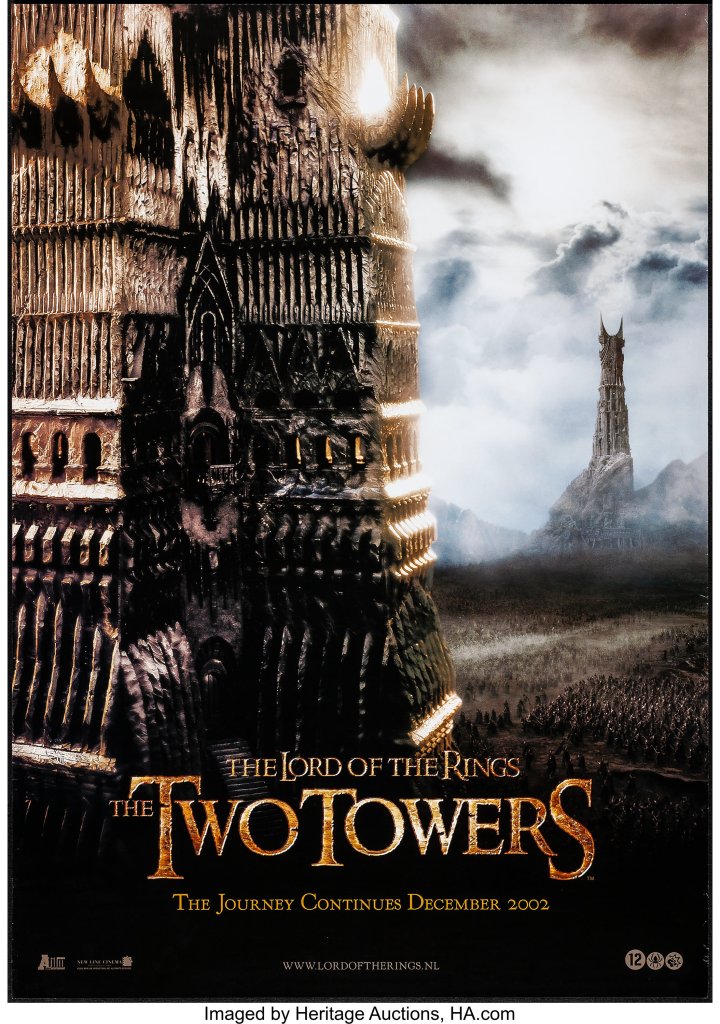
(2002, dir. Peter Jackson) 52-week film challenge, film 16
⭐️⭐️⭐️⭐️⭐️
It’s difficult to believe that just over 20 years have passed since the release of this, the “middle bit” of Jackson’s epic LOTR trilogy of films. A local IMAX screen has been showing the trilogy recently, and I was intrigued by the “remastered for IMAX” tag they added, so I went along to visit this old friend of a movie.
(A brief side note on that particular screening: I should have stayed at home. It was not “remastered for IMAX,” it was just the Blu-ray theatrical version blown up (in proportion, thank heavens) to fit the wider IMAX screen. There were problems with resolution and frame-skipping in the action sequences as a result. Very disappointing.)
When these three films came out originally, I was pretty obsessed with them, since I was re-reading the tales for the first time since college — not to mention the impact the first film had had on fans and first-time viewers alike. It truly brought the story out of “cult” status, and captured the mainstream through a combination of clever screenwriting (to bring cinematic order to the sprawl of Tolkien’s world-building) and state-of-the-art effects work.
According to my first review (back in 2002 on this very blog), I watched The Two Towers at least 10 times while it was in cinemas, both as a student of filmmaking and a Tolkien fan. It was a wonderful feeling to see packed houses and appreciative audiences who would never in a million years have read the dense and nuanced source material.
It was great to see them enjoying a tale that, although laden with special effects, wasn’t a crap sci-fi misfire like Attack of the Clones or the forgettable fantasy Reign of Fire — the latter was about dragons, and nobody remembers it. No, The Two Towers was a “war” movie that focused on the foot soldiers, the power brokers, and the innocent victims who get swept along.
Ironically, the film is probably one of the best “epic battle” movies ever made, though I can think of a few others of that lofty ranking. Both as a book and as a movie, it benefits hugely from all the scene-setting and character-introducing work done in the first movie (The Fellowship of the Ring).
This means that there is little in the way of backstory — since if you were going to see this one, it means you saw the first one, and we get straight on into the action. We do start off with a brief (very brief) recap of the (film) climax of Fellowship, the fall of Gandalf the Grey (and a bit more of what happened in his battle with the Balrog).
Then there is a good-sized break in the action to update us on the progress of the other characters as we left them in the first film — Sam and Frodo trying to enter Mordor; Merry and Pippin held hostage by Orcs and Uruk Hai, and Aragorn, Gimli and Legolas in hot pursuit. Jackson wisely shifts around between the three disparate groupings, signaling the depth and vastness of the different paths the Fellowship is taking towards the same goal.
It is with Sam and Frodo that we quickly meet up with the real star of the second film; the stunningly-realised Gollum (Andy Serkis). Although the character is obviously a CGI-generated effect, he convinces us totally of his physical presence. This is entirely due to Gollum having a physical presence during the filming for the animators to work off of. Played (and voiced by) Serkis, Gollum is (pardon the pun) fleshed out and made convincingly whole as a result.
Not only do the other actors have someone real to interact with, but they hear the voice we hear (one of the more remarkable vocal performances in many a year) — this was the secret to making Gollum so credible, and it really holds up. I would have loved to have seen the faces of Elijah Wood and Sean Astin when they finally got to see how all but Serkis’ facial expressions and movements were replaced with the Gollum character.
Praise should not be spared to the animators as well; though they had a remarkable (and undersung) actor’s performance as a strong starting point, they beautifully embellished it, expanding on Serkis’ unseen physicality and captured facial expressions in an eerie yet beautiful way. Serkis and the animation team should have been awarded a shared Oscar, for Gollum was the most fluid of collaborations between computer animation and human performance that had yet been seen on screen.
What Elijah Wood and Sean Astin saw (right), versus what we saw (left).
The film jumps around between these three sets of main characters, as well as introducing us to new plotlines and the characters that go with them — the Rohirrim, King Theoden and his daughter Eomer, Grima Wormtongue, the Ents, and so on. We learn a lot more about the “manufacture” of the Uruk Hai and the raising of Saruman’s army (which is representative of several nation-states, not just Orcs and Uruk Hai), but of course this is all glossed over compared to the book, because we only have three hours!
We can feel the film’s elements coming together, slowly at first but quickening in pace alongside returning “minor” (in the film) characters like Elrond, Arwen, and Saruman, and the buildup to war is effectively communicated. The film’s climax is the first test of Sauron’s forces, the battle for Helm’s Deep and its aftermath, which makes sense from a film perspective but falls well short of where the actual second book in the trilogy ended.
Mind you, Tolkien never intended the story to end up as three books — that was a merciful publisher’s choice — so the divisions in the books are just as “artificial” as those in the films. Jackson is guilty of rearranging the storylines a bit, glossing over or underplaying some important foreshadowing, and I think it is fair to say that while Jackson and his fellow screenwriters had a genuine gift for boiling down the long and complicated sections of the books without dumbing them down, they are also guilty of lingering on their own invented/contrived segues a bit more than strictly necessary.
Once you accept that most of this was crucial in making a set of films that would perform well at the box office with mainstream audiences rather than just Tolkien wonks, the justification for Jackson’s alterations are much more understandable. Let’s not forget that this was a huge risk by the studio — shooting all three films simultaneously in New Zealand and relying on a relatively-obscure NZ effects house, with a total investment of over $280 million before they saw the first dollar back (but the films earned at least 10x the budgets, so the potential alienation of the Tolkienites paid off).
Almost to a fault, Jackson predictably compressed long sequences (such as the four-day hunt for the Uruk Hai by Aragon and company), lingered on visually beautiful but less-vital plot points (like Edoras and of course Helm’s Deep), and shorthanded drawn-out or not-strictly-vital scenes and characters. The Ents in particular got precious little, but very effective, screen time — and featured some well-done CGI-enhanced puppet work of the time, though it must be said some effects have aged less well than the film overall.
There are a few moments — rare, but notable — that are not as well done as one would have hoped. There are waaay too many shots of Saruman running about and fretting on his balcony as he sees the Ents destroying his Uruk Hai “factory” (but too late to stop the war), but for a wizard he just looks helpless and impotent — very unlike his presence to this point.
The battle for Helm’s Deep takes up the entire third hour of the film, and is wonderfully gritty and dark. How so many filthy, terrorised, unwashed people can be so damn good-looking is one of the main mysteries of the film — but another is how Jackson manages to squeeze in bits of humour even in the most tense of moments, as the soldiers of Edoras face off against an overwhelming army of nightmare creatures. The battle scenes are a bit drawn out, with lots of shaky-cam cutaways of chaos between the more choreographed set pieces, but it is effective and involving.
Jackson cleverly sets up the resolution of the battle much earlier, shortly after the “reborn” Gandalph reappears to (some of) our heroes after seemingly falling to his death — Balrogs apparently make hot but suitable cushions for a long fall — in such a way that when he fulfills the promise he made in Edoras an hour-and-a-half (screen time) ago, it is thrilling and wraps up a plot point that had seemingly been left hanging with the Riders of Rohan scene. I will mention again here that the Balrog scenes near the beginning of this film only touch — lightly, and inaccurately — on the actual reason Gandalph survived and defeated it.
If you’re one of the people who never saw the film because you never read the books, fear not: plot-wise, you will be able to follow this easily, and the lore/minutia you don’t know will roll off your back with ease (and this is the true genius of Jackson’s filmmaking on this project). The overall themes are the power of love and friendship, the underlying presence of evil as the root of all hatred and war, and of course emphasizing kick-ass action sequences over the generally more scholarly and pastoral tone of the source material.
As I said in my original, contemporaneous review, this is the kind of movie they weren’t often making: tales with enough magic to take a long time to tell; grand spectacle very well balanced with thoughtful interludes (the “peaceful” lands versus the terrorized war-torn lands is a particularly sharp allegory that I like to think Tolkien would have appreciated being preserved); characters both major and minor with real depth, even when we first meet them.
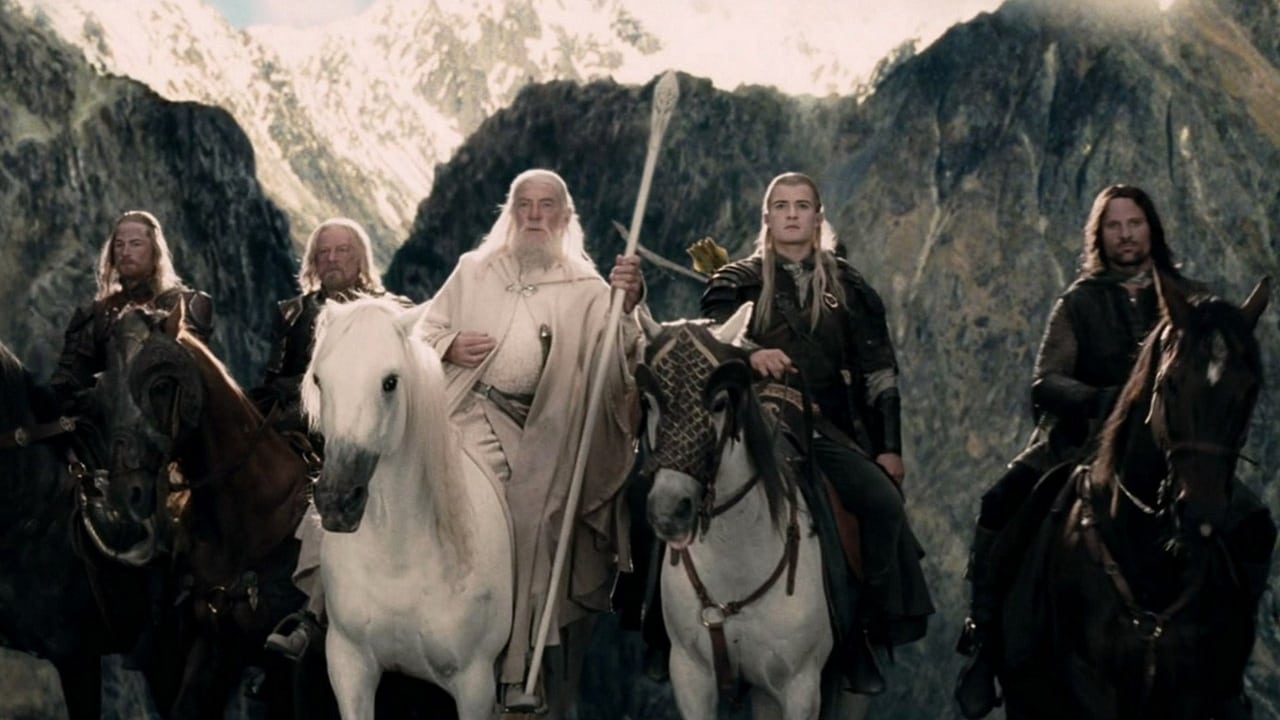
Theoden nearly stole the film — actor Bernard Hill was fabulous in the part and we would have liked to have seen more of his character.
Nitpickers gonna nitpick, and it should be noted that I haven’t seen so much as a single frame of Amazon’s pre-LOTR Tolkien series thus far, but in both my original opinion at the time and upon revisiting The Two Towers now, Jackson did a great job straddling commercial/studio concerns and creating the visual language of the world Tolkien created. That he really introduced the wonder of Tolkien’s epic to the larger world should not be under-appreciated.
Addendum: There was a successful animated film by Ralph Bakshi in 1978 entitled The Lord of the Rings that covered (very roughly) the first half of the LOTR story to roughly the same point where Jackson’s Fellowship and Two Towers gets to. I saw Bakshi’s film on its release, and it was the thing that finally got me to sit down and read the intimidatingly-long books at last.
Bakshi never got to do a sequel to finish what he started on his version, but it was very influential (even to Jackson) — and the rotoscoping techniques Bakshi used in selected moments was very memorable and innovative. Without it, we probably wouldn’t have gotten Jackson’s version, so a hat tip where it is due.
I’m undecided about whether I should finally finish watching the extended versions of Jackson’s films (I have them, on Blu-ray even, but the extended Fellowship sated my appetite at the time), or dig up a copy of Bakshi’s epic and give that a second viewing ahead of its … gulp … inevitable 50th anniversary re-release in a few years’ time. I hope they’ll put it back in cinemas, and I hope they have a senior discount on it by then!





 The Chasbah