Godzilla Minus One (ゴジラ-1.0) (2023)

directed by Takashi Yamazaki
⭐️⭐️⭐️⭐️
52-week film challenge, film 47

This remake of the first Godzilla film from 1954 (my review of that one is here) is a really clever reimagining that turns the perspective around: the focus here is on the human beings affected by the monster, rather than the monster itself. It makes brilliant sense in that the original really showed off the effects, but the new one looks at this phenomenon from a completely different angle.

I certainly did not expect a Godzilla movie to be this emotional, nor did I expect it to be entirely in Japanese with English subtitles in North American cinemas (nice touch). I find it fascinating that 37 films in — with multiple “reboots” from both Toho and Legendary Pictures — they found something new to say about kaiju generally, and yet also reiterate the original’s analogy to nuclear war.
Furthermore, I was completely gobsmacked when I discovered that the budget for this shot-in-the-arm epic was a mere $15 million — there are some films that exist where the catering bill for the shoot was around that amount!

I have, of course, seen quite a number of Godzilla movies over the years, though I largely haven’t seen the post-2000 comeback films. Growing up, Godzilla movies were fun and cheesy, and you (or at least I) never paid a moment’s attention to who was in those (model) ships, tanks, and buildings the monster trashed like the cheap paper maché they were. I also watched TV shows inspired by those movies, including “Ultraman,” a particular favourite.

Godzilla looks so “smol” in the 1954 original. Inflation, I guess, whatcha gonna do?

The genius of writer, director, and visual effects chief Takashi Yamazaki is in putting the emotions and the people up front in this version, with the title character itself getting a fair amount of screen time, but only very rarely being the focus. He even explains both why Godzilla keeps coming back, and why he’s so gigantic and “Hulk-like” compared to his first appearance.

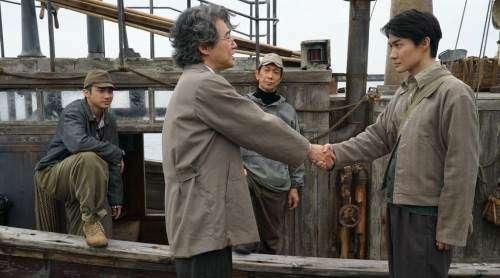
That said, the vast majority of the time spent here is on the humans, specifically telling the story of Kōichi Shikishima (Ryunosuke Kamiki), a kamikaze pilot near the end of World War II — when the outcome was no longer in doubt — who chickens out, and feigns engine trouble and lands on Odo Island. That night, Godzilla emerges and attacks the base. Shikishima gets into the plane, but cannot muster up the courage to shoot at the dinosaur-sized monster.

He survives to find only one other survivor, Tachibana (Munetaka Aoki), who blames Shikishima for the deaths of the other men. A year later (1946), he returns home and learns that his parents were also killed by Allied bombers. He meets a woman named Noriko (Minami Hamabe) who is taking care of an orphaned baby named Akiko (Sae Nagatani) that she has rescued.

As he is suffering from survivor’s guilt, he takes care of Noriko and Akiko, forming a sort of family. Although all three clearly care for each other, it is not made explicitly clear if Shikishima and Noriko actually became romantic partners.

Meanwhile, Godzilla gains his gigantic size and atomic powers via the US military’s nuclear testing in Bikini Atoll. The enlarged and super-powered monster attacks the ships, and then heads towards Japan.

By mid-1947, Shikishima has had some success in a dangerous but well-paying job, aboard a ship clearing mines left by the US around Japan. Authorities, which have been tracking Godzilla’s slow approach to Japan, order the minesweeper try and delay Godzilla’s approach so that more powerful ships can get there.
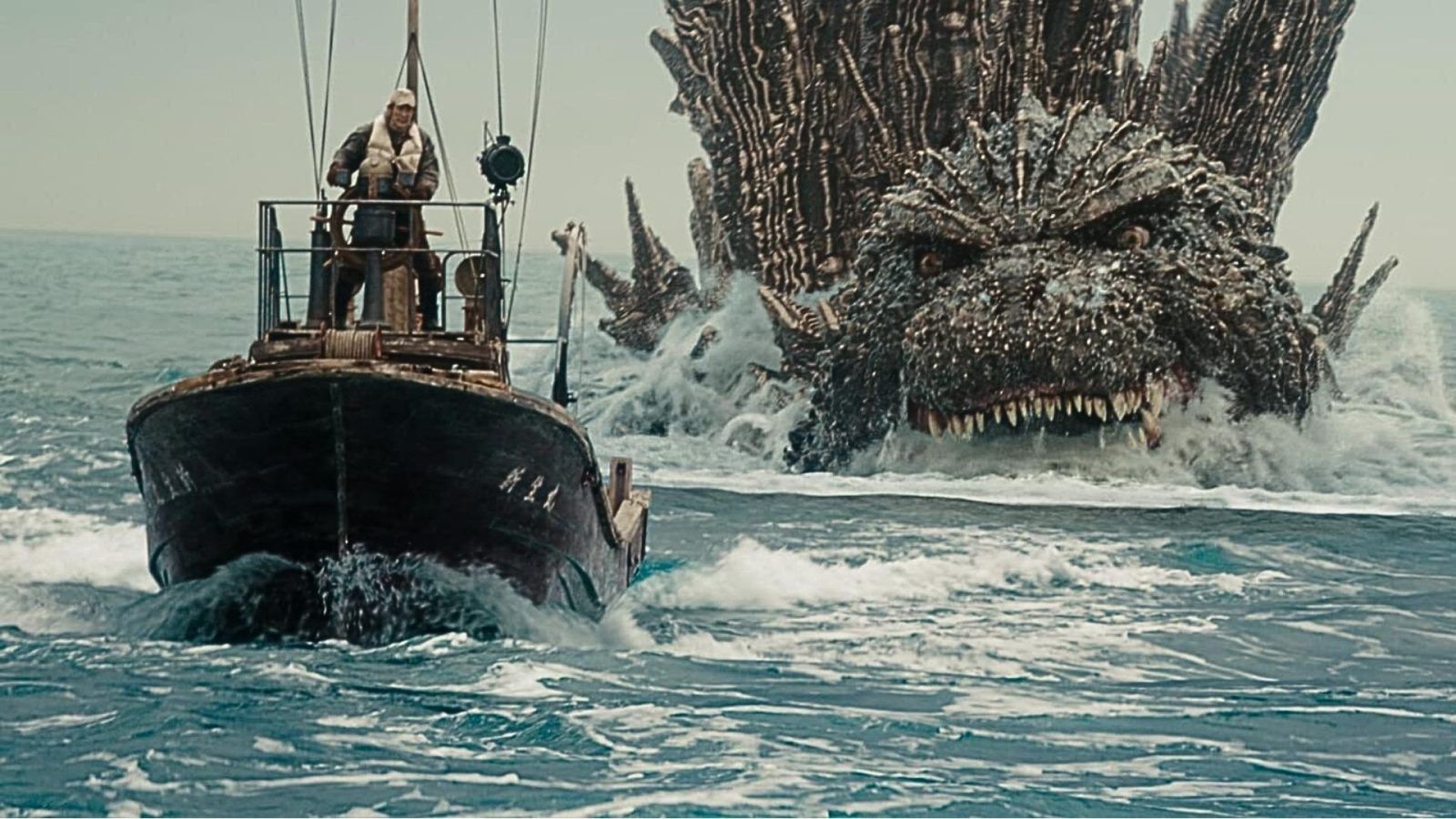
Cleverly, the shipmates use a mine and manage to release one that explodes in Godzilla’s mouth — which does some actual damage — but the creature can seemingly regenerate from injuries. A heavy cruiser arrives just in time, but is destroyed when Godzilla shows off its new power of atomic breath.

Of course, Shikishima is re-traumatized by the return of Godzilla, now enomous and unstoppable. Godzilla eventually reaches Japan, and attacks the city of Ginza. After tanks engage Godzilla, it again employs its atomic breath, destroying the city and seemingly killing Noriko after she saves Shikishima. He is yet again re-traumatized by this loss.

Since neither the US nor Russia will help because of tensions between the two, the Japanese government essentially gives up and does nothing. One of the minesweeper’s crew, Kenji Noda (Hidetaka Yoshioka), assembles a team and comes up with a plan to destroy Godzilla, using a small group of former Navy veterans — including Shikishima — and some disused Navy carriers to carry out the plan.

Unbeknowst to the others, Shikishima has finally been pushed too far, and plots his own revenge on Godzilla, that will presumably cost him his life. He makes arrangements for the care of Akiko with neighbour Sumiko (Sakura Ando), and pretends to cooperate with Nodi’s plan.

And like a good neighbour, Sumiko is there …

That sets up Act 3, and I don’t want to go into the plot any further because the movie is still playing in cinemas as I write this, except to say that some good twists ensue as the group bravely takes on Godzilla and Shikishima seeks revenge and redemption.

I, at least, was surprised by the finale as well as the final scene. I was also utterly delighted by some surprise callbacks to the original film.

Noriko sees Godzilla for the first time, shortly before she is swept away.

I was downright shocked by how engaged I was with the emphasis on the people affected by these events, and how right this alternative approach felt, viewing it from my cinema seat in a world where Godzilla is a stuffed toy with a very long history (and, as mentioned, an ongoing successful franchise for Toho).

70 years on from the original film, the monster itself can still elicit nostalgia and appreciation, but going back to its roots from a very fresh angle has given Godzilla Minus One something new: emotional connections with its audience beyond a general fandom. I’m not sure if this approach would work repeatedly, but it has certainly injected some fresh blood (sorry) into a franchise that had become cliché.

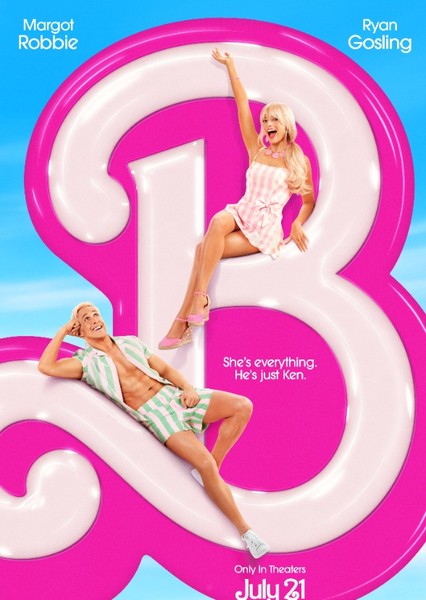
Barbie (2023, dir. Greta Gerwig)

⭐️⭐️⭐️⭐️

52-week film challenge, film 30

Barbie is a fun (and much funnier than I expected) movie that takes some time to make some serious points that are top-of-mind for many people these days. What’s amazing about this film is that it also finds time to address the men in the audience, given that woman are pretty obviously its main focus.

I can certainly see why some repressed critics have brainlessly labeled the film as “too woke,” but given its box office, their silence about the consequences of being woke, i.e. going broke, is pretty deafening.

The last thing in the world I would have expected from a movie about Barbie was a really rather deep dive into both modern society and mental health. I’m hopeful that this film won’t age well over the coming decades, because that would mean we’ve made some evolutionary progress as humans. Sadly, I suspect it will be standard viewing for many years to come, and not for lack of trying.

Barbie is roughly divided into three acts: setting up the status quo in Barbie-land, disrupting that status quo via a visit to the “real world,” and finally a Busby Berkeley entertainment extravaganza about putting it all back together, only with some important lessons learned.

As a Ken … I mean, man … I’m probably not very qualified to talk about the second and third acts too much, since they are so obviously and squarely aimed at both full-grown women as well as girls. But of course, as a man, I will do so anyway.

From my perspective, a few elements of the “awakening” parts of the film are laid on a little thick, but always with some good humour behind them. But of course I would think that, since the Kens are (correctly) lacking much in the way of depth, and blunder through the stuff that should have provided them with more enlightenment about themselves.

Despite this, I did manage to grok that some of the points made needed to be hammered home hard, and not for my benefit — rather, for the benefit of women of nearly any age. While society has certainly made some progress over recent decades, this movie shows that there is still a long and multi-vehicle sparkly process before us.

So, like the film itself, let’s switch back to the more fun parts for a bit. I really enjoyed the Barbie nostalgia and the self-effacing discontinued Barbies, Kens, and pal dolls that pop up routinely in the film. The set designs and Barbie/Ken variety in Barbieland are note-perfect, and it was especially fun (for me) seeing future “Doctor Who” star Ncuti Gatwa as one of the secondary rank of Kens behind Ryan Gosling — Gatwa didn’t get much in the way of lines, but he got a surprising amount of screen time and made for a great other-Ken.

Repeated references to Midge and Allan (and yes, Skipper and even Growing Up Skipper, among others) really added to the humour, the accessories and their cameos, and the significant role Mattel itself plays in the film (even making fun of its own paucity of female CEOs and board members) surprised and delighted me. I found it very interesting that the Mattel board ends up ultimately doing the right thing in the film, but for all the wrong reasons.

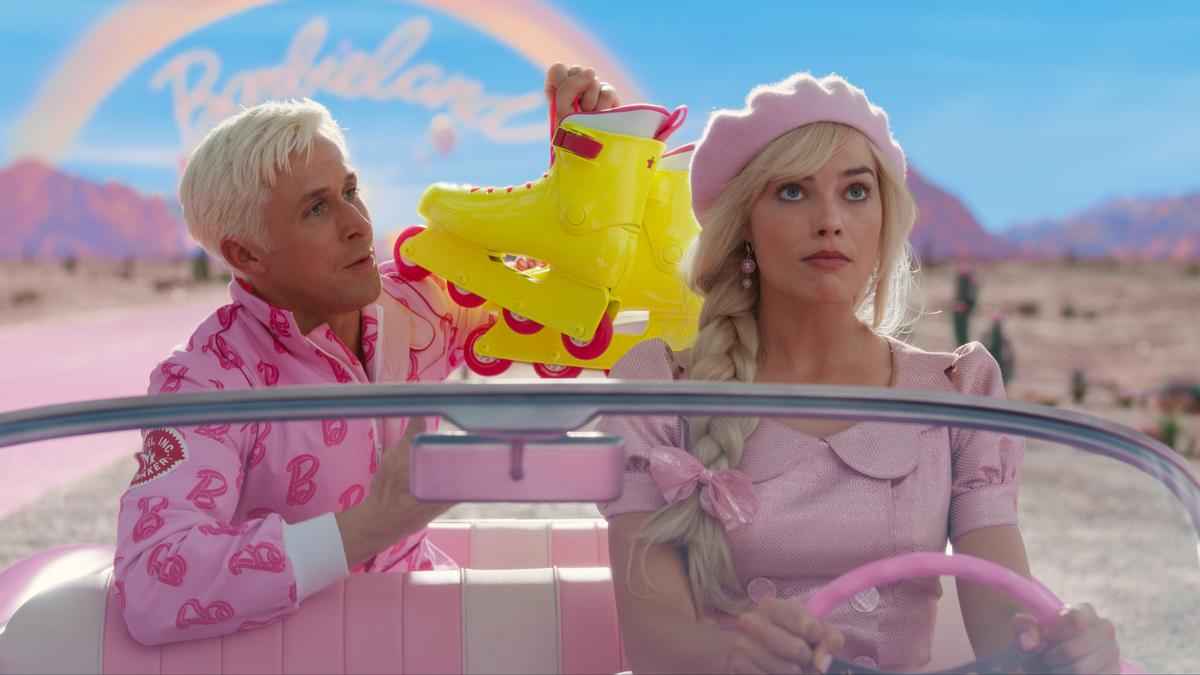
Allan’s movie hair is parted on the “wrong” side compared to the actual doll, but at least his wardrobe is straight out of the box.

After a lengthy introduction to Barbie World and how static it is, Stereotypical Barbie (Margot Robbie) begins to have dark thoughts and other little breakdowns because of a mental link to the (former) little girl who played with her in the real world. She starts to perceive Barbieland as an artifice, and after a consultation with Weird Barbie (scene-stealing Kate McKinnon), she journeys into the real world to find her former playmate and fix what’s wrong.

Only things don’t go according to plan: for starters, lovestruck Ken sneaks into the car and accompanies her on her journey, immediately discovering (and falling in love with) the patriarchal society that allows for only token advances by women every now and again. It turns out Ken has a surprising number of issues for a guy with no penis.

Barbie eventually finds a sullen, self-aware tween girl named Sasha (Ariana Greenblatt) who’s mad at basically everything in her world, and her struggling single mother Gloria (America Ferrara), who as it turns out is the former little girl who owned Stereotypical Barbie. After the usual disbelief at the circumstances, they resolve to return to Barbieland to put things right — but Mattel’s board has gotten wind of Barbie’s return, so a Screwball Chase™ is required, giving Ken (armed with books about patriarchy and men’s history) time to get back to Barbieland first.

When Barbie, Sasha, and Gloria finally arrive in Barbieland, it has been renamed “Kendom,” and the Kens are in charge, and strangely fixated on brewskis and horses. The Barbies have all been brainwashed into being Stepford Wives, essentially (and yes, I’m old enough that I consider this movie something of a remake of it).

Our heroes are at first dismayed by this, but again thanks to Yoda (sorry, I mean Weird Barbie), they work out a plan to disrupt the patriarchy from within. But will things just go back to being what they were before, as the Mattel board (who have followed along) want? That’s what sets up the third act.

The Mattel board of directors, horrified to learn that Barbie is present in the real world, give chase on Venice Beach in California — the nexus point between our world and Barbieland.

Without giving the whole thing away, following the ensuing hi-jinks and reset and a lot of feminine self-enlightenment as the Barbies are de-programmed (and the Kens, in a way), everyone gets at least some of what they want. Ken breaks his dependency on Barbie’s approval, Barbie (the main one, that is) becomes a “real” woman, and the Mattel board get some hot new and more-relevant variations to sell.

It’s not a perfect happy ending, and the Kens are left a bit adrift (and still in a matriarchal society, but somewhat more balanced this time), but both the other Barbies and the Kens become more self-aware, and realise the Big Lesson that happiness can only come from within, not from other people, and that means becoming a whole person.

And then the closing credits finally bring out a version of the insipid hit “I’m a Barbie Girl” song, along with a hit parade of actual WTF Mattel alternate dolls and accessories, including a pooping dog and innumerable outfits that were actually sold across the long history of Barbie. I should mention that Rhea Perlman of all people pops up in the film in small but a very important role, and it was super-nice to see her.

Ths scene is from the beginning of the movie, and this was all it took for me to know I’d enjoy myself. No spoilers, but this one’s for the film buffs.

If you’re going to make a “super-woke” film about female empowerment in a patriarchal society, this is how you do it: with a lot of cleverness and laughs and bright colours and goofy characters. You might even learn something … even if you’re a Ken.

Now if you’ll excuse me, I’m off to buy a Weird Barbie, and a Ncuti Gatwa Ken.

Inspired by the film, someone built an actual Barbie Dreamhouse on the California coast, and turned it into an AirBnB.

The Super Mario Bros. Movie (2023)

⭐️⭐️⭐️⭐️

Dirs: Aaron Horvath, Michael Jelenic
52-film challenge, film 28

As an adult, I can see a few problems here and there that I will of course comment on momentarily — but basically your kids will probably love this, as will most teens and adults that are old enough to remember Donkey Kongand Super Mario Brothers games they played as a kid. This is the first kid‘s film I’ve seen in a long time that I think children will wear out the Blu-ray of from repeated viewings.

You can safely forget any previous attempts at bringing these characters to life in a film, especially that 1993 thing — this one gets it right for the first time. As far as current-generation Mario fans are concerned, this film is damn near perfect — and its biggest flaw, if you can call it that, is that is so busy packing in references that the story sometimes takes a back seat to other events, and that’s okay.

The movie represents a huge jump in quality from the previously third-rate Illumination animation firm, thanks to a wealth of pre-designed characters and an obviously huge software upgrade. Up till now I have pretty much loathed everything they’ve done, particularly Despicable Film (my title for it) and the introductions of the incredibly lazy (and Pixar-“inspired”) Minions. It was like their mission was to make children stupider via inducing attention-deficit disorder.

I’ve seen some reviews from adults that the movie is still too superficial and fast-paced, but in part thanks to Illumination’s previous work, that’s what kids want. Besides, the “lore” of this movie is very well-established in the video games, so there’s no need to go over all that, you just accept the situation and welcome Mario and Luigi’s extended family. Directors of Batman and/or Superman movies, pay attention.

Since I also am an adult — most of the time — I also have a few minor criticisms, but before I get to that the first thing that should be said is that this is what kids/family cartoon computer animation should look like if your name isn’t Pixar/Disney: Incredibly colourful, true-to-the-characters design, followed through for new/additional characters, gorgeous locations, and of course — very little regard for the laws of physics.

The biggest letdown for me was that Mario and Luigi didn’t retain their “fauxtalian” accents throughout the movie, but I can also see how that might offend real-world Italians if they did it through the entire film. This is explained in the film as being exaggerated for the purposes of a TV commercial the brothers make (so you do indeed get to hear Mario say “it’s-a me!”), but except for occasionally remembering to say “Mama Mia,” and of course “Woohoo” a lot, mostly it sounds like Chris Pratt being a New Yorker.

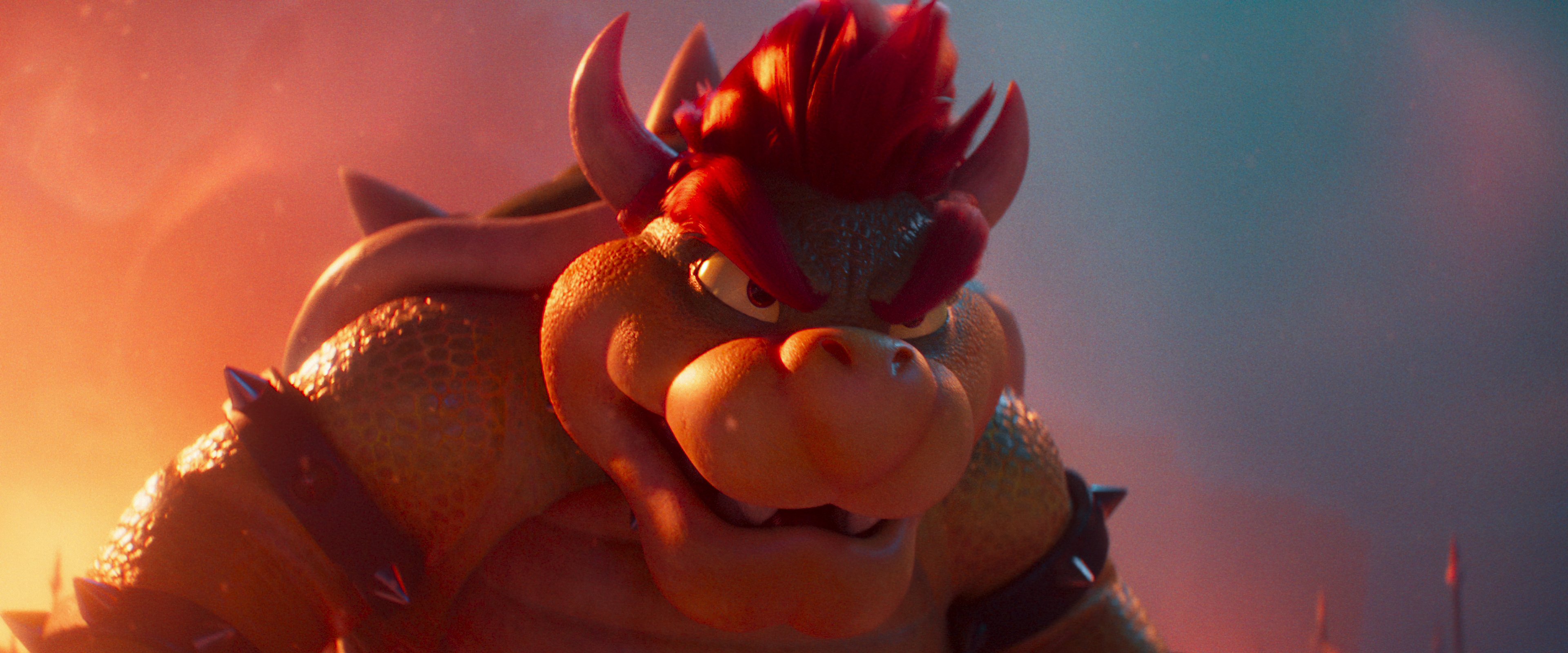
Charlie Day as Luigi does a better job, but the movie is stolen voice-wise by the far-better-cast Jack Black as Bowser, Anya Taylor-Joy as Princess Peach, Keegan-Michael Key as Toad, and Seth Rogan and Fred Armisen as the two main Donkey Kong characters.

Considering many of these characters started off as pixelated bits, the character design is excellent, and instantly “feels” like this is the way the characters should look, even though technically they only got to this point through generations of iteration as the console game technology improved. Likewise, this is a level of background and “set” work we have never seen from Illumination previously, and even the jokes work most of the time.

Princess Peach and Toad prepare for the big race

The film starts off in what passes for “the real world” and, after a funny scene of the brothers failing as real-world plumbers on their first big job, they discover a pipe that leads to what we’ll call Mario World with the characters we know and love. The rest of the movie builds out from the premise of Bowser wanting to marry Princess Peach by force, threatening the peace of the various kingdoms and Mario (& Luigi, who has a much smaller role of mostly being the victim that needs rescuing) arrive just in time to help the Princess and her people fight back.

In short, this movie is one I’ve rated highly because it absolutely achieves what it sets out to do, which is to flesh out Mario World, establish the underlying lore, and defeat the enemy, and looks good doing it. The frantic pacing will perhaps annoy some adults, but there are plenty of reference-checks for us Mario veterans to appreciate, especially if you loved Mario Racing. It’s no classic film-wise, but it will absolutely take its place as a go-to kids’ movie the whole family can enjoy.