Roxy Music – Art Rock (2025)

No, there isn’t any new or unearthed rare material on this new EP. It’s nothing more than the 1999 remastered versions of five of their early tunes, intended as a quick sampler for anyone intrigued by the title but unfamiliar with the band and in need of an introduction.

It’s a digital-only sampler, available via Apple Music and Spotify (and maybe Tidal if that’s still around). Fans of the band will have this stuff and thus can skip it, but it could be a nice way to introduce others to RM if they’re not familiar with anything beyond (maybe) “More Than This” and “Avalon.”

That said, it’s always fun to hear selections from these two classic albums again (or for the first time, if you’re new to the band), and in particular to remind yourself what a strong start Roxy made when it burst onto the scene in the early 1970s. From the US version of the debut album (which I’ve reviewed the SDLX package of starting here), we get “Virginia Plain” and “Ladytron,” but the rest of this EP skips a lot of good stuff from For Your Pleasure and Stranded in favour of the single “Pyjamarama,” rounding off with “Out of the Blue,” and “Prairie Rose,” which both came off of their fourth album, Country Life (1974).

Yes, that’s right: the first album was released in 1972, and two years later they had another three albums out, two of them in 1973 alone. Those were the days, my musical friends.

For the comparison, I listened to each song three times: once from the album it appeared on (apart from “Pyjamarama”), once from The Best of Roxy Music album (if available), and then the remastered version from the Art Rock EP.

In the case of “Pyjamarama,” I also listened to the live version from Viva!, which needless to say was more “present” and well separated that the flat, lifeless original single. The additional squelchiness brought forth by Eno’s replacement Eddie Jobson and the live performance really breathed some life back into the song.

The remastering of the studio rendition of “Pyjamarama” on Art Rock is a huge improvement over the Best Of version, restoring a sense of separation of instruments and generally updating the sound for, you know, high-fidelity stereo. You can hear the very obvious difference from the first chord, and as the band comes in each instrument has been “placed” and is audibly distinct from each other.

The drums and bass in particular have been placed in separate ears (with some crossover) and Ferry sits in the center, while the guitars play around him. A big improvement on the original single in every respect, though the live version has a certain immediacy that beats even the remastered studio cut.

The opening to “Virginia Plain” on the Best Of starts off way too soft, but the song does arrive properly in short order, and its only flaw is that the bass is too high in the mix, though it doesn’t interfere with the other sounds unduly. Eno’s electronics are just fabulous and don’t overplay the rest of the band except for the mid-8.

The remastered version nicely corrects this, while not preventing the band from raising the volume considerably when they come in. The bass is still prominent, but no longer dominant. The drums are much clearer, and the separation of instruments better defined (with better stereo effects as well). It’s only Ferry’s now-clearer vocals that remind you this is the same take.

Whoever remastered this really has a good sense of when instruments should advance and retreat, and where Ferry needs to be in the mix. This bodes well for the two songs that came from Country Life, the first of which here is “Out of the Blue.”

The original is awash in more sophisticated efforts and some stereo effects, and while the bass is still quite promiment, it doesn’t overwhelm the sonic fireworks that are going on. Ferry sings this like a ballad, but the band is completely opposed to the idea — and rocks out to a great degree, making much use of Jobson’s electric violin and MacKay’s oboe, with some light effects on Ferry’s vocal. This was always one of my favourite tracks off this album due to these contrasting flavours, and it still works really well in my view.

The Best Of version, by contrast, sounds like it’s almost a monophonic mix intended for AM radio play. There’s only the barest hint of separation until after the first verse, and everything seems very compressed. Much of the effects on the original album are minimized, or just gone, with the drums in particular sounding quite leaden.

Which brings us to the Art Rock remastering. It starts off subtle, but cleans up the oboe intro without diminishing the bass. Sadly the remastering seems to have been done on the muddier Best Of version, at least until the short instrumental break and the halfway point. From then on, the stereo effects and clearer sound are back, and Jobson’s violin absolutely soars, and double-tracked for a thrilling finale.

From here, we jump to the not-quite-country rock of “Prairie Rose.” Slide guitar shows up briefly, but gets fought back by MacKay’s whirling dervish of a sax solo. On the album, the band takes a slightly-extended jam-out before Ferry returns (strategically double-tracked in places). It’s a lyrically light number, designed to revel in what a UK band thinks country music sounds like.

Since it’s not on the Best Of album, our direct compare is to the Art Rock remastering, which wins this head-to-head contest handily. The voices here are so much clearer (both Ferry and the backup vocals), and the slide guitar has found a more prominent role where it doesn’t have to fight other instruments — leaving MacKay’s sax solo unmolested and crazed as it should be.

Everything on this number sounds like its on FM radio rather than the Best Of’s AM truck radio mix, especially Ferry’s vocals. It’s still a cheezy attempt at country music, but it sounds ridiculously much better in Art Rock’s remastering.

Finally we get to the big finale song: “Ladytron.” Here we have at least three versions to compare: the original version on the band’s debut album, the remastered debut album’s version, and now the Art Rock 1999 remastering.

The bass is very, very prominent in the original album version, but the other sounds are mostly pretty clear, from Ferry’s own backup of his lead to the soft piano in the background. Eno’s electronics dance round like wood nymphs, playfully complementing the band at the end.

On the Deluxe Edition of the album, the intro starts off much more softly but builds up more smoothly, coming into focus nicely. MacKay’s oboe stays in the background, but is clear and sharp. The mid-song jam seems a bit clearer on this version, but is otherwise very similar. Overall, a somewhat better mix but nothing surprising.

On to the Art Rock version: the opening is very similar (of course), but the double-tracked Ferry vocals are noticeably clearer. The instruments are pushed to the sides during the first verse, but come charging into the center as well as the sides better here, with more separation making it easier to hear what’s going on to your left and right alongside the center.

Overall, Art Rock offers and even more cleaned-up version of the song, but doesn’t mess with it much — as it was damn near perfect to begin with.

So, should you purchase Art Rock? I’d say the EP represents mostly a spring cleanup of some well-remembered songs, dusting off sounds and rearranging the sonic furniture a little, but really it’s “Pyjamarama” and “Virginia Plain” that get the biggest glow-up.

By the time the band were doing Country Life, they’d improved either their studio techniques or just hired better engineers, and the two tracks from that album are dolled up a bit, but not re-made (or re-modeled). Likewise, the EP’s closer “Ladytron” was less tampered with than expected, but just enough to make it noteworthy.

If I’d chosen the running order of the tracks, I think I would have led off with “Virginia Plain” and “Ladytron,” stuck “Pyjamarama” in the middle, and swapped out “Prairie Rose” for “All I Want is You.”

But that’s me. Is this worth buying, even though its a digital-only release? For the big improvements to the older songs, I’d say yes. “Out of the Blue” and “Prairie Rose” don’t benefit as much, so you might choose to just buy the three other songs and save a little money.
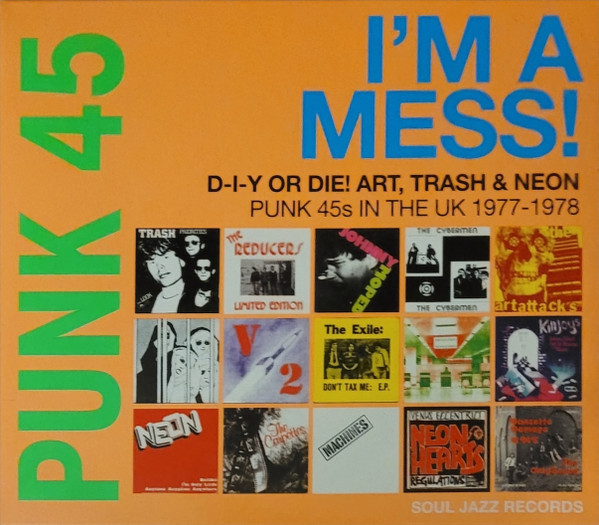
Punk 45: I’m a Mess! (Various Artists)

D-I-Y or Die! Art, Trash, & Neon
Punk 45s in the UK 1977-78
(2022, CD, Soul Jazz Records)

Recently, I have discovered that this compilation is in fact part of a series of punk compilations from Soul Jazz Records that started in 2013 under the “brand” name of “Punk 45,” with each release given a title borrowed from one of the songs on the disc, a subtitle describing the overall style, and a sub-subtitle covering the specific period.

The one we’re reviewing in this case, for example, is the most recent original compilation, though the label reissued the first disc in the Punk 45 series, “Kill the Hippies! Kill Yourself!” on vinyl only in 2024, which I view as symbolic of society’s general regression but is more honestly probably an attempt to lift the comp series out of obscurity.

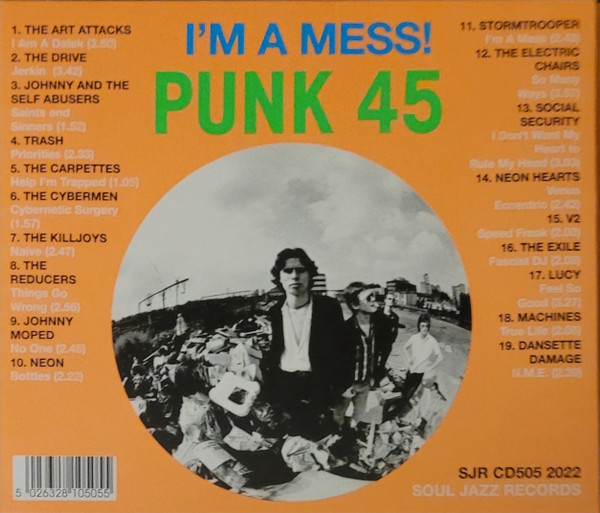
Before we dive in, a brief clarification: the track listing on the back of I’m a Mess! might have been the actual running order at one point in the production process, but it’s not the one we actually get — a truly DIY sort of error, you might say. The correct song order is reflected below.

Overall, this is a compilation of indie punk singles released in the UK in 1977 and 1978, a sampler rather than a comprehensive collection. Now that the background is out of the way, let’s dive in.

The Art Attacks – “I am a Dalek”
Well you know this title is going to grab my attention, given my lifetime love of the TV show “Doctor Who.” And indeed, what’s more punk than a Dalek? Their entire worldview is that everyone but themselves are unworthy and should either be subjugated or killed. It defines punk rock right from the start with three chords, a cloud of dust from furious playing, barely-tuneful singing and multi-tracked Dalek chanting.

The Drive – “Jerkin’”
Rock has a history of songs about masturbation, which is funny because people often join rock bands as much to get hooked up with groupies as they do to make music. This one is far more tuneful than “I am a Dalek” and has a more polished rock sound that betrays their pub rock background.

A lot of bar bands devolved into punk rockers when they observed which way the wind was blowing, and went right back to their usual styles a year or two later, let’s be honest

Jonny & The Self Abusers* – “Saints and Sinners”
Speaking of masturbation, this band is the forerunner of Simple Minds, a band you generally don’t think of when the work “punk” is in the conversation. But by damn, they do a nice job of putting the bass up front on their take on fast punk. The song matter is simple, but well sung and with a bit of harmony thrown in. Nice drop-dead ending also, the first on this album but a common exit for many punk songs.

(*this is how the band’s name is spelled on this compilation; I have seen the name spelled a bit differently elsewhere)

Trash – “Priorities”
Trash have a pretty good vocalist and (gasp!) backing vocals. Like Jonny and the Self Abusers — the bass is the anchor here, alongside the (talented) drummer. Punk is about very simple song structures and simple messages, and this embodies that principle.

The Carpettes – “Help, I’m Trapped”
Speaking of backing vocals, this one is so fast it’s almost punk rapping, with the chorus handled by the rest of the band (with a bit of echo) to give it a distinct sound. A good example of a song that doesn’t outstay the strength of its concept, like a few others here.

Stormtrooper – “I’m a Mess”
The title track of the compilation. The backdrop of chords gives us some under-melodies to add a bit of sophistication (just a bit) to the usual wall of guitar, drum, and vocals. This is an example of punk as being reflective of what was going on in Thatcher’s England.

The Electric Chairs – “So Many Ways”
Wait, what’s this?? GIRLS?? Well I never! And the guitar isn’t the lead instrument, rather a drum machine is? And is that … a sitar? What the blazes is going on? A hint of synth? Robotic “singing”? Did this band time-travel back four years from 1981?

Clearly this is where DIY ethic mentioned in the title comes in. One has to remember that sounding like robots was a fresh take on a punk vocal at the time. I do actually believe I can detect a hint of melody in here as well. Seven singles in, and punk is already evolving! I’m happy to see some female representation at this early stage.

Social Security – “I Don’t Want My Heart to Rule My Head”
Things are just going from bad (as in amateurish) to worse (not very punk, really) with this ahead-of-its-time New Wave-ish anti-love lament. Our narrator really, really wants you to know he’s not interested in a long-term relationship, so his idea here is that this must be anti-rock music, in that he’s not doing this pull groupies — or, apparently, get famous.

Neon Hearts – “Venus Eccentric”
Finally, frenetic sax makes its punk debut. The song consists of the singer complaining about what a bad relationship he’s in, but apparently the sex is great, so I have to give him points for broaching what would become a universal theme in rock music. Bonus points for a fast-paced but distinctive guitar solo.

The Cybermen – “Cybernetic Surgery”
Some punters with ambition and cultural references to Doctor Who (again) provide us what the punks always said they were like emotionally. There is some early vocoder use to make a sort of “cyber” vocal here and there. Musically quite catchy, with a sax break in the middle. As ruthlessly efficient as the monster they are named after.

The Killjoys – “Naive”
Now here’s a real punk song — the singer blaming other people and society in general for his ills. There’s some female vocals supporting the chorus of “I’m bitter” which sadly devolves into various moaning/screaming.

The Reducers – “Things Go Wrong”
More women! And another song about blaming others for the world’s ills, or your specific ills. It doesn’t have the frenetic pace of first-wave punk songs, but it certainly has the attitude and “bad relationships with various entities” subject matter down pat.

Johnny Moped – “No One”
This song takes the opposite approach — its message is that I am no one, and no one is going to make me feel bad. The lead singer brings a distinct northern accent to the party. Punk failed to get away from the “guitar player needs a solo, however short it might be” mentality of rock pretty early on, but this one finishes with a more typical hard-rock ending.

Neon – “Bottles”
Strange sounds in a loop a the beginning, possibly produced by bottles on guitar strings (GET IT?). Vocals pushed back in the mix on the verses, but not on the chorus — hmmm — and they sound like hippies that have been ordered to go punk. It’s not very good, but at least it’s short.

V2 – “Speed Freak”
Air raid sirens enter the chat as a song intro .. at last. A fast rap of verses followed by the simple chorus of (mostly) “Speed freak yeah.” Not the first song here that has been poorly mixed, either.

The Exile – “Fascist DJ”
A complaint rant about a club DJ who wouldn’t take requests. Literally, that’s it.

Lucy – “Feels So Good”
Now here we have a song tailor-made for pogoing, with an urgent beat and a DIY lyric about the DIY ethic. Moves along at a fast clip, which makes the guitar solo more work (and shorter) than it would otherwise be.

Machines – “True Life”
Old-school punk/rap with a lyric about facing up to the fact that the world sucks and it won’t get any better. Nihilist, maybe, but not wrong.

Dansette Damage – “N.M.E.”
Ah, yes, the old “song starts at one tempo in the intro, then picks up a different tempo when the lyrics start” trick. As you might guess, this song is about a fellow obsessed with the New Musical Express newspaper (I guess you could say it was his “enemy” — thank you, thank you, I’ll be here all week). The title eventually becomes all, and the song devolves from there, as is proper and correct for obsession songs.

Is this compilation worth your time? If you have an interest in unsung OG punk rock, then yes — there are some gems here amongst the mediocrity. It hasn’t aged poorly, I will say that for it, but I’ll also say it is mostly pretty clear why these bands didn’t advance within the movement.

One last note: the vinyl version of this compilation featured a bonus single for Record Store Day 2022 that included a b-side which is not part of the CD version. Both the a- and b-side of the single contained songs by the band Stormtrooper. The a-side was the title song in the compilation, “I’m a Mess.” The extra song on the b-side is “It’s Not Me.”

The Stiff Records Box Set – Disc 4

The Stiff Records Box Set — Disc 4
Stiff Records, 1992
4CD box set + booklet

THE PROLOGUE

Well, here we are at last, the final disc in this set, chronicling the last days of Stiff as an active record label roundabouts the mid-80s. Many of the acts Stiff first signed and/or made famous moved on to bigger record labels and more money, and Robinson and Riveria were forced to cast an ever wider net.

It’s a label that kicked off with Nick Lowe because he had already recorded to “publisher demos” at other companies’ expense, so the cost of releasing that very first Stiff single was a staggering £45. Thankfully, it did well – and the rest of the history is encapsulated here.

As mentioned previously, the tracks on these discs are in rough, rather than exact, chronological order, but on the other end of this Stiff journey we alight on the pub rock band Dr Feelgood, still going to this day as an entertainment entity but with a completely different lineup. You might wonder what a mid-70s traditionalist UK rock band is doing here, but they are part of Stiff history for two reasons.

First, singer Lee Brilleaux was the man who lent Jake Riveria and Dave Robinson the 400 quid they needed to register Stiff as the UK’s first independent record label. Second, they were a pretty damn good pub-rock band by the time they finally recorded with the label.

THE MUSIC

Things kick off with “Sign Of The Times” — a nice, poppy single from The Belle Stars, an all-female group that should have gone further than they did. I’m happy that their biggest single was one of their own originals, rather than the cover versions they had been doing for a while prior to that. Prince obviously liked the title also!

The follow-up single from the band is also included here, “Sweet Memory” as the second track on this disk, and it failed to crack the top 20 despite some pretty groove-y instrumentation. It’s certainly not as good as “Sign of the Times,” but it’s not awful either. I think the “aggressive/tough” style vocal on “Sweet Memory” is what hurt it.

Stiff was not doing as well by the time 1983-84 rolled around, and this disc is low on hits (but not without them). The label signed a bunch of new bands as their older acts left for bigger labels, and Electric Guitars is one of those. To be fair, the New Wave edge had faded by this point, but the “angular” attempts at cool had devolved into a similar style for a lot of bands.

It makes sense that the Guitars’ “Language Problems” would follow “Sweet Memory,” since it is rather similar: musically very competent, vocals rather odd.

Thankfully, the fourth song on the CD is a bona fide hit that still gets me dancing to this day: Tracey Ullman’s version of Jackie DeShannon’s “Breakaway,” a sped-up 60s girl-group song that infused extra energy and Ullman’s own sparkly vocals into an irresistible treat. Two minutes and 37 seconds of absolutely perfect pop.

This is followed by a song that might have made it but missed it by this much, Passion Puppets’ “Like Dust.” Musically, it has the moves, the vocals aren’t bad, there’s no reason this harder-rock mainstream number couldn’t have done reasonably well, and yet it didn’t. I can only imagine that the collapse of Stiff in 1984 contributed to the band’s failure to put out more than a single album.

Likewise, “Dangerous Dreams” by Jakko sounds like perfect FM radio fodder, but went nowhere just the same.

But now, time for something different: King Kurt launches “Destination Zululand” at us with a Tempole Tudor style and a bad Elvis impression. This sounds more like the happier days of the label, and it’s competently performed but silly. Not great, but certainly fun.

If you had trouble deciphering exactly what King Kurt is saying at all times on his song, wait till you get a load of poster-boy-for-dental-work Shane McGowan and the Pogues, who debut in this set at last with “The Sick Bed of Cuchulain,” a rollicking 100-proof Irish punk-folk hit complete with tinwhistle. McGowan alternately snarls and rocks it in this tale, which draws from Irish folklore based on an actual 11-century (lost) Yellow Book of Slane.

The next track is absolutely not what you might expect following The Pogues: “Pick Me Up” by the Inspirational Choir of the Pentecostal First Born Church of the Living God. True to their name, its an African-American church choir singing Christian Rock (or more accurately, inoffensive jazz-pop). It … um … certainly stands out among the songs on this disc.

A band remarkably like peak post-punk band The Jam, but they’re called Makin’ Time, borrow the bass riff from “Town Called Malice” for their own very-nearly-as-good version, “Here Is My Number.” It’s a rousing soul-infused rocker, but … you can’t get that other song out of your head when listening to it.

Three of the four members remained active in the music business into the 21st century, with Makin’ Time bassist Martin Blunt eventually joining The Charlatans.

Time to check back in with The Pogues, doing that Pogues-thing they do so well, with a catchy, bouncy Irish … lament … called “Dark Streets of London.” If you’re reading this, you must know The Pogues, even if you can’t stand McGowan’s vocal style, so you know that musically they are both firmly reflective of Ireland’s musical heritage, while infusing the music with the energy and spittle of punk.

We mentioned earlier The Belle Stars as a band that should have been bigger: well here’s another one — The Untouchables. They briefly grabbed the brass ring of exposure and US fame with a later single “Free Yourself,” but “Wild Child” is exactly the same kind of soul-powered rock stomper. I’m reminded to go back and investigate these guys more as well.

Kristy MacColl returns to give us another fantastic song of hers, “A New England.” Sparkling guitars frame a confessional song about a broken relationship and touching on teen pregnancy, bracketed by absolutely inspired lyrics.

Here’s a sample: “I saw two shooting stars last night/I wished on them, but they were only satellites/it’s wrong to wish on space hardware/I wish, I wish, I wish you cared,” and even more so “Once upon a time at home/I sat beside the telephone/Waiting for someone to pull me through/When at last it didn’t ring I knew it wasn’t you.” Genius!

One of Jamie Rae’s two singles ever released, “Pretty One” is included here, and it’s a pleasant enough pop song, but the young Scottish singer only released one other single. Though he found some considerable fame from those two records, he suddenly withdrew from pop music following the unexpected death of his mother from leukemia. Somewhere in a vault, there’s half an album more stuff from him, but as yet it’s not escaped that I know of.

Starting off with a driving groove, 60s mod styling, and a killer bass riff and wonderful call-and-response between lead singer/guitarist Clyde Grimes and the rest of the band, a ska-like touch of horns and synth organ, “Free Yourself” by The Untouchables managed to get some airplay and exposure on MTV and US radio with this irresistable track. As someone used to say back in the day, “if this don’t get in your head, check yourself — you may be dead!”

Speaking of energy, The Pogues waltz back in with another fast-paced Irish punk ballad, “Sally MacLennane.” A punk-pop take on Irish traditional music doesn’t get any better than this. The drunken-voiced callback in the chorus is the perfect finishing touch. Two minutes and 43 seconds of pure boozy bliss.

Then, suddenly, without proper warning: deep-voiced art-rock New Wave! It’s Furniture’s best single (in my opinion), “(You Must Be Out of Your) Brilliant Mind,” with extra-weird bass tomfoolery in the chorus and occasionally elsewehre, synth strings, a New York angry sax break, full of witty lyrics and oddly danceable. It’s … wait for it … brilliant.

From the “Not Really Our Thing So Much, But It Kinda Works, Mate” department, we finally get to Dr. Feelgood, a band that was a staple of the pub-rock circuit which originally formed in 1971, making them antiquated geezers by this point. The band was anchored by singer Lee Brilleaux, but had a rotating cast of other players.

For their single for Stiff, the label gave them some synths to play with, and the result is the smoky ballad “Don’t Wait Up,” which sits a little oddly with most of the other Stiff artists but is in fact a good song well-performed with just a splash of blues.

This is followed by outright bebop jazz from the Tommy Chase Quartet with a song called “Killer Joe (Right Cross)” — no chaser, just straight shots at a quick clip. As per tradition, the piano and sax get their moment of spotlight. What the huh? 50s jazz on Stiff? What the blazes is going on?

Oh wait, whew — Furniture return to get back in the zeitgeist with a return to their cool romantic artiness, courtesy another single a-side “Shake Like Judy Says.” Oddly, it’s not really a bad placement between Tommy Chase and Dr Feelgood — the song features a jazz-tinged trumpet line (and a little xylophone), which are both given some brief prominence amongst the synth/bass/drum/guitar main sounds.

Dr. Feelgood closes out the show with an unexpected redneck anthem, “Hunting Shooting Fishing,” that at least shows off how the band normally operated, and as you might have guessed, they’re not trying for high art. This is pub rock aimed squarely at working-class club audiences, complete with driving lead guitar and drums, plenty of echo on Brilleaux, and what almost manages to be a song for the monster truck crowd. ZZ Top could only wish they rocked this raucously.

THE BOOKLET

Just before we head for the exit on this review, we have to mention – at long last – the one and only thing included in this box set that is not a CD in a jewel case (which also includes an insert card with the table of contents for each disc, also reprinted on the back card) is a 20-page booklet that tries to set the stage for the creation of Stiff and the state of UK rock music at the time, impart a little data about its founders (including police mug shots!), and outline some of the label’s whacky slogans, which really gave it character. These ranged from the enigmatic “Three Nos Don’t Make a Yes” to the punkier “If It Ain’t Stiff It Ain’t Worth a Fuck” and the wry “We Came, We Saw, We Left” (or as the ancient Romans might have said, “Venimus, Vidimus, Reliquimus). Me, I always liked their on-label saying on many of their singles, “Electrically Recorded.”

We then get in the story about the early singles, starting with Nick and his costs-already-covered first single “So It Goes,” which came out on August 14th, 1976, and hit number one in the US two weeks after it was released. “Heart of the City,” the b-side, made a greater impact on the UK music papers, and between the two songs Jake and Dave were able to pay off the initial loan that started the ball rolling.

After a kerfuffle with EMI over the use of a Beatles’ “baby butcher” unused cover for a Roogalator single, Stiff got in the habit of releasing a single and then quickly “deleting” it from the catalog, which turned out to have the effect of encouraging stores to order more copies upfront. On top of that, they’d let artists or producers scratch messages in the runout groove (no, that wasn’t really a thing until Stiff came along). Genius!

The booklet continues with various tales like that, celebrating itself and writing about both its early wins and some of its early losses – for example, the classic “Alison” by Elvis Costello completely failed to chart on its debut. Luckily, the album did a bit of business (wink). It also chronicles the departure of Jake Rivera, taking Lowe, Costello, and Yachts with him to form another indie label, Radar.

It talks about the changing relationship with the ever-fickle and ever-bitchy UK music press, which once championed Stiff but quickly decided the new crop of acts were already old hat, and chronicles the Live Stiffs tours. As punk began to fade and the Two-Tone (another indie label) legend rose, Stiff signed Madness in a canny move.

By this point we’re in the early 80s, and Madness, Tenpole Tudor and Jona Lewie’s surprise hit “Stop the Cavalry” were helping keep Stiff in the charts, desperation was rolling in like fog and Stiff was throwing all kinds of … stuff … at the wall to see what stuck. Then, like a fortuitous lifeline, in 1983 Dave Robinson took an offer of being the Music Director of Island Records, and took the entire label roster with him.

This lasted until 1985 when Robinson and Island parted ways, and Stiff was back to struggling status. By 1986, Robinson could take the swinging between feast and famine anymore, and after a last short respite courtesy Cashmere (also home to the emerging ZTT label at the time), Robinson and Stiff were done.

The booklet carries on for a bit longer eulogising some of the things that made Stiff unique (such as signing Wazmo Nariz, the guy with two ties). It ends with a listing of Stiff Staff, and thank yous to those who helped put this compilation together.

THE WRAP UP

By the mid-80s, Stiff was flailing around wildly and desperate for hits. By this point, it was sailing on reputation and fumes, and the money was running out fast. That said, Discs 3 and 4 show that Stiff still had an eye for talent, and was still taking chances on an ever-increasing variety of artists even as the ship was starting to sink.

We owe this label and those two founding maniacs a great deal of gratitude for finding and publicising such a wide and clever array of new musical talent, and for helping make the very late 70s and early 80s a fookin’ great time to be a young person who loves great music. As the scores for these four CD s show, the hits outweighed the misses, and the legacy of the label is something Dave, Jake, and the artists can be proud of.

As a grave marker of sorts, this CD set is the finest tribute/chronology/potted history you’ll likely ever get of a UK indie record label. It is still a treasure box to me, 32 years (yikes!) since I first bought it. I’ve managed to buy it at least three times: my first copy was stolen in the mid-90s; another was so well-loved it fell apart; and this third one, thus far, has been treated with care. The little bit of velcro that keeps the box closed, on the other hand, has – on all my copies, and like much of this music – never failed me.

Great songs: 10
Good songs: 4
Meh songs: 7

Next time: Roxy Music!

The Stiff Records Box Set (Disc 1)

Stiff Records, 1992
4CD box set + booklet

THE PROLOGUE

For fans of the various artists and general aesthetic of Dave Robinson’s rebel record label Stiff, this is a holy grail relic. A grab-bag of often-great and mostly-good songs, known and obscure artists, a Whitman’s Sampler of the heart and soul of what the label put out in its heyday, and a sonic manifesto of what it was trying to accomplish.

All these years later, it can be definitively said that Dave Robinson and Jake Riveria, the co-founders of Stiff, had a good ear for talent, style, and strong songwriting. The original plan was to call the label Demon Records (a name Jake later “stole” and became very successful with, now known as DMG), but the label’s motto of “It’s a Stiff!” and catalog of BUY (number) was too funny to let go of, so the label was christened as Stiff Records.

What’s even more impressive (and proof of Robinson’s musical sensibilities) is that so many of the artists found here at the beginning of their careers went on to bigger and better. Even the also-rans generally left us with decent and sometimes quite memorable tracks. This box set has a higher ratio of classics-to-crap than nearly any compilation I own.

Happily, this artifact of a time and place in UK music history is still easily obtainable, occasionally even in mint condition for far less than its original selling price. I’ve owned two copies of it so far; the first is probably still stored in a Florida storage unit, but it might have been stolen as part of a break-in to my car that occurred in the mid-90s (I was a radio DJ back then, and trasported a huge and heavy sack of my CDs back and forth to the station for my show in those days).

I bought my second copy of the box set shortly after moving to Canada in 2007. The weak point of this box set is its well-built but cardboard-based outer shell, which has deteriorated over time. Even though the CDs inside are as pristine in their plastic cases as they ever were, I may buy a third copy while I still have this one that I will never open, such a holy relic it is to me (and cheap these days on the resale market).

Rarely has their been a label that could put out such a luxurious and properly-varied sample of its output (most just box up their biggest hits yet again), but Stiff was always very different to most labels, and this box proves it.

THE MUSIC

There are simply too many songs spread across these four discs to do much more than comment briefly on standouts or misfires without turning this into a book on its own (saaayyy …), but I encourage anyone reading this who doesn’t have a copy to get one while it’s easy and cheap to do so. You’ll never find a more varied and eclectic collection of mostly-quality rock music that captured an important time and place – the UK in the late 70s and early 80s – in music history.

The first track of the box set is, appropriately, the first single Stiff issued, catalog BUY 1: former Brinsley Schwartz’s frontman Nick Lowe with “So It Goes,” his first solo effort which kicks off with bold guitar, bass, and drums to remind the listener that nothing beats basic four-piece rock n roll. It’s a quick (2’32”) midtempo rocker with some of Nick’s best storytelling lyrics.

The first verse tells the story of “a kid who cut off his right arm/In a bid to save a bit of power/He got 50 thousand watts/In a big acoustic tower,” while the second verse muses about diplomacy: “Now up jumped the U.S. representative/He’s the one with the tired eyes/747 put him in that condition/Flyin’ back from a peace keepin’ mission.” Despite each verse having nothing to do with the previous, this series of observations rocks along in Nick’s friendly, country-tinged pop-rock style that he’s made a good career out of.

As befits Stiff’s first signee, the B-side for that single is the next track on the CD, the equally appealing but even more rockin’ “Heart of the City.” Not his most substantial song, but a good little story-song of a young runaway looking for a new life in the … well you can guess where. It’s even shorter, at two minutes six seconds.

Pink Fairies, on the other hand, offer the unmemorable and muddily-mixed “Between the Lines.” Perfunctory pub rock with indistinct vocals, but you gotta admire a band choosing a name like “Pink Fairies” in the mid 70s — that took balls.

Roogalator’s “Cincinatti Fatback” showed off the band’s angular funk style that had made them unique on the pub-rock circuit. Curiously, the track chosen is actually the b-side of their one-off single with Stiff, the a-side being “All Aboard,” which brings a semi-country swing to their funk style (but isn’t on this compilation).

Speaking of angular, “Stryofoam” by Tyla Gang is a very odd duck of a song — so weird you kinda like it, but definitely not material that would ever make any label any money, which is why you’ve never heard of them. That Stiff would even give them a shot is a testament to how wide-open the early days of the label were.

Then we come to what most experts agree is the actual first “punk rock” single ever, The Damned’s “New Rose,” released on 22-October 1976. The contempt in Dave Vanian’s spoken-word intro “is she really going out with him?” dripped with contempt for how beholden mainstream rock music continued to be to the 1950s, and “New Rose” proceeded to destroy rock music as it had been at that point without resorting to heavy metal — a revolutionary trick that inspired many other bands.

This is followed by what was for a period the “anthem” of punk rock, “Blank Generation” by Richard Hell and the Voivoids (also the title track of his debut album). Not many will know that the song is actually a rewrite of a Bob McFadden & Rod McKuen song, “The Beat Generation,” which came out in 1959.

It is said that Hell’s rewrite later inspired “Pretty Vacant” by the Sex Pistols, and it is unsurprising to learn that Hell’s vocal style gave a young John Lydon the inspiration to become a band frontman. What I’d give for a duet with those two.

The Damned return with more pure punk, the machine-gun chorus and primitive lyrics of the one minute long “Stab Your Back.” There’s a hell of a lot of songs that should be limited to just the time it takes to get the message and melody marriage across, and this is one of them (but not the only under-two-minute song on this disc).

The now-legend that is Elvis Costello enters the fray with the simmering “Less Than Zero.” A very political song that mentions a swastika tattoo in its first line, it was interpreted at the time as a (rightful) condemnation of the Nazi-like National Front party in the UK, but Costello now prefers to interpret the song as generally about the degradation of morals and behaviour in society everywhere. The song sadly continues to be relevant.

Next up is “England’s Glory” by Max Wall, a delightful comedic piano-led sendup of the British establishment in the 1970s (and beyond), from the monarchy on down. It reminds me of Benny Hill’s musical moments, and features lots of sarcastic references to distinctly British personalities and things.

An angelic chorus starts off “Maybe,” a fantastic and authentic 50s-style wailer of a broken heart love ballad sung by Jill Read, first recorded by The Chantels (and later covered rather poorly by the Shangri-Las). It features her impossibly high-note wailing (I mean this in complimentary sense — this is a really tough song to sing in its original key!) that perfectly mirrors and improves on The Chantels’ version, and skates right along the line of tribute — or is it parody? — without changing a note or word of the original.

“One Chord Wonders” is a nice group effort and debut single by The Adverts, and features a whimsical self-deprecating lyric about how poorly they play. They were touring as the Damned’s opening act, and the tagline for the bill was “The Damned now know three chords, The Adverts know one, come and hear all four!”

This is followed by the first honest-to-god ballad, Mr. Costello’s moving and gorgeous “Alison,” a still-great ballad of lost love with a line that became the title of his debut album. Despite his unusual voice and punk-accountant visual image, his brilliance as a songwriter and particularly a versatile lyricist was already evident just on these two singles.

Dave Edmunds was in a band called Rockpile with Nick Lowe starting in 1976, but was already known as a “wall of sound” type producer in the mould of Phil Spector as he was a blazing guitarist. Because of differing label contracts, they couldn’t officially record together under that name until 1980, but each contributed to the other’s 1979 “solo” albums. Here, Edmunds gives an underwhelming vocal performance but (sure enough) a wall of guitar sounds with “Jo Jo Gunne,” a Chuck Berry original. The original version is, frankly, much better.

Up next, the slow strumming and twee English accent (and humour) of Wreckless Eric’s “Whole Wide World,” which is an underappreciated minor masterpiece. The song is about a man whose mother says there’s only one woman for him, and she’s not around here — sparking a worldwide search for her. It’s rough, it’s cheesy, it’s great.

The next track starts off with a spoken word parody of The Damned’s opening line in “New Rose,” Stiff’s most openly comedic signing — Alberto Y Los Trios Paranoias — faithfully deliver a brilliant parody of the Damned and most contemporary punk bands with “Kill,” the vocal performance of which is the entire basis of Ade Edmondson’s later, brilliant “The Young Ones” punk character Vivian.

It also uses the word “fucking” for the first time in a punk song (I think), and also breaks ground by being the first song to finish with guitar feedback (again, as far as I know).

This is followed by a different sort of classic, “Sex & Drugs & Rock & Roll,” the debut single of Ian Dury & The Blockheads. Everything about Ian Dury’s career is seemingly impossible, and yet he (with the help of musical genius Chas Jankel) had a brilliant career that was never a novelty act, despite his crippling polio, and despite being a very funny and dark-humoured lyricist.

We then get the B-side of Dury’s single, “Razzle in My Pocket,” a little story-song no doubt based on a true incident from Dury’s youth, where he would shoplift porno mags he was too young or broke to buy.

Coming next to the stylish and Wurlitzer-centric “Suffice to Say” by the Yachts, a genuinely witty and catchy little love song. Maybe the first song to warn listeners in the lyric itself that an instrumental break is coming up (other musical jokes are littered throughout). It took me ages to finally pick up a CD from this band, but their self-deprecating style and charm won me over the first time I ever heard this (which was probably from the original copy of this very box set).

Mick Farren and his single “Let’s Loot the Supermarket Like We Did Last Summer” was a one-shot for Stiff, but Farren was actually in a proto-punk band in the 1960s and thus his amusing single and vocal performance should be interpreted as a parody of punk — taking the piss out of taking the piss, if you will.

He ended up being better known as a novelist than musician, but collaborated with the Pink Fairies as well as Lemmy from Motorhead. His own band, the Deviants, recorded in the 70s and then reformed in the late 90s, and continued until his death on stage with them in 2013.

The next track is a stone-cold New Wave classic, Elvis Costello’s “Watching the Detectives.” The lyrics on this are brilliant from start to finish, a take on detective stories and murder mysteries. It’s a slow-burn, bass-driven potboiler that features a stunning stream-of-consciousness style vocal delivery. Probably Elvis’ best song until he formed The Attractions.

Ian Dury returns with another slice-of-life biography, “My Old Man.” As you can guess, it’s a musical biography of Dury’s father, and saying much more about it would spoil it. It’s a thoughtful and low-tempo portrait of a man Dury didn’t really have in his life growing up, and only met again as an adult.

Next up is Larry Wallis with “Police Car,” showing off his status as the most talented (but short-term) member of the Pink Fairies. He was also an early member of Motorhead, but settled into a role as an in-house producer for Stiff, and this was the first of only two solo singles he ever made.

Jane Aire and the Belvederes, here represented with “Yankee Wheels,” also had very limited success, and “Yankee Wheels” starts off on a minor key and never manages to rise above it. The actual musicians accompanying Jane’s double-tracked vocals were also later to be put to better use as Kirsty MacColl’s band.

Trivia: the drummer on this was Jon Moss, later of Culture Club, and the guitarist was Lu Edwards, who worked with a lot of good bands. This single is, like the rest of Jane Aire’s output I have heard, uneven enough that it never warranted further investigation.

The finale for the disc is an early single by Graham Parker, “Back to Schooldays.” It’s poorly mixed in my view, with Graham not yet front and center the way he would be later, but already capable of a strong vocal performance. This particular song reminds me of the sort of warped-50s style that Richard O’Brien of Rocky Horror fame would have put out if he’d had a solo career.

THE WRAP-UP

Great songs: 10
Good songs: 9
Meh songs: 6

Overall score: 7.5 out of 10

25 songs in an hour and 17 minutes is certainly value for money, and on the whole this first disc is pretty good — after all, not everything can be a hit (and some of these are b-sides by design, of course).

Next time: Disc 2!