The Black Pirate (1926)

Director: Albert Parker
⭐️⭐️⭐️⭐️⭐️

I like to think I’ve seen most or all of the “key” early/silent movies, and I’m sure I’ve covered a fair few of the essentials, but every now and again I come across one I somehow missed. The Black Pirate is a masterpiece I somehow overlooked — a Douglas Fairbanks movie, no less! — and it is magnificent.

This was a very early film done in “two strip” Technicolour, so it was probably pretty shocking to audiences in its day for a number of reasons, and a recent remastering means we have a lovely, clear print of it to enjoy now. Although Fairbanks had previously done swashbuckler films, I think The Black Pirate is the primary seed of all future pirate movies.

Comin’ at ya with both barrels!

This is the one they all draw from in one way or another, because its so well done, and while I only have one real criticism of it, so much of what we think of when we think of a “pirate movie” or “high seas adventure film” is all present and accounted for, right here. When it comes to cinematography, music, stunt work, performances, and pacing, this movie is pretty much without flaw.

The main focus, as with Thief of Bagdad and other Douglas Fairbanks adventure films is of course Fairbanks and his enthusiastically physical stunt work, including swinging from ropes, climbing up things with incredible vigour, lowering himself from high up in the mast by sticking a knife in a sail and “riding” it down, and — needless to say — swashing his buckles impressively.

Avast ye swabs! We be a silent movie in colour! Shiver me timbers!

Lest this degenerate into a Fairbanks fan fest, I should mention that the noted actor and director Donald Crisp plays McTavish, who assists our hero even in his darkest hours. Crisp had directed Fairbanks in Don Q, Son of Zorro a year earlier, and their chemistry is very obvious here.

McTavish (left), a shipload o’ scalawags, and The Black Piraten (right)

The story is credited to Fairbanks, who used a pseudonym and essentially cobbled a Cliff Notes version of Howard Pyle’s The Book of Pirates and their archetypal illustrations. The plot moves along surprisingly speedily for a film from the 1920s, and the film’s 94 minutes go by very easily thanks to minimal plot breaks between action scenes.

The film opens immediately to one of those action scenes, where pirates have already taken over a ship and are plundering it before setting fire to the gunpowder in a manner that gives them time to get away before the ship blows up. Two survivors wash ashore on a deserted island, a father and son. As the father dies, the son (Fairbanks) vows revenge on the pirates.

When the pirates park their own ship on the opposite side of the island, Fairbanks appears as the boastful “Black Pirate” and demands to join their crew, setting himself two challenges that he completes that impresses everyone but the second-in-command Pirate Lieutenant, which sets up the conflict.

The soon-to-be-dead Pirate Captain and his first mate, the Pirate Lieutenant.
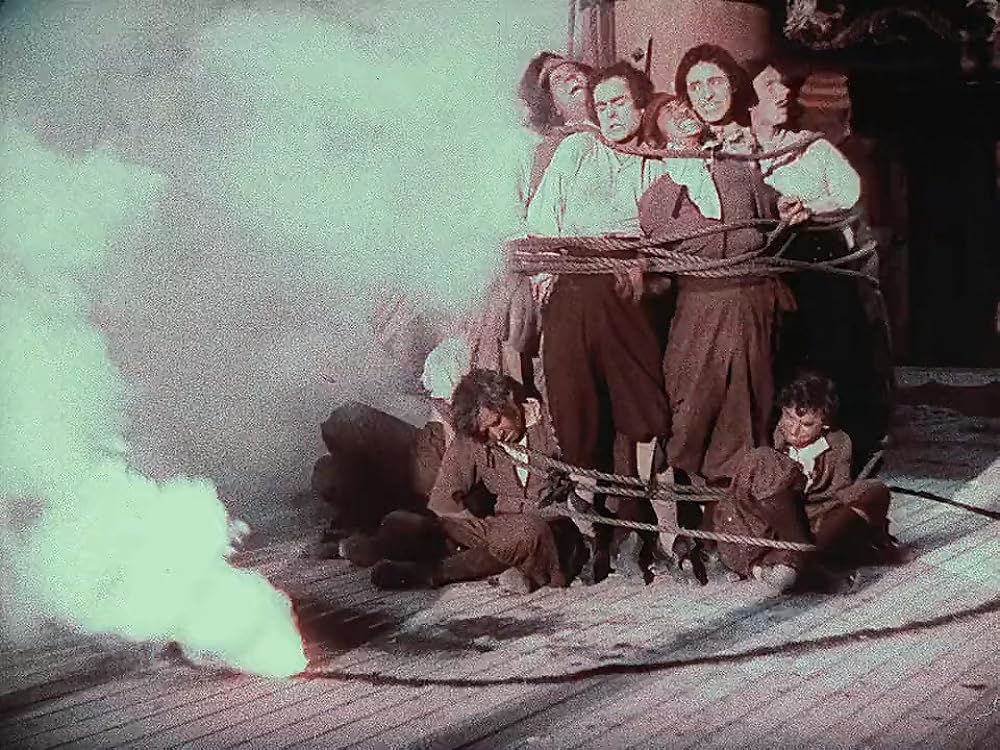
The pirates tie up the crew and use a gunpowder trail to give them time to get off the ship before it blows up — ingenious and cruel all at once.

When the Black Pirate leads the ship to another successful raid (but cleverly prevents them from blowing up the ship), the crew are pretty much ready to make him Captain but for the Lieutenant. When a woman (Billie Dove) is discovered on board the raided ship, the Lieutenant claims her as his prize, but the Black Pirate — who has fallen in love with her on first sight — claims she is a princess they can hold for hostage as long as she remains “spotless and unharmed,” i.e. no raping!

After a few twists, Fairbanks saves the day and the dame, of course, with the help of troops who successfully rout the pirates. Luckily for him, the “princess” has fallen for him as well, and it turns out he’s actually a Duke, and she a noblewoman! How incredibly convenient (nobody cares, it’s the action scenes that are important).

One amusing note of trivia: apparently Fairbanks’ wife Mary Pickford insisted on doubling for Dove for the scene were the Black Pirate kisses the Princess. Jealous much, ma’am?

The one criticism I have is that, although the pirates do get busted, the Black Pirate does in fact lead a raid on another ship, allowing the pirates to steal all the passengers’ valuables (but preventing their mass murder) and takes a hostage who really has no choice but to fall in love with him because otherwise she’ll be raped by the Lieutenant and likely the rest of the crew. I must also point out that the TV show “Mythbusters” also tested the “riding down a split sail” trick and declared it implausible — this hasn’t stopped it being used repeatedly in pirate movies since 1926, though.
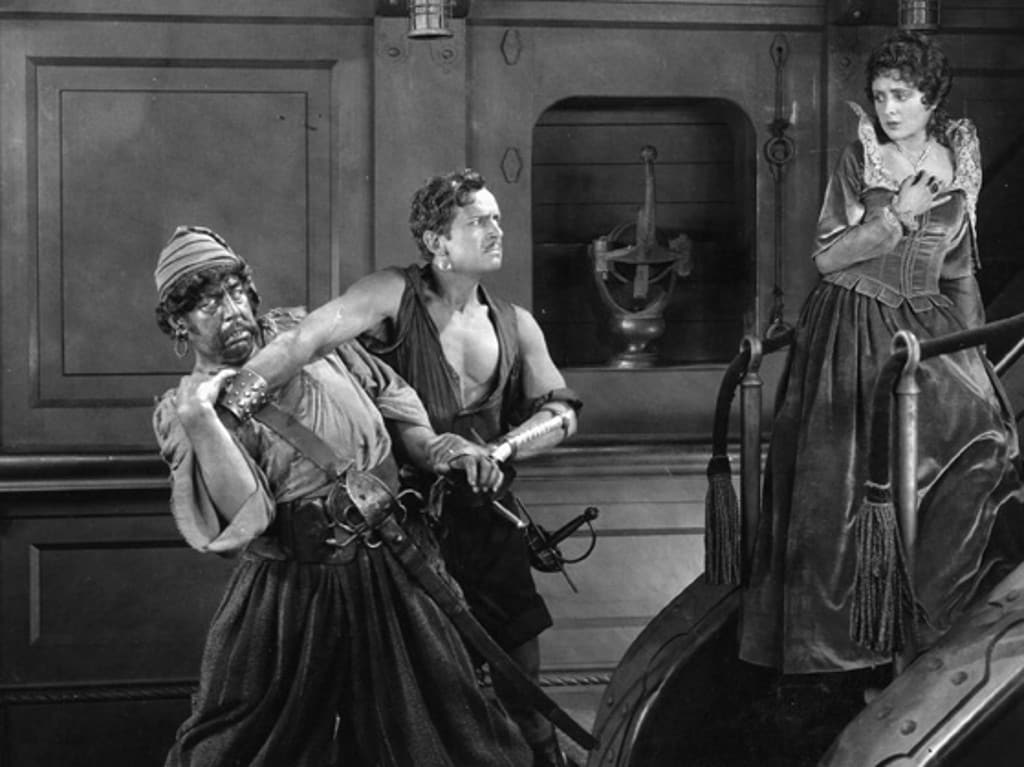
Yes, the one woman in the film is completely treated as an object and under threat of rape, but Fairbanks’ altruistic love and protection saves the day and of course causes her to fall in love with him.

Add The Black Pirate to your list of enjoyable popcorn action movies. The sort-of colour helps, but this is really a stunt movie that sets the tone for the genre of seafaring adventure, and so even if the plot is a bit lightweight, it remains a great film.
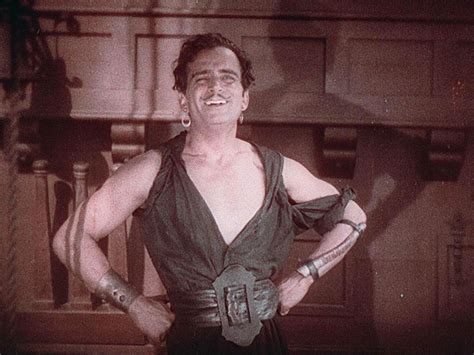
Ha! Ha! I win!

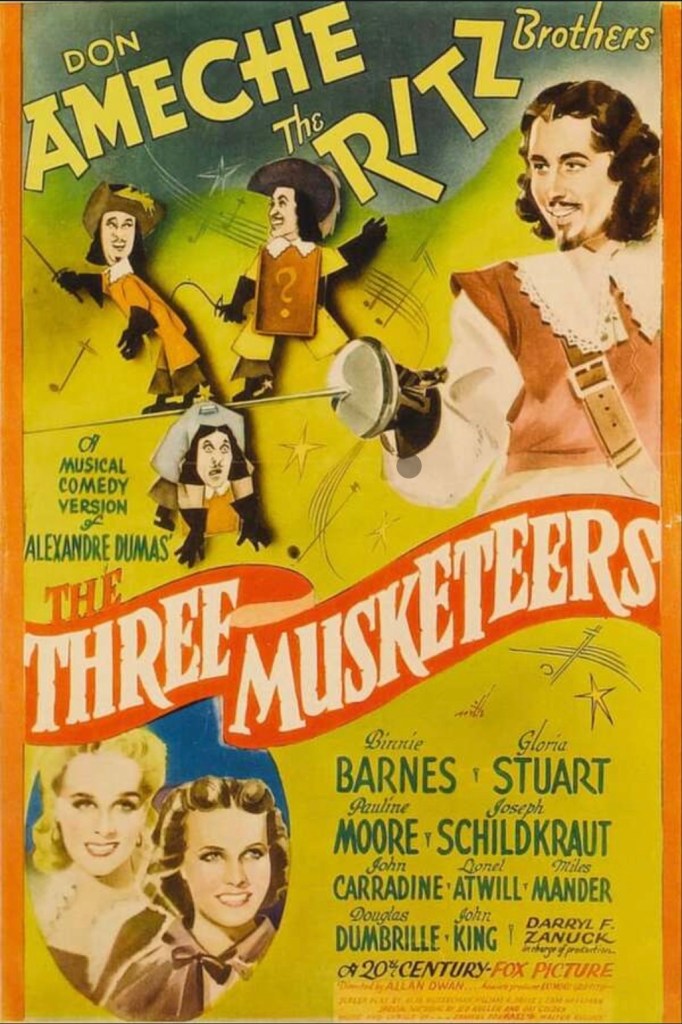
The Three Musketeers (1939, dir. Allan Dwan)

⭐️⭐️
52-week film challenge, film 19

I had a vague memory of seeing a film version of The Three Musketeers from my youth, and went looking around to see if I could find it either in my library or on one of the streaming services. My memory was that the version I saw so long ago was in B&W, but I now think I just watched it on a B&W TV (yep, I’m old). I’m still not sure what version I was thinking of, but I came across one that ticked the boxes, so I watched it. This movie … was not the one I sort of half-remembered.

This 1939 version was a musical comedy version that, despite that terrible idea, actually sticks pretty close to the book for as far as it goes — which really surprised me. I have a lot of time for Don Ameche, the star of this version, and he is one of the best things in it, taking the role seriously while never wiping the smile from his face as he plays the headstrong but skilled D’Artagnon, who hopes to join the King’s Musketeers.

Yes, that’s Don Ameche. Handsome, isn’t he?

In this telling of the tale, D’Artagnon mostly misses the actual Three Musketeers, who appear only briefly. The trio gets passed-out drunk drinking toasts at an inn to the various King Louises, because there are so damn many of them, and the scullery cooks (played by the all-mugging, all-singing, all-pratfalling Ritz Brothers) try on the Muskateers’ outfits and then get mistaken by D’Artagnon for the real Musketeers, and of course from there mischief ensues from all parties.

The success of this film depends very, very, very, very heavily on your tolerance of The Ritz Brothers, who were a vaudeville act that transitioned pretty successfully to film on the strength of being a mix between The Three Stooges and three Chicos from The Marx Brothers. They’re not in any way witty, but they can mug and clown (and also comedically sing and dance) with the best of ‘em.

The Ritz Brothers as the faux Musketeers

Their schtick, in my opinion, hasn’t aged well — but I cannot argue with the fact that they enjoyed a successful career in various forms of show business (though the fact that they got forgotten pretty quickly afterwards may prove me right about them). The film also relies way too heavily on D’Artagnon somehow not seeing the Ritz Brothers’ utter incompetence as pretend Musketeers, which of course he doesn’t since they only end up in his view by accident throughout the film at points where they have been (accidentally-comedically) useful to him.

Ameche handles a sword well, sings in a pleasing tenor, and is handsome enough to pull off the romantic scenes. The Ritz “Musketeers” keep getting pulled in by D’Artagnon’s delusion that they are real Musketeers, but they do aid in his success in the complicated (yet truncated) plot of this brief 73-minute film.

Buckles were most certainly swashed!

If you don’t know the story, read the book, or watch one of the later, more dramatic film or TV versions. Suffice to say Cardinal Richelieu was a very bad man who manipulated royalty both in France and England, and was foiled (ha!) by the Musketeers. The plot works well in this film, it’s just the comedy and the musical bits that fall flat.

First of all, there are only four songs in this “musical,” none of them that good, and the two for Don Ameche sound pretty similar to these ears, though he turns his “on the road” song into a love song later on pretty well. The two Ritz Brothers songs (one of which extols the virtues of chicken soup) are meant to be comedic but seem quite laboured to me.

Near the end of the film, the brothers contribute their best bit: a pie-plate dance that’s actually well-done and quite clever, meant to cover any sound D’Artagnon makes while freeing Lady Constance from the dungeon below the aristocrats they are working against. I should mention that the chase scenes, while regrettably sped up as was the custom of the time, are really well-done and focus on the hardworking horses.

The whole film is well-shot but still somehow kind of cheap-looking (just like The Ritz Brothers, insert rimshot here). I did recognise Lionel Atwill as de Rochefort, but only realized the near-immortal John Carradine was in this (as Naveau) when the credits rolled. I’m giving this a star for the cinematography, a half-star for Don Ameche, and another half-star for the pie-plate dance, and still looking for whatever version I thought was great when I was like nine or so.

Some fantastic matte work in the film that shouldn’t go unmentioned