Roxy Music – Art Rock (2025)

No, there isn’t any new or unearthed rare material on this new EP. It’s nothing more than the 1999 remastered versions of five of their early tunes, intended as a quick sampler for anyone intrigued by the title but unfamiliar with the band and in need of an introduction.

It’s a digital-only sampler, available via Apple Music and Spotify (and maybe Tidal if that’s still around). Fans of the band will have this stuff and thus can skip it, but it could be a nice way to introduce others to RM if they’re not familiar with anything beyond (maybe) “More Than This” and “Avalon.”

That said, it’s always fun to hear selections from these two classic albums again (or for the first time, if you’re new to the band), and in particular to remind yourself what a strong start Roxy made when it burst onto the scene in the early 1970s. From the US version of the debut album (which I’ve reviewed the SDLX package of starting here), we get “Virginia Plain” and “Ladytron,” but the rest of this EP skips a lot of good stuff from For Your Pleasure and Stranded in favour of the single “Pyjamarama,” rounding off with “Out of the Blue,” and “Prairie Rose,” which both came off of their fourth album, Country Life (1974).

Yes, that’s right: the first album was released in 1972, and two years later they had another three albums out, two of them in 1973 alone. Those were the days, my musical friends.

For the comparison, I listened to each song three times: once from the album it appeared on (apart from “Pyjamarama”), once from The Best of Roxy Music album (if available), and then the remastered version from the Art Rock EP.

In the case of “Pyjamarama,” I also listened to the live version from Viva!, which needless to say was more “present” and well separated that the flat, lifeless original single. The additional squelchiness brought forth by Eno’s replacement Eddie Jobson and the live performance really breathed some life back into the song.

The remastering of the studio rendition of “Pyjamarama” on Art Rock is a huge improvement over the Best Of version, restoring a sense of separation of instruments and generally updating the sound for, you know, high-fidelity stereo. You can hear the very obvious difference from the first chord, and as the band comes in each instrument has been “placed” and is audibly distinct from each other.

The drums and bass in particular have been placed in separate ears (with some crossover) and Ferry sits in the center, while the guitars play around him. A big improvement on the original single in every respect, though the live version has a certain immediacy that beats even the remastered studio cut.

The opening to “Virginia Plain” on the Best Of starts off way too soft, but the song does arrive properly in short order, and its only flaw is that the bass is too high in the mix, though it doesn’t interfere with the other sounds unduly. Eno’s electronics are just fabulous and don’t overplay the rest of the band except for the mid-8.

The remastered version nicely corrects this, while not preventing the band from raising the volume considerably when they come in. The bass is still prominent, but no longer dominant. The drums are much clearer, and the separation of instruments better defined (with better stereo effects as well). It’s only Ferry’s now-clearer vocals that remind you this is the same take.

Whoever remastered this really has a good sense of when instruments should advance and retreat, and where Ferry needs to be in the mix. This bodes well for the two songs that came from Country Life, the first of which here is “Out of the Blue.”

The original is awash in more sophisticated efforts and some stereo effects, and while the bass is still quite promiment, it doesn’t overwhelm the sonic fireworks that are going on. Ferry sings this like a ballad, but the band is completely opposed to the idea — and rocks out to a great degree, making much use of Jobson’s electric violin and MacKay’s oboe, with some light effects on Ferry’s vocal. This was always one of my favourite tracks off this album due to these contrasting flavours, and it still works really well in my view.

The Best Of version, by contrast, sounds like it’s almost a monophonic mix intended for AM radio play. There’s only the barest hint of separation until after the first verse, and everything seems very compressed. Much of the effects on the original album are minimized, or just gone, with the drums in particular sounding quite leaden.

Which brings us to the Art Rock remastering. It starts off subtle, but cleans up the oboe intro without diminishing the bass. Sadly the remastering seems to have been done on the muddier Best Of version, at least until the short instrumental break and the halfway point. From then on, the stereo effects and clearer sound are back, and Jobson’s violin absolutely soars, and double-tracked for a thrilling finale.

From here, we jump to the not-quite-country rock of “Prairie Rose.” Slide guitar shows up briefly, but gets fought back by MacKay’s whirling dervish of a sax solo. On the album, the band takes a slightly-extended jam-out before Ferry returns (strategically double-tracked in places). It’s a lyrically light number, designed to revel in what a UK band thinks country music sounds like.

Since it’s not on the Best Of album, our direct compare is to the Art Rock remastering, which wins this head-to-head contest handily. The voices here are so much clearer (both Ferry and the backup vocals), and the slide guitar has found a more prominent role where it doesn’t have to fight other instruments — leaving MacKay’s sax solo unmolested and crazed as it should be.

Everything on this number sounds like its on FM radio rather than the Best Of’s AM truck radio mix, especially Ferry’s vocals. It’s still a cheezy attempt at country music, but it sounds ridiculously much better in Art Rock’s remastering.

Finally we get to the big finale song: “Ladytron.” Here we have at least three versions to compare: the original version on the band’s debut album, the remastered debut album’s version, and now the Art Rock 1999 remastering.

The bass is very, very prominent in the original album version, but the other sounds are mostly pretty clear, from Ferry’s own backup of his lead to the soft piano in the background. Eno’s electronics dance round like wood nymphs, playfully complementing the band at the end.

On the Deluxe Edition of the album, the intro starts off much more softly but builds up more smoothly, coming into focus nicely. MacKay’s oboe stays in the background, but is clear and sharp. The mid-song jam seems a bit clearer on this version, but is otherwise very similar. Overall, a somewhat better mix but nothing surprising.

On to the Art Rock version: the opening is very similar (of course), but the double-tracked Ferry vocals are noticeably clearer. The instruments are pushed to the sides during the first verse, but come charging into the center as well as the sides better here, with more separation making it easier to hear what’s going on to your left and right alongside the center.

Overall, Art Rock offers and even more cleaned-up version of the song, but doesn’t mess with it much — as it was damn near perfect to begin with.

So, should you purchase Art Rock? I’d say the EP represents mostly a spring cleanup of some well-remembered songs, dusting off sounds and rearranging the sonic furniture a little, but really it’s “Pyjamarama” and “Virginia Plain” that get the biggest glow-up.

By the time the band were doing Country Life, they’d improved either their studio techniques or just hired better engineers, and the two tracks from that album are dolled up a bit, but not re-made (or re-modeled). Likewise, the EP’s closer “Ladytron” was less tampered with than expected, but just enough to make it noteworthy.

If I’d chosen the running order of the tracks, I think I would have led off with “Virginia Plain” and “Ladytron,” stuck “Pyjamarama” in the middle, and swapped out “Prairie Rose” for “All I Want is You.”

But that’s me. Is this worth buying, even though its a digital-only release? For the big improvements to the older songs, I’d say yes. “Out of the Blue” and “Prairie Rose” don’t benefit as much, so you might choose to just buy the three other songs and save a little money.

Roxy Music – Roxy Music (box set) – Disc 2

1972/2018, 3CD + 1 DVD
CD 2 of 3

THE PROLOGUE

Hopefully you paid attention to my guidance in the prologue to Disc 1, and now you’ve skipped it and come here first. If so, pat yourself on the back — you’re here to watch the house get built, and then when you go back to the familiar sounds of the actual album, you will marvel anew at how well it all came together.

If you didn’t do that, well, I guess the best analogy would be that you already ate a marvelous cake, and now you’re inspired to go to cooking school to learn how such a cake could be made. Here you’re going to hear the false starts, the unfinished lyrics (and in all cases, unfinished songs), the recording fuck-ups either from the band’s missteps or technical goofs, the latter courtesy either their recording engineer (Andy Hendrickson), or producer Peter Sinfield (he of King Crimson and ELP) interrupting sometimes.

Most listeners don’t appreciate the effort that goes into making any album, let alone a great one like this, and so I think it is illuminative to hear bands still working out or tweaking songs while they are in the studio. Not to spoil anything, but Ferry (who wrote all the songs for this album) clearly had his musical ideas more or less lined up for the songs, and often had the central idea behind the song’s lyrics, but frequently added at least some lyrics somewhere along the way to the final song.

An important part on Disc 2 that shouldn’t be glossed over is that we get a taste of an earlier lineup of the band. Before Roxy was quite Roxy, it included bassist Rick Kenton on one track (his part survives on “Virginia Plain,” both the official single included on the album, and the “outtake” version here). Roger Bunn, not Phil Manzenera, handles guitar on the first four tracks on Disc 2, with Dexter Lloyd on drums for those same tracks.

Holy Re-make/Re-model, Batman! This is yet another reason to listen to this disc first — some of this is proto-Roxy before it all really came into focus. We don’t get to hear Ferry deciding his original lineup isn’t working, but things get more interesting starting with Track 5.

You might have picked up on it even if I hadn’t mentioned it, but things get more interesting starting with Track 5.. Manzenera’s contribution in particular helps put a special stamp on the sound.

We also hear that the musicians are still in the process of figuring out the arrangements of the songs. Sometimes they sound like they’re still trying out ideas that may or may not go anywhere, and you’ll hear several portions where solos will later go but aren’t there yet. It’s always kind of weird and jarring when a solo you like just … doesn’t happen.

There’s a feel throughout that Ferry wants to get this very right, and that they know they are doing something different: I mean, it’s not like there were a lot of oboe players routinely adding to rock songs in 1972. Likewise, the demos don’t feature quite as much of an Eno presence, though he is there (especially in th outtakes) — one gets the feeling that he worked out/added his parts himself and tended to add them “live in the studio,” the way it would seem the core of the tracks were recorded.

So, now that the project has mostly come together, let’s go through the demos (rougher) and outtakes (usually very similar to the finished products, sometimes missing parts to be overdubbed later) to spot the differences.

THE MUSIC

Ladytron (demo): A very Eno opening with an electronic atmosphere with a double-tracked oboe and some organ coming in with the introductory melody line as the electronics retreat. Then the electronic soundscape comes roaring back before a cold stop, with a very echoey Ferry and the band finally coming in. Sung in a bit of lower register, and no majestic riff — just a sax solo before the second verse. This is much more avant-jazz in style and just kinda peters out.

2HB (demo): A short bit of that trademark “snake charmer” music, and again it dies out and Ferry and the band come in cold, with a minimal arrangement. The song itself and its lyrics are complete, with Ferry taking front and center. The horns are absent now that the song has started. After the second verse, the whole tune drops out for an echoey instrumental sax break from … well, nothing to do with 2HB, but everything to do with the horns, which eventually devolve into free jazz bouncing off a deep bass sound.

Again, all that drops off the face of the earth and the song returns to finish up. The electric guitar in both song parts is played acoustically.

Chance Meeting (demo): Once again, a quavery verse, a long instrumental break (at least sticking to the song’s tune this time), and then the second verse, then another instrumental break, and another verse, a shorter instrumental break, and out.. Since these songs don’t have choruses, I guess they thought this might be a good way to present them?

The BOB (Medley) (demo): This one does something different: it starts with the first verse. It’s worth noting that there don’t seem to be any difference in lyrics from the finished versions, and the basic melodies also seem to be here for all the songs so far. The structure of the medley and lyrics are also here as it is in the finished song, so the impression of these demos is that Ferry’s got his act together, but the band is starting to work out what they might do in between the verses, and often falling back to easy cliches for now. Not much for Eno to do, though he makes his mark from time to time.

We’re now into outtakes that didn’t work rather than demos, but the band seem to know what each one is supposed to end up sounding like.

Instrumental (outtake): Very short and seemingly improvised riffing against an Eno backdrop. From here on out, it’s the band lineup as credited on the album.

Re-make/Re-Model (outtake): Now this starts off sounding like a song, then dies as Ferry tries to have a second go, and we get something VERY close to what we ended up with for a bit, albeit not mixed well at all. This one has a lot of back-and-forth between the engineer and Ferry, but the third take gels nicely. It kind of shines a light on how the non-vocal parts were shaped (prior to this point) through directed improv. There’s no band call-and-response in this version, though, which to me is second only to the lyrics in importance. The instrumental breaks here are almost identical to the finished product except for the sax.

Ladytron (outtake): By contrast, this one starts out quite a bit differently than the final product, but with the same idea in mind until the oboe comes in. Then a count-in, and Ferry on voice and piano with bass, then drums coming in. More like an actual traditional song after that instrumental break, and they still don’t have that heroic riff at the end of the verses yet.

If There is Something (outtake): trying to get started with the engineer first with Ferry on piano, then they count in and the band get going pretty much as we hear on the final track, except that Ferry hasn’t written past the first couple of lines of the lyric, so it is mostly instrumental — and a bit less “country” sounding. The hypnotic sax riff is here, though. Ferry returns for the … middle lyric? Not-chorus? Whatever you call this bit, the lyric here is done, as is most of the instrumentation. A long break before we get to the middle waiting lyric, with Ferry handling the “when we were young” part also.

2HB (outtake): Not far from the finished product, some unfinished lyrics and much tamer band breaks, and we find out why after the song ends.

The BOB (Medley) (outtake): “There’s no bass guitar or saxophone!” Ferry complains about the previous performance. Doh!

The band begins again in earnest at the 1’15” mark, and now with a just the synth part. It fades out at 3’20, and the second part comes in with the what seems to be the band minus the bass player. They stop and complain about this, and restart only to fall apart almost immediately. Thankfully they laugh about Paul breaking his stick, and suddenly fall into a bass/oboe/piano filler piece briefly. After a bit of natter, they start again and finally all parts can be heard — so they stop again, and faff around for a few more seconds.

Chance Meeting (outtake): Piano and bass only this time. Who the hell is the engineer on this thing?

Would You Believe? (outtake): synth and guitar only this time for the first 1’35”, then the song starts properly, but this is clearly not the final take. You are, however, reminded of Fats Domino’s influence on Ferry.

Sea Breezes (outtake): piano, bass, and drums only this time. This guy is so fired.

Bitters End (outtake): a stately opening, then the sound of the tape being rewound, then the tape jumps around a bit with a odd “fake birdsong” repeated effect. It eventually stops, then some conversation working out a take, then they start again. This is nothing like the 50s barbershop approach they settled on finally, its mostly just the piano and no lyrics. It’s fun to listen to it as almost solo piano, and then they discuss the arrangement a bit.

Virginia Plain (outtake): A false start, then another. Then a harsh cut, and suddenly the song is already in progress. Ferry’s performance is a rote runthrough of the lyrics rather than the actual whole-hearted performance as we ended up with, but we can finally hear the whole band again. Even in this very rough form, you want this song to be in there — it’s the most irresistable thing on the record, and I think they know it full well.

THE VERDICT

Historically speaking, this is fly-on-the-wall time — a glimpse at an earlier lineup (and why some people were replaced), a peek through the door of Ferry working out parts of songs, and a seat at the table as the band starts putting it all together. Re-make/Re-model (which still sounds like a stolen Kraftwerk song title to me) is the closest thing we get here to Athena bursting fully formed from the head of Zeus.

The demos get the basic ideas across but are far from finished, and really I suspect the outtakes were included both to round out the disc as well as embarrass the engineer one final time. Why? Because if there’s one thing we know about Bryan Ferry, it’s that he likes to look polished, poised, and debonair, and the clown in the booth is wasting Ferry’s time and money.

The outtakes remind us that, although he might be a songwriting god (already), Ferry’s a human being and an artist who takes the advice to revise, revise, revise. We are certainly all the better for that discipline, but on top of that we get to hear the new lineup coalesce and figure things out, something you don’t often get to see.

This shines a light on the creative process, and it doesn’t just apply to Roxy Music — these sessions all took place just a couple of years after the Beatles inadvertently documented their disintegration by filming their Let It Be sessions for a TV special.

As indicated by my encouragement to listen to Disc 2 first, I think hearing this first re-shapes how the final album sounds to us. Undoubtedly, most bands could have secret tapes like this, but in the case of Roxy something new and fresh was happening, and I like to think that’s why they kept at it to get this record made.

How lucky for us, eh?

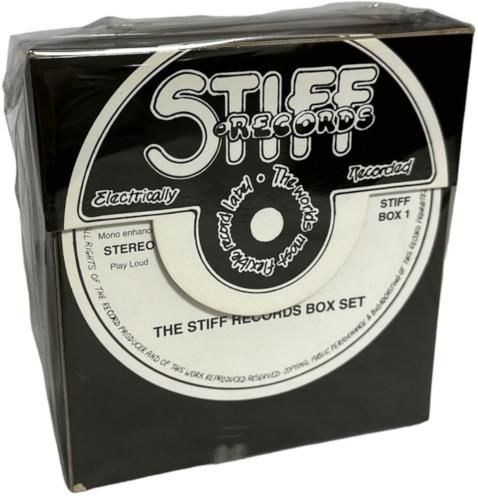
The Stiff Records Box Set – Disc 2

The Stiff Records Box Set — Disc 2
Stiff Records, 1992
4CD box set + booklet

THE PROLOGUE

Settle in, dear readers, it’s another disc and another 25 songs spread out another hour and 17 minutes, or an average runtime per song of 3’08”. As before, there’s a mix of Stiff’s artists that went on to become famous and/or influential, and a smattering of songs and artists that … didn’t.

THE MUSIC

Disc Two kicks off with another pair of songs by Nick Lowe, just as Disc One did. This time, we get the non-album track “I Love My Label,” which is probably why he got more songs on this compilation than anyone other than his protege Elvis Costello (at four songs each).

Nick’s original of it has only ever appeared on a handful of Stiff Records compilations, of which this is of course one of them, but Wilco very faithfully covered the song as a bonus track on their 2011 album The Whole Love.

This is followed by “Marie Prevost” from his first album, Jesus of Cool, released in March of 1978. It tells the tale (inaccurately) of the silent film star’s life and death. A story had gone around that part of Prevost’s dead body was consumed by her two dogs, and this was used by Lowe in the song.

It isn’t true — she died, destitute, at age 40 from alcoholism and malnutrition due to anorexia nervosa, with her body intact. One of her dogs, in fact, caused neighbours to discover that she had died via the animal’s incessant barking.

Next up is Ian Dury & The Blockheads with “What a Waste,” a song about all his squandered opportunities in other occupations, but for that he chose “to play the fool in a six-piece band.” It’s another mildly entertaining and amusing song, as is his forte.

Elvis Costello pops up next with a live track, which he announces is written by Burt Bacharach and Hal David: “I Just Don’t Know What To Do With Myself,” one of the duo’s many pop standards. Elvis is perhaps surprisingly sincere in his performance of the 1962 number, first made famous by Dusty Springfield’s version.

You could be forgiven for thinking that the fifth track, “Whoops-A-Daisy” by Humphrey Ocean and the Hardy Annuals, was just a more twee version of Ian Dury on a lark. In fact, however, Mr. Ocean is a real person, and a noted UK painter.

The uncanny resemblance in this track stems from Ocean’s affiliation with Dury (who was his art teacher, friend, and apparently vocal coach). Ocean had played bass in Dury’s previous band, Kilburn and the High Roads. Following this music-hall type single, Ocean gave up music and returned to painting.

This is followed by a trio of well-known songs from the New Wave era, the first of which is Lene Lovich’s outstanding cover of Tommy James and the Shondell’s 1967 hit “I Think We’re Alone Now,” originally written by Ritchie Cordell and Bo Gentry. The pop hit about two young people desperately trying to find a place to “be alone” (cough) never sounded fresher, and Lovich was rewarded with helping it chart once again.

“Jocko Homo” was DEVO’s first b-side (the a-side was “Mongoloid,”) as well as Mark Mothersbaugh’s first solo writing contribution. The name comes from a 1924 anti-evolution tract called Jocko-Homo Heavenbound, and the memorable time signatures and call-and-response chant is a play on a similar one in the movie Island of Lost Souls. It’s a compelling song because of its two time tempos (from 7/8 to 4/4 for the call-and-response part), and handily established DEVO as a completely unique band and the vanguard of the post-punk landscape called New Wave.

Ian Dury returns with one of his better-known songs, “Hit Me With Your Rhythm Stick,” centered on a brilliant Chas Jankel melody and the spoken (and occasionally multi-language) poetry of Dury, not to mention an insane sax solo. One of the things that so attracts me to the New Wave movement was the incredibly size of that tent — wildly different music fit and blossomed in that tent.

“Semaphore Signals” by Wreckless Eric (one of the acts that had very limited success), is a nondescript number about lovers trying to secretly communicate. He’s a “working class” singer one might charitably say, and this is a song with a cute idea behind it but stretched too thin to support its “drunk karaoke”-style vocal performance.

Speaking of drunk performers, Jona Lewie (who did at least get one big hit out of his time with Stiff), seems like a Depression-era pianist somehow transported to the 1980s, and not sure quite what to do with himself. Thankfully, he’s pretty entertaining even when he sounds … er, relaxed, and “I’ll Get By in Pittsburgh” sounds like a closing-time tune by a pianist who’s quite relaxed about his performance. Generally I quite like Lewie’s first album, but this “Pittsburgh” was the b-side to his novelty hit “In the Kitchen at Parties” for a reason.

From there, we go to “B-A-B-Y” by Rachel Sweet. She has a powerhouse voice that you either find thrilling or its like fingers on a blackboard for you. I’m more in the former camp, though Sweet certainly missed her calling as the leader of a 60s girl group by simply having been born too late (1962).

Today, she’s a successful TV writer and producer, but back then she was Stiff’s jailbait ingenue, a veteran child star who was 16 in 1978, switching from singing country to rock music and releasing her first album, Fool Around, that same year. It’s a well-regarded album that has aged well (the musicians on it would later form the band The Records), but only the single showcased here did terribly well.

By 1982 her career as a solo artist was over, with only four original albums and a live record. That said, she later wrote and sang several songs for John Waters’ films Hairspray and Cry-Baby.

For the halfway mark on this disc, we return to the ever-reliable Lene Lovich and her first and arguably biggest hit, 1978/9’s “Lucky Number,” which managed to get substantial video play on the nascent MTV. It went Top 10 in most countries in Europe and the UK where it was released.

The Members were a group that I personally judged never quite good enough to actively collect, but that said I like what I hear from them. “Solitary Confinement” is a very witty song about how “great” it is to get out of your parents’ house and live on your own for the first time.

Or, as they put it: “You are living in the suburbs/And you have problems with your parents/So you move on up to London town/Where you think everything’s happening, going down/Living in a bedsit/Travelling on a tube train/Working all day long/And you know no one/So you don’t go out/And you eat out of tins/And you watch television/Solitary confinement.” Missle hits its target, dunnit?

This live version really captures how meaningful this song was to so many at the time.

Next up is “Frozen Years” by The Rumour (minus Graham Parker). Not everyone remembers that The Rumour put out three albums on their own. This song is a lightweight and pleasant synth-driven number with clever lyrics, sung by Brinsley Schwartz himself (though you’d be forgiven if you thought it was a very low-key Nick Lowe).

Then we’re back to Wreckless Eric with “Take the Cash.” Sound, practical advice regarding the handling of money and job protocols from our Mr. Eric. He embodies the “three chords and enthusiasm” ethic that embodied a number of Stiff acts, but as with “Semaphone Signals” it’s a very amusing but incredibly basic idea, and again he stretches it to within an inch of its life at 3’44”. If he’d get in and out much more quickly, I’d think him a comedic genius.

Following this is one of the absolute gems of the Stiff lineup with an absolute jewel of a song: Kirsty MacColl, the daughter of the revered folk singer and composer Ewan, absolutely nails her debut with the exquisitely gorgeous “They Don’t Know,” the story of a teenager who has found their true love on a level that their parents and others would just never understand.

The 50s styling, multi-tracked choral backup (learned from intently listening to Beach Boys albums), and the puncturing “BAY-bee” that climaxes the instrumental break are spot-on perfect, and the blend of pre-rock ballad style and nascent 80s instrumentation effortlessly show off both her talent and her musical lineage in three perfect minutes flat.

She and Stiff head Dave Robinson didn’t get on very well at the time, however, so he buried the 1979 single, and she wasn’t able to release her own album until 1985 (!). I’ve been a fan of hers since I first heard this in ’79, and was delighted when Tracey Ullman brought it to a wider audience in 1983, making it the hit it always should have been (Tracey herself became a Stiff artist, and appears later in this comp).

Robinson may have had some regrets about how he treated MacColl later on, or maybe he just finally understood how brilliant she actually was, so thankfully she gets two songs on this box set: we’ll get to the other one when we come to Disc Four.

Mickey Jupp was pushing 40 by the time he recorded for Stiff, having done the music scene in the 60s before leaving it. When “pub rock” became a thing in the UK, he happily signed back up for another hitch, and “You’ll Never Get Me Up in One of Those” is a good example of the good-time but rough-n-ready pub sound that dominates the first side of his album Juppanese (the second half is quite different — a trick more artists should employ).

The A-side was produced by Nick Lowe and features an uncredited Rockpile as the backing band, and sounds like it. The B-side of the album was produced by Procol Harum’s Gary Brooker, and is considerably more polished. After seven more solo albums, he took another break from music — but returned to recording in 2009 and most recently released new music in 2022 at age 78.

Rachel Sweet returns for “Who Does Lisa Like?” a nicely angular single that reinforces her under-age image with a song about high-school gossip. The album, titled Fool Around, gave her two popular singles: “B-A-B-Y” and “Stranger in the House,” the latter of which led her to masterfully cover a number of other classic pop and country songs.

“Drive Friendly” is the next song by a band called Motor Boys Motor. It’s a pretty terrible song about a killer car, and thankfully they do not appear again on this compilation — but hey, it might possibly have inspired Stephen King to write “Christine,” so maybe it has some value after all.

After their one 1982 album, the band reformulated itself and became the Screaming Blue Messiahs, another band I don’t care for.

We then get introduced to Lew Lewis Reformer, another pub-rocker but with a certain … something that makes me like him better than Mickey Jupp or Wreckless Eric. I think he manages to communicate his enthusiasm for the genre better than the others, and has a clearer, somewhat higher tone that stands out better from the instruments.

We move along to Theatre of Hate and their fifth single, “The Hop.” The band members had all been in punk bands earlier, but ToH carved out a sort of “art-punk” that didn’t fit easily into other labels, and indeed exemplified the genre by not fitting into any other existing label at the time, going away from the direction of New Wave right from their first single (“Original Sin” b/w “Legion”) in 1980.

I got and liked their first couple of albums (the live He Who Dares Wins and their first studio album, Westworld), but they didn’t appear to do anything else original beyond that for quite a while so I stopped paying attention. I’ll have to catch up on their 90s output, but after that spurt of activity they went kind of quiet again until 2016, so I have some homework to do on their later evolutions.

And the award for the band with the very best introductory single ever (at least in my view) may well go to … Madness’ “One Step Beyond,” the next track here. The heavy reverb’d voice and Camden Town accent (a place I know well), the playful video, and — for a lot of white boys — the introduction to a form of the Jamacian ska sound just hits us white kids like a tonne of very danceable bricks.

It’s one of those occasional songs that pretty much picks you up by your lapels and makes you move. Even better, it’s utterly timeless and joyful with every play. One of the best tracks on this disc, maybe even this whole compilation (which manages quite a few classics within its 96 offerings).

While we are catching our breath in recovery from the heavy heavy monster sound, The Rumour are here with what I think is their best single, “Emotional Traffic.” On paper, it’s a catchy song about avoiding extreme emotions. On record, it borrows from both traditional pop and nascent New Wave to give us something that’s not quite either one, but very pleasant indeed.

We’re on to the third Ian Dury number on this disc, and by this point you know it’s more of the similar. He’s wonderful at varying up the subject matter of his songs, but not very good at varying up his delivery, or the music. This is quite acceptable when you’re delivering singles, but has always been a point of annoyance for me with his albums.

Lew Lewis Reformer comes back to close out the disc with another slab of his well-produced, well-sung and perfectly-performed good-time rockers, “Lucky Seven.” It’s nothing innovative at all, but so well-done you don’t mind, and might even sing along with the rest of the pub regulars.

THE WRAP-UP

As always, these scores are simply my opinion. Your mileage may vary!

Great songs: 10
Good songs: 8
Meh songs: 7

Overall score: 7 out of 10

25 songs in an hour and 17 minutes continues to be value for money, and carries on representing the great, good, and “save it for the b-side” personality of this eclectic record label. Let’s hope the next two discs, moving into the later days of the label, can keep up their strong average.

Next time … Disc 3!