At last, it is time for a (short) break from the audio tracks, and a lateral move into video clips. The fourth disc of this set is in fact a DVD that includes some UK and French television appearances to promote the album.
It also includes a full 5.1 DTS 96/24 or Dolby AC3 Sound remix of the album for those of you with 5.1 surround sound setups. I lack such a home theatre setup, but that said even listening to it with a “spatial audio” assist via AirPods Pro reveals obvious improvements.
THE VIDEOS
Naturally, video clips from 1972 are sometimes hard to find, as videotape oxidizes over time and the tapes are often buried in archives. Thankfully, the band (or their record company) got copies of the tapes and preserved them well enough for presentation here.
The first “track” is a version of “Re-Make/Re-Model” performed live and filmed at the Royal College of Art in London on 6-June, 1972, intended as a promotional video rather than taken from a live show.
The sound is muddy mono as you’d expect, and the video is “marred” by an excess of 70s-era video effects that are so hokey and old they’ve come around to being cool again. The effects get excessive, but the visual and audio message gets delivered nonetheless.
From there we move to the venerable TV music show “The Old Grey Whistle Test,” a BBC show that ran from 1971 to 1988. This appearance was on 24-August of ’72. The video of this performance opens with an out-of-focus disco ball slowly spinning before dissolving into the quiet intro to “Ladytron” being played by the band.
Sleepy-eyed Bryan is off in the corner. The video of the band performing is beautifully sharp and clear, though the sound is of course still mono. Andy effortlessly shifts from oboe to sax with cover from the rest of the band. Manzenera’s bug-eye specs get a fair amount of focus, as well as his and Eno’s interplay of guitar effects vs. electronic efforts.
An extended guitar-and-electronics jam follows, and ends with some video feedback. If you were watching this while high, I can only imagine the either panicked or euphoric reception you gave this.
Likewise, “Top of the Pops” started off with blurry psychedics before sharpening up and focusing on the band in their full splendor for a version of “Virginia Plain.” Bryan is resplendent in his spangly green dress suit, Paul Thompson has now formally adopted (or perhaps this is the debut of) his “long-haired caveman with one black eye” look. Manzenera still relies on his shiny track suit and bug-eye glasses, while Eno is rocking a black ostrich-feather jacket, and the crowd are not quite sure how to dance to this, but they give it a go anyway.
Another live but more echoey (and very brief) performance of “Re-Make/Re-Model” is done for “Full House” on 25-November, with the band also doing “Ladytron” for the show on the same day. The band are positioned on a circular stage, with the camera slowly swooping in over the audience (who are seated).
The camera pans around behind the stage, and the band stops suddenly after the end of the first verse to applause. Yes, just one minute of the song! I believe this was used at the top of the show as a “teaser” for the bands that would be performing.
The (more complete) performance of “Ladytron” starts off with a close-up angle of one of Eno’s synth knobs. He kicks things off with some ambient noise while MacKay does a slightly-shortened oboe intro. Ferry and the band kick into the song proper, with more echo than normal because of the studio.
Manzenera is shown without his bug-specs. You can actually (gasp) see his eyes! Every instrument is clearly heard, so the sound mix is impressive. After Phil’s guitar solo and Eno’s stylings, the song comes to a quick close.
We then move on to a filmed performance at the Bataclan, in Paris, in front of a very large and enthusiastic audience. The set kicks off with “Would You Believe,” and the band are engaging in a bit of 50s style choreography. The song is unfortunately interrupted by an announcer telling the television audience (in French) about the venue and the band.
Eno is shown among those singing backing vocals, and while the sound mix is muddy and shifting, Bryan’s vocals are, as always, very clear. The 16mm film cuts into the instrumental break and second verse of “If There is Something.” This is clearly from towards the end of the concert, as Bryan is very sweaty but still very into it.
We do get the full “Sea Breezes,” with Manzenera doing his impressive “weeping guitar” style as heard on the album. Again, one is reminded that both Ferry’s vocals and the basic direction of the band are very polished and consistent with the album verison, allowing for only minor variations (mostly due to Eno’s electronic squelchiness).
The film cuts slightly to the opening of “Virgina Plain,” which the audience are clearly familiar with, clapping the count-in. Again, the band engages in a little synchronized movement while Ferry pounds that repeating chord. The song returns in full force for the sudden ending, the band waves goodnight and the crowd goes wild.
THE 5.1 MIX(ES)
Finally we arrive at the album once again, only this time a little different: a newly-created “surround sound” mix done by Stephen Wilson from the master tapes. Right away, you notice the crowd sound is floating around before the piano kicks in.
Even using just conventional headphones, there is stronger stereo separation and clear positioning of the players: Ferry in the center with MacKay’s oboe, Manzenera and Simpson on the left side (probably with Manz in front of Simpson front), Thompson on the center “back,” Eno and MacKay’s sax mostly on the right. Backing vocals are likely positioned in the back center, but on normal headphones they just sound a bit distant, like Thompson’s drums.
At the time of this review, I don’t have access to a full 5.1 surround system where I can listen to this mix in the way it is intended; that said, some headphones and earbuds (such as the AirPods Pro) do their best to simulate the experience, doing a good job at the separation but unconvincing when it comes to sounds that are intended to becoming from behind you.
If I can find a way in the near future to put this on at some stereo boutique or some friend’s home with 5.1, I’ll amend the review to include those impressions.
Naturally, the bass can only be as woofer-y as your headphones allow, and cranking up the bass on your stereo doesn’t really replace a true subwoofer. In my experience, however, owners of home theatres tend to crank the subwoofer up somewhat higher than they should, because of the novelty of truly having room-shaking bass at last.
The conventional headphone experience still rates as a novel and “different” way to experience the record, with the two rather different types of “surround” experiences and the appropriate amount of bass if you keep the levels even. For those who are long familiar with the album already, the 5.1 mixes might also be a good place to start, especially if you actually have the setup needed for it.
There’s probably less difference when experienced on a proper 5.1 setup, but to my ears the DTS option seems to give conventional headphone listeners more distinct separation, while the Dolby AC3 version draws it lines fuzzier, with most of the instruments having a better grouping, if you will. The sounds sometimes travel from one “side” to another, though the transitions are very smooth; some sounds seem further away, while others are perceived as being “closer.”
I’m just sorry I’m not getting the full experience. Yet.
THE CONCLUSION
This box set could be called a lab on how to experience the same album in a few different ways, but for me working my way through it, it was more about rediscovering what a remarkably fresh-sounding and original album it was at the time, not to mention re-appreciating a few songs that once forgets about compared to the singles. As a debut album, this thing is damn hard to top.
On top of that, the entire album sounds like it fell through a time warp from the first wave of post-punk “New Wave” bands that started using synths, and at least some of that obviously goes to Brian Eno’s contribution. Take him out of the picture and the band still rocks, but it wouldn’t have that “futuristic” vibe that makes the band stand so far apart from their 1972 contemporaries.
Roxy Music would certainly be a strong candidate for the honour of being “the first New Wave record.”
As someone who certainly hasn’t listened to every possible debut album from that year to compare but is broadly familiar with stuff came out back then, I’d still say Roxy Music is likely to be one of the absolute best and most innovative records. That Roxy Music emerged this fully-formed gives a lot of credit to Ferry as a superb songwriter, as a bandleader, and as an incredible talent-spotter.
Hopefully you paid attention to my guidance in the prologue to Disc 1, and now you’ve skipped it and come here first. If so, pat yourself on the back — you’re here to watch the house get built, and then when you go back to the familiar sounds of the actual album, you will marvel anew at how well it all came together.
If you didn’t do that, well, I guess the best analogy would be that you already ate a marvelous cake, and now you’re inspired to go to cooking school to learn how such a cake could be made. Here you’re going to hear the false starts, the unfinished lyrics (and in all cases, unfinished songs), the recording fuck-ups either from the band’s missteps or technical goofs, the latter courtesy either their recording engineer (Andy Hendrickson), or producer Peter Sinfield (he of King Crimson and ELP) interrupting sometimes.
Most listeners don’t appreciate the effort that goes into making any album, let alone a great one like this, and so I think it is illuminative to hear bands still working out or tweaking songs while they are in the studio. Not to spoil anything, but Ferry (who wrote all the songs for this album) clearly had his musical ideas more or less lined up for the songs, and often had the central idea behind the song’s lyrics, but frequently added at least some lyrics somewhere along the way to the final song.
An important part on Disc 2 that shouldn’t be glossed over is that we get a taste of an earlier lineup of the band. Before Roxy was quite Roxy, it included bassist Rick Kenton on one track (his part survives on “Virginia Plain,” both the official single included on the album, and the “outtake” version here). Roger Bunn, not Phil Manzenera, handles guitar on the first four tracks on Disc 2, with Dexter Lloyd on drums for those same tracks.
Holy Re-make/Re-model, Batman! This is yet another reason to listen to this disc first — some of this is proto-Roxy before it all really came into focus. We don’t get to hear Ferry deciding his original lineup isn’t working, but things get more interesting starting with Track 5.
You might have picked up on it even if I hadn’t mentioned it, but things get more interesting starting with Track 5.. Manzenera’s contribution in particular helps put a special stamp on the sound.
We also hear that the musicians are still in the process of figuring out the arrangements of the songs. Sometimes they sound like they’re still trying out ideas that may or may not go anywhere, and you’ll hear several portions where solos will later go but aren’t there yet. It’s always kind of weird and jarring when a solo you like just … doesn’t happen.
There’s a feel throughout that Ferry wants to get this very right, and that they know they are doing something different: I mean, it’s not like there were a lot of oboe players routinely adding to rock songs in 1972. Likewise, the demos don’t feature quite as much of an Eno presence, though he is there (especially in th outtakes) — one gets the feeling that he worked out/added his parts himself and tended to add them “live in the studio,” the way it would seem the core of the tracks were recorded.
So, now that the project has mostly come together, let’s go through the demos (rougher) and outtakes (usually very similar to the finished products, sometimes missing parts to be overdubbed later) to spot the differences.
THE MUSIC
Ladytron (demo): A very Eno opening with an electronic atmosphere with a double-tracked oboe and some organ coming in with the introductory melody line as the electronics retreat. Then the electronic soundscape comes roaring back before a cold stop, with a very echoey Ferry and the band finally coming in. Sung in a bit of lower register, and no majestic riff — just a sax solo before the second verse. This is much more avant-jazz in style and just kinda peters out.
2HB (demo): A short bit of that trademark “snake charmer” music, and again it dies out and Ferry and the band come in cold, with a minimal arrangement. The song itself and its lyrics are complete, with Ferry taking front and center. The horns are absent now that the song has started. After the second verse, the whole tune drops out for an echoey instrumental sax break from … well, nothing to do with 2HB, but everything to do with the horns, which eventually devolve into free jazz bouncing off a deep bass sound.
Again, all that drops off the face of the earth and the song returns to finish up. The electric guitar in both song parts is played acoustically.
Chance Meeting (demo): Once again, a quavery verse, a long instrumental break (at least sticking to the song’s tune this time), and then the second verse, then another instrumental break, and another verse, a shorter instrumental break, and out.. Since these songs don’t have choruses, I guess they thought this might be a good way to present them?
The BOB (Medley) (demo): This one does something different: it starts with the first verse. It’s worth noting that there don’t seem to be any difference in lyrics from the finished versions, and the basic melodies also seem to be here for all the songs so far. The structure of the medley and lyrics are also here as it is in the finished song, so the impression of these demos is that Ferry’s got his act together, but the band is starting to work out what they might do in between the verses, and often falling back to easy cliches for now. Not much for Eno to do, though he makes his mark from time to time.
We’re now into outtakes that didn’t work rather than demos, but the band seem to know what each one is supposed to end up sounding like.
Instrumental (outtake): Very short and seemingly improvised riffing against an Eno backdrop. From here on out, it’s the band lineup as credited on the album.
Re-make/Re-Model (outtake): Now this starts off sounding like a song, then dies as Ferry tries to have a second go, and we get something VERY close to what we ended up with for a bit, albeit not mixed well at all. This one has a lot of back-and-forth between the engineer and Ferry, but the third take gels nicely. It kind of shines a light on how the non-vocal parts were shaped (prior to this point) through directed improv. There’s no band call-and-response in this version, though, which to me is second only to the lyrics in importance. The instrumental breaks here are almost identical to the finished product except for the sax.
Ladytron (outtake): By contrast, this one starts out quite a bit differently than the final product, but with the same idea in mind until the oboe comes in. Then a count-in, and Ferry on voice and piano with bass, then drums coming in. More like an actual traditional song after that instrumental break, and they still don’t have that heroic riff at the end of the verses yet.
If There is Something (outtake): trying to get started with the engineer first with Ferry on piano, then they count in and the band get going pretty much as we hear on the final track, except that Ferry hasn’t written past the first couple of lines of the lyric, so it is mostly instrumental — and a bit less “country” sounding. The hypnotic sax riff is here, though. Ferry returns for the … middle lyric? Not-chorus? Whatever you call this bit, the lyric here is done, as is most of the instrumentation. A long break before we get to the middle waiting lyric, with Ferry handling the “when we were young” part also.
2HB (outtake): Not far from the finished product, some unfinished lyrics and much tamer band breaks, and we find out why after the song ends.
The BOB (Medley) (outtake): “There’s no bass guitar or saxophone!” Ferry complains about the previous performance. Doh!
The band begins again in earnest at the 1’15” mark, and now with a just the synth part. It fades out at 3’20, and the second part comes in with the what seems to be the band minus the bass player. They stop and complain about this, and restart only to fall apart almost immediately. Thankfully they laugh about Paul breaking his stick, and suddenly fall into a bass/oboe/piano filler piece briefly. After a bit of natter, they start again and finally all parts can be heard — so they stop again, and faff around for a few more seconds.
Chance Meeting (outtake): Piano and bass only this time. Who the hell is the engineer on this thing?
Would You Believe? (outtake): synth and guitar only this time for the first 1’35”, then the song starts properly, but this is clearly not the final take. You are, however, reminded of Fats Domino’s influence on Ferry.
Sea Breezes (outtake): piano, bass, and drums only this time. This guy is so fired.
Bitters End (outtake): a stately opening, then the sound of the tape being rewound, then the tape jumps around a bit with a odd “fake birdsong” repeated effect. It eventually stops, then some conversation working out a take, then they start again. This is nothing like the 50s barbershop approach they settled on finally, its mostly just the piano and no lyrics. It’s fun to listen to it as almost solo piano, and then they discuss the arrangement a bit.
Virginia Plain (outtake): A false start, then another. Then a harsh cut, and suddenly the song is already in progress. Ferry’s performance is a rote runthrough of the lyrics rather than the actual whole-hearted performance as we ended up with, but we can finally hear the whole band again. Even in this very rough form, you want this song to be in there — it’s the most irresistable thing on the record, and I think they know it full well.
THE VERDICT
Historically speaking, this is fly-on-the-wall time — a glimpse at an earlier lineup (and why some people were replaced), a peek through the door of Ferry working out parts of songs, and a seat at the table as the band starts putting it all together. Re-make/Re-model (which still sounds like a stolen Kraftwerk song title to me) is the closest thing we get here to Athena bursting fully formed from the head of Zeus.
The demos get the basic ideas across but are far from finished, and really I suspect the outtakes were included both to round out the disc as well as embarrass the engineer one final time. Why? Because if there’s one thing we know about Bryan Ferry, it’s that he likes to look polished, poised, and debonair, and the clown in the booth is wasting Ferry’s time and money.
The outtakes remind us that, although he might be a songwriting god (already), Ferry’s a human being and an artist who takes the advice to revise, revise, revise. We are certainly all the better for that discipline, but on top of that we get to hear the new lineup coalesce and figure things out, something you don’t often get to see.
This shines a light on the creative process, and it doesn’t just apply to Roxy Music — these sessions all took place just a couple of years after the Beatles inadvertently documented their disintegration by filming their Let It Be sessions for a TV special.
As indicated by my encouragement to listen to Disc 2 first, I think hearing this first re-shapes how the final album sounds to us. Undoubtedly, most bands could have secret tapes like this, but in the case of Roxy something new and fresh was happening, and I like to think that’s why they kept at it to get this record made.
Although Roxy Music as we know it began in 1970, it was two further years before the concept became a recording act, providing evidence of what they were up to in the form of their debut album. For this super deluxe box set, founder Bryan Ferry emptied his vaults for material well beyond the original album, including the early demos, album out-takes, radio sessions, and a DVD of mostly short television appearances, capped (on the DVD) by a new 5.1 DTS and Dolby AC3 mix of the album by Steven Wilson.
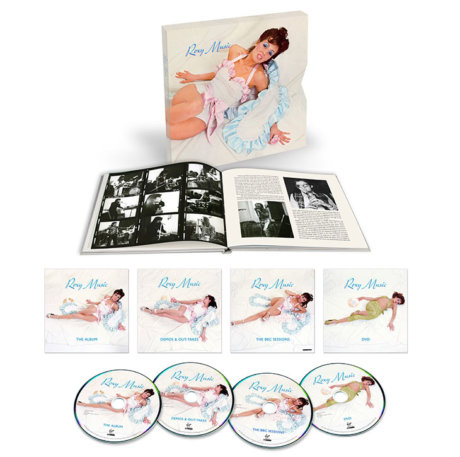
Billed as a 45-anniversary deluxe box set — even though it actually came out a year late, in 2018 — this weighty box includes three CDs and one DVD, the latter of which contains both visual and audio-only information (more on that later).
Where the weight gets put on is in the incorporated 136-page book documenting the band’s formation by The Guardian journalist and author Richard Williams, who first wrote about the group for the music paper Melody Maker in 1971. It features a plethora of previously rare or unpublished photos from those early days, along with a Ferry-approved essay on the founding and early days of the band. Everything is on a heavy stock glossy paper, surrounded by a glossy, high-grade cover.
We’ll begin our examination with the packaging and book before diving into the music. The set’s presentation, from the outside, suggests that you might be buying a five-disc vinyl box set and/or a coffee-table art book of the sort you find in museums, but thankfully this hefty tome devotes itself as much to sound as to vision. While there’s no vinyl to be found here, there are three CDs, 1 DVD, and the book on to very pleasurably work your way through.
THE BOX AND THE BOOK
The box is a three-sided slipcase box for the book, and the discs are tucked away in individual sleeves in the back of the book. The box reproduces the cover of the book, which in turn is a recreation the outside cover of the album. On the back of the box is a “removable” — if one is patient and careful — spot-glued paper outsert that shows the band logo, a brief blurb explaining the contents, the covers of the four discs in miniature, and the contents of each one.
This is the only spot on the outside where you will see all the requisite industry logos for the material inside, including the DVD logo, the all-region logo, and a couple of others. Given how radical a departure this album was from the mainstream in 1972, that “exempt from classification” MPAA “E” logo feels very appropriate.
The sound recording and other copyright logos and text are first seen on the stuck-on paper, as well as discreetly placed on the bottom of the slipcase. If one chooses to remove the paper to appreciate the full cover reproduction, the legally-required info is still there — a classy touch.
As packaged, the book spine is showing on the “open” side of the outer box, reproducing the gatefold spine. This of course means that as you pull the book out, you’ll be seeing Kari-Ann Muller’s lower leg and the gold record side of the cover.
If there’s one thing you can count on from a Bryan Ferry-led project, it’s that it should look, feel, and sound like no expense was spared, and that it is an important release. There’s only so much you can do to make a CD or vinyl album into a luxury item — though in the 70s, making it a gatefold album design was one sure way of transmitting that feel to the buyer, and indeed this debut album got the gatefold treatment in its original release.
The inside front and back cover and first and last endsheets showcase film positives of the many alternate takes and poses of Ms. Muller. There’s a title page with just the band’s logo, of course, and then the essay begins on the following page with yet another reproduction of the iconic cover.
A few of the many, many, many alternate images from the cover photoshoot.
Within the first few paragraphs, we learn that the two-tone Roxy Music logo uses a blue and pink that exactly matches the shade of Muller’s eye shadow and lipstick — again a mark of a premium product and that the carefully-constructed image with Muller’s “sultry” gaze was “an explicit taunt to the new rock establishment” that had come to dominate the form in the late 1960s.
Author Richard Williams notes that Elvis Presley had used a similarly bold two-tone logo and provocative photo for his debut album in 1956, and that eight years later, the Rolling Stones used an “unheard of” at the time stark photo with no text other than the Decca logo on the cover — another daring move for a debut album.
Eight years after that, Roxy Music made used the provocative and daring swimsuit-clad Muller, in a “glamour” type shot in a wraparound style, as their attention-grabbing debut cover. Compared to most the album covers of the time, Roxy’s cover was bold and wildly sexy for the time: “a signpost to a future of exotic promise,” as the essay describes it.
The book is a collaborative effort between Ferry, Wilson, Puxley, and a small army of mostly-uncredited photographers, although Ferry himself is among them (his are likely the photos of the other band members in rehearsal rooms). Without delving much into specifics and glossing over any conflicts, it outlines the history of the band, starting with Ferry’s idea for it, with his friend Graham Simpson providing some musical foundation, and the process of recruiting the others — including some, like Roger Bunn and Dexter Lloyd, who didn’t last past the demo tape.
Andy Mackay was an early addition who made the grade, though, and he was the one who the world must thank for bringing in Brian Eno. Eno was initially brought in to play Andy’s synthesizer and mix the sound, meaning he would be at the mixing desk rather than onstage with the band. The group rehearsed at the home of Ferry’s girlfriend Susie Cussins, to whom the first album is dedicated.
Phil Manzerera had been part of that round of auditions, but had been passed over initially, and then called back when Ferry’s first choice — David O’List — eventually didn’t pan out. O’List went on to a fairly illustrious career playing with a bunch of bands, including The Nice, Jet, Jethro Tull, Pink Floyd and others. He has two solo albums out in the 21st century.
Davy O’List’s prior band, The Attack, from 1966. He’s the curly-haired chap.
By May 1971, “Roxy” was finally deemed ready to cut a demo to shop to record labels. Ironically, the big obstacle with the first round of record companies didn’t turn out to be the band — it was Ferry.
His singing was very out-of-fashion for the rock of the time, with a mannered upper-class style and sort of anguished general tone, as if he is straining to not just say the lines rather than sing them. No hint of blues or soul style could be detected, and he had a rather fey quavering falsetto that was sparingly used.
That first demo tape, which we’ll get to hear on Disc 2, is all pre-Eno, and mostly features the “Mark 1” version of the band, with the early musicians and rougher sketches of the songs they would become, some with different titles.
They had to change the name to “Roxy Music” since there was already a band named “Roxy” in the US. The demo helped solidify the band, specifically helping attract Paul Thompson as the new (and permanent) drummer, replacing Lloyd, and of course eventually adding the mystery ingredient that was Brian Eno and his cutting-edge electronic wizardry.
This lineup, and a dash of glam and glitter and sequins all over the place, got them invited to a lot of events. Eventually, they met the legendary DJ John Peel, who had heard the demo. With the help of John Walters, Peel’s producer, they got a couple of live guest spots on Peel’s popular radio show.
This got them the thing they needed most: some positive press in the mainstream and music papers. From there, everything started to fall into place, and the band we know and love was cemented and offered the chance to make an album.
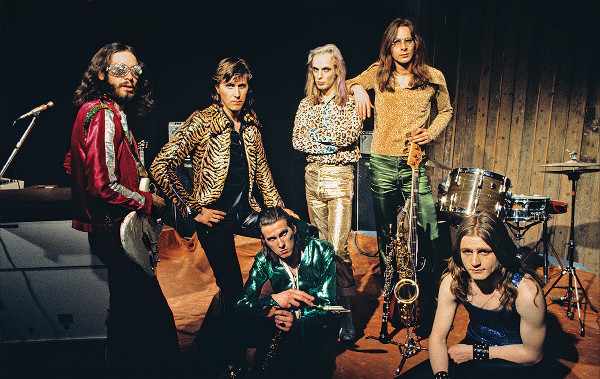
The essay itself is peppered with early images, and after the words we get many pages of more photos from live gigs and in the studio, some candid shots and a handful of formal pics. Even in these, we see also the band’s visual sense: Ferry’s formality, Eno’s glitter bombing, Mackay’s sequins, Manzanera’s bizarre eyewear. Thompson, who occasionally favored leopard-print and caveman-type clothing when he wasn’t shirtless but for a sequined vest, was the least-photographed member in these as he’s always in the back, of course.
This is followed by pages of lyrics (accompanied by more photos), the typewritten original lyric sheets (with a few scratch-throughs and notes), a page of quotes reflecting on the album by Ferry, a few pages of Puxley’s eccentric descriptions of the songs and key lyrical phrases, a few more pages of Keri-Ann photos including one in a completely different outfit).
This goes on to show images of the master-tape boxes, early press releases and bios, many pictures from the Lincoln Festival in May of ’72 (their first festival show), the UK tour of ’72 program book cover and dates (with a few photos), a brief tour diary, an ad for the album, a montage of small venue notices, want ads the band took out looking for a drummer and guitarist (“for avant-rock group”, single covers and posters from various countries, newspaper notices (mostly positive, but a few not quite complimentary), the US tour listing, and — finally — big colour pictures and stills from TV appearances, and the US and UK shows.
L-R: Mazenera, Ferry, Mackay, Eno, Rik Kenton (who replaced Graham Simpson for the first tour), Thompson
The book wraps with a two-page spread of the CD covers and their contents, a page of credits for the book, the CDs and some of the photos, and another page of Keri-Ann outtakes.
Many people are under the impression that 1972, when Ziggy came out, was Bowie’s biggest year in the early 70s, but in fact it was ’73 — the Ziggy tour caught on in the US, and he managed to get out two further albums (Aladdin in April, and this one in December) — both of which went to #1 in the UK and did well elsewhere on the strength of Ziggy alongside their own charms. Pin Ups was, ironically, released on the very same day as an album of covers by Bryan Ferry (These Foolish Things) — his debut solo album. Ferry didn’t do quite as well commercially (merely reaching #5 in the UK charts), but received more critical praise (and, frankly, is the better album of the two). While Bowie stuck to covers from a very specific and influential period for him (the bands and sounds he most often tried to emulate in his pre-first album period, 1964–67), Ferry picked his personal favourites from all across his youth, from songs that predate him quite considerably (probably favoured by his parents) to his pre-teen and early teen years in the 1950s.
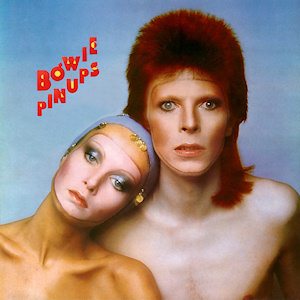
The original “face swap selfie”
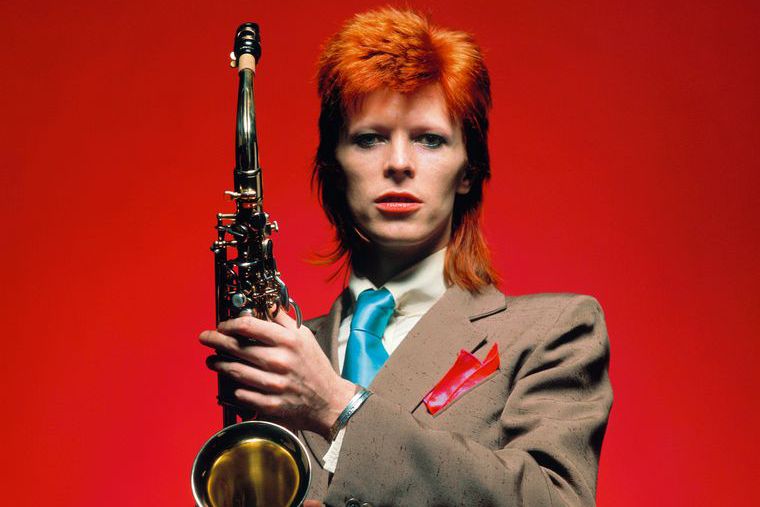
We mention this not just because the two were such contemporaries, but because Ferry was pleased enough with the reception to do another covers album a year later (Another Time, Another Place, 1974), but Bowie — despite very much wanting to — did not. Pin Ups was, in fact, intended as the first installment of a two-part plan: it was intended to bring English songs specifically to a US audience that wouldn’t be that familiar with them, while the follow-up album (called, at least at one point, Bowie-ing Out) would have consisted of Bowie covers of US artists. A few of these selections were covered by Bowie much later (“God Only Knows,” “I’ve Been Waiting for You,” “I Took a Trip on a Gemini Spaceship,” and others). In 1973, though, Bowie’s hair was in full-on mullet mode, but as mentioned previously he appears to be the one male humanoid that made it work (ironically it became a popular hairstyle more than a decade later, among both men and women). The cover art with Twiggy was originally intended for Vogue, but they didn’t use it, so Bowie recycled it.
In addition to the two pretty things on the cover, Bowie also kicked off the album with his version of “Rosalyn,” a raucous rave-up R&B rocker based on the Bo Diddley sound originally written by the Pretty Things and issued as a single by them in 1964 (he also covered the band’s other notable single from that year, “Don’t Bring Me Down” later on this album), and referenced the band in at least two song titles in his career (“Oh You Pretty Things” and “The Pretty Things are Going to Hell”). Apparently he liked them, and it couldn’t be more obvious in his cover of “Rosalyn” — Bowie surprises by aping the Pretty Things’ lead singer Phil May so well that, to quote May, “[Bowie] even screamed in the same places I did.” The two versions are similar enough that Bowie fans would be forgiven for thinking that possibly May had guested the lead vocal on this one, with one of the few differences in the cover being Ronson’s meatier guitar work.
This segues directly into a cover of “Here Comes the Night,” a song of teenage angst and jealousy first recorded by future Bowie pal Lulu (it didn’t do well for her) and was later a #2 hit for Van Morrison and Them (though it was not written by Morrison) in 1964. Oddly, Bowie never committed anything written by Sir Van the Man to an album or b-side, though his band Hype did “Madame George,” and David incorporated Morrison’s “Gloria” into extended concert versions of “Jean Genie” alongside other song snippets, so there was clearly some regard there. I would speculate that Lulu may have suggested the number as a good choice for him.
Lulu’s version emphasised the sadness of humiliation and regret; Them’s version (with Jimmy Page as a session guy on lead guitar!) focused more on the anger and jealously. On Pin Ups, the song is done in more of a rock-musical style with a very theatrical, exaggerated vocal that sounds a lot like what I’d imagine Patti Smith or Tim Curry (again) might have done with it. Naturally, the Pin Ups version again has sterling guitar work, but also a strong saxophone presence missing from Lulu’s violin-centric, slower take, or the Rolling Stones-style interpretation Them recorded. Bowie clearly borrowed from both singles.
From there we go to a proper blues cover, a song written by Billy Boy Arnold (one of Bo Diddley’s sidemen) using a very borrowed Diddley beat. The song “I Wish You Would,” is only heard in its complete form on Arnold’s original; the Yardbirds’ version rearranges and generally fools around with the lyrics, and omits a verse, where the singer is supposed to reveal that the reason his woman done left him is because he was a drinker (as heard in the original 1955 single, above). Bowie’s cover, taken heavily from the Yardbirds single, also leaves that bit off. Curiously, Bowie and Ronson opted to replace nearly all of the signature harmonica line that was a defining characteristic of the 1955 song’s “blues-ness” — faithfully aped and augmented in the Yardbirds recording — with more guitar instead. If Clapton’s first band “whitewashed” the lyric, Bowie’s take on it whitewashed the music as well. Again, as with “Here Comes the Night,” he chose to go with rock rave-up type vocals that further cut the emotional heart out of the thing as well. Ronson outplays Clapton on this, but gets ever further away from the roots of the song.
This leads us into a brief return of David Bowie mk1, in the form of his cover of The Pink Floyd’s/Syd Barrett’s “See Emily Play,” very much the sort of music Bowie himself created in his first two albums. His take on it sounds like a fusion of the vocal style of his debut mixed with the backing band that created “The Man Who Sold the World.” Bowie backs himself up on Varispeed vocals to create a chorus of mental demons — he absolutely has a lot of empathy for the material and Syd, having had many mentally-ill relatives, the tragedy of his half-brother, his acquaintance with Barrett himself, and of course at this point in his life the madness of rock stardom. Garson again provides a lot of augmentation, while Ronson, Bolder, and Dunsbar create an arrangement significantly better than the original. The addition of strings at the end can, as O’Leary notes, be interpreted as the introduction of soothing medicine or a sign that the heroine of the song has completely withdrawn into her own troubled mind. It’s a great song made greater by Bowie, but it’s still rather jarring in the track mix, sandwiched as it is between the more typical “I Wish You Would” and the more typical rocker “Everything’s Alright.”
Speaking of, the only reason I can think of that this lightweight pub-rocker was included on the album is that drummer Aynsley Dunsbar also played on the original recording by the Mojos. This is the sort of song the early Beatles might have done in their Cavern Club/Hamburg days, and indeed Bowie’s version ends with him doing a multi-tracked “ooooh” finale that sounds lifted straight from “She Loves You.” Compared to two contemporary covers from 1965 — a very good one by the Liverpool 5 and an even livelier one from the Robin Hoods — Bowie’s version sounds rather by-the-numbers, though as usual the instrumentation is pretty solid.
Side One comes to an end with a strangely slowed-down cover the Who’s “I Can’t Explain.” Bowie openly ripped off The Who for a few of his early singles, in particular infusing his own “Can’t Help Thinking About Me” with all the fury the Who themselves could have mustered (and got called out on it by Townsend at their first meeting).
The odd choice to do “I Can’t Explain” as sort of a torch-song version that, but for Ronson’s presence, sounds like it could have been in Bowie’s cabaret act from six years earlier can only stem from his fundamental misinterpretation of the song. Bowie sings it like the chorus is a metaphor for an expression of lust in polite company, when in fact the song is clearly about a teen or pre-teens first inklings of sexual awakening, where they haven’t yet got the vocabulary for what they’re feeling. Despite having Dunsbar on board, the Pin Ups version strips down the drums, removes the teenage angst, and essentially neuters the song.
Side Two kicks off with “Friday On My Mind,” a hit for the Easybeats in 1966. The band perform the song admirably, but Bowie literally sounds like he can’t decide how to approach this as he’s singing it. Half the time, he’s doing it in his recently-favoured rave-up style (there’s no doubt in our mind that Bowie had taken in a performance of The Rocky Horror Show after it opened on the West End in June of ’73 with Tim Curry in the lead role), but for other parts — including some high notes he can’t quite reach — he goes the Tony Newley route from his early days. It’s very disconcerting when Bowie himself is by far the weakest element on a given track, but that’s the case here. That said, Bowie follows this up with by far the strongest of his performances on this album, “Sorrow.”
The track — originally written by Bob Feldman, Jerry Goldstein, and songwriting legend Richard Gottehrer — was first recorded by the McCoys (who used it for a b-side in ’65) and then the Merseys (who had a big hit with it a year later). Despite being a cover, it seems both like a natural Bowie number as well as one for which he has some obvious affection. As Bowie discographer Nicholas Pegg notes, the arrangement makes it sound very much like something he’d have written for his pal Lulu, and adds that an ironic reissue of Bowie’s own “The Laughing Gnome” is said to have caused RCA to hold back the “Sorrow” single for a while (the “Laughing Gnome” re-release actually hit #6 on the UK charts, such as the popularity for anything with Bowie’s name on it by this point). Bowie’s version went on to become one of his most successful singles ever in terms of chart staying power; it lasted 15 weeks in the UK Top 40, peaking at #3.
Back to the blues for the next number “Don’t Bring Me Down,” the other Pretty Things number, and the entire band turn in a solid performance, particularly Dunsbar (finally allowed to really shine on drums) and Bowie himself on harmonica. For everything Bowie and producer Ken Scott did wrong with “I Wish You Would,” they certainly nailed the blues down solidly on this track, mainly by closely copying the Pretty Things’ version (only turning down the mod stylings a tad, letting Dunsbar ply his trade, and clearly having access to a better recording studio). As with “Rosalyn,” it’s quite obvious Bowie really did like the Pretty Things, although this time around he lends the vocal a more mature style that he would make more use of as he, well, matured. I could see Bowie re-recording this in the same style 20 years later with no appreciable difference in the vocal stylings.
Listeners might be forgiven for feeling a bit of whiplash as the record veers wildly again, into “Shapes of Things,” the second Yardbirds cover on Pin Ups and their first self-penned single. The original had a nicely-mid-’60s youth rebellion feel to it (and clever use of overdriven guitar courtesy Jeff Beck), but Bowie and Ronson amp it up into a much more psychedelic arrangement that better suited the late ‘60s (but seemed just a touch retro in 1973), complete with a background string section. Much more Jefferson Airplane-meets-Moody-Blues than anything else on the album, with Ronson paying due tribute to Beck’s searing original solo. Again, this wouldn’t have been much out of place on The Man Who Sold the World.
The following track is a second slice of The Who, this time 180 degrees away from the lounge-y “I Can’t Explain” to a full-on, no-apologies imitation of the band outright on “Anyway, Anyhow, Anywhere.” Bowie does his best Daltrey, and Dunsbar does his best Moon — while Ronson and Bolder mostly refrain from trying to imitate Townshend and Entwhistle directly, yet they still capture the vibe. Apart from some tell-tale stylings, Bowie and the band manage to pull off a strong impression of The Who at their best (again). The album concludes with a faithful but again harder-edged cover of “Where Have All the Good Times Gone,” which (unusually for this album) was a Kinks b-side rather than an a-side. It’s a bit of a “response” in sentiment to the youthful worries of “Shapes of Things,” where a more cynical narrator bemoans his youthful idealism, and Bowie shows off how much he likes the Kinks with another homage-cum-impression, this time Ray Davies.
The 1990 Rycodisc release of Pin Ups includes two notable bonus tracks: an early Bruce Springsteen composition, “Growin’ Up,” which features Rolling Stone Ron Wood on guitar (!) for the Bowie version, and the long-delayed inclusion of Brel’s “Port of Amsterdam,” originally left off Ziggy Stardust and now added to this album of covers. Bowie likely came to “Growin’ Up” through the original demo version, before Greetings From Asbury Park came out in late ’73, but even way back then the Boss’ style and voice were quite distinct, and Bowie sounds (in hindsight) like he’s covering a Springsteen (or Jim Steinman) song, letting his fascination with Americana ride free. The cover was actually recorded during the Diamond Dogs sessions, and was likely intended for the US-centric sequel to Pin Ups, and thus doesn’t really belong on this album: the song was also appended (more appropriately) to the 30th anniversary release of Diamond Dogs.
Clockwise: Bowie, Visconti, Springsteen, Garson
Bowie (a year or so later) covered Springsteen again with “It’s Hard to be a Saint in the City” again from Brooooce’s debut album around the time of Young Americans and Station to Station, but although Bowie and Springsteen met during those initial sessions, and the former clearly had an affinity for what the latter was doing, they never worked together. Bowie, after meeting Springsteen and gathering that The Boss wasn’t too impressed with the cover, never released his version, which was actually quite prescient with regards to where Springsteen would later end up, and the track finally turned up on the compilation Sound + Vision.
The “Port of Amsterdam” cover — both the original “first mix” and the Ryko Pin Ups “second mix” bonus track — follows Scott Walker’s 1967 English-language version pretty closely (there’s a pretty amazing video of Brel himself performing it live; see below), and brings all the power and poetry of Walker’s version to a simpler arrangement of just him (or possibly Ronson) on 12-string guitar. O’Leary notes that after deciding to leave it off Ziggy, Bowie apparently wrote “Rock n Roll Suicide” as a faux-Brel replacement. There’s another “clean” acoustic version of the song Bowie did, even more passionate in its performance, now on the Bowie at the Beeb CD. Bowie performed the song a half-dozen times times on the radio, but the first mix of the studio version ended up as a b-side for “Sorrow.”
Although it would have technically broken the theme of UK singles from the mid-60s, I think an appropriate bonus track (should they ever get round to doing another reissue of Pin Ups) would be the “White Light White Heat” cover Bowie originally started, but never completed, during those sessions. Mick Ronson later sought, and got, permission from Bowie to use the tracks for his own cover of the song on his album Play Don’t Worry. Bowie covered the song about a zillion times in concert, however, and there are something like a half-dozen versions recorded for the BBC floating around. This one (below) is probably my favourite of them, as you can hear Bowie aping Lou for all he’s worth. Mr. Reed himself joined Bowie in some live versions, including one as early as 1972, and most memorably for David’s 50th birthday concert.
Regarding Pin Ups as a complete work: while there are definitely occasions on Pin Ups where Bowie covered songs well, there are almost as many where he appears to have missed the point of the song entirely. Though Bowie claimed in interviews that most of the songs chosen for Pin Ups were singles or albums he had at home from his early days, none of these bands (bar The Who) seem to have been big influences on him.
While he might have enjoyed the songs (either seeing them performed live back in the day, as he would claim, or from the records), it can’t be a coincidence that almost none of these songs ever reached US radio listeners, making this “contractual obligation” album seem like just a new Bowie album to many American fans, or to younger UK fans. Pin Ups is an collection of focused (and occasionally un-focused) nostalgia at a time when that was really coming into vogue: in addition to Bryan Ferry putting out the same sort of album at the same time, it was around this time that the simpler mid-50s and early-60s rock songs, now looking dated by comparison with the contemporary 70s, became nostalgic “oldies” to those who grew up on that stuff as teens themselves.
A lot of the songs Bowie chose for the record are good, though a surprising number offer rather empty, throwaway lyrics; the simplistic “Rosalyn,” the abridged “I Wish You Would,” the pointless “Everything’s Alright” — odd choices by an artist known for his multi-layered and often-complex verses, and affinity for others who specialized in allegorical and symbolic lyrics. There’s a troubling feeling, however, that Bowie didn’t really put his full effort into, let’s say, half of the material. It’s quite possible the influence of “The Rocky Horror Show” was playing a role here, but much of the first side sounds like theatrical takes on the songs rather than heartfelt covers (his a-game is much more present on the second side).
For those unfamiliar with the originals, Pin Ups is an uneven but fun (and now, rather underrated) album featuring a variety of styles performed by an incredibly solid band — but I have to say I got more enjoyment out of re-listening to the various original releases, even when Bowie’s version was arguably better. While far from his worst record thus far, Pin Ups does at times feel like a “contractual obligation” record lacking in focus and effort, only periodically interspersed with songs or bands that he actually did hold in high regard. The album did very well — better than Ziggy in some ways — but those awaiting the next chapter in Bowie’s rapid development would have to wait one more year: Pin Ups is more of an entertaining intermission.
Here’s a treat for those listeners who remember the local band scene in Orlando and all the great concerts we used to have — this episode’s twin focus is on the upcoming Bryan Ferry appearances that were happening that week, as well as both concerts and a new seven-inch, four-track EP put together by a handful of great local bands.
Our pal Jim was on the show, bringing along the latest Bryan Ferry album (which we go all fanboy over) and news of his upcoming appearance, and the two of us cooked up plenty of familiar and obscure New Wave gems, a few rarities and dance mixes as well. We took a little time to spotlight the local band EP and our special guest Aaron of Thee Exotic Aarontones in the middle of the show, and we also have a special all-new “bonus track” at the end from NYC-based Rude Boy George, who do a killer ska cover of the Romantics’ “Talking in Your Sleep” with a guest vocalist from the English Beat!
You can listen to the episode below, download it from the web site or subscribe to it in iTunes for free. Let us know how you like it at crustyoldwave@me.com, and keep an ear out for part two of this shindig, coming soon!





 This leads us into a brief return of David Bowie mk1, in the form of his cover of The Pink Floyd’s/Syd Barrett’s “See Emily Play,” very much the sort of music Bowie himself created in his first two albums. His take on it sounds like a fusion of the vocal style of his debut mixed with the backing band that created “The Man Who Sold the World.” Bowie backs himself up on Varispeed vocals to create a chorus of mental demons — he absolutely has a lot of empathy for the material and Syd, having had many mentally-ill relatives, the tragedy of his half-brother, his acquaintance with Barrett himself, and of course at this point in his life the madness of rock stardom. Garson again provides a lot of augmentation, while Ronson, Bolder, and Dunsbar create an arrangement significantly better than the original. The addition of strings at the end can, as O’Leary notes, be interpreted as the introduction of soothing medicine or a sign that the heroine of the song has completely withdrawn into her own troubled mind. It’s a great song made greater by Bowie, but it’s still rather jarring in the track mix, sandwiched as it is between the more typical “I Wish You Would” and the more typical rocker “Everything’s Alright.”
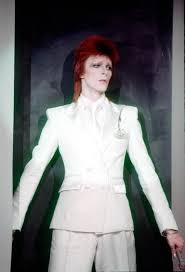 The track — originally written by Bob Feldman, Jerry Goldstein, and songwriting legend Richard Gottehrer — was first recorded by the McCoys (who used it for a b-side in ’65) and then the Merseys (who had a big hit with it a year later). Despite being a cover, it seems both like a natural Bowie number as well as one for which he has some obvious affection. As Bowie discographer Nicholas Pegg notes, the arrangement makes it sound very much like something he’d have written for his pal Lulu, and adds that an ironic reissue of Bowie’s own “The Laughing Gnome” is said to have caused RCA to hold back the “Sorrow” single for a while (the “Laughing Gnome” re-release actually hit #6 on the UK charts, such as the popularity for anything with Bowie’s name on it by this point). Bowie’s version went on to become one of his most successful singles ever in terms of chart staying power; it lasted 15 weeks in the UK Top 40, peaking at #3.
 The Chasbah