The Muppet Christmas Carol (1992)

⭐️⭐️⭐️½
Disney Studios
Director: Brian Henson


We have a Christmas tradition of what I think is the best version of “A Christmas Carol” ever committed to film, the 1951 Alastair Sim version (UK title: Scrooge, and my review of it is here). This year, just to do something a little different, we revisited The Muppet Christmas Carol after not having seen it since its 1992 theatrical debut, just to change things up a bit. The film sticks to the same story (more faithfully than Scrooge, in some ways), but approached the source material in an almost-completely different way: it’s a musical, for starters, and it only has two substantial speaking roles for human beings.

In short, this film is a technical marvel, and the overall story is well-executed — but Caine as Scrooge is curiously flat, and the songs (by Paul Williams) are both samey, and rather meh. I’d certainly recommend this one over my beloved 1951 version when it comes to “suitable for kids, grandparents, pets, and the whole family,” but while it scores well on some fronts, its general over-busyness, the decision to make it a musical, and the changes to the story probably won’t sit well with Dickens fans.

Statler & Waldorf as the Marley BROTHERS (wtf?) was the film’s first overreach in shoehorning Muppets into the story.

I’m not sure who’s to blame for Michael Caine’s mostly-lifeless portrayal of Scrooge; director Brian Henson was of course focused on his muppets, and they uniformally shine here, so he may have decided that Scrooge’s inhumanity to his fellow man should be more low-key until his reformation. Or maybe Caine thought the movie was dumb, and did it for the paycheck (that’s certainly the vibe he gives off for the first two-thirds of the film).

For what it’s worth, I think the film would have worked better with maybe one big musical number at each end rather than making the whole thing a musical, since the songs are, to be frank, unmemorable and just fill time. The Muppets’ recasting into various roles from the story, on the other hand, works surprisingly well, with The Great Gonzo (Dave Goelz) as Charles Dickens (among many other roles) and Rizzo the Rat (Steve Whitmire, again also playing Kermit, Beaker, Bunsen Honeydew and a half-dozen other parts) serving as the Greek Chorus to Gonzo’s Dickens narration. Long-time Muppet veterans Jerry Nelson and Frank Oz take up their usual roles with wit and gusto, with David Rudman handling some minor roles and a cameo from the Swedish Chef.

Gonzo (left) as Charles Dickens narrates, while Rizzo questions the story.

When Scrooge is seen in flashbacks in the early parts of his life (Raymond Coulthard, Russell Martin, Theo Sanders, Kristopher Milnes, and Edward Sanders), the character is more “alive,” a trait Caine slowly picks up on during his ghostly visits, and finally brings to the fore at the very end. The other main human-being speaking role is Fred, Scrooge’s nephew, and actor Steve Mackintosh is just fine in the role, but should have been used elsewhere (we’ll come to that later).

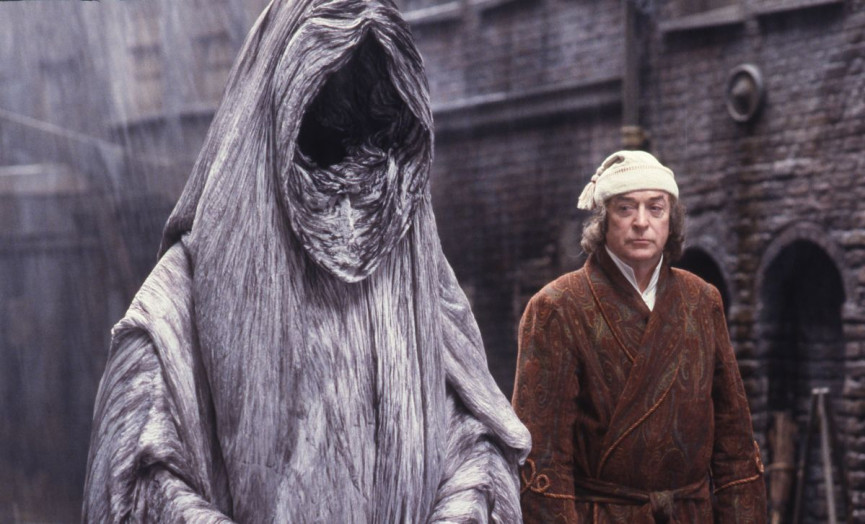
A lot of respect must go to the muppet performers in the lead roles, who have decades of experience with these familiar characters and carry it off on a movie scale just as well as they do on television. Special respect must go to the muppet performers who play the ghosts: the floating and diminutive Ghost of Christmas Past (Karen Prell with voice by Jessica Fox), the giant Ghost of Christmas Present (Jerry Nelson and Donald Austen), and the effectively haunting Ghost of Christmas Yet to Come (Rob Tygner and Donald Austen).
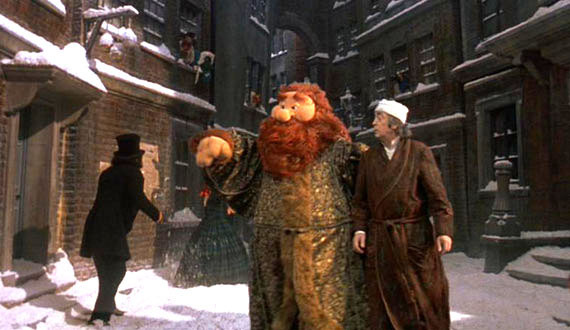
The Ghost of Christmas Present guides Scrooge through London
The Ghost of Christmas Yet to Come is suitably spooky but not TOO scary for kids.

There are also dozens of “little” Muppet characters (mice inside the homes, rats who work for Scrooge’s office, etc), and some giant characters, and the spirit of Jim Henson lives on in these parts and the talented people who bring them to life. In the finale, we get to see over 100 muppets in a panning shot, a very impressive accomplishment that makes them all the more “real” throughout much of the film.

It later came out that English actors David Hemings, Ron Moody and David Warner (the latter would have been my pick), alongside American comic George Carlin (who might also have been quite good) were considered for the role of Scrooge before Michael Caine finally won the role. I’m still not sure if Caine’s low-key misery was his choice or Henson’s, given that this is a family/kids version of the tale, but Caine noted that he based his portrayal on the present-day vultures of Wall Street and the banks, which may account for the more bloodless, cynical portrayal.

This is as evil looking as Caine gets, and he looks more bored than menacing.

The “London street set” used in the film was uncannily similar to the one used in the 1951 Scrooge — modified for scale, obviously — which delighted me, but while I understand the decision to keep the Muppet characters the audience would know using their original voices, the lack of UK accents from nearly everyone apart from Mackintosh and Caine was a disappointment to me, especially for the Ghosts. Given that the story, author, characters, and filming location were all in the UK, I felt like every character (with the Swedish Chef obviously exempt) should have added a UK lilt to their voices.

I haven’t mentioned Kermit the Frog as Bob Cratchit thus far in the film, for two reasons: first, although Bob is the raison d’etre of Scrooge’s reformation, he’s hardly in the film; and two, he doesn’t really communicate Cratchit’s plight because Kermit is a good-natured, happy frog at heart and is incapable of portraying suffering. I can’t believe I’m saying this, but Kermit was badly miscast, and should have played nephew Fred — while Steve Mackintosh, who played Fred, should have played Bob.
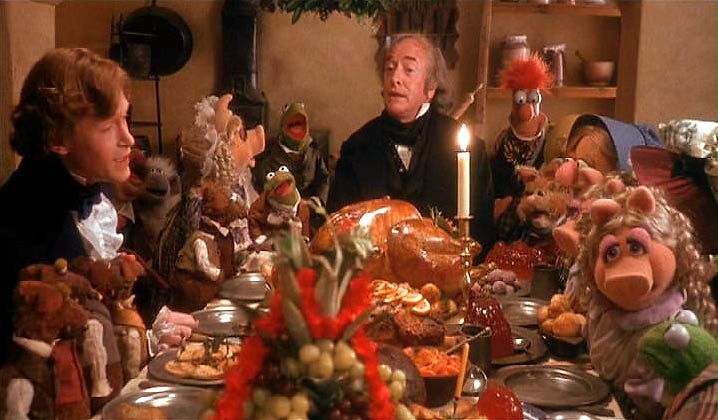
Fred, the Cratchit family and friends, Scrooge, etc – nobody seems poor here at all.

Nitpicking aside, the film does carry a lot of family-friendly humour, and succeeds in reforming Scrooge and being generally heartwarming. It’ll never replace Scrooge for me, but that said it is also nowhere near the worst version of A Christmas Carol committed to film. As a first version for kids to see that might get them interested in the story and other film versions, it’s fine.

The one high mark I will give this version is that, despite the musicality and comedy inherent in it, it does not shy away from painting the capitalist banking system as morally bankrupt and preying on poor people — the point of Dickens’ original tale in the first place, so good on them for that.

There’s a moment where Sam the Eagle, the All-American type, gets corrected in scene that this is a British story, and does a retake correcting “the American Way” to “the British Way” that I found quite amusing. On the whole, it’s a classic aimed at the smols in your household, it’s cute, it’s fun. There’s an extended version of the movie that restores one cut song, but don’t bother with that — one more song is exactly what this movie didn’t need.
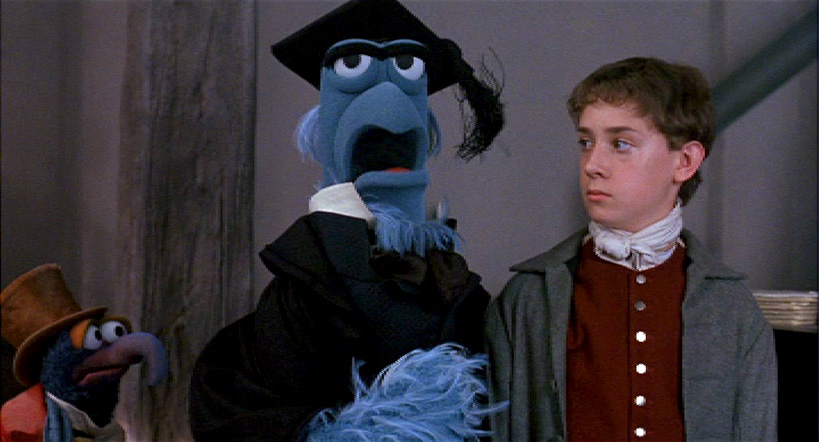
Sam Eagle has a brief but amusing cameo in the movie. Yay!

Scrooge (1951)

dir. Brian Desmond Hurst
(US title: A Christmas Carol)
⭐️⭐️⭐️⭐️⭐️
52-week film challenge, film 50

Naturally we have to do at least one Christmas movie in the 52-week challenge, and for me of course it would be this one. I watch this movie every year, and never get bored of it — always admiring something new, like the lighting of certain shots, the long shadows Scrooge casts, details of Bob Cratchit’s family and so on endlessly.

There are many decent-to-excellent film versions of “A Christmas Carol,” but this one is far and away my favourite, in large part because of its marvelous casting, superb performances (particularly from Alastair Sim as Scrooge), and striking B&W cinematography. Every single member of the cast is on point, camera angles are uniformally well-chosen, the musical score is quite striking (more about that later), the supporting characters are also very memorable, and in short this film is perfect in all the ways — even the additions to Dickens’ story are so well-done you’d hardly believe, for example, that there’s no Mr. Jorkin (Jack Warner) in the original novella.

Mr Jorkin (Jack Warner, middle) introduces Young Scrooge (George Cole, right) to his future partner, Jacob Marley (the film acting debut of Patrick McNee, left).

I sincerely believe that if Dickens could be brought forward in time to watch his story on film, this one would be the one most likely to meet with his approval. Certainly he’d like it better than either of the two best-known previous attempts, the comical short silent version from 1910 or the mediocre full-length version starring Reginald Owen from 1938.

Everyone thinks they know the story of “A Christmas Carol,” but relatively few have ever actually read the original work. Changes required to make the story more visual in the various film versions have added elements to the original story, and so does Scrooge, but it is a testament to the skill of screenplay writer Noel Langley that the joins are largely seamless to anyone this side of a Dickens scholar.

Scrooge wasn’t always a jerk: he was always kind and tender to his sister Fanny (Carol Marsh)

In particular, Dickens’ original social commentary is strongly intact in this version, and resonated deeply in postwar Britain of the early 1950s, when the country struggled with crushing debt from the war, and continuing rationing and austerity. Also preserved is traces of Dickens’ Christian faith, and while explicit in some moments it doesn’t overshadow the message of social justice and the responsibility of the the well-off to alleviate the suffering of the poor.

Marley’s ghost (Michael Hordern) tries to show Scrooge the suffering of the poor, but it’s not (yet) effective.

Aside from the radiant performance of Alastair Sim, who set a bar of believability in both pre- and post-reformation Scrooge that no other actor has equaled, special mention should be made of Mervyn Johns as Bob Cratchit, Hermione Baddeley as Mrs. Cratchit, Michael Hordern as Jacob Marley, the incredible Ernest Thesinger as the mortician, Miles Malleson as Old Joe, and of course Kathleen Harrison as Mrs. Dilber, another performance that will never be bettered. There are a wealth of character actors in this, all doing their British Character Actor thing to an absolutely flawless standard.

Special mention too must go to Richard Addinsell, who gave the film a very booming, menacing score that softens all the way to down to music box-like Victorian lullaby in places, and throws in a traditional ballad (“Barbara Allen”) for the film’s climax. Finally, the combination of Ralph W. Brinton (the art director) and C. M. Pennington-Richards (the cinematographer) produce a detailed but very dark style where the shadows are long, the lighting is sparse (until Scrooge’s reformation), and the harshness of life in Dickens’ fable is not shied away from — it is simply gorgeous to look at, and downright spectacular if you have a OLED high-definition television.

Glyn Dearman as Tiny Tim, enjoying a splendid display of Victorian toys.

In these current days of increasing western poverty and misery, with inflation making the working class ever poorer and more angry, the film again becomes more relevant to complement its timeless moral. To quote Bob Cratchit, “it is a perfect pudding!”

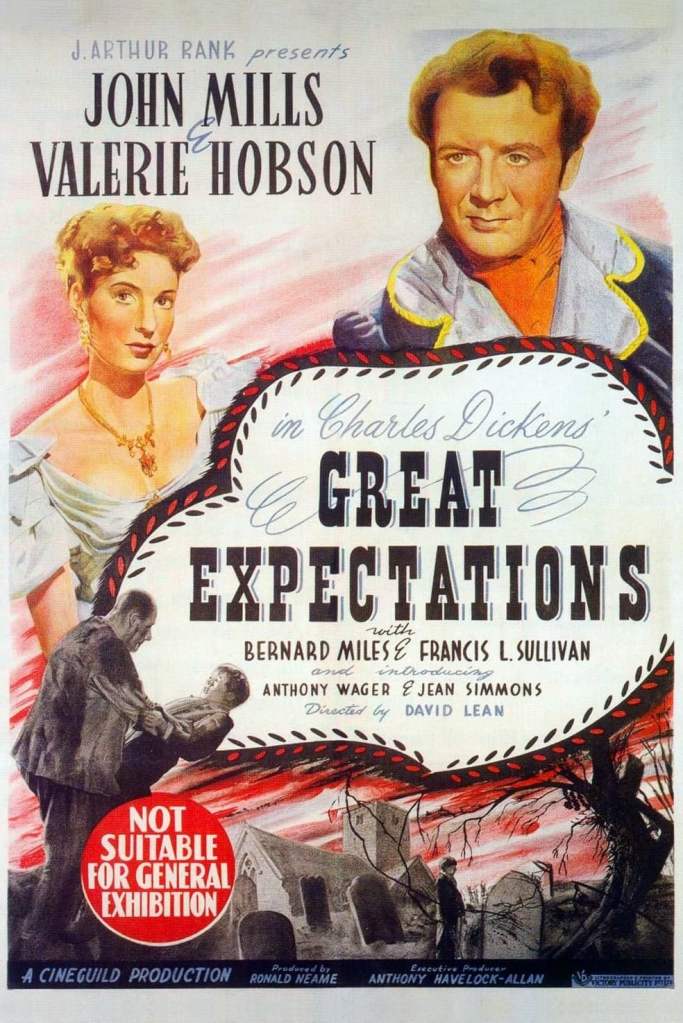
Great Expectations (1946, dir. David Lean)

⭐️⭐️⭐️⭐️
52-week film challenge, film 21

Whether you are a fan of Dickens, or you’ve not read any of his work beyond A Christmas Carol, this is a fantastic film adaptation to offer insight into Dickens’ other work, full of strong visual language to put you in the authors’ mindset and life experiences. Great Expectations covers poverty, the working class, and injustice, but contrasts this with power, privilege and good old British eccentricity; themes Dickens constantly came back to in his other works.


As an adaptation of the book, Lean and his fellow screenwriters condense and cut some plot strands in order to make for a followable two-hour film, and made the deliberate choice to make the film in B&W rather than colour to further establish the film as being part of a bygone age. As a single film, no other version since has surpassed it.

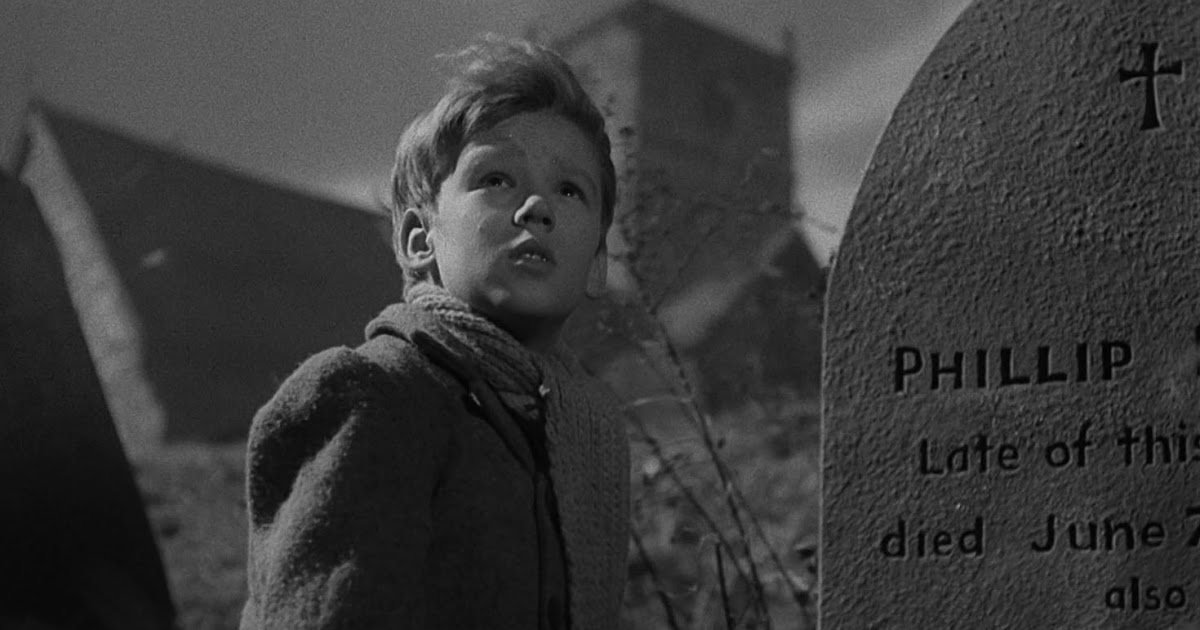
Without trying to rehash the entire plot, an orphan named Philip Pirrup, whom absolutely everyone calls “Pip” as a single first and last name, is living with his older sister and her husband Joe, a kindly blacksmith. A chance encounter with the desperate escaped convict Abel Magwich in the graveyard of Pip’s parents and an act of kindness on Pip’s part sets in motion plot lines that will only show up much later.

In the meantime, Pip falls into the orbit of an eccentric patron, Miss Havisham, who has a macabre backstory and a young adopted daughter Estella, who is seemingly impervious to love and rather cold (and occasionally brusque), though of course young Pip falls in love with her anyway. As an adult, Estella does take on a beau but is, as Pip observes, simply using him. She explains matter-of-factly (again) to Pip that she has no heart and does this to all men — except Pip. It is a beautifully understated moment of foreshadowing where Pip finally “gets” her and what Miss Havisham has done to her.

As Pip turns 20, he discovers he has a mysterious benefactor (whom he assumes is Miss Havisham) who wants Pip trained in London to become a proper gentleman of society. Leaving his family, his patron, Estella and all he has known, he travels and meets up with a boyhood colleague, Herbert Pocket, who becomes his roommate and friend. A year later, matters come to a head as the benefactor reveals himself, setting in motion the means to resolve the various plot lines (and finally some action scenes!).

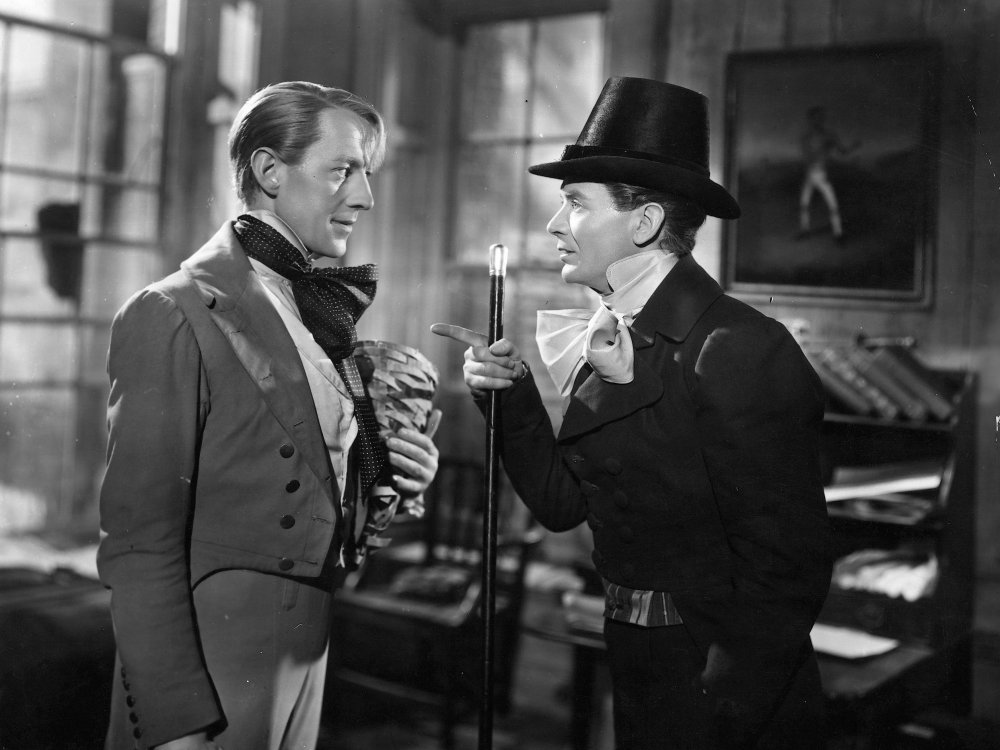
Pip (right) recognises schoolboy acquaintance Herbert Pocket, played by Alec Guinness.

A David Lean film is always beautifully shot and extremely well-directed, and this one is no exception. The B&W cinematography, apart from the opening sequence, was shot by Guy Green, who also worked with Lean on his other Dickens’ film, the even more memorable 1948 Oliver Twist. Both Alec Guinness and Martita Hunt had played their respective roles (Herbert Pocket and Miss Havisham) in a stage adapterion of the tale Guinness wrote, which prompted Lean to make the film in the first place (though he did not use Guinness’ stage script).

Lean definitely had a talent for picking and working with child actors, as both the young Pip (Anthony Wager) and the boy Herbert (John Forrest) are great in their parts, and a young Jean Simmons beautifully played the young Estella, with Valerie Hobson seamlessly taking on the adult Estella. Also of note is the ageless Frances L. Sullivan, who flawlessly played the lawyer Mr Jaggers in perfect Victorian style, but to be fair he had experience in the part — he had played the same role in a 1934 film version of Great Expectations as well!

There are only two serious errors in this film in my opinion, one of which was unavoidable: you can’t film the entire story, it would have likely doubled the running length of the film. Lean does his best to choose the best plot strands to follow, and resolves them all satisfactorily, but in truth Dickens’ lengthy storyline — it was originally written as a serial for a magazine, and the novel was originally published in three volumes — doesn’t lend itself to anything less than a mini-series.

The other flaw (and this was a big one) was casting a 38-year-old John Mills as the adult (21 year-old) Pip. I have no quibble with Mills’ excellent and emotional performance, but the age jump between the boy Pip and the (mature!) man Pip is just not credible on-screen. In a rare foot wrong, Lean should have cast a younger actor — at times, Mills looks more like 26-year-old Alec Guiness’ father than his contemporary.

A trip back to the mannered and class-centric world of Dickens’ time is probably not for everyone, even as beautifully realised as it is here, but as a picture of a bygone age (and Dickens’ clever way of pointing out the injustices and flaws of it), Great Expectations puts you right into the author’s imagination. The resolution of the film is a bit fast and tidy, but not before a series of memorable scenes in which Pip first (accidentally) destroys Miss Havisham and then forcibly prevents Estella from becoming Havisham’s prisoner — a powerful statement on the importance of finding your own way in the world, regardless of your circumstances or background.

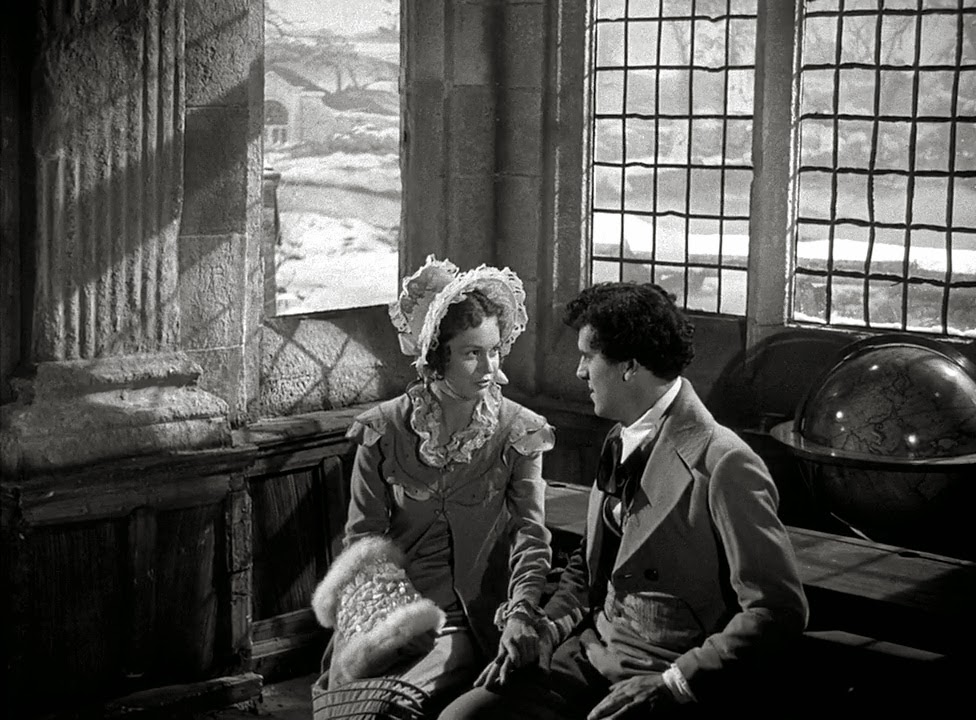
Pip tries to love the cold, quixotic Estrella.