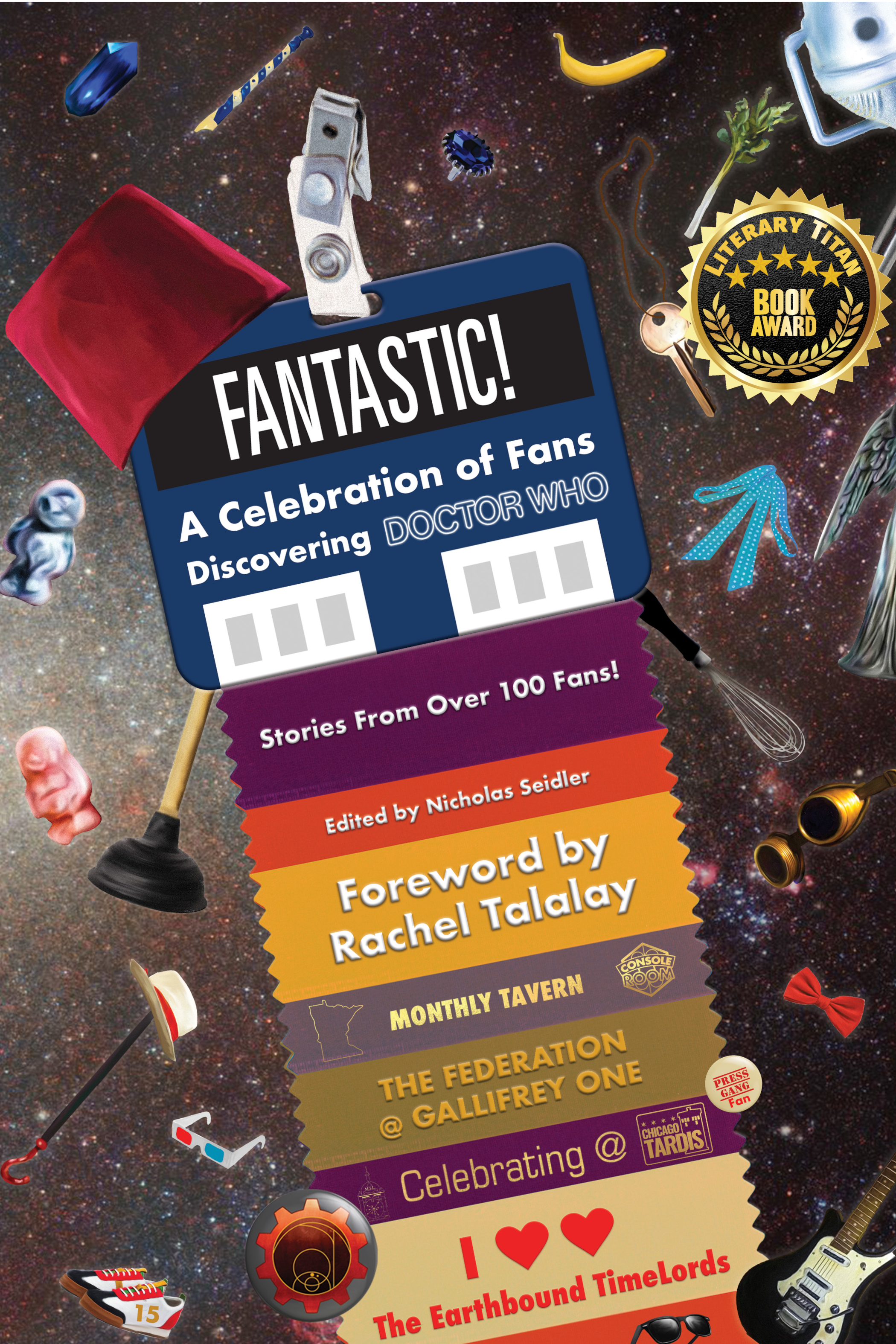
I’m more of an essayist than book writer these days, though I have contributed to quite a number of published books, magazines, and newspapers over the years. My most recent published contribution was an essay about my deep love for the insanely long-running sci-fi/fantasy TV show “Doctor Who” in a new book called Fantastic! A Celebration of Fans Discovering Doctor Who.
I’m very pleased to note that the book has won a Literary Titan Book Award as one of a handful of Gold Award winners for Non-Fiction Books in the month of March. This book was published out of Chicago by fans and for fans of the show and the larger “Whoniverse” of official and unofficial spin-off works. There are a lot of co-authors on this project, and many of them along with the publishers are dear friends — which makes it all more fun.
The Chicago area (and the publishers) are also some of the people responsible for one of America’s three great Doctor Who fan conventions: Chicago TARDIS. If you love the show and haven’t been to the convention, it’s in a superb major (and importantly, warm) hotel, held every year on the anniversary weekend of the show’s debut in November 1963 (it was actually postponed a week from its original planned debut date due to the assassination of President Kennedy).
What’s that, you say? Where can you buy a copy? Well, on Amazon of course, but also directly from the publisher. The book is available in both hardcover and softcover editions for your perusing comfort. There is also an e-book version if you prefer that format. Buy it for my little contribution, buy it to find out how nearly 100 other fans were lulled into this cult, and be sure to check out the forward by extremely talented director (who has also made some incredible contributions to the show) Rachel Talalay.
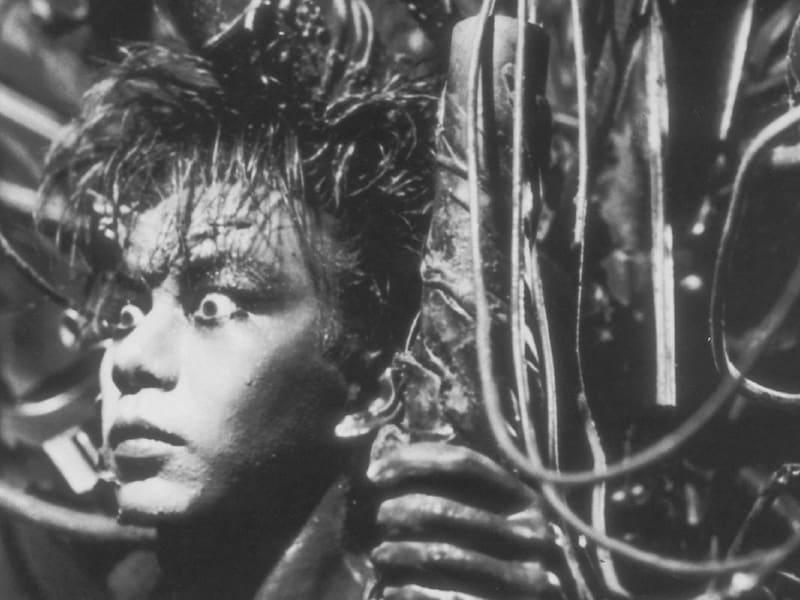
If you’ve seen this film, there’s not a lot I can say apart from some small bits of trivia that you might not already know. If you haven’t seen it, this is the first and perhaps the greatest Japanese cyberpunk/body horror/indie metal/sex comedy film of all time. I haven’t seen either of the two sequels, but that’s the only reason I say “perhaps.”
Perfectly timed with a youth-cultural rising tide of nihilism, low-budget renegade filmmaking, steampunk fashion, and the emergence of “industrial” music, Tetsuo combines it all into a movie that was very much of its moment. I first saw the film at and independent cinema in central Florida a few months after it premiered, and I was simply not prepared for the onslaught of sight and sound I witnessed.
It was in some ways traumatic, in other ways compelling — and it haunted me for a while with a mixture of revulsion and wonder at the time. I have finally dared to take a second look, and I squirmed in places — but could still could hardly bear to blink.
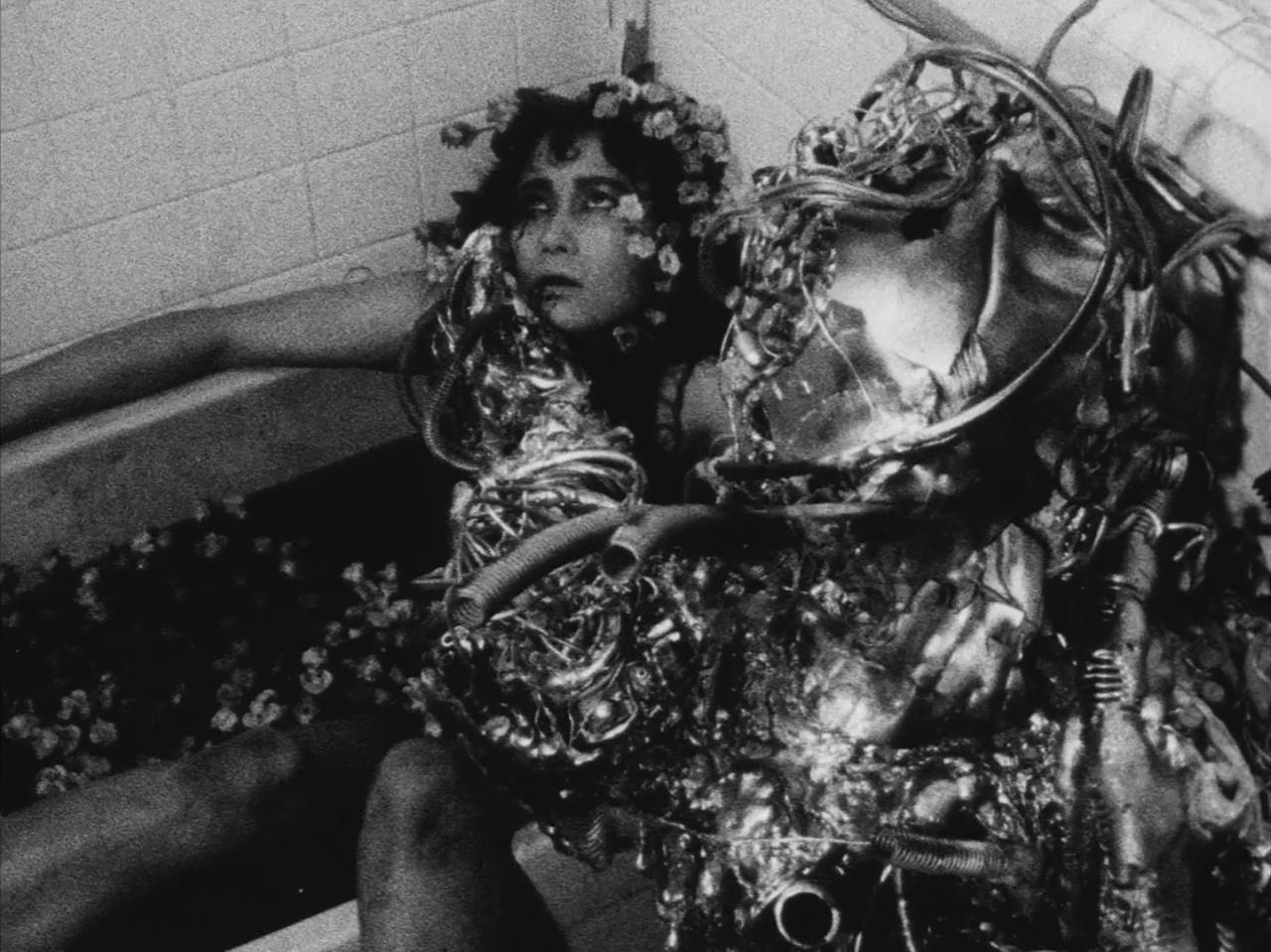
The film is in B&W, and doesn’t look quite as absurdly cheap as it is most of the time thanks to ludicrously frenetic stop-motion effects, brilliant editing, and mesmerizing performances, while still mostly giving its audiences only glimpses of what’s fully happening. The assault of hard music contributes to the urgency and raw emotions on display throughout.
The film went on to be an enormous influence on both musicians and indie directors, and makes those Godzilla movies look like pastoral landscape paintings for children by comparison.
The plot is weird yet simple: we start with meeting a young man (played by director Tsukamoto) who is cutting his thigh open so he can insert some metal into it. His surroundings are composed of lots of scrap metal, and this is a fetish of his apparently.
It goes very wrong, and maggots begin to feed on the wound. Driven mad with disgust, he runs out of his tiny room and into the night, and is soon run down by a “salaryman” (businessman) — played by Tomorowo Taguchi — and his girlfriend (Kei Fujiwara).
The pair investigate the corpse, are revolted, and dispose of the body. Not long after, the businessman notices that he is growing metal out of his body, and soon the girlfriend is transmuting as well.
Slowly but surely the metal is taking over their bodies (mostly done using stop-motion animation), turning them both into metal-human hybrids. This takes a while, and is documented in beautiful detail in the grainy B&W cinema verité style, augmented with the hardened edges of industrial music.
Once it starts, it is a relentless onslaught, and the victims here are bewildered, terrified, and powerless to stop it.
To this point, the film is a hyperactive low-budget body horror escapade, but strangely compelling. We know where this story is going, but it is clever enough to make us want to see it through.
The salaryman’s transformation is much further along by the time the girlfriend turns up, equally starting to transform. They end up being compelled to have what I’ll just call “drillsex,” which at this point provides a much-needed moment of relative levity.
Others have described the film as something of a mash-up between Un Chien Andalou (1925), Videodrome (1983), and Eraserhead (1977) in Japan, and I have to nod and say “yes, but with all these films thrown in a blender while you’re watching them.” Tetsuo vibrates with energy and intensity, never relents from its breakneck pace, and cranks the music up to 11.
Since it’s release, we’ve all started down its path: rare is the moment now where you don’t see someone glued to their smartphone, to the point where we treat it as an extension of “ourselves.” The messages of the film regarding societal sexual repression, industrialized alienation, body dysmorphia, work-life imbalance, and are alternately sublimated and beaten over your head.
Being so hyperkinetic and, well, metal is likely to be overwhelming for any casual viewer, even though the film clocks in at a mere 67 minutes (and thank heavens its not any longer). By the end, you’re not sure if the salaryman and his girl likes what has ultimately become of them or not.
It reminds of a rollercoaster you’ve never been on before: terrifying, exhilarating, and you’re relieved you survived it — and then, knowing that you did, you want to go back and do it again.
Tsukamoto served as writer, director, producer, art director, lighting director cinematographer and editor of the film. A number of the other crew members who worked on the film quit in disgust or in dispute with what Tsukamoto was doing.
It is a visionary, hugely influential and eye-popping film in many ways, but I think most people whose idea of a horror movie is Friday the 13th would probably turn down a second opportunity to see it. That said, a little of that metal fetishism stays with you, in the sense that you can’t unsee it.
We have a Christmas tradition of what I think is the best version of “A Christmas Carol” ever committed to film, the 1951 Alastair Sim version (UK title: Scrooge, and my review of it is here). This year, just to do something a little different, we revisited The Muppet Christmas Carol after not having seen it since its 1992 theatrical debut, just to change things up a bit. The film sticks to the same story (more faithfully than Scrooge, in some ways), but approached the source material in an almost-completely different way: it’s a musical, for starters, and it only has two substantial speaking roles for human beings.
In short, this film is a technical marvel, and the overall story is well-executed — but Caine as Scrooge is curiously flat, and the songs (by Paul Williams) are both samey, and rather meh. I’d certainly recommend this one over my beloved 1951 version when it comes to “suitable for kids, grandparents, pets, and the whole family,” but while it scores well on some fronts, its general over-busyness, the decision to make it a musical, and the changes to the story probably won’t sit well with Dickens fans.
Statler & Waldorf as the Marley BROTHERS (wtf?) was the film’s first overreach in shoehorning Muppets into the story.
I’m not sure who’s to blame for Michael Caine’s mostly-lifeless portrayal of Scrooge; director Brian Henson was of course focused on his muppets, and they uniformally shine here, so he may have decided that Scrooge’s inhumanity to his fellow man should be more low-key until his reformation. Or maybe Caine thought the movie was dumb, and did it for the paycheck (that’s certainly the vibe he gives off for the first two-thirds of the film).
For what it’s worth, I think the film would have worked better with maybe one big musical number at each end rather than making the whole thing a musical, since the songs are, to be frank, unmemorable and just fill time. The Muppets’ recasting into various roles from the story, on the other hand, works surprisingly well, with The Great Gonzo (Dave Goelz) as Charles Dickens (among many other roles) and Rizzo the Rat (Steve Whitmire, again also playing Kermit, Beaker, Bunsen Honeydew and a half-dozen other parts) serving as the Greek Chorus to Gonzo’s Dickens narration. Long-time Muppet veterans Jerry Nelson and Frank Oz take up their usual roles with wit and gusto, with David Rudman handling some minor roles and a cameo from the Swedish Chef.
Gonzo (left) as Charles Dickens narrates, while Rizzo questions the story.
When Scrooge is seen in flashbacks in the early parts of his life (Raymond Coulthard, Russell Martin, Theo Sanders, Kristopher Milnes, and Edward Sanders), the character is more “alive,” a trait Caine slowly picks up on during his ghostly visits, and finally brings to the fore at the very end. The other main human-being speaking role is Fred, Scrooge’s nephew, and actor Steve Mackintosh is just fine in the role, but should have been used elsewhere (we’ll come to that later).
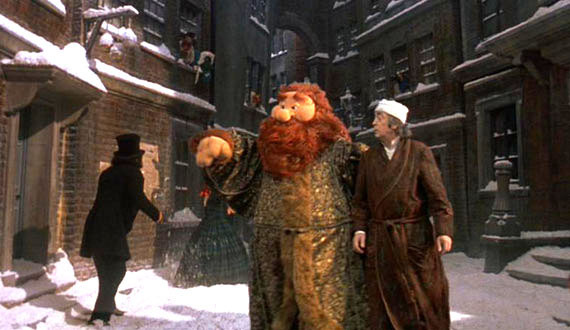
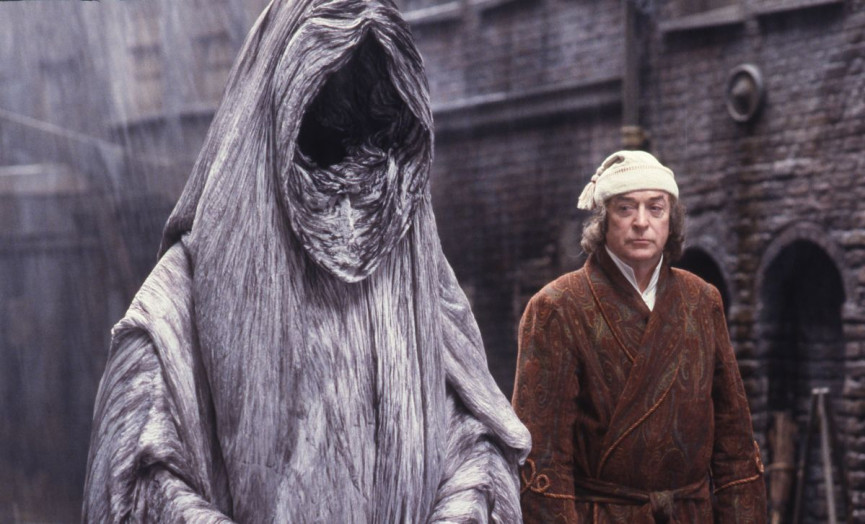
A lot of respect must go to the muppet performers in the lead roles, who have decades of experience with these familiar characters and carry it off on a movie scale just as well as they do on television. Special respect must go to the muppet performers who play the ghosts: the floating and diminutive Ghost of Christmas Past (Karen Prell with voice by Jessica Fox), the giant Ghost of Christmas Present (Jerry Nelson and Donald Austen), and the effectively haunting Ghost of Christmas Yet to Come (Rob Tygner and Donald Austen).
The Ghost of Christmas Present guides Scrooge through London
The Ghost of Christmas Yet to Come is suitably spooky but not TOO scary for kids.
There are also dozens of “little” Muppet characters (mice inside the homes, rats who work for Scrooge’s office, etc), and some giant characters, and the spirit of Jim Henson lives on in these parts and the talented people who bring them to life. In the finale, we get to see over 100 muppets in a panning shot, a very impressive accomplishment that makes them all the more “real” throughout much of the film.
It later came out that English actors David Hemings, Ron Moody and David Warner (the latter would have been my pick), alongside American comic George Carlin (who might also have been quite good) were considered for the role of Scrooge before Michael Caine finally won the role. I’m still not sure if Caine’s low-key misery was his choice or Henson’s, given that this is a family/kids version of the tale, but Caine noted that he based his portrayal on the present-day vultures of Wall Street and the banks, which may account for the more bloodless, cynical portrayal.
This is as evil looking as Caine gets, and he looks more bored than menacing.
The “London street set” used in the film was uncannily similar to the one used in the 1951 Scrooge — modified for scale, obviously — which delighted me, but while I understand the decision to keep the Muppet characters the audience would know using their original voices, the lack of UK accents from nearly everyone apart from Mackintosh and Caine was a disappointment to me, especially for the Ghosts. Given that the story, author, characters, and filming location were all in the UK, I felt like every character (with the Swedish Chef obviously exempt) should have added a UK lilt to their voices.
I haven’t mentioned Kermit the Frog as Bob Cratchit thus far in the film, for two reasons: first, although Bob is the raison d’etre of Scrooge’s reformation, he’s hardly in the film; and two, he doesn’t really communicate Cratchit’s plight because Kermit is a good-natured, happy frog at heart and is incapable of portraying suffering. I can’t believe I’m saying this, but Kermit was badly miscast, and should have played nephew Fred — while Steve Mackintosh, who played Fred, should have played Bob.
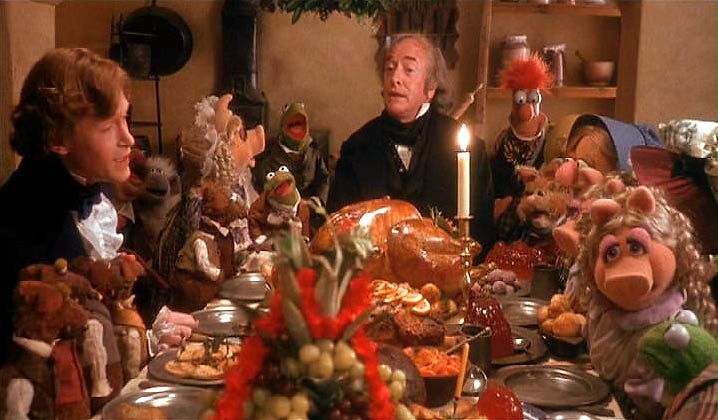
Fred, the Cratchit family and friends, Scrooge, etc – nobody seems poor here at all.
Nitpicking aside, the film does carry a lot of family-friendly humour, and succeeds in reforming Scrooge and being generally heartwarming. It’ll never replace Scrooge for me, but that said it is also nowhere near the worst version of A Christmas Carol committed to film. As a first version for kids to see that might get them interested in the story and other film versions, it’s fine.
The one high mark I will give this version is that, despite the musicality and comedy inherent in it, it does not shy away from painting the capitalist banking system as morally bankrupt and preying on poor people — the point of Dickens’ original tale in the first place, so good on them for that.
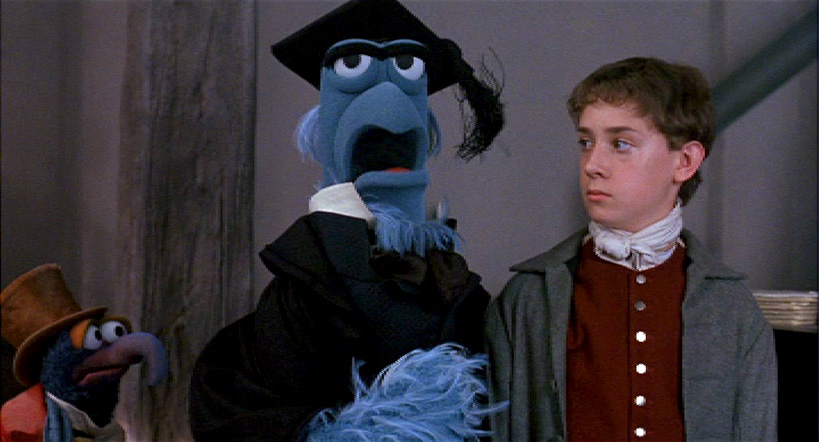
There’s a moment where Sam the Eagle, the All-American type, gets corrected in scene that this is a British story, and does a retake correcting “the American Way” to “the British Way” that I found quite amusing. On the whole, it’s a classic aimed at the smols in your household, it’s cute, it’s fun. There’s an extended version of the movie that restores one cut song, but don’t bother with that — one more song is exactly what this movie didn’t need.
Sam Eagle has a brief but amusing cameo in the movie. Yay!
⭐️⭐️⭐️⭐️ Disney/Pixar Studios Director: Pete Docter
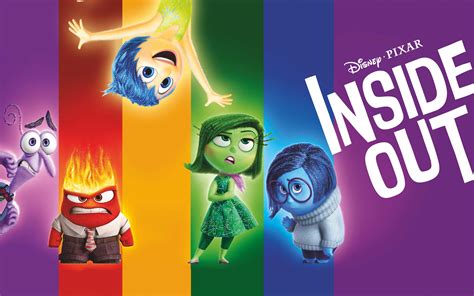
A short review: this is a pretty brilliant film, focusing on Riley, an 11-year-old girl, and her emotional state. It’s also the story of Joy, one of those emotions living in her head, coming to an understanding of the role Sadness should play in Riley’s present life and memories.
The other emotions are good, but kind of backgrounded — except for Anger, played brilliantly by Lewis Black. The parents are fairly minor characters as well, which I felt was a flaw at first, but they’re very much meant to be minor characters — the focus is on Riley. There are occasional representations of what’s going on in Mom’s and Dad’s brains, and those are also amusing.
The film won a (very large) bucketful of awards for Best Animated Feature that year, though only one Oscar — for Best Animated Feature. The American Film Institute and the National Board of Review, however, both picked it as one of the Top 10 films of 2018. It has since become another Pixar family classic, and is really well-suited to show boys and girls at around Riley’s age, or kids of almost any age who are going through the trauma of moving and leaving their previous friends behind.
Riley is, for the most part, a well-adjusted and well-rounded kid with a happy childhood and loving parents. We should all be so lucky, eh?
There is one serious flaw in the story that bothers me: when Sadness touches a memory, she changes it into a sad one from its previous state — she gets scolded for this several times in the film. Oddly, when (let’s say) Anger touches one of the memories, it doesn’t change — nor does it when Joy or any other of the emotion characters touch it. It’s not reeeeaalllly a plot hole as much as it is foreshadowing, but there was probably a better way to handle that.
That said, the most genuine sad moment in the film is a stunningly perfect heartbreaker: Bing Bong, and that’s all I’m going to say about that.
In short, it remains of Pixar’s best original movies. Even better ones have since been made from that studio, but Inside Out is still truly great, still relevant – and really does tug at the heartstrings, elicit emotional responses. For the non-kids this was also aimed at, the film gently gives us parenting advice while also making us recall our own pre-teen years.
The grey tones, minimal lighting, and troubled dinner conversation reflect Riley’s more sombre emotional state as she wrestles with the adjustment to a new town, no friends, and her emotional struggles.
I’d recommend you reacquaint yourself with this film before seeing the new sequel, Inside Out 2. I’m glad they waited nine years to do the sequel.
(Czech title: Cesta do pravěku) dir. Karel Zeman ⭐️⭐️⭐️⭐️
There’s a song by the Norwegian band synth-pop band a-ha on their debut album, Hunting High and Low, called “Living a Boy’s Adventure Tale.” Karel Zeman’s remarkable second feature film, Journey Into Prehistory (US title: Journey to the Beginning of Time) is that phrase fleshed out in colour.
It uses the framework of a group of pre-teen and teen boys thirsty for knowledge and adventures as a vehicle to achieve Zeman’s own boyhood dreams, combining 2D and 3D models, animation, and live-action into a seamless Sci-fi fantasy film. While slow-moving by today’s standards, it is a perfect illustration of the kind of imaginative escapades you would have found in books and serialized magazine stories in the late 19th and early 20th centuries.
For those not familiar with Zeman’s work, his films are some of the most effective combinations of live-action and animation ever done to that point — until a fan of his, Terry Gilliam, began his own filmmaking career. While I haven’t seen many Zeman films, the other two I have seen — the amazing 1962 Baron Munchausen and the jaw-droppingly incredible 1958 Invention for Destruction — are just mind-blowing masterpieces of imagination. Zeman combines his own filmic skills with whimsical tales and brings great stories into the visual world of movies.
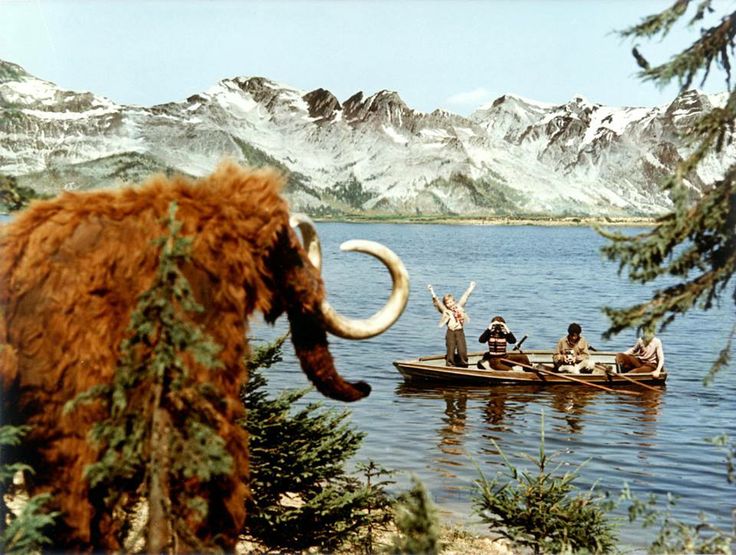
The boys encounter their first prehistoric creature — a curious wooly mammoth.
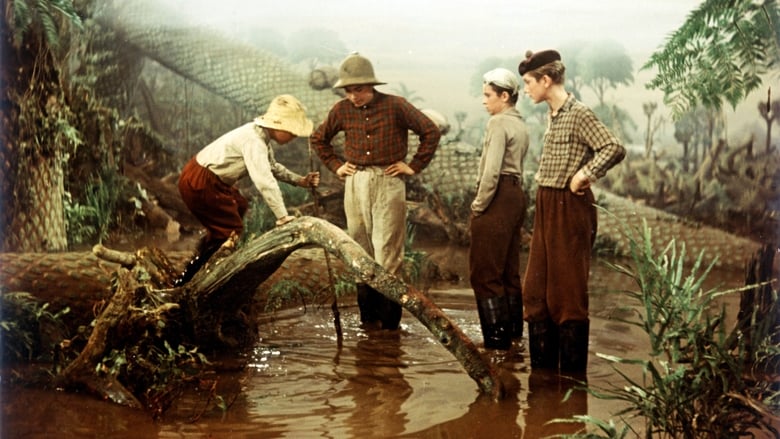
In the film, the boys learn about the prehistoric creature the trilobite by examining the fossil of one. The youngest, Jirka (Vladimir Bejval), is disappointed that there are no living triobites left, so the older boys propose taking a trip back in time to find one — like you do — and take a boat up river into a cave that allows them to pass through it, and into progressively earlier eras of earth’s development as the continue upstream.
The oldest boy Petr (Josef Lukáš) narrates most of the film and does most of the rowing and planning, while the second-oldest Toník (Petr Herrmann) keeps a logbook. Jenda (Zdeněk Husták) and Jirka, the younger boys, help out as they can, with Jirka in particular running off to explore too eagerly, which causes the occasional misadventure.
Jirka (left) is a bit of a jerk-a sometimes, deliberately ignoring safety warnings to explore.
They indeed pass through the four main periods of prehistory (as defined in 1955) — from the Ice Age, to the Tertiary, the Mezozoic and the Paleozoic, and all the way back to Silurian age.
This film is more sparse on the effects compared to Zeman’s later ones, but importantly when special effects appear, they are as realistic as it was possible to make them. Some effects used puppetry, some used a very smooth form of stop-motion, but clever use of shot-matching allowed the actors to travel with beautiful backgrounds and “living” prehistoric creatures very smoothly integrated and fluidly animated.
Along their journey, they encounter and learn about progressively older examples of prehistoric creatures. Interestingly (at least to me), the film makes no attempt to get the boys back to their own time, even after tragedy befalls their original vessel. I don’t want to say more about the plot to avoid spoilers, but the film is both blatantly educational but also filled with moments of danger, suspense, and the single-minded energy of the young to sate their curiosity.
The Czech version runs 93 minutes, and while the pacing makes it sometimes hard to stay on board with the slowly-unfolding story, the promise of another effects sequence soon will hold most viewers, and also curiosity about how the story will be resolved.
A life-size Stegasaurus model was built for this sequence.
A US version was created later, using a new intro and outro where the boys (replaced by US actors shot only from the back of their heads in the opening and end sequences) imagine the whole adventure while visiting the Museum of Natural History, and stretches credibility pretty hard. The recut US version runs only 84 minutes, dropping some exposition to get to the effects more quickly.
The story is a mash-up of Jules Verne’s 1912 novel The Lost World and a Russian novel called Plutonia from 1915, both obviously influences on Zeman (he would go on to a brilliant and straight-up later film combining several Verne stories named after the primary story its based on, the novel Facing the Flag).
For many years, the existing prints of Journey Into Prehistory were of such low quality that the film almost passed into unseen obscurity, following its initial worldwide success. Thankfully, the film has since been digitally restored and repaired, so we can see it the way Zeman intended.
A friendly creature from long before the dinosaurs
dir. Brian Desmond Hurst (US title: A Christmas Carol) ⭐️⭐️⭐️⭐️⭐️ 52-week film challenge, film 50
Naturally we have to do at least one Christmas movie in the 52-week challenge, and for me of course it would be this one. I watch this movie every year, and never get bored of it — always admiring something new, like the lighting of certain shots, the long shadows Scrooge casts, details of Bob Cratchit’s family and so on endlessly.
There are many decent-to-excellent film versions of “A Christmas Carol,” but this one is far and away my favourite, in large part because of its marvelous casting, superb performances (particularly from Alastair Sim as Scrooge), and striking B&W cinematography. Every single member of the cast is on point, camera angles are uniformally well-chosen, the musical score is quite striking (more about that later), the supporting characters are also very memorable, and in short this film is perfect in all the ways — even the additions to Dickens’ story are so well-done you’d hardly believe, for example, that there’s no Mr. Jorkin (Jack Warner) in the original novella.
Mr Jorkin (Jack Warner, middle) introduces Young Scrooge (George Cole, right) to his future partner, Jacob Marley (the film acting debut of Patrick McNee, left).
I sincerely believe that if Dickens could be brought forward in time to watch his story on film, this one would be the one most likely to meet with his approval. Certainly he’d like it better than either of the two best-known previous attempts, the comical short silent version from 1910 or the mediocre full-length version starring Reginald Owen from 1938.
Everyone thinks they know the story of “A Christmas Carol,” but relatively few have ever actually read the original work. Changes required to make the story more visual in the various film versions have added elements to the original story, and so does Scrooge, but it is a testament to the skill of screenplay writer Noel Langley that the joins are largely seamless to anyone this side of a Dickens scholar.
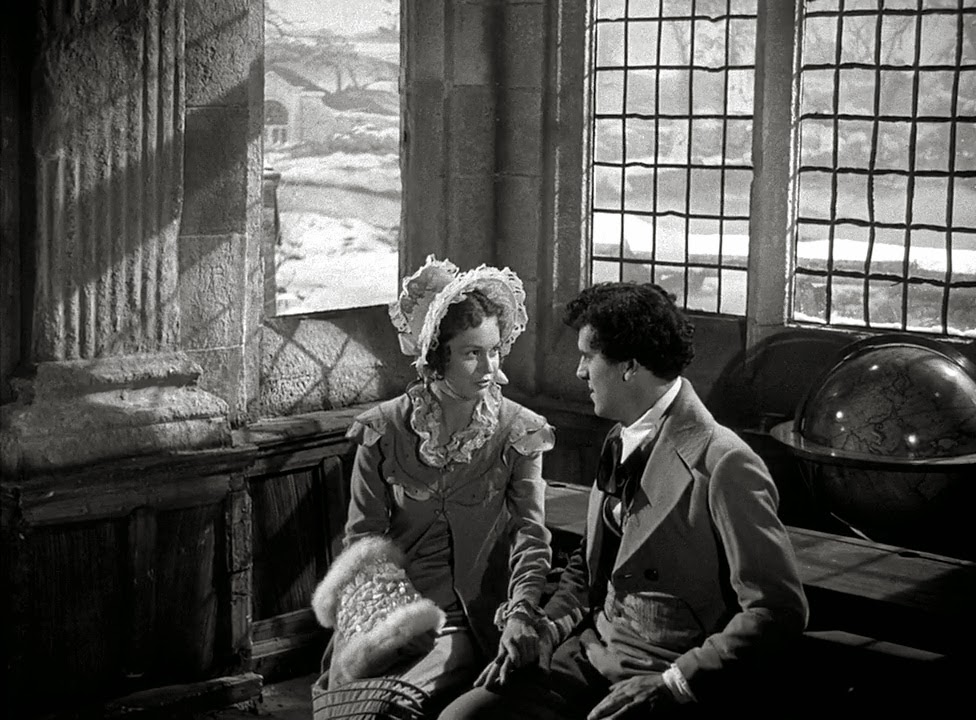
Scrooge wasn’t always a jerk: he was always kind and tender to his sister Fanny (Carol Marsh)
In particular, Dickens’ original social commentary is strongly intact in this version, and resonated deeply in postwar Britain of the early 1950s, when the country struggled with crushing debt from the war, and continuing rationing and austerity. Also preserved is traces of Dickens’ Christian faith, and while explicit in some moments it doesn’t overshadow the message of social justice and the responsibility of the the well-off to alleviate the suffering of the poor.
Marley’s ghost (Michael Hordern) tries to show Scrooge the suffering of the poor, but it’s not (yet) effective.
Aside from the radiant performance of Alastair Sim, who set a bar of believability in both pre- and post-reformation Scrooge that no other actor has equaled, special mention should be made of Mervyn Johns as Bob Cratchit, Hermione Baddeley as Mrs. Cratchit, Michael Hordern as Jacob Marley, the incredible Ernest Thesinger as the mortician, Miles Malleson as Old Joe, and of course Kathleen Harrison as Mrs. Dilber, another performance that will never be bettered. There are a wealth of character actors in this, all doing their British Character Actor thing to an absolutely flawless standard.
Special mention too must go to Richard Addinsell, who gave the film a very booming, menacing score that softens all the way to down to music box-like Victorian lullaby in places, and throws in a traditional ballad (“Barbara Allen”) for the film’s climax. Finally, the combination of Ralph W. Brinton (the art director) and C. M. Pennington-Richards (the cinematographer) produce a detailed but very dark style where the shadows are long, the lighting is sparse (until Scrooge’s reformation), and the harshness of life in Dickens’ fable is not shied away from — it is simply gorgeous to look at, and downright spectacular if you have a OLED high-definition television.
Glyn Dearman as Tiny Tim, enjoying a splendid display of Victorian toys.
In these current days of increasing western poverty and misery, with inflation making the working class ever poorer and more angry, the film again becomes more relevant to complement its timeless moral. To quote Bob Cratchit, “it is a perfect pudding!”
dir. Rachel Talalay ⭐️⭐️⭐️⭐️ 52-week film challenge, film 49
This review has to come with three disclaimers:
I have never read the “Tank Girl” comic (though it looks like something I’d enjoy). I am reviewing the film strictly as a movie.
I have met and chatted with the director, Rachael Talalay, about her career, US-Canadian immigration issues, and more recently I was present in Chicago for the debut of her latest bit of TV work (for Doctor Who, as it happens), but this doesn’t influence the review too much.
I am aware that the film was, in parts, heavily re-edited by the studio.
With that out of the way, let’s dive in.
Hoo boy, has Tank Girl ever aged well. On its original release, it didn’t do well financially, though it later earned cult status on the strength of its strong “feminist futurism” and humour. It is almost, but not quite, a mirror-universe version of 1984’s The Adventures of Buckaroo Bonzai Across the Eighth Dimension, only with far fewer goatees and more mutants, who eventually form an alliance to take down the mad big bad (Malcolm McDowell, in this case).
Like the earlier film, it has a definite aesthetic that reflects the decade in which it was made, is funny but not meant as a parody, and does some excellent world-building that pays homage to its influences. In the case of Tank Girl, the world of 2033 looks increasingly likely to come to pass — only instead of a comet directly hitting earth causing the climate to change, we just have man-made climate change. I can see this “future” from my house, so to speak.
A hasty voiceover from yet-to-be Tank Girl herself (Lori Petty) sets up the story: since the comet hit (presumably with enough force to push the earth closer to the sun), it hasn’t rained in 11 years, and the world has mostly turned to desert. The (male) elites have taken control of the enormous reservoirs of water underneath the sands in the only livable area left (the former Australia), thus controlling nearly all of the remaining population.
Director Talalay with star Lori Petty.
Some Mad-Maxian-type rebels live “free” in the outback in a commune, relying on finding and tapping into parts of the reservoir to survive. Although the head of the monopolistic Water & Power Corporation, Kesslee (McDowell), is trying to find and destroy these water pirates, the rebels fear another enemy much more: The Rippers, who are kind of armored super-soldiers operating from a secret base.
Buck is quickly established as a sarcastic rebel even before the commune is attacked.
The Rippers attack both W&P and occasionally the rebels under cover of darkness. Insert your own analogy to the aboriginal native populations of various countries (and of course capitalism) right here.
W&P discover the last well the commune has tapped, and attack the commune (which is decorated like every 90s teen’s dream) with corporation troops, killing many of the rebels. The body count includes Rebecca Buck’s (Petty) boyfriend Richard (Brian Wimmer) and, after a brave fight, capturing Buck and a young girl from the commune named Sam (Stacy Linn Ramsower).
Sam (L) and Rebecca
In a classic trope, Kesslee is fascinated by Buck’s spunk and sarcasm — and instead of just killing her, instead enslaves her. When she continues to rebel, he subjects her to various tortures.
Buck meets a fellow prisoner, who Buck nicknames Jet Girl (Naomi Watts) because she is being used as a jet mechanic by the cruel (read: rape-minded) troops. Jet Girl urges Buck not to fight back, but Buck is having none of it — and saves Jet Girl from a stalker trooper by pretending to be Jet Girl’s jealous girlfriend.
Kesslee decides to use the rebellious Buck to lure the Rippers out into the open, but the plan backfires, and Kesslee is gravely injured. Buck gets a tank (and is now Tank Girl), Jet Girl steals a jet, and they seek shelter and spend time modifying their weapons and plotting to break W&P’s control of the world’s water.
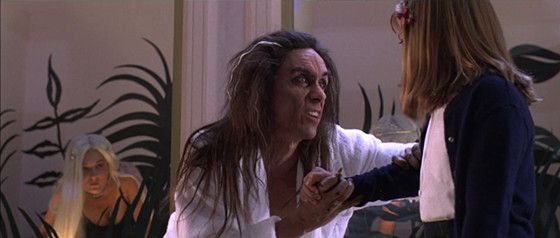
Their success prompts Kesslee to use the little girl Sam as both a hostage and bait, and puts the child in serious danger at one point — I don’t want to say more than that, but Iggy Pop is involved, and not in a good way. The Girls (Tank, Jet, and the little-seen Sub) get wind of this, and redouble their efforts.
Iggy Pop as a (thankfully unsuccessful) pedophile.
The ladies form an alliance with the Rippers, who we discover are mutated men (and the occasional dog that was first mutated into a man) who have been fused with kangaroo DNA (because Australia!) into a funny-looking mercenary force originally created by W&P before being largely wiped out for rebelling. Kesslee hopes their united force will attack so that his army can crush them all, but things don’t quite go according to plan.
That’s Ice-T on the left there, as T-Saint — one of the smarter and more poetic Rippers.
The film might possibly err a little too much on the comic side, but the look and set pieces are aesthetically pleasing throughout. As mentioned, looking at this almost 30 years after its initial release, it seems prescient and less unrealistic than it probably did in 1995. Indeed, “Kesslee” rhymes with “Nestle,” and if you don’t think that evil corporation isn’t trying to buy up as much of the fresh water supply as it can, you might want to read up on that topic.
In the meantime, the rise of women as role models, heroes, rebels, and the leads of non-drama films over the last three decades makes Tank Girl ever more relevant as the years go by. When it was first released, some critics and most audiences didn’t quite “get it,” but the tween/teen girls who got to see it took it into their hearts, and built a cult following around it.
The film turns out to have had enormous staying power as an influence, both outside and inside Hollywood. Although the film flopped in its theatrical run, it did okay with critics — and I think it has since garnered enough respect that a Blu-ray release beyond just the US would be justified.
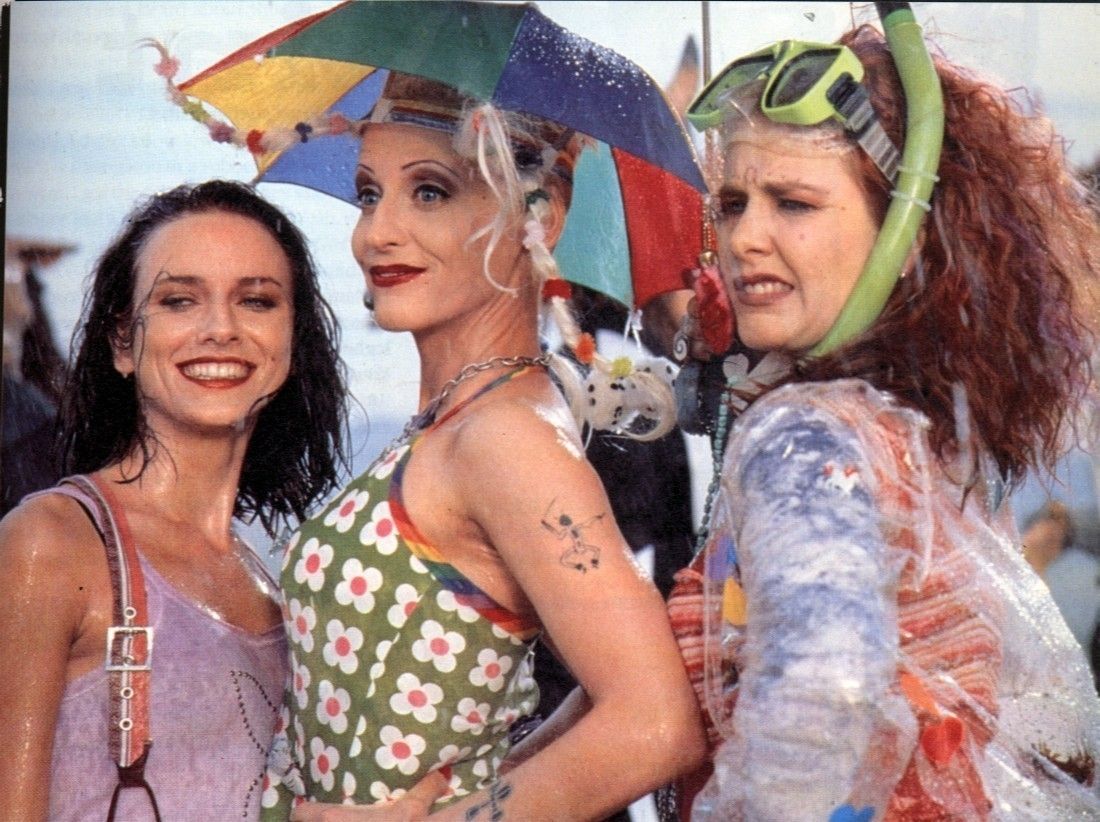
The “Girls” together — (L-R) Jet, Tank, and Sub
If said Blu-ray could also include a ”restored” version that undid the watering-down cuts and edits the studio insisted on (among many other things, reducing Jet Girl and the blink-and-you’ll-miss-her Sub Girl’s roles, not to mention changing the ending), I think it could even be a hit on the revival circuit as well. As Ms. Talalay has gone on to a strong career in TV and film since then, I look forward to asking her about the “Kesslee” name, and the possibility of a “Director’s Cut,“ when next our paths cross.
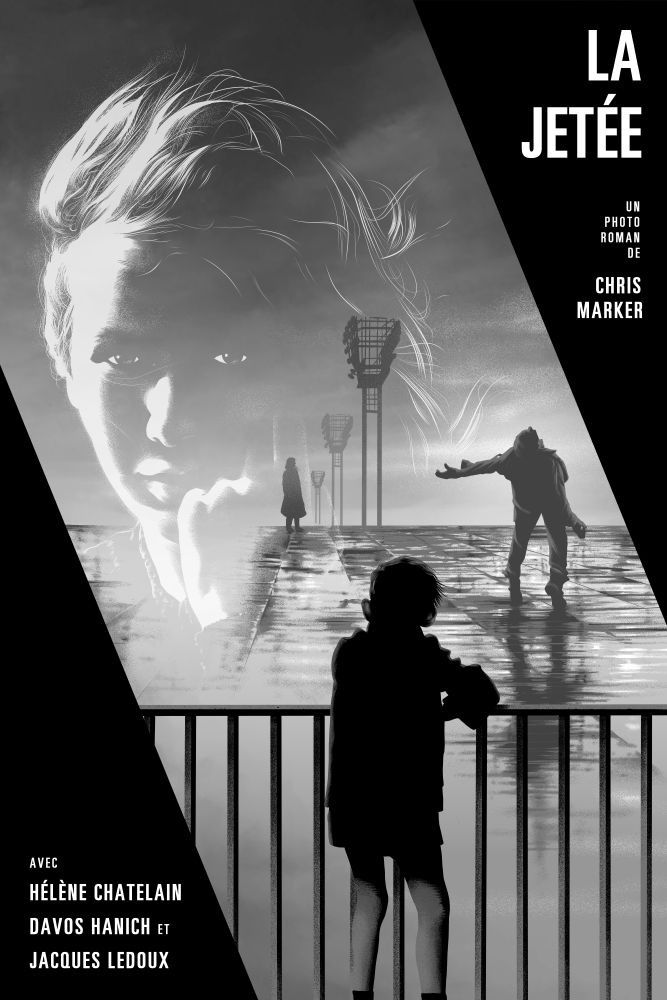
dir. Chris Marker ⭐️⭐️⭐️⭐️⭐️ 52-week film challenge, film 46
I believe I am correct in saying that La jetée, at only 28 minutes long, is the shortest film in “Sight & Sound” magazine’s listing of the greatest films in history (currently ranked at #67 in the critics’ poll, but #35 in the directors’ poll). Nonetheless, its impact on the medium of film, on storytelling, and on the notion of “science fiction” is significant.
Some wag once called it “a slide show with an IQ of 180,” and they’re … not wrong. Except for a small moment of moving images, the film is composed almost entirely of photographic still images, where the viewer must study what’s briefly on screen carefully to extract as much information as possible, combining the visual information with the audio cues and narration. Of course the medium of film is itself a series of photographed still images, but show quickly enough that the illusion of movement, of synchronised sound, of emotion and performance, is fluid.
Here, director Marker slows down the flow to create an irony, rendering it as a unique method from which we get our information; we infer, rather than see, the passage of time between each image — that interesting process in our minds where our vague memories and our dreams cross each others’ paths.
The “story,” such as it is, is stark and minimal: in a bleak post-nuclear dystopia sometime after World War III, a man is selected by a small group of scientists (German, it seems, given the whispering that occasionally appears behind Jean Négroni’s vital and nearly poetic narration), to engage in an experiment to save the present by calling on the past and the future to provide a solution — induced psychological “time travel”
The man has always held some strong mental images to keep his memories intact, and these scientists can see into people’s minds, so they have picked him. While being held captive, he is injected with something to prompt his (mental) return to the past, before the current situation, where he meets a woman not unlike “The Time Traveller’s Wife” — a figure not part of his memories, who accepts each new visit without question, calls him “her ghost” and builds a bond of trust and friendship with him.
Having successfully sent him into the past, the scientist then attempt to send him into the future, with far more obscure results. The man, seduced by the woman of his “dreams,” appears to “escape” his present and live permanently within his memories with this woman — combining the hazy glow of happy memories with this new dream-like woman, forging his own personal paradise.
Despite the vagueness that is part and parcel of this story, there is a definite ending I won’t spoil. The narration acts as a hypnotic element drawing the viewer in alongside the score — the visuals, the narration, the score, and the still-image juxtaposition of past, present, and future all interplay with each other to create a remarkable journey that is likely to stay with viewers as they reassess their own recollections, dreams, and reality.
Yes, the Terry Gilliam film 12 Monkeys is something of an expanded and re-envisioned remake of La jetée, but I’d encourage anyone who hasn’t seen that (or even if they have) to sit with La jetée and let it mess with your own head a little bit.
Even the title is a bit of a mind-slip: Literally, it refers to the jetway at Orly airport (which we repeatedly come back to), but it’s been pointed out to me that the could be seen as a play on là j’étais, which translates to “there I was.”
(1973, dir. Gordon Hessler) ⭐️⭐️⭐️⭐️⭐️ 52-week film challenge, film 41
The quick summary: The Golden Voyage of Sinbad is as good as Sinbad movies with Ray Harryhausen effects get. This one has everything: a great actor for the title role (John Phillip Law), an intriguing and well-played villain (Tom Baker), a beautiful love interest (Caroline Munro), some comic moments alongside the race to victory, and a great selection of original Harryhausen monsters to complement a well-constructed fantasy adventure tale.
This was the second of the Columbia Sinbad movies, a revival of sorts following the first one, 1958’s The Seventh Voyage of Sinbad. While it would really be nice to someday get a mainstream Sinbad movie where the lead was played by an actual Muslim from the actual region in which these stories are set, John Phillip Law charismatically embodies the qualities of the heroic wayfarer, unlike his successor (my review of Sinbad and the Eye of the Tiger is here).
As mentioned there, for the month of November I’m reviewing movies that feature actors who also played the title role in the TV show “Doctor Who.” While Tom Baker may have one of the longer filmographies of that select group of actors, there are only a handful of films where he had such a large role, and this one is a personal favourite.
What’s great about this film is that, while it is a little slower-paced that modern films in terms of setting up the story location, major characters, and conflict, it is well-directed and tightly edited to to ensure that every scene in the film has a purpose that serves the overall story — the main failing of Eye of the Tiger, in my view.
In this tale, we find Sinbad just doing nothing in particular at sea, when along comes a strange flying creature with a shiny bauble. One of his men injures the creature via bow and arrow, causing it to drop the shiny item — a strange piece of jewelry that looks like some kind of puzzle part. Sinbad decides to wear it as a necklace, despite warnings from his crew.
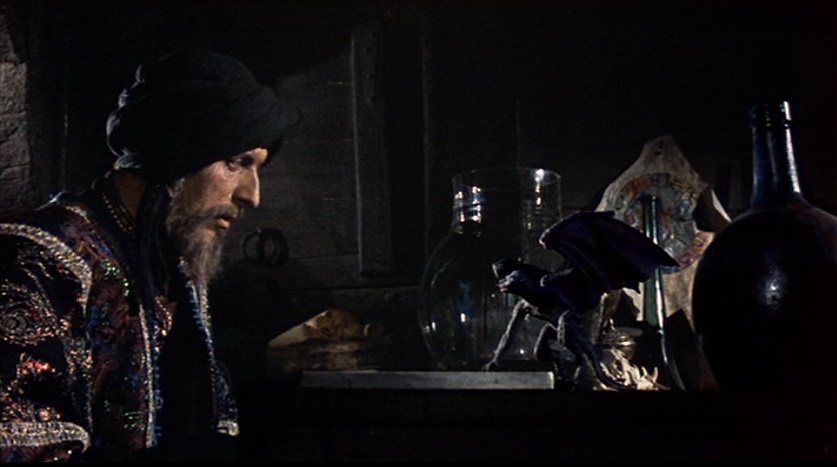
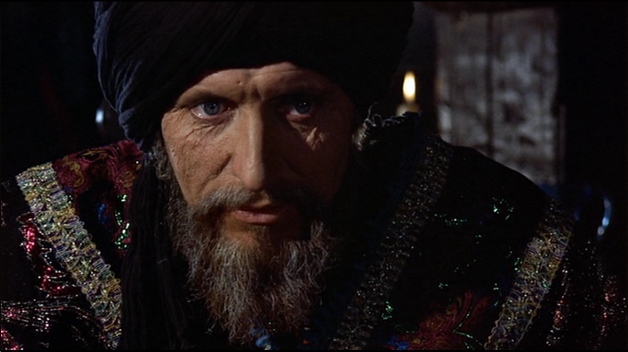
That night, he was strange dreams, including a disguised but ominous man calling his name, and a sequence involving a dancing girl with a tattoo of an eye on the palm of her hand. A storm comes out of nowhere to knock the ship off course, taking them to the land of Marabia, where Sinbad encounters the ominous man, who turns out to be the evil magician Koura (Baker).
Koura demands the puzzle piece back, but Sinbad escapes with it into the city, where he meets the Grand Vizier (Douglas Wilmer), who wears a golden headdress/facemask to hide his disfigured face (from an earlier attempt by Koura to take over Marabia). The Vizier has a matching piece of the jewelry, but there is a missing third that, when matched with the other two, forms a map to the Fountain of Destiny, on the lost continent of Lemuria.
(L-R) Sinbad, Haroun, and the Grand Vizier
Those who can bring the three pieces back to the Fountain will receive youth, a “shield of darkness” (invisibility), and “a crown of untold riches.” Sinbad agrees to help the Vizier find the third piece, but unbeknownst to them, another of Koura’s flying homoculuses has seen and heard their conversation, and related it magically to Koura’s castle. They discover and kill the homoculous, but the race to Lemuria is now on.
Koura with one of his homoculus spies.
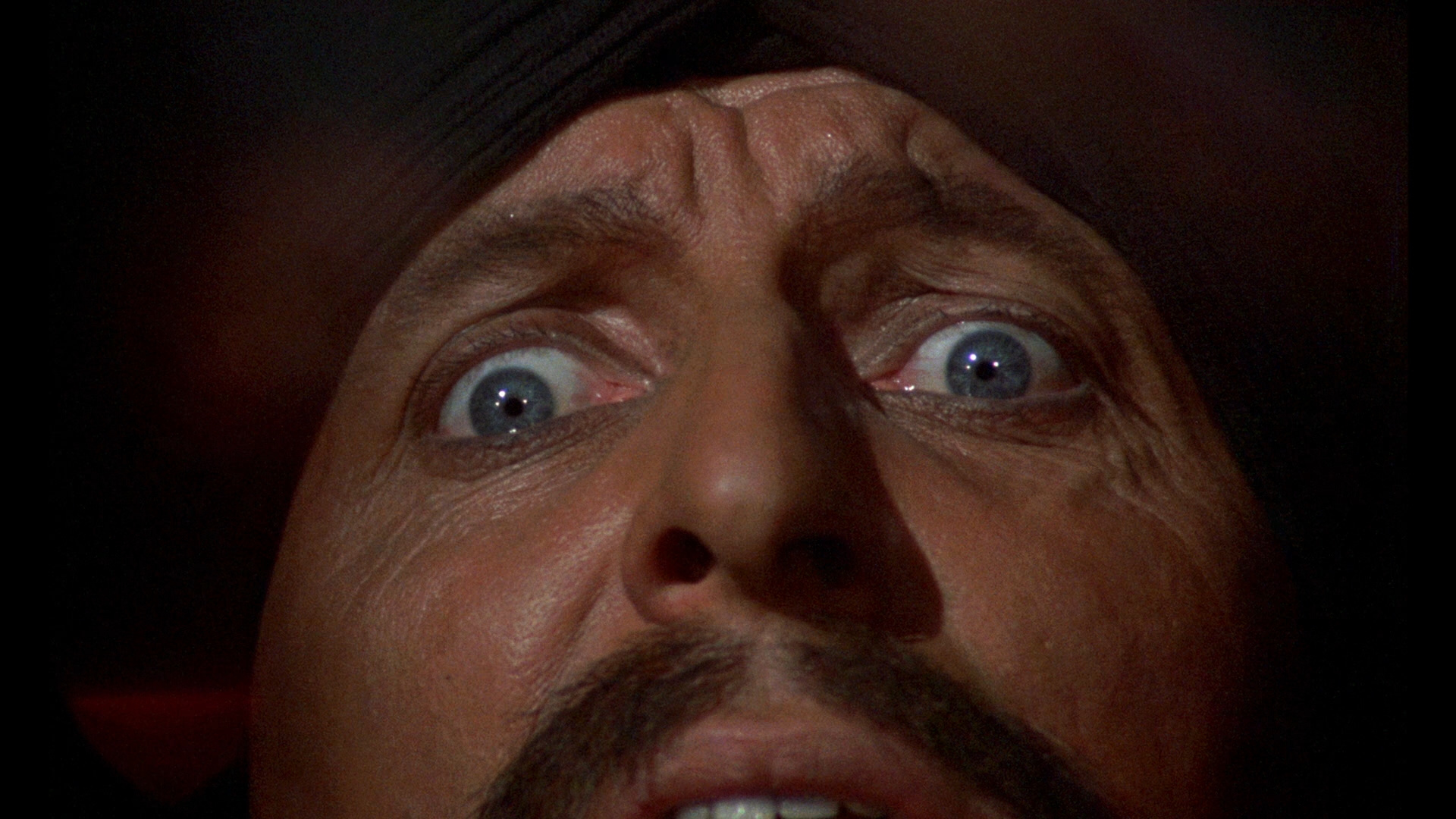
Koura is no ordinary magician; he is steeped in the black arts, and calls upon the forces of darkness for his magic — and each time he does so, the darkness takes some of his life force, visibly aging him in small or significant ways, depending upon what Koura calls for.
The aging begins, and gets worse Koura grows more desperate
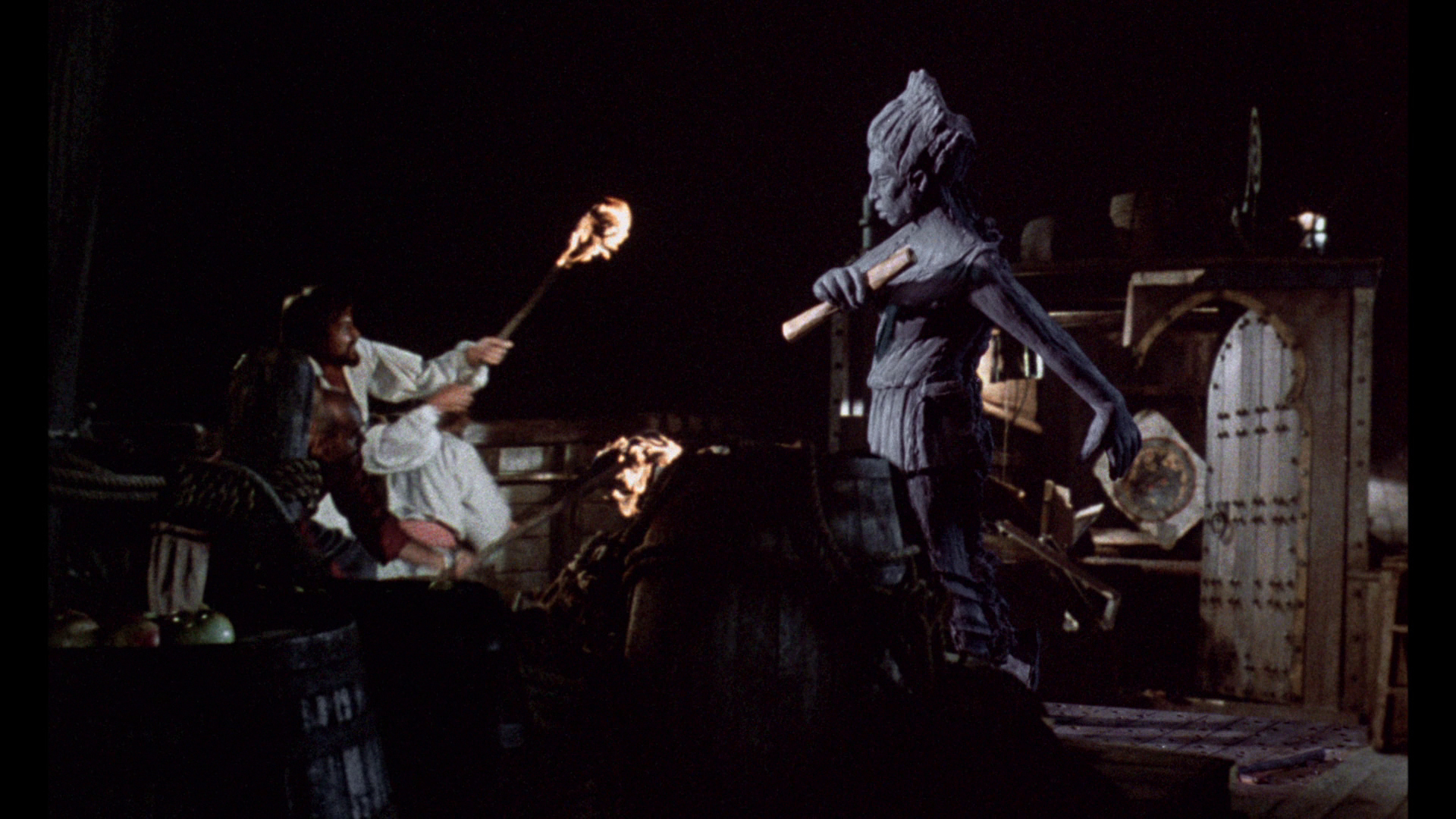
In a later scene, Koura is desperate to avoid crashing on some rocks that Sinbad knows how to navigate around, and casts a spell to bring the figurehead of Sinbad’s ship to life, so it can steal the map and bring it to Koura. This is, as you might expect, a big “ask” of magic, and when the (terrific) sequence is over, his assistant Achmed (Takis Emmanuel) is shocked to see that Koura is much visibly older.
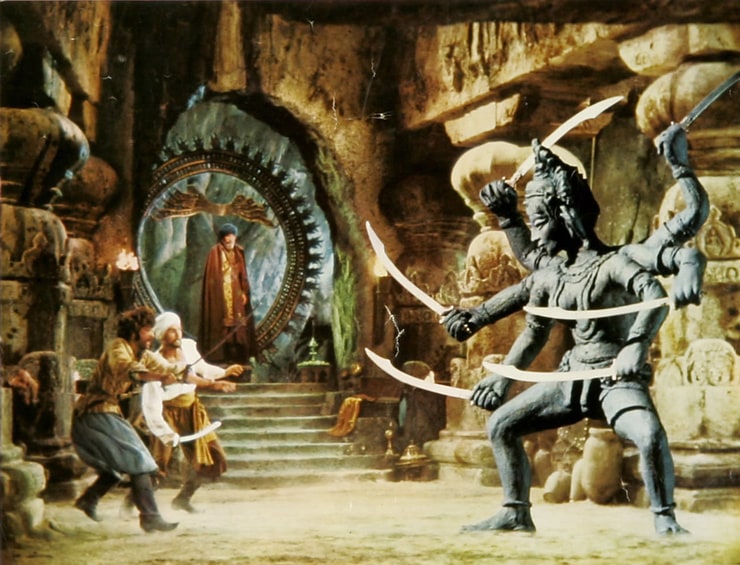
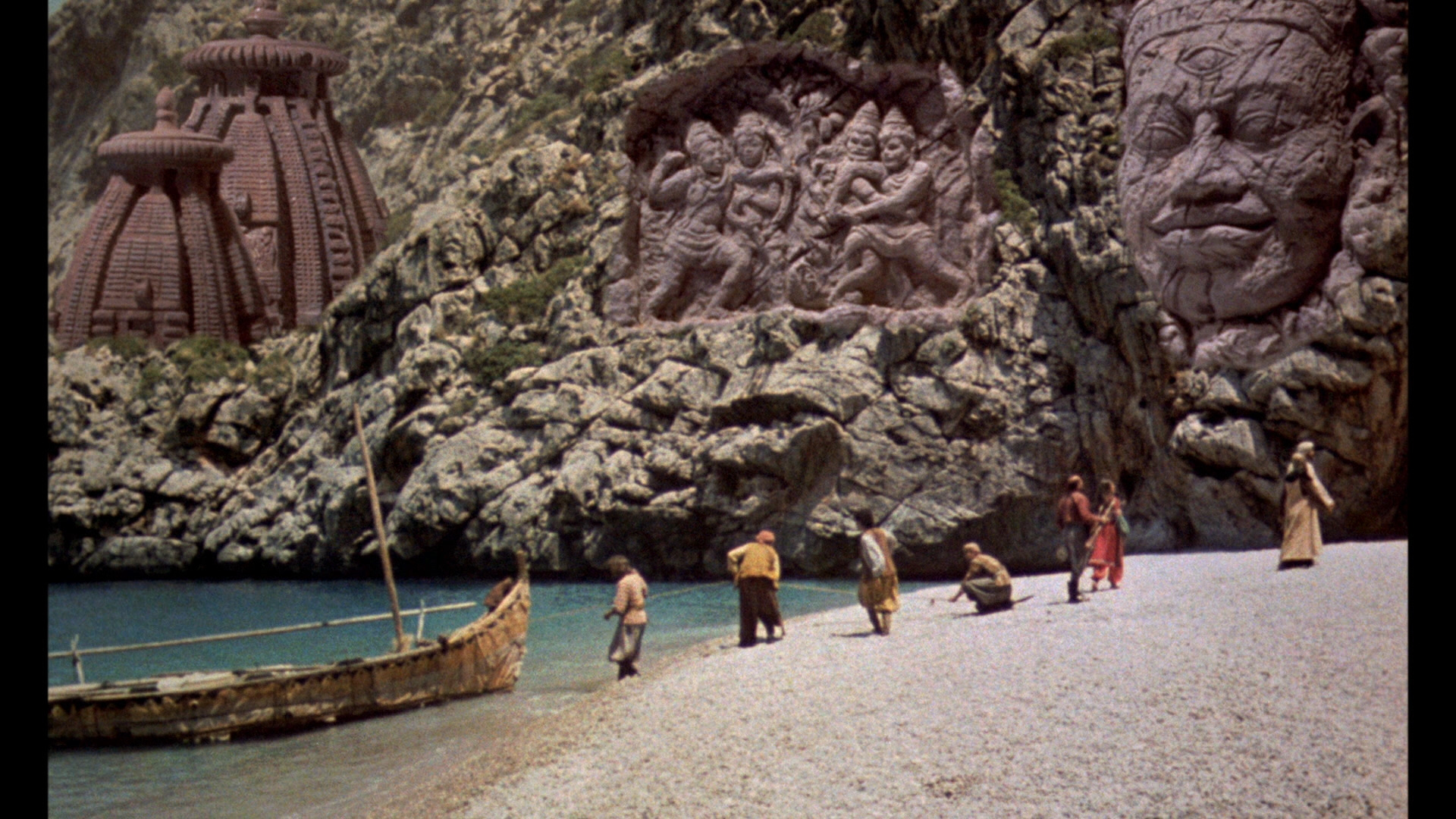
The chase continues through a series of interesting set-pieces, and the third bit of the jeweled map does at first fall into the right hands — following a magnificent bit of Harryhausen work as Kourna animates a statue of the six-armed god Kali to win over the natives, with the statue fighting Sinbad’s main crew simultaneously — but Koura steals it and takes the completed ornament to the Fountain, where he appears to win the day (going so far as to receive the youth that was promised, which restores him from the very old man he has had to become to try and stop Sinbad).
Koura also receives the shield of darkness, which prevents Sinbad’s attempt to steal the completed ornament back, but Koura makes the fatal mistake of hiding inside the fountain, where his shadow can be seen, and is then killed by Sinbad before he can claim the third prize. Sinbad thus wins the crown of many riches, but chooses to give it instead to the Vizier, where it restores his face and melts away his mask, making him the new Sultan. Now free to marry Caroline Munro’s Margiana, Sinbad and his friends sail off for Marabia.
The Vizier’s true face is restored by the Crown of Untold Riches
As I mentioned in my review of Eye of the Tiger, that film could be edited way down to reduce the padding and come out a much more exciting 90- to 110-minute film. Golden Voyage proves this theory by being much tighter and faster-paced, and clocking in at … 105 minutes.
Once you accept the (excellent) stop-motion effects work, the movie just carries you along on its quest with a rich set of characters, obstacles, and — let’s face it — cleavage (courtesy of Ms. Munro). It’s also worth noting the film’s b-plot — a merchant who enslaves Margiana begs Sinbad to take his drunken, useless son on the voyage to make a man of him, in exchange for Margiana and 400 gold coins.
Initially operating strictly as comic relief, the son Haroun (Kurt Christian, who would go on to play one of the villains in Eye of the Tiger) does complete his story. By the end of the film, he is a keen sailor who loves the thrill of adventure.
Even by today’s standards, The Golden Voyage of Sinbad is still an enjoyable Saturday afternoon adventure, anchored by Law’s credibility in the Sinbad role, the judicious use of comic moments to move the story along, and in particular Baker’s strong performance as Koura (so much so that it led “Doctor Who” producer Barry Letts to cast him for the title character in early 1974).
Baker delivers both on the evil the part requires, and his own powerful charisma to rivet attention on Koura without ever stealing the spotlight away from the story. Yet, he still gives us a markedly different performance here than he would bring to the more heroic Doctor, where he created the first truly “alien” incarnation that remains one of the all-time favourite takes on the character. It’s a pity he didn’t get the chance to do more movies, but at least in one of them he got to play Rasputin — yet another definitive interpretation, in my view.
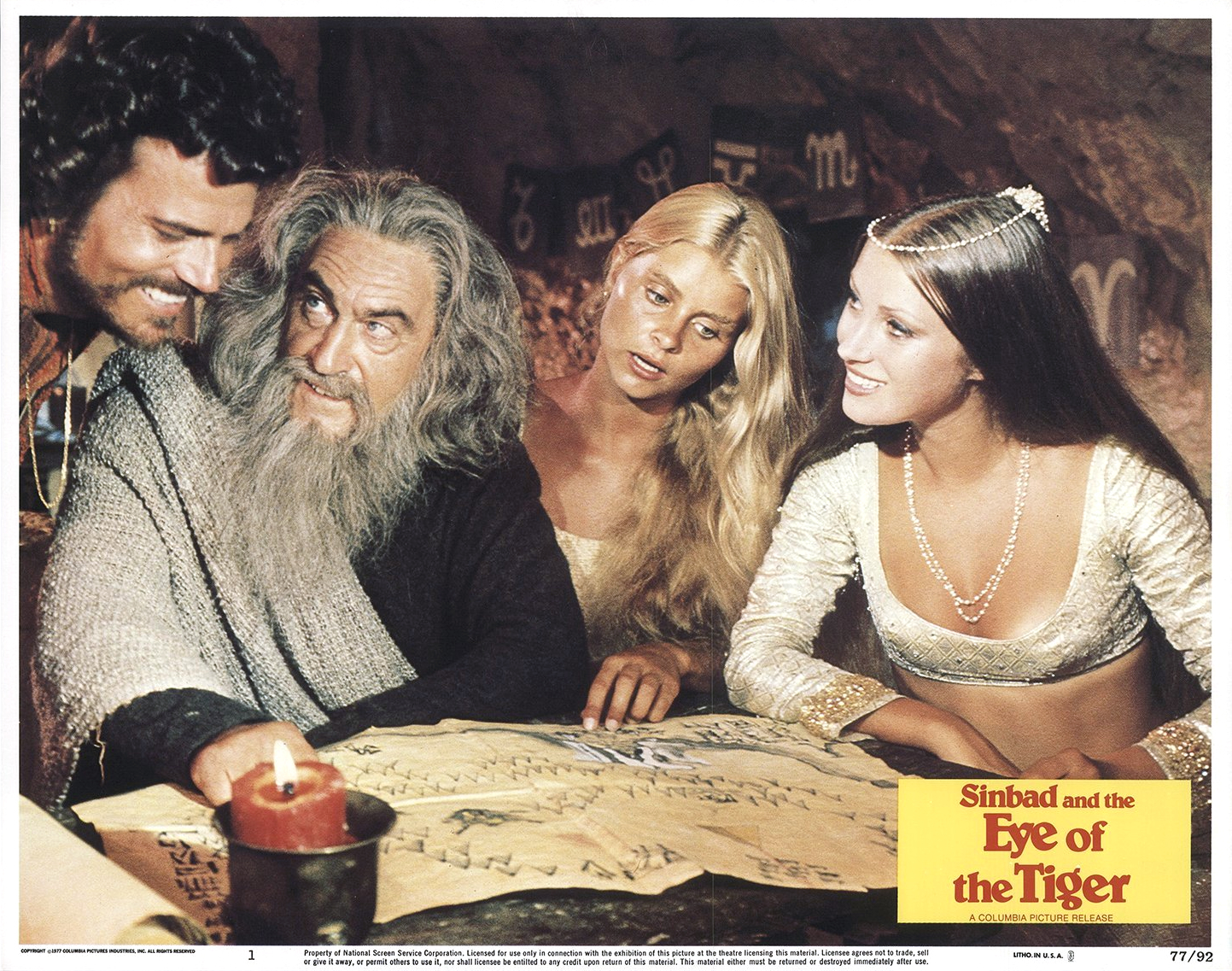
Continuing with our theme this month celebrating the 60th anniversary of “Doctor Who,” we continue to spotlight films that feature actors who played The Doctor over the years for November. This time, it’s the last Harryhausen Sinbad movie, Sinbad and the Eye of the Tiger, featuring one of my absolute favourite Doctors, Patrick Troughton, in a major role.
It’s a pity this is probably the weakest of the three Columbia Sinbad movies, but it had a surprising amount of bad luck behind it. Patrick Wayne (son of John) is a handsome enough Sinbad, but … no charisma. He definitely puts in the work on the buckling of the swashes and such, but he never comes off as the lead of the film, or even as the hero of the story. Even Sam Wanamaker couldn’t pull a convincing performance out of him.
Another issue with this particular entry in the Sinbad series was that they literally gave animator Ray Harryhausen too much to do, resulting in a mix of excellent work and some clearly rushed and less-well-done effects. As a result, the story really drags, and has difficulty building any tension.
But the killer problem is that, as luck would have it, the film opened just three months after the truly revolutionary (and by comparison, breakneck-paced) first Star Wars movie, that instantly made Harryhausen’s mostly-great work look very dated by comparison.
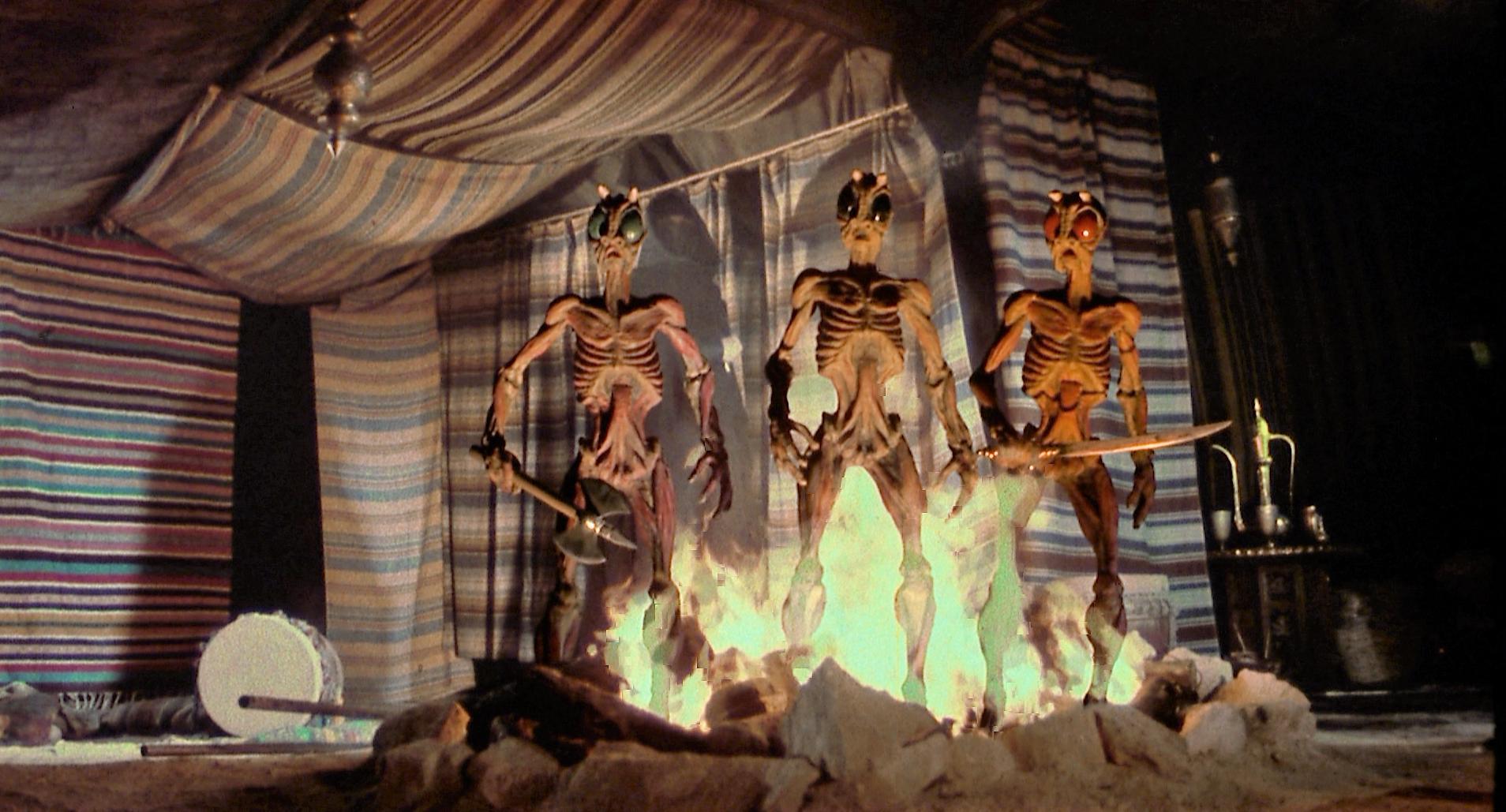
Fans of Harryhausen’s incredible stop-motion work get a feast with this picture, and point to some of the creatures as among his best work — and they’re right, so if you want to see those you kinda have to suffer through the non-animated slog. The best of these effects are really enjoyable, but there are perhaps too many sequences of them for one movie, and the ghouls we see early on seem very lazy —- since they strongly resemble repurposed skeleton soldiers from The Golden Voyage of Sinbad.
No, they’re not quite the same, but too close to the Skeleton Warriors of the previous movie for comfort.
The storyline reads well on paper: Prince Kassim is about to be crowned Caliph of the kingdom of Charak, but his evil stepmother, the witch Zenobia (Margaret Whiting), places a curse on him that turns him into a prehistoric baboon. If the curse cannot be lifted within seven (full) moons, Zenobia’s son Rafi (Kurt Christian) will become Caliph.
Sinbad enters the picture by sailing into town to seek the hand of Princess Farah (Jane Seymour), but the town is under lockdown. Farah eventually finds Sinbad, and tells him of Kassim’s curse and that Kassim must be made whole and assume the Caliph before she can marry Sinbad.
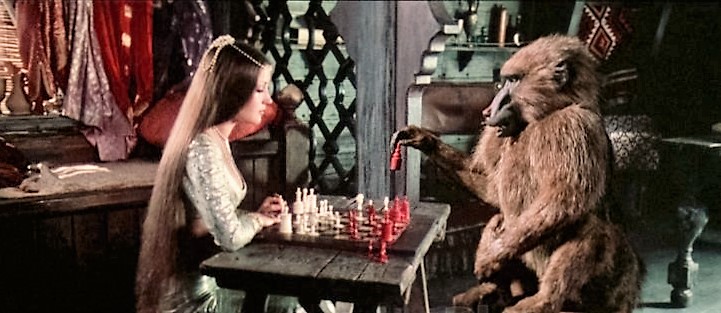
Prince Kassim sees exactly what he looks like under the curse, to his horror.
The pair set sail to find the Greek alchemist Melanthius (Troughton), who may be able to help. Zenobia and Rafi, worried that they could succeed in undoing her curse, set off in pursuit using a ship powered by a giant “Minodon,” a Bull-Man creature made of metal, brought to life by Zenobia. The Minodon can do the rowing of six men from a single master oar (an uncredited Peter Mayhew, ironically also playing Chewbacca in the competing Star Wars), so they don’t need a crew.
Our heroes eventually do find Melanthius, who can’t help them, but knows of a temple in the faraway land of Hyperborea that will be able to undo the curse, if they can get there quickly. If they can’t, Kassim will remain an ape forever, so Melanthius and his lovely daughter Dione (Taryn Power) accompany the group to help in the quest.
Farah and others pass the time by playing chess with Kassim, which is beautifully done.
Zenobia, who transformed herself into a seagull to go spy on the group (a really bad effect that’s really noticeable in a movie with mostly strong effects), sees enough of the map they have to navigate her own path there, but some of her potion was spilled when the crew discovered her in seagull form, so when she transforms back, she still has one foot as a seagull — a nice touch (and callback to Koura’s price to pay for his own sorcery, but that’s from another Sinbad movie).
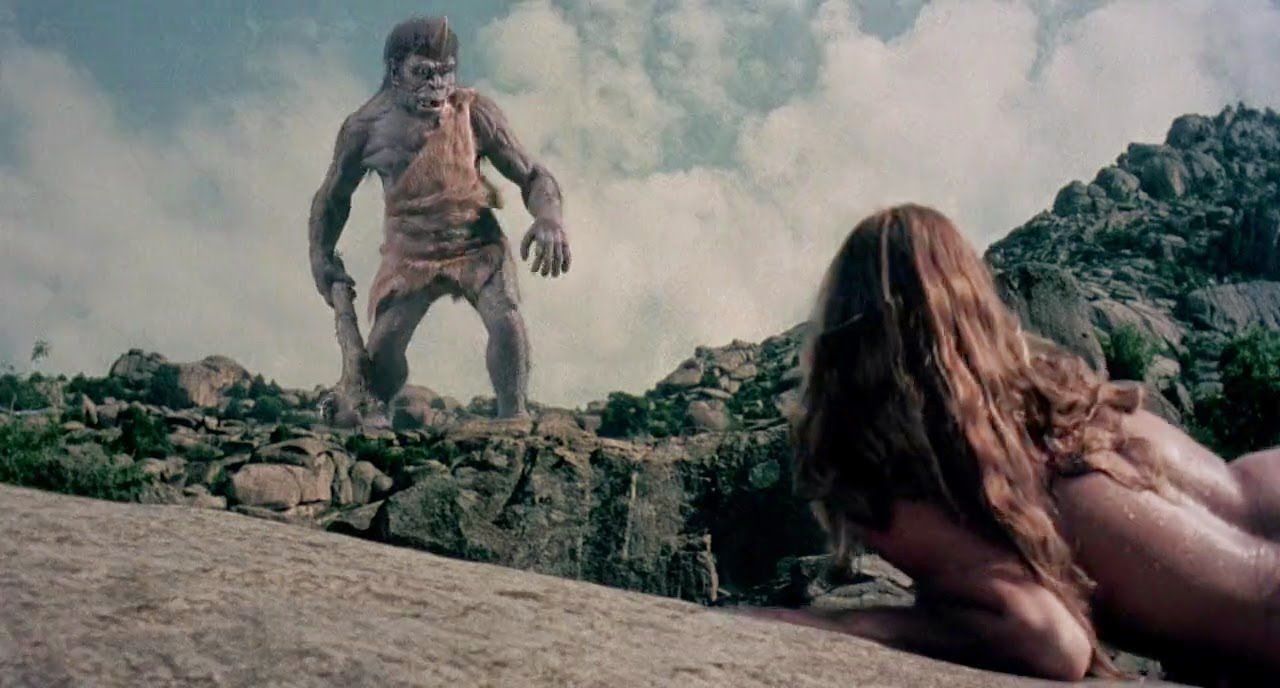
Anyway, it’s a loooonnnngggg journey to get to this mythical land, that keeps getting interrupted by stop-motion creatures (mostly quite good) and some disappointing traveling mattes that don’t quite work. Both ships finally make it to the Arctic, eventually find alternate ways into the somehow-temperate lost city, which provides the opportunity for a brief nude scene of the girls swimming — until they discover a giant troglodyte.
Well, hello there!
Finally, the two opposing crews have their big fight scene that also involve stop-motion creatures inside the temple of the lost civilization. One guess who wins (and who doesn’t end up as an ape permanently, as we were constantly warned would happen if they didn’t hurry things along), but it’s pretty well-done — and of course they make their escape just as the temple and city destroy themselves, and all ends up well for our heroes and very badly for the villains.
Kassim-ape is by far the most consistently excellent effect, almost at times convincing you that in some shots an actual ape was used. The now-friendly troglodyte and friends’ battle against Zenobia-in-smilodon-form in the climax is another standout sequence, though it’s never made fully clear why this creature threatens and then later helps our heroes, other than a weird “friendship” with Kassim-ape, maybe.
You could cut this film down, shorthand more of the interminable “here’s Sinbad’s boat … and here’s Zenobia’s boat” travel sequences, tighten the plot machinations, and have a really pretty good, exciting adventure movie that runs maybe 80-90 minutes instead of the poor pace of its actual 1h53m. It’s a pity they didn’t do that, because there’s some excellent work scattered among the overrunning parts.
I may be biased, but Troughton as Melanthius is far and away the best actor in the film, apart from the stop-motion ape which is kind of mesmerizing. I should add that the two women, Seymour and Power, do a very effective job in their stereotypical love-interest roles even if poor Jane is romancing up against a flat wall named Patrick Wayne sometimes. At least Kassim, once restored to human form, also finds a mate in Dione.
It’s a pity the Columbia Sinbad franchise finished on such an uneven note, both because of the flaws of the film and because it was mistimed to a fluke revolution in sci-fi special effects by Star Wars and Close Encounters at the box office that same summer. The earlier two Sinbad films are much better examples of the adventure genre, with the pinnacle of Harryhausen’s Sinbad work shown off in the second one, The Golden Voyage of Sinbad — which just so happens to have Fourth Doctor Tom Baker in a major role …
The Minodon (Peter Mayhew) does all the henchman work and gets no thanks whatsoever.
This film is a bit bewildering to me, I must confess. Taken as a filmic version of a horror-based dream (its clear intention), a reflection on some of the many tropes surrounding our own fear of our mortality and the ways we might depart this life, Vampyr should be considered a powerful success. If one is watching the film hoping for a coherent plot or definitive statement of meaning, you’re completely out of luck.
Given the utter brilliance of Dreyer’s previous film, 1928’s The Passion of Joan of Arc, his first sound movie — a horror movie about vampires — should have been a massive success.
Instead, it was a huge flop with audiences at first, and even after re-editing only garnered mixed reviews. This appears to be down to two main factors: his comfort in shooting movies in the silent style, along with unexpected struggles with adding sound (beyond music) to his film was the first problem.
The second “flaw” of a sort was his decision to make a dreamy, soft-focus, motivation-less tale dependent on atmosphere and imagery rather than story. Vampyr is 90 percent a silent movie, shot in that style, complete with title cards to explain things some (not enough) things from time to time.
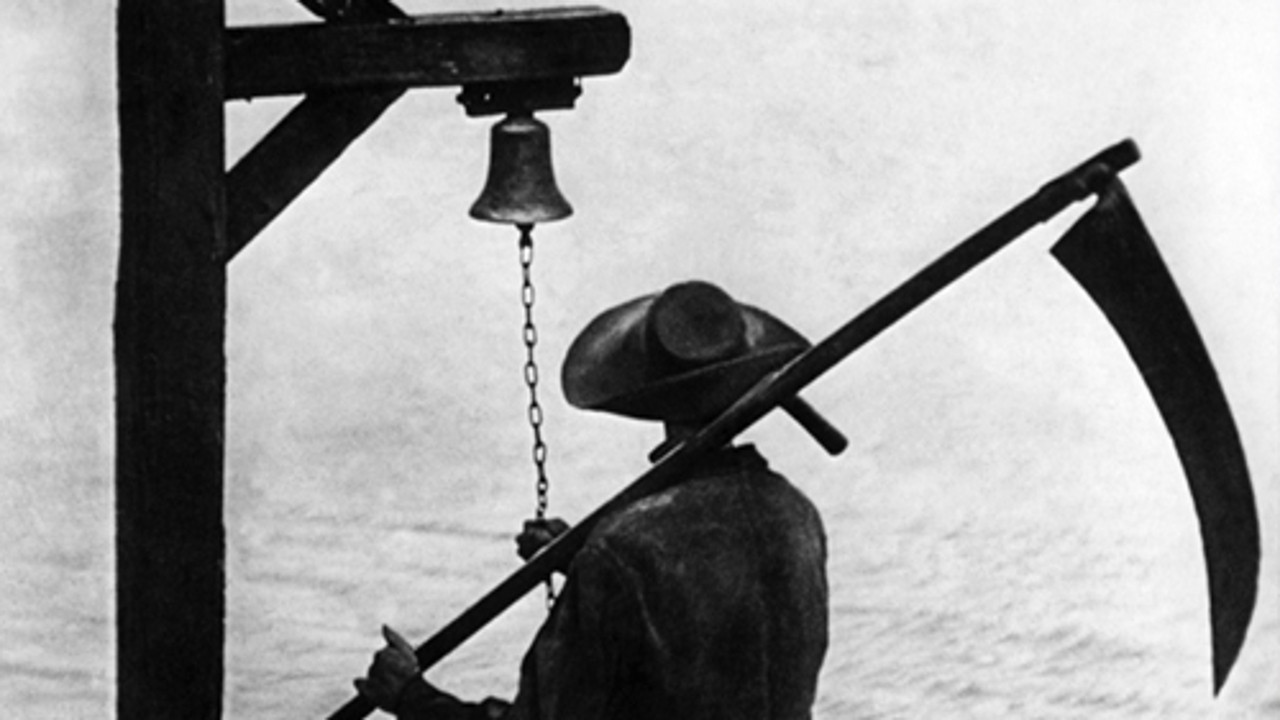
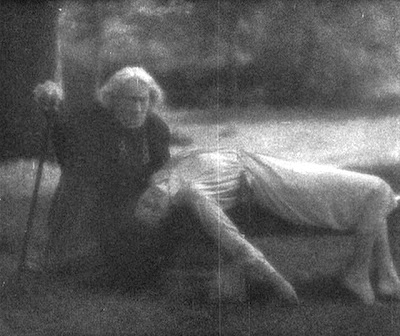
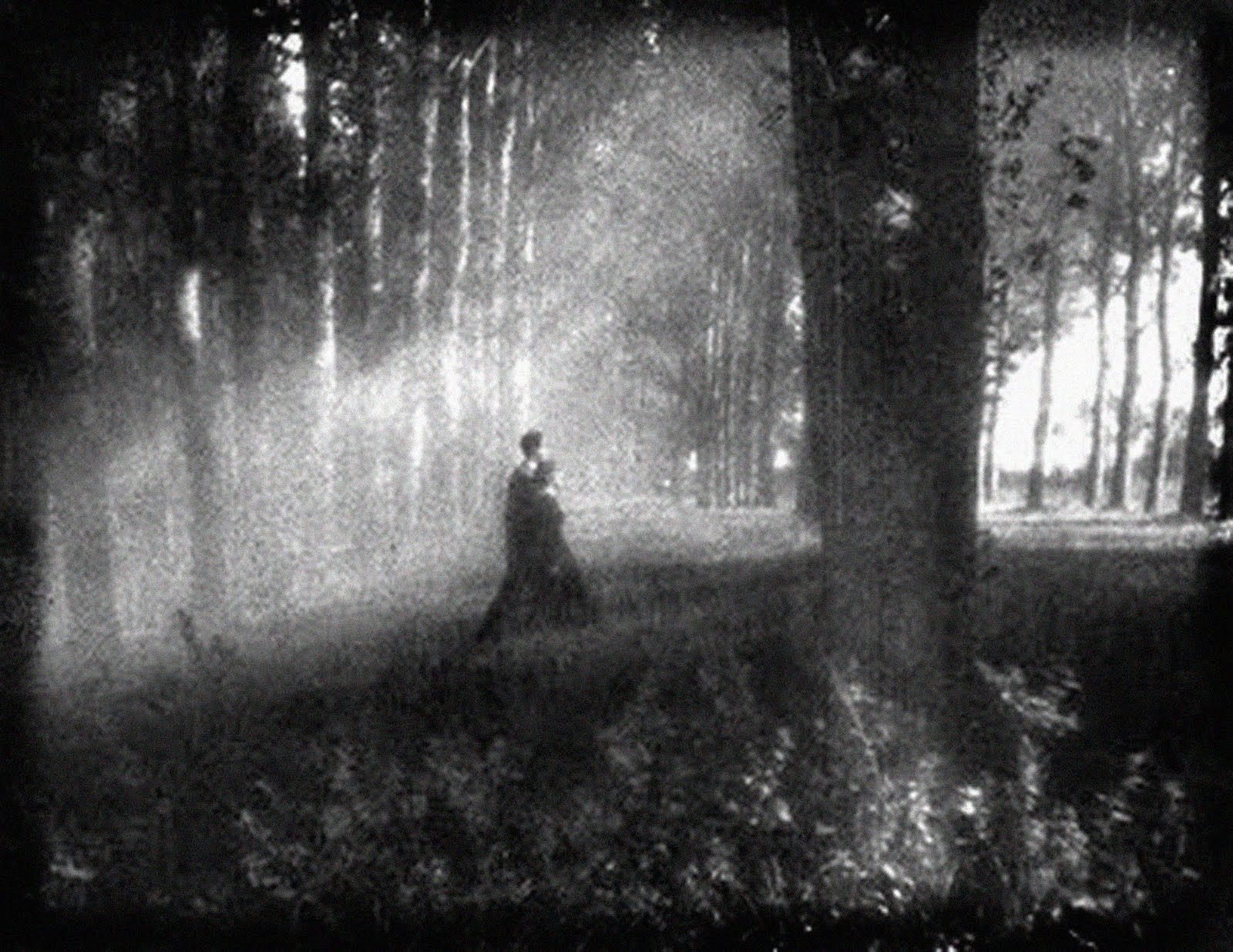
One of many haunting images in Vampyr.
The acting, likewise, is very silent-movie style, with few characters having much of anything to say on the rare occasions that they do speak. That said, there is some spoken dialogue and sound effects, which kind of gain a Bergman-like weight by their rarity.
The plot, such as it is: a man named Allan Gray, who is introduced as a dreamer who is obsessed with the occult to the point where he lives in a sort of dream state comes to a town, takes a room at the inn, where a man breaks in and leaves him a book “in the event of my death.” Shadows and instinct guide him to the manor of the man, who is murdered by a shadow with a rifle (?) shortly after Gray’s arrival.
He rushes to help, but it is too late. He meets the man’s youngest daughter, Gisèle, who says that her older sister, Léone, is gravely ill. Just then, they see Léone walking outside.
As they rush out to collect her, she is found with fresh bite marks and a briefly-glimpsed older person who quickly disappears. They carry Léone inside, Gray remembers the book, and starts to read it (there’s a lot of reading this book in the film).
Turns out it’s a book about vampyrs and their powers, which leads Gray to conclude (duh) that Léone is the victim of a vampire. A very odd and suspicious local doctor shows up, looking for all the world like Mark Twain.
The doctor says Léone can only be saved by donated blood, and arranges for Gray to provide some. Tired afterwards, he falls asleep.
You’re never quite sure who’s side Mark Twain is on in this movie.
One of the servants of the house reads Gray’s book, figures out what is going on, and knows who the Vampyr must be. Gray wakes up, senses danger, and saves Léone from being poisoned by the doctor, who may or may not have been trying to prevent her becoming a Vampyr.
Gray tries to catch the fleeing doctor, who may be a servant of the Vampyr, but stops to rest and has an out-of-body experience where he has died and is about to be buried by Marguerite Chopin (the Vampyr he saw earlier) and the doctor, confirming their alliance (maybe). As he returns to his body, he sees the old servant heading to the graveyard, and accompanies him.
The incredible out-of-body effect is stunningly good and far ahead of its time.
They open the grave of Marguerite Chopin, finding her perfectly preserved. They drive an iron bar through her heart, and she dies a true death, instantly becoming a skeleton.
Léone is released from the curse, the doctor suddenly sees the face of the late lord of the manor, chasing him away from the house and killing the soldier who was helping him (?). Gray rescues the tied up Gisèle (?), while the doctor hides in the old mill, somehow becoming trapped in a grain bin.
Léone under the control of the Vampyr
The old servant shows up and turns on the mill, eventually burying the doctor in grain. Gisèle, who is apparently now in love with the nearly-silent Gray, leaves with him on a boat across the river and they find a bright clearing. The end.
For a sound movie, very little is said, and the interstitial titles give us a little background but avoid explaining much of anything as the story progresses. As mentioned, Dreyer opted to film this like a dream — complete with putting gauze near the lens of the camera for all the outdoor shots.
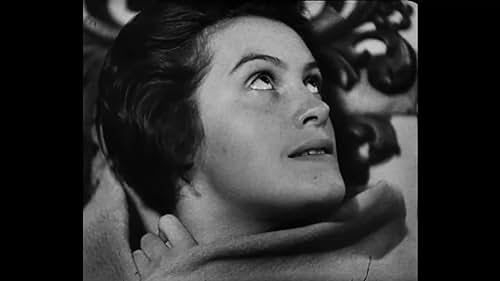
Gisèle under threat
It’s very clear that he intended this to be a silent film, and was coerced to adding sound and really struggled with that. Thankfully, his next film, Day of Wrath (1943), received better reviews and largely found him back on course.
If you want a film that will weird you out, this might be a good candidate. Lots of gorgeous shots and symbolism give it a very disconnected dream-like effect, and I’m of little doubt that this film had a profound effect on David Lynch.
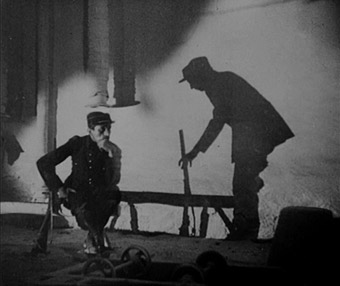
The shadows in this movie are another force of evil
That said, the overall impression is that it’s half a movie: the visuals are there, but the storytelling is severely lacking. Even worse, the “hero” (or maybe more accurately, the “subject”) of the film, Allan Gray, is a nondescript nobody who spends the entire first half silently reacting to things, and leaving little impression on anyone but Gisèle, inexplicably.
He’s not even the hero; the old servant, who we don’t even meet until halfway through the film, is the one who actually resolves things — almost as though he was waiting for Allan to do it, gave up, and decided to end the movie as quickly as possible.
I’ve given it three stars because the visuals are ahead of their time, artistically interesting, and communicate the dream-like intention extremely well. Once people stop reading books and actually start doing things, the film really picks up — but even though the film is just 73 minutes long, the first half is an awful slog of odd things happening for no reason and an ineffective subject.
To put this another way: you’d never guess this was directed by the genius that gave us The Passion and the smaller masterpiece Gertrud, his final film. Vampyr feels more like an ambitious art-college experimental film.
From the 50s and into the early 60s, Roger Corman was churning out hit-or-miss exploitation films and grind house movies. In 1960, having established a reliable reputation, he opted to do something a little different — making House of Usher based on the book by Edgar Allan Poe. The screenplay was written by Richard Matheson, art direction by Daniel Haller, and the film starred Vincent Price.
It was a critical and commercial hit, and thus the same team made another Poe-based film in 1961, The Pit and the Pendulum, and again it was a hit. In all, Corman made eight movies based on the works of Poe, with only one of them (The Premature Burial, made for a different production company) not starring Vincent Price, but rather Ray Milland.
When making Tales of Terror in 1962, the tale “The Black Cat” inspired Corman and his team to make a movie out of Poe’s famous poem, “The Raven.” In a signature move, he re-used the sets created for The Raven in his next film, The Terror (which was not part of the Poe Cycle, as the Poe-based films became known collectively). Once again, Matheson provided a script, Haller the art direction, and Vincent Price the lead — though this time, Corman brought in Boris Karloff as one of the villains, with Peter Lorre as a rival to both.
Because the segment “The Black Cat” in Tales was comedic in nature, Matheson and Corman opted to make “The Raven” a comedy as well. Although there are amusing moments throughout the film, the comedy largely falls flat because, in my view, Corman was, at least at this point, not competent at comedic timing.
Price plays Dr Erasmus Craven, a wizard and expert at “gesture magic,” who has rejected the Brotherhood of Magicians in preference to leading a quiet, nearly solitary life. His only company is his daughter Estelle (Olive Sturgess), and a coachman he employs. One evening, a raven raps at the window, Craven lets him in, and discovers the raven can talk — and is in fact another wizard, the pugnacious (and, as it turns out, alcoholic) Dr Bedlo (Lorre). With Bedlo’s nagging, Craven crafts a potion to restore him to human form, having been transformed in the first place by Dr Scarabus (Karloff), another wizard of gesture magic and other skills.
The trained raven in this film is *amazing*.
Bedlo recruits a reluctant Craven to return to Scarabus’ castle (the exterior itself reused from House of Usher, and very visibly composited into this film) to help him finish the duel. Craven’s coachman is taken over by Scarabus from afar and attacks the party, but recovers after a protracted axe-attack scene. Instead, Bedlo enlists his son Rexford (Jack Nicholson) to be the coachman, but as the journey begins Rexford is also controlled by Scarabus and nearly drives the coach off the cliffs. He recovers in time to bring the carriage to Scarabus’ castle.
Scarabus greets his guests as a perfect gentlemen, trying to undo his reputation and greeting Craven as a long-lost colleague. Bedlo, who has been rude, aggressive, and belligerent throughout the picture, demands that the duel resume, and sets about demonstrating his style of artifact-based magic, calling up a storm. Scarabus secretly gestures to intensify the storm, eventually directing a lightning bolt to strike Bedlo, destroying him.
Literally the only “magical” thing Dr Bedlow is seen to do in the entire movie.
The shocked party adjourn for the evening, being offered hospitality by Scarabus until the storm passes. Rexford, who saw what Scarabus did to bring about Bedlo’s destruction, hides in Estelle’s room, but they quickly find themselves prisoner when the door is magically locked. Rexford uses a window and the castles ledges to make his way over to Craven’s room, convincing him that Scarabus is not the charming and gentle man he seems to be.
On the way to confront Scarabus, Rexford discovers his father still alive, unharmed, and hiding. Bedlo confesses the entire plot thus far was staged to bring Craven to Scarabus so that the latter could duel against his closest rival, Craven. Meanwhile, Craven discovers that his “dead” wife Lenore (Hazel Court), for whom he has been grieving for two years, is in fact not dead, but feigned death to become Scarabus’ mistress.
Utterly not-dead Lenore (Hazel Court).
Thus, the duel is on, with the two wizards seated in fancy chairs, attacking each other magically in turn. This is by far the best part of the picture, with various practical as well as optical effects (but not really much in the way of imagination) used effectively. Bedlo, who has now decided to become a raven again, redeems his treachery by aiding Craven, leaving his son Rexford to woo the fair Estelle, and despite Scarabus’s castle and magic being destroyed as a result, even he and Lenore survive (for no good reason). All’s well that ends well.
This movie isn’t terrible, but it is … not good. Lorre’s character is just plain obnoxious, and apparently the actor ad-libbed himself a few extra lines throughout the film, leading to he and “son” Jack Nicholson not getting along, and rubbing the ailing Karloff the wrong way as well. Karloff and Price are excellent, with Price in particular showing off his effortless style and charm, which is why he’s the star of nearly all of these Poe films.
Although there are some occasional moments that might bring a smile, mostly from Lorre’s rude outbursts, there is not one single laugh to be found in this “comedy” at all, and I’m putting that on Corman’s very flat and hands-off direction. The plot is convoluted and contrived, and its pretty shocking to think that Richard Matheson had anything to do with it, but as with Corman, movie comedy just didn’t seem to be his strong suit at this point.
I often found myself watching the sets (which make the film look at lot more expensive than it was) as much as the actors, though some of the dead-body effects (for Craven’s father in particular, but also for the fake dead “Lenore”) were quite effective. Sturgess and Nicholson are merely perfunctory in their roles, while Hazel Court chews the scenery whenever she gets the chance.
Once the scene shifts to Scarabus’ castle, the film becomes more watchable, particularly the duel, but it doesn’t overcome the “failed attempt at camp humour” vibe of the overall film. The other Corman Poe films, such as Masque of the Red Death, are much better and still recommended, despite being very much of their filmmaking era.







































 The Chasbah