The Super Mario Bros. Movie (2023)

⭐️⭐️⭐️⭐️

Dirs: Aaron Horvath, Michael Jelenic
52-film challenge, film 28

As an adult, I can see a few problems here and there that I will of course comment on momentarily — but basically your kids will probably love this, as will most teens and adults that are old enough to remember Donkey Kongand Super Mario Brothers games they played as a kid. This is the first kid‘s film I’ve seen in a long time that I think children will wear out the Blu-ray of from repeated viewings.

You can safely forget any previous attempts at bringing these characters to life in a film, especially that 1993 thing — this one gets it right for the first time. As far as current-generation Mario fans are concerned, this film is damn near perfect — and its biggest flaw, if you can call it that, is that is so busy packing in references that the story sometimes takes a back seat to other events, and that’s okay.

The movie represents a huge jump in quality from the previously third-rate Illumination animation firm, thanks to a wealth of pre-designed characters and an obviously huge software upgrade. Up till now I have pretty much loathed everything they’ve done, particularly Despicable Film (my title for it) and the introductions of the incredibly lazy (and Pixar-“inspired”) Minions. It was like their mission was to make children stupider via inducing attention-deficit disorder.

I’ve seen some reviews from adults that the movie is still too superficial and fast-paced, but in part thanks to Illumination’s previous work, that’s what kids want. Besides, the “lore” of this movie is very well-established in the video games, so there’s no need to go over all that, you just accept the situation and welcome Mario and Luigi’s extended family. Directors of Batman and/or Superman movies, pay attention.

Since I also am an adult — most of the time — I also have a few minor criticisms, but before I get to that the first thing that should be said is that this is what kids/family cartoon computer animation should look like if your name isn’t Pixar/Disney: Incredibly colourful, true-to-the-characters design, followed through for new/additional characters, gorgeous locations, and of course — very little regard for the laws of physics.

The biggest letdown for me was that Mario and Luigi didn’t retain their “fauxtalian” accents throughout the movie, but I can also see how that might offend real-world Italians if they did it through the entire film. This is explained in the film as being exaggerated for the purposes of a TV commercial the brothers make (so you do indeed get to hear Mario say “it’s-a me!”), but except for occasionally remembering to say “Mama Mia,” and of course “Woohoo” a lot, mostly it sounds like Chris Pratt being a New Yorker.

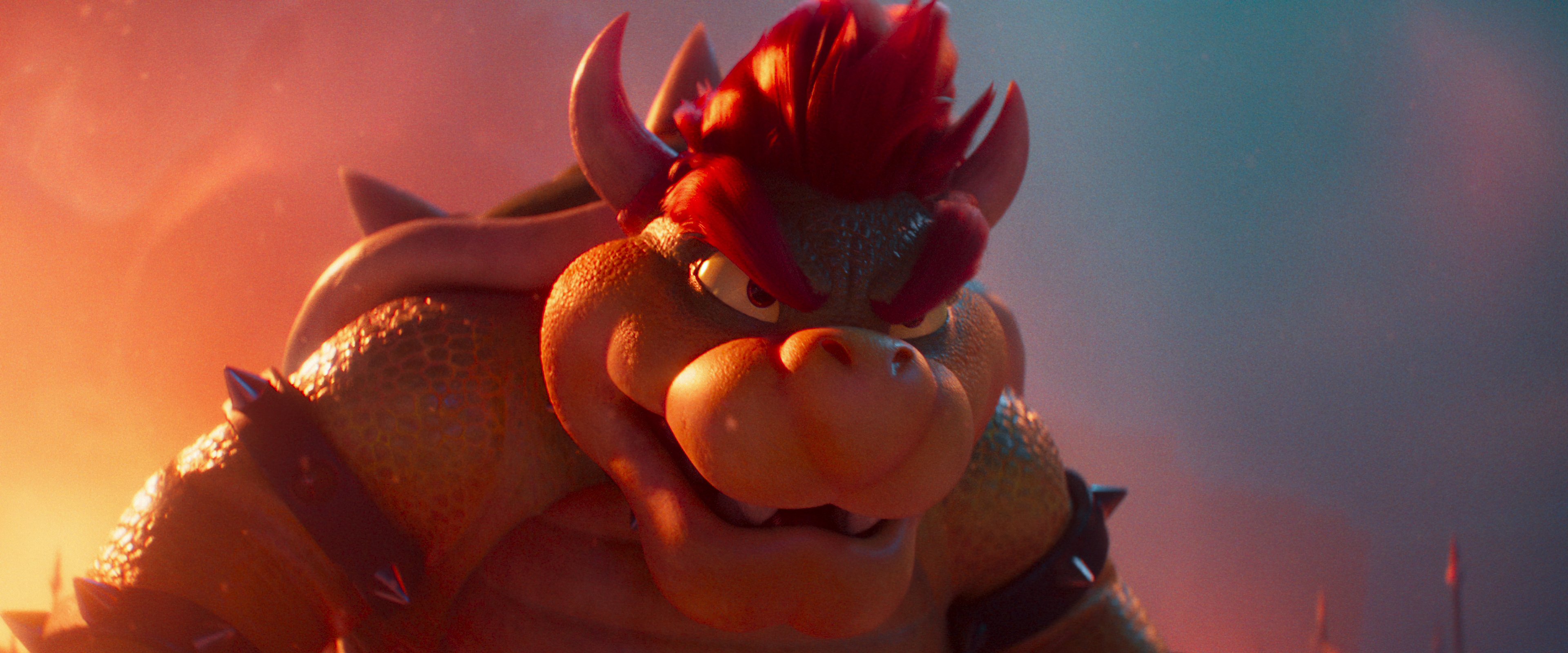
Charlie Day as Luigi does a better job, but the movie is stolen voice-wise by the far-better-cast Jack Black as Bowser, Anya Taylor-Joy as Princess Peach, Keegan-Michael Key as Toad, and Seth Rogan and Fred Armisen as the two main Donkey Kong characters.

Considering many of these characters started off as pixelated bits, the character design is excellent, and instantly “feels” like this is the way the characters should look, even though technically they only got to this point through generations of iteration as the console game technology improved. Likewise, this is a level of background and “set” work we have never seen from Illumination previously, and even the jokes work most of the time.

Princess Peach and Toad prepare for the big race

The film starts off in what passes for “the real world” and, after a funny scene of the brothers failing as real-world plumbers on their first big job, they discover a pipe that leads to what we’ll call Mario World with the characters we know and love. The rest of the movie builds out from the premise of Bowser wanting to marry Princess Peach by force, threatening the peace of the various kingdoms and Mario (& Luigi, who has a much smaller role of mostly being the victim that needs rescuing) arrive just in time to help the Princess and her people fight back.

In short, this movie is one I’ve rated highly because it absolutely achieves what it sets out to do, which is to flesh out Mario World, establish the underlying lore, and defeat the enemy, and looks good doing it. The frantic pacing will perhaps annoy some adults, but there are plenty of reference-checks for us Mario veterans to appreciate, especially if you loved Mario Racing. It’s no classic film-wise, but it will absolutely take its place as a go-to kids’ movie the whole family can enjoy.

The Color of Pomegranates (1969, dir. Sergei Parajanov)

⭐️⭐️⭐️½
52-week film challenge, film 25

With most commercial movies, you can walk into the cinema not needing to know much about the subject and still enjoy (or hate) them, either because they explain the story within the film or some portion of needed background knowledge is communicated to you through the promotion or trailer or title of the film. Most movies touch on universal themes in their tales, or reference moments in time that are reflective of those periods, and what I’m trying to say here is that most of us have some frame of reference heading into a given film.

Not so much with The Color of Pomegranates. I watched this thing completely cold. Big mistake. After viewing it, I then had to go back and watch no less than five short documentaries about it to really get a fix on what the hell it was I’d seen.

So why did I watch it at all? Because it kept showing up on Sight & Sound’s list of some of the greatest movies ever made, that’s why. If you’ve seen another such film, the unconventional sci-fi flick La Jetée, this might remind you of it in its unconventional, idiosyncratic presentation — but that’s where the comparison ends.

With as many films as I’ve watched at this point (hundreds, maybe even a thousand), it’s pretty shocking when one comes along that throws me a complete curveball. Not an unpleasant shock, mind you; more intriguing than annoying. This is a really innovative and thus important use of film as art, but if you don’t have the aforementioned frame of refererance to understand where it’s coming from, it’s pretty bewildering for its hour and 20-minute run time.

So what we have here is an attempt by director Sergei Parajanov to illustrate the life and times of a heroic 18th-century Armenian poet, who went by the name Sayat-Nova (though he was born as Harutyun Sayatyan). To give you the shortest possible backstory, he was mostly an ashugh — a poet and bard who recites or sings their poetry while accompanying themselves on an instrument; similar to a troubadour. He remains a very influential cultural figure in Armenian history, though he is celebrated also in the countries of Georgia and Azerbaijan, since he spoke and composed in all three languages, and wandered freely among them.

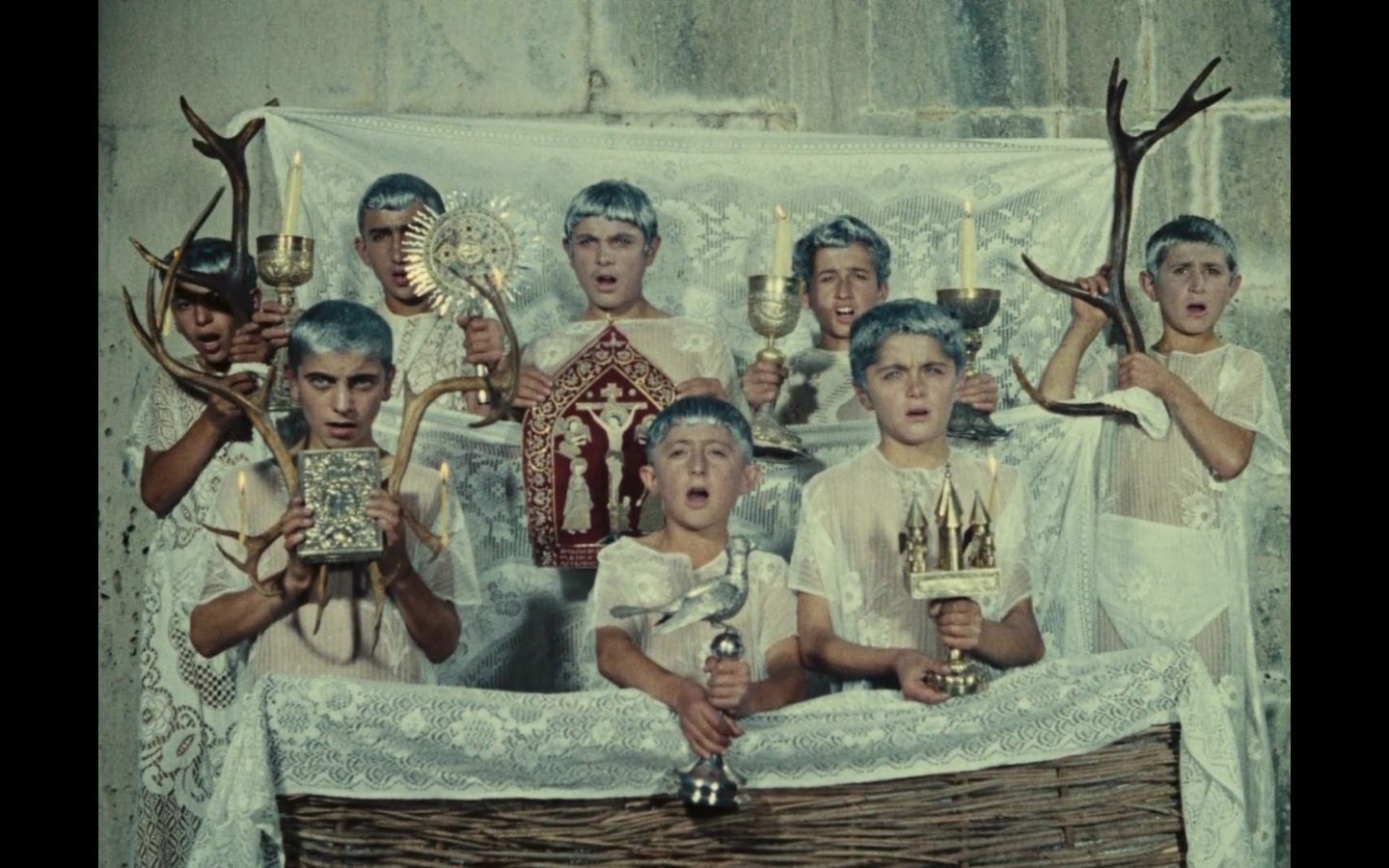
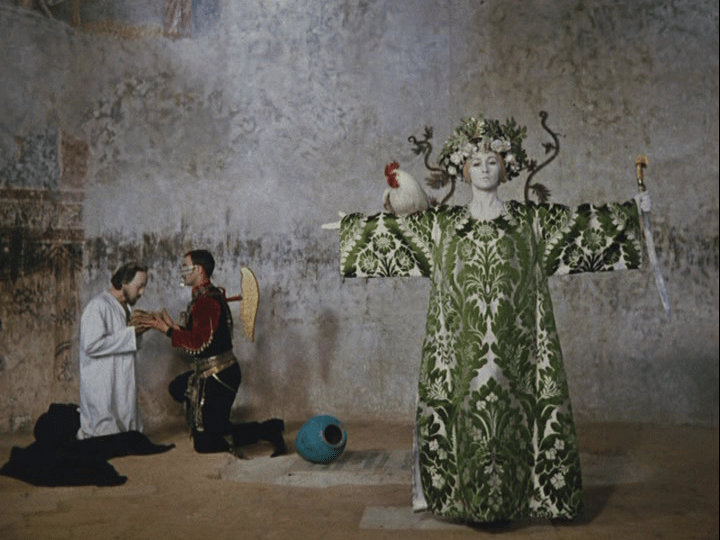
What Parajanov did that makes this film so flummoxing to anyone not steeped in both Armenian culture as well as the dominant Catholicism in that region of the world is that he didn’t attempt any sort of conventional narrative film structure at all. Instead, Parajanov attempts to illustrate “the mind of the poet” through a series of active tableaux, some virtually still and others in motion, illustrating ideas and motifs taken from both Sayat-Nova’s life as well as his compositions. Living photographs, dripping with symbolism but also reminding me of artful dreams.

So you kinda have to take at least a crash-course on this tri-national folk hero and his writings before any of this is imbued with meaning. Thankfully, Parajanov does follow the life of Sayat-Nova pretty much linearly, starting with his birth and going to through to the end of his life, utilizing his own visual symbology to accompany Sayat-Nova’s own poetic metaphors and allegories.

The areas covered include Childhood, Youth, the Prince’s Court (where Sayat-Nova falls in love for the first time), The Monastery, The Dream, Old Age, The Angel of Death, and Death. There are title cards that let you know where you are in his life story, but again you still need to have a knowledge and appreciation of Sayat-Nova’s life and work to translate what you are seeing.

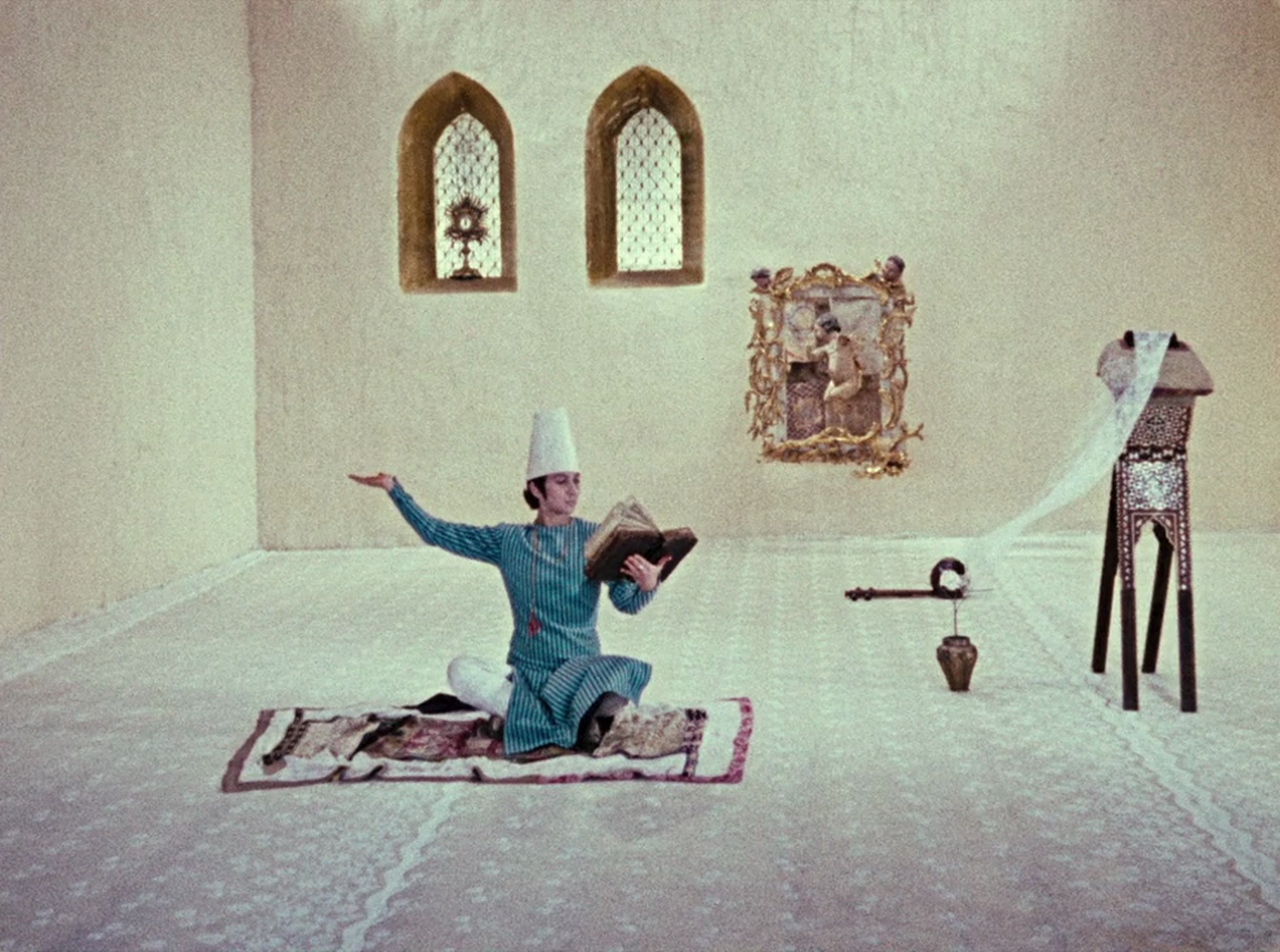
So what are you seeing? Artfully-created scenes, usually without dialogue at all, of actors dressed in beautiful Aremenian costumes, posed or interacting with other symbolic objects. Many are shot on a box-like set meant to represent Armenian illuminated miniatures, which are little hand-crafted, three-dimensional picture boxes. It would seem dreadfully pretentious if it wasn’t all so earnest.

There is sound throughout, and some singing later on, and as the subject of the film moves into adulthood, the film relies more heavily on location shooting around various ancient monasteries in the three countries where Sayat-Nova mostly lived, including the one where he spent the last 20 years of his life (and where he is buried).

As an almost unique cinematic language, Parajanov should get five stars, but I originally deducted two of them for a couple of reasons. The fifth star went for having to know so very much backstory before you should even be allowed to watch this film — let’s just say it wasn’t intended for the wider distribution it eventually got. The fourth star was removed for the lack of clues as to how to interpret what you’re seeing — there’s no explanation at the beginning that Sayat-Nova’s story will be told in visual metaphors and allegories, only that the film is about him.

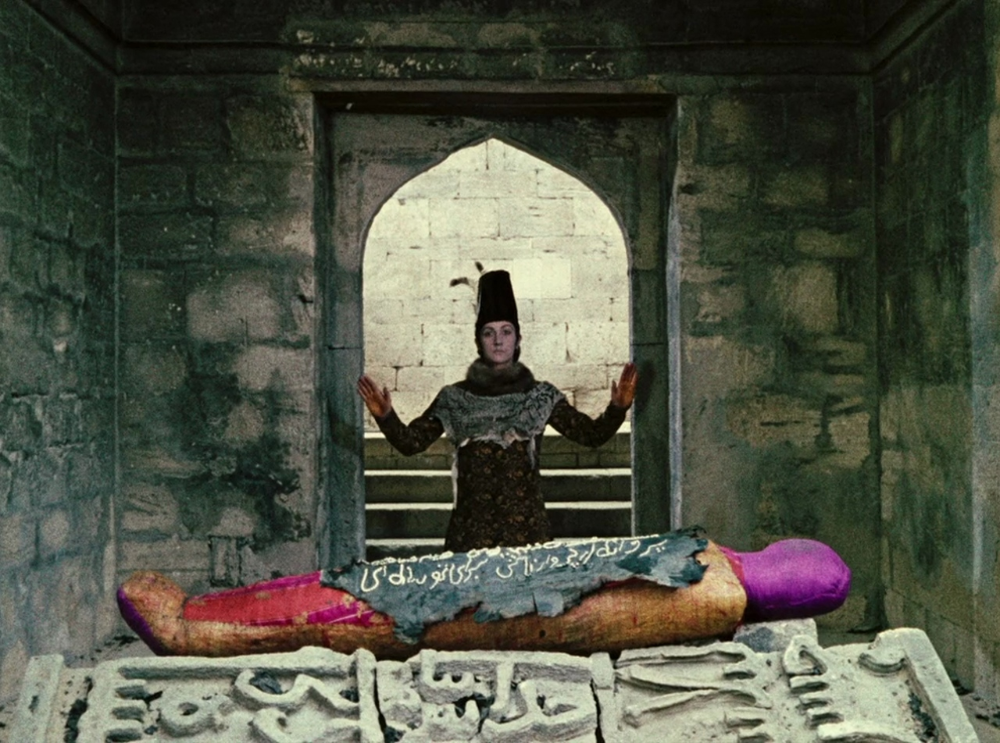
One of the most striking images in the film, and that’s saying a lot because there are many memorable images in this film.

I put a half-star back because, despite the requirements to understand the film, a story about a poet of such influence probably should be told in an unconventional way. Once you finally understand what Parajanov is doing, and what some of the symbolism means, it still doesn’t make full sense, but you appreciate much better the use of a completely different visual “language” within this visual medium.

Thankfully, I discovered after screening the film that the Criterion Channel has what they call a “collection” to go with the movie, including a commentary track on the film which I will avail myself of if I ever re-watch it, and the previously-mentioned documentaries that range from a profile of the director, to a potted history of Sayat-Nova, to a literal “decoding” video to help with the translation of the visual imagery.

It must be said that those documentaries helped me enormously in moving from “what the hell was that?” to an appreciation for the unconventional way I learned a lot about the central subject, his poetry, his background, and some core Armenian-Georgian-Azerbaijanian history and cultural influence, both from Sayat-Nova and his religion of choice. My brain feels bigger now.

It turns out the film was originally titled simply Sayat-Nova, but the title was changed when Russian censors thought the style of filmmaking was a little too difficult, though they only cut a small portion of the film and rearranged a few scenes. Indeed, Parajanov was later jailed by the Russians for his later work.

That said, pomegranates do indeed contribute meaningful metaphors that are less difficult to understand, especially in the clever use of their blood-red juice. I did not know until afterwards that the flow of the juices in some white-linen tabletop scenes are deliberately controlled to “draw” a map of the region, and in other instances to make a commentary on sexual desire, and on war.

As glad as I am to have been challenged in this way, and to have seen a film this unusual, I find it very difficult to recommend it to most others. I can think of a few academic friends (and one particular Russian history buff I know) who might be interested, but this is absolutely not a film the average person not familiar with that region of the world would want to just put on because one enjoys the aforementioned fruit.

The Thief of Bagdad (1940, multiple directors)

⭐️⭐️⭐️½
52-week film challenge, film 24

I had previously seen clips from this version of the story, but never saw the entire film until now. I have to say I like it a great deal less than the 1924 version with Douglas Fairbanks (Senior), but this first colour production was a huge technological achievement for its time, even though — what with the breakout of World War II, and no less than five directors, along with various other issues — this version is mostly successful at what it sets out to do, but is also a bit of a hot mess.

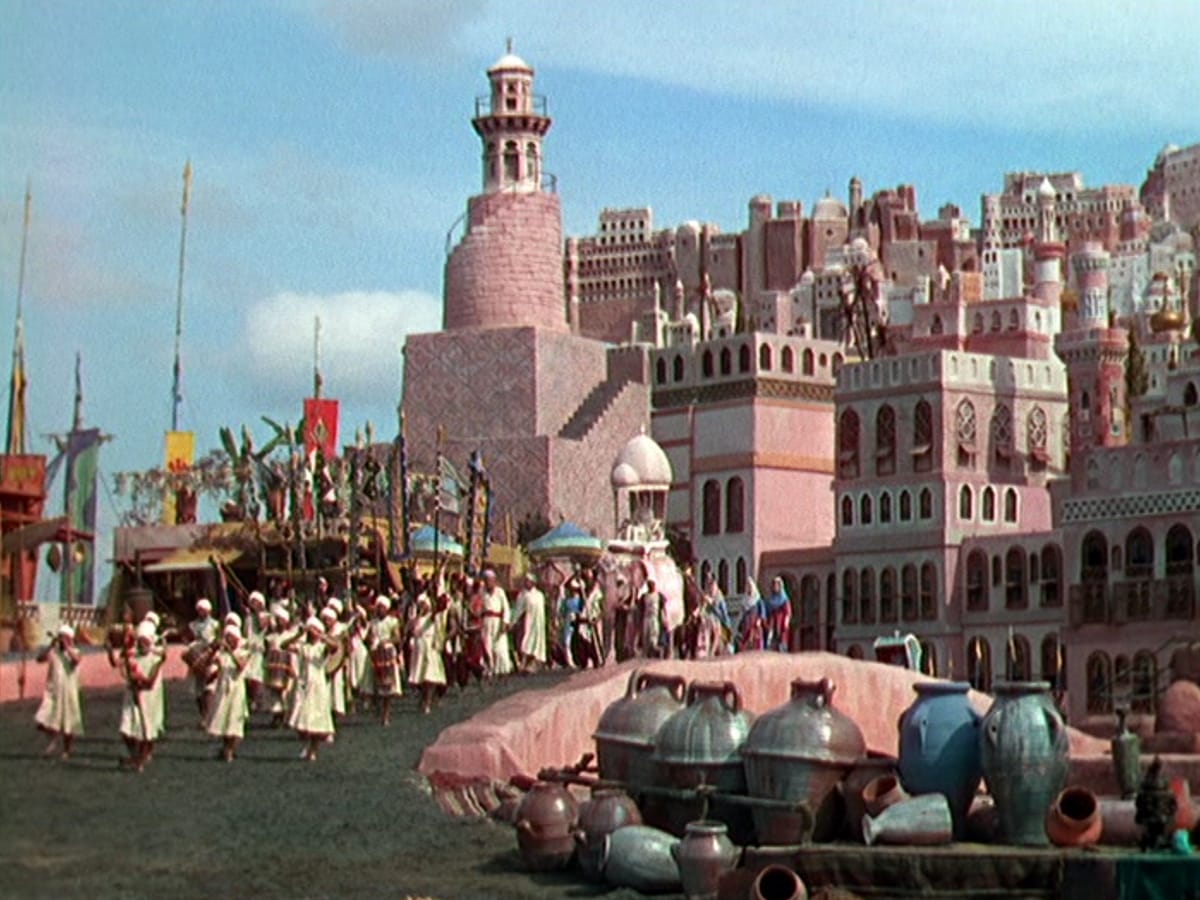
You have to respect the ground-breaking effects (including the first use of what is now called Chromakey), the brilliant sets, the beautiful location photography (a mix of London and California, the latter being used after the war broke out), the lovely set pieces, and the gorgeous three-strip Technicolour process. It won Academy Awards for cinematography, art direction, and special effects, and was nominated for its music (the latter by the great Miklós Rózsa after a false start by Oscar Straus).

Because of the various problems during production, original director Ludwig Berger and Berger’s choice of composer (Straus) were eventually replaced primarily by Michael Powell. Powell also had to leave the production before its completion due to the war, and American Tim Whelan directed nearly all of the latter half’s outdoor scenes in California with assistance from the Korda brothers. You can already see why the film, as entertaining and gorgeous as it turned out, doesn’t always hang together.

The story, which has also gone by the name Aladdin and variations thereof for many film versions, was first made into a film in 1905 and across the 20th century (and into the 21st, with Disney’s live action remake of its own 1992 animated Aladdin). The core story is often said to be drawn from the medieval collection of Middle Eastern tales known as One Thousand and One Nights, but this is somewhat inaccurate. The Aladdin tale specifically (along with the Ali Baba tales) was added to the collection from other sources by the 17th-century European translator of the tales, Antoine Galland.

Producer Alexander Korda was inspired to do this movie by the 1924 silent version, but changed the story pretty substantially — as just one example, making the thief and the King two separate characters. If you don’t know the 1924 version like I do, this is a mostly-successful telling that tries to combine some variations of the tale into a coherent whole, and mostly does it quite well.

It is certainly a fine family film with enough fantasy to hold its audience even now, though I’m very glad they changed direction from its intended “full blown musical” idea. Three songs are still in the film, but apart from Abu’s solo song, they don’t disrupt the story.

The film opens brilliantly, as a blind beggar in ancient Basra along with his faithful dog companion tells the first part of the film’s tale in flashback. He tells of a young and naive King Ahmad of “Bagdad” (John Justin), who wants to learn more about the people he rules, so he is persuaded to go undercover by his evil Grand Vizier, Jaffar ((the great Conrad Veidt, who completely steals every scene he’s in).

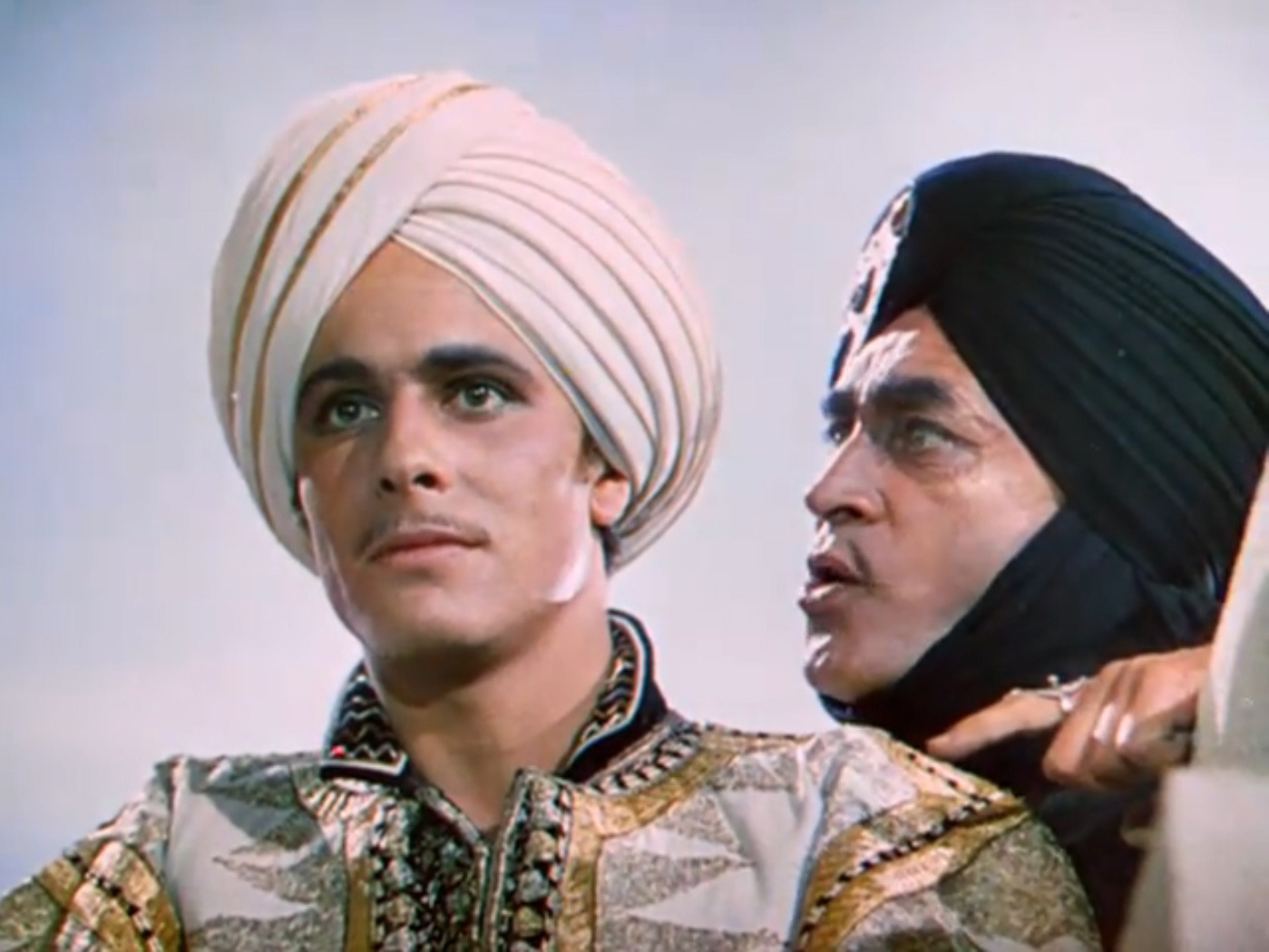
King Ahmad (John Justin) and Jaffar (Conrad Veidt), his Grand Vizier

Once Ahmad is out of the castle and pretending to be a humble beggar, Jaffar has him arrested, and thrown in prison — later telling the people that Ahmad died, so Jaffar can claim the throne. Ahmad meets a young thief while in his cell called Abu (played by then 15-year-old Sabu Dastagir, who just went by “Sabu” in his film career).

Abu, a carefree youth, disbelieves his cell mate is the king at first, but befriends Ahmad — and pickpocketed the key to the cell so they could escape. They flee to Basra, where Ahmad spots the princess (June Duprez) and immediately falls in love with her. However, Jaffar is also in Basra and trying to win the Princess through other means — flattering her father, the Sultan (Miles Malleson, also one of the writers of the film), with life-size toys — the Sultan’s obsession. Malleson is another highlight, a wonderfully child-like old man played to perfection.
Jaffar seals the deal by giving the Sultan a mechanical flying horse, but in the meantime the princess and Ahmad have met, and the attraction is now mutual and she escapes the palace. Enraged, Jaffar uses his magical powers to blind Ahmad, and turn Abu into a dog. The princess is recaptured, but falls into “a deep sleep” and cannot be awakened.

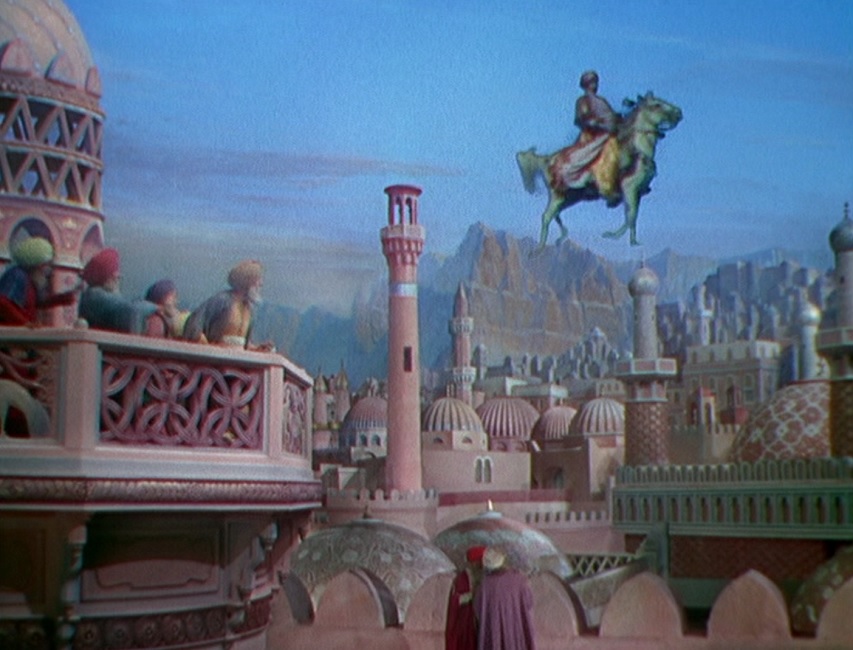
You can see here how the Chromakey stuff is VERY primitive and doesn’t always match well.

Ahmad, still blind, is eventually tricked into returning to the palace, where he awakens the princess, and is then dismissed, along with his dog Abu. We return to the dock where we first met them, as he concludes his story — but the adventure quickly continues as the Princess is tricked into boarding Jaffar’s ship.

Now a prisoner, Jaffar tells her that his curses on Ahmad and Abu can only be lifted by her embracing him, which she very reluctantly does out of love for Ahmad. The spells are lifted, and Ahmad spots her and sets after the ship along with the now-human-again Abu. Jaffar sees them a bit later, and raises a storm that shipwrecks their small dinghy, then returns to Basra and uses a mechanical dancing goddess toy to kill the Sultan before returning to Baghdad.

He does TRY to woo Princess Noname, but ultimately has to resort to threats and hypnosis, of course.

Meanwhile, by sheer lucky coincidence, Abu finds a bottle on the deserted beach and opens it, revealing a very temperamental and gigantic genie (Rex Ingram). Ingram handles the role as best he can, but he’s just not very convincing — and the effects regarding the size differences between him and Abu, though imaginative, aren’t generally carried off well enough to continue the suspension of disbelief.

The scaling effects work reasonable well, but Genie’s performance is uneven (and you should see his toenails! Ayieee!)

Still, the influence of this film on later filmmakers like Ray Harryhausen simply cannot be overstated — this is the blueprint he and others followed for decades to come when it came to imaginative tales of fantasy. In addition to Harryhausen, Terry Gilliam’s best films are also clearly influenced by this movie.

The genie helps Abu steal a magical jewel from a faraway temple (with a Keystone Kops-esque guard squad) that helps him find and reunite with Ahmad, all of which is really well done. Abu and Ahmad use the jewel to see Jaffar hypnotizing the Princess to forget her love for Ahmad, and our hero loses hope and angers Abu — until Abu accidentally uses his third and final wish to send Ahmad back to Baghdad.

Abu then breaks his giant jewel out of anger, which introduces a handy plot device to get him also back to Baghdad via a flying carpet (very well done compared to the flying horse effects), the appearance of which triggers the population into overthrowing Jaffar, who is then killed by Abu, restoring Ahmad to power and allowing him to marry the Princess, who never did get an actual name.

Abu is offered the position of Grand Vizier to King Ahmad, but shuns any form of responsibility, re-steals the flying carpet, and heads out to more adventure. Everyone laughs, and the film concludes happily. You can almost forget how bad Sabu’s song was (he was otherwise generally excellent).

The flying carpet sequences, both in Chromakey and physical effects, work much better.

In its day, the film was a wonder and did very well at the box office. It maintains a good reputation (now as a children’s movie) to this day.

This version of The Thief of Bagdad was the template for most future special-effects-heavy fantasy films for decades to come, largely due to Larry Butler’s invention of ChromaKey, which with some later polish became the successor to the “traveling matte” techniques used in prior films.

Viewed as an adult, the physical effects are mostly great — and while the Chromakey effects are often so obvious it takes you out of the film, the alterations to the tale and a few handy plot machinations do not. Watched bearing in mind its technological and historical importance, it is still enjoyable, and well worth the 108 minute runtime.

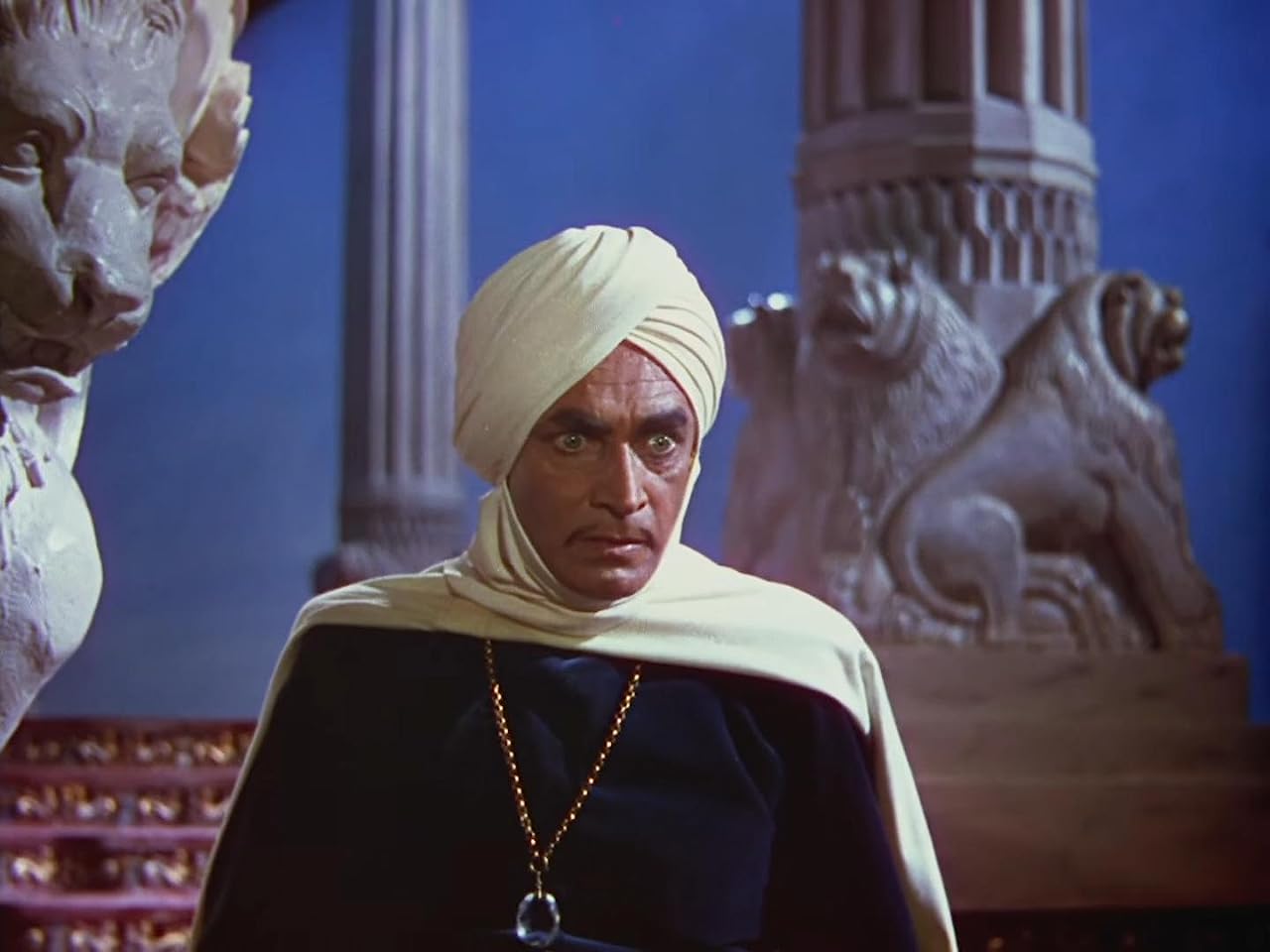
Conrad Veidt does more acting with his eyeballs alone than most actors do with their whole body.

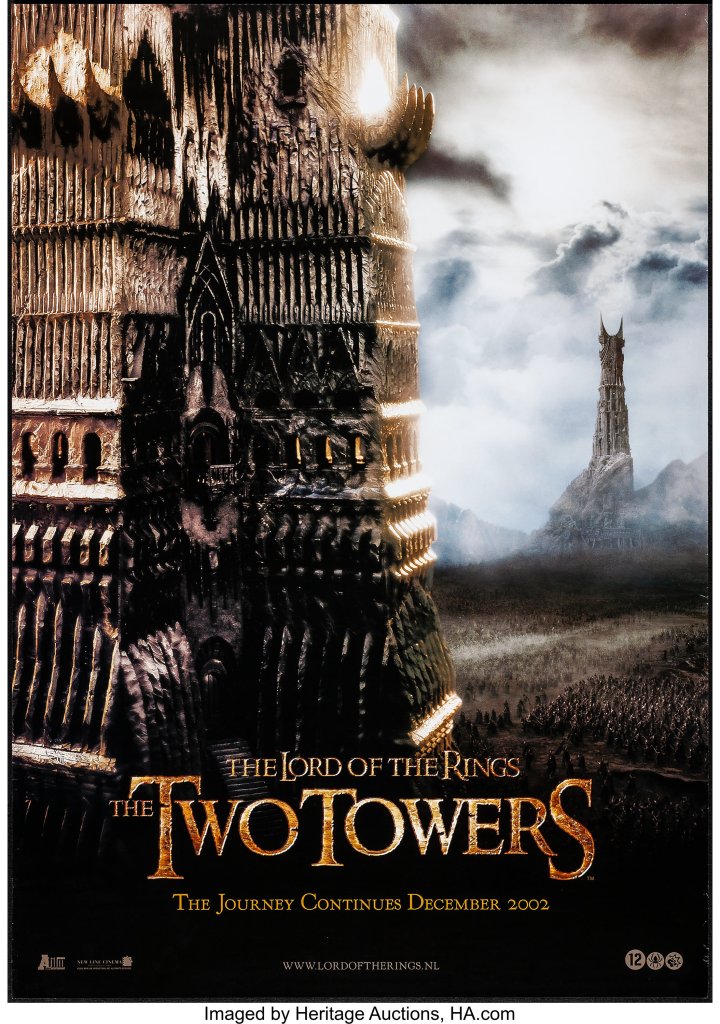
The Lord of the Rings: The Two Towers – revisited

(2002, dir. Peter Jackson)
52-week film challenge, film 16

⭐️⭐️⭐️⭐️⭐️

It’s difficult to believe that just over 20 years have passed since the release of this, the “middle bit” of Jackson’s epic LOTR trilogy of films. A local IMAX screen has been showing the trilogy recently, and I was intrigued by the “remastered for IMAX” tag they added, so I went along to visit this old friend of a movie.

(A brief side note on that particular screening: I should have stayed at home. It was not “remastered for IMAX,” it was just the Blu-ray theatrical version blown up (in proportion, thank heavens) to fit the wider IMAX screen. There were problems with resolution and frame-skipping in the action sequences as a result. Very disappointing.)

When these three films came out originally, I was pretty obsessed with them, since I was re-reading the tales for the first time since college — not to mention the impact the first film had had on fans and first-time viewers alike. It truly brought the story out of “cult” status, and captured the mainstream through a combination of clever screenwriting (to bring cinematic order to the sprawl of Tolkien’s world-building) and state-of-the-art effects work.

According to my first review (back in 2002 on this very blog), I watched The Two Towers at least 10 times while it was in cinemas, both as a student of filmmaking and a Tolkien fan. It was a wonderful feeling to see packed houses and appreciative audiences who would never in a million years have read the dense and nuanced source material.

It was great to see them enjoying a tale that, although laden with special effects, wasn’t a crap sci-fi misfire like Attack of the Clones or the forgettable fantasy Reign of Fire — the latter was about dragons, and nobody remembers it. No, The Two Towers was a “war” movie that focused on the foot soldiers, the power brokers, and the innocent victims who get swept along.

Ironically, the film is probably one of the best “epic battle” movies ever made, though I can think of a few others of that lofty ranking. Both as a book and as a movie, it benefits hugely from all the scene-setting and character-introducing work done in the first movie (The Fellowship of the Ring).

This means that there is little in the way of backstory — since if you were going to see this one, it means you saw the first one, and we get straight on into the action. We do start off with a brief (very brief) recap of the (film) climax of Fellowship, the fall of Gandalf the Grey (and a bit more of what happened in his battle with the Balrog).

Then there is a good-sized break in the action to update us on the progress of the other characters as we left them in the first film — Sam and Frodo trying to enter Mordor; Merry and Pippin held hostage by Orcs and Uruk Hai, and Aragorn, Gimli and Legolas in hot pursuit. Jackson wisely shifts around between the three disparate groupings, signaling the depth and vastness of the different paths the Fellowship is taking towards the same goal.

It is with Sam and Frodo that we quickly meet up with the real star of the second film; the stunningly-realised Gollum (Andy Serkis). Although the character is obviously a CGI-generated effect, he convinces us totally of his physical presence. This is entirely due to Gollum having a physical presence during the filming for the animators to work off of. Played (and voiced by) Serkis, Gollum is (pardon the pun) fleshed out and made convincingly whole as a result.

Not only do the other actors have someone real to interact with, but they hear the voice we hear (one of the more remarkable vocal performances in many a year) — this was the secret to making Gollum so credible, and it really holds up. I would have loved to have seen the faces of Elijah Wood and Sean Astin when they finally got to see how all but Serkis’ facial expressions and movements were replaced with the Gollum character.

Praise should not be spared to the animators as well; though they had a remarkable (and undersung) actor’s performance as a strong starting point, they beautifully embellished it, expanding on Serkis’ unseen physicality and captured facial expressions in an eerie yet beautiful way. Serkis and the animation team should have been awarded a shared Oscar, for Gollum was the most fluid of collaborations between computer animation and human performance that had yet been seen on screen.

What Elijah Wood and Sean Astin saw (right), versus what we saw (left).

The film jumps around between these three sets of main characters, as well as introducing us to new plotlines and the characters that go with them — the Rohirrim, King Theoden and his daughter Eomer, Grima Wormtongue, the Ents, and so on. We learn a lot more about the “manufacture” of the Uruk Hai and the raising of Saruman’s army (which is representative of several nation-states, not just Orcs and Uruk Hai), but of course this is all glossed over compared to the book, because we only have three hours!

We can feel the film’s elements coming together, slowly at first but quickening in pace alongside returning “minor” (in the film) characters like Elrond, Arwen, and Saruman, and the buildup to war is effectively communicated. The film’s climax is the first test of Sauron’s forces, the battle for Helm’s Deep and its aftermath, which makes sense from a film perspective but falls well short of where the actual second book in the trilogy ended.

Mind you, Tolkien never intended the story to end up as three books — that was a merciful publisher’s choice — so the divisions in the books are just as “artificial” as those in the films. Jackson is guilty of rearranging the storylines a bit, glossing over or underplaying some important foreshadowing, and I think it is fair to say that while Jackson and his fellow screenwriters had a genuine gift for boiling down the long and complicated sections of the books without dumbing them down, they are also guilty of lingering on their own invented/contrived segues a bit more than strictly necessary.

Once you accept that most of this was crucial in making a set of films that would perform well at the box office with mainstream audiences rather than just Tolkien wonks, the justification for Jackson’s alterations are much more understandable. Let’s not forget that this was a huge risk by the studio — shooting all three films simultaneously in New Zealand and relying on a relatively-obscure NZ effects house, with a total investment of over $280 million before they saw the first dollar back (but the films earned at least 10x the budgets, so the potential alienation of the Tolkienites paid off).

Almost to a fault, Jackson predictably compressed long sequences (such as the four-day hunt for the Uruk Hai by Aragon and company), lingered on visually beautiful but less-vital plot points (like Edoras and of course Helm’s Deep), and shorthanded drawn-out or not-strictly-vital scenes and characters. The Ents in particular got precious little, but very effective, screen time — and featured some well-done CGI-enhanced puppet work of the time, though it must be said some effects have aged less well than the film overall.

There are a few moments — rare, but notable — that are not as well done as one would have hoped. There are waaay too many shots of Saruman running about and fretting on his balcony as he sees the Ents destroying his Uruk Hai “factory” (but too late to stop the war), but for a wizard he just looks helpless and impotent — very unlike his presence to this point.

The battle for Helm’s Deep takes up the entire third hour of the film, and is wonderfully gritty and dark. How so many filthy, terrorised, unwashed people can be so damn good-looking is one of the main mysteries of the film — but another is how Jackson manages to squeeze in bits of humour even in the most tense of moments, as the soldiers of Edoras face off against an overwhelming army of nightmare creatures. The battle scenes are a bit drawn out, with lots of shaky-cam cutaways of chaos between the more choreographed set pieces, but it is effective and involving.

Jackson cleverly sets up the resolution of the battle much earlier, shortly after the “reborn” Gandalph reappears to (some of) our heroes after seemingly falling to his death — Balrogs apparently make hot but suitable cushions for a long fall — in such a way that when he fulfills the promise he made in Edoras an hour-and-a-half (screen time) ago, it is thrilling and wraps up a plot point that had seemingly been left hanging with the Riders of Rohan scene. I will mention again here that the Balrog scenes near the beginning of this film only touch — lightly, and inaccurately — on the actual reason Gandalph survived and defeated it.

If you’re one of the people who never saw the film because you never read the books, fear not: plot-wise, you will be able to follow this easily, and the lore/minutia you don’t know will roll off your back with ease (and this is the true genius of Jackson’s filmmaking on this project). The overall themes are the power of love and friendship, the underlying presence of evil as the root of all hatred and war, and of course emphasizing kick-ass action sequences over the generally more scholarly and pastoral tone of the source material.

As I said in my original, contemporaneous review, this is the kind of movie they weren’t often making: tales with enough magic to take a long time to tell; grand spectacle very well balanced with thoughtful interludes (the “peaceful” lands versus the terrorized war-torn lands is a particularly sharp allegory that I like to think Tolkien would have appreciated being preserved); characters both major and minor with real depth, even when we first meet them.

Theoden nearly stole the film — actor Bernard Hill was fabulous in the part and we would have liked to have seen more of his character.

Nitpickers gonna nitpick, and it should be noted that I haven’t seen so much as a single frame of Amazon’s pre-LOTR Tolkien series thus far, but in both my original opinion at the time and upon revisiting The Two Towers now, Jackson did a great job straddling commercial/studio concerns and creating the visual language of the world Tolkien created. That he really introduced the wonder of Tolkien’s epic to the larger world should not be under-appreciated.

Addendum: There was a successful animated film by Ralph Bakshi in 1978 entitled The Lord of the Rings that covered (very roughly) the first half of the LOTR story to roughly the same point where Jackson’s Fellowship and Two Towers gets to. I saw Bakshi’s film on its release, and it was the thing that finally got me to sit down and read the intimidatingly-long books at last.

Bakshi never got to do a sequel to finish what he started on his version, but it was very influential (even to Jackson) — and the rotoscoping techniques Bakshi used in selected moments was very memorable and innovative. Without it, we probably wouldn’t have gotten Jackson’s version, so a hat tip where it is due.

I’m undecided about whether I should finally finish watching the extended versions of Jackson’s films (I have them, on Blu-ray even, but the extended Fellowship sated my appetite at the time), or dig up a copy of Bakshi’s epic and give that a second viewing ahead of its … gulp … inevitable 50th anniversary re-release in a few years’ time. I hope they’ll put it back in cinemas, and I hope they have a senior discount on it by then!

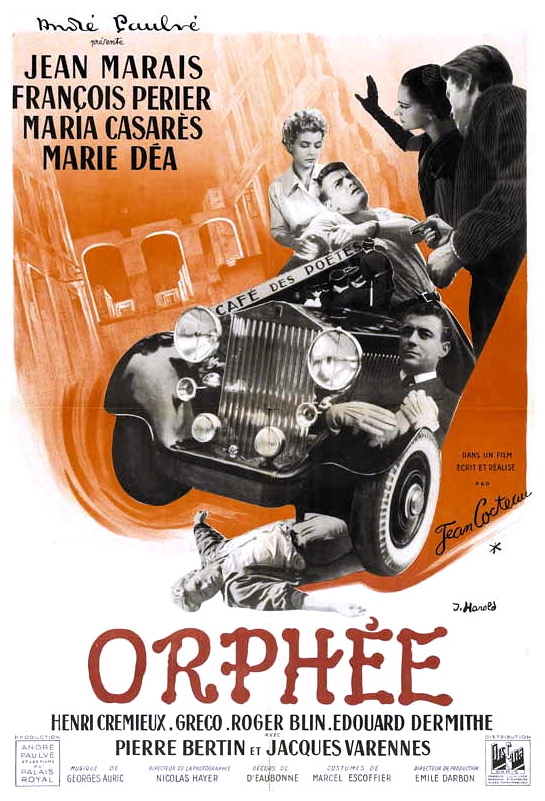
Orpheus (Orphée), (1950, dir. Jean Cocteau)

52-week film challenge, film 12
⭐️⭐️⭐️⭐️

As I watched Cocteau’s previous take on the idea of chaining the mythological tale of Orpheus to the struggle artists go through to create and realise their art, The Blood of a Poet, I kept getting flashbacks of some other film I had seen decades ago that featured some of the same inventive visual effect and angst-y performances, but I couldn’t quite place it. I’ve seen more than my fair share of arty and experimental films, so I imagined that it was simply some film that had been influenced by Cocteau, as many have been.

I turned out to be right — it was Orpheus, Cocteau’s own second attempt at some of the visual ideas and concepts he expressed in Blood of a Poet. I had seen the second part of this prolonged trilogy many years ago, and remembered more the story and contemporary setting than the effects and other bits he borrowed and polished up from his earlier film. My scholastic impression of Orpheus was that I liked the urgent, modern (at the time), beatnik tone of the first half, and was less impressed with the slower-paced second half.

Now that I’ve rewatched it after all these years, I’m even more impressed with it (though I still think the second half could have used better editing). Cocteau was a pioneer of shorthand storytelling, and of deliberately leaving a lot of elements unresolved — I’m still working out the full meaning of the character Cégeste (Édouard Dermit), though I think he may represent the image of a writer at his peak, and be sort of a representation of Orpheus’ (Jean Marais) image of himself.

Poor Cégeste spends nearly all of the movie either dead or as a zombie servant.

In the film, Orpheus is a famous poet, hanging out in a bar for poets, being kind of an ass until a Princess (a memorable performance by Maria Casares) and her boy toy Cégeste arrive. Orpheus is mesmerised by the Princess, while Cégeste starts a brawl, dropping some of his own poetry in the fracas. Cégeste starts to flee, but is run over by two mysterious motorcycle riders.

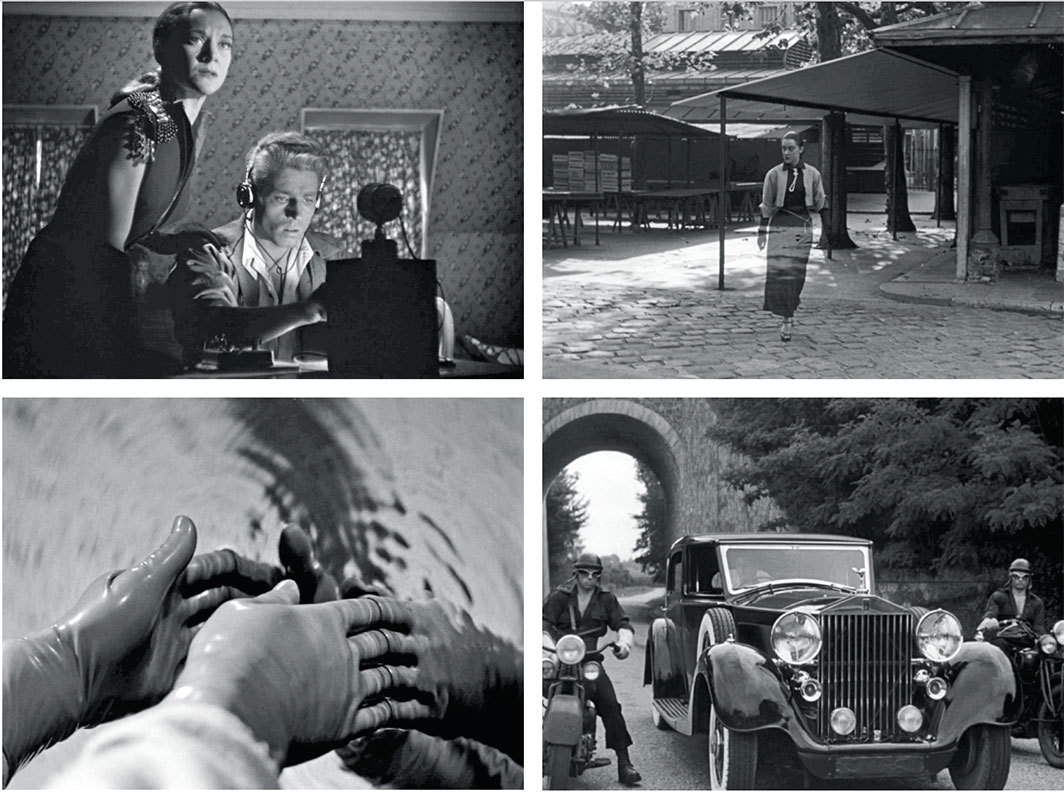
The Princess persuades the arriving police that she will take Cégeste to hospital, and drags a willing Orpheus along into her limo “as a witness.” Along the way, Orpheus discovers that Cégeste is actually dead, and the Princess is some otherworldly creature. His instincts make him fall in love with her as they ride to her ruined chateau, accompanied by the motorcylists who killed Cégeste. Abstract poetry begins to play on the radio (which is later revealed to be Cégeste’s own poetry, read by him: time is meaningless in the underworld).

Cégeste is resurrected by the Princess, and the riders exit the chateau through a mirror (a direct steal from The Blood of a Poet, and only one of several in this movie). Orpheus, who is isolated in another room, eventually wakes up the next morning far from home, with the Princess’ limo driver Heurtebise (François Périer) waiting for him to take him home. Orpheus offers Heurtebise room and board in his home and space in the garage to hide the limo, which everyone in the village would recognise and alert police.

Heurtebise (l) and Orpheus (r) receive a threat from the underworld.

Orpheus refuses to discuss his all-night disappearance or what happened to Cégeste with his wife Eurydice (Marie Déa), and really behaves in a self-centered, brutish manner — even as she tries to tell him she is pregnant. As Heurtebise starts to fall in love with Eurydice, all Orpheus wants to do is sit in the limo and transcribe some strange poetry mixed with meaningless other oration — that mysteriously only comes through on the limo’s car radio.

The Princess visits Orpheus while he is asleep, and influences his dreaming. She eventually has Eurydice killed in the same fashion as Cégeste, as she is in love with Orpheus. We learn that both the Princess and Heurtebise are themselves spirits, and servants of Death (who is not personified in the film).

The Princess in her Death uniform as she watches Orpheus sleep.

Orpheus is shocked out of his defensive state by the news, and Heurtebise reveals himself as an agent of Death, noting that the Princess accidentally left a pair of gloves behind. He offers to lead Orpheus into the underworld to retrieve the unjustly killed Eurydice. Orpheus confesses his secret to Heurtebise: he is in love with the Princess, but agrees to travel with Heurtebise to undo Eurydice’s murder.

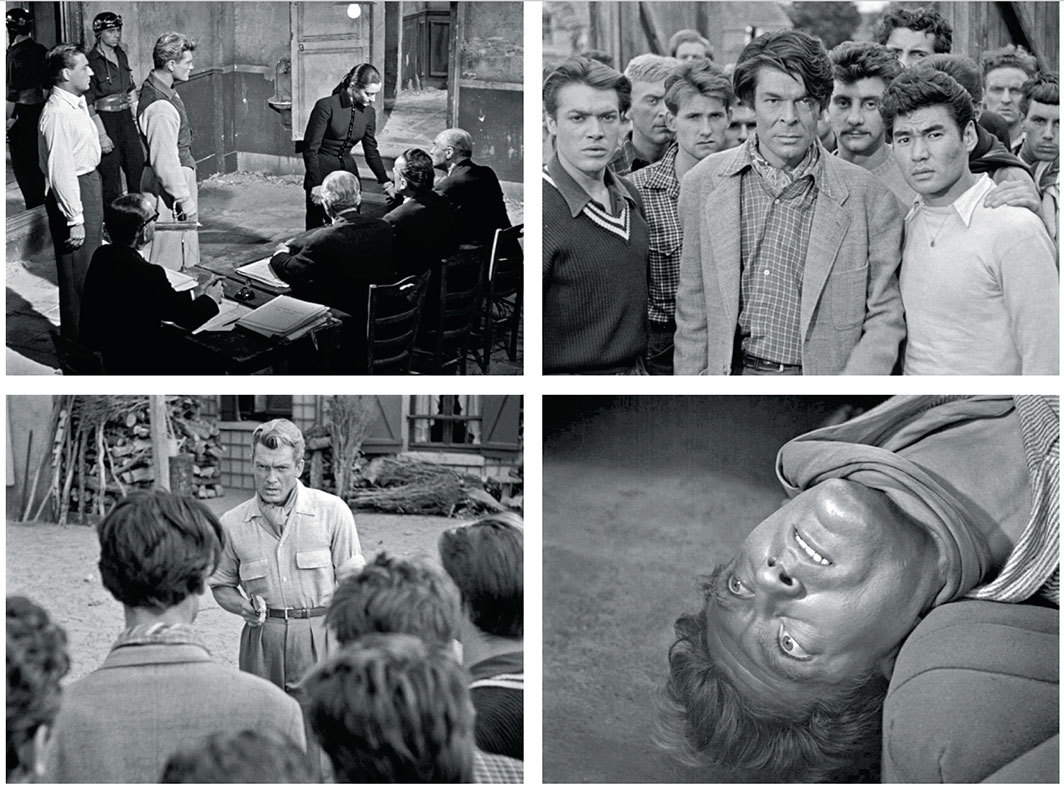
Orpheus is able to enter the underworld through the mirror by donning the Princess’ gloves, and Heurtebise and Orpheus move through a ruined city until arriving at a barren room where other agents conduct an investigation of Eurydice’s murder, questioning the Princess, Cégeste, Orpheus, and Heurtebise before concluding that the Princess overstepped her authority.

They agree to return Orpheus and Eurydice to the land of the living, on one impossible condition: Orpheus may never look upon her again, or Eurydice will disappear from this world and return to being dead. Forced to agree, Heurtebise, Orpheus, and Eurydice return to the living world, but find the restriction very difficult to avoid. Ultimately, Orpheus errs, and Eurydice disappears.

At that moment, a gang from the poet’s cafe arrives, angry that Orpheus has refused to reveal what happened to Cégeste and his missing body. In a violent confrontation, Orpheus takes a pistol but is quickly disarmed and himself shot dead. This of course causes Orpheus to reappear in the underworld, where he finds the Princess and declares his undying love for her.

The Princess seems to know that this affair was her own doing, and regretfully decides to sacrifice herself to Death so that Orpheus might be returned to life and become “an immortal poet.” After another tribunal hearing, the decision is made to return Eurydice and Orpheus to life with no memory of previous events. With no recollection of his love for the Princess, Orpheus returns to his true nature and loves Eurydice again, excited for his forthcoming child.

The Princess and Heurtebise, having caused this mess, are sentenced to a fate worse than death: they must replace the tribunal members who judge the dead. The sadness in the Princess’ eyes at the end is a powerful image, and the audience is left wondering if the crowd at the poet’s cafe has also had their memories wiped of these events.

Taken as a whole, my initial impressions on first viewing were not wrong, but very incomplete: having known the story of Orpheus already — thank you, Edith Hamilton — I mostly ignored that part of the film (while enjoying the visuals, some of which return to the same locations as in The Blood of a Poet). Now, I see more of what Cocteau was going for — again comparing the difficulty of true artistic creation of going to hell and back and forcing one’s self to confront one’s angels and demons.

It’s true the second half is slower-paced, at times becoming a cosmic version of a police procedural — but the performances, the passionate flow of emotions, and the gorgeous filming — particularly of the ruins of the underworld — kept me more attentive to the mystical aspects of the story this time around.

Orpheus is not quite as good as Cocteau’s earlier Beauty and the Beast, but it is a classic and it is a stunning accomplishment that still feels fresh in many ways. The influence of the film in later works by others is now obvious, though somehow Cocteau’s films remain singular in style and vision.

There have been many variations on the Orpheus & Eurydice story, and I haven’t seen all of them, but I’m confident that this remains one of the most original and interesting versions. The conclusion of his “trilogy” around this tale — The Testament of Orpheus, in which the director himself is the star — is next on my list, and I encourage anyone with an interest in classic French cinema to investigate this incredible artistic achievement.