Yellow Submarine (1968)

Director: George Dunning

⭐️⭐️⭐️⭐️
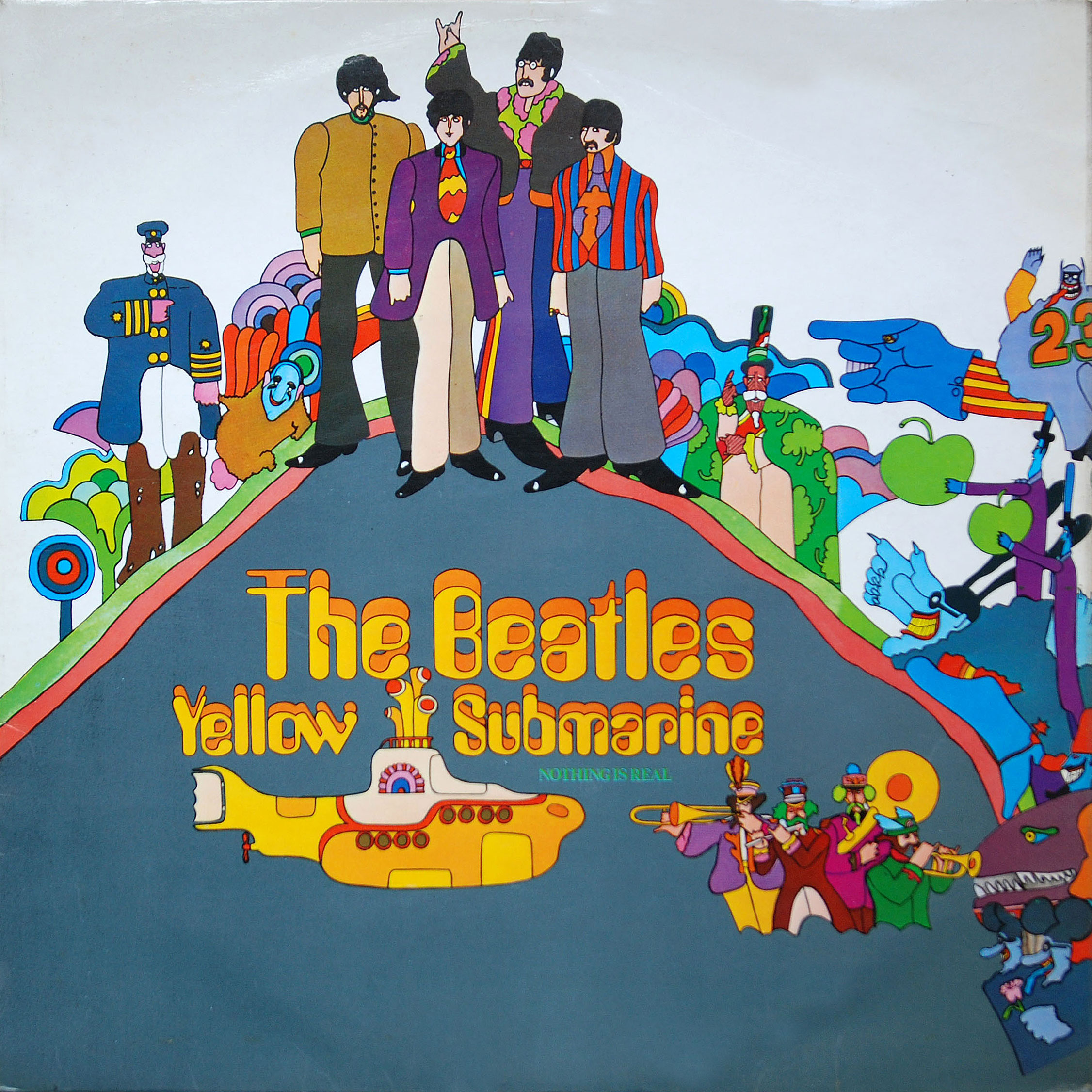
I’ve seen this film quite a number of times in my life, but until now I haven’t written about it because I still think of its as a “kid’s movie,” since I first saw it as a child myself. My affection for it meant I bought the DVD release when that came out in 1999, though I haven’t yet gotten (and should get) the later 4K/Blu-Ray version at some point.

The adult in me is always, always disappointed that the Beatles themselves did not play a bigger role in the film, though they do appear in a short and kind of awkward live-action sequence at the very end — and of course those are their real voices in all the songs. Voice actors portrayed them in all the film’s dialogue for some reason, though the impersonators do a credible enough job making the four Liverpudlians sound (mostly) distinct from each other.

The Lord High Mayor thanks “The Beatles” for their help. I’m not sure why “George” is consistently shown as somewhat darker-skinned than the other Beatles.

John Clive portrayed John Lennon’s speaking voice, and Geoffrey Hughes played Paul McCartney pretty accurately. A completely uncredited Paul Batten did most of George Harrison’s voice.

There’s a reason Batten didn’t complete his role in the film, or get credited for it — midway through it, he was arrested for being a deserter from the British Army!

Special kudos to Paul Angelis for his very spot-on Ringo — he (unlike most of the other voice actors) played multiple roles, including the narrator, and the Chief Blue Meanie, with great variety — and following Batten’s arrest, Angelis took on the rest of the George Harrison dubbing as well.

The Blue Meanies gather their forces to invade Pepperland.

Comedian Dick Emory was the only other actor to voice multiple roles (he did Max, the Lord Mayor, and the principal add-on character of Jeremy Hillary Boob, who acts as a kind of guide through the adventure. As near as I can tell, he’s the only main character entirely original to the film, in the sense of the fact that he’s not inspired by or referenced by any Beatles lyric.

The unique animation of the film is very influenced by Peter Max and the general mod/psychedelic tone of the late 60s, but I was suprised to later learn that Max actually had nothing to do with the film. Looking at the artwork now, it’s an obvious influence of course — but not up to the standards of Max’s print work.
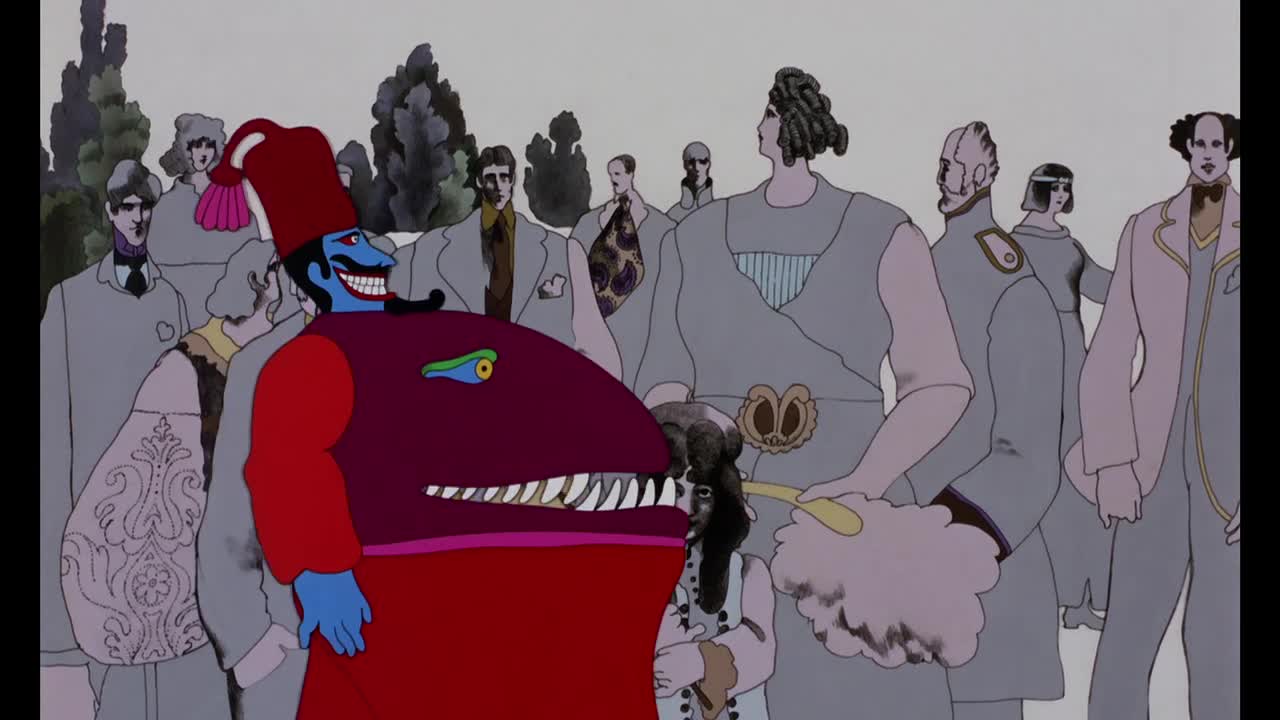
One of the Meanies’ underlings enforces the music ban to suppress any acts of rebellion.

The 1999 DVD release boasts “frame by frame hand restoration” and does indeed look terrific. It also included a 5.1 surround sound remix, as well as the original stereo and mono audio as options. The version I have also offered reproduction film cells, stickers, and an expanded booklet — the latter featuring an introduction by Disney and Pixar’s John Lassiter.

Lassiter points out that the mixed-media animation of Yellow Submarine undoubtedly was influenced by then-recent UK immigrant Terry Gilliam, who brought his style of mixed-media animation to early shows like “Do Not Adjust Your Set” before ending up in “Monty Python’s Flying Circus.” The images in Yellow Submarine subsequently influenced cartoons for US kid’s shows like “Sesame Street” and “The Electric Company,” and even “Schoolhouse Rock.”

Was Gilliam’s work influenced by this, or did Gilliam influence it? Gilliam was already doing this style of image before he was a part of Monty Python, so I think it was the latter.

As for the film itself: what it lacks in plot complexity, it more than makes up for with this visual feast. The rich imagination and style of the original characters in “Pepperland,” from the Lonely Hearts Club Band to the supporting characters of Sgt. Pepper, Old Fred, the Blue Meanies, the Apple Bonkers, and the helpful Jeremy Boob are all interesting enough to keep the film moving along between musical numbers.

Jeremy Hillary Boob, a new friend they meet in the Sea of Holes.

It might have been good to not have so much of the film’s background be completely white, but I guess they opted to put the main artwork front and center — to say nothing of saving money on background animators.

That’s not to say the backgrounds aren’t imaginative, such as the Sea of Holes and the Sea of Science (among others), which do a good job holding viewers’ attention across the thin plot. There’s even time for a classic “hall of doors” comedy bit during one of the numerous musical numbers.

Another of the many “seas” our heroes pass through on their way back to Pepperland.

It is helpful to bear in mind when watching the film that much of this Beatles music would have been brand new or very recently released to the original cinema audience and fans of the band, including “Only a Northern Song,” “Hey Bulldog.” Of course, the foundational musical score outside of the songs came from George Martin, and remains excellent and memorable as his soundtrack work generally is.
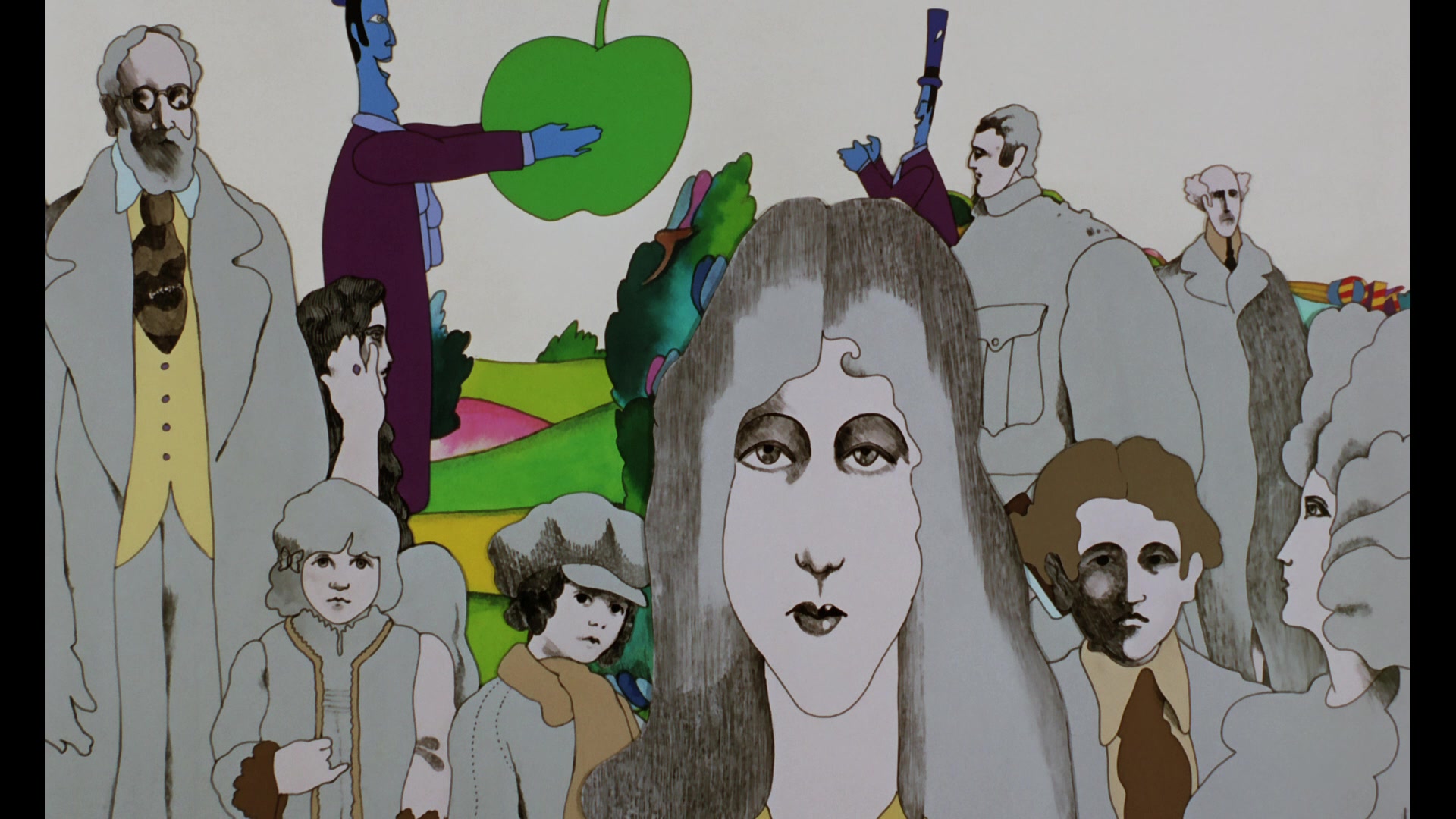
The lifeless, frozen people of Pepperland as the Blue Meanies and the Apple Bonkers invade.

Some of the best animation takes place at the beginning and end of the film: the population of Pepperland being attacked and frozen, drained of all colour — and the restoration of Pepperland at the conclusion. The plot, such as it is, is that the Blue Meanies decide to be evil and come over the hill to steal all the music that brings joy to the people of Pepperland.

They starting by attacking Sgt. Pepper’s Lonely Hearts Club Band, the main source of the music there. The incredibly elderly Lord High Mayor sends his lieutenant, Old Fred, to get help.

Sgt. Pepper (right) and Old Fred (left) climb the stairs to get to the Yellow Submarine.

Fred manages to outrun the Meanies, commandeering the handy artifact of the Yellow Submarine, and travels through strange lands before coming across the Beatles, whom he persuades to help him.

They cross those and other “lands” in trying to return to Pepperland, with occasional stops to explore. Once back in Pepperland, our heroes evade the Meanies and Bonkers before the Beatles can finally take the place of the original Sgt. Pepper’s band, using their own music to unfreeze Pepperland and defeat its enemies and restore the original Lonely Hearts Club band.
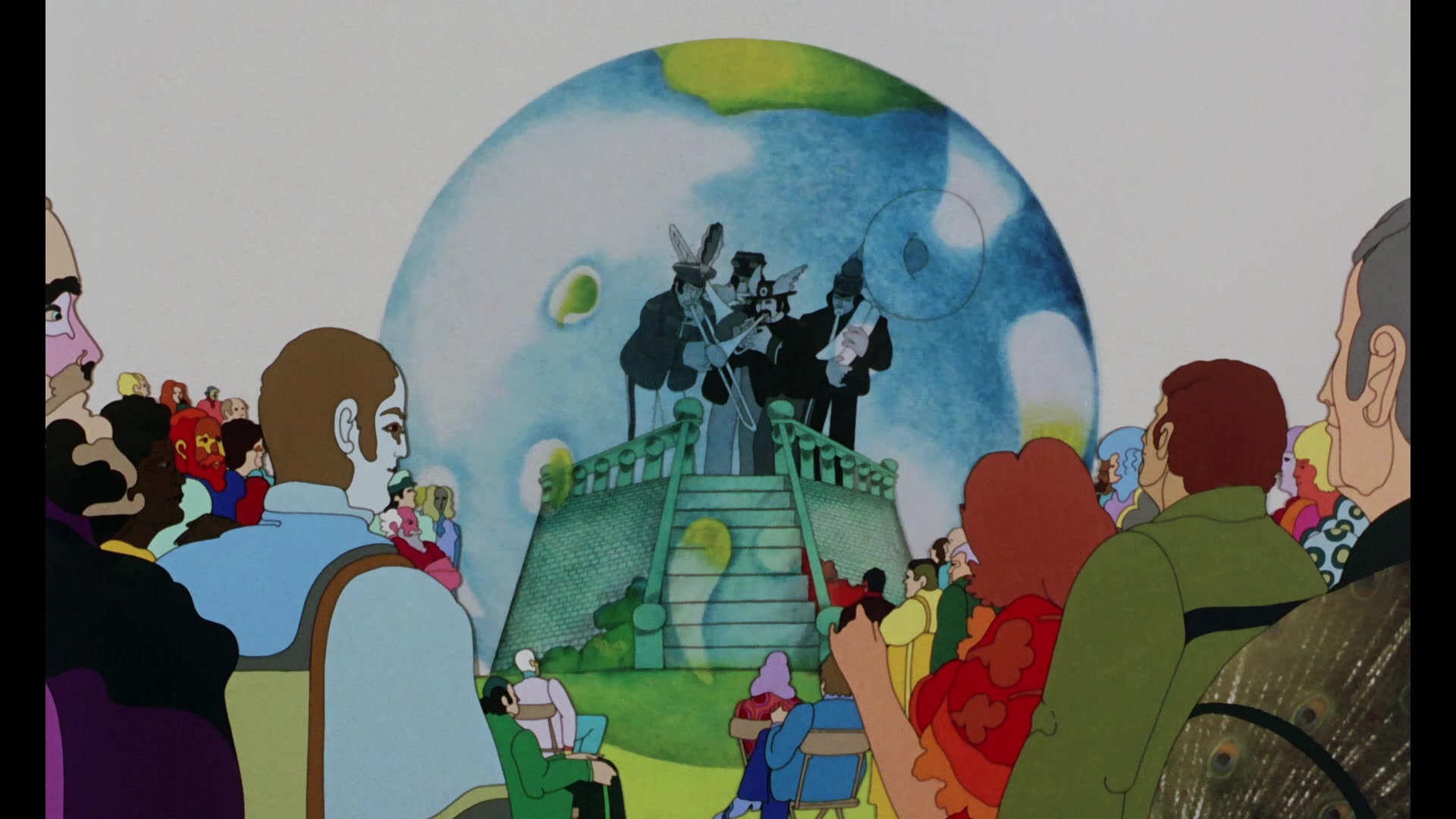
The (original) Lonely Hearts Club band after being stopped from making music at the beginning of the invasion.
The band finally get restored and live to play another day.

By today’s pacing standards, some viewers will feel it a bit drawn out (which it is). However, if you appreciate the Beatles’ late-60s output and the changes the band itself was going through, watching the beautiful artwork (still like no other animation I can think of) and listening to the songs will help the 90-minute length go by pleasurably.

It remains a unique film, both in the history of animated films and as the only non-live action Beatles movie. It also remains effective as a time capsule of a short moment in history where this look, sound, and style was all the rage.

Yellow Submarine reminds me a lot of episodes of TV comedy “Laugh-In,” which adopted a very similar look and feel for its whimsical and fashionable late-60s comedy show.

The inside of the Yellow Submarine.

You never knew what was going to happen next in that TV show, and likewise you mostly don’t know what you’ll be seeing next in Yellow Submarine. There are some 17 (!) Beatles songs heard in whole or in part, so if you are one of the few that really don’t like the Beatles’ music, this film is most definitely not for you.

For everyone else, more than five decades after its original release, it’s a musical and visual treat that blends fab (four) pop-rock tunes and simple but stylish animation to make for a pleasant animated adventure musical. The fact that there’s (still!) nothing else much like it all these years later is a testament to the originality of the approach.

After initially not wanting to be a part of the film, the Beatles were won over by the artwork, and appeared in a short cameo at the end of the film after all.

If the Beatles had done their own voices for the dialogue, I’d have rated it the second-best of the Beatles’ five-film music career, with number one being their whimsical debut A Hard Day’s Night, which I reviewed in 2023.

Sadly they didn’t, so I think it gets knocked down to third place, with the uneven but wonderfully weird Magical Mystery Tour in second (for me), the straight performance film and breakup documentary Let It Be in fourth, and the witless Help! a nearly-undisputed clunker at the bottom of the list.
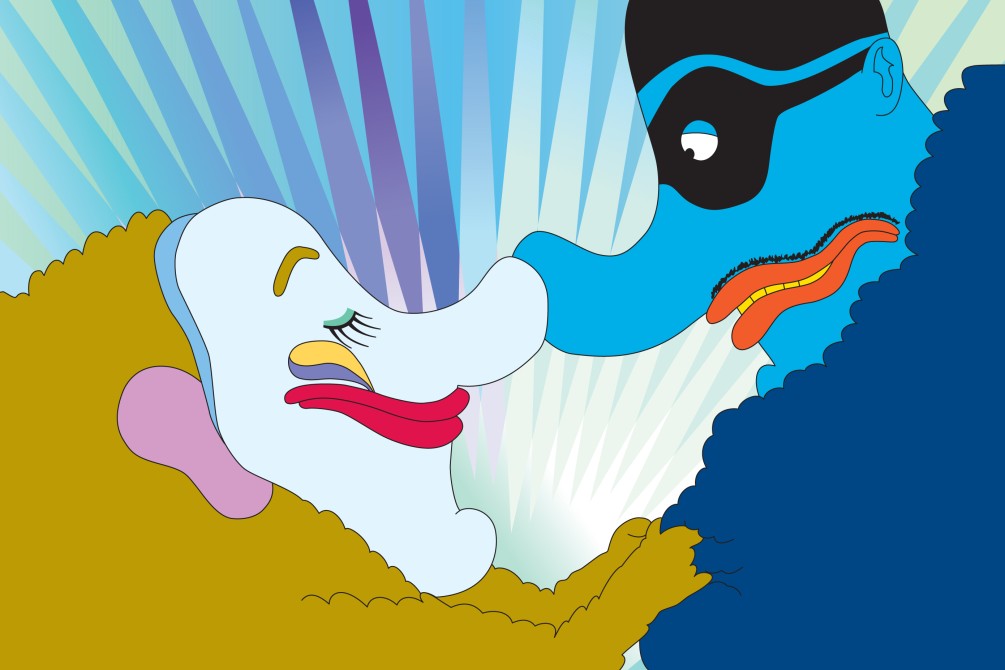
Love always finds a way.

Tetsuo, the Iron Man (1989)

Director: Shinya Tsukamoto
⭐️⭐️⭐️⭐️

If you’ve seen this film, there’s not a lot I can say apart from some small bits of trivia that you might not already know. If you haven’t seen it, this is the first and perhaps the greatest Japanese cyberpunk/body horror/indie metal/sex comedy film of all time. I haven’t seen either of the two sequels, but that’s the only reason I say “perhaps.”

Perfectly timed with a youth-cultural rising tide of nihilism, low-budget renegade filmmaking, steampunk fashion, and the emergence of “industrial” music, Tetsuo combines it all into a movie that was very much of its moment. I first saw the film at and independent cinema in central Florida a few months after it premiered, and I was simply not prepared for the onslaught of sight and sound I witnessed.

It was in some ways traumatic, in other ways compelling — and it haunted me for a while with a mixture of revulsion and wonder at the time. I have finally dared to take a second look, and I squirmed in places — but could still could hardly bear to blink.

The film is in B&W, and doesn’t look quite as absurdly cheap as it is most of the time thanks to ludicrously frenetic stop-motion effects, brilliant editing, and mesmerizing performances, while still mostly giving its audiences only glimpses of what’s fully happening. The assault of hard music contributes to the urgency and raw emotions on display throughout.

The film went on to be an enormous influence on both musicians and indie directors, and makes those Godzilla movies look like pastoral landscape paintings for children by comparison.

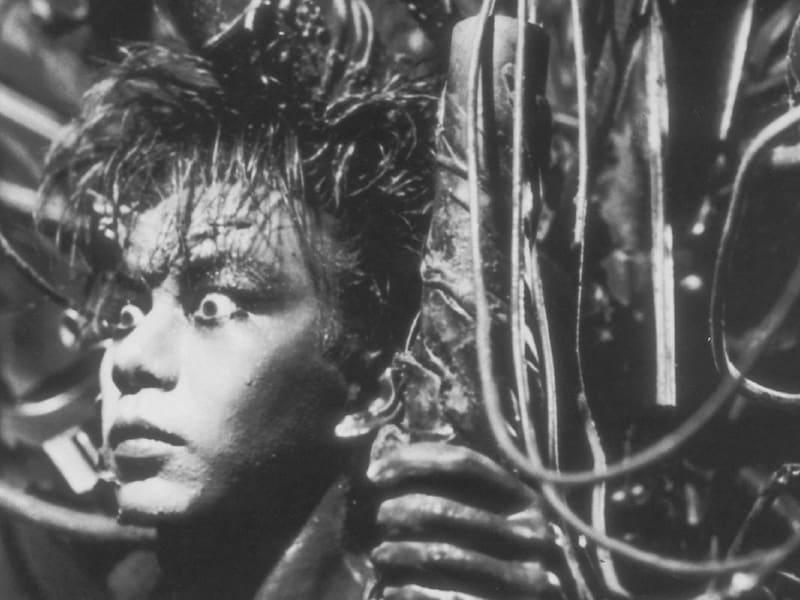
The plot is weird yet simple: we start with meeting a young man (played by director Tsukamoto) who is cutting his thigh open so he can insert some metal into it. His surroundings are composed of lots of scrap metal, and this is a fetish of his apparently.

It goes very wrong, and maggots begin to feed on the wound. Driven mad with disgust, he runs out of his tiny room and into the night, and is soon run down by a “salaryman” (businessman) — played by Tomorowo Taguchi — and his girlfriend (Kei Fujiwara).

The pair investigate the corpse, are revolted, and dispose of the body. Not long after, the businessman notices that he is growing metal out of his body, and soon the girlfriend is transmuting as well.

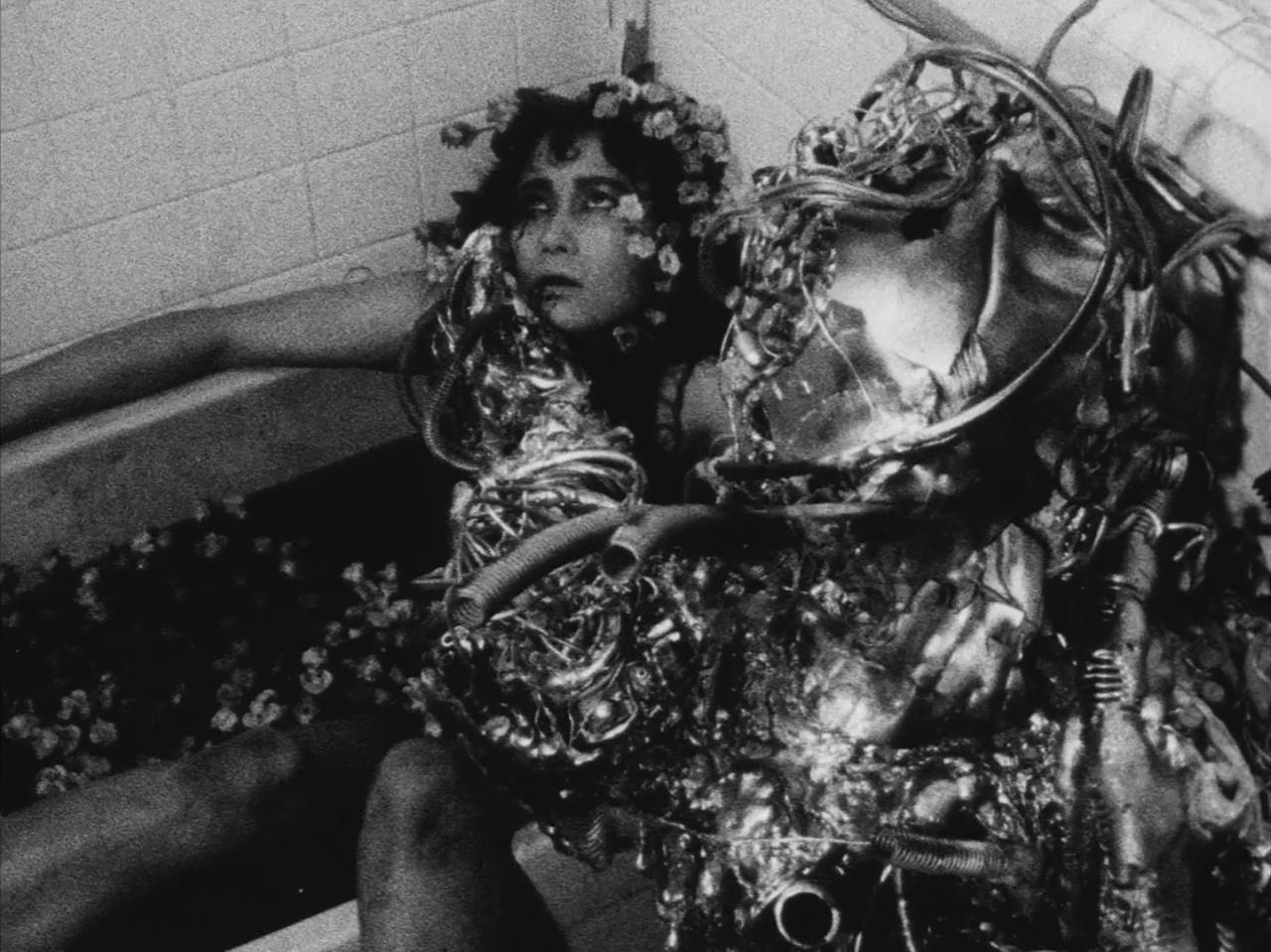
Slowly but surely the metal is taking over their bodies (mostly done using stop-motion animation), turning them both into metal-human hybrids. This takes a while, and is documented in beautiful detail in the grainy B&W cinema verité style, augmented with the hardened edges of industrial music.

Once it starts, it is a relentless onslaught, and the victims here are bewildered, terrified, and powerless to stop it.

To this point, the film is a hyperactive low-budget body horror escapade, but strangely compelling. We know where this story is going, but it is clever enough to make us want to see it through.

The salaryman’s transformation is much further along by the time the girlfriend turns up, equally starting to transform. They end up being compelled to have what I’ll just call “drillsex,” which at this point provides a much-needed moment of relative levity.

Others have described the film as something of a mash-up between Un Chien Andalou (1925), Videodrome (1983), and Eraserhead (1977) in Japan, and I have to nod and say “yes, but with all these films thrown in a blender while you’re watching them.” Tetsuo vibrates with energy and intensity, never relents from its breakneck pace, and cranks the music up to 11.

Since it’s release, we’ve all started down its path: rare is the moment now where you don’t see someone glued to their smartphone, to the point where we treat it as an extension of “ourselves.” The messages of the film regarding societal sexual repression, industrialized alienation, body dysmorphia, work-life imbalance, and are alternately sublimated and beaten over your head.

Being so hyperkinetic and, well, metal is likely to be overwhelming for any casual viewer, even though the film clocks in at a mere 67 minutes (and thank heavens its not any longer). By the end, you’re not sure if the salaryman and his girl likes what has ultimately become of them or not.

It reminds of a rollercoaster you’ve never been on before: terrifying, exhilarating, and you’re relieved you survived it — and then, knowing that you did, you want to go back and do it again.

Tsukamoto served as writer, director, producer, art director, lighting director cinematographer and editor of the film. A number of the other crew members who worked on the film quit in disgust or in dispute with what Tsukamoto was doing.

It is a visionary, hugely influential and eye-popping film in many ways, but I think most people whose idea of a horror movie is Friday the 13th would probably turn down a second opportunity to see it. That said, a little of that metal fetishism stays with you, in the sense that you can’t unsee it.

Maestro (2003)

⭐️⭐️⭐️
Writer/Director: Josell Ramos

Only in New York would you find people who brag about inventing Chicago house music. 🙂

But more seriously, this is a video documentary covering some of the origins of DJ culture that grew out of predominately gay-oriented clubs in New York City in the late 1970s and into the 80s. Ramos talks to the now-legends of that era, the DJs at clubs like The Loft and The Paradise Garage and that sound did indeed make its way to Chicago to blossom in the Windy City.

What’s interesting and important about this documentary is that it brings together people who danced their night away at those clubs and the DJs behind that music, and how the magic of the sound opened the (closet) door of these gay clubs to women, straight people, and 24-hour party people of all races. Aside from the music itself, the diversity was a very special thing in the 70s and 80s, particularly the largely black, white, and Hispanic crowds.

As the world was grower darker as the 80s began with the election of Reagan and the dawn of the AIDS epidemic, people — especially those in the LGBT+ community — went looking for the sound and the fury, and were drawn by word of mouth alone to a trio of clubs across the years that held out the opportunity for escape and ecstasy of all sorts. In hindsight, it is unsurprising that straight people who got told about the scene found it irresistible.

Everybody, Everybody

These were bold DJs who experimented beyond the standard mixing two records with similar tempos together. People like Larry Levan, David Mancuso, Frankie Knuckles, Nicky Siano, and Francis Grasso (Nu Yoik names if ever I’ve heard some) had an open-door and open-mind policy, and dared to mix rhythms and sounds, created a form of manipulating the vinyl that would lead to hip-hop’s “scratching” in the 90s, and would build the music, over the evening, into non-stop ecstatic dancing.

That said, the production/direction is mostly fine but occasionally the camera work is a bit ham-fisted, as one might expect from a first-time director. That said, Ramos has to rely heavily on interviews conducted between 1999 and 2003 with the former DJs and patrons.

This probably couldn’t really be avoided: there isn’t much surviving video from the clubs from that era (though a bit more than you might suspect), and thus the audience is bounced back and forth between footage from the time and 2003-era interviews with the movers (DJs) and shakers (club-goers) who patronised these clubs, and some of them frankly go on too long. I spotted the late artist Keith Haring dancing in some of the footage, and a later section of the doc spotlighted him.

The DJs, now middle-aged guys, recollect their glory days with real fondness, especially Levan, and paint themselves as friends and colleagues using music as a weapon against the mainstream and it’s close-minded attitudes.

The interviews are mostly good (particularly with the DJs) but get a bit more repetitive with the club-goers, though Ramos wisely mixes single-person and group interview comments. If I have to complain about something, I’ll pick two things: first, I really wish this had been shot on film, though I completely understand why it wasn’t.

Second, there are not enough clips of still-famous DJs like Jellybean Benitez, Dimitri from Paris, and UK DJ Pete Tong singing the praises of these innovative pioneers, and I’m not sure there’s a good excuse for that apart from budget.

As a club patron in those days myself, though not of course in NYC, I recognized a song or three from the soundtrack, like Booker T and MG’s “Melting Pot,” Chocolette’s “It’s That Easy Street Beat” and Sylvester’s “Over and Over.” Here, the song “Release Yourself” by Aleems is used very effectively to relate a story about how a DJ can remix the music to build, and then release, tension.

I’m not personally a huge fan of house music, but I know very, very well that the combination of alcohol, certain recreational substances, fabulous light shows, and attractive people overwhelmed by screamingly loud beat music being built to a frenzy and then cooled back down can be the closest thing to sex you can have while (barely) clothed (and sweating like a pig). The video feels a bit long but is only 88 minutes. The “survivors” of those days, the club goers and DJs, seem to have established a friendly bond that comes from knowing you were a part of something special.

Ramos’ focus on the music means that he has left an opportunity to explore the tight-knit gay community that fostered these club on the table, and that’s a bit of a shame (though it’s certainly a subject that has been covered elsewhere). If you remember your clubbing days, particularly if they were in the late 70s into the 90s, you may want to seek this video out — the DVD version includes a second DVD of more material, and a CD of some of the music featured in the film.

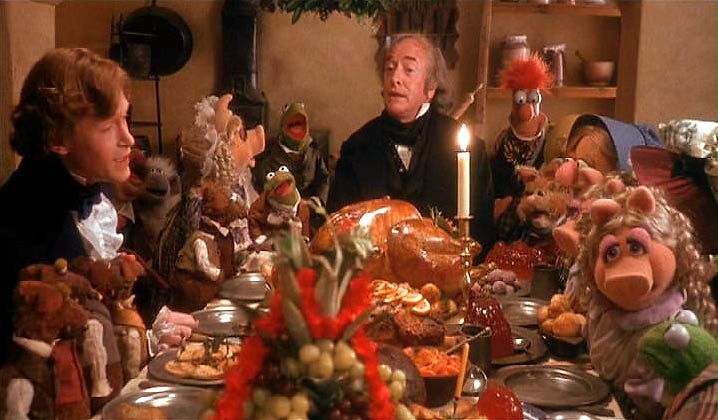
The Muppet Christmas Carol (1992)

⭐️⭐️⭐️½
Disney Studios
Director: Brian Henson


We have a Christmas tradition of what I think is the best version of “A Christmas Carol” ever committed to film, the 1951 Alastair Sim version (UK title: Scrooge, and my review of it is here). This year, just to do something a little different, we revisited The Muppet Christmas Carol after not having seen it since its 1992 theatrical debut, just to change things up a bit. The film sticks to the same story (more faithfully than Scrooge, in some ways), but approached the source material in an almost-completely different way: it’s a musical, for starters, and it only has two substantial speaking roles for human beings.

In short, this film is a technical marvel, and the overall story is well-executed — but Caine as Scrooge is curiously flat, and the songs (by Paul Williams) are both samey, and rather meh. I’d certainly recommend this one over my beloved 1951 version when it comes to “suitable for kids, grandparents, pets, and the whole family,” but while it scores well on some fronts, its general over-busyness, the decision to make it a musical, and the changes to the story probably won’t sit well with Dickens fans.

Statler & Waldorf as the Marley BROTHERS (wtf?) was the film’s first overreach in shoehorning Muppets into the story.

I’m not sure who’s to blame for Michael Caine’s mostly-lifeless portrayal of Scrooge; director Brian Henson was of course focused on his muppets, and they uniformally shine here, so he may have decided that Scrooge’s inhumanity to his fellow man should be more low-key until his reformation. Or maybe Caine thought the movie was dumb, and did it for the paycheck (that’s certainly the vibe he gives off for the first two-thirds of the film).

For what it’s worth, I think the film would have worked better with maybe one big musical number at each end rather than making the whole thing a musical, since the songs are, to be frank, unmemorable and just fill time. The Muppets’ recasting into various roles from the story, on the other hand, works surprisingly well, with The Great Gonzo (Dave Goelz) as Charles Dickens (among many other roles) and Rizzo the Rat (Steve Whitmire, again also playing Kermit, Beaker, Bunsen Honeydew and a half-dozen other parts) serving as the Greek Chorus to Gonzo’s Dickens narration. Long-time Muppet veterans Jerry Nelson and Frank Oz take up their usual roles with wit and gusto, with David Rudman handling some minor roles and a cameo from the Swedish Chef.

Gonzo (left) as Charles Dickens narrates, while Rizzo questions the story.

When Scrooge is seen in flashbacks in the early parts of his life (Raymond Coulthard, Russell Martin, Theo Sanders, Kristopher Milnes, and Edward Sanders), the character is more “alive,” a trait Caine slowly picks up on during his ghostly visits, and finally brings to the fore at the very end. The other main human-being speaking role is Fred, Scrooge’s nephew, and actor Steve Mackintosh is just fine in the role, but should have been used elsewhere (we’ll come to that later).

A lot of respect must go to the muppet performers in the lead roles, who have decades of experience with these familiar characters and carry it off on a movie scale just as well as they do on television. Special respect must go to the muppet performers who play the ghosts: the floating and diminutive Ghost of Christmas Past (Karen Prell with voice by Jessica Fox), the giant Ghost of Christmas Present (Jerry Nelson and Donald Austen), and the effectively haunting Ghost of Christmas Yet to Come (Rob Tygner and Donald Austen).

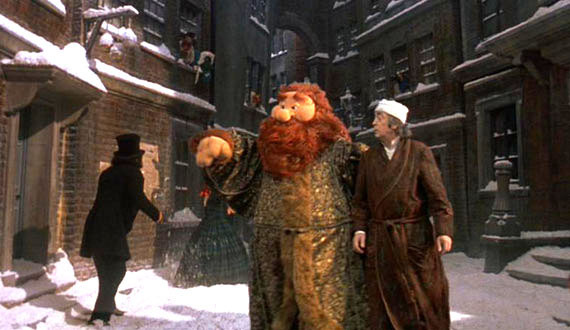
The Ghost of Christmas Present guides Scrooge through London
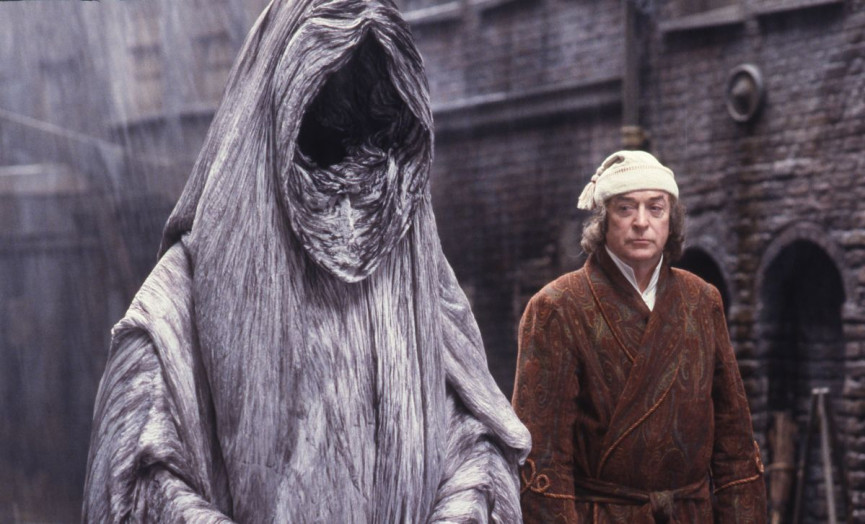
The Ghost of Christmas Yet to Come is suitably spooky but not TOO scary for kids.

There are also dozens of “little” Muppet characters (mice inside the homes, rats who work for Scrooge’s office, etc), and some giant characters, and the spirit of Jim Henson lives on in these parts and the talented people who bring them to life. In the finale, we get to see over 100 muppets in a panning shot, a very impressive accomplishment that makes them all the more “real” throughout much of the film.

It later came out that English actors David Hemings, Ron Moody and David Warner (the latter would have been my pick), alongside American comic George Carlin (who might also have been quite good) were considered for the role of Scrooge before Michael Caine finally won the role. I’m still not sure if Caine’s low-key misery was his choice or Henson’s, given that this is a family/kids version of the tale, but Caine noted that he based his portrayal on the present-day vultures of Wall Street and the banks, which may account for the more bloodless, cynical portrayal.

This is as evil looking as Caine gets, and he looks more bored than menacing.

The “London street set” used in the film was uncannily similar to the one used in the 1951 Scrooge — modified for scale, obviously — which delighted me, but while I understand the decision to keep the Muppet characters the audience would know using their original voices, the lack of UK accents from nearly everyone apart from Mackintosh and Caine was a disappointment to me, especially for the Ghosts. Given that the story, author, characters, and filming location were all in the UK, I felt like every character (with the Swedish Chef obviously exempt) should have added a UK lilt to their voices.

I haven’t mentioned Kermit the Frog as Bob Cratchit thus far in the film, for two reasons: first, although Bob is the raison d’etre of Scrooge’s reformation, he’s hardly in the film; and two, he doesn’t really communicate Cratchit’s plight because Kermit is a good-natured, happy frog at heart and is incapable of portraying suffering. I can’t believe I’m saying this, but Kermit was badly miscast, and should have played nephew Fred — while Steve Mackintosh, who played Fred, should have played Bob.

Fred, the Cratchit family and friends, Scrooge, etc – nobody seems poor here at all.

Nitpicking aside, the film does carry a lot of family-friendly humour, and succeeds in reforming Scrooge and being generally heartwarming. It’ll never replace Scrooge for me, but that said it is also nowhere near the worst version of A Christmas Carol committed to film. As a first version for kids to see that might get them interested in the story and other film versions, it’s fine.

The one high mark I will give this version is that, despite the musicality and comedy inherent in it, it does not shy away from painting the capitalist banking system as morally bankrupt and preying on poor people — the point of Dickens’ original tale in the first place, so good on them for that.

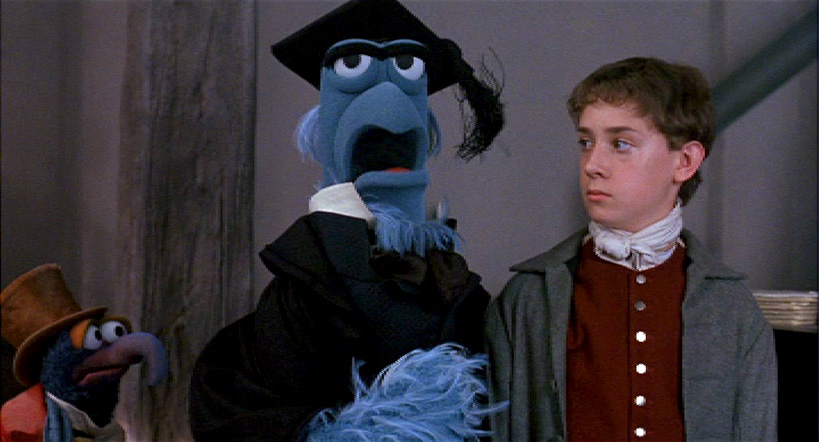
There’s a moment where Sam the Eagle, the All-American type, gets corrected in scene that this is a British story, and does a retake correcting “the American Way” to “the British Way” that I found quite amusing. On the whole, it’s a classic aimed at the smols in your household, it’s cute, it’s fun. There’s an extended version of the movie that restores one cut song, but don’t bother with that — one more song is exactly what this movie didn’t need.

Sam Eagle has a brief but amusing cameo in the movie. Yay!

Inside Out (2015)

⭐️⭐️⭐️⭐️
Disney/Pixar Studios
Director: Pete Docter

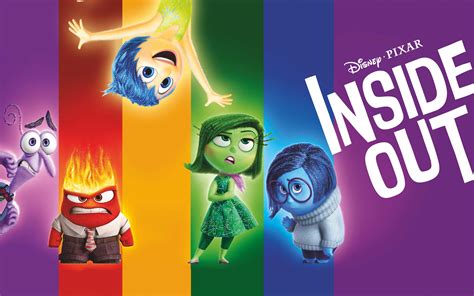
A short review: this is a pretty brilliant film, focusing on Riley, an 11-year-old girl, and her emotional state. It’s also the story of Joy, one of those emotions living in her head, coming to an understanding of the role Sadness should play in Riley’s present life and memories.

The other emotions are good, but kind of backgrounded — except for Anger, played brilliantly by Lewis Black. The parents are fairly minor characters as well, which I felt was a flaw at first, but they’re very much meant to be minor characters — the focus is on Riley. There are occasional representations of what’s going on in Mom’s and Dad’s brains, and those are also amusing.

The film won a (very large) bucketful of awards for Best Animated Feature that year, though only one Oscar — for Best Animated Feature. The American Film Institute and the National Board of Review, however, both picked it as one of the Top 10 films of 2018. It has since become another Pixar family classic, and is really well-suited to show boys and girls at around Riley’s age, or kids of almost any age who are going through the trauma of moving and leaving their previous friends behind.

Riley is, for the most part, a well-adjusted and well-rounded kid with a happy childhood and loving parents. We should all be so lucky, eh?

There is one serious flaw in the story that bothers me: when Sadness touches a memory, she changes it into a sad one from its previous state — she gets scolded for this several times in the film. Oddly, when (let’s say) Anger touches one of the memories, it doesn’t change — nor does it when Joy or any other of the emotion characters touch it. It’s not reeeeaalllly a plot hole as much as it is foreshadowing, but there was probably a better way to handle that.

That said, the most genuine sad moment in the film is a stunningly perfect heartbreaker: Bing Bong, and that’s all I’m going to say about that.

In short, it remains of Pixar’s best original movies. Even better ones have since been made from that studio, but Inside Out is still truly great, still relevant – and really does tug at the heartstrings, elicit emotional responses. For the non-kids this was also aimed at, the film gently gives us parenting advice while also making us recall our own pre-teen years.

The grey tones, minimal lighting, and troubled dinner conversation reflect Riley’s more sombre emotional state as she wrestles with the adjustment to a new town, no friends, and her emotional struggles.

I’d recommend you reacquaint yourself with this film before seeing the new sequel, Inside Out 2. I’m glad they waited nine years to do the sequel.

Journey Into Prehistory (1955)

(Czech title: Cesta do pravěku)
dir. Karel Zeman
⭐️⭐️⭐️⭐️

There’s a song by the Norwegian band synth-pop band a-ha on their debut album, Hunting High and Low, called “Living a Boy’s Adventure Tale.” Karel Zeman’s remarkable second feature film, Journey Into Prehistory (US title: Journey to the Beginning of Time) is that phrase fleshed out in colour.

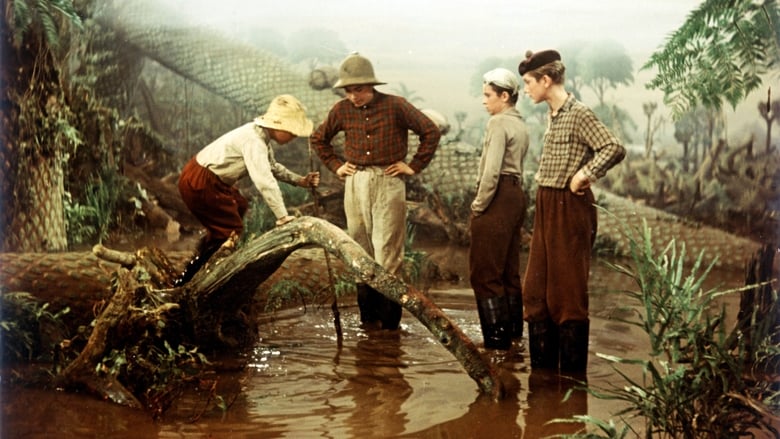
It uses the framework of a group of pre-teen and teen boys thirsty for knowledge and adventures as a vehicle to achieve Zeman’s own boyhood dreams, combining 2D and 3D models, animation, and live-action into a seamless Sci-fi fantasy film. While slow-moving by today’s standards, it is a perfect illustration of the kind of imaginative escapades you would have found in books and serialized magazine stories in the late 19th and early 20th centuries.

For those not familiar with Zeman’s work, his films are some of the most effective combinations of live-action and animation ever done to that point — until a fan of his, Terry Gilliam, began his own filmmaking career. While I haven’t seen many Zeman films, the other two I have seen — the amazing 1962 Baron Munchausen and the jaw-droppingly incredible 1958 Invention for Destruction — are just mind-blowing masterpieces of imagination. Zeman combines his own filmic skills with whimsical tales and brings great stories into the visual world of movies.

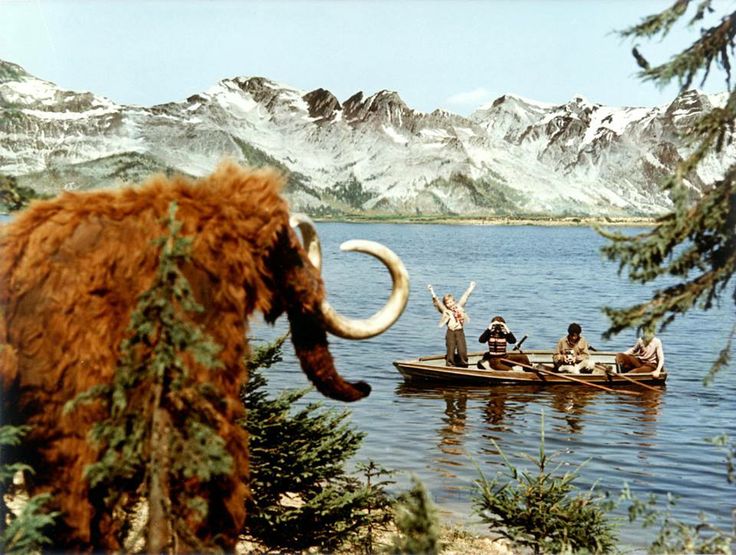
The boys encounter their first prehistoric creature — a curious wooly mammoth.

In the film, the boys learn about the prehistoric creature the trilobite by examining the fossil of one. The youngest, Jirka (Vladimir Bejval), is disappointed that there are no living triobites left, so the older boys propose taking a trip back in time to find one — like you do — and take a boat up river into a cave that allows them to pass through it, and into progressively earlier eras of earth’s development as the continue upstream.

The oldest boy Petr (Josef Lukáš) narrates most of the film and does most of the rowing and planning, while the second-oldest Toník (Petr Herrmann) keeps a logbook. Jenda (Zdeněk Husták) and Jirka, the younger boys, help out as they can, with Jirka in particular running off to explore too eagerly, which causes the occasional misadventure.

Jirka (left) is a bit of a jerk-a sometimes, deliberately ignoring safety warnings to explore.

They indeed pass through the four main periods of prehistory (as defined in 1955) — from the Ice Age, to the Tertiary, the Mezozoic and the Paleozoic, and all the way back to Silurian age.

This film is more sparse on the effects compared to Zeman’s later ones, but importantly when special effects appear, they are as realistic as it was possible to make them. Some effects used puppetry, some used a very smooth form of stop-motion, but clever use of shot-matching allowed the actors to travel with beautiful backgrounds and “living” prehistoric creatures very smoothly integrated and fluidly animated.

Along their journey, they encounter and learn about progressively older examples of prehistoric creatures. Interestingly (at least to me), the film makes no attempt to get the boys back to their own time, even after tragedy befalls their original vessel. I don’t want to say more about the plot to avoid spoilers, but the film is both blatantly educational but also filled with moments of danger, suspense, and the single-minded energy of the young to sate their curiosity.

The Czech version runs 93 minutes, and while the pacing makes it sometimes hard to stay on board with the slowly-unfolding story, the promise of another effects sequence soon will hold most viewers, and also curiosity about how the story will be resolved.

A life-size Stegasaurus model was built for this sequence.

A US version was created later, using a new intro and outro where the boys (replaced by US actors shot only from the back of their heads in the opening and end sequences) imagine the whole adventure while visiting the Museum of Natural History, and stretches credibility pretty hard. The recut US version runs only 84 minutes, dropping some exposition to get to the effects more quickly.

The story is a mash-up of Jules Verne’s 1912 novel The Lost World and a Russian novel called Plutonia from 1915, both obviously influences on Zeman (he would go on to a brilliant and straight-up later film combining several Verne stories named after the primary story its based on, the novel Facing the Flag).

For many years, the existing prints of Journey Into Prehistory were of such low quality that the film almost passed into unseen obscurity, following its initial worldwide success. Thankfully, the film has since been digitally restored and repaired, so we can see it the way Zeman intended.

A friendly creature from long before the dinosaurs

Tom of Finland (2017)

(dir. Dome Karukoski)
⭐️⭐️⭐️
52-week challenge, film 52

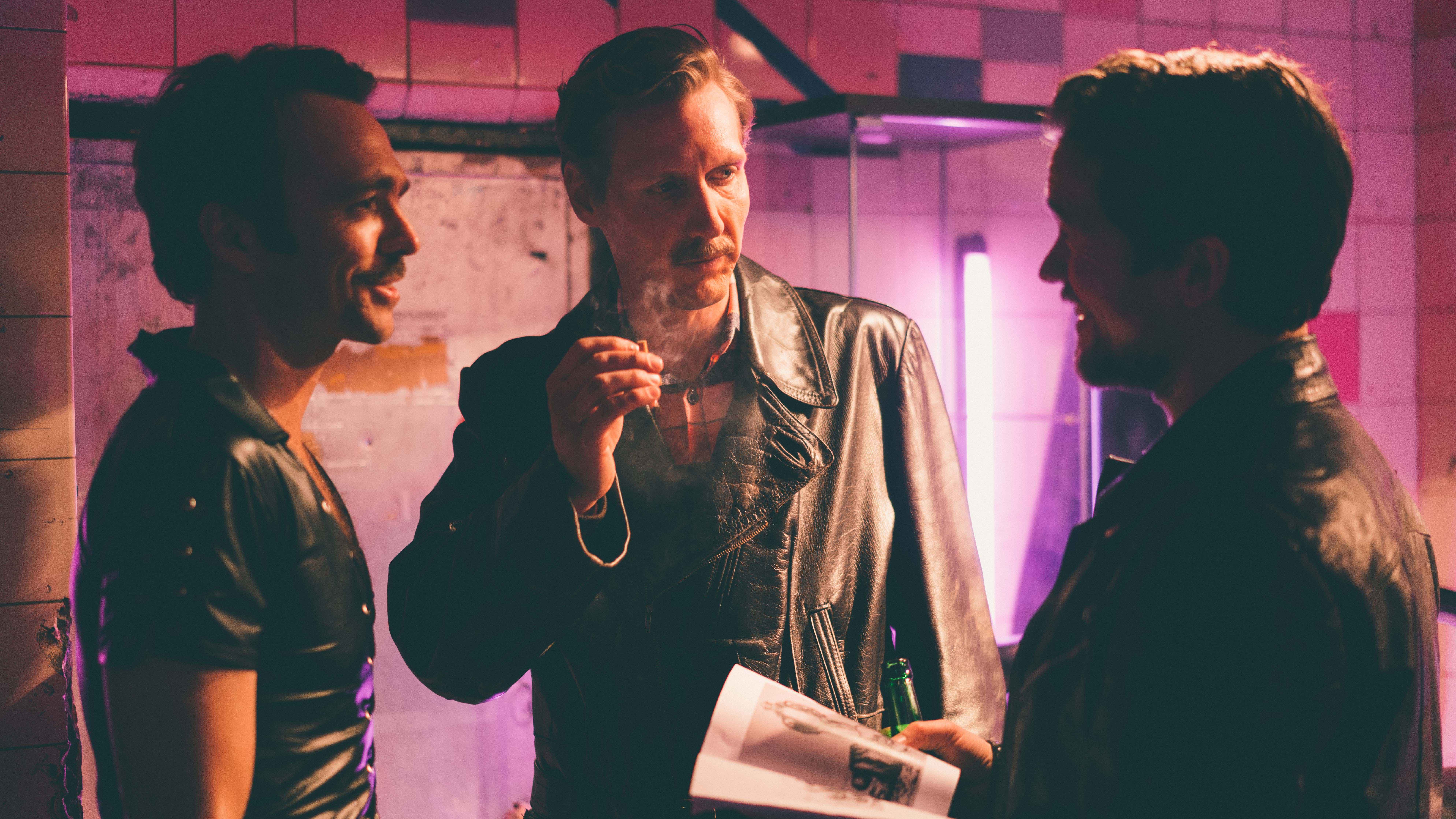
When looking this film up and reading the description, I was led to believe that this would be a documentary of the artist Touko Laaksonen (portrayed by the similar-looking Pekka Strang), better known in the gay community (at least previous generations thereof) as “Tom of Finland.” Disappointingly, it isn’t … but it is a biographical drama of the man, which gives us a lot of background information on his adult years both in finding inspiration for his art, and his rise to fame-slash-notoriety.

The film itself was made in Finland, which really marks an acceptance of the artist the country shunned for decades. Learning more about this time as a Finnish soldier in World War II is worthwhile, and about his remaining family (we only see Touko from about the age 23-onwards) — his sister Kaija (Jessica Grabowski), with whom he lives. As the film begins, Touko has returned from the war with some mental scars, but also an obsession … men, especially men in leather or more traditional kinds of uniform.

He makes his living by day as a commercial artist for an ad agency, but begins frequenting parks after dark where other gay men meet for anonymous sex. One amusing scene where he first meets Veli (Lauri Tilkanen).

Their sex is interrupted by police, but instead of running, Touko composes himself and walks casually through the park — running into the police and asking them what’s going on, thus allying any suspicion that he might be one of the homosexuals. There aren’t many laughs in this film, but there are few more to be had in the final third.

Kaija doesn’t accept Touko’s homosexuality, and is mostly unaware of his predilection for explicit fetish erotic drawings. They are both talented artists, so Touko takes to hiding his “gay” portfolio in the attic. As so many gay men in the 1940s to 80s did, he skated a very fine line between looking for love (or something a bit quicker) and avoiding the police and society’s rejection.

The film shows Touko getting older, getting beaten by straight men he mistook for gay, and the other realities of life for gay men in a sexually-repressive society. He finally does meet up with Veli again (ironically when Veli begins dating Kaija), and the trio pal around for a while until Veli finally ends up with Touko, which forces Kaija to accept the situation.

The final third of the film, where Touko’s drawings begin to been seen in the US and bring his pen name great fame, is where the viewer feels things are finally coming together for Touko. He is flown to LA and sees the fetish scene he has created among the gay men there, and is hailed as a hero.

Finally getting up the courage to publish his own book of his work, he runs into a roadblock … nobody in Finland will publish him. In one of the most amusing scenes in the film, Touko and Veli finally locate a religious Jewish printer who is willing to take on the work, but is too small a shop to print and bind 10,000-plus copies. An ingenious solution ensues, and “Tom’s” lasting fame is ensured.

Now in a stable relationship and his own place back in Finland, and celebrated as a gay icon in the US and elsewhere, “Tom” has found his place in the world at last … until Veli gets sick (of throat cancer), and other gay men are being stricken with what become known as AIDS. Touko feels partially responsible for this “gay” disease, but is quickly dissuaded as the epidemic grows.

The last scene in the film is an elderly Touko, having lost Veli some years before, appearing at a fetish convention as the guest of honour, walking on stage to an army of Leatherman. As he gazes across this army of men his works inspired, his opening words are “Hello, boys …”

As with the man himself, the film’s first half is very straightforward and mostly strait-laced, at least as much as a biographical drama of a gay man can be. As with Touko’s art finding its audience, the film finally starts to loosen up and celebrate its subject in the final third, and while the first half can seem stilted and slow at times, the last act makes the journey all worth it.

Author’s note: Well, I did it. An average of one movie every week for a year, with a few days to spare, even — documented with what I hope readers will find as informative and helpful reviews. The point of this exercise was to select a bunch of films randomly, some I’d seen before but most I hadn’t, and appraise or re-appraise them to help others decide if they wanted to delve into a particular film, as well as encourage readers to take a chance on some films they wouldn’t normally make the effort to see. If you look over the whole set, I found a bunch of new gems over the course of the year.

What’s great about movies is the way they can bring you into worlds outside your own, especially in a visual way that books cannot fully compete with. Like travel, film broadens the mind, and sometimes profoundly changes some aspect of your own worldview — or just takes you out of your own reality for a couple of hours, which can be good for your own mental and emotional health.

I’ll continue to post the occasional movie review here, but for 2024 I’ve decided to take up a new reviewing challenge — I’ll be sharing with you my discoveries, delights, and disappointments (if any) once a month over a given box set of music CDs — sometimes a career compendium, sometimes a greatly-expanded album, sometimes just a curated collection of music related to a given theme. The CD format is said to be commercially dying, ironically giving way to its predecessor, vinyl — which, as you may have guessed, I find a very odd consumer choice.

Hopefully we’ll see you over at Bargain Boxset Bin Bonanza — a new page coming soon to this same website — in the near future, and we much appreciate those of you who have visited to read the film reviews.

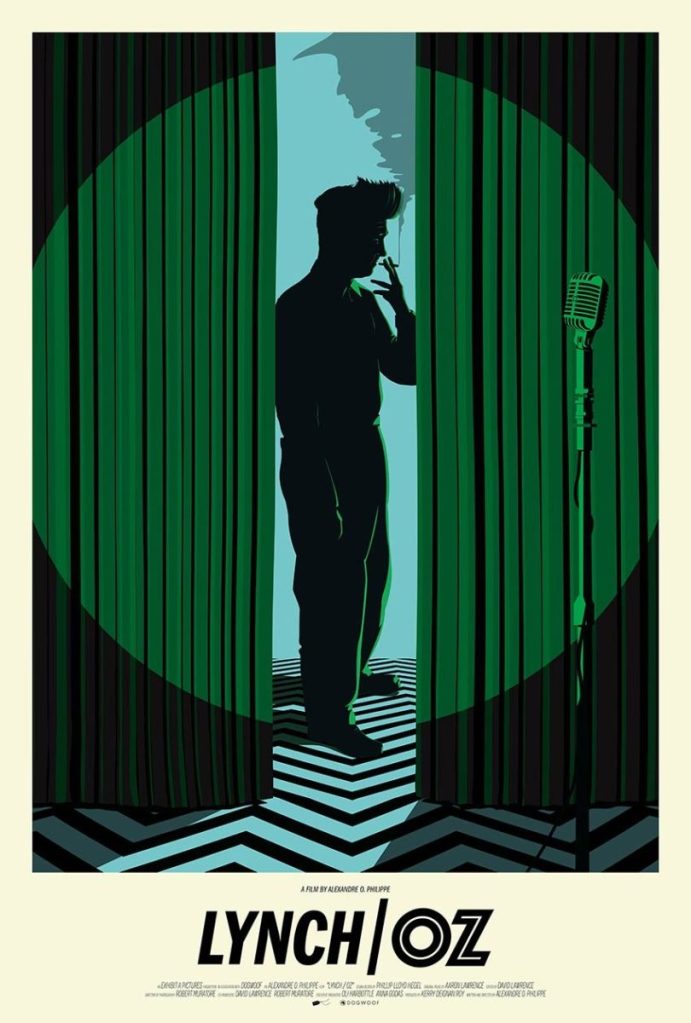
Lynch/Oz (2022, dir. Alexandre O. Philippe)


⭐️⭐️½
52-week film challenge, film 48

The short version: this film-school set of academic essays read aloud with visual accompaniment, which collectively try waaaaaay too hard to connect everything David Lynch has done to the 1939 film The Wizard of Oz is overlong and misguided.

That’s not to say that there aren’t a lot of references and visual cues in Lynch’s work that parallel TWoO; of course there are.

He’s obviously influenced by it, and there’s plenty of examples, either spoken in his films or visual/story metaphors. In answer to one essayist’s question at a Q&A somewhere, Lynch himself says that not a day goes by that he doesn’t think about that film.

Glinda the Good Witch literally makes an appearance in Wild at Heart, FFS.

The problem (one of several) with the central premise behind this is that most artists Lynch’s age or younger can easily be demonstrated to have been influenced by The Wizard of Oz: it was a unique film that embraced Technicolour in a new way, giving new life to L. Frank Baum’s first Oz book (he went on to write another 13 in the Oz series). The film version’s characters, dialogue, and songs have all entered the public consciousness in a huge and enduring way, thanks to the film’s yearly repeats on television and its extravagant, nearly-timeless tale of poverty, fantasy, and the power of friendship and imagination.

Even if you accept that Oz was a major influence on Lynch’s films — and there’s plenty of evidence that it was, in places — the documentary goes on to point out that it was also a significant influence in dozens and dozens of other films that have nothing to do with Lynch at all, thereby diluting Lynch/Oz’s central premise. This adds significant time to the already-thin but interesting premise, with the documentary running a very long-seeming hour and 49 minutes, when it could have been a really tight and more interesting hour.

Lynch/Oz is divided into six chapters, following what director Philippe probably thought was a Lynchian oddball introduction by odd-looking Jason Stoval (as Sid Pink) that falls very flat, as does the reprise at the end of the doc.

Another element that might have helped make this tribute less dull would have been to actually see the six essayists who read their written analyses of Oz’s influence on Lynch. Instead, we get clips from many other movies that also in some way reference The Wizard of Oz, seeming undermining the point of this particular doc — Oz is a very influential picture across all of the last 80 years, we get it.

Amy Nicholson has one of the weakest premises in her section, titled “Wind.” Yes, she talks about the use of strong winds to be transformative agents in both The Wizard of Oz and Lynch movies, of which there are but a handful of examples. Rodney Ascher’s “Membranes,” which posits the dividers between “reality” and the things beyond that (often illustrated with curtains in Lynch’s work, akin to Toto pulling back the curtain to reveal that the Wizard is not who he seems), is much more successful. It’s a very, very, obvious point, but well-explored.

Lynch’s films frequently deal with a character discovering a larger — and more sinister — world than the one they live in, which sparks a journey of discovery.

The third essay is the one that is the most completely worth watching: fellow filmmaker John Waters, who has a delightful personality and distinctive speaking voice that radiates joy, talks about how he and Lynch are of similar age, and so of course are in some ways influenced by the same films they saw as kids — not to mention that, like Lynch, he developed a fixation on the undersides of façades. Waters shares an anecdote of meeting Lynch, talks about their shared influences, and similar — but very distinct — desire to poke around underneath the fantasies we all try so hard to fit into our realities: it’s by far the best of the essays.

That’s not to say Karyn Kusama’s pondering on “Multitudes” in her exploration isn’t good also, but it marks a return to the more dry and academic style of analysis that has dominated this documentary until Waters brought some fun in with him. Thankfully, this is followed by Justin Benson and Aaron Moorhead’s humourous ruminations on the frequent reference to a never-seen “Judy” in Lynch’s TV and film work, which brings in an excuse to explore the influence of Judy Garland’s own life on Lynch — a genuine and, once you see it, obvious musical influence that their essay makes clearer.

I did appreciate the documentary pointing out some examples of red heels (and even clicking them) in Lynch’s work.

This leaves David Lowery to bring up the rear with his essay on the theme of digging — a pretty weak link, and a curious choice for the finale of the documentary. He pokes around at the rather obvious point that Lynch’s characters often try to either bury things they don’t like, or have such things dug up (metaphorically or literally).

As a Lynch fan, I was hoping I’d get more out of this documentary than I did, though I do appreciate both some of the essays and examples they gave to support their point, and of course the archival footage of Lynch interviews, which are sprinkled throughout. Lynch doesn’t talk that much about his own work, so these nuggets are rare and Lynch’s obtuse way of answering questions about his work are mischievous and amusing.

If they’d drop the pretentious opening/closing, the seemingly-endless references to non-Lynch films that have obvious Oz references, and maybe the weakest of the essays (either “Wind” or “Dig”), you’d have a smart, shorter documentary with some real insight. It’s too bad director Philippe didn’t do that, because what he ended up with is a documentary that will have you squirming in your seat — for all the wrong reasons.

The Thief of Bagdad (1940, multiple directors)

⭐️⭐️⭐️½
52-week film challenge, film 24

I had previously seen clips from this version of the story, but never saw the entire film until now. I have to say I like it a great deal less than the 1924 version with Douglas Fairbanks (Senior), but this first colour production was a huge technological achievement for its time, even though — what with the breakout of World War II, and no less than five directors, along with various other issues — this version is mostly successful at what it sets out to do, but is also a bit of a hot mess.

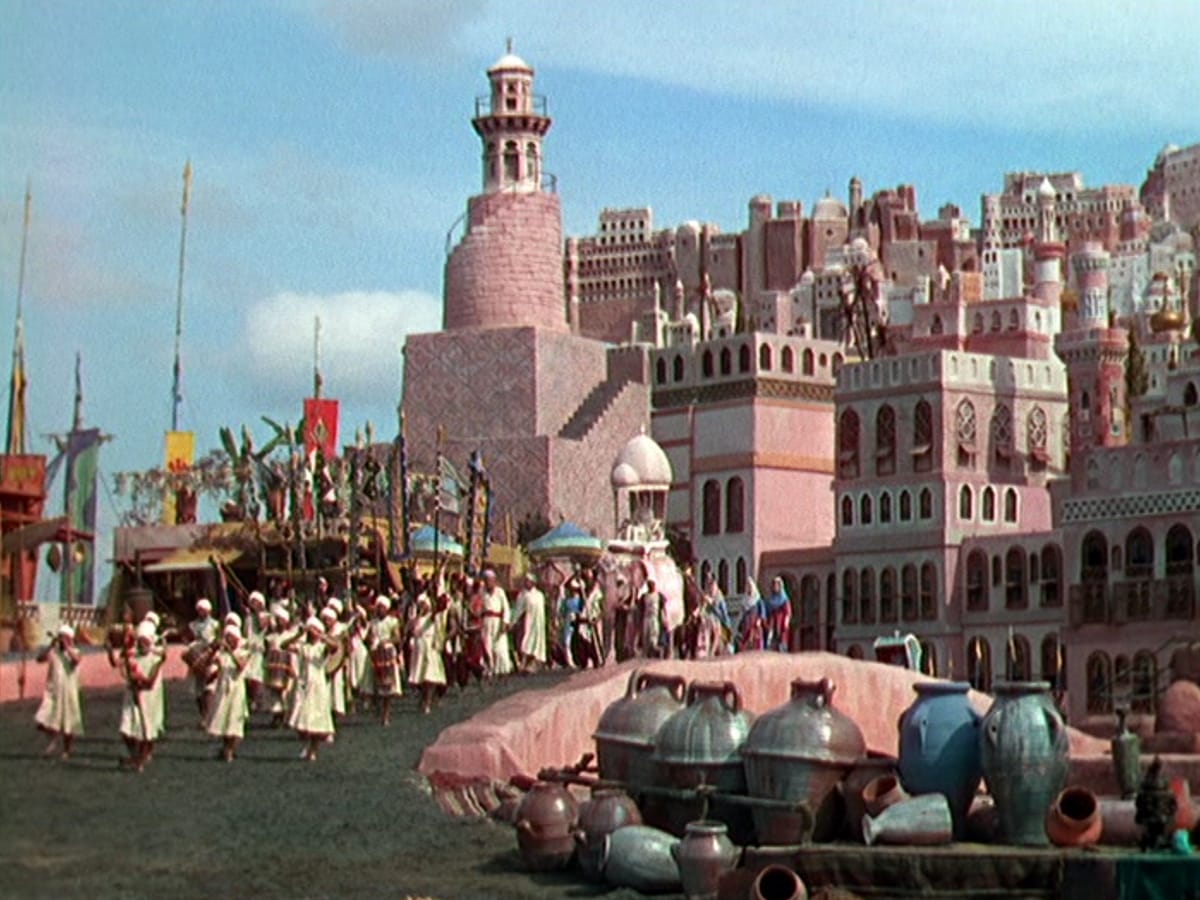
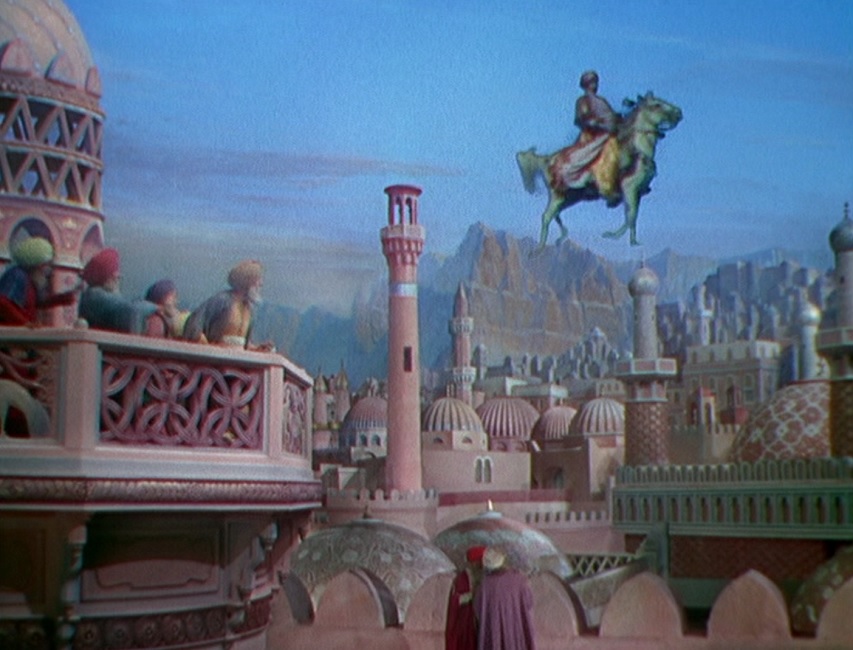
You have to respect the ground-breaking effects (including the first use of what is now called Chromakey), the brilliant sets, the beautiful location photography (a mix of London and California, the latter being used after the war broke out), the lovely set pieces, and the gorgeous three-strip Technicolour process. It won Academy Awards for cinematography, art direction, and special effects, and was nominated for its music (the latter by the great Miklós Rózsa after a false start by Oscar Straus).

Because of the various problems during production, original director Ludwig Berger and Berger’s choice of composer (Straus) were eventually replaced primarily by Michael Powell. Powell also had to leave the production before its completion due to the war, and American Tim Whelan directed nearly all of the latter half’s outdoor scenes in California with assistance from the Korda brothers. You can already see why the film, as entertaining and gorgeous as it turned out, doesn’t always hang together.

The story, which has also gone by the name Aladdin and variations thereof for many film versions, was first made into a film in 1905 and across the 20th century (and into the 21st, with Disney’s live action remake of its own 1992 animated Aladdin). The core story is often said to be drawn from the medieval collection of Middle Eastern tales known as One Thousand and One Nights, but this is somewhat inaccurate. The Aladdin tale specifically (along with the Ali Baba tales) was added to the collection from other sources by the 17th-century European translator of the tales, Antoine Galland.

Producer Alexander Korda was inspired to do this movie by the 1924 silent version, but changed the story pretty substantially — as just one example, making the thief and the King two separate characters. If you don’t know the 1924 version like I do, this is a mostly-successful telling that tries to combine some variations of the tale into a coherent whole, and mostly does it quite well.

It is certainly a fine family film with enough fantasy to hold its audience even now, though I’m very glad they changed direction from its intended “full blown musical” idea. Three songs are still in the film, but apart from Abu’s solo song, they don’t disrupt the story.

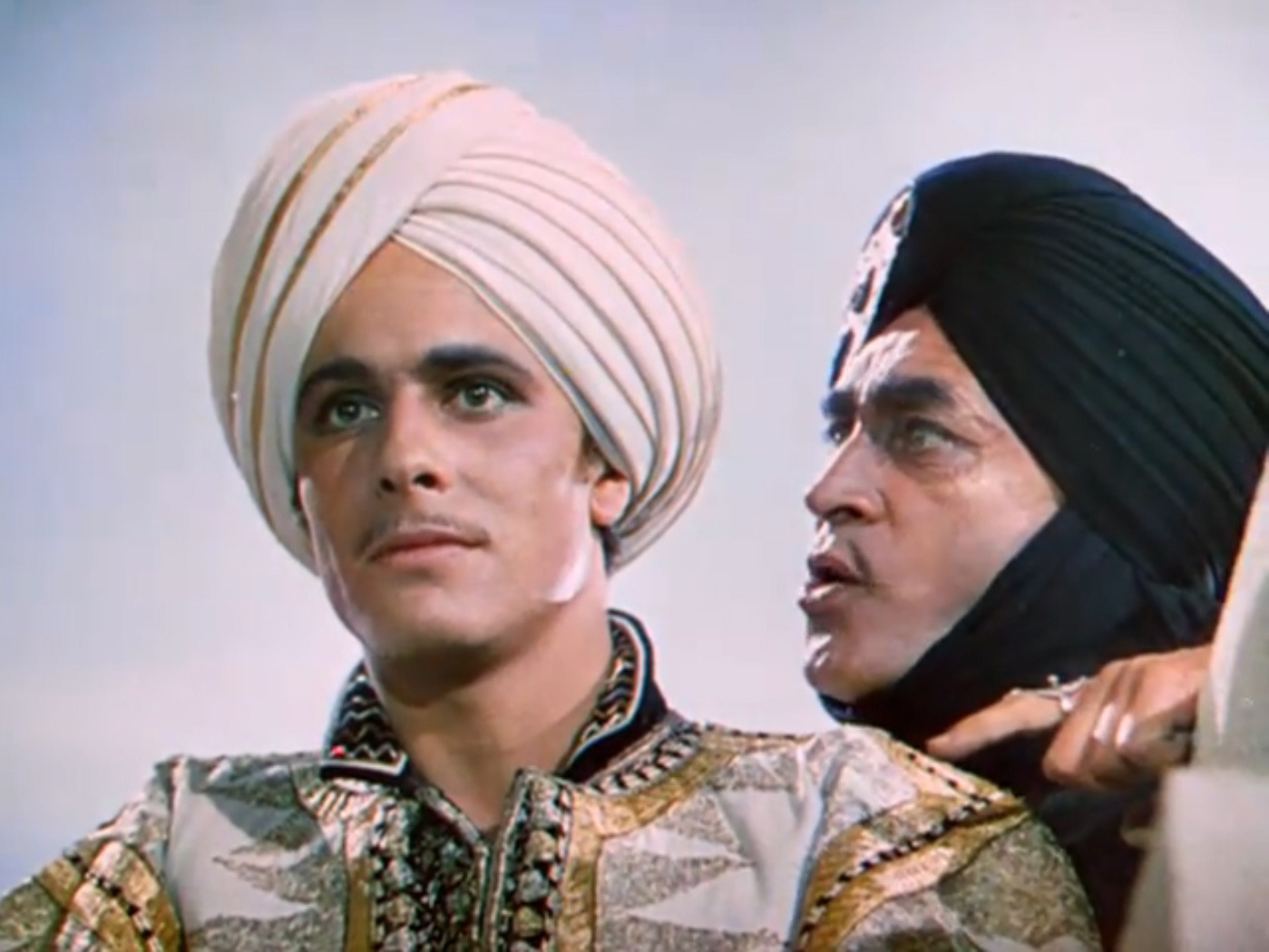
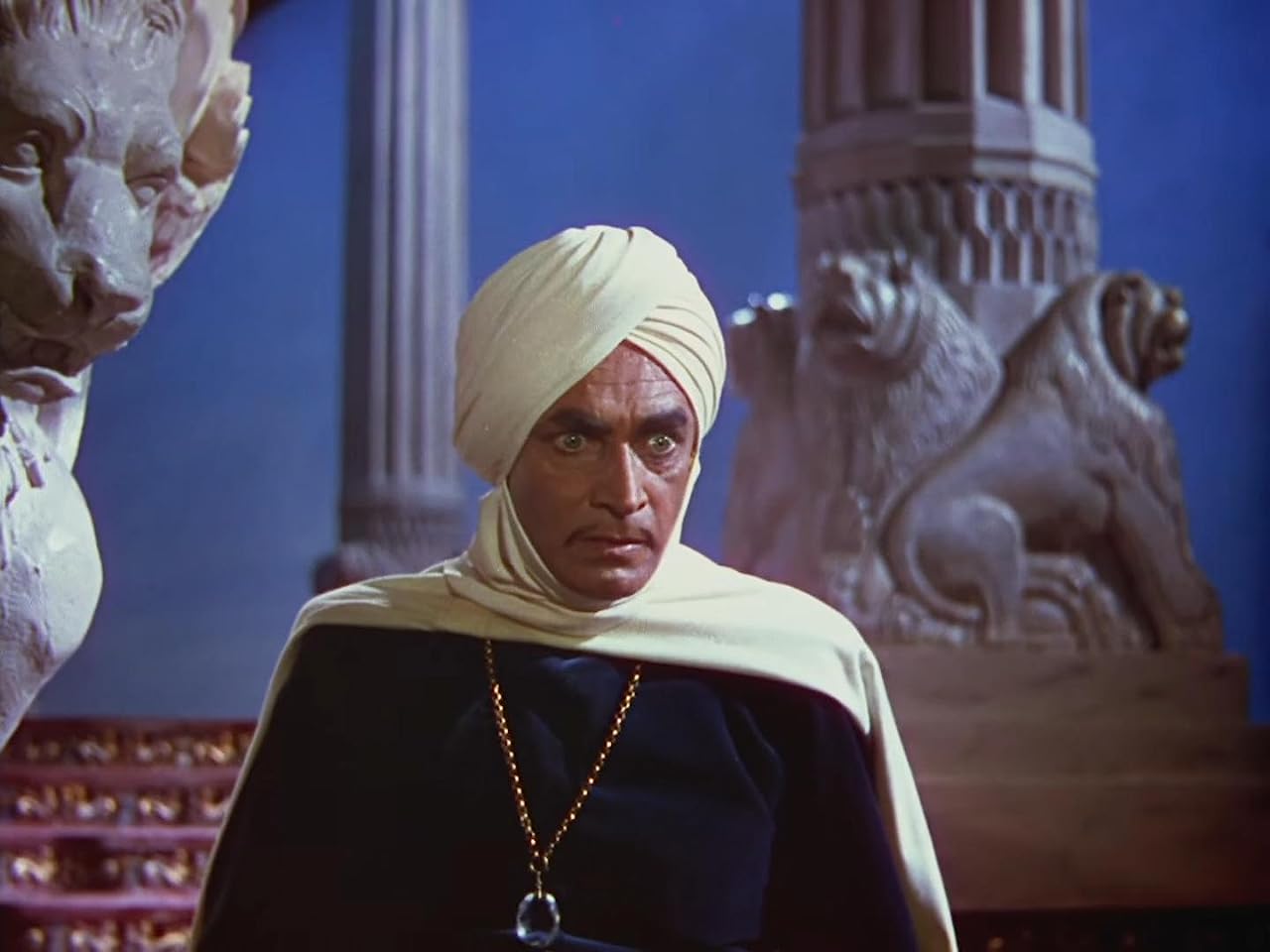
The film opens brilliantly, as a blind beggar in ancient Basra along with his faithful dog companion tells the first part of the film’s tale in flashback. He tells of a young and naive King Ahmad of “Bagdad” (John Justin), who wants to learn more about the people he rules, so he is persuaded to go undercover by his evil Grand Vizier, Jaffar ((the great Conrad Veidt, who completely steals every scene he’s in).

King Ahmad (John Justin) and Jaffar (Conrad Veidt), his Grand Vizier

Once Ahmad is out of the castle and pretending to be a humble beggar, Jaffar has him arrested, and thrown in prison — later telling the people that Ahmad died, so Jaffar can claim the throne. Ahmad meets a young thief while in his cell called Abu (played by then 15-year-old Sabu Dastagir, who just went by “Sabu” in his film career).

Abu, a carefree youth, disbelieves his cell mate is the king at first, but befriends Ahmad — and pickpocketed the key to the cell so they could escape. They flee to Basra, where Ahmad spots the princess (June Duprez) and immediately falls in love with her. However, Jaffar is also in Basra and trying to win the Princess through other means — flattering her father, the Sultan (Miles Malleson, also one of the writers of the film), with life-size toys — the Sultan’s obsession. Malleson is another highlight, a wonderfully child-like old man played to perfection.

Jaffar seals the deal by giving the Sultan a mechanical flying horse, but in the meantime the princess and Ahmad have met, and the attraction is now mutual and she escapes the palace. Enraged, Jaffar uses his magical powers to blind Ahmad, and turn Abu into a dog. The princess is recaptured, but falls into “a deep sleep” and cannot be awakened.

You can see here how the Chromakey stuff is VERY primitive and doesn’t always match well.

Ahmad, still blind, is eventually tricked into returning to the palace, where he awakens the princess, and is then dismissed, along with his dog Abu. We return to the dock where we first met them, as he concludes his story — but the adventure quickly continues as the Princess is tricked into boarding Jaffar’s ship.

Now a prisoner, Jaffar tells her that his curses on Ahmad and Abu can only be lifted by her embracing him, which she very reluctantly does out of love for Ahmad. The spells are lifted, and Ahmad spots her and sets after the ship along with the now-human-again Abu. Jaffar sees them a bit later, and raises a storm that shipwrecks their small dinghy, then returns to Basra and uses a mechanical dancing goddess toy to kill the Sultan before returning to Baghdad.

He does TRY to woo Princess Noname, but ultimately has to resort to threats and hypnosis, of course.

Meanwhile, by sheer lucky coincidence, Abu finds a bottle on the deserted beach and opens it, revealing a very temperamental and gigantic genie (Rex Ingram). Ingram handles the role as best he can, but he’s just not very convincing — and the effects regarding the size differences between him and Abu, though imaginative, aren’t generally carried off well enough to continue the suspension of disbelief.

The scaling effects work reasonable well, but Genie’s performance is uneven (and you should see his toenails! Ayieee!)

Still, the influence of this film on later filmmakers like Ray Harryhausen simply cannot be overstated — this is the blueprint he and others followed for decades to come when it came to imaginative tales of fantasy. In addition to Harryhausen, Terry Gilliam’s best films are also clearly influenced by this movie.

The genie helps Abu steal a magical jewel from a faraway temple (with a Keystone Kops-esque guard squad) that helps him find and reunite with Ahmad, all of which is really well done. Abu and Ahmad use the jewel to see Jaffar hypnotizing the Princess to forget her love for Ahmad, and our hero loses hope and angers Abu — until Abu accidentally uses his third and final wish to send Ahmad back to Baghdad.

Abu then breaks his giant jewel out of anger, which introduces a handy plot device to get him also back to Baghdad via a flying carpet (very well done compared to the flying horse effects), the appearance of which triggers the population into overthrowing Jaffar, who is then killed by Abu, restoring Ahmad to power and allowing him to marry the Princess, who never did get an actual name.

Abu is offered the position of Grand Vizier to King Ahmad, but shuns any form of responsibility, re-steals the flying carpet, and heads out to more adventure. Everyone laughs, and the film concludes happily. You can almost forget how bad Sabu’s song was (he was otherwise generally excellent).

The flying carpet sequences, both in Chromakey and physical effects, work much better.

In its day, the film was a wonder and did very well at the box office. It maintains a good reputation (now as a children’s movie) to this day.

This version of The Thief of Bagdad was the template for most future special-effects-heavy fantasy films for decades to come, largely due to Larry Butler’s invention of ChromaKey, which with some later polish became the successor to the “traveling matte” techniques used in prior films.

Viewed as an adult, the physical effects are mostly great — and while the Chromakey effects are often so obvious it takes you out of the film, the alterations to the tale and a few handy plot machinations do not. Watched bearing in mind its technological and historical importance, it is still enjoyable, and well worth the 108 minute runtime.

Conrad Veidt does more acting with his eyeballs alone than most actors do with their whole body.

The General (1926, dirs. Buster Keaton, Clyde Bruckman)

⭐️⭐️⭐️⭐️⭐️
52-week film challenge, film 23

Blah blah blah Tom Cruise blah blah stunts blah blah Mission Impossible blah blah blah. You want stunts? You want life-threatening risks? You want thrills? Buster Keaton had Tom Cruise beat, handily, nearly 100 years ago with The General. Not only that, but you’ll learn at least a dozen new ways to stop a train you probably never thought of before.

Some of what he accomplishes in this 79-minute film seriously could have killed or severely injured him, and in fact he was knocked unconscious on one occasion during the filming. Several of the spike-pulling moments in the film would have put his life in severe danger if he had mistimed his actions, and there’s a lot of cow-catcher stunt work performed with the train and boxcars moving at speeds that added a great deal of risk to the shots.

The plot is pretty typical Keaton: there’s a girl he wants, but there’s an obstacle or set of obstacles in the way, and by a combination of dumb luck and reckless foolhardiness he blunders his way into overcoming the obstacles and gets the girl. The film is based on a true story of a Civil War locomotive chase, though Keaton for reasons unclear switched the sides, believing the public would be more sympathetic to the Confederate side, thus making the Union soldiers the villains.

Perhaps this contributed to the film’s poor performance at the box office at the time, despite having an exceedingly high budget (much to the studio’s consternation). But, to be fair, every dollar of it is on screen).

In The General, Keaton is Johnnie Gray, the engineer of his beloved locomotive, and is wooing a girl from the Lee family of Marietta, Georgia (having spent a fair amount of time in Marietta, this has always been an added bonus in the film for me). When the Civil War breaks out, the father and brother of Annabelle Lee rush to enlist, as does Keaton.

When he tells the clerk he is a railroad engineer, he is deemed too valuable in that role and turned away, though he is not told why. He comes across the Lee men after being rejected, but turns down their offer to join the line, branding him a coward in their minds.

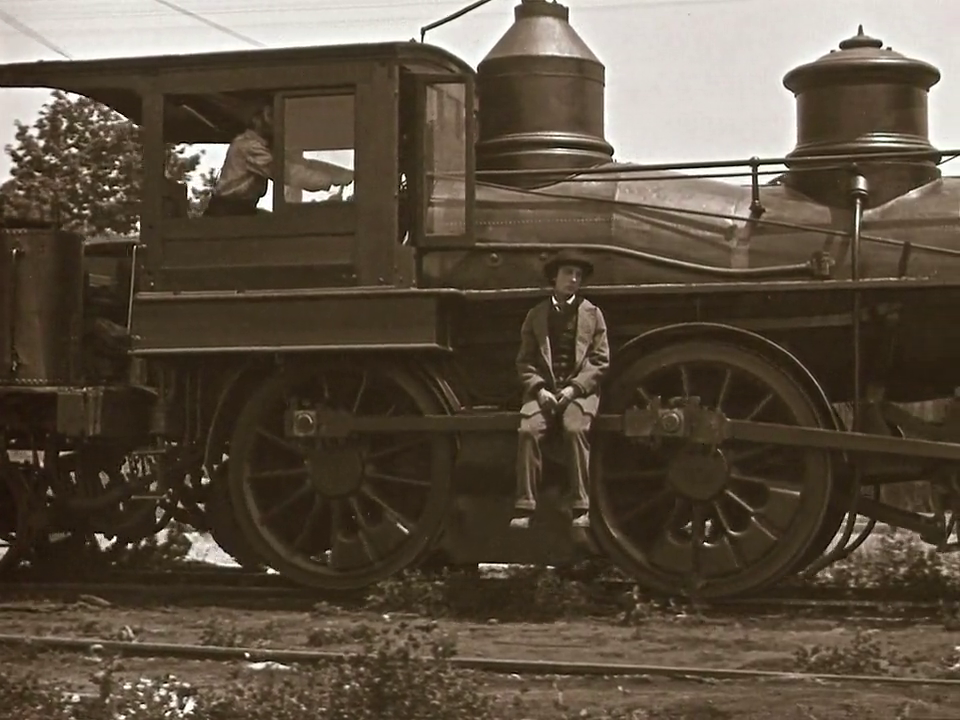
Despondent Johnnie rides the literal rail after being rejected by his girl and her family.

They tell Annabella of his cowardice, and she rejects him “until I see you in uniform.” A year later — a time lapse not made explicitly clear in the film — a gang of disguised Union operatives plan to hijack a Confederate train (guess which one) and use it to destroy bridges behind them as the travel north, cutting off the Confederate supply lines.

The ruse succeeds and strands Keaton, but he quickly finds both another locomotive and a group of Confederate soldiers to give chase — but as he pulls out, he fails to realise that the locomotive was not attached to the rail cars full of soldiers, so now it is just him chasing The General and its carful of Union saboteurs to get his train back.

And now, the plot wrinkle: Annabella was on the train being hijacked to go see her wounded-in-battle father, and unlike her fellow passengers, did not disembark the train during the dinner break, instead heading to the luggage car to retrieve something. She is thus captured by the Union hijackers, and held prisoner aboard The General.

After losing his second locomotive, he continues the chase anyway he can.

Once Johnnie discovers this some time later, he becomes determined not just to get his own locomotive back, but to rescue his girl and stop their dastardly plan. Before and up to that point, the film engages in a series of incredible stunts as the rogues engage in a series of gambits to slow or stop Keaton’s chase, believing Keaton’s train is full — once they discover it’s just the engine and him, the stunts get even more impressive, and occasionally some malarkey goes on in other locations besides the two trains.

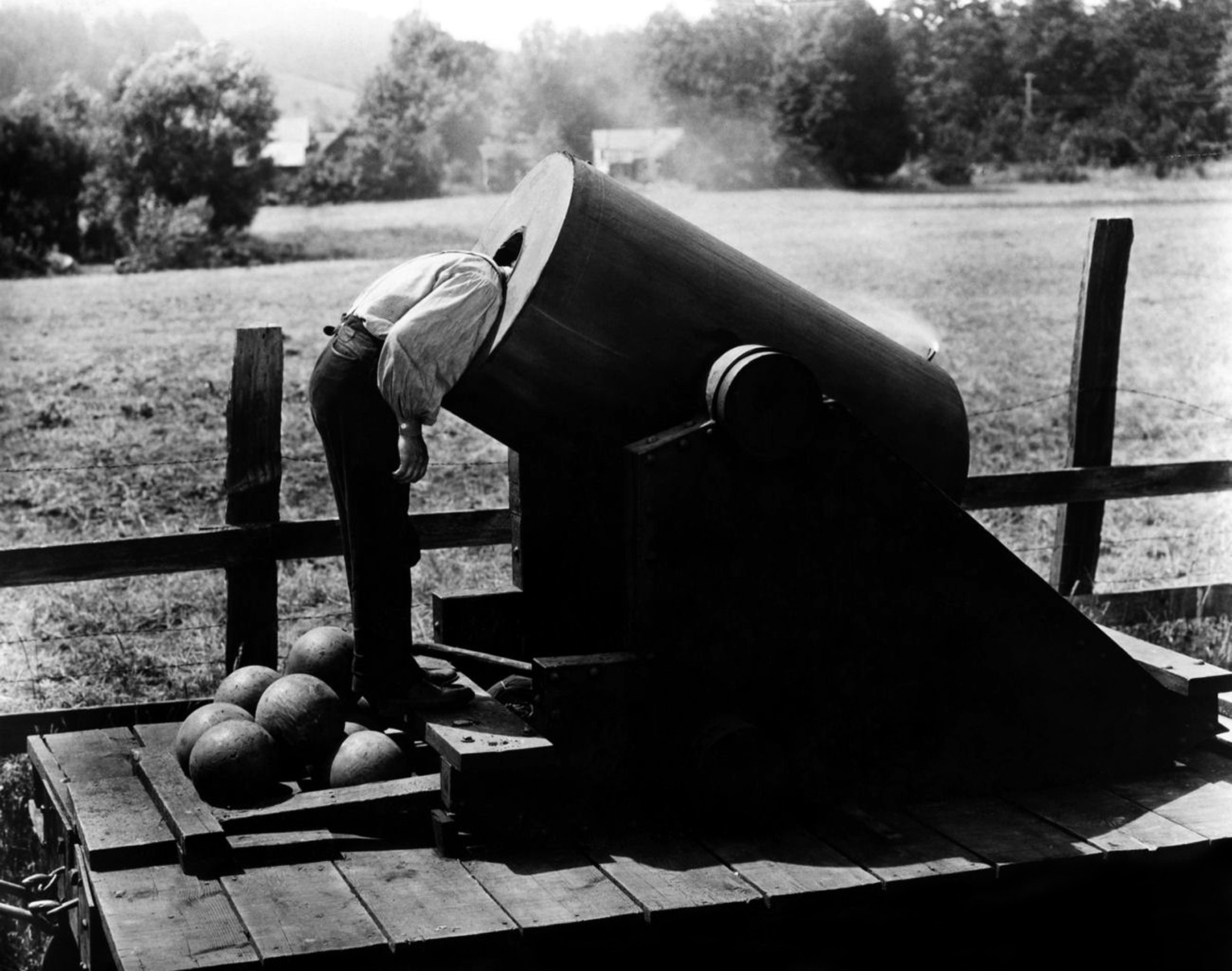
Checking to see if the canon he was towing in his earlier attempt to catch The General was working.

Keaton’s physical stunt-work is just mind-blowing to watch, especially considering that films in those days didn’t have the luxuries of safety considerations (though they did have stunt people for some long shots, those are much fewer than you’d expect — it’s mostly all Keaton). He climbs all over that locomotive like a spider, all while the train is in motion. If you’ve seen any of his films, you know he is the undisputed master of the thrilling-comedy-stunt moment, and there’s nothing Tom Cruise or anyone else can do about it.

The rail-thin Johnnie follows the raiders to a dinner where they reveal their plan.

I don’t think I’m spoiling anything by saying it all resolves in the end, Johnnie goes from civilian engineer to decorated leiutenant thanks to a field promotion, changes his occupation to “soldier” and finally enlists properly. Of course, the Lee family witness the finale and are deeply impressed, none more so than Annabelle.

Johnnie and Annabelle after he frees her from captivity by pretending to be a Union soldier.

Although it didn’t do well at its initial box-office debut, the film has risen steadily in the minds of both critics and cinephiles, and is now widely regarded as a true classic — and still routinely places very highly in lists of the all-time greatest movies, and still boasts the single most-expensive stunt shot in silent-movie history, which forms the spectacular climax of the film. While I’m still confused as to why Keaton reversed the sides to make it a peculiarly pro-Confederate film, the stellar filmmaking and Keaton’s performance overcome that one lapse in judgement.

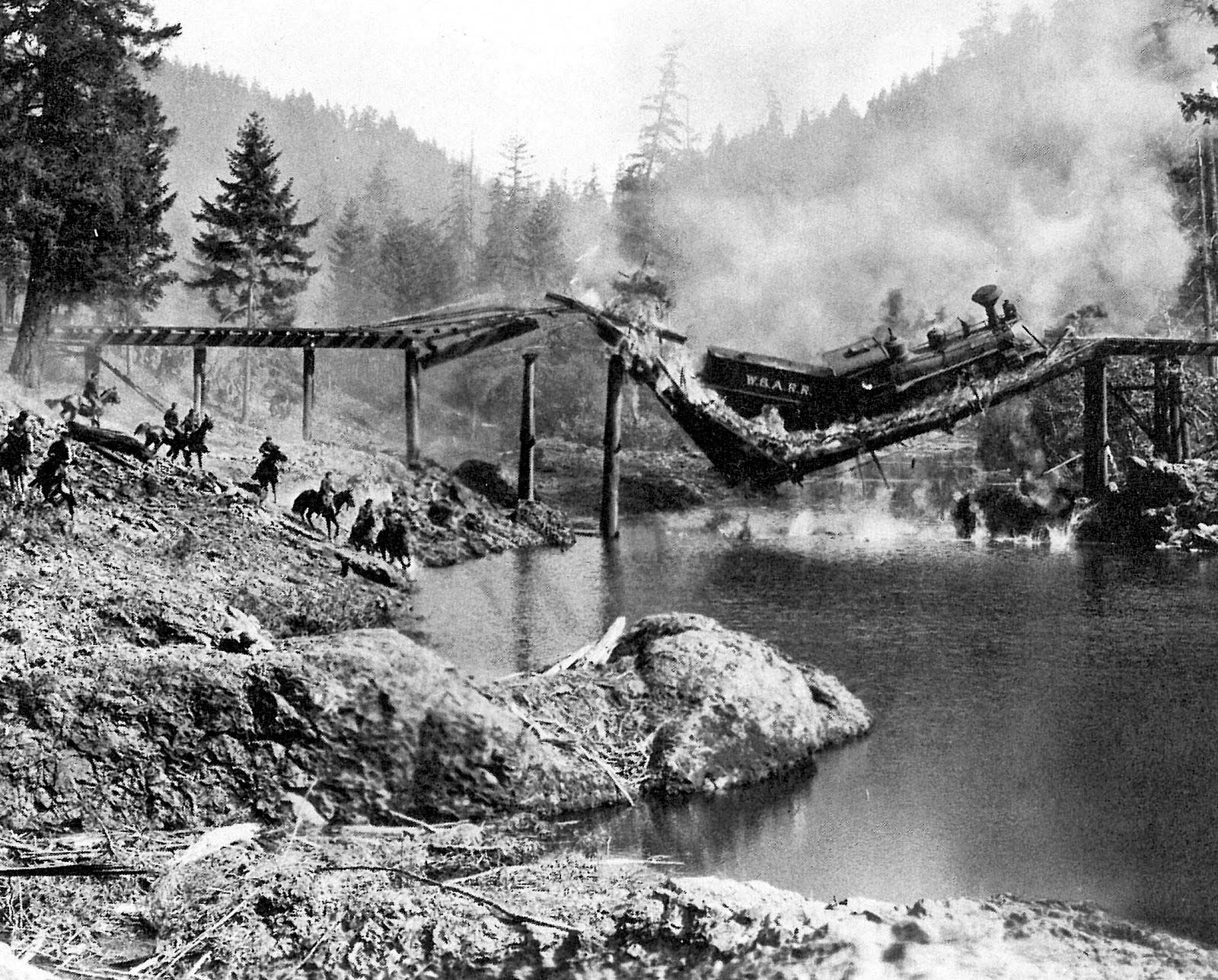
You will hardly believe your eyes as a full-on steam locomotive (in real life, the “Texas”) crosses a burning bridge and crashes into the river below; this is not a model shot, nor were any special effects used or needed — director Clyde Bruckman just left the wreckage there in the river bed until it was finally salvaged for scrap during WWII.

They really did build a bridge, set it on fire, then drive a train across it and plunge it into the river. For realz! No wonder it went over budget!

Apart from crowd scenes where a lot of running or marching is required, the film is mostly speed-corrected to show the actors in natural motion, and this really brings the sophisticated nature of late-silent era filmmaking to the fore. The recreated original score is also a treat, though alternative and more modern scores exist for the 4K Blu-ray release (the first silent movie released on Blu-ray, and a wise choice among many good options).

Apart from being in B&W, I believe you could show this to modern audiences and they would still find the pacing to be attention-holding, the story layered enough for today’s audiences, the humour still funny, and the stunt-work disbelieved to be as real as it actually was. It’s a mystery to me why the film isn’t a regular visitor to revival-house cinemas, or better known to this generation’s cinephiles.

I’m just glad nobody’s been dumb or reckless enough to try and remake it, because The General is truly a unique example of the best the reckless early days of American filmmaking has to offer that really holds up across its nearly 100-year history. Plus it’s a better movie than any of the Mission: Impossible series. There, I said it.

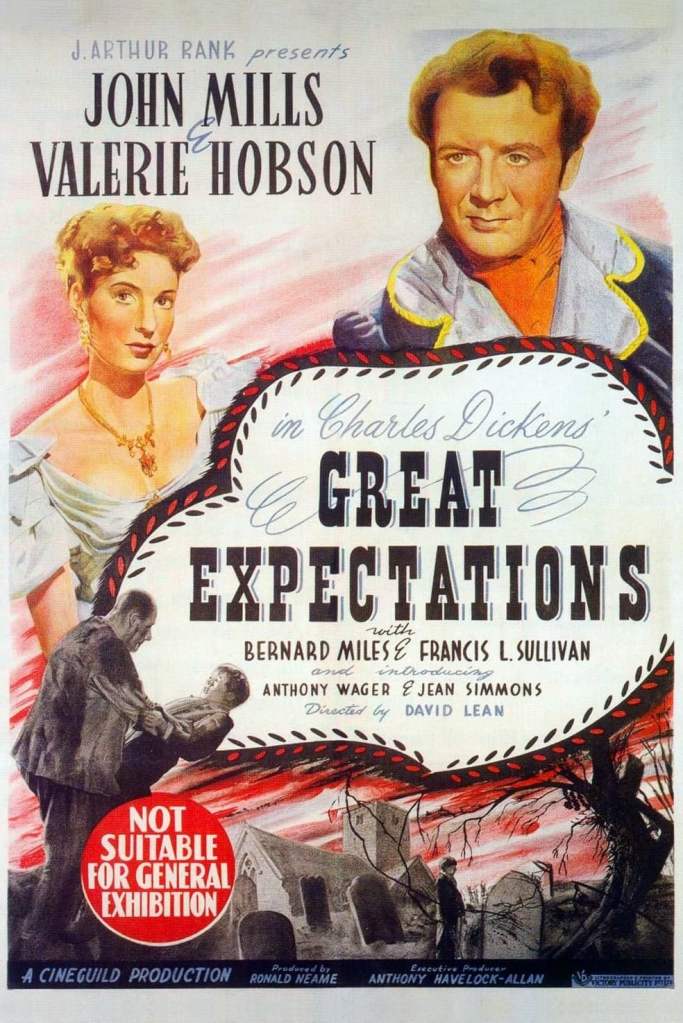
Great Expectations (1946, dir. David Lean)

⭐️⭐️⭐️⭐️
52-week film challenge, film 21

Whether you are a fan of Dickens, or you’ve not read any of his work beyond A Christmas Carol, this is a fantastic film adaptation to offer insight into Dickens’ other work, full of strong visual language to put you in the authors’ mindset and life experiences. Great Expectations covers poverty, the working class, and injustice, but contrasts this with power, privilege and good old British eccentricity; themes Dickens constantly came back to in his other works.


As an adaptation of the book, Lean and his fellow screenwriters condense and cut some plot strands in order to make for a followable two-hour film, and made the deliberate choice to make the film in B&W rather than colour to further establish the film as being part of a bygone age. As a single film, no other version since has surpassed it.

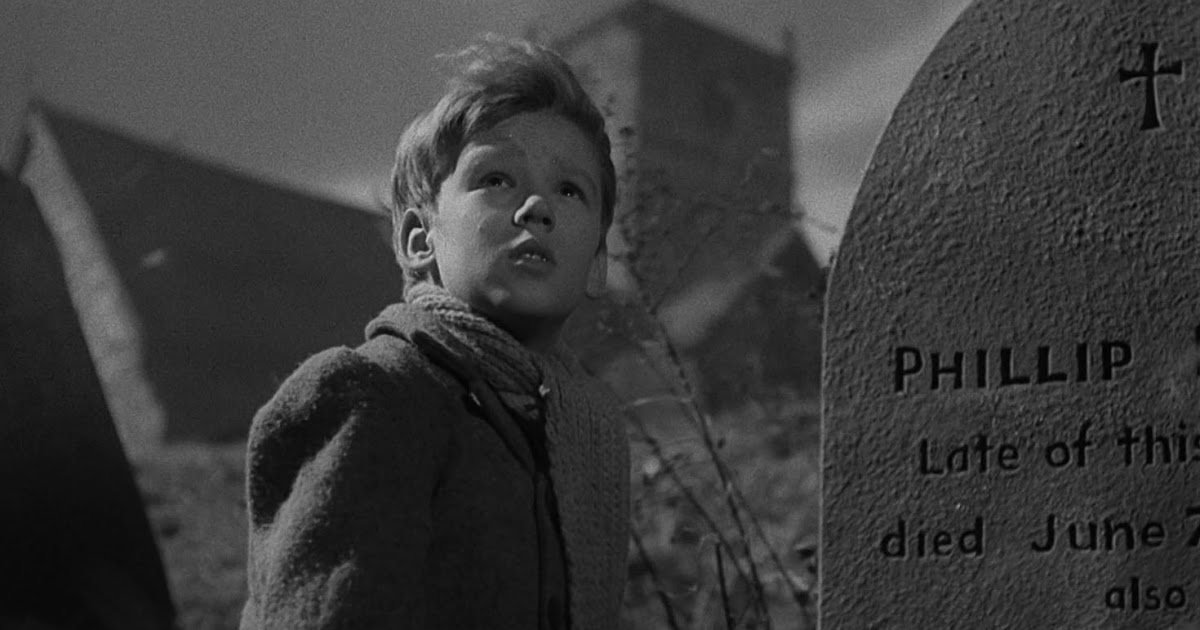
Without trying to rehash the entire plot, an orphan named Philip Pirrup, whom absolutely everyone calls “Pip” as a single first and last name, is living with his older sister and her husband Joe, a kindly blacksmith. A chance encounter with the desperate escaped convict Abel Magwich in the graveyard of Pip’s parents and an act of kindness on Pip’s part sets in motion plot lines that will only show up much later.

In the meantime, Pip falls into the orbit of an eccentric patron, Miss Havisham, who has a macabre backstory and a young adopted daughter Estella, who is seemingly impervious to love and rather cold (and occasionally brusque), though of course young Pip falls in love with her anyway. As an adult, Estella does take on a beau but is, as Pip observes, simply using him. She explains matter-of-factly (again) to Pip that she has no heart and does this to all men — except Pip. It is a beautifully understated moment of foreshadowing where Pip finally “gets” her and what Miss Havisham has done to her.

As Pip turns 20, he discovers he has a mysterious benefactor (whom he assumes is Miss Havisham) who wants Pip trained in London to become a proper gentleman of society. Leaving his family, his patron, Estella and all he has known, he travels and meets up with a boyhood colleague, Herbert Pocket, who becomes his roommate and friend. A year later, matters come to a head as the benefactor reveals himself, setting in motion the means to resolve the various plot lines (and finally some action scenes!).

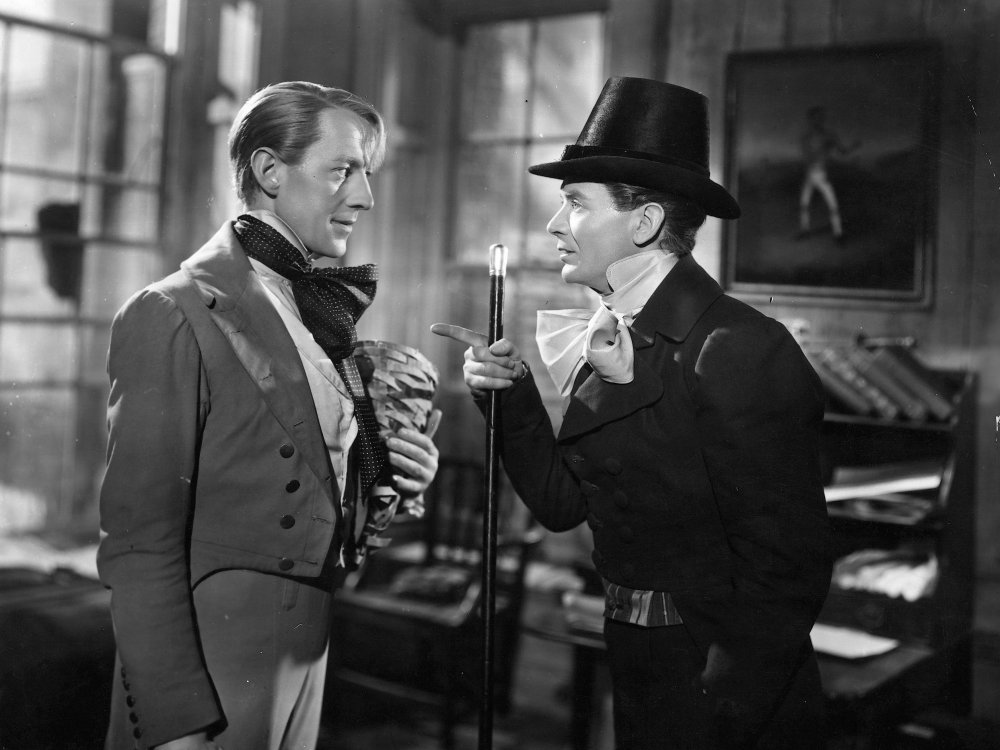
Pip (right) recognises schoolboy acquaintance Herbert Pocket, played by Alec Guinness.

A David Lean film is always beautifully shot and extremely well-directed, and this one is no exception. The B&W cinematography, apart from the opening sequence, was shot by Guy Green, who also worked with Lean on his other Dickens’ film, the even more memorable 1948 Oliver Twist. Both Alec Guinness and Martita Hunt had played their respective roles (Herbert Pocket and Miss Havisham) in a stage adapterion of the tale Guinness wrote, which prompted Lean to make the film in the first place (though he did not use Guinness’ stage script).

Lean definitely had a talent for picking and working with child actors, as both the young Pip (Anthony Wager) and the boy Herbert (John Forrest) are great in their parts, and a young Jean Simmons beautifully played the young Estella, with Valerie Hobson seamlessly taking on the adult Estella. Also of note is the ageless Frances L. Sullivan, who flawlessly played the lawyer Mr Jaggers in perfect Victorian style, but to be fair he had experience in the part — he had played the same role in a 1934 film version of Great Expectations as well!

There are only two serious errors in this film in my opinion, one of which was unavoidable: you can’t film the entire story, it would have likely doubled the running length of the film. Lean does his best to choose the best plot strands to follow, and resolves them all satisfactorily, but in truth Dickens’ lengthy storyline — it was originally written as a serial for a magazine, and the novel was originally published in three volumes — doesn’t lend itself to anything less than a mini-series.

The other flaw (and this was a big one) was casting a 38-year-old John Mills as the adult (21 year-old) Pip. I have no quibble with Mills’ excellent and emotional performance, but the age jump between the boy Pip and the (mature!) man Pip is just not credible on-screen. In a rare foot wrong, Lean should have cast a younger actor — at times, Mills looks more like 26-year-old Alec Guiness’ father than his contemporary.

A trip back to the mannered and class-centric world of Dickens’ time is probably not for everyone, even as beautifully realised as it is here, but as a picture of a bygone age (and Dickens’ clever way of pointing out the injustices and flaws of it), Great Expectations puts you right into the author’s imagination. The resolution of the film is a bit fast and tidy, but not before a series of memorable scenes in which Pip first (accidentally) destroys Miss Havisham and then forcibly prevents Estella from becoming Havisham’s prisoner — a powerful statement on the importance of finding your own way in the world, regardless of your circumstances or background.

Pip tries to love the cold, quixotic Estrella.

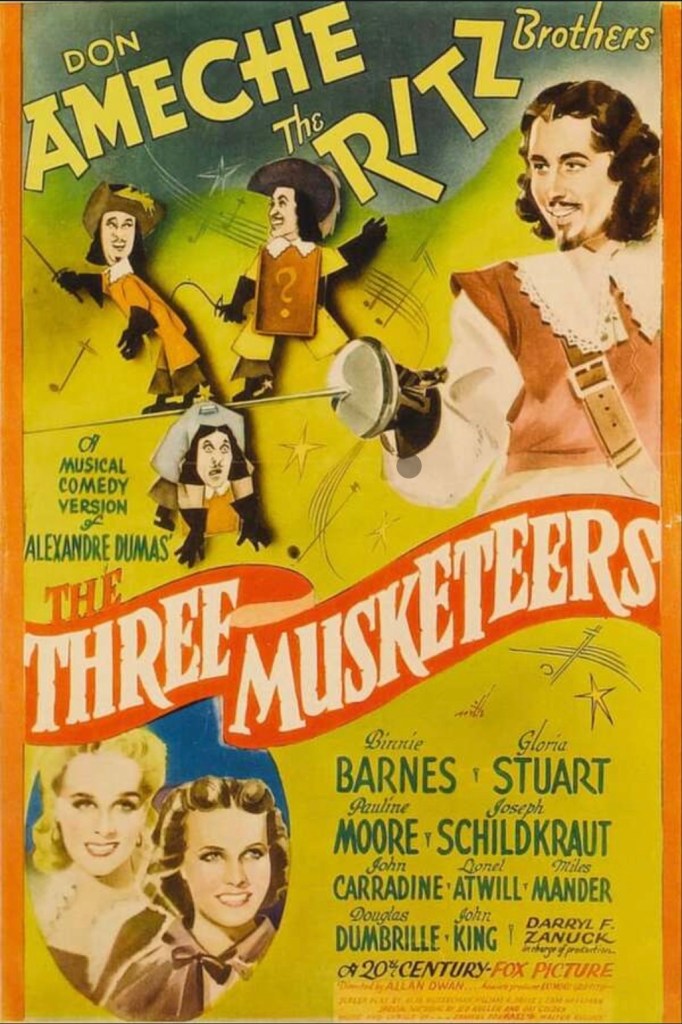
The Three Musketeers (1939, dir. Allan Dwan)

⭐️⭐️
52-week film challenge, film 19

I had a vague memory of seeing a film version of The Three Musketeers from my youth, and went looking around to see if I could find it either in my library or on one of the streaming services. My memory was that the version I saw so long ago was in B&W, but I now think I just watched it on a B&W TV (yep, I’m old). I’m still not sure what version I was thinking of, but I came across one that ticked the boxes, so I watched it. This movie … was not the one I sort of half-remembered.

This 1939 version was a musical comedy version that, despite that terrible idea, actually sticks pretty close to the book for as far as it goes — which really surprised me. I have a lot of time for Don Ameche, the star of this version, and he is one of the best things in it, taking the role seriously while never wiping the smile from his face as he plays the headstrong but skilled D’Artagnon, who hopes to join the King’s Musketeers.

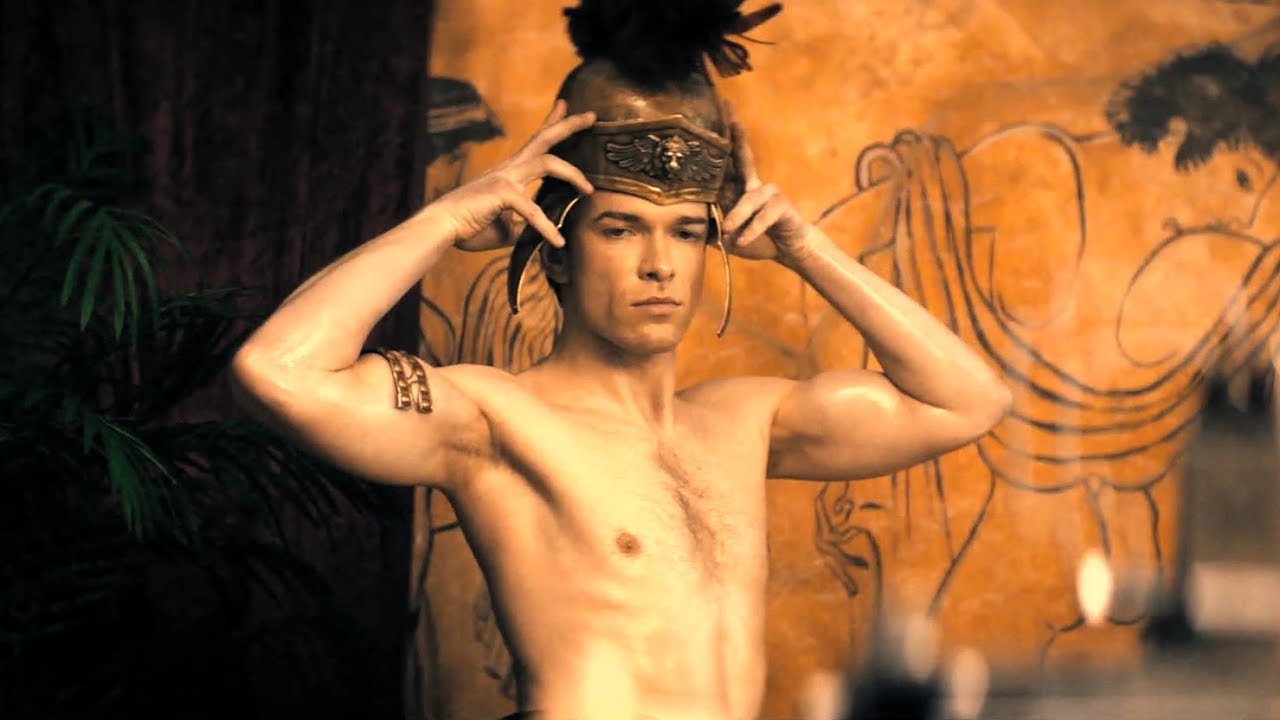
Yes, that’s Don Ameche. Handsome, isn’t he?

In this telling of the tale, D’Artagnon mostly misses the actual Three Musketeers, who appear only briefly. The trio gets passed-out drunk drinking toasts at an inn to the various King Louises, because there are so damn many of them, and the scullery cooks (played by the all-mugging, all-singing, all-pratfalling Ritz Brothers) try on the Muskateers’ outfits and then get mistaken by D’Artagnon for the real Musketeers, and of course from there mischief ensues from all parties.

The success of this film depends very, very, very, very heavily on your tolerance of The Ritz Brothers, who were a vaudeville act that transitioned pretty successfully to film on the strength of being a mix between The Three Stooges and three Chicos from The Marx Brothers. They’re not in any way witty, but they can mug and clown (and also comedically sing and dance) with the best of ‘em.

The Ritz Brothers as the faux Musketeers

Their schtick, in my opinion, hasn’t aged well — but I cannot argue with the fact that they enjoyed a successful career in various forms of show business (though the fact that they got forgotten pretty quickly afterwards may prove me right about them). The film also relies way too heavily on D’Artagnon somehow not seeing the Ritz Brothers’ utter incompetence as pretend Musketeers, which of course he doesn’t since they only end up in his view by accident throughout the film at points where they have been (accidentally-comedically) useful to him.

Ameche handles a sword well, sings in a pleasing tenor, and is handsome enough to pull off the romantic scenes. The Ritz “Musketeers” keep getting pulled in by D’Artagnon’s delusion that they are real Musketeers, but they do aid in his success in the complicated (yet truncated) plot of this brief 73-minute film.

Buckles were most certainly swashed!

If you don’t know the story, read the book, or watch one of the later, more dramatic film or TV versions. Suffice to say Cardinal Richelieu was a very bad man who manipulated royalty both in France and England, and was foiled (ha!) by the Musketeers. The plot works well in this film, it’s just the comedy and the musical bits that fall flat.

First of all, there are only four songs in this “musical,” none of them that good, and the two for Don Ameche sound pretty similar to these ears, though he turns his “on the road” song into a love song later on pretty well. The two Ritz Brothers songs (one of which extols the virtues of chicken soup) are meant to be comedic but seem quite laboured to me.

Near the end of the film, the brothers contribute their best bit: a pie-plate dance that’s actually well-done and quite clever, meant to cover any sound D’Artagnon makes while freeing Lady Constance from the dungeon below the aristocrats they are working against. I should mention that the chase scenes, while regrettably sped up as was the custom of the time, are really well-done and focus on the hardworking horses.

The whole film is well-shot but still somehow kind of cheap-looking (just like The Ritz Brothers, insert rimshot here). I did recognise Lionel Atwill as de Rochefort, but only realized the near-immortal John Carradine was in this (as Naveau) when the credits rolled. I’m giving this a star for the cinematography, a half-star for Don Ameche, and another half-star for the pie-plate dance, and still looking for whatever version I thought was great when I was like nine or so.

Some fantastic matte work in the film that shouldn’t go unmentioned