Tetsuo, the Iron Man (1989)

Director: Shinya Tsukamoto
⭐️⭐️⭐️⭐️

If you’ve seen this film, there’s not a lot I can say apart from some small bits of trivia that you might not already know. If you haven’t seen it, this is the first and perhaps the greatest Japanese cyberpunk/body horror/indie metal/sex comedy film of all time. I haven’t seen either of the two sequels, but that’s the only reason I say “perhaps.”

Perfectly timed with a youth-cultural rising tide of nihilism, low-budget renegade filmmaking, steampunk fashion, and the emergence of “industrial” music, Tetsuo combines it all into a movie that was very much of its moment. I first saw the film at and independent cinema in central Florida a few months after it premiered, and I was simply not prepared for the onslaught of sight and sound I witnessed.

It was in some ways traumatic, in other ways compelling — and it haunted me for a while with a mixture of revulsion and wonder at the time. I have finally dared to take a second look, and I squirmed in places — but could still could hardly bear to blink.
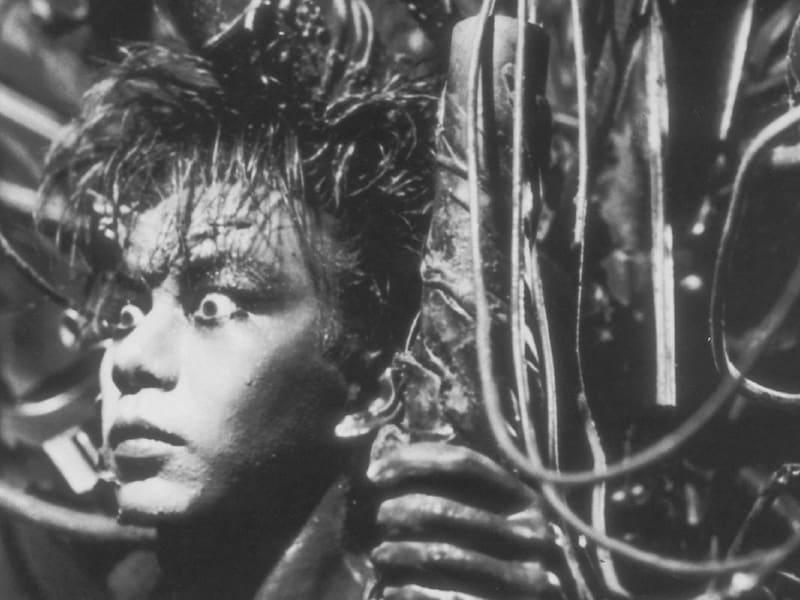
The film is in B&W, and doesn’t look quite as absurdly cheap as it is most of the time thanks to ludicrously frenetic stop-motion effects, brilliant editing, and mesmerizing performances, while still mostly giving its audiences only glimpses of what’s fully happening. The assault of hard music contributes to the urgency and raw emotions on display throughout.

The film went on to be an enormous influence on both musicians and indie directors, and makes those Godzilla movies look like pastoral landscape paintings for children by comparison.

The plot is weird yet simple: we start with meeting a young man (played by director Tsukamoto) who is cutting his thigh open so he can insert some metal into it. His surroundings are composed of lots of scrap metal, and this is a fetish of his apparently.

It goes very wrong, and maggots begin to feed on the wound. Driven mad with disgust, he runs out of his tiny room and into the night, and is soon run down by a “salaryman” (businessman) — played by Tomorowo Taguchi — and his girlfriend (Kei Fujiwara).

The pair investigate the corpse, are revolted, and dispose of the body. Not long after, the businessman notices that he is growing metal out of his body, and soon the girlfriend is transmuting as well.

Slowly but surely the metal is taking over their bodies (mostly done using stop-motion animation), turning them both into metal-human hybrids. This takes a while, and is documented in beautiful detail in the grainy B&W cinema verité style, augmented with the hardened edges of industrial music.

Once it starts, it is a relentless onslaught, and the victims here are bewildered, terrified, and powerless to stop it.

To this point, the film is a hyperactive low-budget body horror escapade, but strangely compelling. We know where this story is going, but it is clever enough to make us want to see it through.

The salaryman’s transformation is much further along by the time the girlfriend turns up, equally starting to transform. They end up being compelled to have what I’ll just call “drillsex,” which at this point provides a much-needed moment of relative levity.

Others have described the film as something of a mash-up between Un Chien Andalou (1925), Videodrome (1983), and Eraserhead (1977) in Japan, and I have to nod and say “yes, but with all these films thrown in a blender while you’re watching them.” Tetsuo vibrates with energy and intensity, never relents from its breakneck pace, and cranks the music up to 11.

Since it’s release, we’ve all started down its path: rare is the moment now where you don’t see someone glued to their smartphone, to the point where we treat it as an extension of “ourselves.” The messages of the film regarding societal sexual repression, industrialized alienation, body dysmorphia, work-life imbalance, and are alternately sublimated and beaten over your head.

Being so hyperkinetic and, well, metal is likely to be overwhelming for any casual viewer, even though the film clocks in at a mere 67 minutes (and thank heavens its not any longer). By the end, you’re not sure if the salaryman and his girl likes what has ultimately become of them or not.
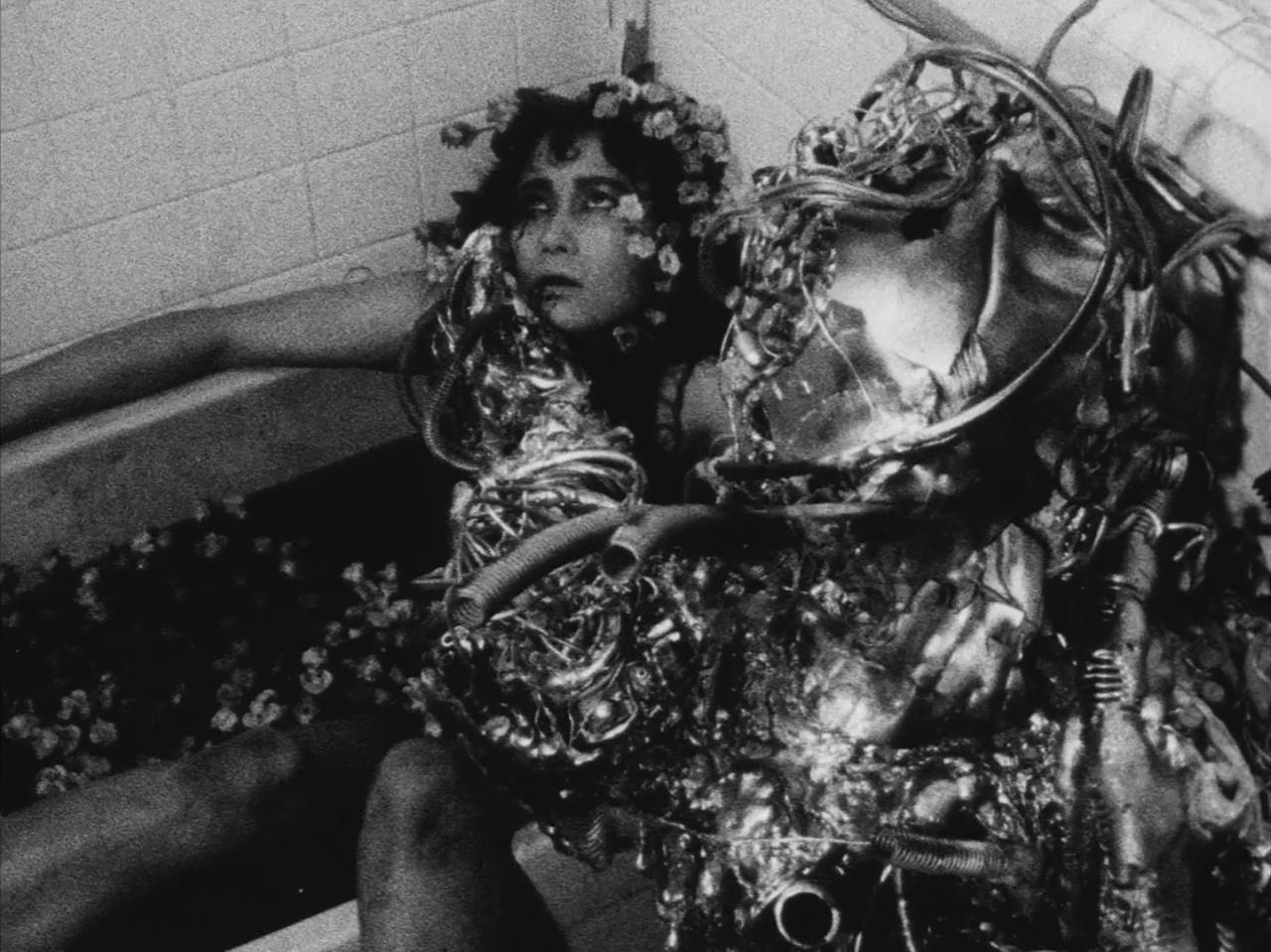
It reminds of a rollercoaster you’ve never been on before: terrifying, exhilarating, and you’re relieved you survived it — and then, knowing that you did, you want to go back and do it again.

Tsukamoto served as writer, director, producer, art director, lighting director cinematographer and editor of the film. A number of the other crew members who worked on the film quit in disgust or in dispute with what Tsukamoto was doing.

It is a visionary, hugely influential and eye-popping film in many ways, but I think most people whose idea of a horror movie is Friday the 13th would probably turn down a second opportunity to see it. That said, a little of that metal fetishism stays with you, in the sense that you can’t unsee it.

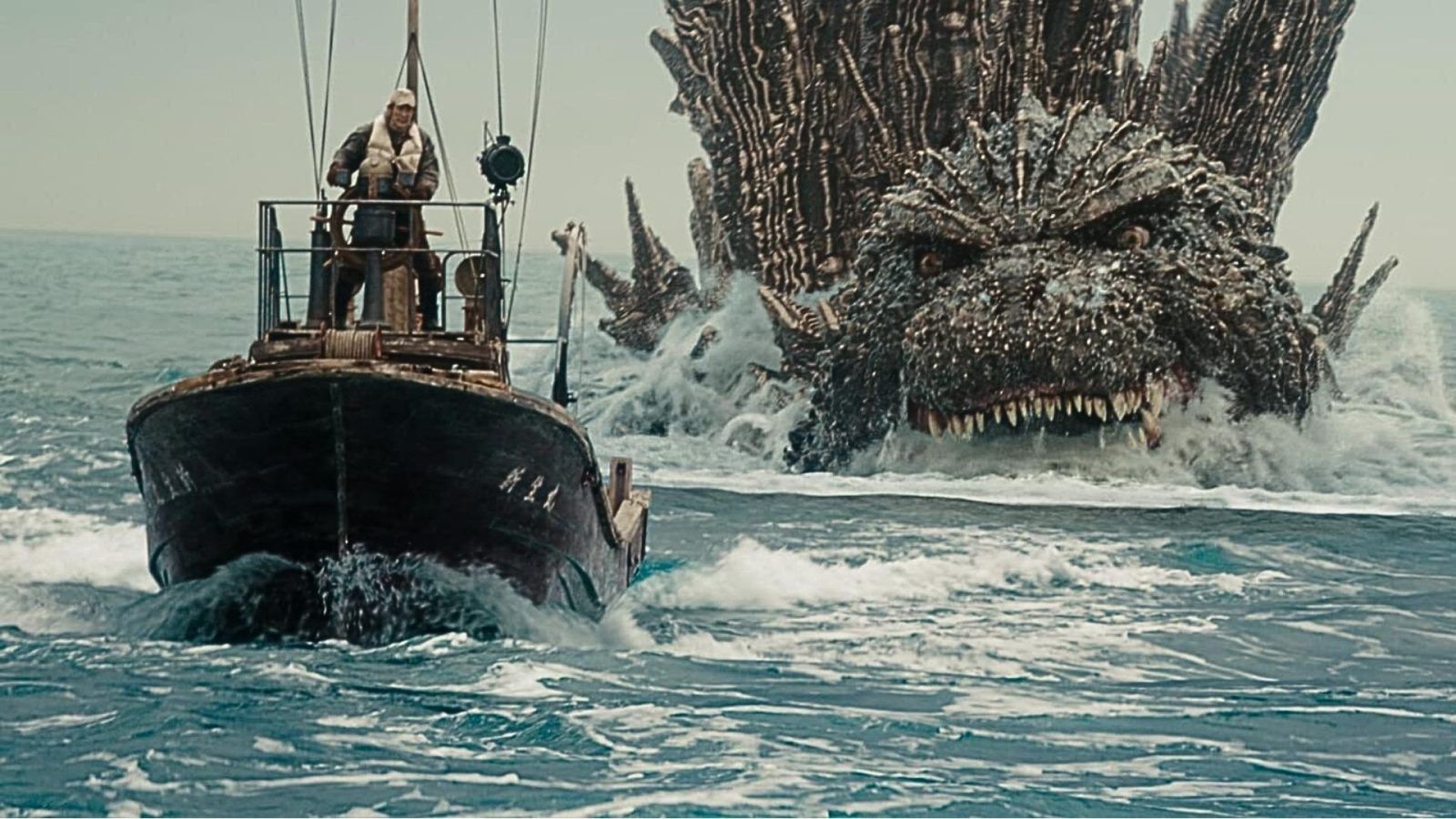
Godzilla Minus One (ゴジラ-1.0) (2023)

directed by Takashi Yamazaki
⭐️⭐️⭐️⭐️
52-week film challenge, film 47

This remake of the first Godzilla film from 1954 (my review of that one is here) is a really clever reimagining that turns the perspective around: the focus here is on the human beings affected by the monster, rather than the monster itself. It makes brilliant sense in that the original really showed off the effects, but the new one looks at this phenomenon from a completely different angle.

I certainly did not expect a Godzilla movie to be this emotional, nor did I expect it to be entirely in Japanese with English subtitles in North American cinemas (nice touch). I find it fascinating that 37 films in — with multiple “reboots” from both Toho and Legendary Pictures — they found something new to say about kaiju generally, and yet also reiterate the original’s analogy to nuclear war.

Furthermore, I was completely gobsmacked when I discovered that the budget for this shot-in-the-arm epic was a mere $15 million — there are some films that exist where the catering bill for the shoot was around that amount!

I have, of course, seen quite a number of Godzilla movies over the years, though I largely haven’t seen the post-2000 comeback films. Growing up, Godzilla movies were fun and cheesy, and you (or at least I) never paid a moment’s attention to who was in those (model) ships, tanks, and buildings the monster trashed like the cheap paper maché they were. I also watched TV shows inspired by those movies, including “Ultraman,” a particular favourite.

Godzilla looks so “smol” in the 1954 original. Inflation, I guess, whatcha gonna do?

The genius of writer, director, and visual effects chief Takashi Yamazaki is in putting the emotions and the people up front in this version, with the title character itself getting a fair amount of screen time, but only very rarely being the focus. He even explains both why Godzilla keeps coming back, and why he’s so gigantic and “Hulk-like” compared to his first appearance.

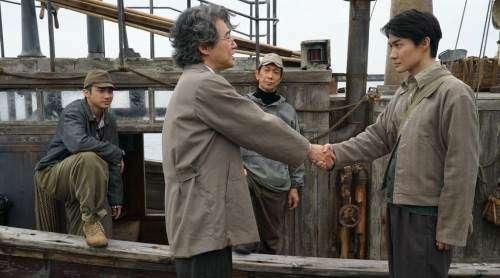
That said, the vast majority of the time spent here is on the humans, specifically telling the story of Kōichi Shikishima (Ryunosuke Kamiki), a kamikaze pilot near the end of World War II — when the outcome was no longer in doubt — who chickens out, and feigns engine trouble and lands on Odo Island. That night, Godzilla emerges and attacks the base. Shikishima gets into the plane, but cannot muster up the courage to shoot at the dinosaur-sized monster.

He survives to find only one other survivor, Tachibana (Munetaka Aoki), who blames Shikishima for the deaths of the other men. A year later (1946), he returns home and learns that his parents were also killed by Allied bombers. He meets a woman named Noriko (Minami Hamabe) who is taking care of an orphaned baby named Akiko (Sae Nagatani) that she has rescued.

As he is suffering from survivor’s guilt, he takes care of Noriko and Akiko, forming a sort of family. Although all three clearly care for each other, it is not made explicitly clear if Shikishima and Noriko actually became romantic partners.

Meanwhile, Godzilla gains his gigantic size and atomic powers via the US military’s nuclear testing in Bikini Atoll. The enlarged and super-powered monster attacks the ships, and then heads towards Japan.

By mid-1947, Shikishima has had some success in a dangerous but well-paying job, aboard a ship clearing mines left by the US around Japan. Authorities, which have been tracking Godzilla’s slow approach to Japan, order the minesweeper try and delay Godzilla’s approach so that more powerful ships can get there.

Cleverly, the shipmates use a mine and manage to release one that explodes in Godzilla’s mouth — which does some actual damage — but the creature can seemingly regenerate from injuries. A heavy cruiser arrives just in time, but is destroyed when Godzilla shows off its new power of atomic breath.

Of course, Shikishima is re-traumatized by the return of Godzilla, now enomous and unstoppable. Godzilla eventually reaches Japan, and attacks the city of Ginza. After tanks engage Godzilla, it again employs its atomic breath, destroying the city and seemingly killing Noriko after she saves Shikishima. He is yet again re-traumatized by this loss.

Since neither the US nor Russia will help because of tensions between the two, the Japanese government essentially gives up and does nothing. One of the minesweeper’s crew, Kenji Noda (Hidetaka Yoshioka), assembles a team and comes up with a plan to destroy Godzilla, using a small group of former Navy veterans — including Shikishima — and some disused Navy carriers to carry out the plan.

Unbeknowst to the others, Shikishima has finally been pushed too far, and plots his own revenge on Godzilla, that will presumably cost him his life. He makes arrangements for the care of Akiko with neighbour Sumiko (Sakura Ando), and pretends to cooperate with Nodi’s plan.

And like a good neighbour, Sumiko is there …

That sets up Act 3, and I don’t want to go into the plot any further because the movie is still playing in cinemas as I write this, except to say that some good twists ensue as the group bravely takes on Godzilla and Shikishima seeks revenge and redemption.

I, at least, was surprised by the finale as well as the final scene. I was also utterly delighted by some surprise callbacks to the original film.

Noriko sees Godzilla for the first time, shortly before she is swept away.

I was downright shocked by how engaged I was with the emphasis on the people affected by these events, and how right this alternative approach felt, viewing it from my cinema seat in a world where Godzilla is a stuffed toy with a very long history (and, as mentioned, an ongoing successful franchise for Toho).

70 years on from the original film, the monster itself can still elicit nostalgia and appreciation, but going back to its roots from a very fresh angle has given Godzilla Minus One something new: emotional connections with its audience beyond a general fandom. I’m not sure if this approach would work repeatedly, but it has certainly injected some fresh blood (sorry) into a franchise that had become cliché.

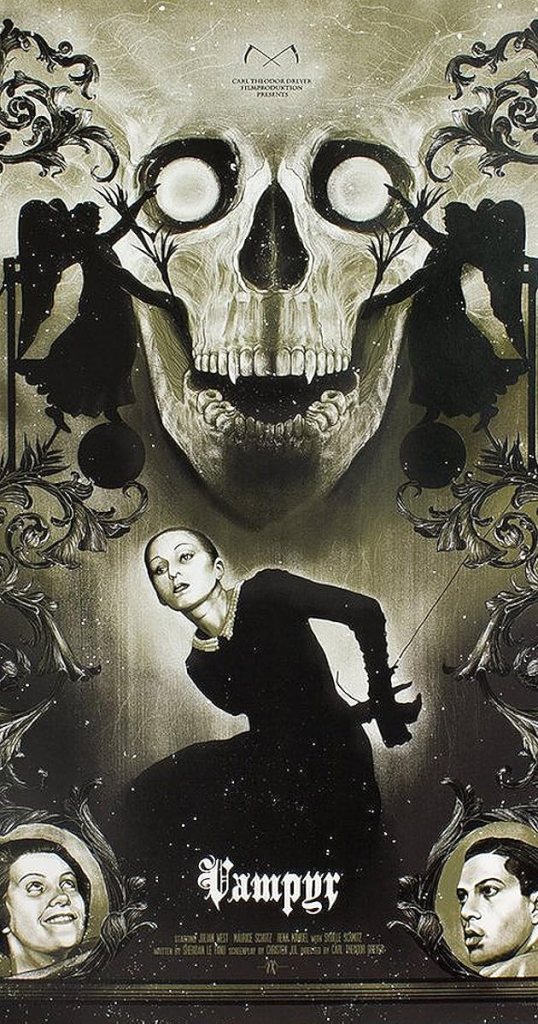
Vampyr (1932, dir. Carl Th. Dreyer)

⭐️⭐️⭐️
52-week film challenge, film 38

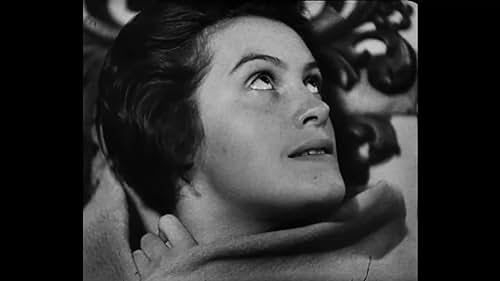
This film is a bit bewildering to me, I must confess. Taken as a filmic version of a horror-based dream (its clear intention), a reflection on some of the many tropes surrounding our own fear of our mortality and the ways we might depart this life, Vampyr should be considered a powerful success. If one is watching the film hoping for a coherent plot or definitive statement of meaning, you’re completely out of luck.

Given the utter brilliance of Dreyer’s previous film, 1928’s The Passion of Joan of Arc, his first sound movie — a horror movie about vampires — should have been a massive success.

Instead, it was a huge flop with audiences at first, and even after re-editing only garnered mixed reviews. This appears to be down to two main factors: his comfort in shooting movies in the silent style, along with unexpected struggles with adding sound (beyond music) to his film was the first problem.

The second “flaw” of a sort was his decision to make a dreamy, soft-focus, motivation-less tale dependent on atmosphere and imagery rather than story. Vampyr is 90 percent a silent movie, shot in that style, complete with title cards to explain things some (not enough) things from time to time.

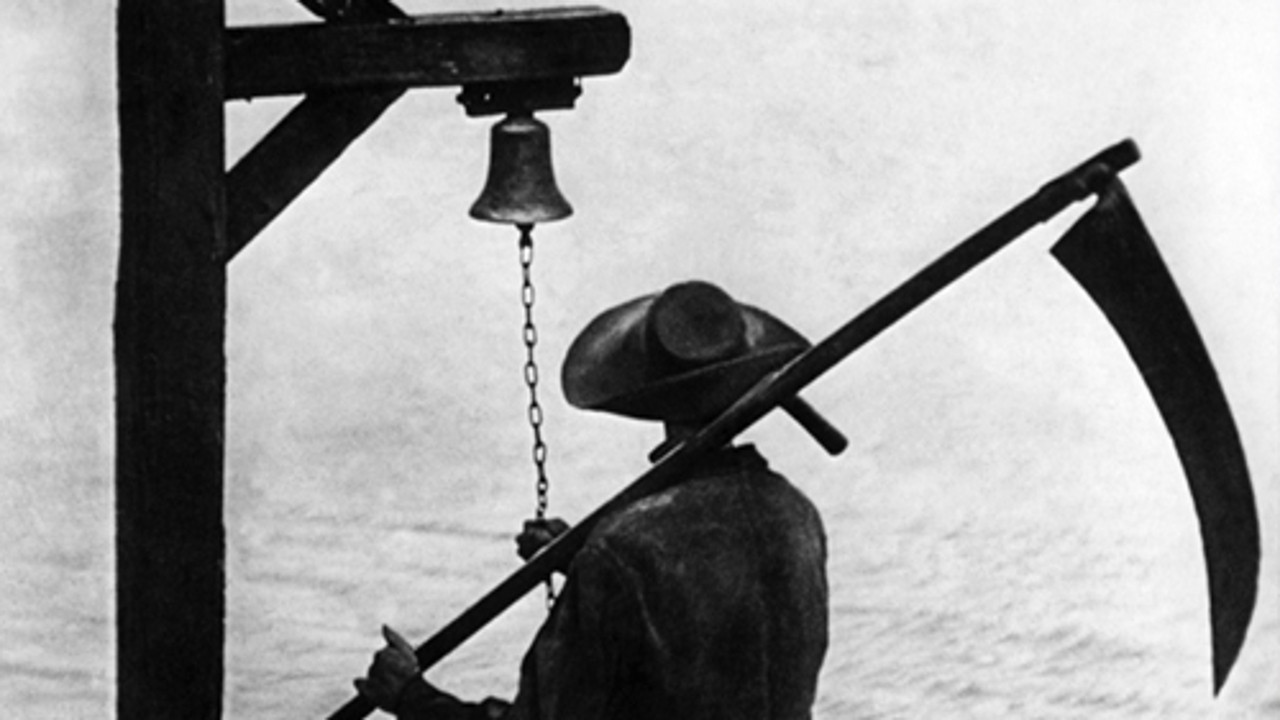
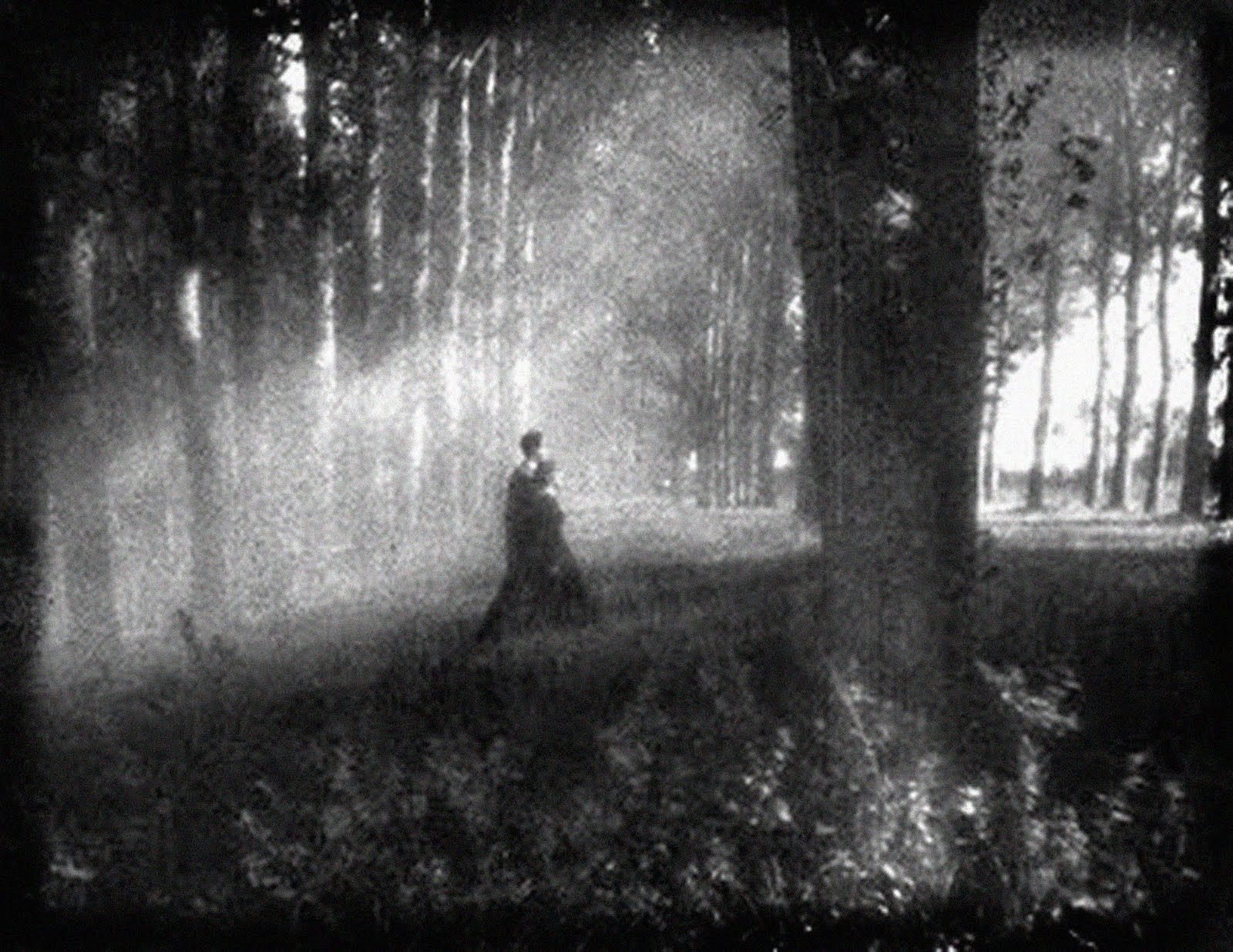
One of many haunting images in Vampyr.

The acting, likewise, is very silent-movie style, with few characters having much of anything to say on the rare occasions that they do speak. That said, there is some spoken dialogue and sound effects, which kind of gain a Bergman-like weight by their rarity.

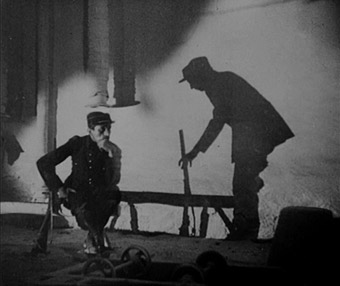
The plot, such as it is: a man named Allan Gray, who is introduced as a dreamer who is obsessed with the occult to the point where he lives in a sort of dream state comes to a town, takes a room at the inn, where a man breaks in and leaves him a book “in the event of my death.” Shadows and instinct guide him to the manor of the man, who is murdered by a shadow with a rifle (?) shortly after Gray’s arrival.

He rushes to help, but it is too late. He meets the man’s youngest daughter, Gisèle, who says that her older sister, Léone, is gravely ill. Just then, they see Léone walking outside.

As they rush out to collect her, she is found with fresh bite marks and a briefly-glimpsed older person who quickly disappears. They carry Léone inside, Gray remembers the book, and starts to read it (there’s a lot of reading this book in the film).

Turns out it’s a book about vampyrs and their powers, which leads Gray to conclude (duh) that Léone is the victim of a vampire. A very odd and suspicious local doctor shows up, looking for all the world like Mark Twain.

The doctor says Léone can only be saved by donated blood, and arranges for Gray to provide some. Tired afterwards, he falls asleep.

You’re never quite sure who’s side Mark Twain is on in this movie.

One of the servants of the house reads Gray’s book, figures out what is going on, and knows who the Vampyr must be. Gray wakes up, senses danger, and saves Léone from being poisoned by the doctor, who may or may not have been trying to prevent her becoming a Vampyr.

Gray tries to catch the fleeing doctor, who may be a servant of the Vampyr, but stops to rest and has an out-of-body experience where he has died and is about to be buried by Marguerite Chopin (the Vampyr he saw earlier) and the doctor, confirming their alliance (maybe). As he returns to his body, he sees the old servant heading to the graveyard, and accompanies him.

The incredible out-of-body effect is stunningly good and far ahead of its time.

They open the grave of Marguerite Chopin, finding her perfectly preserved. They drive an iron bar through her heart, and she dies a true death, instantly becoming a skeleton.

Léone is released from the curse, the doctor suddenly sees the face of the late lord of the manor, chasing him away from the house and killing the soldier who was helping him (?). Gray rescues the tied up Gisèle (?), while the doctor hides in the old mill, somehow becoming trapped in a grain bin.

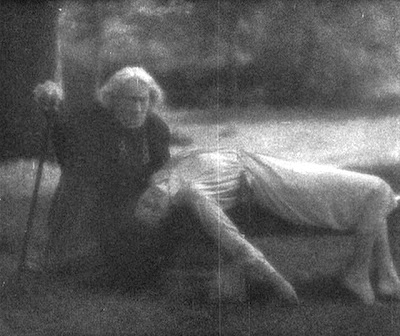
Léone under the control of the Vampyr

The old servant shows up and turns on the mill, eventually burying the doctor in grain. Gisèle, who is apparently now in love with the nearly-silent Gray, leaves with him on a boat across the river and they find a bright clearing. The end.

For a sound movie, very little is said, and the interstitial titles give us a little background but avoid explaining much of anything as the story progresses. As mentioned, Dreyer opted to film this like a dream — complete with putting gauze near the lens of the camera for all the outdoor shots.

Gisèle under threat

It’s very clear that he intended this to be a silent film, and was coerced to adding sound and really struggled with that. Thankfully, his next film, Day of Wrath (1943), received better reviews and largely found him back on course.

If you want a film that will weird you out, this might be a good candidate. Lots of gorgeous shots and symbolism give it a very disconnected dream-like effect, and I’m of little doubt that this film had a profound effect on David Lynch.

The shadows in this movie are another force of evil

That said, the overall impression is that it’s half a movie: the visuals are there, but the storytelling is severely lacking. Even worse, the “hero” (or maybe more accurately, the “subject”) of the film, Allan Gray, is a nondescript nobody who spends the entire first half silently reacting to things, and leaving little impression on anyone but Gisèle, inexplicably.

He’s not even the hero; the old servant, who we don’t even meet until halfway through the film, is the one who actually resolves things — almost as though he was waiting for Allan to do it, gave up, and decided to end the movie as quickly as possible.

I’ve given it three stars because the visuals are ahead of their time, artistically interesting, and communicate the dream-like intention extremely well. Once people stop reading books and actually start doing things, the film really picks up — but even though the film is just 73 minutes long, the first half is an awful slog of odd things happening for no reason and an ineffective subject.

To put this another way: you’d never guess this was directed by the genius that gave us The Passion and the smaller masterpiece Gertrud, his final film. Vampyr feels more like an ambitious art-college experimental film.

Doctor X (1932, dir. Michael Curtiz)

⭐️⭐️
52-week film challenge, film 36

Normally when someone says “wanna watch a pre-Code horror movie from the early 1930s during October?” I’d be all-in. I’m disappointed to report that I’ve finally found one that, despite a few good things going for it, completely wastes its potential.

The good things first: Doctor X has a mostly-stellar cast, including Lionel Atwill, Lee Tracy, and Fay Wray. It’s in a sort of colour (more on this in a moment), which was rare for 1932. The sets are wonderful, complete with an eccentric mad-scientist lab — that oddly doesn’t belong to the mad scientist — and some downright neo-German Expressionism moments.

At the core of this movie is a plot that involves ritual murder and partial cannibalism — so yes, it’s a pre-Code horror movie all right. Despite this, almost none of what is lurid about this tale is actually shown, there’s an endless amount of talking about doing things before actually doing them, and the “comedic” element meant to lighten the tone is just irritatingly jarring, and completely amusement-free.

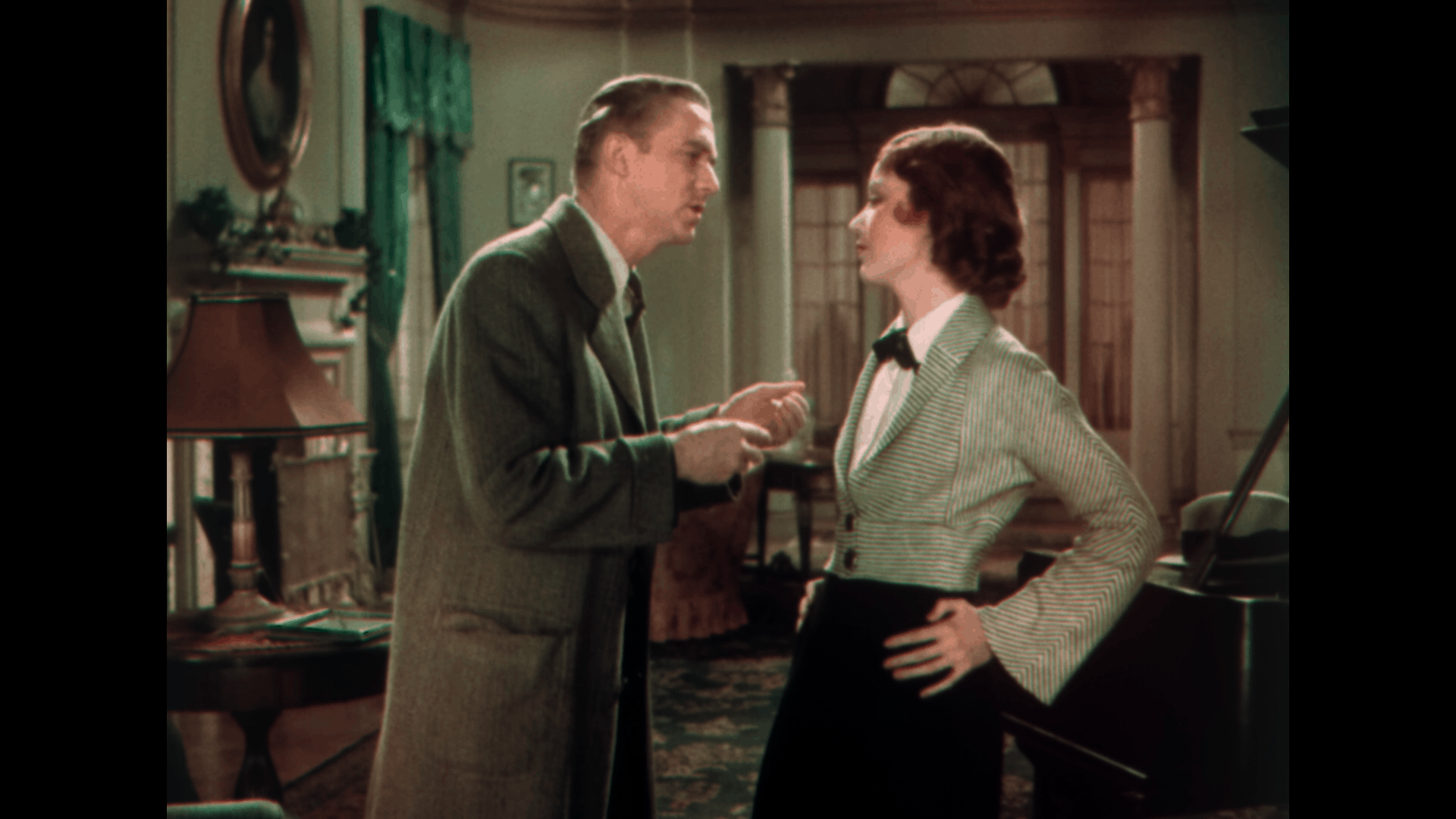
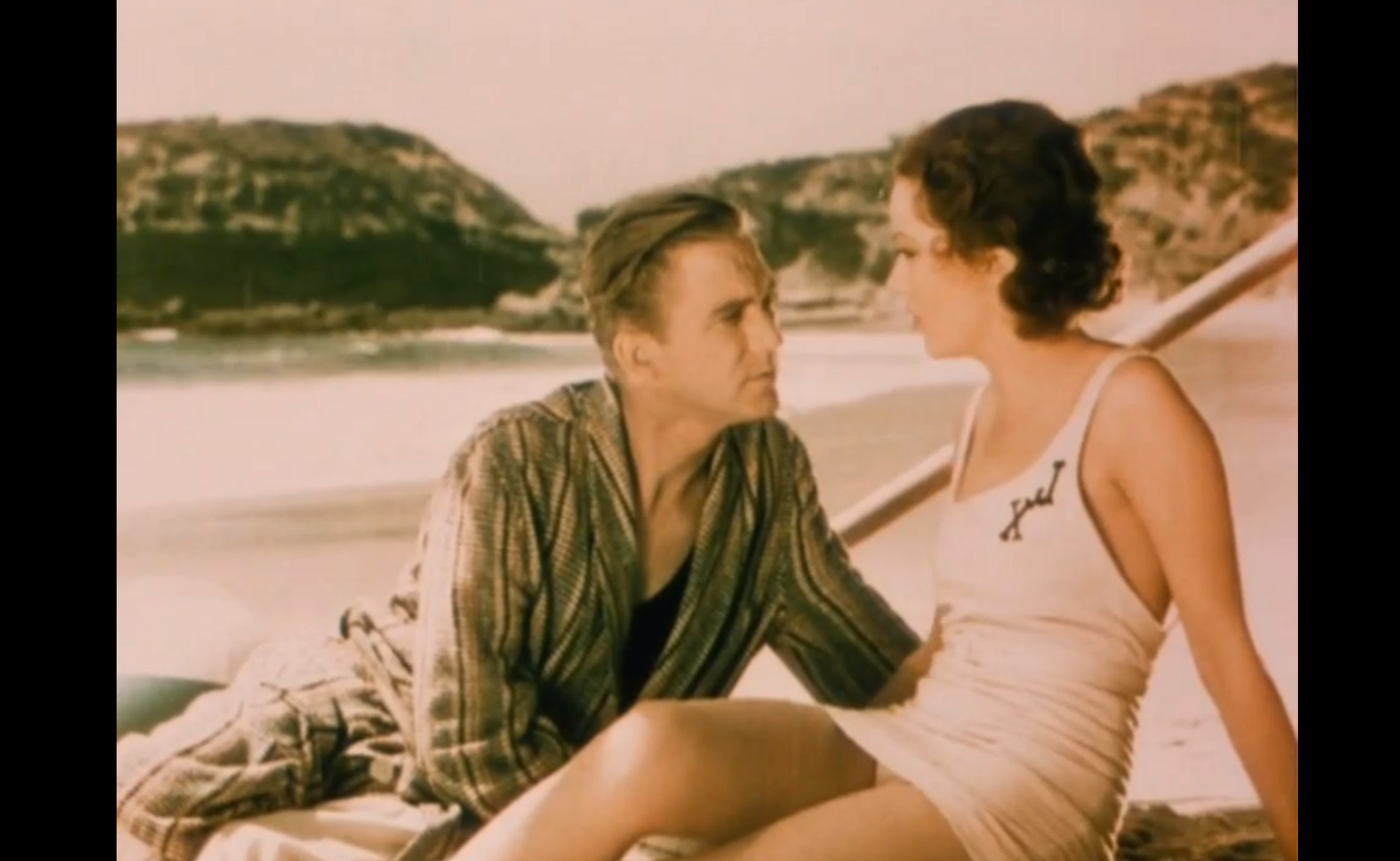
Intrepid reporter Taylor, caught burgling, tries turning on his nonexistant charm.

This film gets one star just for its cast, though many of the players seem off their A-game at times, occasionally having to correct their own lines as though the cost of the color filming was too expensive for second takes. It only gets a second star because the film is simply gorgeous to look at, with great sets, Max Factor makeup (!!), and the novelty of colour.

Well, as I say, sort-of colour — not quite full colour, but rather the third “process” used for two-colour Technicolor (often and incorrectly referred to as “two-strip” Technicolor). This is the same process used for the later, and more famous (but also not great) Michael Curtiz horror film, Mystery of the Wax Museum (1933).

Without getting too technical about it, anything red or green really stood out, and the filmmakers played that up here, but oddly not with blood as much as one might expect. The plot of the film belies its origins as a stage play: a handful of key sets, lots of talking, very little action.

I’m still left wondering why the movie is even called Doctor X — since the lead character, Doctor Xavier (Atwill), is not the title character, the mad killer (and that’s not really a spoiler). I suppose its because it is meant to keep you guessing who the villain is, but I picked him out around the halfway mark, and only stuck around to get the inevitable explanation of how he kept his true identity secret.

In the film itself, the series of murders that only happen under a full moon and involved a partial cannibalisation of the body means the police (and the press) refer to the murderer as the Moon Killer, which really would have been a better title. As the film opens, we find a curiously aggressive but determined reporter, Lee Taylor (Tracy), trying to find new leads on the story of the killer by quizzing police.

When that doesn’t work, he gets wind of a new victim being delivered to the morgue, and sneaks in and hides as another body in order to overhear what the coroner, police, and Dr. Xavier (called in to consult on the body) have to say. The police put the screws to Xavier quickly, pointing out that all the victims have been killed and mutilated using a special kind of scalpel found only at Xavier’s medical academy.

Xavier, fearing bad publicity that could ruin the school, persuades the police to let him conduct his own secret investigation first for the next 48 hours before telling anyone — especially the press — about this direct connection to the killer. They very reluctantly agree, and Taylor has gotten his scoop, but he also withholds some of it from his editor to see where this is all going to go.

Dr. Xavier, knowing that the scalpel connections means that the killer is one of his own colleagues, tells the other doctor/instructors of the academy of this, and arranges an experiment to determine who the killer might be — not even ruling himself out. The only doctor of the group who is pre-cleared is Dr. Wells, because he only has one hand and the killer clearly has two, and thus Wells stands in for Xavier in actually running the experiments.

Meanwhile, in the process of breaking and entering into the academy and also trying to steal a few photographs for the newspaper to use, Taylor is caught by Xavier’s daughter Joanne, thus setting up a later romantic angle — after all, how could she resist a jerk and petty criminal she caught ransacking her home in the name of a scoop?

Down in the basement, Xavier starts his investigation by having all the doctors but Wells sit in special chairs (including himself), where fantastic electrical equipment will record each man’s heart rate while they witness a staged re-creation of the last murder, using Xavier’s butler and maid to play those parts. At the height of the very Frankenstein-like electrical show, just as the readings are to reveal the killer, a blackout occurs.

Literally the killer accidentally reveals himself in this scenem, but everyone is too dumb to notice.

When the lights come back on, the doctor whose pulse was the highest, Dr. Rowitz, is found murdered by a scalpel to the brain. Later his body is discovered to have been partially cannibalised — so the killer is obviously in the room! Dun dun DUNNNNN!

While a second experiment is arranged where the suspects will all be locked down this time (except, again, Wells), we spend way too much time following up on the efforts of Taylor to romance Joanne — which slowly begins to win her over. Because that’s how you handle obnoxious jerks who might ruin your father’s academy in the 1930s apparently. Men really could behave badly back then, and still be seen as “the hero.”

What she sees in unfunny jerk Taylor, other than he’s the first man she’s not already met in this movie, I’ll never know.

We do also see that the maid and butler are getting kind of creeped out by the events, and that the police are putting even more pressure on Xavier to find the killer. We also get lots of “funny” shots of the actual killer lurking around the house, almost but never quite getting his hands on Taylor, which is a damn shame.

After the maid refuses to participate as the victim in the second staged murder recreation, she is actually killed by the killer. Under this cloud of tragedy, Joanne steps up to play the victim role, which puts Xavier on edge, but he has no options left.

With everyone strapped in, the recreation begins again, and without spoiling things we’ll just say that the killer reveals himself by entering a secret laboratory, where his disguise method is seen by us, and then he tries to kill Joanne. Finally, Taylor has a genuine heroic moment and stops the killer, since the other doctors are restrained, and the killer meets his gruesome comeuppance.

Doctor X is woefully short on any real tension (because those moments keep getting defused by Taylor’s pratfalls and dumb luck), and as a whodunnit it probably came off as fresher in 1932 than it does now. The film is only an hour and 16 minutes long, but seems to drag in places — especially the “comedy” moments.

To borrow and paraphrase a quip from another reviewer: if you love film history, the significance of Doctor X means you sorta have to see it. If you love movies for how they make you feel, you should skip this one.

“What’s that, Taylor? You’ve committed numerous misdemeanors to get the story, and you might get a date out of it? Okay, I’ll hold the presses for ya!”

Phantom of the Paradise (1974, dir. Brian de Palma)

⭐️⭐️⭐️1/2

52-week film challenge, film 35

This review is dedicated to Don Smith, a recently-deceased podcaster on one of my favourite podcasts (Watchers of the Fourth Dimension), who loved this movie.

The early 70s covered a lot of cultural ground, but one of the weirder cul-de-sacs was the emergence of the Rock Opera, in which pop composers attempted to Do Something Meaningful by combining multiple rock songs into a (sometimes semi-) cohenent plot line. The form began in either 1968 (with S.F. Sorrow by The Pretty Things) or 1969 (The Who’s Tommy), depending on who you ask.

It hit big first with Jesus Christ Superstar in ‘70, Bowie’s album The Rise and Fall of Ziggy Stardust and the Spiders From Mars in 72, and the original stage production of The Rocky Horror Show in ’73. Movies of some of these efforts followed on, peaking in the mid–70s: Jesus Christ Superstar in late ‘73, Phantom of the Paradise in ‘74, and arguably the most successful examples, The Rocky Horror Picture Show in ‘74 and The Who’s Tommy in ‘75.

Of these films, all but one was a well-polished and long-running stage musical, and it was Phantom of the Paradise. In my view, it is less successful as a rock opera because of this — but on the other hand it borrows liberally from two great sources: the 1909 novel and 1925 classic film The Phantom of the Opera and Lon Chaney’s memorable performance, and of course Faust.

Brian De Palma’s second commercial film, seen now, will remind people of Rocky Horror in some ways — over-the-top camp, rollickin’ rock music, and the eccentric camerawork. It’s an amusing movie, particularly as a parody of Faust (and for pre-Muppets Paul Williams) but the humour is probably boosted if you are already enjoying some recreational substances, as people surely did at the time this came out. There’s no doubt in my mind that De Palma saw Rocky Horror on stage, and spotted the future filmic potential, though I’d love to verify that.

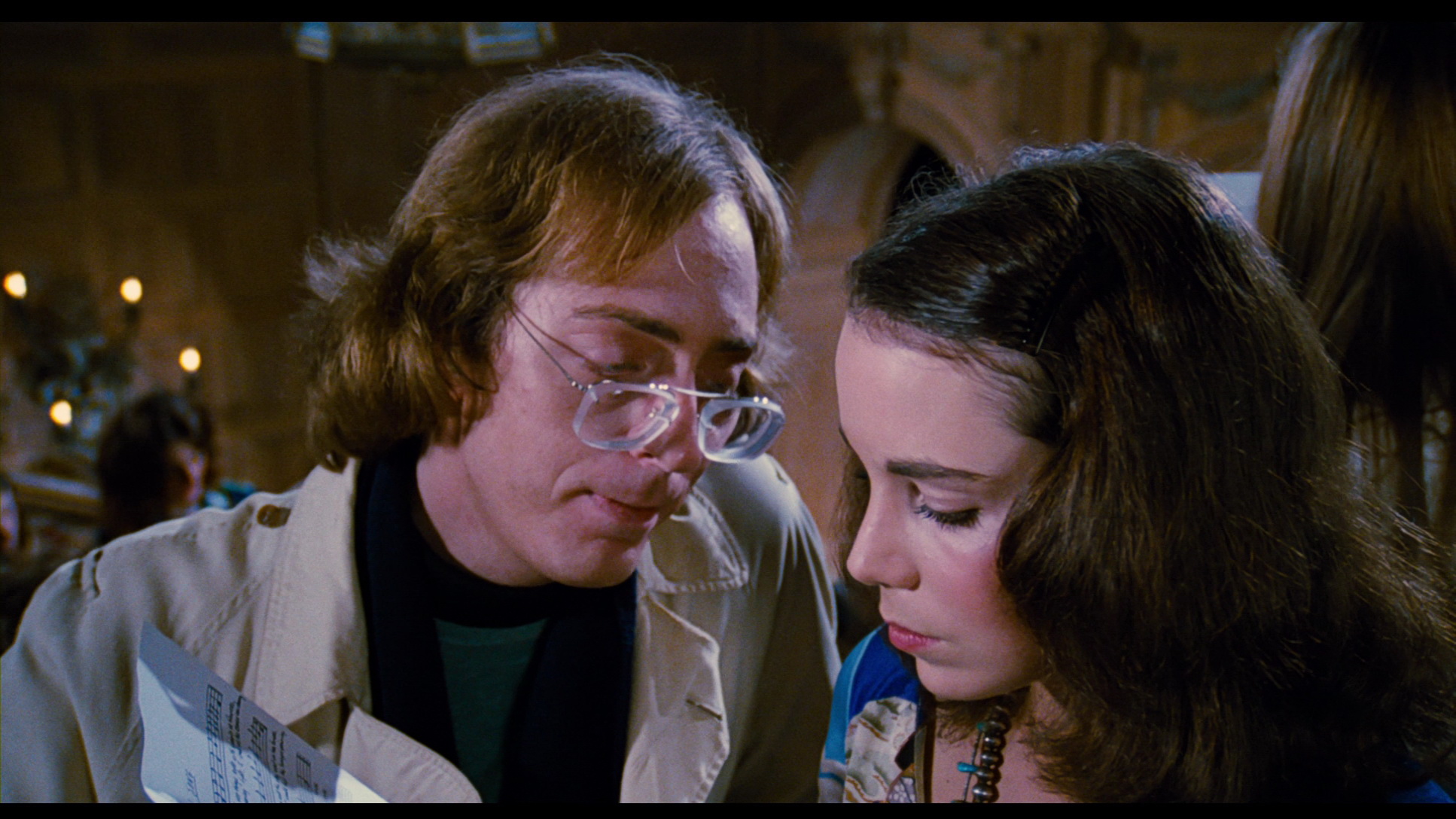
Winslow, soon to become the Phantom, and Phoenix.

The plot, basically: a singer-songwriter named Winslow Leach (William Finley) creates a cantata based on Faust, and this gets heard by a rich record producer named Swan (Paul Williams). Swan thinks the cantata will be perfect for the opening of his new concert hall, and has his henchman Arnold Philbin (George Memmoli) steal it.

Leach, expecting to hear back from Swan, makes repeated attempts to get back in touch but keeps getting thrown out. On one of these visits, he hears Phoenix (Jessica Harper) singing a portion of his work and falls in love.

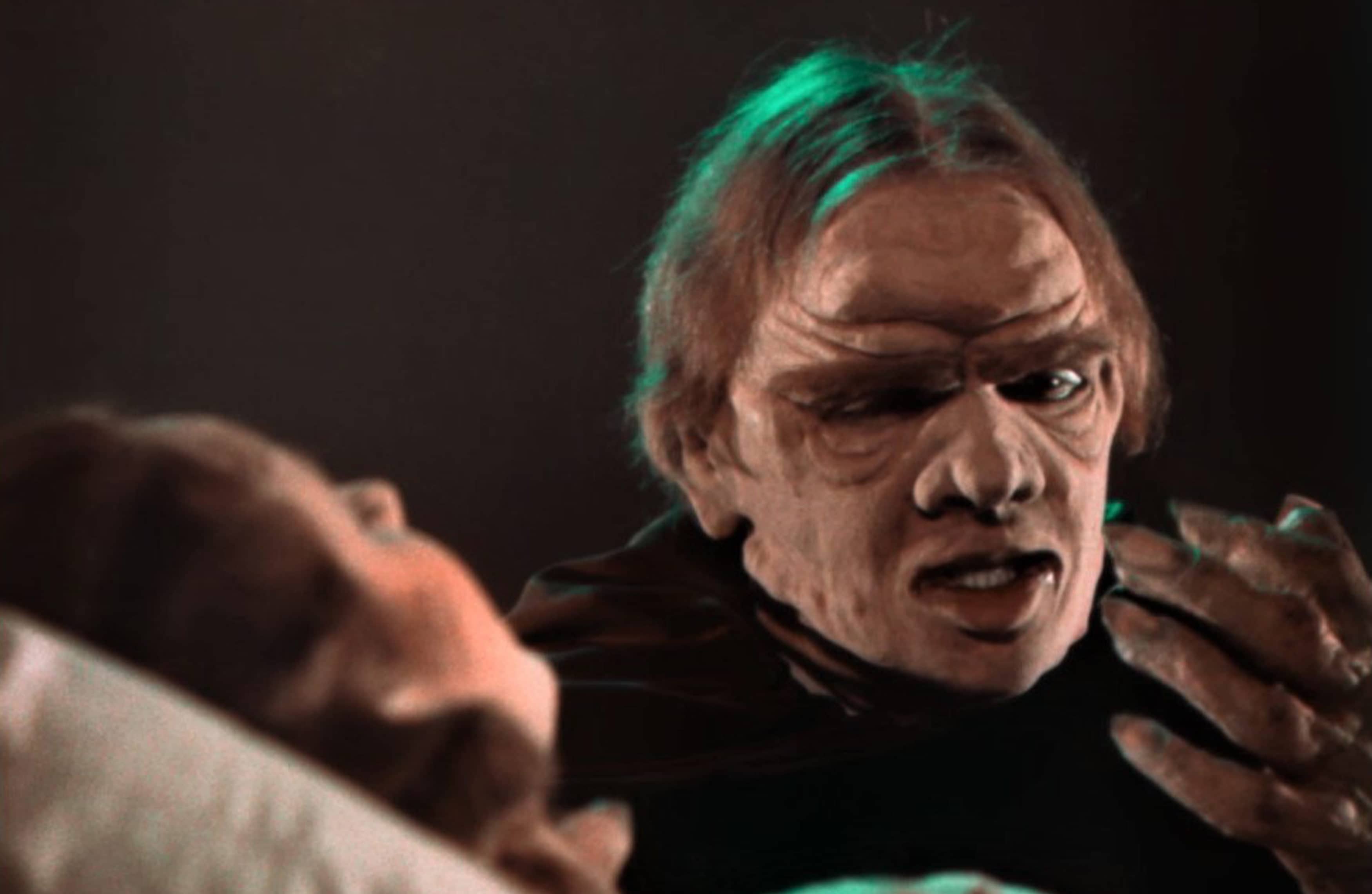
This time, Leach is framed for drug possession, is sent to prison for life, and has his teeth forcibly replaced with a steel set. A few months later, he hears that Swan’s band The Juicy Fruits have covered part of his music, goes berserk and escapes prison, breaks into Swan’s record-pressing plant as is severely disfigured when he falls into one of the record-pressing machines.

Yes, various tricks are used to keep Paul Williams’ actual (lack of) height obscured.

Seeking revenge, he breaks into the Paradise club itself, hiding in the costume department and finding a stylish silver owl mask and cape to complete his transformation into the Phantom (these bird metaphors are already laid on kind of thick). He hears the Beach Bums (formerly the Juicy Fruits) rehearsing a reworked version of his music and nearly kills them all, which attracts Swan’s attention.

Swan tracks Leach down and proposes a deal: finish the cantata and record it in a custom built recording studio. Swan gives Leach a voice box to (kind of) replace his destroyed vocal cords, promises that Phoenix will be the lead, and makes him sign a contract in blood.

The Phantom and Swan are the original frenemies.

Leach completes the cantata at the point of exhaustion, allowing Swan to steal it and replace Phoenix as the lead with (I’m not kidding) a glam rock prima donna named Beef (Gerrit Graham). Swan orders the studio sealed up with bricks.

Leach recovers, and in a fit of adrenaline smashes his way out of the bricked-up exit, makes his way to the Paradise, and confronts Beef in his shower, threatening him not to perform the lead.

If this image looks a bit familiar, you might be a film buff.

Beef agrees, but is forced by Swan and Philbin to return and perform for the rehearsal. Leach’s Phantom is in the rafters, and when he see this repeated betrayal he sends a neon lightning bolt down, which fries Beef.

Beef.

Philbin, understanding that the Phantom is behind this, promotes Phoenix to do the next song, and — surprise! — everyone loves her, including Swan. Swan promptly begins seducing Phoenix, and the Phantom tries briefly to warn her, but she is panicked and doesn’t recognize Leach.

Later, the Phantom spies on Swan and Phoenix as they prepare to make love. He tries to kill himself out of despondence, but Swan appears on the roof to tell Leach he cannot die until Swan dies because of their contract. So Leach attempts to kill Swan, but Swan points out that “I’m under contract too,” explicitly revealing he made a pact with the devil 20 years earlier to stay eternally young.

Swan announces to the press that he and Phoenix will marry during the finale of his production of Faust. Leach realizes that Swan plans to have Phoenix assassinated as the wedding concludes, as she has also signed a blood contract with him. He goes to Swan’s vault, destroying the tapes and Swan’s filmed and blood-signed contracts, then hastens to prevent the assassination during the wedding.

Because of this, Swan is starting to deteriorate, and dons a mask for the wedding. The Phantom, arriving just in time, swings onto the stage, removes Swan’s mask, and stabs the now-vulnerable Swan again. As a result, they both are now dying, but the now-saved Phoenix finally sees who the Phantom is, and stays with him as he dies.

So yeah, pretty convoluted, with a little “Picture of Dorian Gray” thrown in for good measure. It’s very well-shot in most places, with a bright colour palette and some fish-eye shots and other moments that remind me of A Clockwork Orange.

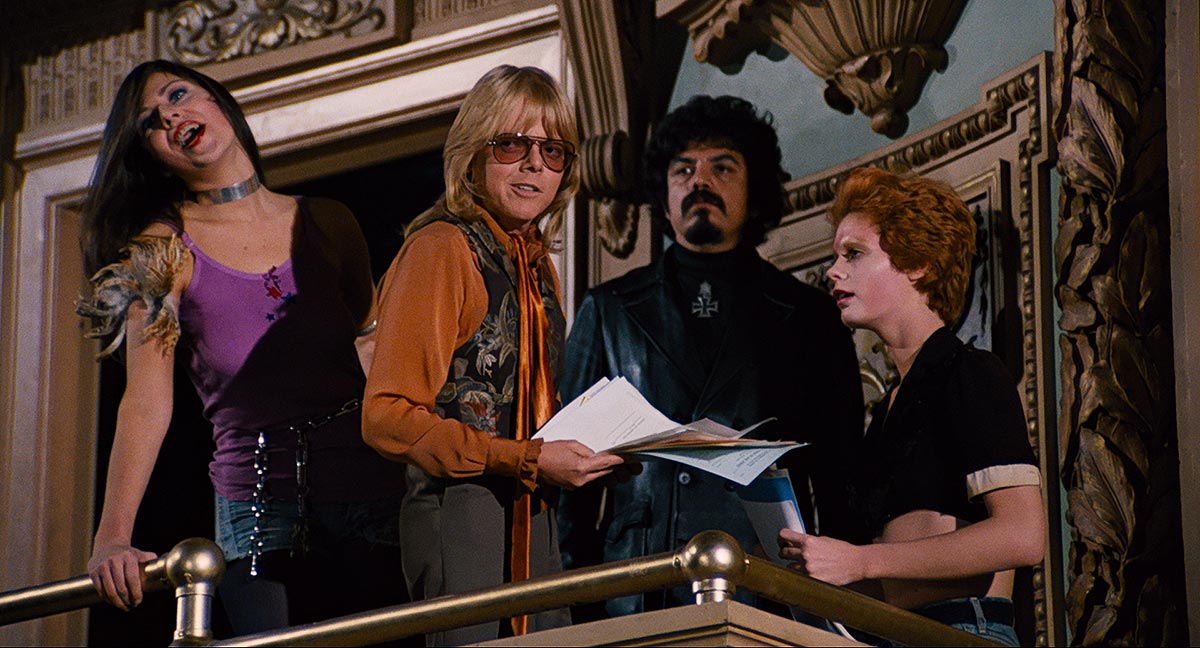
The Juicy Fruits (the best-sounding incarnation of this band)

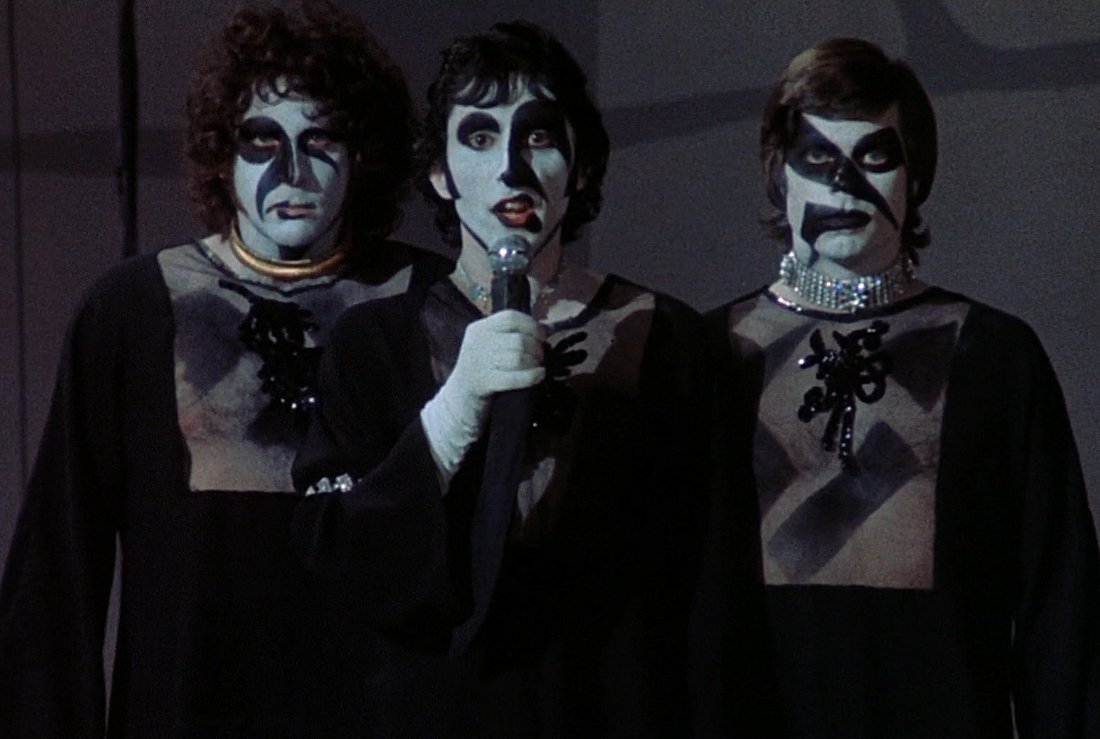
Williams wrote all the music, and performs as the Phantom’s singing voice, and it should be mentioned that the staging of the actual in-film Faust is a glorious tribute to The Cabinet of Doctor Caligari, with the Juicy Fruits/Beach Bums now performing as goth-y Greek chorus The Undead. I should mention that Williams’ songs are not at all bad, but as catchy as they are (at times), they never hit the level of “memorable” the way the aformentioned started-as-a-stage-musical songs do.

As a horror/comedy/drama, it kind of works, but it’s a stew with too many ingredients in my view. Luckily, the film improves as it goes on, and the ending is really very satisfying.

The Juicy Fruits become the Beach Bums …

I can see why some people love this film, as it is as bombastic, in-your-face and over-the-top as a rock musical perhaps should be. If it had been polished and honed as a stage show first, I have little doubt that I’d love it like that as well. By the way — why hasn’t this film gotten a proper stage treatment yet?

Rocky Horror, which came out a year later, is frankly a better example of a sex/drugs/rock musical on film on every level. That said, Phantom of the Paradise has its charms, and remains an upstanding denizen of the “midnight movie” genre.

The Beach Bums become Kiss (actually, The Undead)!

The Black Cat (1934, dir. Edgar G. Ulmer

⭐️⭐️⭐️⭐️½

52-week film challenge, film 34

Note: this is a 20-anniversary, “remastered” version of a review I initially did for my film blog back in 2003, but I did indeed watch the film again on October 2nd, 2023 to refresh my memories for this new version.

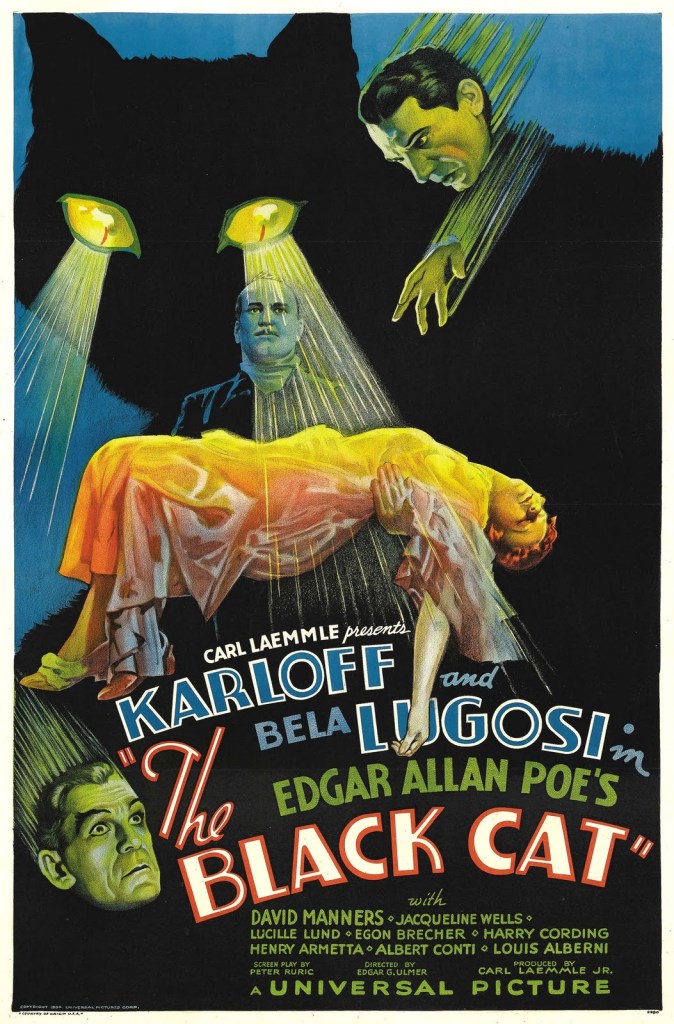
As I publish this, it is the beginning of October and the season of the witch, so if you are seeking a slow-burn horror film absolutely brimming with style — this may well be the most Neo-Expressionistic/Art Deco horror movie ever made — starring two absolute legends of horror in unconventional roles, have I got a great movie for you.

I think I first saw The Black Cat when I was about 12, and I’m sure it was one of those that played a role in my lifelong interest in highly-styled architechture and design in films.

At that age, parts of the film were indeed scary, but it was all too weird and mesmerising for me to take my eyes off of it. When I reviewed it again from my own film blog in 2003, the exterior model and interior sets of Dr. Hjalmar Poelzig’s house was the second greatest thing about it, the first of course being the first time I’d seen Karloff and Lugosi acting together without monster makeup.

The third thing about this movie is its incredible time compression. Despite some glacial pacing in some scenes between the two leads, there is plenty of action, especially near the end, and the film packs in necrophilia, satanism, murder, double-crosses, torture, the horrors of war, an undead black cat, secret vaults, and so much more into a film that astonishingly runs only one hour and four minutes.

The film makes numerous references to World War I, but the set design and intentional cruelty (not to mention its unusual setting of Hungary) also act as a prescient forerunner to World War II in some ways. The (black) cat-and-mouse game Lugosi’s Vitus Werdegast and Karloff’s Poelzig play might be seen by some as slow, but the tension between them is delicious.

The basic plot is, at its core, Standard Horror Plot #17: two “perfectly ordinary” strangers meet mysterious character on a train, who happens to be going to the same place they are; incident ensues, so mysterious character offers his new friends shelter at nearby house of arch-enemy; sufficient weirdness starts right from that moment and gets darker and weirder until “happy?” ending.

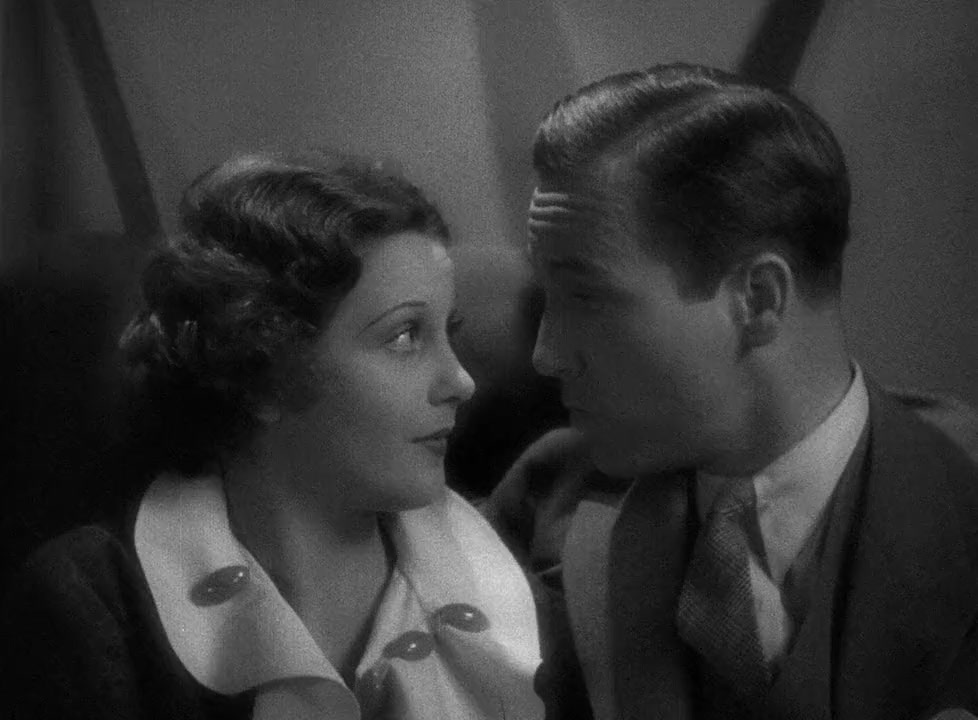
In this case, the couple is Peter (David Manners) and Joan Allison (Julie Bishop under the stage name of “Jacqueline Wells”), the mysterious (and intense) stranger is the kindly but creepy Bela Lugosi (Werdegast), and the mysterious mansion is the home of Karloff (Poelzig). I should mention that Werdegast has a hulking manservent named Thamal (Henry Cording), who pretends to be Poelzig’s servant.

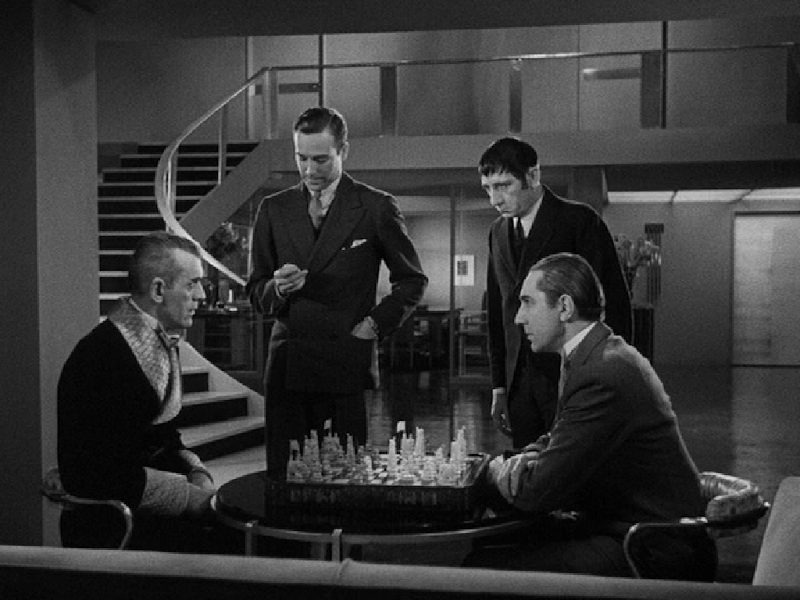
Joan, who has been injured when their bus (from the train) goes off a cliff, is attended to by Werdegast, but from the moment Karloff (and his geometric hair) appears, the tension and complexity of Werdegast and Poelzig’s relationship just builds and builds. They talk a lot, but don’t say much — their eyes, wardrobe, and silences say a lot more.

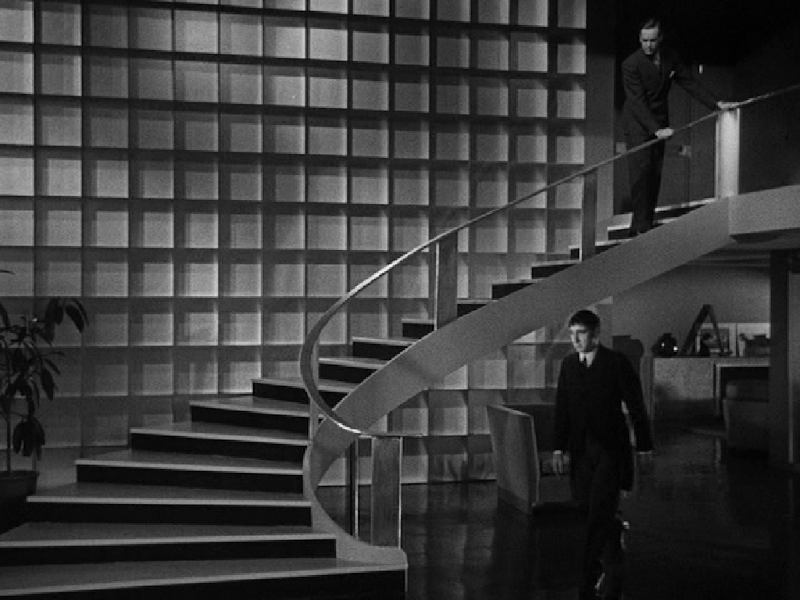
And the house!! For an architecture fan like me, the exterior model shot, taken straight out of Frank Lloyd Wright’s dreams, was a thrill. Then, to see the perfectly art-deco 30s interior sets, looking as minimalist and futuristic as 1934 can manage, still astounds and impresses. Poelzig looks completely at home, which is not to say that he ever looks relaxed or comfortable but rather to say that his appearance and wardrobe complement the rooms perfectly.

An important element I missed on earlier viewings of the film is that the house is built on the ruins of a World War I battlefield they both participated in. Werdegast was taken prisoner and spent 15 years in jail, while Poelzig spent the time seducing first Werdegast’s wife and then, when she died, his daughter (yeah, the creep-o-meter just went to 11).

Like the chess game the two men play for control of Joan (Werdegast wants to set them both free, Poelzig has other unnamed and probably unspeakable plans), every interaction between the two is the clash of two opposing forces who both like and hate each other. Incredibly, Werdegast is the hero of The Black Cat, but his fatal flaw is revealed early on: he has a nearly psychotic fear of cats.

When one appears in Poelzig’s house, Werdegast grabs a knife and throws it to expertly kill it. Other black cats (or maybe the same one, as Poelzig makes reference to a cat’s many lives) appear in the film, but the amazing thing is that Werdegast kills a cat right in front of everyone, but nobody seems to think anything of it. This is the only real link to Poe’s work in this movie.

What makes this movie stand out from the thick river of horror movies produced around the same time is that so much of the actual horror is understated or imagined rather than actually seen by the viewer. If it weren’t for the gorgous costumes and sets, this film would be as close to a radio play as a horror movie could get!

My god, this house!

Stripped of their usual arsenal of makeup, Karloff and Lugosi rely on their great chemistry to light up the set, in this — the first of eight films where they appear together. The architecture of the house and interior sets are so stunning (have I mentioned this already?) that it should get third billing, behind Karloff and Lugosi but ahead of Manners and Bishop. As another reviewer noted, “architectural nuts probably rent this movie as architecture porn. The house is that cool.” She’s absolutely right.

Once Poelzig is revealed as a Satanist who has designs on Joan for a sacrifice, the film’s action finally kicks into high gear. Unlike the stage-y verbal jousting of earlier, Werdegast — who every so often says he is “biding his time” for his revenge” — now has to make good on that threat, and quickly.

Well hello, pre-Code 1930s creep-a-thon!

The climax, in which Werdegast “wins” in the sense of triumping over Poelzig is really quite stylish and stunning, but even in shadow, Werdegast’s delight at inflicting torture on Poelzig is a little tough to watch, even 90 years later. The newlyweds, which everyone stopped caring about 30 minutes ago, escape with their lives — which any viewer of The Rocky Horror Picture Show will have seen coming a mile off (and that’s is not the only influence The Black Cat had on Richard O’Brien’s little moneyspinner).

While this movie has some issues of its own — I’m still trying to figure out what an all-American couple like Peter and Joan are even doing in postwar Hungary, the delicious slow-burn and the stars’ chemistry make this pre-code horror movie a time capsule of incredibly beautiful horror like nobody has made since. If you’re ready for something off-beat, classic yet wonderfully dated, comic in spots and scary in a psychological way, you are ready to cross paths with The Black Cat.

The “floating women” effect of Poelzig’s victims is just mesmerising.

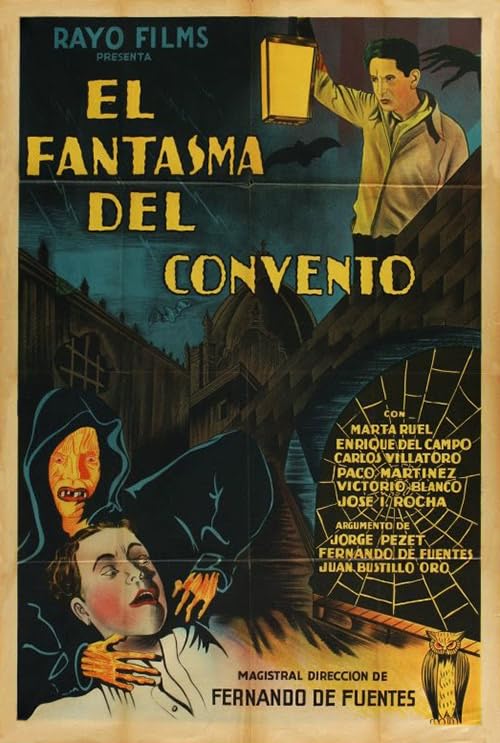
El Fantasma de Convento/The Phantom of the Convent (1934)

dir. Fernando de Fuentes
⭐️⭐️⭐️½
52-week film challenge, film 29

This film, often retitled in the US as Phantom of the Monestary because sexism, is a good old-fashioned ghost story for adults, made in Mexico in the mid-1930s, that’s nice and creepy. By today’s standards, it moves a bit slowly, but it lays on the atmosphere nice and thick, just like I like it.

It was largely forgotten for decades because of its paucity of “jump scares” or relatively little body horror, or maybe because it’s not dumb, nor does it have El Santo anywhere in it (he was a teenager when this came out, perhaps he saw it and thought to himself “I could do that … wearing a mask!”). Happily, it was rediscovered thanks to a Blu-ray release in 2022, and has taken its place as a well-regarded classic of early Mexican horror.

It’s just a good creepy morality tale, perhaps a touch too heavy-handed, but the surprises are spaced out just right to keep you roped into the story, and the use of lighting, cinematography, and non-music sound are superb (more about the music later). There’s also a lot of silence in this, as befits a movie that mostly takes place in the Convent of Silence.

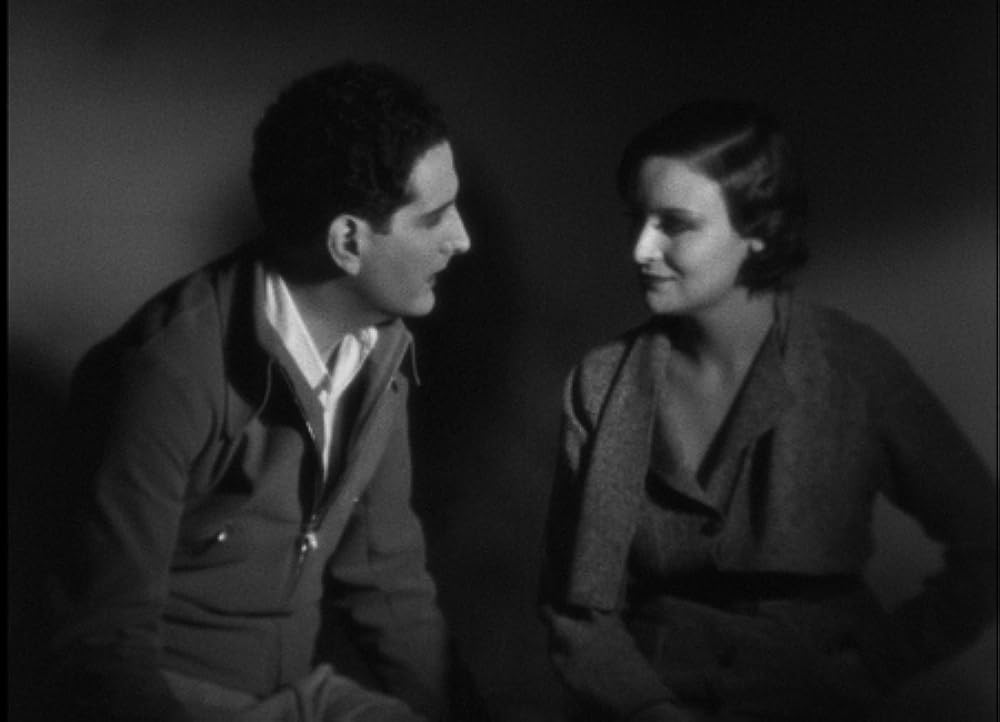
Our three leads: (L-R) Eduardo, Alphonso, and Cristina.

A married couple, Eduardo (Carlos Villatoro) and Cristina (Marta Roel), and Eduardo’s best friend Alphonso (Enrique del Campo), find themselves lost in the woods and, as the film opens, Eduardo has slipped off a ravine edge and is hanging on for dear life as Christina and Alphonso rescue him in a nice bit of foreshadowing. It’s obvious right from the get-go that Eduardo is kind of a wimp in the eyes of Cristina, who has the hots for Alphonso, and the feeling appears to be mutual — though they try to behave honourably, even though Eduardo is obviously aware of the flirting.

Once he’s back up and on his feet, they hope to find shelter in a nearby convent, only to run into a mysterious monk-like figure and his large dog Shadow (although the stranger is not named, it is Brother Rodrigo, returning to the convent). He leads them to the convent, then (of course) disappears inexplicably.

The lights are on in the convent, but at first there appears to be nobody home. Eventually the Prior (a wonderfully wizened Paco Martinez) appears, explaining that the other monks have taken vows of silence, and welcoming the trio to stay the night and find their way back in the morning. Walking through the convent, our heroes notice various oddities, such as how old-fashioned the monks appear to be, including a self-flagellating monk (in shadow), and a tumbled cabinet near a room that Alphonso attempts to straighten, but which reverts the moment his back is turned.

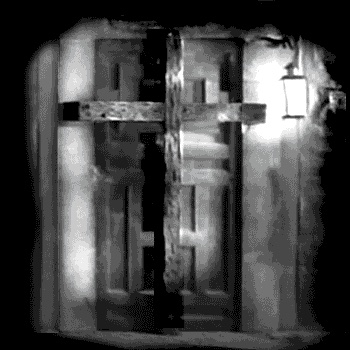
The “wandering around” part is reprised a few times, including once where our heroes come across a room with a dozen or so open – and empty – coffins. They also come across a door to one of the cells that is blocked, and has a huge crucifix nailed to it – to keep something out, or to lock something in?

Before they can ask any questions, they are invited to share a meal with the monks. The atmosphere is thick with tension, which only ratchets up when the convent is attacked by unseen forces, which moves the monks into action. Our trio follows along discreetly, as the monks reassemble in a “battle station” of sorts to try and fend off the unseen horror through vigorous prayer. The threat passes, and the trio quickly return to the dining room — only to find that all the bowls of soup they were eating before are full of ash now — until the monks return to the room.

The one monk who is allowed to speak but previously didn’t want to talk much returns to the dining hall and speaks mysteriously (of course) about the brothers and the threat they face. He relates a story about Brother Rodrigo that has a direct parallel to the adulterous triangle of our hapless heroes. Rodrigo lusted for his best friend’s wife, eventually murdering his friend and subsequently was consumed with guilt, returning to the convent to unsuccessfully atone for his sins. The blocked cell with the giant crucifix is, you guessed it, Rodrigo’s cell.

The door to Brother Rodrigo’s cell.

All three of our protagonists seem enraptured with the story and feel that they are under a spell of some kind, but in particular Cristina appears to (and even articulates) be most influenced by the events in a strange way – seemingly getting more and more aroused by the events they are witnessing. When the three are escorted to their three separate cells (it is a convent, after all), she goes immediately to Alphonso and makes allusions that she is as ready as she’ll ever be to consummate their relationship (it is the 1930s, after all). Alphonso is also ready, but finds the willpower to resist her under the spooky circumstances, which angers Cristina.

The mystery deepens, weirder things happen, and the film slowly builds to a deliciously scary climax (not involving Cristina, har har) in which Alphonso wrestles with his guilt, and his temptation, and works his way into Rodrigo’s cell, where the mummified body of the monk still resides, and he encounters an undead version of Eduardo and a book that drips blood, and is tortured by visions before collapsing.

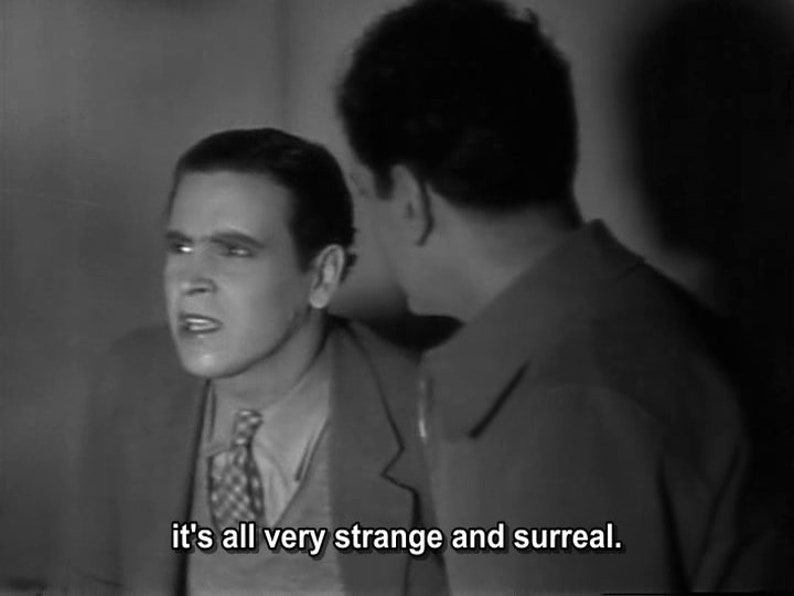
Cristina and Alphonso confront their adulterous hearts

He awakes in the morning, gathers his friends (who are all okay), and they hurriedly try to leave. There’s a great denouement where they discover a caretaker (Jose I. Rocha), who doesn’t believe a word of their adventure and shows them the reality of the place, which has been abandoned for centuries. Was it all a shared hallucination, time travel, or what?

If you are in the mood for an old-fashioned ghost story, if you enjoyed the Mexican version of Dracula, or if you just appreciate well-shot, moodily-lit horror films like Frankenstein, you’re likely to enjoy The Phantom of the Convent as well. The biggest flaw in the film, in my view, is the sometimes-histrionic and mostly-stock soundtrack, which tries far too hard and too often to built tension or suggest a climactic moment that, until the film’s actual pinnacle arrives, is ill-suited to this gentler horror movie. Thankfully, it’s not there all the time, and when a genuinely climactic scene does finally appear, the music is finally ready for it.

The mummified body of Rodrigo points to a book dripping with blood, in the wonderfully creepy climax.
I think the film holds up very well, particularly given that it was made in the 1930s, though viewers should be aware that the influence of Catholicism in Mexico was strongly dominant at the time. Even better, it’s left hanging as to the ultimate fates of the three friends, though it would appear the lust factor has been forgive me – exorcised from Alphonso and Cristina.