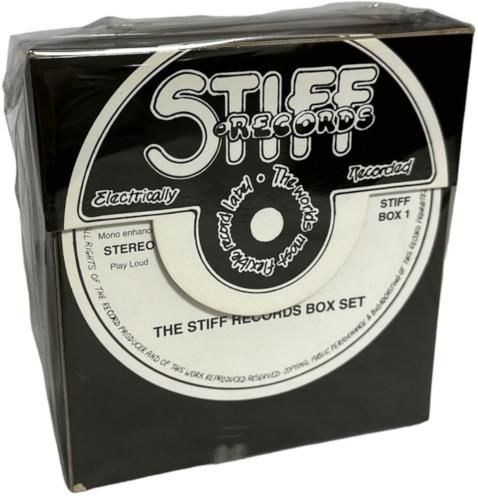
The Stiff Records Box Set – Disc 4

The Stiff Records Box Set — Disc 4
Stiff Records, 1992
4CD box set + booklet

THE PROLOGUE

Well, here we are at last, the final disc in this set, chronicling the last days of Stiff as an active record label roundabouts the mid-80s. Many of the acts Stiff first signed and/or made famous moved on to bigger record labels and more money, and Robinson and Riveria were forced to cast an ever wider net.

It’s a label that kicked off with Nick Lowe because he had already recorded to “publisher demos” at other companies’ expense, so the cost of releasing that very first Stiff single was a staggering £45. Thankfully, it did well – and the rest of the history is encapsulated here.

As mentioned previously, the tracks on these discs are in rough, rather than exact, chronological order, but on the other end of this Stiff journey we alight on the pub rock band Dr Feelgood, still going to this day as an entertainment entity but with a completely different lineup. You might wonder what a mid-70s traditionalist UK rock band is doing here, but they are part of Stiff history for two reasons.

First, singer Lee Brilleaux was the man who lent Jake Riveria and Dave Robinson the 400 quid they needed to register Stiff as the UK’s first independent record label. Second, they were a pretty damn good pub-rock band by the time they finally recorded with the label.

THE MUSIC

Things kick off with “Sign Of The Times” — a nice, poppy single from The Belle Stars, an all-female group that should have gone further than they did. I’m happy that their biggest single was one of their own originals, rather than the cover versions they had been doing for a while prior to that. Prince obviously liked the title also!

The follow-up single from the band is also included here, “Sweet Memory” as the second track on this disk, and it failed to crack the top 20 despite some pretty groove-y instrumentation. It’s certainly not as good as “Sign of the Times,” but it’s not awful either. I think the “aggressive/tough” style vocal on “Sweet Memory” is what hurt it.

Stiff was not doing as well by the time 1983-84 rolled around, and this disc is low on hits (but not without them). The label signed a bunch of new bands as their older acts left for bigger labels, and Electric Guitars is one of those. To be fair, the New Wave edge had faded by this point, but the “angular” attempts at cool had devolved into a similar style for a lot of bands.

It makes sense that the Guitars’ “Language Problems” would follow “Sweet Memory,” since it is rather similar: musically very competent, vocals rather odd.

Thankfully, the fourth song on the CD is a bona fide hit that still gets me dancing to this day: Tracey Ullman’s version of Jackie DeShannon’s “Breakaway,” a sped-up 60s girl-group song that infused extra energy and Ullman’s own sparkly vocals into an irresistible treat. Two minutes and 37 seconds of absolutely perfect pop.

This is followed by a song that might have made it but missed it by this much, Passion Puppets’ “Like Dust.” Musically, it has the moves, the vocals aren’t bad, there’s no reason this harder-rock mainstream number couldn’t have done reasonably well, and yet it didn’t. I can only imagine that the collapse of Stiff in 1984 contributed to the band’s failure to put out more than a single album.

Likewise, “Dangerous Dreams” by Jakko sounds like perfect FM radio fodder, but went nowhere just the same.

But now, time for something different: King Kurt launches “Destination Zululand” at us with a Tempole Tudor style and a bad Elvis impression. This sounds more like the happier days of the label, and it’s competently performed but silly. Not great, but certainly fun.

If you had trouble deciphering exactly what King Kurt is saying at all times on his song, wait till you get a load of poster-boy-for-dental-work Shane McGowan and the Pogues, who debut in this set at last with “The Sick Bed of Cuchulain,” a rollicking 100-proof Irish punk-folk hit complete with tinwhistle. McGowan alternately snarls and rocks it in this tale, which draws from Irish folklore based on an actual 11-century (lost) Yellow Book of Slane.

The next track is absolutely not what you might expect following The Pogues: “Pick Me Up” by the Inspirational Choir of the Pentecostal First Born Church of the Living God. True to their name, its an African-American church choir singing Christian Rock (or more accurately, inoffensive jazz-pop). It … um … certainly stands out among the songs on this disc.

A band remarkably like peak post-punk band The Jam, but they’re called Makin’ Time, borrow the bass riff from “Town Called Malice” for their own very-nearly-as-good version, “Here Is My Number.” It’s a rousing soul-infused rocker, but … you can’t get that other song out of your head when listening to it.

Three of the four members remained active in the music business into the 21st century, with Makin’ Time bassist Martin Blunt eventually joining The Charlatans.

Time to check back in with The Pogues, doing that Pogues-thing they do so well, with a catchy, bouncy Irish … lament … called “Dark Streets of London.” If you’re reading this, you must know The Pogues, even if you can’t stand McGowan’s vocal style, so you know that musically they are both firmly reflective of Ireland’s musical heritage, while infusing the music with the energy and spittle of punk.

We mentioned earlier The Belle Stars as a band that should have been bigger: well here’s another one — The Untouchables. They briefly grabbed the brass ring of exposure and US fame with a later single “Free Yourself,” but “Wild Child” is exactly the same kind of soul-powered rock stomper. I’m reminded to go back and investigate these guys more as well.

Kristy MacColl returns to give us another fantastic song of hers, “A New England.” Sparkling guitars frame a confessional song about a broken relationship and touching on teen pregnancy, bracketed by absolutely inspired lyrics.

Here’s a sample: “I saw two shooting stars last night/I wished on them, but they were only satellites/it’s wrong to wish on space hardware/I wish, I wish, I wish you cared,” and even more so “Once upon a time at home/I sat beside the telephone/Waiting for someone to pull me through/When at last it didn’t ring I knew it wasn’t you.” Genius!

One of Jamie Rae’s two singles ever released, “Pretty One” is included here, and it’s a pleasant enough pop song, but the young Scottish singer only released one other single. Though he found some considerable fame from those two records, he suddenly withdrew from pop music following the unexpected death of his mother from leukemia. Somewhere in a vault, there’s half an album more stuff from him, but as yet it’s not escaped that I know of.

Starting off with a driving groove, 60s mod styling, and a killer bass riff and wonderful call-and-response between lead singer/guitarist Clyde Grimes and the rest of the band, a ska-like touch of horns and synth organ, “Free Yourself” by The Untouchables managed to get some airplay and exposure on MTV and US radio with this irresistable track. As someone used to say back in the day, “if this don’t get in your head, check yourself — you may be dead!”

Speaking of energy, The Pogues waltz back in with another fast-paced Irish punk ballad, “Sally MacLennane.” A punk-pop take on Irish traditional music doesn’t get any better than this. The drunken-voiced callback in the chorus is the perfect finishing touch. Two minutes and 43 seconds of pure boozy bliss.

Then, suddenly, without proper warning: deep-voiced art-rock New Wave! It’s Furniture’s best single (in my opinion), “(You Must Be Out of Your) Brilliant Mind,” with extra-weird bass tomfoolery in the chorus and occasionally elsewehre, synth strings, a New York angry sax break, full of witty lyrics and oddly danceable. It’s … wait for it … brilliant.

From the “Not Really Our Thing So Much, But It Kinda Works, Mate” department, we finally get to Dr. Feelgood, a band that was a staple of the pub-rock circuit which originally formed in 1971, making them antiquated geezers by this point. The band was anchored by singer Lee Brilleaux, but had a rotating cast of other players.

For their single for Stiff, the label gave them some synths to play with, and the result is the smoky ballad “Don’t Wait Up,” which sits a little oddly with most of the other Stiff artists but is in fact a good song well-performed with just a splash of blues.

This is followed by outright bebop jazz from the Tommy Chase Quartet with a song called “Killer Joe (Right Cross)” — no chaser, just straight shots at a quick clip. As per tradition, the piano and sax get their moment of spotlight. What the huh? 50s jazz on Stiff? What the blazes is going on?

Oh wait, whew — Furniture return to get back in the zeitgeist with a return to their cool romantic artiness, courtesy another single a-side “Shake Like Judy Says.” Oddly, it’s not really a bad placement between Tommy Chase and Dr Feelgood — the song features a jazz-tinged trumpet line (and a little xylophone), which are both given some brief prominence amongst the synth/bass/drum/guitar main sounds.

Dr. Feelgood closes out the show with an unexpected redneck anthem, “Hunting Shooting Fishing,” that at least shows off how the band normally operated, and as you might have guessed, they’re not trying for high art. This is pub rock aimed squarely at working-class club audiences, complete with driving lead guitar and drums, plenty of echo on Brilleaux, and what almost manages to be a song for the monster truck crowd. ZZ Top could only wish they rocked this raucously.

THE BOOKLET

Just before we head for the exit on this review, we have to mention – at long last – the one and only thing included in this box set that is not a CD in a jewel case (which also includes an insert card with the table of contents for each disc, also reprinted on the back card) is a 20-page booklet that tries to set the stage for the creation of Stiff and the state of UK rock music at the time, impart a little data about its founders (including police mug shots!), and outline some of the label’s whacky slogans, which really gave it character. These ranged from the enigmatic “Three Nos Don’t Make a Yes” to the punkier “If It Ain’t Stiff It Ain’t Worth a Fuck” and the wry “We Came, We Saw, We Left” (or as the ancient Romans might have said, “Venimus, Vidimus, Reliquimus). Me, I always liked their on-label saying on many of their singles, “Electrically Recorded.”

We then get in the story about the early singles, starting with Nick and his costs-already-covered first single “So It Goes,” which came out on August 14th, 1976, and hit number one in the US two weeks after it was released. “Heart of the City,” the b-side, made a greater impact on the UK music papers, and between the two songs Jake and Dave were able to pay off the initial loan that started the ball rolling.

After a kerfuffle with EMI over the use of a Beatles’ “baby butcher” unused cover for a Roogalator single, Stiff got in the habit of releasing a single and then quickly “deleting” it from the catalog, which turned out to have the effect of encouraging stores to order more copies upfront. On top of that, they’d let artists or producers scratch messages in the runout groove (no, that wasn’t really a thing until Stiff came along). Genius!

The booklet continues with various tales like that, celebrating itself and writing about both its early wins and some of its early losses – for example, the classic “Alison” by Elvis Costello completely failed to chart on its debut. Luckily, the album did a bit of business (wink). It also chronicles the departure of Jake Rivera, taking Lowe, Costello, and Yachts with him to form another indie label, Radar.

It talks about the changing relationship with the ever-fickle and ever-bitchy UK music press, which once championed Stiff but quickly decided the new crop of acts were already old hat, and chronicles the Live Stiffs tours. As punk began to fade and the Two-Tone (another indie label) legend rose, Stiff signed Madness in a canny move.

By this point we’re in the early 80s, and Madness, Tenpole Tudor and Jona Lewie’s surprise hit “Stop the Cavalry” were helping keep Stiff in the charts, desperation was rolling in like fog and Stiff was throwing all kinds of … stuff … at the wall to see what stuck. Then, like a fortuitous lifeline, in 1983 Dave Robinson took an offer of being the Music Director of Island Records, and took the entire label roster with him.

This lasted until 1985 when Robinson and Island parted ways, and Stiff was back to struggling status. By 1986, Robinson could take the swinging between feast and famine anymore, and after a last short respite courtesy Cashmere (also home to the emerging ZTT label at the time), Robinson and Stiff were done.

The booklet carries on for a bit longer eulogising some of the things that made Stiff unique (such as signing Wazmo Nariz, the guy with two ties). It ends with a listing of Stiff Staff, and thank yous to those who helped put this compilation together.

THE WRAP UP

By the mid-80s, Stiff was flailing around wildly and desperate for hits. By this point, it was sailing on reputation and fumes, and the money was running out fast. That said, Discs 3 and 4 show that Stiff still had an eye for talent, and was still taking chances on an ever-increasing variety of artists even as the ship was starting to sink.

We owe this label and those two founding maniacs a great deal of gratitude for finding and publicising such a wide and clever array of new musical talent, and for helping make the very late 70s and early 80s a fookin’ great time to be a young person who loves great music. As the scores for these four CD s show, the hits outweighed the misses, and the legacy of the label is something Dave, Jake, and the artists can be proud of.

As a grave marker of sorts, this CD set is the finest tribute/chronology/potted history you’ll likely ever get of a UK indie record label. It is still a treasure box to me, 32 years (yikes!) since I first bought it. I’ve managed to buy it at least three times: my first copy was stolen in the mid-90s; another was so well-loved it fell apart; and this third one, thus far, has been treated with care. The little bit of velcro that keeps the box closed, on the other hand, has – on all my copies, and like much of this music – never failed me.

Great songs: 10
Good songs: 4
Meh songs: 7

Next time: Roxy Music!
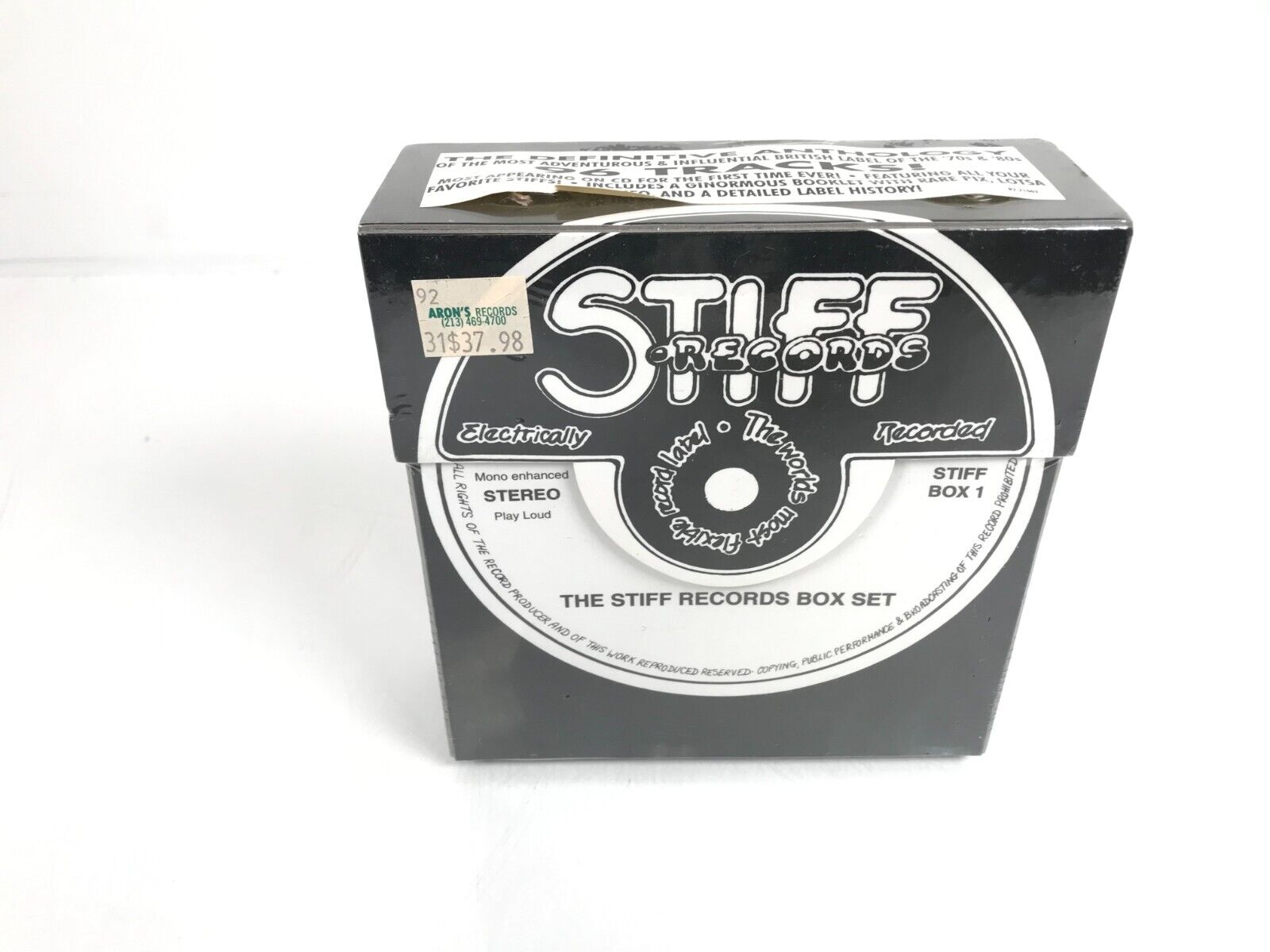
The Stiff Records Box Set — Disc 3

The Stiff Records Box Set — Disc 3
Stiff Records, 1992
4CD box set + booklet

THE PROLOGUE

We’ve already sampled 50 songs from the Stiff catalog, and my suggestion is you don’t do this in one sitting! It’s all (well, very high percentage) good-to-great stuff, and a snapshot of an era as well as a label. But will Punk-New Wave-Powerpop-Pub—Rock-Uncategorized fatigue set in? Let’s find out!

In response to some readers – yes, we’ll cover the booklet when we get to Disc 4, and yes, I probably should have done that with the Disc 1 review. Insert traditional UK two-finger wag … here.

THE MUSIC

If you were feeling a little fatigued from listening to (or just reading about) the first 50 songs, Disc 3 is here with a shot of Vitamin Groove to revive you. Stiff could hardly have picked two more energetic, get-up-and-dance-you-fool numbers than Madness’ mid-tempo-domestic-squabble-set-to-ska song “My Girl” to kick things off, and then followed it with Jamaica’s musical master Desmond Dekker’s insanely catchy 1968 reggae classic “Israelites.”

Joe “King” Carrasco (and The Crowns) has the uneviable duty to follow that, but does a decent job with his equally-partying and Wurlitzer-led Tex-Mex hit “Buena,” which of course incorporates some Spanish into the mix.

We shift gears with Graham Parker’s faux-punk rockin’ diatribe “Stupefaction,” complete with a snarling indictment of life in Los Angeles. It was the first single from his final album with the (uncredited) Rumour, The Up Escalator, and while the single didn’t chart, the album was his best-selling record to that point (1980). If you like the song and his attitude, you’ll enjoy the album.

Next up is a masterpiece of the New Wave era — a “love” song that probably could never have been written, performed, or been a success in any other era. Jona Lewie’s biggest hit, “You’ll Always Find Me in the Kitchen at Parties,” was a song I identified with in my very early teen years, until I become the social butterfly I am today (heh).

It’s minimalist, it’s low-key, it’s monotone, and I love it (and it’s not like everything else he’s done). I’m sure it was intended as a “novelty” single, but it bypassed Doctor Demento and became a surprise Top 20 hit in the UK, reaching the #3 spot in New Zealand and parking there (on both charts) for weeks on end.

To the best of my knowledge, there’s only been one “cover” of this song … in 2010, a duo called Man Like Me took the backing track, replaced Lewie’s vocals with their own, and made a video. It’s not horrible, it’s not great, and it’s on YouTube if you want to see it.

If you’ve never heard the original, good lord people — listen to it RIGHT NOW. It’s an Awkward Teenager Redemption Anthem! Plus, this particular video features bonus Kirsty MacColl!

This is followed by the joyous power-pop of Any Trouble, with the song “Trouble With Love.” The group as a whole had its ups and downs, but I have always been a fan of anything lead singer and songwriter Clive Gregson cared to put down on tape — he does a great job of marrying upbeat pop with “unlucky in love” lyrics.

Dave (L.) Stewart — not the guy from the later Eurythmics — spent his time at Stiff mostly covering old songs, as far as I can tell. He had played with bands like Hatfield and the North in the 70s, but by 1981 he was putting out singles with guest vocalists.

The first of two such collaborations we’ll hear on this disc is “What Becomes of the Broken-Hearted,” with vocals by Colin Blunstone (formerly the singer for The Zombies) with some female backing vocals. The song, from 1966, was first recorded by the great soul singer Jimmy Ruffin, who really poured a sense of genuine heartache into it.

Almost every singer who has covered the song since has hewed very close to the original arrangement, but often don’t bring the anguish Ruffin did. It’s the same problem here: Stewart’s instrumentation, while nicely departing from the Ruffin arrangement, replaces it with a cold, synthy-piano-led, clinical style. Blunstone’s singing, while pleasant, is likewise perfunctory for the most part. We’re not looking forward to more of the same later.

Since the last song was so soulless, it follows that Graham Parker would have to follow with his sarcastic takedown of his (former by this point) record label, “Mercury Poisoning,” which is a rollicking complaint letter set to music. His new record company (Arista at the time) had no issues with it, but Parker didn’t last too long there either. This live version got licensed to Stiff and they ran with it, and emerged seemingly unscathed (at least, I’m unaware of any song by Parker with a play on the name Stiff …).

Dirty Looks was one of those bands that always seemed interesting, seemed promising, but at least for me they never managed to push it over the line into being a fan. “Let Go” is a nicely energetic and tuneful number with a great pre-chorus praising the rock n roll spirit embodied in the advice of the title. It’s a good single that probably should have done better than it did — see what you think:

Madness returns with their clown car of fun ska and “nutty boys” story-songs with “Baggy Trousers,” showing that their style had legs to cover more than just their first (brilliant) album. Madness by this point is a reliable and predictable brand, beloved by skinheads and grandmas alike. Nice trick if you can pull it off!

Dave Stewart returns, this time with regular partner Barbara Gaskin in tow, for another off-beat take on a standard: this time, “It’s My Party.” This version works better than Dave’s cover of “Broken Hearted,” because the song was a torch song in the first place, and so performing it like a morose ballad technically makes it a better version that Lesley Gore’s original, but I still prefer Gore’s version. The girl-group backing vocals just put the cherry on this synth-minimalist but perceptive cake.

Speaking of covers, John Otway’s take on the old country standard “The Green Green Grass of Home” is … well hang on, who is this person anyway? I confess I’m not that familiar with him, but he appears to be simply an eccentric musician who tries to do thing in his own unique way.

So, knowing that, it’s possible to appreciate this sometimes atonal, weirdly performed, nearly acapella first minute of the cover, followed by the full band kicking in and Otway singing a raucus version in the second half. It’s certainly a “chaser” between the first half and the second half of the disc, I’ll say that.

Following that, Tenpole Tudor swing around playfully with “Three Bells in a Row,” a tuneful song about “fruit machines,” (coin-operated UK roulette machines where you try to line up three items in a row, with the big winner being three bells). Frontman Ed Tudor-Pole is just out for a good time, and pretty much all the music I’ve heard from the band is the audio equivalent of a good-time pub crawl.

It was good choice to sequence Jona Lewie’s cheery (or as cheery as his deadpan voice allows) “Stop the Calvary” as the next track, as it keeps up the good mood and suddenly turns into a Christmas single unexpectedly (and it’s still played around Christmas time on UK radio to this day).

What’s next? The two songs by Department S you’re ever likely to have heard before, “Going Left Right” and “Is Vic There?” Oh but plot twist — the version of “Is Vic There?” is the French version! Qu’elle surprise!

The former song has a driving style with a lovely swirling synth dressing and snarky lyrics about disco dancing. I still like this song very much, and wish they’d done more in this vein, even though it’s the longest song on this disc (at four and a half minutes).

“Is Vic There?” is a fragment of a phone conversation turned into another catchy, intense yet danceable single, with both French and English lyrics. I should really look into the rest of their output, but I can only think of a handful of Department S songs I’ve ever heard, and they’ve all been good.

Here’s the English-language version of the track.

Now we come to a band called the Equators that I know nothing of other than this one song. “If You Need Me,” has a ska influence to it, and there’s nothing really wrong with the song other than it being a bland love tune, lyrically. It didn’t inspire me to investigate them further.

As if in reaction to the mediocrity of the Equators, Tenpole Tudor return to overturn the table, spike the punch, and swing from the chandelier in an attempt to bring the party back to life with “Wunderbar.” It’s not as energetic as punk in the verses, but it chugs along nicely and the chorus is a big drunk gang singing the word “wunderbar” and whistling as only a big drunk gang can. As good as it is, they get one-upped in due course.

“Allamana” is a quite forgettable number by Desmond Dekker, and was likely a b-side. Nuff said.

We shift gears pretty hard from this string of ska-jacent music with the arrival of Alvin Stardust and his urgent mission to put a new spin on the traditional 50s love ballad. Blessed with the smoothest voice this side of Buddy Holly, he ups the tempo, drips with echo, and has perfectly harmonious backup singers. It’s fabulous.

Billy Bremner of Rockpile (and Nick Lowe and Dave Edmunds’ various other records) drops by with a serviceable but relaxed performance of a song called “Loud Music in Cars,” where the title is not only the subject, but the first words sung (and he has a pleasant-enough voice, though the influence of Lowe and Edmunds is keenly felt). It’s a simple Scottish pop song about a simple subject — loud music in cars is something Bremner enjoys, apparently. It somehow sticks in your head, though.

Oh, but then … Tenpole Tudor return to take us away from all that amiable-pop-rock crap with another stomper likely to be sung by football hooligans, “Throwing My Baby Out With the Bathwater,” a good-time breakup song.

This is stunningly well one-upped by a band called Pookiesnackenburger, who I am astonished to report managed not only to produce more than this one madcap song, but indeed produced two complete albums I really must investigate. “Just One Cornetto,” flatly, my favourite song on this disc by a long way.

Following some incomprehensible chatter, the song begins with a Madness-like call to action, becoming a party set to music and a delightfully mad lyric — a love song to an ice cream novelty, the beloved Cornetto. The whole thing is as delightfully mad as the band’s name, and all over in 2’26”. Love it.

Next is Via Vagabond with a driving, swinging jazz number called, brilliantly, “Who Likes Jazz.” It’s wonderfully performed with blazing piano, a touch of synth, but really driven by the drum-and-stand-up-bass 50s style tempo.

The disc concludes with Tracey Ullman with another slab of 60’s style girl-pop, with a beautifully clever title lyric — “you broke my heart in 17 places … Shepard’s Bush was only one.” The secret sauce behind Ullman was always Kirsty MacColl, and this is one of her cleverest songs.

This was part of Tracey’s debut album of the same name, mostly consisting of an eclectic array of remakes of well-known love songs, including Blondie’s “(I’m Always Touched By Your) Presence, Dear,” and a lovely cover of Jackie DeShannon’s brilliant “Breakaway.” MacColl also contributed one of her songs she’d had a hit with herself, “They Don’t Know,” and Ullman’s version was a bigger hit than MacColl’s version — reaching the top 10 in the US and peaking at number two in the UK singles chart.

THE WRAP UP

The tracks on these discs are not arranged in strictly chronological order, but they do roughly follow the progression and diversification of the label, and we’re definitely seeing that here. Thankfully, Robinson’s ear and eye for talent remained true, but the number of Stiff acts that went on to bigger labels and greater success is a remarkable testament to that.

“Punk acts” on this compilation mostly consist of The Damned and Alberto Y Lost Trios Paranoias, and they’re not heard from after the first CD here. That said, my personal rating of “great” songs goes up to a new high mark here . Here’s the score for CD number three:

GREAT SONGS: 14
GOOD SONGS: 6
MEH SONGS: 5

Next time: Disc 4 … and oh yeah, the booklet!

The Stiff Records Box Set – Disc 2

The Stiff Records Box Set — Disc 2
Stiff Records, 1992
4CD box set + booklet

THE PROLOGUE

Settle in, dear readers, it’s another disc and another 25 songs spread out another hour and 17 minutes, or an average runtime per song of 3’08”. As before, there’s a mix of Stiff’s artists that went on to become famous and/or influential, and a smattering of songs and artists that … didn’t.

THE MUSIC

Disc Two kicks off with another pair of songs by Nick Lowe, just as Disc One did. This time, we get the non-album track “I Love My Label,” which is probably why he got more songs on this compilation than anyone other than his protege Elvis Costello (at four songs each).

Nick’s original of it has only ever appeared on a handful of Stiff Records compilations, of which this is of course one of them, but Wilco very faithfully covered the song as a bonus track on their 2011 album The Whole Love.

This is followed by “Marie Prevost” from his first album, Jesus of Cool, released in March of 1978. It tells the tale (inaccurately) of the silent film star’s life and death. A story had gone around that part of Prevost’s dead body was consumed by her two dogs, and this was used by Lowe in the song.

It isn’t true — she died, destitute, at age 40 from alcoholism and malnutrition due to anorexia nervosa, with her body intact. One of her dogs, in fact, caused neighbours to discover that she had died via the animal’s incessant barking.

Next up is Ian Dury & The Blockheads with “What a Waste,” a song about all his squandered opportunities in other occupations, but for that he chose “to play the fool in a six-piece band.” It’s another mildly entertaining and amusing song, as is his forte.

Elvis Costello pops up next with a live track, which he announces is written by Burt Bacharach and Hal David: “I Just Don’t Know What To Do With Myself,” one of the duo’s many pop standards. Elvis is perhaps surprisingly sincere in his performance of the 1962 number, first made famous by Dusty Springfield’s version.

You could be forgiven for thinking that the fifth track, “Whoops-A-Daisy” by Humphrey Ocean and the Hardy Annuals, was just a more twee version of Ian Dury on a lark. In fact, however, Mr. Ocean is a real person, and a noted UK painter.

The uncanny resemblance in this track stems from Ocean’s affiliation with Dury (who was his art teacher, friend, and apparently vocal coach). Ocean had played bass in Dury’s previous band, Kilburn and the High Roads. Following this music-hall type single, Ocean gave up music and returned to painting.

This is followed by a trio of well-known songs from the New Wave era, the first of which is Lene Lovich’s outstanding cover of Tommy James and the Shondell’s 1967 hit “I Think We’re Alone Now,” originally written by Ritchie Cordell and Bo Gentry. The pop hit about two young people desperately trying to find a place to “be alone” (cough) never sounded fresher, and Lovich was rewarded with helping it chart once again.

“Jocko Homo” was DEVO’s first b-side (the a-side was “Mongoloid,”) as well as Mark Mothersbaugh’s first solo writing contribution. The name comes from a 1924 anti-evolution tract called Jocko-Homo Heavenbound, and the memorable time signatures and call-and-response chant is a play on a similar one in the movie Island of Lost Souls. It’s a compelling song because of its two time tempos (from 7/8 to 4/4 for the call-and-response part), and handily established DEVO as a completely unique band and the vanguard of the post-punk landscape called New Wave.

Ian Dury returns with one of his better-known songs, “Hit Me With Your Rhythm Stick,” centered on a brilliant Chas Jankel melody and the spoken (and occasionally multi-language) poetry of Dury, not to mention an insane sax solo. One of the things that so attracts me to the New Wave movement was the incredibly size of that tent — wildly different music fit and blossomed in that tent.

“Semaphore Signals” by Wreckless Eric (one of the acts that had very limited success), is a nondescript number about lovers trying to secretly communicate. He’s a “working class” singer one might charitably say, and this is a song with a cute idea behind it but stretched too thin to support its “drunk karaoke”-style vocal performance.

Speaking of drunk performers, Jona Lewie (who did at least get one big hit out of his time with Stiff), seems like a Depression-era pianist somehow transported to the 1980s, and not sure quite what to do with himself. Thankfully, he’s pretty entertaining even when he sounds … er, relaxed, and “I’ll Get By in Pittsburgh” sounds like a closing-time tune by a pianist who’s quite relaxed about his performance. Generally I quite like Lewie’s first album, but this “Pittsburgh” was the b-side to his novelty hit “In the Kitchen at Parties” for a reason.

From there, we go to “B-A-B-Y” by Rachel Sweet. She has a powerhouse voice that you either find thrilling or its like fingers on a blackboard for you. I’m more in the former camp, though Sweet certainly missed her calling as the leader of a 60s girl group by simply having been born too late (1962).

Today, she’s a successful TV writer and producer, but back then she was Stiff’s jailbait ingenue, a veteran child star who was 16 in 1978, switching from singing country to rock music and releasing her first album, Fool Around, that same year. It’s a well-regarded album that has aged well (the musicians on it would later form the band The Records), but only the single showcased here did terribly well.

By 1982 her career as a solo artist was over, with only four original albums and a live record. That said, she later wrote and sang several songs for John Waters’ films Hairspray and Cry-Baby.

For the halfway mark on this disc, we return to the ever-reliable Lene Lovich and her first and arguably biggest hit, 1978/9’s “Lucky Number,” which managed to get substantial video play on the nascent MTV. It went Top 10 in most countries in Europe and the UK where it was released.

The Members were a group that I personally judged never quite good enough to actively collect, but that said I like what I hear from them. “Solitary Confinement” is a very witty song about how “great” it is to get out of your parents’ house and live on your own for the first time.

Or, as they put it: “You are living in the suburbs/And you have problems with your parents/So you move on up to London town/Where you think everything’s happening, going down/Living in a bedsit/Travelling on a tube train/Working all day long/And you know no one/So you don’t go out/And you eat out of tins/And you watch television/Solitary confinement.” Missle hits its target, dunnit?

This live version really captures how meaningful this song was to so many at the time.

Next up is “Frozen Years” by The Rumour (minus Graham Parker). Not everyone remembers that The Rumour put out three albums on their own. This song is a lightweight and pleasant synth-driven number with clever lyrics, sung by Brinsley Schwartz himself (though you’d be forgiven if you thought it was a very low-key Nick Lowe).

Then we’re back to Wreckless Eric with “Take the Cash.” Sound, practical advice regarding the handling of money and job protocols from our Mr. Eric. He embodies the “three chords and enthusiasm” ethic that embodied a number of Stiff acts, but as with “Semaphone Signals” it’s a very amusing but incredibly basic idea, and again he stretches it to within an inch of its life at 3’44”. If he’d get in and out much more quickly, I’d think him a comedic genius.

Following this is one of the absolute gems of the Stiff lineup with an absolute jewel of a song: Kirsty MacColl, the daughter of the revered folk singer and composer Ewan, absolutely nails her debut with the exquisitely gorgeous “They Don’t Know,” the story of a teenager who has found their true love on a level that their parents and others would just never understand.

The 50s styling, multi-tracked choral backup (learned from intently listening to Beach Boys albums), and the puncturing “BAY-bee” that climaxes the instrumental break are spot-on perfect, and the blend of pre-rock ballad style and nascent 80s instrumentation effortlessly show off both her talent and her musical lineage in three perfect minutes flat.

She and Stiff head Dave Robinson didn’t get on very well at the time, however, so he buried the 1979 single, and she wasn’t able to release her own album until 1985 (!). I’ve been a fan of hers since I first heard this in ’79, and was delighted when Tracey Ullman brought it to a wider audience in 1983, making it the hit it always should have been (Tracey herself became a Stiff artist, and appears later in this comp).

Robinson may have had some regrets about how he treated MacColl later on, or maybe he just finally understood how brilliant she actually was, so thankfully she gets two songs on this box set: we’ll get to the other one when we come to Disc Four.

Mickey Jupp was pushing 40 by the time he recorded for Stiff, having done the music scene in the 60s before leaving it. When “pub rock” became a thing in the UK, he happily signed back up for another hitch, and “You’ll Never Get Me Up in One of Those” is a good example of the good-time but rough-n-ready pub sound that dominates the first side of his album Juppanese (the second half is quite different — a trick more artists should employ).

The A-side was produced by Nick Lowe and features an uncredited Rockpile as the backing band, and sounds like it. The B-side of the album was produced by Procol Harum’s Gary Brooker, and is considerably more polished. After seven more solo albums, he took another break from music — but returned to recording in 2009 and most recently released new music in 2022 at age 78.

Rachel Sweet returns for “Who Does Lisa Like?” a nicely angular single that reinforces her under-age image with a song about high-school gossip. The album, titled Fool Around, gave her two popular singles: “B-A-B-Y” and “Stranger in the House,” the latter of which led her to masterfully cover a number of other classic pop and country songs.

“Drive Friendly” is the next song by a band called Motor Boys Motor. It’s a pretty terrible song about a killer car, and thankfully they do not appear again on this compilation — but hey, it might possibly have inspired Stephen King to write “Christine,” so maybe it has some value after all.

After their one 1982 album, the band reformulated itself and became the Screaming Blue Messiahs, another band I don’t care for.

We then get introduced to Lew Lewis Reformer, another pub-rocker but with a certain … something that makes me like him better than Mickey Jupp or Wreckless Eric. I think he manages to communicate his enthusiasm for the genre better than the others, and has a clearer, somewhat higher tone that stands out better from the instruments.

We move along to Theatre of Hate and their fifth single, “The Hop.” The band members had all been in punk bands earlier, but ToH carved out a sort of “art-punk” that didn’t fit easily into other labels, and indeed exemplified the genre by not fitting into any other existing label at the time, going away from the direction of New Wave right from their first single (“Original Sin” b/w “Legion”) in 1980.

I got and liked their first couple of albums (the live He Who Dares Wins and their first studio album, Westworld), but they didn’t appear to do anything else original beyond that for quite a while so I stopped paying attention. I’ll have to catch up on their 90s output, but after that spurt of activity they went kind of quiet again until 2016, so I have some homework to do on their later evolutions.

And the award for the band with the very best introductory single ever (at least in my view) may well go to … Madness’ “One Step Beyond,” the next track here. The heavy reverb’d voice and Camden Town accent (a place I know well), the playful video, and — for a lot of white boys — the introduction to a form of the Jamacian ska sound just hits us white kids like a tonne of very danceable bricks.

It’s one of those occasional songs that pretty much picks you up by your lapels and makes you move. Even better, it’s utterly timeless and joyful with every play. One of the best tracks on this disc, maybe even this whole compilation (which manages quite a few classics within its 96 offerings).

While we are catching our breath in recovery from the heavy heavy monster sound, The Rumour are here with what I think is their best single, “Emotional Traffic.” On paper, it’s a catchy song about avoiding extreme emotions. On record, it borrows from both traditional pop and nascent New Wave to give us something that’s not quite either one, but very pleasant indeed.

We’re on to the third Ian Dury number on this disc, and by this point you know it’s more of the similar. He’s wonderful at varying up the subject matter of his songs, but not very good at varying up his delivery, or the music. This is quite acceptable when you’re delivering singles, but has always been a point of annoyance for me with his albums.

Lew Lewis Reformer comes back to close out the disc with another slab of his well-produced, well-sung and perfectly-performed good-time rockers, “Lucky Seven.” It’s nothing innovative at all, but so well-done you don’t mind, and might even sing along with the rest of the pub regulars.

THE WRAP-UP

As always, these scores are simply my opinion. Your mileage may vary!

Great songs: 10
Good songs: 8
Meh songs: 7

Overall score: 7 out of 10

25 songs in an hour and 17 minutes continues to be value for money, and carries on representing the great, good, and “save it for the b-side” personality of this eclectic record label. Let’s hope the next two discs, moving into the later days of the label, can keep up their strong average.

Next time … Disc 3!

The Stiff Records Box Set (Disc 1)

Stiff Records, 1992
4CD box set + booklet

THE PROLOGUE

For fans of the various artists and general aesthetic of Dave Robinson’s rebel record label Stiff, this is a holy grail relic. A grab-bag of often-great and mostly-good songs, known and obscure artists, a Whitman’s Sampler of the heart and soul of what the label put out in its heyday, and a sonic manifesto of what it was trying to accomplish.

All these years later, it can be definitively said that Dave Robinson and Jake Riveria, the co-founders of Stiff, had a good ear for talent, style, and strong songwriting. The original plan was to call the label Demon Records (a name Jake later “stole” and became very successful with, now known as DMG), but the label’s motto of “It’s a Stiff!” and catalog of BUY (number) was too funny to let go of, so the label was christened as Stiff Records.

What’s even more impressive (and proof of Robinson’s musical sensibilities) is that so many of the artists found here at the beginning of their careers went on to bigger and better. Even the also-rans generally left us with decent and sometimes quite memorable tracks. This box set has a higher ratio of classics-to-crap than nearly any compilation I own.

Happily, this artifact of a time and place in UK music history is still easily obtainable, occasionally even in mint condition for far less than its original selling price. I’ve owned two copies of it so far; the first is probably still stored in a Florida storage unit, but it might have been stolen as part of a break-in to my car that occurred in the mid-90s (I was a radio DJ back then, and trasported a huge and heavy sack of my CDs back and forth to the station for my show in those days).

I bought my second copy of the box set shortly after moving to Canada in 2007. The weak point of this box set is its well-built but cardboard-based outer shell, which has deteriorated over time. Even though the CDs inside are as pristine in their plastic cases as they ever were, I may buy a third copy while I still have this one that I will never open, such a holy relic it is to me (and cheap these days on the resale market).

Rarely has their been a label that could put out such a luxurious and properly-varied sample of its output (most just box up their biggest hits yet again), but Stiff was always very different to most labels, and this box proves it.

THE MUSIC

There are simply too many songs spread across these four discs to do much more than comment briefly on standouts or misfires without turning this into a book on its own (saaayyy …), but I encourage anyone reading this who doesn’t have a copy to get one while it’s easy and cheap to do so. You’ll never find a more varied and eclectic collection of mostly-quality rock music that captured an important time and place – the UK in the late 70s and early 80s – in music history.

The first track of the box set is, appropriately, the first single Stiff issued, catalog BUY 1: former Brinsley Schwartz’s frontman Nick Lowe with “So It Goes,” his first solo effort which kicks off with bold guitar, bass, and drums to remind the listener that nothing beats basic four-piece rock n roll. It’s a quick (2’32”) midtempo rocker with some of Nick’s best storytelling lyrics.

The first verse tells the story of “a kid who cut off his right arm/In a bid to save a bit of power/He got 50 thousand watts/In a big acoustic tower,” while the second verse muses about diplomacy: “Now up jumped the U.S. representative/He’s the one with the tired eyes/747 put him in that condition/Flyin’ back from a peace keepin’ mission.” Despite each verse having nothing to do with the previous, this series of observations rocks along in Nick’s friendly, country-tinged pop-rock style that he’s made a good career out of.

As befits Stiff’s first signee, the B-side for that single is the next track on the CD, the equally appealing but even more rockin’ “Heart of the City.” Not his most substantial song, but a good little story-song of a young runaway looking for a new life in the … well you can guess where. It’s even shorter, at two minutes six seconds.

Pink Fairies, on the other hand, offer the unmemorable and muddily-mixed “Between the Lines.” Perfunctory pub rock with indistinct vocals, but you gotta admire a band choosing a name like “Pink Fairies” in the mid 70s — that took balls.

Roogalator’s “Cincinatti Fatback” showed off the band’s angular funk style that had made them unique on the pub-rock circuit. Curiously, the track chosen is actually the b-side of their one-off single with Stiff, the a-side being “All Aboard,” which brings a semi-country swing to their funk style (but isn’t on this compilation).

Speaking of angular, “Stryofoam” by Tyla Gang is a very odd duck of a song — so weird you kinda like it, but definitely not material that would ever make any label any money, which is why you’ve never heard of them. That Stiff would even give them a shot is a testament to how wide-open the early days of the label were.

Then we come to what most experts agree is the actual first “punk rock” single ever, The Damned’s “New Rose,” released on 22-October 1976. The contempt in Dave Vanian’s spoken-word intro “is she really going out with him?” dripped with contempt for how beholden mainstream rock music continued to be to the 1950s, and “New Rose” proceeded to destroy rock music as it had been at that point without resorting to heavy metal — a revolutionary trick that inspired many other bands.

This is followed by what was for a period the “anthem” of punk rock, “Blank Generation” by Richard Hell and the Voivoids (also the title track of his debut album). Not many will know that the song is actually a rewrite of a Bob McFadden & Rod McKuen song, “The Beat Generation,” which came out in 1959.

It is said that Hell’s rewrite later inspired “Pretty Vacant” by the Sex Pistols, and it is unsurprising to learn that Hell’s vocal style gave a young John Lydon the inspiration to become a band frontman. What I’d give for a duet with those two.

The Damned return with more pure punk, the machine-gun chorus and primitive lyrics of the one minute long “Stab Your Back.” There’s a hell of a lot of songs that should be limited to just the time it takes to get the message and melody marriage across, and this is one of them (but not the only under-two-minute song on this disc).

The now-legend that is Elvis Costello enters the fray with the simmering “Less Than Zero.” A very political song that mentions a swastika tattoo in its first line, it was interpreted at the time as a (rightful) condemnation of the Nazi-like National Front party in the UK, but Costello now prefers to interpret the song as generally about the degradation of morals and behaviour in society everywhere. The song sadly continues to be relevant.

Next up is “England’s Glory” by Max Wall, a delightful comedic piano-led sendup of the British establishment in the 1970s (and beyond), from the monarchy on down. It reminds me of Benny Hill’s musical moments, and features lots of sarcastic references to distinctly British personalities and things.

An angelic chorus starts off “Maybe,” a fantastic and authentic 50s-style wailer of a broken heart love ballad sung by Jill Read, first recorded by The Chantels (and later covered rather poorly by the Shangri-Las). It features her impossibly high-note wailing (I mean this in complimentary sense — this is a really tough song to sing in its original key!) that perfectly mirrors and improves on The Chantels’ version, and skates right along the line of tribute — or is it parody? — without changing a note or word of the original.

“One Chord Wonders” is a nice group effort and debut single by The Adverts, and features a whimsical self-deprecating lyric about how poorly they play. They were touring as the Damned’s opening act, and the tagline for the bill was “The Damned now know three chords, The Adverts know one, come and hear all four!”

This is followed by the first honest-to-god ballad, Mr. Costello’s moving and gorgeous “Alison,” a still-great ballad of lost love with a line that became the title of his debut album. Despite his unusual voice and punk-accountant visual image, his brilliance as a songwriter and particularly a versatile lyricist was already evident just on these two singles.

Dave Edmunds was in a band called Rockpile with Nick Lowe starting in 1976, but was already known as a “wall of sound” type producer in the mould of Phil Spector as he was a blazing guitarist. Because of differing label contracts, they couldn’t officially record together under that name until 1980, but each contributed to the other’s 1979 “solo” albums. Here, Edmunds gives an underwhelming vocal performance but (sure enough) a wall of guitar sounds with “Jo Jo Gunne,” a Chuck Berry original. The original version is, frankly, much better.

Up next, the slow strumming and twee English accent (and humour) of Wreckless Eric’s “Whole Wide World,” which is an underappreciated minor masterpiece. The song is about a man whose mother says there’s only one woman for him, and she’s not around here — sparking a worldwide search for her. It’s rough, it’s cheesy, it’s great.

The next track starts off with a spoken word parody of The Damned’s opening line in “New Rose,” Stiff’s most openly comedic signing — Alberto Y Los Trios Paranoias — faithfully deliver a brilliant parody of the Damned and most contemporary punk bands with “Kill,” the vocal performance of which is the entire basis of Ade Edmondson’s later, brilliant “The Young Ones” punk character Vivian.

It also uses the word “fucking” for the first time in a punk song (I think), and also breaks ground by being the first song to finish with guitar feedback (again, as far as I know).

This is followed by a different sort of classic, “Sex & Drugs & Rock & Roll,” the debut single of Ian Dury & The Blockheads. Everything about Ian Dury’s career is seemingly impossible, and yet he (with the help of musical genius Chas Jankel) had a brilliant career that was never a novelty act, despite his crippling polio, and despite being a very funny and dark-humoured lyricist.

We then get the B-side of Dury’s single, “Razzle in My Pocket,” a little story-song no doubt based on a true incident from Dury’s youth, where he would shoplift porno mags he was too young or broke to buy.

Coming next to the stylish and Wurlitzer-centric “Suffice to Say” by the Yachts, a genuinely witty and catchy little love song. Maybe the first song to warn listeners in the lyric itself that an instrumental break is coming up (other musical jokes are littered throughout). It took me ages to finally pick up a CD from this band, but their self-deprecating style and charm won me over the first time I ever heard this (which was probably from the original copy of this very box set).

Mick Farren and his single “Let’s Loot the Supermarket Like We Did Last Summer” was a one-shot for Stiff, but Farren was actually in a proto-punk band in the 1960s and thus his amusing single and vocal performance should be interpreted as a parody of punk — taking the piss out of taking the piss, if you will.

He ended up being better known as a novelist than musician, but collaborated with the Pink Fairies as well as Lemmy from Motorhead. His own band, the Deviants, recorded in the 70s and then reformed in the late 90s, and continued until his death on stage with them in 2013.

The next track is a stone-cold New Wave classic, Elvis Costello’s “Watching the Detectives.” The lyrics on this are brilliant from start to finish, a take on detective stories and murder mysteries. It’s a slow-burn, bass-driven potboiler that features a stunning stream-of-consciousness style vocal delivery. Probably Elvis’ best song until he formed The Attractions.

Ian Dury returns with another slice-of-life biography, “My Old Man.” As you can guess, it’s a musical biography of Dury’s father, and saying much more about it would spoil it. It’s a thoughtful and low-tempo portrait of a man Dury didn’t really have in his life growing up, and only met again as an adult.

Next up is Larry Wallis with “Police Car,” showing off his status as the most talented (but short-term) member of the Pink Fairies. He was also an early member of Motorhead, but settled into a role as an in-house producer for Stiff, and this was the first of only two solo singles he ever made.

Jane Aire and the Belvederes, here represented with “Yankee Wheels,” also had very limited success, and “Yankee Wheels” starts off on a minor key and never manages to rise above it. The actual musicians accompanying Jane’s double-tracked vocals were also later to be put to better use as Kirsty MacColl’s band.

Trivia: the drummer on this was Jon Moss, later of Culture Club, and the guitarist was Lu Edwards, who worked with a lot of good bands. This single is, like the rest of Jane Aire’s output I have heard, uneven enough that it never warranted further investigation.

The finale for the disc is an early single by Graham Parker, “Back to Schooldays.” It’s poorly mixed in my view, with Graham not yet front and center the way he would be later, but already capable of a strong vocal performance. This particular song reminds me of the sort of warped-50s style that Richard O’Brien of Rocky Horror fame would have put out if he’d had a solo career.

THE WRAP-UP

Great songs: 10
Good songs: 9
Meh songs: 6

Overall score: 7.5 out of 10

25 songs in an hour and 17 minutes is certainly value for money, and on the whole this first disc is pretty good — after all, not everything can be a hit (and some of these are b-sides by design, of course).

Next time: Disc 2!

John Foxx – Metamatic (3CD box set)

Disc 3 – Rarities

(2018, Metal Beat)

The third disc in the collection is the sonic equivalent of an attic clear-out: anything contemporaneous from the period around Metamatic that hasn’t already been committed to disc goes here.

There’s a fair number of instrumentals on offer, which often feel like audio notes regarding certain moods or sonic backdrops to be used elsewhere, and in some cases hinting at future ambient works. The disc finishes up with a handful of previously-rare demos made for the original album.

THE MUSIC

The overall quixotic feel of the disc is established almost immediately with the first two tracks. The curtain rises on “A Frozen Moment” — about a minute-and-a-half of beepy-boopy synth effects, a sonic notebook of wayward sounds that would later on find homes. Here, it serves as a scene-setting appetizer for the glorious steak that is track two, “He’s a Liquid (Instrumental Dub Version).”

It’s kind of hard to imagine a John Foxx karaoke event, but here’s your chance to try your hand at it. This version includes more of the echoey whistling of the original that, with the vocals not present, somehow adds a creepier effect to this already cold-wave classic.

“Mr No (Alternative Version”) is a similar but more basic version of the track we hear on Disc 2 of this set. Like some of the additional “Early Versions” we’ll hear later on this disc (and a few of the “Alternative Versions” we heard on the last one), this feels like a demo done on Foxx’s own equipment. That said, it follows the more polished official version that eventually made it as far as being a b-side pretty closely.

We now come to a section of songs not heard on any of the previous Metamatic reissues. These are some leftover sound beds, backgrounds, tone experiments and other bits of recorded emphemera, mostly without rhythm but with a sense of chasing down a set of beautiful and/or evocative synth sounds — a kind of sonic notebook that he thought might come in handy later.

We start with “The Uranium Committee.” The usual low-hum drone runs for a bit, then a cycling higher-hum wipe. This fades slowly out at the two-minute mark. It’s more like a backing sound set in search of a melody.

“A Man Alone,” however is more of a proper instrumental with a melody line, but is still mostly just synth noodling that seems to be an experiment in what sounds blend well together. This is Foxx experimenting with setting a mood before adding the beat that would drive something like this.

R2-D2 and the accompanying dark sci-fi vibe return in the aptly-titled “Terminal Zone.” This in particular would have made for some great soundtrack music in some then-future Doctor Who episode. Likewise, the fragment “Urban Code” is another mood piece of sinister machinery.

The mood lightens considerably with the melodic “A Version of You,” hinting at the romantic overtones that first showed up in the early “Like a Miracle” heard on Disc 2.

Speaking of that previous disc, we get to a proper full (albeit instrumental) song in the “Alternative Version” of “Glimmer.” The “official” version is the better of the two in my view, but both are very similar.

A synth wash drapes around the mostly-untreated piano of “Fragmentary City,” another of Foxx’s solid dreamscape soundtracks.

“Metamorphosis” is mostly some SynthFarts™ but also sounds like an early experiment with what would later become the “metal beat” sound. Listening to experimental tracks like this now, it’s helpful to recall that synths around this time had to be painstakingly hand-tweaked to produce sounds other than the pre-programmed ones.

These little recorded “workshops” are how Foxx arrived at many of the amazing sounds that finally graced the album proper, and drawings in his notebook would suggest that illustrations of the synth settings for easy re-creation were made when he was happy with what he heard.

“Approaching the Monument” is another soundscape, vaguely sound like a motorcycle revving against a backdrop of ambient low noise. It constantly threatens to turn into a further set of sounds, but never does.

The best collection of these synth experiments comes in the form of “Critical Mass,” which captures a number of key sounds — and even has some percussion! — that would later to be used to augment the songs on Metamatic.

This whole section of nerdy noodling will probably not be of interest even to most Foxx fans, but is the background research, if you will, that made the album what it became musically.

We end this section with the whimsically-titled “Alamogordo Logic,” a shorter compilation of potential synth settings.

To finish up the disc, we return to some actual pieces of music. The “Early Version” of “Touch and Go” kicks things off, in a faster but otherwise nearly-complete demo version of the song.

Foxx then moves into an almost House-like beat paired with a semi-succcessful vocal in “Miss Machinery,” a song where the vocals don’t quite work and doesn’t appear to have been developed further — despite an interesting melody — but has the great phrase “let me introduce my army.” With a bit more work, this could have made a decent b-side. It’s bursting with potential but just didn’t quite gel.

The last track is the “Early Version” demo of “No-One Driving,” remastered specifically for the White Vinyl and this version of the expanded Metamatic album.

This take is pretty awesome too, with a different opening sequence and no handclaps, some “ghost vocals” but otherwise very similar to what became the finished vocals, and exactly the same lyrics. It is, if you’ll pardon the pun, a real “high note” to end the box set on, and reminds listeners why they are fans of Foxx in the first place.

THE POSTSCRIPT

If you’ve been obsessed with the original album since it came out half a lifetime ago (!), you will want to own this box set, even the more experimental Disc 3. If you’re a more casual fan who enjoyed Metamatic but may have another Foxx solo album as your favourite, the 2007 Edsel 2CD reissue will probably tide you over very well — it has many but not quite all of the highlights found here.

If you really need all the “Alternative” and “Early” versions, though, and are willing to slog through some unfinished bits, you will want this much-superior 3CD version from 2018. The CD scores over any previous vinyl version (even if you prefer the latter format over the former) by way of the art cards, silvertone booklet, and the possibility of the autographed card.

Next time: The Neasden Queen of Soul!

Dutch Discs 2024

I recently took a trip across Europe, spending the majority of my time in the Amsterdam area of The Netherlands, with smaller stops in Brussels, Paris, and Keflavik, Iceland (to see the volcano!). It was a meetup with some old and new friends to see a musical group we all deeply appreciated, Nits.


If you’ve never heard of them, fret not. They are best known in their native Holland, but tour the rest of Europe regularly to great acclaim, and release albums pretty steadily, also to great acclaim. After 50 years as a band (!), their creative well hasn’t run dry.

As for the music, “smartly-written pop with a poetic edge” might cover it, and of course being pretty old now, the tempo has gradually slowed over the decades, though I’m not sure they were ever in danger of being called a “rock-n-roll band.”

***

Anyway, that’s the background behind the trip, though far from the only thing we did. The purpose of this post is to serve as a mental bookmark for me, since I want to file the CDs and DVD I bought while I was there, but I want to remember which discs I bought while I was on that specific trip. I’m vain enough to think that someone out there would be interested in knowing also, maybe, so here it is.

Top of the list, of course, is the Nits’ latest release, Tree House Fire. At only six songs, it could be called an EP or a mini-album, but what’s important about it (besides being bought from the band directly, in Amsterdam), is that it is the group’s artistic response to a tragedy — the band’s Werf Studio, also effectively their storage locker, archive, and clubhouse — burned to the ground.

Many bands would have struggled to overcome the loss, but this group knows one main way to express how they feel, and that is through song. Not every song on it has a direct connection to that event (I think), though most of them do. I was very happy to finally be able to support the band directly, to share in their sorrow and strength to carry on, and to finally see a band I’ve been collecting since 1981 or so (!) in person, performing live on stage to an appreciative hometown audience.

***

Okay, that’s the context, here’s the list with no more commentary, not ranked in any particular order (prices included when known):

— Nits, Tree House Fire (EP), €10
Cinerama, Quick Before it Melts (CD-single), €1
— Brian Eno, Brian Eno’s Original Score for the Documentary Film about Dieter Rams (Album), €5
— The Monochrome Set, Access All Areas CD+DVD concert, €5
— Nits, Wool, (Album), €5
— David Bowie, A Reality Tour (DVD), €12

The Primitives: Bloom! The Full Story 1985-1992 (Disc 4)

Galore + Bonus Tracks
(Cherry Red, 2020)

THE OVERVIEW

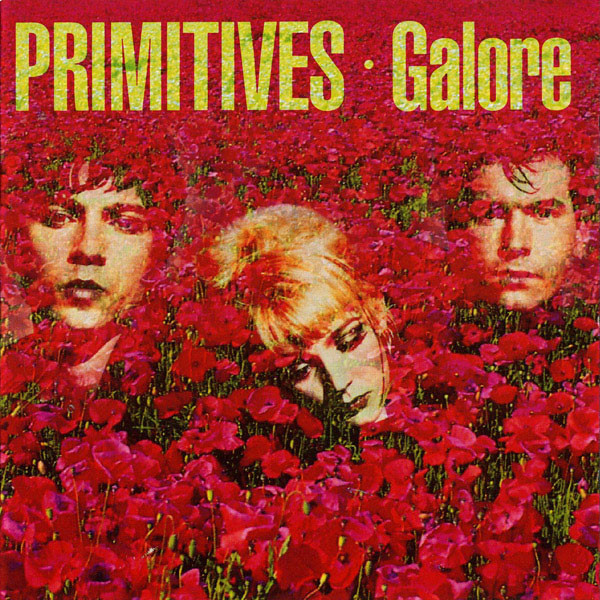
Galore is a bit of a mixed bag for early Primitives fans, but that’s not to say it’s not another very good album, because it most certainly is. The group started stretching their super-catchy jangle-pop style on Pure, and while keeping the basic indie-psych-guitar sound here, they move further away from the surf-style periodically, and embrace that darker “psychedelic” side of their nature more heavily.

There also seems to be signs of paying attention to record-company dictates to be more radio friendly by making the songs longer, and having less ambiguous lyrics on the few clearly-identifiable love songs. Partial producer Ian Broudie from The Lightning Seeds co-wrote one of the best songs, “You Are The Way,” but the album suffers from “producer soup” a bit. Broudie, Ed Buller (best known for his later work with Suede and Pulp) and bassist Paul Sampson all get producer credits, along with the band in full.

Although we’ve only mentioned the not-dissimilar band The Darling Buds previously in passing, it’s worth noting that both bands progressed in similar ways across the course of their first three albums. and likewise both broke up (see below) due to a lack of record company success within a year of each other.

(They even reformed within a year of each other! You have to wonder if they ever called each other up and yelled “STOP FOLLOWING US!” down the line.)

THE MUSIC

Galore kicks off with a really strong quartet of songs: radio-friendly love songs sung by Tracy, “You are the Way” and “Lead Me Astray,” followed by more psychedelic “Earth Thing,” sung mainly by Paul (with very New Age/Zen lyrics), returning to what passes for their “typical” style with “Give This World to You.”

The guitar licks are still very satisfyingly tasty, but not so “jangly” as on the first album especially, though you get a taste of that on “Lead Me Astray.” That said, “Earth Thing” is as “heavy” as this band gets, and it’s also got a great fast tempo that makes it great driving music, and nice little bass “solo” three-quarters of the way through.

The band’s knack for writing catchy hooks has never deserted them, and part of the marvel of the group is that they keep coming up with worthwhile variations on their basic 60s/70s-influenced power pop groove.

For the fifth track, the guitars move back behind the bass to give some sonic variety to “Slip Away.” Although their songs have gotten progressively more about attraction and love as a theme, I’m not sure you can really call their stuff “love songs” in a lyrical sense so much as “hazy summer fun + flirting word pictures.”

“Cold Enough to Kill” again mixes things up, trading the driving tempo with a slightly slower, more layered and moody vibe, with a darker yet still airy tone.

And then comes “Hello Jesus.” It starts off with wind sound effects, and a few slow chords before launching the nearest thing yet to a ballad. Is it a religious song? If not, what is it about exactly?

You got me (shrug). Here’s a sample lyric:
You’re just about to fall
You know that you can’t fly
You better make that call
Hello Jesus
… and then it ends as mysteriously as it started. Certainly the oddest thing the band have yet produced.

This quieter, more thoughtful, slower-but-not-balladey groove continues with “Empathise.” Still pretty, still of a certain “evening” mood compared to their sunny mainstays, still exploring alternatives to just doing power pop.

A fan-made music video made using clips from the not-online “Earth Thing” video.

And then just as suddenly, we’re back on the beach, twisting the night away to the uptempo yet still nebulous “See Thru the Dark.” This is followed by a great echoey guitar riff and drum/bass combo that unfolds into “Kiss Mine,” which is another “positive attitude” song, as I suspect a lot of Primitives songs have been, but the real meaning of their lyrics is rarely crystal clear or obvious, with the words just blending into the music.

Boy I sure do hate it when incompetent YouTubers put the wrong cover art on their uploads, don’t you?

Another great riff kicks off the Paul-led semi-ballad “Smile,” which is more unabashedly romantic song that still manages to work in some dark notes into its romantic lyrics.

“The Little Black Egg” is a cover, and the final song of the original album, and I’ve finally given up trying to figure out what the hell this song is about. Here, you give it a try:

Here comes Nancy, here comes Lee
I’ve got what they want to see
I won’t let them stretch their necks
To see my little black egg
With the little white specks

Answers on a postcard, please. I would venture to say the band just found it as weird and folky as I do, and included for “the lolz.”

THE BONUS TRACKS

The version of Galore in this Bloom! box set has all of the bonus tracks found on the deluxe 2CD reissue of Galore from the 2015 UK reissue. That said, they’re not all on this particular disc — the live tracks finally turn up on Disc 5, the “odds and sods” cleanup disc.

The bonus tracks here kick off with “In My Dreams,” which reminds me of the Primitives of earlier albums, i.e. it’s a gorgeous number, and a bit more directly lusty than most of their other songs. Likewise, “Sunpulse” is another signature Primitives track, evoking summer and joy as so many of their songs do — and on this one, the bass gets to shine for a change.

“Flow” appears to mimic the end of “Sunpulse” at first, but very quickly you realise it’s just a portion of “Sunpulse” backwards – another odd choice, but hey we have to cover everything from the band during this period, so here it is.

We then come to an acoustic version of “Stop Killing Me” that you can perfectly picture being sung round an evening campfire on a beach somewhere. The background “bop-bop-de-bop”s are nicely underplayed until the end of the track.

Next up is “You Are The Way (September Mix),” which lays down a solid but unexpected bass-and-drum-heavy music bed that underplays the guitars so that Tracy’s vocals are even more center stage. This, like many of this band’s songs, can’t be performed or re-arranged badly.

We move on to the second of the three versions of “You Are The Way” here, this time the “Re-Ravishing Mix.” It’s a great way to sample how the band re-envisions their songs, with this version going for a longer and hypnotic percussion-led intro and a true “remix,” rearranging the vocal intro and minimizing any guitar presence (!)until a couple of minutes into this six-and-a-half (!!) minute version, and remaining a minimal presence throughout.

It’s an interesting experiment in getting as far away from the band’s “natural” sound as possible, but I doubt many people who aren’t DJs will listen to the track more than once. This is followed by yet another remix version called the “God’s Own Garage Band Mix — Alternate Version,” which is only minimally distinguishable from the “Re-Ravishing Mix.” This one is only a 4’18” mix though.

My favourite version of “You Are The Way,” though, remains the album cut – with the “September Mix” a very close second. The reason we have all these versions is clear: the song was the single, but either the band or the record companies let some others have their way with remixing it for 12-inch b-sides.

Happily, the guitars return with a vengeance (and Paul on vocal) with “Under My Spell.” This one is notable for only have a very minimal trace of Tracy on it.

The bonus tracks wrap up with “Haunted,” which could easily have been an album track. It’s a more polished number than “Under My Spell,” which barely rises above demo status.

THE POST-MORTEM

Galore continues the band’s exploration beyond just jangly guitar pop, since they perfected that form right out of the starting gate with their first major-label album. They continue to struggle with the notion of writing a bad song (a “problem” very few bands can claim to have), but they get close to the idea on this album, without ever actually achieving that “goal.”

The band, down to a threesome for this album, again failed to chart with Galore and decided to call it a day, even as they remained college-radio darlings. Fortunately for us all, this wasn’t where the story ended, but its the final album of the period covered by Bloom!.

Next time: BBC Sessions, and a live gig!

1979 — Revolt Into Style (Disc 3)

(2022, Cherry Red)

THE OVERVIEW

The final disc in this three-CD set feels a lot like someone spent a lot of time on the first two, then realised “oh crap, there’s a mountain of stuff I haven’t even gotten to yet!” and tried to cram as much of it in at the last minute — which reminds me of me and my suitcase packing. There is a marathon 27 tracks here (literally hitting the 80-minute CD limit), and as with the other two discs, the “hits” are in the minority and the also-rans are in the majority.

Much of the fun of this set is discovering some lost gold, but also this whole set paints a picture of both the fall (but lasting influence) of punk and the rise of post-punk, which dominated ’79 until fashion (and better/more affordable synthesizers) entered the picture, whereupon it evolved again into New Wave. Some acts were more forward-looking (XTC, Human League, The Monochrome Set, The Vapors, The Wall), some weren’t (Swell Maps, Disco Zombies, The Regents, Notsensibles) but most were just taking advantage of the spirit of the times to either play at being a rock star (The Zipps, The Monks, The Freshies), or seriously explore their own creative path (The Mekons, PiL, Scritti Politti).

What I like about these sorts of “specific year, period, or genre” comps, at least the way Cherry Red does them, is that they make you a true Whitman’s Sampler of the subject, rather than focusing on the most memorable hits like most labels would — thus grossly misusing the term “Best of.” Instead, we get a marbled slice of the whole cake — nothing truly terrible, but the gamut of acts that got to the record-cutting stage who ended up being run-of-the-mill at worst, and gloriously daring and original at best.

One thing I noticed about the third CD was that the famous/infamous “two minutes-ish” standard was really starting to slip – most of the songs here are over two minutes, many are over three minutes, and a handful sail right past a scandalous four minutes!

At a total of 76 tracks, “Revolt Into Style” is probably best suited as the soundtrack for a 1979-themed party, with prizes for those who can name the more obscure tracks, but … as a snapshot of a moment in music, it is far better and more representative of a time where the “next big thing” wasn’t yet clear, and popular music was open to more possibilities than had been there for a while.

THE MUSIC

Disc 3 starts off with a strong set of four songs — one from the quixotic XTC, who managed to become a minor but mainstream success with a number of charting hits; two from bands that are beloved by their fans (which include me), but all but unknown to everyone else (The Revillos aka Rezillos and The Monochrome Set); and a oddly attracting but utterly obscure song about driving habits (!) from a band that sank without a trace (Passage).

★“Making Plans for Nigel” is one of Colin Moulding’s unlikely hits, which must have confused the heck out of main songwriter Andy Partridge (who had to wait quite some time for one of his to climb the charts. It is, as is a theme throughout the entire boxset, not a love song — and showcased their angular soundscape and unconventional vocals, yet still managed to become their first Top Twenty single and bring more attention to the band. Happily, they kept following up with strong choices for single and album material for quite a while.

★“Where’s the Boy for Me?” is a brilliant mod-ish parody of teenbeat songs (like those of Lesley Gore, whom I adore) and those boy-crazy beach movies. It features the best damn fake Farisa sound around, plus the requisite twangy guitar solo, great garbage-can-lid drums, and starts frantic and builds up to a sudden hard stop. Not the first band to create a warped image of the 1950s, but one of the best.

★“The Monochrome Set” by The Monochrome Set is, surprisingly, not the only self-named single on this disc (!), but in this case it’s a manifesto of wit and whimsy from the point of view of the bored, cynical offspring of the rich — one of those things Noel Coward might have tossed off if he’d been a pop star. The single version included here was reworked a bit for the album version (found on Strange Boutique), but its the blueprint for Bid’s entire ouevre of smart, humourous songwriting.

★Passage were the first band on the disc that were utterly new to me, and the song “Taking My Time” is … odd … in its subject matter, but it has lodged itself firmly in my head for some reason. I mean, who writes a song about bad driving? It really makes me curious to explore whatever other music they put out. Perhaps the fact that it was produced by David Cunningham of the Flying Lizards gives it a touch of commerciality (with surprise cello at the end), coupled with a simplistic chorus and odd subject.

THE BEST OF THE REST …

★Other winners on this disc for me included “Empire State Human,” which is technically the very first Human League single (the one before, “I Don’t Depend On You,” was done under the name The Men). Of course Human League were one of the bands that took their very forward-looking sound and made commercial hay with it, but this one stands out even on this disc the way Gary Numan did on Disc 1. It’s a story-song, which I always like, plus its really funny.

It didn’t actually do well on initial release, what with being a song about a man who is deteremined to become the tallest person in the world (and succeeds), but was re-released later and became a hit. The segue out of the song features the lyrics “fetch more water, fetch more sand/biggest person in the land,” which somehow works with the whole bizarre thing. I love it.

★“Kiss the Mirror” by The Wall is an early dark-rock song that predates the big obsession with that genre as we suffer through the Thatcher reign of austerity in the UK, followed by the election of war-happy Ronnie Ray-Gun in the US. While this particular track suffers from some poor production or mastering, it can’t hide the band’s talent — and made me go look up some more of their scattered discography, all of which I sampled was in much the same solid vein.

Their first single, “New Way,” was another John Peel favourite (as you may have gathered, his opinion was very important to the compilers of this set, as it was to most young people in the UK at the time). “New Way” borrowed a chorus from the Sex Pistols, but they’re forgiven because the song was produced by former Pistols Paul Cook and Steve Jones. Beset by personnel changes, the band split up in 1982, but have had at least one reunion (in 2007), and their two studio albums have been augmented by a live album in 2009 and a compilation of the Ian Lowry material that came out in 2021.

★Public Image Ltd’s lesser-heard single “Memories” is an other example of a band that doesn’t sound like everyone else (often a problem for the also-ran bands, on this disc in particular). Long-forgotten but brought to my attention in this track is the repeated use of the phrase “I could be wrong” — which he used again to even greater affect on the band’s biggest hit, “Rise.” Feeling nostalgic after hearing this, I went to look up their latest album (End of World) and sampled the song “Car Chase” — yep, still Johnny, still unique, still great.

The very next track on the disc is the compilers sneaking in a musical joke. “Johnny B. Rotten” by The Monks, who have no aspirations of imitating either the Sex Pistols or the former Mr. Rotten; it’s just a fun pop song taking the piss — or maybe it’s meant as the flip side of “Johnny B. Goode.”

★Then we come to a breath of fresh air with The Vapors’ first single, “Prisoners.” In many ways, it’s the same old “three chords and a cloud of dust” approach so many of the other bands use, but smart backup vocals and the stylish interplay between David Fenton and Ed Bazelgette really shows off their talent. It can’t have hurt that Fenton borrowed a musical phrase from Bruce Springsteen’s 1975 hit “Born to Run,” but I love how he used it here.

Finally, we get to a ska song (sort of), and it’s Madness’ “Bed and Breakfast Man,” a very mainstream hit from the Nutty Boys, again in the tradition of a Kinks-ian story-song but with that ska influence. This was the one that proved the band wouldn’t be a one-hit wonder, and that they could grow and embrace other styles as well.

★There’s also a single by the emerging Dexy’s Midnight Runners called “Dance Stance” (originally called “Burn It Down” when they were still a punk band, and that titled returned for the album version). Singer Kevin Rowland and guitarist Al Archer had soured on punk, rethought their goals, and came up with Dexy’s style of northern soul.

This was the first indicator of their new direction, and it’s thus rougher than what they would become, but it still captures that rebellious spirit the fuelled punk, addresses an anti-Irish sentiment that was prevalent during “The Troubles,” and takes it in a different direction (including a litany of Irish literature legends name-checked in the song). Thankfully we get the demo version here, rather than the official single (which stripped out the remaining punk element and just wasn’t as good).

★Another keeper was The Lurkers with “New Guitar in Town,” which does a lovely job with what would later be called “jangle pop.” It closely follows the style of drum-and-guitar driven fast pop that dominates the sound of ’79, but good vocals and agile play make it work.

★The last of the highlights for me was the inclusion of the perennial post-punk novelty number, “Where’s Captain Kirk?” by Spizzenergi. You gotta love a man (Kenneth Spiers) who has made an entire career (still going!) out of a single song (okay, that’s not quite true … have you heard his cover of “The Model” by Kraftwerk?), and ever-changing band names on the theme of “Spizz.” Fast, fun, whacky, excellent guitars and gratuitous vocal effects (plus a human farisa organ!) … what’s not to love?

… AND THE REST OF THE REST

Another wrinkle that occasionally gets into the music here (and throughout the collection) is the introduction of sax and occasionally other horns to add some soul and punch to the guitar-heavy sound. In the earlier discs, bands would often lead with the bass and drums, but by Disc 3 bass has been mostly pushed into the background in favour of more guitar. We’re also sloooowwwwlllyyy getting back to love songs, which isn’t a bad thing — but we were enjoying the break and the variety of other subjects that dominate this compilation.

As we’ve noted across these discs, there was (and still is) a tradition of the occasional single (that sometimes does rather well) of a bunch of lads on a musical lark (see also “Zip Nolan” by the Cult Figures on Disc 2). These days its mostly the realm of novelty Xmas singles or forcing the tournament football team to make a loutish charity record, but a … let’s call it “project” … called Swell Maps managed to make a career out of it for a while.

The example given here, “Real Shocks,” will remind listeners of the Cult Figures, but to be fair one can detect more musicianship than is immediately evident in this basement-studio type sound of young men having a good time, semi-melodically. Having sampled them a bit more (going back to 1972!), I acknowledge that they didn’t always sound like this — in their early days they were more acolytes of Can and Faust — but I doubt any of their output will ever make it into my collection except by means of a compilation like this.

That said, it is similarly paired well with the next track, “Friends” by The Zipps, who really were a group of students from Belfast who recorded exactly two songs and then went back to school and the rest of their lives. Even though there was only this one single from them, it actually ended up as a pretty good effort — but lead singer Mel Power just wasn’t lead-singer material (though I think it could be a hit if some more-talented group covered it).

Next up is “Disco Zombies” by the Disco Zombies. Now, I’m kind of a sucker for bands that write songs about themselves (see also “The Monochrome Set” and “Hey Hey We’re the Monkees”), but this one is a bit on the meh side, relying like many of the songs here on a limited set of guitar chords. As with The Zipps’s effort, the song isn’t actually bad, just poorly produced — and without the spark of much talent.

“Number 12” by The Pack is, as you’d expect from a Rough Trade release at this point in its history, pretty “yelly” and punky. It’s actually the b-side from the “King of Kings” single, but ultimately The Pack went nowhere. The lead vocalist Kirk Brandon and Simon and Jon Werner (guitar and bass, respectively) got together years later as Theatre of Hate, which was a more successful effort.

The Mekons, who are still active (but slowing down) to this day, are represented by “Work All Week,” a pre-album single not included on the album until a 1990 reissue. Given that they came from the same group of students that formed Gang of Four and Delta 5, and that the band used Gang of Four’s instruments to record it, as you can imagine it sounds a lot like them.

The musical style is still gelling on this one, but the lyrics make a good comment on the price of love under capitalism. This really should have been paired with “You Got to Pay” by The Only Ones from Disc 1.

Following this we have a deliberate attempt to be “commercial” by punk band 999 after various singles and a couple of albums failed to interest the public — they did better later — and this didn’t move the needle for the band. It’s pretty meh, to be honest, but astonishingly they are still together, playing and releasing albums as recently as 2020.

The Outcasts were an interesting story: a decent band, you might like them if you only listen to the music, but apparently the members were all hooligans who constantly got in fights and other such shenanigans. The song included here is called “Self Conscious Over You,” and it’s not bad at all, and it’s one of the few songs about love on this disc. It’s a pity they self-sabotaged themselves out of a potential career.

“Children of the World” by The Freshies changed up the mood as a middle-of-the-road pop band with a nice sound but un-followable lyrics. Chris Sievy had (and still has) a propensity for silly titles, and indeed in 1981 he had a hit with this band with a cute song called “I’m in Love with the Girl on the Virgin Manchester Megastore Checkout Desk,” which a glorious title for a single. These days, he’s better known as Frank Sidebottom, another odd but enjoyable cult thing.

Secret Affair, a “mod” revival band with punkish leanings, are also still around — having taken a long break after the third album — and this song, “Glory Boys” was indicative of the direction they would take for the rest of their recording career.

“7 Teen” by The Regents shows up on a lot of post-punk compilations, and is the only song on this disc explicitly about sex. Cleverly put together with a female backup crew that gave them a strong faux-50s vocal sound, the single version used here includes the lyric “a permanent reaction” rather than the original “a permanent erection.” It hit #11, but The Regents never had a successful follow-up.

The Boys (formerly the Choirboys) are up next with “Kamikaze” — a hard-rocker story-song that has a low opinion of Japanese-made motorbikes. It would be seen today as a bit racist, but I can testify that this was “a thing” back in those days, with Harley fans spitting on Honda and Kawasaki bikes for being small and fuel efficient.

“Easy Way Out” by the Carpettes is an enjoyable but kind of a fatalistic punk number. They eventually went full-on New Wave (with Mod influence) later on in their career and for me were more interesting in that period.

This brings us to an early Scritti Politti single “Messthetics,” of which the clever title is the best thing about it, apart from Green Gartside’s fine (and slightly lower register) vocal. The song itself is a bit of a mish-mash, but you know — refer back to the title!

This brings us to the very last track and that feeling you get where you’ve completed a very long, somewhat grueling yet pleasant journey. The Notsensibles (who might well be Swell Maps collaborating with Cult Figures, they’re that similar) bring us “I’m in Love with Margaret Thatcher.” Have I mentioned the influence she had on most of this music? That said, I suppose we do have to “thank” her for a lot of the protest content that came out in these years.

She was a very hated woman in many quarters, and remains so to this day — as is only right and proper. Sadly, the Tories learned nothing from this, then or now. Even worse than that, it’s no longer too fashionable to craft protest songs about bad government policies on either side of the Atlantic, and that’s a damn shame. As Johnnie B. Rotten himself once said, “Anger is an energy.”

THE WRAP UP

Even though this set covers a tremendous pivoting year in music, it’s frankly not for everyone — or even most people. They’ll want “the hits” or at least more familiar songs from 1979 from bands they recognise, and that’s fine … but it’s not this box set’s purpose.

As I mentioned previously, it’s more like a candy box — there’s (almost) nothing here that isn’t sweet and nice, but if you’ve ever gotten a box that has no “map” of what’s inside the chocolates … there’s a few you’re sure you will like, but the others are a little bit of a gamble.

Thanks to the thoughtful curation, a wide gamut of power-pop tastes are catered to, and for those who like a bit of adventure and are open-minded, this is a fun journey. It’s augmented nicely by some brief but informative notes about each release that occasionally shine a new light on the music you’re hearing.

1978 through the early 80s was a period where record companies really had no idea what was going to “hit” with the public, and with the birth of the indie label, almost anyone with a interesting sound or look had a shot. Those days seem long gone now, and music is likely to be done by “AI” in the near future with minimal human involvement (or emotion), so enjoy some passionately hand-crafted <s>pottery</s> music that may or may not be very good, or is good but not to your taste, or is familiar and fun, or is utterly fantastic and right up my alley and why have I never heard this before?

If you’re up for a little musical spelunking, you’ll hit the highs and (relatively soft) lows with this set, and maybe open up your tastes a little bit more. Can’t ask for much better than that.

1979 – Revolt Into Style (Disc 2)

OVERVIEW

Moving on to disc 2, we find a higher ratio of commercially-successful singles, but still a fair selection of “who?” bands and also-rans. For me, at least, the ratio of obscure bands dropped considerably, and the number of tracks that actually charted went up.

Sadly, this disc also features a couple of tracks I’m not inclined to listen to again. I didn’t hate anything here — the tunefulness of this collection, along with the humour evident in even some of the “bad” songs is one of the hallmarks of 1979 (the year we could make fun of punk, apparently), but we’ll come back to some of those later.

That said, it also has a higher ratio of “add to playlist” songs (11 out of 24 tracks) and a bit more variety. The brash, angry influence of punk is starting to fade, but thankfully not the sense of urgency: most of these songs hover around three minutes, with some closer to two minutes (and one that’s even less than that!).

THE MUSIC

The disc kicks off with “Up the Junction,” a really clever composition by Squeeze from their second album that pulls off an entire UK kitchen-sink drama told within a song of love won and lost without using any repeated lyrics or offering a chorus. As I listened beyond this story-song, I kept coming back to it to check that it really did sound as muddy from a production standpoint as I initially thought it did, and indeed its true; very muffled drums and bass, and the vocal was a bit understated but at least properly recorded.

After a few re-listens to be sure, I decided to check my copy of the album — only to find that the entire Cool for Cats sounds pretty bad, even by then-contemporary standards. Producer John Wood (and the band), for shame!

Just for the record (heh), Squeeze’s first album (titled U.K. Squeeze outside the UK) did not have this problem, even though the band itself produced two of the tracks, with John Cale producing the rest of the album. Although the band didn’t like working with Cale too much (he wanted “tougher” songs than they had been doing), I think the debut album holds up pretty well, and the two tracks the band produced themselves slot nicely into their general ouevre.

The very next track on Disc 2 is also by a band that went on to bigger and better, so let’s take a look at all the best-known tracks here first. “Groovy Times” by The Clash was an interestingly off-beat choice for this comp, as it comes from an EP released after the second of their influential “punk” albums.

It’s an alarmingly relaxed and amiable single, with Joe trying to croon as best he can, but the lyrics are a bit snarky still. Hard to believe this is on the same EP as their blistering cover of “I Fought the Law,” which for me is the definitive version of that song.

Track 3 is a rougher single than you might expect from The Records, who hit it big right out of the gate with their first single, “Starry Eyes.” Good to hear them doing something a bit harder, but this track reminded me that I haven’t listened to the band’s non-singles output in years, and that I should rectify that. “Girls That Don’t Exist” is a song that grows on you, though it is less than their best.

Other notable tracks I enjoyed on the disc from the “name brand” bands include Skids’ “Masquerade” (very anthemic, but I’m still not quite sure what it’s about); Gang of Four’s “At Home He’s a Tourist” because it’s still brilliant; “Disorder” by Joy Division (for being the most New Order-ish of the JD songs); the Jags’ best-known song “Back of My Hand” because it’s a damn-near-perfect pop single; “Kid” by The Pretenders because “first and best” lineup doing a different sort of ballad; and The Jam’s energetic “When You’re Young” for its less-chosen single status and teen-life subject. There’s also the Echo & the Bunnymen version of “Read It in Books” as an alternative to Julian Cope’s version — long story short, McCullogh and Cope (and Pete Wylie) were once in a band together, and they wrote this back then.

Having just mentioned Julian Cope, I should add that the “original” (aka demo) version of “Bouncing Babies” is here, and like the Squeeze song the sound quality pretty bad compared to the tracks around it — Cope (whose vocal is nicely clear) is pushed back in the mix like he’s singing from inside a wardrobe. The drum sound is akin to someone beating on carpet rolls with an exhaust pipe, and the bass isn’t much better — and yet you still can’t hide what a good song it is.

The Undertones may be a band you’ve not heard before, but I’ve been a fan from the debut of their first album from the moment it was available as an import. It showed some fresh-faced Irish lads on the cover, it was a Sire record, and their logo had an arrow pointing forward in it. I was sold, and even more delighted to hear its light, happy pop-punk sound (remembering that “The Troubles” were still going on when this came out), complete with the most Irish vocalist you could hope to hear this side of the Rovers in Feargal Sharkey (also a very Irish name, to be sure!).

“Here Comes the Summer” isn’t their best song, but it’s very representative of that early-era sound they had, and is just naturally infectious. Happy, cheerful Irish people? Don’t breathe a word of this to James Joyce!

The first real clanger you come across is track five, by Clive Langer (and the Boxes). “The Whole World” features some nice guitar work by Clive, but is otherwise pretty undercooked and unmemorable, and we’re back to “working class” accents with not much to say. Thankfully he became a producer (along with Alan Winstanley), and was responsible for a lot of great stuff from other artists.

As for the other “lesser” tunes on this disc, “Burning Bridges” by The Cravats wasn’t a bad song per se, but it had a really bad vocalist. Spat-out and snarled spoken lyrics work well in punk songs, but less so in hooky, sax-driven, upbeat frantic rock. It’s short (2’27”), which musically is a shame … but vocally, it’s a relief.

Speaking of bad singers, “Citinite” by Fashion is represented here, featuring short-lived original vocalist Al James. The rest of the band are pretty good, but oh my gosh he’s terrible. I’m so glad they dropped him, and the promise you can hear musically on this song is more fulfilled by the time we get around to their best-known album, Fabrique.

Rounding out the “crap singer” trilogy, we have the Teenbeats with “I Can’t Control Myself,” that pairs a really catchy riff with a singer who only occasionally delivers a smooth vocal — the rest is pretty rough, and sounds put-on, like someone told them to sound “edgier.”

“Alternative Suicide” by The Numbers isn’t actually bad, but it just doesn’t gel. It’s a dark rocker with an amusing viewpoint, but if I’m being kind I’ll say that it’s ahead of its time with its Mopey Goth Kid style.

It does pair well with Adam and the Ants’ “Whip in My Valise,” though … a slow-burn ode to the “pleasures” of BDSM with very arch, darkly campy vocals from Mr Goddard. It’s really more notable for featuring the original Ants — guitarist Andy Warren went on to the Monochrome Set (where he resides to this day), and the bassist and drummer were stolen away by Malcolm McLaren to form Bow Wow Wow.

A special mention of badness has to be given to The Stranglers, and it’s astonishing to think that their song “(Don’t Bring) Harry” was ever considered a single, when in fact it may well be the worst thing they ever recorded (and certainly the worst song on this disc). As a big fan of the original lineup and early albums, the slow pace of the song doesn’t throw me off nearly as much as Hugh Cornwall’s attempt at a whispery “dreamy” vocal featuring a lot of low notes he doesn’t quite hit, in a song about heroin that has some fine musicianship but a vocal that sounds like Cornwall was on heroin when it was recorded.

The remaining songs on this disc range from “meh” to “good, but not quite there,” and there’s only a handful of them, thankfully. Ruts’ “Something That I Said” is a fully competent rock song that moves along well but repeats its title way too many times, covering up for a lack of lyrical meaning. Plenty of tasty guitar work for you to pump your fist to, though.

Likewise, “There Must Be Thousands” by The Quads was a nice find, a working-class club-friendly band pouring out the earnest rock with above average subject matter, with feeling. “Radio-Active” by The Cheetahs is a pretty pleasant slice of power-pop, but its anti-radiation theme (admittedly a significant topic of the times) wears a bit thin now, and this one is a forerunner of the many songs of the 80s that were also had that (less obvious) fretting about the potential for nuclear attack.

Cult Figures’ “Zip Nolan” is kind of funny if you’re drunk (as the band seems to have been); it comes across as an improvised theme song for a fictional action hero put together at the pub that’s barely coherent and sounds like frat boys having a laugh at karaoke.

Another dumb/funny song is the final track on the disc, “I Want My Woody Back,” by The Barracudas. It starts off as a lament, but like it’s a double-entendre for … something … so the band feel the need to explain in the song that a “Woody” is a wood-paneled car you take your surfboards and girlfriends to the beach in for a day doing beach stuff. Unlike “Zip Nolan,” though, this one is well performed and might make a cute girl blush, and thus it brings the disc to a gentler, lighter-hearted end.

One of Us

Guest post by Jim Kerr

I first met Sinéad O’Connor in the late 80’s, not so long after she had become a mother.

Living in London at the time and she had become friendly with friends of ours, resultantly they all visited together when we were having a kids party one sunny afternoon.

Already an admirer by then, like the rest of the world I had fallen for the brilliance of her debut records. Aside from the music I was also aware of some of the publicity she had generated.

The thing I now recall mostly on meeting her that day, was the beauty of her soft spoken accent and the effect when she broke into what I can only describe as her 1,000 watt smile.
Much later, Charlie Burchill and I were fortunate enough to witness that same smile many times over within the walls of our dressing room, when Simple Minds toured with Sinéad.

Nervous before each show, then utterly relaxed in our company afterwards, the experience of that tour rewarded us with the opportunity to witness up close the magnitude of Sinéad’s exceptional talent, it was beyond colossal.
And as we do with all artists and musicians Simple Minds share a stage with, from then on we have always considered Sinéad as ‘one of us.’

It is for that reason, on the news of Sinéad’s passing, that we feel our hearts ache today.

Jim Kerr

COW 20-May-2013 – “Candy and Records”

This is a super-fantastic new episode (well, recorded on the 20th of May, 2013), and I was back in Orlando as part of a Fringe Show a friend of mine did — he later went on to win Best Comedy! If you’ve heard of “rap battles” or a battle of the bands or even the double-dutch dance-offs between those New York City girls, then this delightful DJ duel is going to be a special treat.

Sometimes when WPRK DJ Phantom Third Channel and I get together, we challenge each other — with music! As Frankie says, when two tribes go to war, the audience is the winner. This show has a tremendous diversity of sound pulled from across several decades of indie and college rock, but with a definite 80s atmosphere. Over the next two hours you’ll hear bands like Wire, XTC, They Might Be Giants, Bruce Wooley, Veronica Falls, Roxy Music, PIL, Galaxie 500, the Stone Roses and John Foxx — and more!

In between songs, we chatter and gush over all the great stuff we play for each other. One of our best sessions, but stay tuned … there’s more new episodes to come!

You can listen to the episode below, download it from the web site or subscribe to it in iTunes for free. Let us know how you like it at crustyoldwave@me.com, and enjoy!

[audio http://www.buzzsprout.com/6230/172646-cow-20-may-2013-candy-and-records.mp3]