Tetsuo, the Iron Man (1989)

Director: Shinya Tsukamoto
⭐️⭐️⭐️⭐️

If you’ve seen this film, there’s not a lot I can say apart from some small bits of trivia that you might not already know. If you haven’t seen it, this is the first and perhaps the greatest Japanese cyberpunk/body horror/indie metal/sex comedy film of all time. I haven’t seen either of the two sequels, but that’s the only reason I say “perhaps.”

Perfectly timed with a youth-cultural rising tide of nihilism, low-budget renegade filmmaking, steampunk fashion, and the emergence of “industrial” music, Tetsuo combines it all into a movie that was very much of its moment. I first saw the film at and independent cinema in central Florida a few months after it premiered, and I was simply not prepared for the onslaught of sight and sound I witnessed.

It was in some ways traumatic, in other ways compelling — and it haunted me for a while with a mixture of revulsion and wonder at the time. I have finally dared to take a second look, and I squirmed in places — but could still could hardly bear to blink.
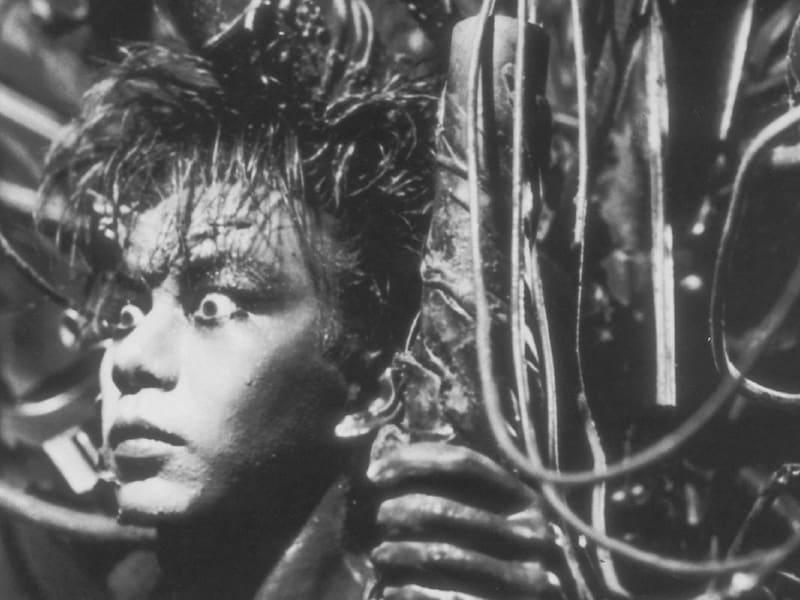
The film is in B&W, and doesn’t look quite as absurdly cheap as it is most of the time thanks to ludicrously frenetic stop-motion effects, brilliant editing, and mesmerizing performances, while still mostly giving its audiences only glimpses of what’s fully happening. The assault of hard music contributes to the urgency and raw emotions on display throughout.

The film went on to be an enormous influence on both musicians and indie directors, and makes those Godzilla movies look like pastoral landscape paintings for children by comparison.

The plot is weird yet simple: we start with meeting a young man (played by director Tsukamoto) who is cutting his thigh open so he can insert some metal into it. His surroundings are composed of lots of scrap metal, and this is a fetish of his apparently.

It goes very wrong, and maggots begin to feed on the wound. Driven mad with disgust, he runs out of his tiny room and into the night, and is soon run down by a “salaryman” (businessman) — played by Tomorowo Taguchi — and his girlfriend (Kei Fujiwara).

The pair investigate the corpse, are revolted, and dispose of the body. Not long after, the businessman notices that he is growing metal out of his body, and soon the girlfriend is transmuting as well.

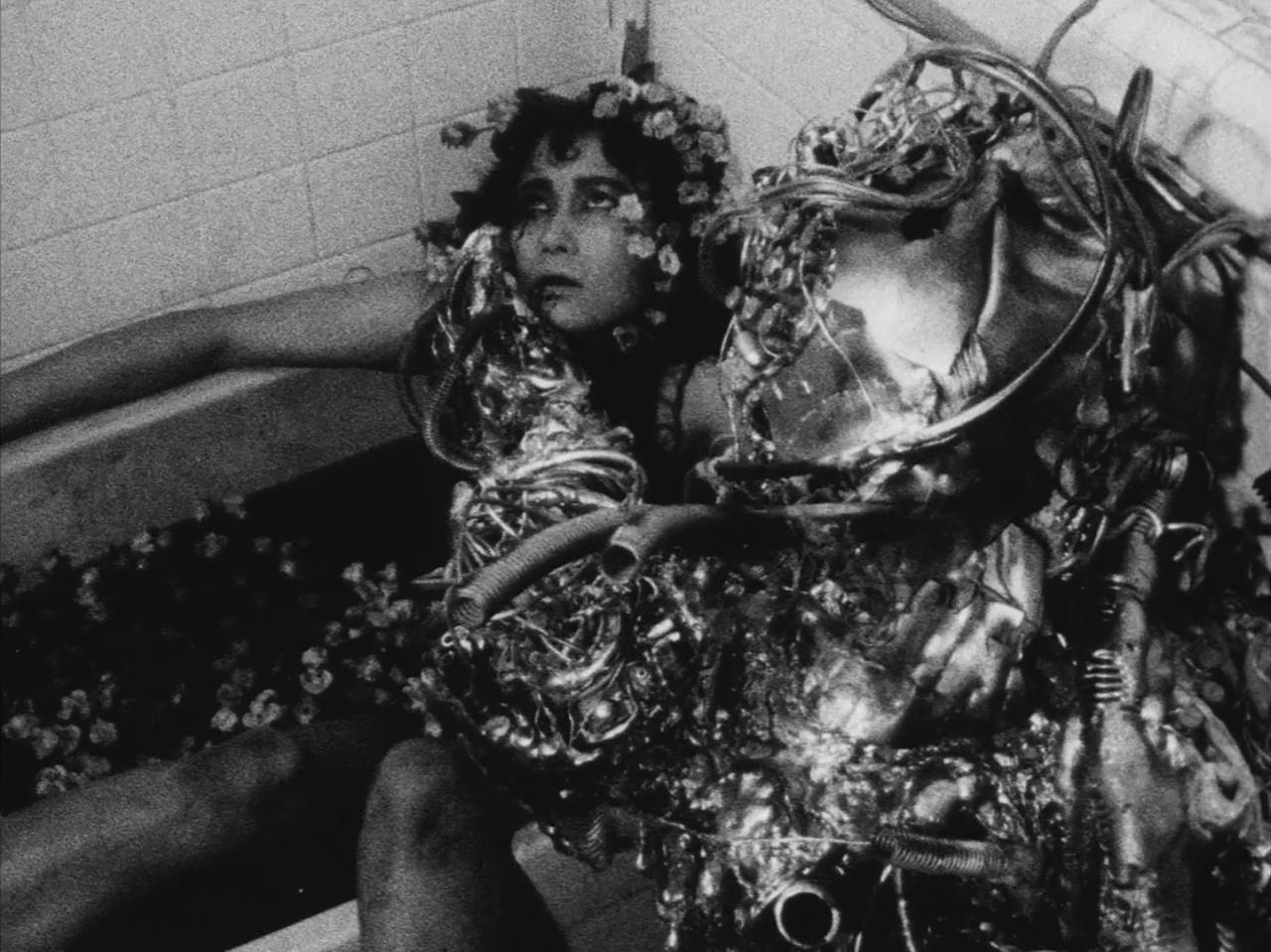
Slowly but surely the metal is taking over their bodies (mostly done using stop-motion animation), turning them both into metal-human hybrids. This takes a while, and is documented in beautiful detail in the grainy B&W cinema verité style, augmented with the hardened edges of industrial music.

Once it starts, it is a relentless onslaught, and the victims here are bewildered, terrified, and powerless to stop it.

To this point, the film is a hyperactive low-budget body horror escapade, but strangely compelling. We know where this story is going, but it is clever enough to make us want to see it through.

The salaryman’s transformation is much further along by the time the girlfriend turns up, equally starting to transform. They end up being compelled to have what I’ll just call “drillsex,” which at this point provides a much-needed moment of relative levity.

Others have described the film as something of a mash-up between Un Chien Andalou (1925), Videodrome (1983), and Eraserhead (1977) in Japan, and I have to nod and say “yes, but with all these films thrown in a blender while you’re watching them.” Tetsuo vibrates with energy and intensity, never relents from its breakneck pace, and cranks the music up to 11.

Since it’s release, we’ve all started down its path: rare is the moment now where you don’t see someone glued to their smartphone, to the point where we treat it as an extension of “ourselves.” The messages of the film regarding societal sexual repression, industrialized alienation, body dysmorphia, work-life imbalance, and are alternately sublimated and beaten over your head.

Being so hyperkinetic and, well, metal is likely to be overwhelming for any casual viewer, even though the film clocks in at a mere 67 minutes (and thank heavens its not any longer). By the end, you’re not sure if the salaryman and his girl likes what has ultimately become of them or not.
It reminds of a rollercoaster you’ve never been on before: terrifying, exhilarating, and you’re relieved you survived it — and then, knowing that you did, you want to go back and do it again.

Tsukamoto served as writer, director, producer, art director, lighting director cinematographer and editor of the film. A number of the other crew members who worked on the film quit in disgust or in dispute with what Tsukamoto was doing.

It is a visionary, hugely influential and eye-popping film in many ways, but I think most people whose idea of a horror movie is Friday the 13th would probably turn down a second opportunity to see it. That said, a little of that metal fetishism stays with you, in the sense that you can’t unsee it.

Godzilla Minus One (ゴジラ-1.0) (2023)

directed by Takashi Yamazaki
⭐️⭐️⭐️⭐️
52-week film challenge, film 47

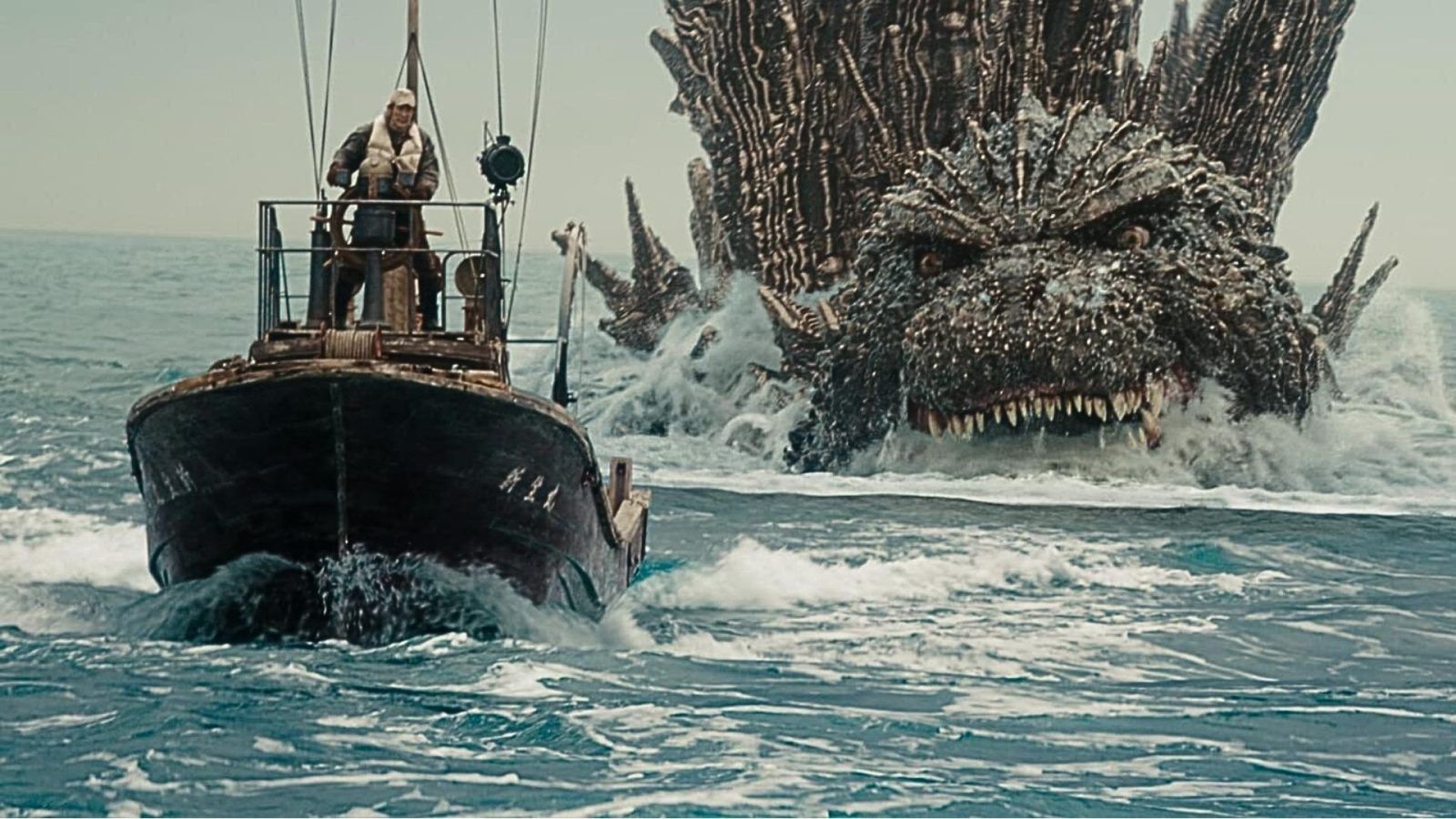
This remake of the first Godzilla film from 1954 (my review of that one is here) is a really clever reimagining that turns the perspective around: the focus here is on the human beings affected by the monster, rather than the monster itself. It makes brilliant sense in that the original really showed off the effects, but the new one looks at this phenomenon from a completely different angle.

I certainly did not expect a Godzilla movie to be this emotional, nor did I expect it to be entirely in Japanese with English subtitles in North American cinemas (nice touch). I find it fascinating that 37 films in — with multiple “reboots” from both Toho and Legendary Pictures — they found something new to say about kaiju generally, and yet also reiterate the original’s analogy to nuclear war.

Furthermore, I was completely gobsmacked when I discovered that the budget for this shot-in-the-arm epic was a mere $15 million — there are some films that exist where the catering bill for the shoot was around that amount!

I have, of course, seen quite a number of Godzilla movies over the years, though I largely haven’t seen the post-2000 comeback films. Growing up, Godzilla movies were fun and cheesy, and you (or at least I) never paid a moment’s attention to who was in those (model) ships, tanks, and buildings the monster trashed like the cheap paper maché they were. I also watched TV shows inspired by those movies, including “Ultraman,” a particular favourite.

Godzilla looks so “smol” in the 1954 original. Inflation, I guess, whatcha gonna do?

The genius of writer, director, and visual effects chief Takashi Yamazaki is in putting the emotions and the people up front in this version, with the title character itself getting a fair amount of screen time, but only very rarely being the focus. He even explains both why Godzilla keeps coming back, and why he’s so gigantic and “Hulk-like” compared to his first appearance.

That said, the vast majority of the time spent here is on the humans, specifically telling the story of Kōichi Shikishima (Ryunosuke Kamiki), a kamikaze pilot near the end of World War II — when the outcome was no longer in doubt — who chickens out, and feigns engine trouble and lands on Odo Island. That night, Godzilla emerges and attacks the base. Shikishima gets into the plane, but cannot muster up the courage to shoot at the dinosaur-sized monster.

He survives to find only one other survivor, Tachibana (Munetaka Aoki), who blames Shikishima for the deaths of the other men. A year later (1946), he returns home and learns that his parents were also killed by Allied bombers. He meets a woman named Noriko (Minami Hamabe) who is taking care of an orphaned baby named Akiko (Sae Nagatani) that she has rescued.

As he is suffering from survivor’s guilt, he takes care of Noriko and Akiko, forming a sort of family. Although all three clearly care for each other, it is not made explicitly clear if Shikishima and Noriko actually became romantic partners.

Meanwhile, Godzilla gains his gigantic size and atomic powers via the US military’s nuclear testing in Bikini Atoll. The enlarged and super-powered monster attacks the ships, and then heads towards Japan.

By mid-1947, Shikishima has had some success in a dangerous but well-paying job, aboard a ship clearing mines left by the US around Japan. Authorities, which have been tracking Godzilla’s slow approach to Japan, order the minesweeper try and delay Godzilla’s approach so that more powerful ships can get there.

Cleverly, the shipmates use a mine and manage to release one that explodes in Godzilla’s mouth — which does some actual damage — but the creature can seemingly regenerate from injuries. A heavy cruiser arrives just in time, but is destroyed when Godzilla shows off its new power of atomic breath.

Of course, Shikishima is re-traumatized by the return of Godzilla, now enomous and unstoppable. Godzilla eventually reaches Japan, and attacks the city of Ginza. After tanks engage Godzilla, it again employs its atomic breath, destroying the city and seemingly killing Noriko after she saves Shikishima. He is yet again re-traumatized by this loss.

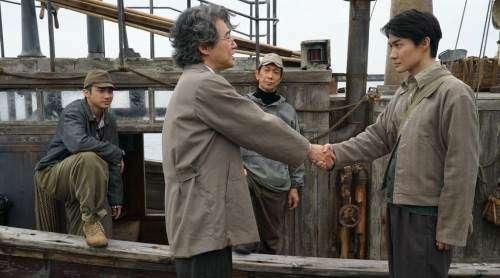
Since neither the US nor Russia will help because of tensions between the two, the Japanese government essentially gives up and does nothing. One of the minesweeper’s crew, Kenji Noda (Hidetaka Yoshioka), assembles a team and comes up with a plan to destroy Godzilla, using a small group of former Navy veterans — including Shikishima — and some disused Navy carriers to carry out the plan.

Unbeknowst to the others, Shikishima has finally been pushed too far, and plots his own revenge on Godzilla, that will presumably cost him his life. He makes arrangements for the care of Akiko with neighbour Sumiko (Sakura Ando), and pretends to cooperate with Nodi’s plan.

And like a good neighbour, Sumiko is there …

That sets up Act 3, and I don’t want to go into the plot any further because the movie is still playing in cinemas as I write this, except to say that some good twists ensue as the group bravely takes on Godzilla and Shikishima seeks revenge and redemption.

I, at least, was surprised by the finale as well as the final scene. I was also utterly delighted by some surprise callbacks to the original film.

Noriko sees Godzilla for the first time, shortly before she is swept away.

I was downright shocked by how engaged I was with the emphasis on the people affected by these events, and how right this alternative approach felt, viewing it from my cinema seat in a world where Godzilla is a stuffed toy with a very long history (and, as mentioned, an ongoing successful franchise for Toho).

70 years on from the original film, the monster itself can still elicit nostalgia and appreciation, but going back to its roots from a very fresh angle has given Godzilla Minus One something new: emotional connections with its audience beyond a general fandom. I’m not sure if this approach would work repeatedly, but it has certainly injected some fresh blood (sorry) into a franchise that had become cliché.