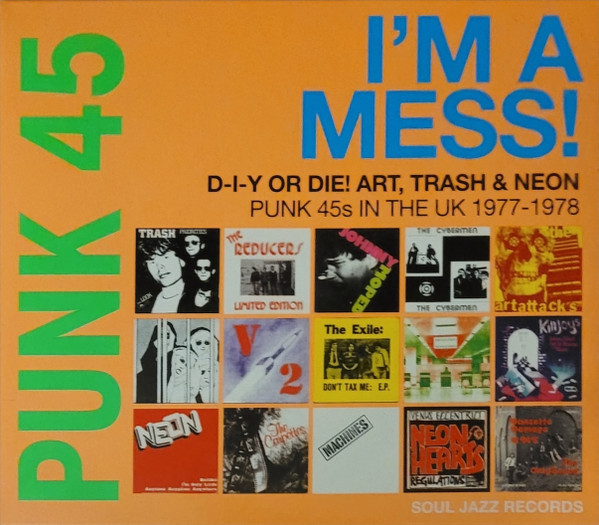
Punk 45: I’m a Mess! (Various Artists)

D-I-Y or Die! Art, Trash, & Neon
Punk 45s in the UK 1977-78
(2022, CD, Soul Jazz Records)
Recently, I have discovered that this compilation is in fact part of a series of punk compilations from Soul Jazz Records that started in 2013 under the “brand” name of “Punk 45,” with each release given a title borrowed from one of the songs on the disc, a subtitle describing the overall style, and a sub-subtitle covering the specific period.

The one we’re reviewing in this case, for example, is the most recent original compilation, though the label reissued the first disc in the Punk 45 series, “Kill the Hippies! Kill Yourself!” on vinyl only in 2024, which I view as symbolic of society’s general regression but is more honestly probably an attempt to lift the comp series out of obscurity.

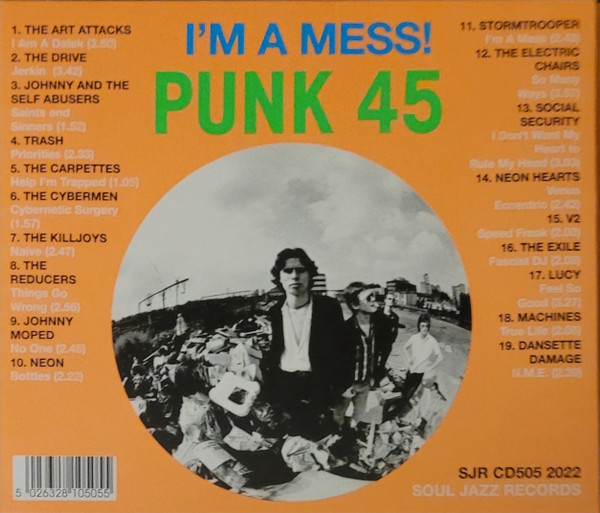
Before we dive in, a brief clarification: the track listing on the back of I’m a Mess! might have been the actual running order at one point in the production process, but it’s not the one we actually get — a truly DIY sort of error, you might say. The correct song order is reflected below.

Overall, this is a compilation of indie punk singles released in the UK in 1977 and 1978, a sampler rather than a comprehensive collection. Now that the background is out of the way, let’s dive in.

The Art Attacks – “I am a Dalek”
Well you know this title is going to grab my attention, given my lifetime love of the TV show “Doctor Who.” And indeed, what’s more punk than a Dalek? Their entire worldview is that everyone but themselves are unworthy and should either be subjugated or killed. It defines punk rock right from the start with three chords, a cloud of dust from furious playing, barely-tuneful singing and multi-tracked Dalek chanting.

The Drive – “Jerkin’”
Rock has a history of songs about masturbation, which is funny because people often join rock bands as much to get hooked up with groupies as they do to make music. This one is far more tuneful than “I am a Dalek” and has a more polished rock sound that betrays their pub rock background.

A lot of bar bands devolved into punk rockers when they observed which way the wind was blowing, and went right back to their usual styles a year or two later, let’s be honest

Jonny & The Self Abusers* – “Saints and Sinners”
Speaking of masturbation, this band is the forerunner of Simple Minds, a band you generally don’t think of when the work “punk” is in the conversation. But by damn, they do a nice job of putting the bass up front on their take on fast punk. The song matter is simple, but well sung and with a bit of harmony thrown in. Nice drop-dead ending also, the first on this album but a common exit for many punk songs.

(*this is how the band’s name is spelled on this compilation; I have seen the name spelled a bit differently elsewhere)

Trash – “Priorities”
Trash have a pretty good vocalist and (gasp!) backing vocals. Like Jonny and the Self Abusers — the bass is the anchor here, alongside the (talented) drummer. Punk is about very simple song structures and simple messages, and this embodies that principle.

The Carpettes – “Help, I’m Trapped”
Speaking of backing vocals, this one is so fast it’s almost punk rapping, with the chorus handled by the rest of the band (with a bit of echo) to give it a distinct sound. A good example of a song that doesn’t outstay the strength of its concept, like a few others here.

Stormtrooper – “I’m a Mess”
The title track of the compilation. The backdrop of chords gives us some under-melodies to add a bit of sophistication (just a bit) to the usual wall of guitar, drum, and vocals. This is an example of punk as being reflective of what was going on in Thatcher’s England.

The Electric Chairs – “So Many Ways”
Wait, what’s this?? GIRLS?? Well I never! And the guitar isn’t the lead instrument, rather a drum machine is? And is that … a sitar? What the blazes is going on? A hint of synth? Robotic “singing”? Did this band time-travel back four years from 1981?

Clearly this is where DIY ethic mentioned in the title comes in. One has to remember that sounding like robots was a fresh take on a punk vocal at the time. I do actually believe I can detect a hint of melody in here as well. Seven singles in, and punk is already evolving! I’m happy to see some female representation at this early stage.

Social Security – “I Don’t Want My Heart to Rule My Head”
Things are just going from bad (as in amateurish) to worse (not very punk, really) with this ahead-of-its-time New Wave-ish anti-love lament. Our narrator really, really wants you to know he’s not interested in a long-term relationship, so his idea here is that this must be anti-rock music, in that he’s not doing this pull groupies — or, apparently, get famous.

Neon Hearts – “Venus Eccentric”
Finally, frenetic sax makes its punk debut. The song consists of the singer complaining about what a bad relationship he’s in, but apparently the sex is great, so I have to give him points for broaching what would become a universal theme in rock music. Bonus points for a fast-paced but distinctive guitar solo.

The Cybermen – “Cybernetic Surgery”
Some punters with ambition and cultural references to Doctor Who (again) provide us what the punks always said they were like emotionally. There is some early vocoder use to make a sort of “cyber” vocal here and there. Musically quite catchy, with a sax break in the middle. As ruthlessly efficient as the monster they are named after.

The Killjoys – “Naive”
Now here’s a real punk song — the singer blaming other people and society in general for his ills. There’s some female vocals supporting the chorus of “I’m bitter” which sadly devolves into various moaning/screaming.

The Reducers – “Things Go Wrong”
More women! And another song about blaming others for the world’s ills, or your specific ills. It doesn’t have the frenetic pace of first-wave punk songs, but it certainly has the attitude and “bad relationships with various entities” subject matter down pat.

Johnny Moped – “No One”
This song takes the opposite approach — its message is that I am no one, and no one is going to make me feel bad. The lead singer brings a distinct northern accent to the party. Punk failed to get away from the “guitar player needs a solo, however short it might be” mentality of rock pretty early on, but this one finishes with a more typical hard-rock ending.

Neon – “Bottles”
Strange sounds in a loop a the beginning, possibly produced by bottles on guitar strings (GET IT?). Vocals pushed back in the mix on the verses, but not on the chorus — hmmm — and they sound like hippies that have been ordered to go punk. It’s not very good, but at least it’s short.

V2 – “Speed Freak”
Air raid sirens enter the chat as a song intro .. at last. A fast rap of verses followed by the simple chorus of (mostly) “Speed freak yeah.” Not the first song here that has been poorly mixed, either.

The Exile – “Fascist DJ”
A complaint rant about a club DJ who wouldn’t take requests. Literally, that’s it.

Lucy – “Feels So Good”
Now here we have a song tailor-made for pogoing, with an urgent beat and a DIY lyric about the DIY ethic. Moves along at a fast clip, which makes the guitar solo more work (and shorter) than it would otherwise be.

Machines – “True Life”
Old-school punk/rap with a lyric about facing up to the fact that the world sucks and it won’t get any better. Nihilist, maybe, but not wrong.

Dansette Damage – “N.M.E.”
Ah, yes, the old “song starts at one tempo in the intro, then picks up a different tempo when the lyrics start” trick. As you might guess, this song is about a fellow obsessed with the New Musical Express newspaper (I guess you could say it was his “enemy” — thank you, thank you, I’ll be here all week). The title eventually becomes all, and the song devolves from there, as is proper and correct for obsession songs.

Is this compilation worth your time? If you have an interest in unsung OG punk rock, then yes — there are some gems here amongst the mediocrity. It hasn’t aged poorly, I will say that for it, but I’ll also say it is mostly pretty clear why these bands didn’t advance within the movement.

One last note: the vinyl version of this compilation featured a bonus single for Record Store Day 2022 that included a b-side which is not part of the CD version. Both the a- and b-side of the single contained songs by the band Stormtrooper. The a-side was the title song in the compilation, “I’m a Mess.” The extra song on the b-side is “It’s Not Me.”
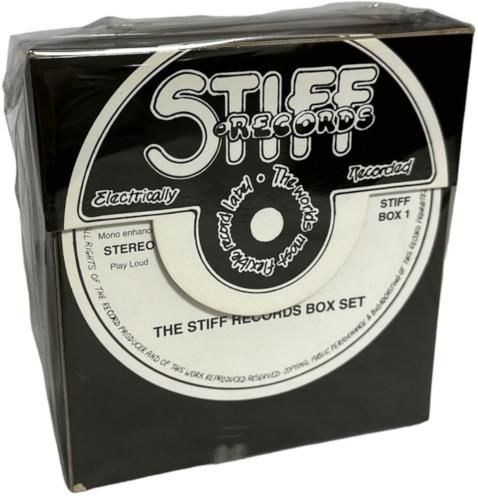
The Stiff Records Box Set – Disc 2

The Stiff Records Box Set — Disc 2
Stiff Records, 1992
4CD box set + booklet

THE PROLOGUE

Settle in, dear readers, it’s another disc and another 25 songs spread out another hour and 17 minutes, or an average runtime per song of 3’08”. As before, there’s a mix of Stiff’s artists that went on to become famous and/or influential, and a smattering of songs and artists that … didn’t.

THE MUSIC

Disc Two kicks off with another pair of songs by Nick Lowe, just as Disc One did. This time, we get the non-album track “I Love My Label,” which is probably why he got more songs on this compilation than anyone other than his protege Elvis Costello (at four songs each).

Nick’s original of it has only ever appeared on a handful of Stiff Records compilations, of which this is of course one of them, but Wilco very faithfully covered the song as a bonus track on their 2011 album The Whole Love.

This is followed by “Marie Prevost” from his first album, Jesus of Cool, released in March of 1978. It tells the tale (inaccurately) of the silent film star’s life and death. A story had gone around that part of Prevost’s dead body was consumed by her two dogs, and this was used by Lowe in the song.

It isn’t true — she died, destitute, at age 40 from alcoholism and malnutrition due to anorexia nervosa, with her body intact. One of her dogs, in fact, caused neighbours to discover that she had died via the animal’s incessant barking.

Next up is Ian Dury & The Blockheads with “What a Waste,” a song about all his squandered opportunities in other occupations, but for that he chose “to play the fool in a six-piece band.” It’s another mildly entertaining and amusing song, as is his forte.

Elvis Costello pops up next with a live track, which he announces is written by Burt Bacharach and Hal David: “I Just Don’t Know What To Do With Myself,” one of the duo’s many pop standards. Elvis is perhaps surprisingly sincere in his performance of the 1962 number, first made famous by Dusty Springfield’s version.

You could be forgiven for thinking that the fifth track, “Whoops-A-Daisy” by Humphrey Ocean and the Hardy Annuals, was just a more twee version of Ian Dury on a lark. In fact, however, Mr. Ocean is a real person, and a noted UK painter.

The uncanny resemblance in this track stems from Ocean’s affiliation with Dury (who was his art teacher, friend, and apparently vocal coach). Ocean had played bass in Dury’s previous band, Kilburn and the High Roads. Following this music-hall type single, Ocean gave up music and returned to painting.

This is followed by a trio of well-known songs from the New Wave era, the first of which is Lene Lovich’s outstanding cover of Tommy James and the Shondell’s 1967 hit “I Think We’re Alone Now,” originally written by Ritchie Cordell and Bo Gentry. The pop hit about two young people desperately trying to find a place to “be alone” (cough) never sounded fresher, and Lovich was rewarded with helping it chart once again.

“Jocko Homo” was DEVO’s first b-side (the a-side was “Mongoloid,”) as well as Mark Mothersbaugh’s first solo writing contribution. The name comes from a 1924 anti-evolution tract called Jocko-Homo Heavenbound, and the memorable time signatures and call-and-response chant is a play on a similar one in the movie Island of Lost Souls. It’s a compelling song because of its two time tempos (from 7/8 to 4/4 for the call-and-response part), and handily established DEVO as a completely unique band and the vanguard of the post-punk landscape called New Wave.

Ian Dury returns with one of his better-known songs, “Hit Me With Your Rhythm Stick,” centered on a brilliant Chas Jankel melody and the spoken (and occasionally multi-language) poetry of Dury, not to mention an insane sax solo. One of the things that so attracts me to the New Wave movement was the incredibly size of that tent — wildly different music fit and blossomed in that tent.

“Semaphore Signals” by Wreckless Eric (one of the acts that had very limited success), is a nondescript number about lovers trying to secretly communicate. He’s a “working class” singer one might charitably say, and this is a song with a cute idea behind it but stretched too thin to support its “drunk karaoke”-style vocal performance.

Speaking of drunk performers, Jona Lewie (who did at least get one big hit out of his time with Stiff), seems like a Depression-era pianist somehow transported to the 1980s, and not sure quite what to do with himself. Thankfully, he’s pretty entertaining even when he sounds … er, relaxed, and “I’ll Get By in Pittsburgh” sounds like a closing-time tune by a pianist who’s quite relaxed about his performance. Generally I quite like Lewie’s first album, but this “Pittsburgh” was the b-side to his novelty hit “In the Kitchen at Parties” for a reason.

From there, we go to “B-A-B-Y” by Rachel Sweet. She has a powerhouse voice that you either find thrilling or its like fingers on a blackboard for you. I’m more in the former camp, though Sweet certainly missed her calling as the leader of a 60s girl group by simply having been born too late (1962).

Today, she’s a successful TV writer and producer, but back then she was Stiff’s jailbait ingenue, a veteran child star who was 16 in 1978, switching from singing country to rock music and releasing her first album, Fool Around, that same year. It’s a well-regarded album that has aged well (the musicians on it would later form the band The Records), but only the single showcased here did terribly well.

By 1982 her career as a solo artist was over, with only four original albums and a live record. That said, she later wrote and sang several songs for John Waters’ films Hairspray and Cry-Baby.

For the halfway mark on this disc, we return to the ever-reliable Lene Lovich and her first and arguably biggest hit, 1978/9’s “Lucky Number,” which managed to get substantial video play on the nascent MTV. It went Top 10 in most countries in Europe and the UK where it was released.

The Members were a group that I personally judged never quite good enough to actively collect, but that said I like what I hear from them. “Solitary Confinement” is a very witty song about how “great” it is to get out of your parents’ house and live on your own for the first time.

Or, as they put it: “You are living in the suburbs/And you have problems with your parents/So you move on up to London town/Where you think everything’s happening, going down/Living in a bedsit/Travelling on a tube train/Working all day long/And you know no one/So you don’t go out/And you eat out of tins/And you watch television/Solitary confinement.” Missle hits its target, dunnit?

This live version really captures how meaningful this song was to so many at the time.

Next up is “Frozen Years” by The Rumour (minus Graham Parker). Not everyone remembers that The Rumour put out three albums on their own. This song is a lightweight and pleasant synth-driven number with clever lyrics, sung by Brinsley Schwartz himself (though you’d be forgiven if you thought it was a very low-key Nick Lowe).

Then we’re back to Wreckless Eric with “Take the Cash.” Sound, practical advice regarding the handling of money and job protocols from our Mr. Eric. He embodies the “three chords and enthusiasm” ethic that embodied a number of Stiff acts, but as with “Semaphone Signals” it’s a very amusing but incredibly basic idea, and again he stretches it to within an inch of its life at 3’44”. If he’d get in and out much more quickly, I’d think him a comedic genius.

Following this is one of the absolute gems of the Stiff lineup with an absolute jewel of a song: Kirsty MacColl, the daughter of the revered folk singer and composer Ewan, absolutely nails her debut with the exquisitely gorgeous “They Don’t Know,” the story of a teenager who has found their true love on a level that their parents and others would just never understand.

The 50s styling, multi-tracked choral backup (learned from intently listening to Beach Boys albums), and the puncturing “BAY-bee” that climaxes the instrumental break are spot-on perfect, and the blend of pre-rock ballad style and nascent 80s instrumentation effortlessly show off both her talent and her musical lineage in three perfect minutes flat.

She and Stiff head Dave Robinson didn’t get on very well at the time, however, so he buried the 1979 single, and she wasn’t able to release her own album until 1985 (!). I’ve been a fan of hers since I first heard this in ’79, and was delighted when Tracey Ullman brought it to a wider audience in 1983, making it the hit it always should have been (Tracey herself became a Stiff artist, and appears later in this comp).

Robinson may have had some regrets about how he treated MacColl later on, or maybe he just finally understood how brilliant she actually was, so thankfully she gets two songs on this box set: we’ll get to the other one when we come to Disc Four.

Mickey Jupp was pushing 40 by the time he recorded for Stiff, having done the music scene in the 60s before leaving it. When “pub rock” became a thing in the UK, he happily signed back up for another hitch, and “You’ll Never Get Me Up in One of Those” is a good example of the good-time but rough-n-ready pub sound that dominates the first side of his album Juppanese (the second half is quite different — a trick more artists should employ).

The A-side was produced by Nick Lowe and features an uncredited Rockpile as the backing band, and sounds like it. The B-side of the album was produced by Procol Harum’s Gary Brooker, and is considerably more polished. After seven more solo albums, he took another break from music — but returned to recording in 2009 and most recently released new music in 2022 at age 78.

Rachel Sweet returns for “Who Does Lisa Like?” a nicely angular single that reinforces her under-age image with a song about high-school gossip. The album, titled Fool Around, gave her two popular singles: “B-A-B-Y” and “Stranger in the House,” the latter of which led her to masterfully cover a number of other classic pop and country songs.

“Drive Friendly” is the next song by a band called Motor Boys Motor. It’s a pretty terrible song about a killer car, and thankfully they do not appear again on this compilation — but hey, it might possibly have inspired Stephen King to write “Christine,” so maybe it has some value after all.

After their one 1982 album, the band reformulated itself and became the Screaming Blue Messiahs, another band I don’t care for.

We then get introduced to Lew Lewis Reformer, another pub-rocker but with a certain … something that makes me like him better than Mickey Jupp or Wreckless Eric. I think he manages to communicate his enthusiasm for the genre better than the others, and has a clearer, somewhat higher tone that stands out better from the instruments.

We move along to Theatre of Hate and their fifth single, “The Hop.” The band members had all been in punk bands earlier, but ToH carved out a sort of “art-punk” that didn’t fit easily into other labels, and indeed exemplified the genre by not fitting into any other existing label at the time, going away from the direction of New Wave right from their first single (“Original Sin” b/w “Legion”) in 1980.

I got and liked their first couple of albums (the live He Who Dares Wins and their first studio album, Westworld), but they didn’t appear to do anything else original beyond that for quite a while so I stopped paying attention. I’ll have to catch up on their 90s output, but after that spurt of activity they went kind of quiet again until 2016, so I have some homework to do on their later evolutions.

And the award for the band with the very best introductory single ever (at least in my view) may well go to … Madness’ “One Step Beyond,” the next track here. The heavy reverb’d voice and Camden Town accent (a place I know well), the playful video, and — for a lot of white boys — the introduction to a form of the Jamacian ska sound just hits us white kids like a tonne of very danceable bricks.

It’s one of those occasional songs that pretty much picks you up by your lapels and makes you move. Even better, it’s utterly timeless and joyful with every play. One of the best tracks on this disc, maybe even this whole compilation (which manages quite a few classics within its 96 offerings).

While we are catching our breath in recovery from the heavy heavy monster sound, The Rumour are here with what I think is their best single, “Emotional Traffic.” On paper, it’s a catchy song about avoiding extreme emotions. On record, it borrows from both traditional pop and nascent New Wave to give us something that’s not quite either one, but very pleasant indeed.

We’re on to the third Ian Dury number on this disc, and by this point you know it’s more of the similar. He’s wonderful at varying up the subject matter of his songs, but not very good at varying up his delivery, or the music. This is quite acceptable when you’re delivering singles, but has always been a point of annoyance for me with his albums.

Lew Lewis Reformer comes back to close out the disc with another slab of his well-produced, well-sung and perfectly-performed good-time rockers, “Lucky Seven.” It’s nothing innovative at all, but so well-done you don’t mind, and might even sing along with the rest of the pub regulars.

THE WRAP-UP

As always, these scores are simply my opinion. Your mileage may vary!

Great songs: 10
Good songs: 8
Meh songs: 7

Overall score: 7 out of 10

25 songs in an hour and 17 minutes continues to be value for money, and carries on representing the great, good, and “save it for the b-side” personality of this eclectic record label. Let’s hope the next two discs, moving into the later days of the label, can keep up their strong average.

Next time … Disc 3!