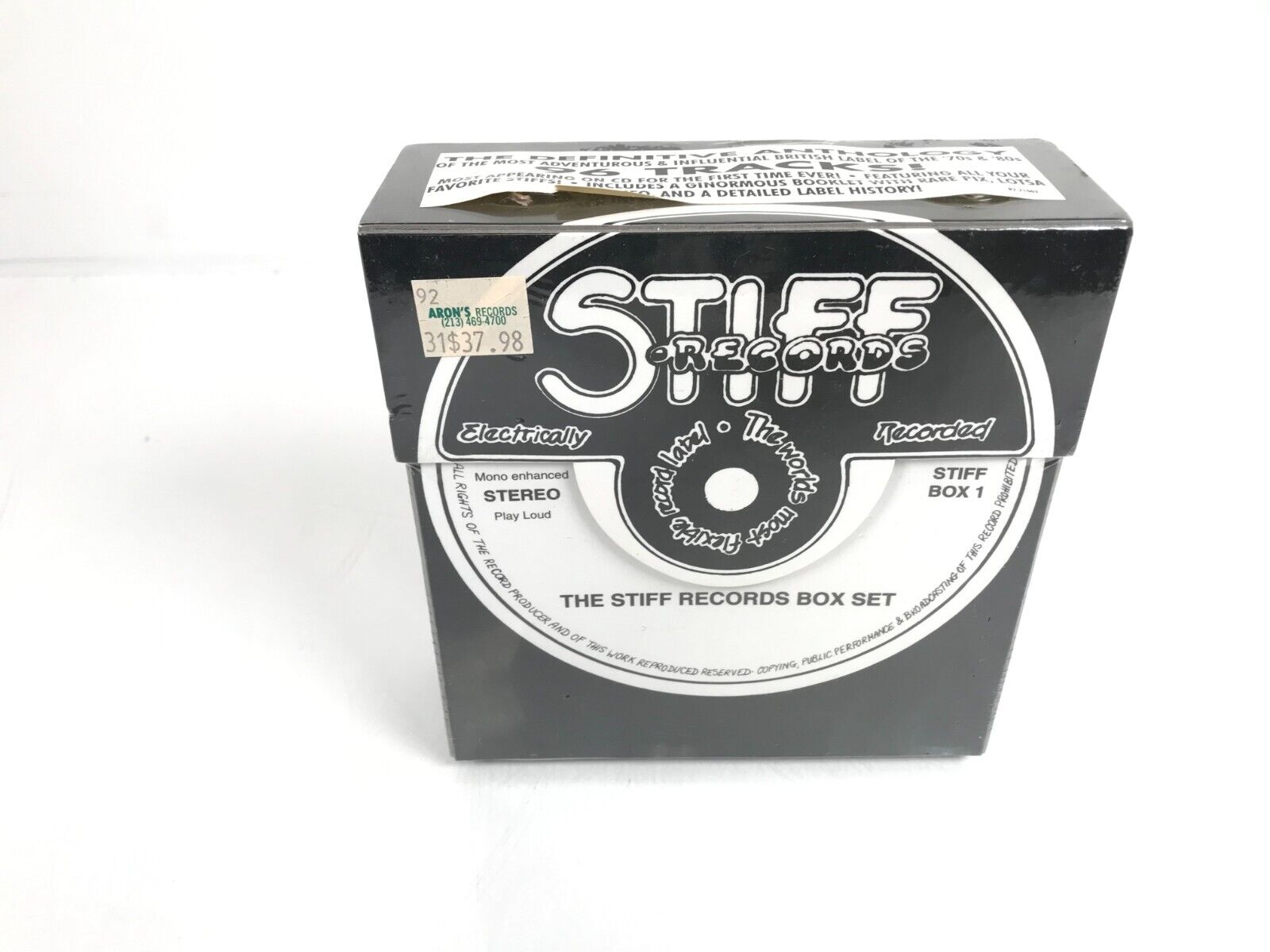
The Stiff Records Box Set — Disc 3
Stiff Records, 1992
4CD box set + booklet

THE PROLOGUE
We’ve already sampled 50 songs from the Stiff catalog, and my suggestion is you don’t do this in one sitting! It’s all (well, very high percentage) good-to-great stuff, and a snapshot of an era as well as a label. But will Punk-New Wave-Powerpop-Pub—Rock-Uncategorized fatigue set in? Let’s find out!
In response to some readers – yes, we’ll cover the booklet when we get to Disc 4, and yes, I probably should have done that with the Disc 1 review. Insert traditional UK two-finger wag … here.
THE MUSIC
If you were feeling a little fatigued from listening to (or just reading about) the first 50 songs, Disc 3 is here with a shot of Vitamin Groove to revive you. Stiff could hardly have picked two more energetic, get-up-and-dance-you-fool numbers than Madness’ mid-tempo-domestic-squabble-set-to-ska song “My Girl” to kick things off, and then followed it with Jamaica’s musical master Desmond Dekker’s insanely catchy 1968 reggae classic “Israelites.”
Joe “King” Carrasco (and The Crowns) has the uneviable duty to follow that, but does a decent job with his equally-partying and Wurlitzer-led Tex-Mex hit “Buena,” which of course incorporates some Spanish into the mix.
We shift gears with Graham Parker’s faux-punk rockin’ diatribe “Stupefaction,” complete with a snarling indictment of life in Los Angeles. It was the first single from his final album with the (uncredited) Rumour, The Up Escalator, and while the single didn’t chart, the album was his best-selling record to that point (1980). If you like the song and his attitude, you’ll enjoy the album.
Next up is a masterpiece of the New Wave era — a “love” song that probably could never have been written, performed, or been a success in any other era. Jona Lewie’s biggest hit, “You’ll Always Find Me in the Kitchen at Parties,” was a song I identified with in my very early teen years, until I become the social butterfly I am today (heh).
It’s minimalist, it’s low-key, it’s monotone, and I love it (and it’s not like everything else he’s done). I’m sure it was intended as a “novelty” single, but it bypassed Doctor Demento and became a surprise Top 20 hit in the UK, reaching the #3 spot in New Zealand and parking there (on both charts) for weeks on end.
To the best of my knowledge, there’s only been one “cover” of this song … in 2010, a duo called Man Like Me took the backing track, replaced Lewie’s vocals with their own, and made a video. It’s not horrible, it’s not great, and it’s on YouTube if you want to see it.
If you’ve never heard the original, good lord people — listen to it RIGHT NOW. It’s an Awkward Teenager Redemption Anthem! Plus, this particular video features bonus Kirsty MacColl!
This is followed by the joyous power-pop of Any Trouble, with the song “Trouble With Love.” The group as a whole had its ups and downs, but I have always been a fan of anything lead singer and songwriter Clive Gregson cared to put down on tape — he does a great job of marrying upbeat pop with “unlucky in love” lyrics.
Dave (L.) Stewart — not the guy from the later Eurythmics — spent his time at Stiff mostly covering old songs, as far as I can tell. He had played with bands like Hatfield and the North in the 70s, but by 1981 he was putting out singles with guest vocalists.
The first of two such collaborations we’ll hear on this disc is “What Becomes of the Broken-Hearted,” with vocals by Colin Blunstone (formerly the singer for The Zombies) with some female backing vocals. The song, from 1966, was first recorded by the great soul singer Jimmy Ruffin, who really poured a sense of genuine heartache into it.
Almost every singer who has covered the song since has hewed very close to the original arrangement, but often don’t bring the anguish Ruffin did. It’s the same problem here: Stewart’s instrumentation, while nicely departing from the Ruffin arrangement, replaces it with a cold, synthy-piano-led, clinical style. Blunstone’s singing, while pleasant, is likewise perfunctory for the most part. We’re not looking forward to more of the same later.
Since the last song was so soulless, it follows that Graham Parker would have to follow with his sarcastic takedown of his (former by this point) record label, “Mercury Poisoning,” which is a rollicking complaint letter set to music. His new record company (Arista at the time) had no issues with it, but Parker didn’t last too long there either. This live version got licensed to Stiff and they ran with it, and emerged seemingly unscathed (at least, I’m unaware of any song by Parker with a play on the name Stiff …).
Dirty Looks was one of those bands that always seemed interesting, seemed promising, but at least for me they never managed to push it over the line into being a fan. “Let Go” is a nicely energetic and tuneful number with a great pre-chorus praising the rock n roll spirit embodied in the advice of the title. It’s a good single that probably should have done better than it did — see what you think:
Madness returns with their clown car of fun ska and “nutty boys” story-songs with “Baggy Trousers,” showing that their style had legs to cover more than just their first (brilliant) album. Madness by this point is a reliable and predictable brand, beloved by skinheads and grandmas alike. Nice trick if you can pull it off!
Dave Stewart returns, this time with regular partner Barbara Gaskin in tow, for another off-beat take on a standard: this time, “It’s My Party.” This version works better than Dave’s cover of “Broken Hearted,” because the song was a torch song in the first place, and so performing it like a morose ballad technically makes it a better version that Lesley Gore’s original, but I still prefer Gore’s version. The girl-group backing vocals just put the cherry on this synth-minimalist but perceptive cake.
Speaking of covers, John Otway’s take on the old country standard “The Green Green Grass of Home” is … well hang on, who is this person anyway? I confess I’m not that familiar with him, but he appears to be simply an eccentric musician who tries to do thing in his own unique way.
So, knowing that, it’s possible to appreciate this sometimes atonal, weirdly performed, nearly acapella first minute of the cover, followed by the full band kicking in and Otway singing a raucus version in the second half. It’s certainly a “chaser” between the first half and the second half of the disc, I’ll say that.
Following that, Tenpole Tudor swing around playfully with “Three Bells in a Row,” a tuneful song about “fruit machines,” (coin-operated UK roulette machines where you try to line up three items in a row, with the big winner being three bells). Frontman Ed Tudor-Pole is just out for a good time, and pretty much all the music I’ve heard from the band is the audio equivalent of a good-time pub crawl.
It was good choice to sequence Jona Lewie’s cheery (or as cheery as his deadpan voice allows) “Stop the Calvary” as the next track, as it keeps up the good mood and suddenly turns into a Christmas single unexpectedly (and it’s still played around Christmas time on UK radio to this day).
What’s next? The two songs by Department S you’re ever likely to have heard before, “Going Left Right” and “Is Vic There?” Oh but plot twist — the version of “Is Vic There?” is the French version! Qu’elle surprise!
The former song has a driving style with a lovely swirling synth dressing and snarky lyrics about disco dancing. I still like this song very much, and wish they’d done more in this vein, even though it’s the longest song on this disc (at four and a half minutes).
“Is Vic There?” is a fragment of a phone conversation turned into another catchy, intense yet danceable single, with both French and English lyrics. I should really look into the rest of their output, but I can only think of a handful of Department S songs I’ve ever heard, and they’ve all been good.
Now we come to a band called the Equators that I know nothing of other than this one song. “If You Need Me,” has a ska influence to it, and there’s nothing really wrong with the song other than it being a bland love tune, lyrically. It didn’t inspire me to investigate them further.
As if in reaction to the mediocrity of the Equators, Tenpole Tudor return to overturn the table, spike the punch, and swing from the chandelier in an attempt to bring the party back to life with “Wunderbar.” It’s not as energetic as punk in the verses, but it chugs along nicely and the chorus is a big drunk gang singing the word “wunderbar” and whistling as only a big drunk gang can. As good as it is, they get one-upped in due course.
“Allamana” is a quite forgettable number by Desmond Dekker, and was likely a b-side. Nuff said.
We shift gears pretty hard from this string of ska-jacent music with the arrival of Alvin Stardust and his urgent mission to put a new spin on the traditional 50s love ballad. Blessed with the smoothest voice this side of Buddy Holly, he ups the tempo, drips with echo, and has perfectly harmonious backup singers. It’s fabulous.
Billy Bremner of Rockpile (and Nick Lowe and Dave Edmunds’ various other records) drops by with a serviceable but relaxed performance of a song called “Loud Music in Cars,” where the title is not only the subject, but the first words sung (and he has a pleasant-enough voice, though the influence of Lowe and Edmunds is keenly felt). It’s a simple Scottish pop song about a simple subject — loud music in cars is something Bremner enjoys, apparently. It somehow sticks in your head, though.
Oh, but then … Tenpole Tudor return to take us away from all that amiable-pop-rock crap with another stomper likely to be sung by football hooligans, “Throwing My Baby Out With the Bathwater,” a good-time breakup song.
This is stunningly well one-upped by a band called Pookiesnackenburger, who I am astonished to report managed not only to produce more than this one madcap song, but indeed produced two complete albums I really must investigate. “Just One Cornetto,” flatly, my favourite song on this disc by a long way.
Following some incomprehensible chatter, the song begins with a Madness-like call to action, becoming a party set to music and a delightfully mad lyric — a love song to an ice cream novelty, the beloved Cornetto. The whole thing is as delightfully mad as the band’s name, and all over in 2’26”. Love it.
Next is Via Vagabond with a driving, swinging jazz number called, brilliantly, “Who Likes Jazz.” It’s wonderfully performed with blazing piano, a touch of synth, but really driven by the drum-and-stand-up-bass 50s style tempo.
The disc concludes with Tracey Ullman with another slab of 60’s style girl-pop, with a beautifully clever title lyric — “you broke my heart in 17 places … Shepard’s Bush was only one.” The secret sauce behind Ullman was always Kirsty MacColl, and this is one of her cleverest songs.
This was part of Tracey’s debut album of the same name, mostly consisting of an eclectic array of remakes of well-known love songs, including Blondie’s “(I’m Always Touched By Your) Presence, Dear,” and a lovely cover of Jackie DeShannon’s brilliant “Breakaway.” MacColl also contributed one of her songs she’d had a hit with herself, “They Don’t Know,” and Ullman’s version was a bigger hit than MacColl’s version — reaching the top 10 in the US and peaking at number two in the UK singles chart.
THE WRAP UP
The tracks on these discs are not arranged in strictly chronological order, but they do roughly follow the progression and diversification of the label, and we’re definitely seeing that here. Thankfully, Robinson’s ear and eye for talent remained true, but the number of Stiff acts that went on to bigger labels and greater success is a remarkable testament to that.
“Punk acts” on this compilation mostly consist of The Damned and Alberto Y Lost Trios Paranoias, and they’re not heard from after the first CD here. That said, my personal rating of “great” songs goes up to a new high mark here . Here’s the score for CD number three:
GREAT SONGS: 14
GOOD SONGS: 6
MEH SONGS: 5
Next time: Disc 4 … and oh yeah, the booklet!






 The Chasbah