Let’s start off by being honest: I haven’t seen every movie that’s come out this year, so I can’t possibly tell you exactly which were the ten best. Moreover, many of the films being hailed by critics in LA, NY and overseas as “the year’s best” haven’t even gotten around to Orlando yet. But even if I had somehow seen them all, it would still only be my opinion, which is by no means assured to be the general view of a particular film.
Thus, all you’re getting here is the best of what I saw, which is most of the major films. It has to be said that some local critics disagreed with me on some choices (notably Dogville), but I stand my ground. Even though critics sometimes disagree, as they sit down to write up their 10-best lists each year, a consensus forms among the “name” movie critics because once a film has picked up some honest buzz (as opposed to film-industry hype), they make a point of seeing it.
It should also explain why some films the critics hate do pretty well, or films the critics love do poorly: film reviewers are desperate for films that show them something they haven’t seen a thousand times. Unlike the public, who don’t see 100 or more movies a year, film critics see the predictable and mundane, the poorly-cast or deeply flawed with much greater frequency, and thus are a lot less forgiving of hackery than the general public.
By contrast, when a unique film comes along, critics can often champion them, overlooking minor defects that nonetheless fail to win over the public at large. Last year’s Girl With A Pearl Earring is a perfect example: critics saw a gorgeous, beautifully-cast whimsical invention that fleshed out a historical mystery; audiences saw a beautiful — but empty and slow-moving — snoozefest.
Unlike some other critics, I never rank films in terms of preference. Here’s ten movies I saw that I thought were really wonderful — a few you probably saw, most you didn’t, in no particular order.
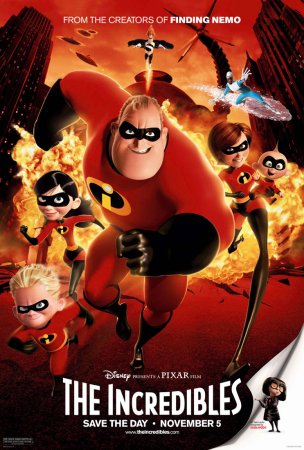
 • The Incredibles — the clear winner in the animation category, people tend to overlook that this (along with the rest of Pixar’s body of work) is also a terrific movie on every level. Edna Mode, the superhero costume designer, is by far the most original (and hilarious) character of the year. Yes, the computer animation continues to dazzle, but the real secret of Pixar’s success is pushing some heart and soul into those pixels. Again and again and again.
• Ray — it’s always heartening to see a biopic get some mainstream attention, and few deserve it more than this picture, which benefits both from the rich life of its subject and the superb performance of Jamie Foxx in the lead role. Director Taylor Hackford makes the wise decision to depict Ray Charles’ good and bad sides, a risk given his beloved public persona, but a move that gives the film a depth and feeling that reflects Charles’ music.
 • A Very Long Engagement — rather unusually this year, there’s not a lot of foreign films in the top 10. This, however, is a lovely exception: a lovely French film (with subtitles) that tales a tale of two lovers since childhood, separated by war, and the one who seeks the other. The phrase “swept away” comes to mind, combining breathtaking photography with heartbreaking (and heart-stopping) moments from a fine cast. It’s tough to be bloody and lyrical, but this one manages somehow.
 • Sky Captain and the World of Tomorrow — Imagine trying to make Raiders of the Lost Ark in your garage, with only bluescreens. For that alone, this film is a remarkable achievement. I’ve got a weak spot for movies that take me somewhere I’ve almost, but never quite, been. This one did the trick, transporting the audience back to a 1940s that only existed in art noir comic books and futuristic pulp novels. Visually stunning, it’s plot was kind of predictable, but that was hardly the point. I absolutely love this movie, despite the fact that I loathe every single one of its marquee stars.
• Fahrenheit 9/11 — Some people are almost violently alienated by Michael Moore’s films, mostly because he reminds people of uncomfortable truths they’d rather sweep under the rug, but also in part because they are wildly (and often willfully) misunderstood, particularly by those who haven’t seen them (don’t believe me? Wait till you hear some Rethuglican call Moore “a fat slob” or something similar, and then check out the size of their gut). Just as Bowling for Columbine was emphatically not an attack on gun owners, neither is Fahrenheit 9/11 a mean-spirited attack on President Bush. What both films actually are is an exploration of how our media outlets increasingly ignore the real issues, conspire with those in power to hide the truth, and shamelessly manipulate the public with disinformation. But of course, the media either don’t recognise that, or do recognise it and exact their revenge by mischaracterising the attacker. It will be interesting to see if Moore’s next film — said to be an exposé of the health care industry — receives the same vitriolic venom from his current critics.
 • Harry Potter and the Prisoner of Azkaban — there are inherent and insurmountable problems in attempting to film a Harry Potter book: after the first one, the books became too long and intricate to boil down into a single film without cutting out huge chunks of plot, the effects department sometimes lets the audience down, and the leads — wonderful as they are — are rapidly aging themselves out of a job. All that said, new director Alfonso Cuaron has a deft touch with visuals and with the teen actors, really bringing out the best in them. The ending — heck, the whole movie — feels rushed, but most of it is the best stuff we’ve seen from this franchise since the first film.
• House of Flying Daggers and Hero — I’m cheating a little here, combining two films into one entry, but it’s the ultimate double feature: flying kung-fu dreamscapes deluxe. If you thought Crouching Tiger, Hidden Dragon was good, these two films go way beyond that one. The stories strangely underserve the visuals, but if you’re looking for an eye-popping good time, skip the awful Alexander or the terrible Troy and go for these epics instead.
• Monster and Aileen: Life and Death of a Serial Killer — again with the double feature, but these two are linked to the point of being joined at the sprockets. Aileen Wournos’ life, murders and death are all examined, in Monster by the incredible in-her-skin performance of Charlize Theron and in Life and Death by a director who can claim a sort of friendship with the serial killer. Both are riveting, like a road accident you can’t look away from.
 • End of the Century: the Story of the Ramones — even if you’ve never heard of the Ramones, this is an invaluable slice of music history that until recently was under-chronicled. The film could easily have been subtitled How We Invented Punk Rock and Changed Music Forever, their influence was really that large on the last hurrahs of modern rock. A rare peek inside the minds of the band that was “Too Tough to Die.”
• Festival Express — I’ll end this list with a film I personally didn’t care for, but which I appreciate for the impact it has on people from “back in the day” and which has incredible value both for its backstory and its historical significance. Festival Express is a documentary made in 1970 and trapped in litigation ever since, featuring interviews, candid moments and performances never seen before from some of the biggest names of the just-post-Beatles era. The big draw for American hippies is the heretofore unscreened moments with Jerry Garcia, The Band, and Janis Joplin, but there’s plenty more for fans of that era. In some ways this is the ultimate “stoner movie,” since both the audience and the stars of the film have a definite familiarity with the excesses of the era.
There are of course many, many great films that didn’t make the cut here, including The Dreamers, Napoleon Dynamite, Sideways, Supersize Me and Finding Neverland, among others. Overall, I’d have to say it was a fair year for movies — as opposed to 2003, which was a really fantastic year.
And now, as they say, for something completely different:
Five Truly Terrible 2004 Movies
Gothika – More funny than scary. If you’re a horror movie, that’s a bad thing. Worse, it was Halle Berry’s return to the screen after winning an Oscar for Monster’s Ball. This and Catwoman might just put an end to her movie career.
Johnson Family Vacation — Whoever thought an all-black ripoff of National Lampoon’s Family Vacation was a good idea should be slapped. Repeatedly. With a frying pan. Manages to demean and insult both whites and blacks, to say nothing of Missouri (which may never recover).
Dogville — My lord, this was awful. Nicole Kidman plays Jesus, I mean Everyman, in this Biblical morality play a la “Our Town.” The sparse, theatrical staging may seem novel (unless you’ve seen any plays in your life), but the film is unrelentingly unpleasant, excessively cruel, and patently obvious in its “twists.”
White Chicks — Amazing makeup. That’s all, though.
Catch That Kid — Even though one has to accept a certain amount of ridiculousness in a film aimed at children, this one crossed way over the line of stupidity, mediocrity and inanity. The plot machinations are absurd, the kids themselves are studiously over-directed, the implications of the film are horrific … everything about this is just awful. Frankie Muinz’s Agent Cody Banks 2 looks like Citizen Kane by comparison.
 Imagine a young John Waters, only with no sense of urgency, more militantly queer, and tone-deaf to the subtleties of satire. There you have Bruce La Bruce, writer/director of Otto, or Up With Dead People. You would think a “gay zombie political porno movie” would be a lot of laughs, or at least creepily arousing (if you’re into that sort of thing). Wrong on both counts.
 The story (such as there is) runs like this: Otto the gay zombie may or may not even be a zombie, nobody’s really sure, but he shambles around and eats road kill like one. He falls into the clutches of a Grand Guignol-type director named Medea Yarn and her posse, who has been struggling to make the aforementioned “political gay zombie porno movie” Up With Dead People (her “magnum corpus”) and decides Otto is perfect for it. So we get a lot of arty “film within a film” cliches and a sound mix that sounds like road construction going on outside a disco. Eventually Otto abandons Medea’s film (at its climax, no less) to go find his former boyfriend, who still isn’t interested. Otto decides to leave town, leaving a lot of blood and pointlessness behind.




 Tim Tom was the first of two stunning pieces of animation that blew the audience away. A cunning and incredibly stylish mix of computer animation and live action, the soundtrack (by Django Rheinhart!) blended perfectly with the piece in a polished, B&W homage to the Merrie Melodies style of slapstick.
 Jumping back to traditional animation but with a delicious twist on the “women behind bars” genre was Penguins Behind Bars. Fish jokes abound, and the plot is played perfectly straight, but by making the characters all penguins, you get high comedy.
 The Family Shorts finale’d with Lorenzo, the first new piece of strictly-traditional Disney animation in ages and quite possibly the best piece of cartooning they’ve done in-house in the last forty years. Yes, it’s that good — a stunning tour-de-force of music, animation and whimsy that recalls everything that used to be good and magical about Disney’s unique brand of animation. Look for Lorenzo as the opener to a future Disney feature, but don’t miss it if you’d like to see what Disney (even without Pixar) is really capable of when they try hard enough.
 It’s rare to see a film that almost perfectly embodies the dream-like experience of floating without restraint through time and memory, but Aleksandr Sokurov appears to have hit his creative peak with his latest and most groundbreaking film, Russkij kovcheg (Russian Ark).
 But ignoring the technical accomplishments of the film (which often overshadow the content in reviews), Sokurov has also crafted a mystical and enchanting dream-like film that meanders through time and history with serious and absurd shadings whose introspection and spectacle threaten to overwhelm the viewer. And even beyond that, the film is an elegy (one of Sokurov’s favourite forms, apparently) to the glory of Russion at it’s height, and a meditation on the past and future of the country and it’s culture.
 The dialogue has layers of meaning, many of which were probably lost on me, but the ongoing debate between the narrator and the guide on how Russia has usurped a lot of its identity from the European countries it plundered was most amusing. As the film unfolds, we sense three main “levels” to the film — the first is something of a wandering tour of the place, the second is an appreciation of the simply unbelievable number of great artworks scattered throughout the property, and the third attempts to inject the elements of life and passion back into the history of the museum — people actually lived here, great events really happened here, and through the fog of time we catch glimpses of this in a way that a straightforward telling (“now in this room, a formal state apology was given to the King of Prussia blah blah blah”).
 It is no accident that as the party ends and we leave the Hermitage along with a class and generation of people who thought they and their ideas would live forever, the music dies away and we slowly find ourselves in a silent, empty fog — it’s a commentary on what became of the Revolution, and a powerful one at that. After over an hour of rich, beautiful European art treasures by El Greco and Rubens among hundreds of others, royalty and pageantry and theatre and excess of all sorts, the final images of wind and sea and desolation are jarring indeed.
 Gracious, has this film actually been out for more than six months?
 Gollum succeeds where all computer-animated characters before him have failed; he convinces us totally of his physical presence. This is entirely due to Gollum having a physical presence during the filming. Played (and voiced by) the incredible Andy Serkis, Gollum is (pardon the pun) fleshed out and made whole. The other actors have something real to interact with, and they hear the voice we hear (one of the more remarkable vocal performances in many a year), and this makes all the difference. Praise should not be spared to the animators as well; though they had a remarkable (and undersung) actor’s performance as a strong starting point, they beautifully embellished it, expanding on Serkis’ unseen physicality and facial expressions in an eerie yet beautiful way. Serkis and the animation team should have been awarded a shared Oscar, for Gollum is the most fluid of collaborations between computers and man yet seen on screen.
 This is the first time a documentary crew have been allowed inside the workings of an animated Disney film, and it will probably be the last — and therein lies a lot of the problem. As this film clearly illustrates, Disney desperately needs to open up it’s film process to people with some actual artistic/creative vision. The people who start these films, and the people who work on these films, are all people of that calibre. It’s the Disney executives (in this case, just two very bizarre people) who sit in judgment of the artists that drive the filmmakers (and the audience) up a wall. These guys are two of the most arrogant, snobbish, uncreative pencil-pushers ever seen on film. They quite clearly brown-nosed their way into these jobs and would be objects of utter ridicule (even without their funny speaking voices) at any other studio. That none of the animators has the balls to say “who the hell are you people? What awards have you won? What creative vision have you ever displayed? How dare you sit in god-like judgment of my work?” is a major disappointment, and our hearts break right along with the animators when High & Mighty (as my little group dubbed them) savage their years-long efforts and completely destroy their work in a matter of seconds.
 The greatest sadness comes from the fact that this is exactly the sort of thing Disney should put on the Emperor’s New Groove DVD, as an honest document of the pain and work involved in bringing such a film out at all. It is the kind of documentary that every Disney executive should watch over and over until they get it: Pixar, for example, does not have these kinds of problems, and I can immediately think of two reasons why that is. Hopefully somebody at Disney will have the personal temerity to actually sit down and watch this film and then make the changes needed to the Animation Dept. to get them back doing films that not only meet the Disney standard of quality but actually move the company forward. Empire of the Sun would have been such a film — rich in the Disney tradition yet larger and wider in scope, more international (and with more international appeal), more sophisticated to match today’s more sophisticated audiences (yes, even the children), a film that might actually make critics stand up and take notice rather than just dismiss it as a good or bad “Disney film,” a classification that has become synonymous with “safe but tired family fare.”
 The illustration of humanity reflected in technology is most obvious in the first half of the film, starting with “My Robot Baby.” As the name implies, a career-obsessed couple opt for a robot baby (which looks a lot like a pressure cooker/vacuum cleaner) rather than a real one, thinking to get the best of both worlds — the “experience” of parenting while not giving up their self-centered, shallow lifestyles. When the robot doesn’t react as expected, they have to grow up themselves — and fast. This portion could have been a lot better with more money, but it certainly gets its point across and a few others as well. I wonder how many young people watching this vignette wondered to themselves just how ready they were for parenthood, or if they should rethink those plans.
 The most touching tale for me personally was “The Robot Fixer.” A mom vents her anguish and grief over her son’s coma by taking over his compulsion/fixation with small “Transformer”-like toys. This section really worked well both as a film and as a story, and Wai Ching-ho really ought to get some consideration for a heart-breaking performance.
 Geeks in the audience will whoop with delight at the third tale, “Machine Love,” which stars the filmmaker as an “iPerson,” the ultimate Macintosh working as a humanoid automaton in an office environment. The term “second-class citizen” springs to life here (and may well have been meant as a subtle comment on racism or classism by Pak) but we see the machine as a person even if nobody else does … until the segment’s hilarious “climax.”
 The final tale in the quadrology (is that even a word?) is simply titled “Clay.” There are no robots per se in this segment, just the surprisingly effective use of Artificial Intelligence (AI) doppelgangers. John Lee is a sculptor and stubborn old coot who can’t accept that he’s dying and that he must soon be “scanned” into the matrix-like repository in order to be with his loved ones and achieve a kind of immortality. As he struggles to complete his last big commission, he also struggles to come to terms with death when “death” as we know it is merely optional. This one again is a very subtle commentary both on where technology is taking us as well as the struggle many ethnic groups feels as they are torn between traditions of the past and realities/opportunities inherent in “assimilation.”
 Kind of an unusual move, but in celebration of the opening of the
  Beer Goggles was my introduction to the world of T. Arthur Cottam. Following a magnificent and side-splitting PT Barnum-esque PR buildup, this just-over-five-minutes epic finally arrived at my door and was relished like a kosher hot dog from start to finish. Like the mouth-breather heroes of the film, my jaw was agape and the simple elegance and earthy reality of his plot and characters. I went to high school with some of those guys, ah sway-ah!
 Once it’s revealed that Karloff (who beautifully underplays his evil) is a Satan worshipper who sacrificed his wife (Werdegast’s former wife) and married Werdegast’s daughter (I told you this was hella creepy!) and has his eyes on sacrificing Joan Allison to the nether gods, we speed all too rapidly to the finale. The first two-thirds of the film are all just getting to the house and then Lugosi and Karloff threatening each other as only old pals can, the last 20 minutes literally fly by with action.
 Finally got a chance to see this movie, one of the few times I’ve ever looked forward to an “all-star” vehicle. At the time of this writing, I have seen Anderson’s Bottle Rockets but I haven’t yet seen the one film of his my friends keep commending to me, Rushmore. Normally when you get a cast of this calibre together, you end up with some overblown nonsense like Cannonball Run or the recent Rat Race, but this time there is no attempt to have a story as grand as the actors, and the focus is smaller and more personal — an approach that seems to work.
 Each of the grown-children Tenenbaums share their father’s inability to live up to their name: In particular, Gwyneth Paltrow’s uncanny Margot Kidder impersonation as Margot (who makes much hay of her secret obsessions) and Ben Stiller as a too-wound-up Chas (who has forgotten the meaning of the word “relax” so completely that he thinks wearing a track suit 24 hours a day will make up the difference) stand out. Bill Murray contributes as Margot’s long-suffering husband but doesn’t really get the chance to shine that I’d have hoped for. Luke Wilson’s troubled Richie (in love with his adopted sister — a surprisingly dark turn in an otherwise lighthearted film) is masterfully underplayed compared to Eli Cash (Owen Wilson), who is meant to be the comic relief in a film full of comic despair. Doesn’t quite work in my opinion.
 The Chasbah